Ⅰ. 서 론
그룹치료는 두 명 이상의 클라이언트가 목표를 성취하 기 위해 함께 협력하는 치료를 말한다(Graham &
Avent, 2004; Schwartzberg, Howe, & Barnes, 2008).
그룹치료는 클라이언트에게 심리적인 지지를 강화하여 자기이해와 자기수용을 가능하게 하고 효과적인 동기부 여를 통해 활동에 적극적으로 참여하게 한다(Coulter, Weber, & Scarvell, 2009; Graham & Avent, 2004;
Hong & Howard, 2002). 또한 개인간의 상호작용 및 의
사소통의 기회를 제공하며(Cole, 1993), 개별치료 보다 같은 시간에 더 많은 서비스를 제공하므로 경제적인 효 율성과 시간절약이라는 장점이 있다(Chen, Lin, Wei, Liu, & Wuang, 2013). 임상에서 그룹치료의 사용이 점차 증가하고 있다(Bell, Corfield, Davies, & Richardson, 2010; Miller et al., 2008).
특히 유아기에서 학령기까지의 아동 그룹은 또래와의 경험을 통해 인성을 발달시키고 사회화의 기초를 정립하 는데 매우 중요하다. 이 시기에 아동 그룹은 다른 아동들 과의 상호작용을 통해 행동이나 언어, 놀이에 대한 관심 대한감각통합치료학회지 제14권 제2호
The Journal Korean Academy of Sensory Integration 2016 Vol. 14, No. 2
https://doi.org/10.18064/JKASI.2016.14.2.033
아동 그룹 작업치료의 효과 : 체계적 고찰
이가영*, 이지호**, 김보람***, 김경미****
*소리나라언어발달치료센터, **양산서울요양병원,
***푸르메재활센터, ****인제대학교 의생명공학대학 작업치료학과
국문초록
목적 : 아동을 대상으로 실시한 그룹 작업치료에 대한 효과를 체계적 고찰을 통해 알아보고 이를 통해 아동 그룹 작업치료에 대한 근거를 마련하고자 한다.
연구방법 : 국외 검색 데이터베이스는 Pubmed와 Ovid를 국내 검색 데이터베이스는 학술연구정보서비스(RISS), 한국학술정보(KISS), 디비피아(DBpia)를 사용하여 2014년까지의 국외/국내 학회지를 검색하였다. 국외/국내 검 색어를 다르게 사용하여 총 14개의 연구를 선정하였으며 근거의 질적 수준에 따라 나누고 PICO(Patient, Intervention, Comparison, Outcome) 형식으로 정리하였다.
결과 : 대상자는 정상아동보다 진단을 받은 아동이 많았고, 감각통합장애 아동(28.6%)이 가장 많았다. 중재방법은 그룹감각통합치료(40%)가 가장 많았고, 중재 결과 분석을 위해 사용된 평가 영역 및 평가도구로는 사회성(31.0%) 을 측정하기 위한 것이 가장 많았다. 중재 효과는 통계학적으로 유의한 결과가 전체의 40.7%이었다.
결론 : 앞으로 아동을 대상으로 실시하는 그룹 작업치료는 다양한 진단군을 대상으로 폭 넓은 중재내용을 통해 높은 근거수준의 효과가 입증 되어야 할 것이다.
주제어 : 아동그룹치료, 작업치료, 체계적 고찰
교신저자: 김경미([email protected])
접수일: 2016.08.01. ∥ 심사일: (1차: 2016.08.06. / 2차: 2016.08.22.) ∥ 게재확정일: 2016.08.29.
과 흥미를 보이게 되고, 신체적인 민첩성, 도덕성, 협조 적인 태도와 판단력을 배우게 된다(Lee, 1996). 자신의 발달향상 뿐만 아니라 사회성이 함께 발달되어 다른 아 동을 모방할 수 있는 기회도 얻게 된다(Laforme &
Effgen, 2007). 이러한 모방행동들은 아동이 경험한 활 동에서 인지적인 능력, 사회적인 인식과 관습적인 상징 을 배우기 위한 기초가 된다(Lee & Kim, 2009). 그룹 안에서 다른 아동과의 협동을 통해 단체정신이나 감정이 입이 발달하고 사회적 성장이 이루어진다(Seo & Lee, 1995). 또한 다른 아동에게 도움을 주거나 양보하면서 자기긍지와 자기가치가 발달하고 자부심을 얻기도 한다 (Chen, Lin, Wei, Liu, & Wuang, 2013). 아동은 그룹 에서 일정한 역할을 수행하게 되고 다른 아동과의 관계 를 파악하면서 상호 수용할 수 있는 대인관계의 기술을 습득하게 된다. 그리고 사회적 기술도 발달하고 사회적 이해를 위한 특별한 기회를 제공받게 되며 긍정적인 또 래관계의 경험으로 바람직한 자아개념 형성에도 도움이 된다(Kim, Park, & Kim, 2009).
이와 같이 아동기의 그룹 활동은 다양한 장점을 가지 며 아동의 발달을 위해 필수적이다. 그러나 임상 환경 안 에서 그룹치료를 사용한 연구와 아동과 관련된 연구의 수가 부족하다(Chantal, Sylvie, & Bonnie, 2011). 객관 적인 근거를 제시할 수 있는 무작위 임상실험 설계 연구 는 전무한 실정이다. 국내에서 그룹치료의 효과를 알아 보기 위한 연구로는 중재 전-후 비교가 대부분이다 (Hong & Kim, 2009a; Hong & Kim, 2009b; Kim &
Kim, 2009; Kim, Noh, Namgung, & Kim, 2012;
Kim, Park, & Kim, 2009). 이러한 연구방법을 토대로 그룹치료가 효과가 있다고 말하기에는 근거가 부족하다.
근거 중심의 치료는 보건의료서비스 분야에서 중요한 흐 름이다(Law & Baum, 1998; Tickle -Degnen, 1999).
현재 가장 우수한 근거를 제공하는 연구방법은 체계적 고찰로 임상 서비스에 대한 확신을 할 수 있는 과학적 기반을 제공한다(Evans, 2001). 따라서 본 연구에서는 아동을 대상으로 실시한 그룹 작업치료에 대한 효과를 체계적 고찰을 통해 알아보고자 한다. 이를 통해 아동 그 룹 작업치료의 근거를 마련하고 근거수준에 따른 분류를 통해 아동 그룹 작업치료의 효과를 제시하고자 한다.
Ⅱ. 연구 방법 1. 자료 수집 방법 및 연구대상
1) 포함기준
(1) 그룹치료 중재를 사용한 연구
(2) 감각통합치료, 일상생활동작 훈련 등과 같은 작 업치료를 기반으로 한 중재를 사용한 연구 (3) 3∼13세의 아동을 대상으로 한 연구
(4) 통계적 분석을 사용하여 결과제시를 한 연구 (5) 그룹치료의 전‧후 효과비교, 두 그룹의 치료효과
비교, 개인과 그룹간의 치료효과 비교를 한 경우
2) 배제기준
(1) 그룹중재 대상의 연령이 13세 이상도 포함된 연구 (2) 실험군 중재에서 그룹치료 외에 개별 치료도 함
께한 연구
(3) 대조군에 그룹중재, 실험군에 개별 치료를 한 연구
3) 검색방법
국외 연구 데이터베이스는 Pubmed와 OVID를 사용하 였다. 검색어로는 그룹치료를 포함하는 “group therapy OR group intervention OR group work OR group activity OR group based OR group program”과 작업 치료기반을 포함하는 “neuromotor OR CIMT OR constraint induced movement therapy OR modified constraint-induced movement therapy OR sensory integration OR Ayres sensory integration OR sensory integration therapy OR sensory processing OR sensory integration program OR sensory integration function OR praxis OR sensory modulation OR motor planning OR sensory behavior OR sensory and motor behavior OR handwriting OR handwriting intervention OR handwriting program OR biomec- hanical OR ROM OR range of motion OR cognitive- psychosocial OR visual perceptual OR visual perception OR activity of daily living OR ADL OR instrumental activities of daily living OR splint OR assistive technology OR orthosis OR motor control
OR motor learning OR hand motor function OR NDT OR neurodevelopmental treatment OR hand function OR hand skill OR task-oriented OR developmental approach OR occupation-based rehabilitation OR occupational therapy-related interventions OR occupational performance OR occupational therapy OR occupation based OR mirror therapy OR social participation OR social interaction skill”을 사용하였다. 국내 연구 데이터베 이스는 DBpia, KISS, RISS를 사용하였으며 “그룹치료”,
“그룹중재” 그리고 “그룹프로그램”으로 키워드 검색을 한 후 결과 내 재검색을 통해 영어 키워드와 같이 작업치료 기반의 중재방법을 사용한 논문을 선정하였다.
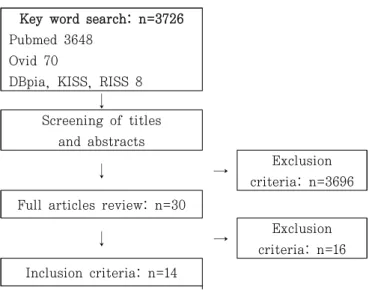
검색결과 3726개의 논문이 검색되었으며 제목과 초록 을 검토하여 포함기준에 맞는 논문 30개를 연구대상으로 선정하였다. 전문분석을 통해 배제기준에 포함되는 논문 16개를 제외하고 최종적으로 연구대상에 포함된 논문은 14개이었다(Figure 1). 검색된 연구는 본 연구의 저자 3 인이 독립적으로 제목 및 초록, 전문을 검토하였다. 제외 된 논문은 그룹중재가 아닌 것 3개, 3∼13세를 초과한 연령의 아동이 포함된 논문 8개, 작업치료기반의 중재가 아닌 논문 3개, 그리고 실험군에서 개별치료를 제공한 논문 2개이었다.
2. 연구 근거의 질적 수준
세 명의 저자가 대상 논문의 대한 질적 수준을 평가하 였으며 Sackett, Rosenberg, Gray, Haynes, &
Richardson(1996)의 근거 기준을 사용하였다. 그 결과 실험설계가 아닌 대조군 실험설계(근거수준Ⅱ) 5개, 무 작위 실험설계가 아닌 단일군 실험설계(근거수준Ⅲ) 9개 가 포함되었다(Table 1).
3. 분석 방법
최종 선정된 연구들을 연구자 세 명이 독립적으로 분 석하였으며 의견이 일치하지 않는 부분은 토의를 통해 결정하였다. 선정된 연구는 근거의 질적 수준에 따라 나 누었으며 PICO(Patient, Intervention, Comparison, Outcome)에 따라 정리하였다(Table 5, Table 6).
Ⅲ. 연구 결과
1. 그룹치료를 받은 아동의 특징
총 14개의 대상논문을 분석한 결과 다양한 진단군의 아동을 포함한 연구는 1개(7.1%), 단일 진단 아동들을 대
Key word search: n=3726 Pubmed 3648
Ovid 70
DBpia, KISS, RISS 8
↓
Screening of titles and abstracts
↓ → Exclusion
criteria: n=3696 Full articles review: n=30
↓ → Exclusion
criteria: n=16 Inclusion criteria: n=14
Figure 1. Diagram on process about searching process
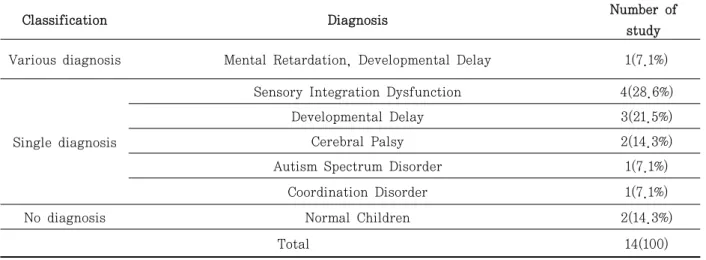
상으로 한 논문은 11개(78.6%), 정상아동을 대상으로 한 논문은 2개(14.3%)이었다. 다양한 진단군의 아동들은 지 적장애, 발달지연의 진단을 받았고, 단일진단의 아동들 은 감각통합장애 대상논문이 4개(28.6%), 발달지연 대 상논문이 3개(21.5%), 뇌성마비 대상논문이 2개(14.3%), 자폐성장애 대상논문이 1개(7.1%), 협응장애 대상논문 이 1개(7.1%)이었다(Table 2).
2. 그룹치료의 효과를 측정하기 위해 사용된 평가도구
아동을 대상으로 한 그룹치료의 효과를 보기위해 사용 된 평가도구는 하나의 논문에 두 개 이상의 평가도구가 사용된 것을 포함하여 총 29개였다. 이 평가도구들은 12 개의 범주(운동기능, 사회기술, 감각통합능력, 소근육
기능, 신체기능, 지능지수, 부모/보호자 인식, 일상생활 능력, 행동, 놀이기술, 조절, 분노지수)로 분류하였다.
운동기능에서 소근육 기능을 따로 분류한 것은 그룹치료 의 효과를 측정하기 위한 종속변수에서 소근육 기능만을 따로 측정한 연구가 포함되었기 때문에 2개의 범주로 나 누어 분류하였다.
운동기능을 평가하기 위해 사용된 도구로는 Bruininks - Oseretasky Test of Motor Proficiency, Second Edition(BOT-2)가 2회(6.9%), Peabody Developmental Motor Scales(PDMS-1), Peabody Developmental Motor Sacales, Second Edition (PDMS-2), Movement Assesment Battery for Children(MABC), Pediatric Evaluation of Disability Inventory(PEDI)가 각각 1회 (3.45%)씩 사용되었다. 사회기술을 평가하기 위해 Social Maturity Scale(SMS)가 3회(10.3%), Walker-
Evidence level Definition Frequency
Ⅰ Systematic review, meta-analysis,
randomized controlled trials 0
Ⅱ Non-randomized two group studies 5(35.71%)
Ⅲ Non-randomized one group studies 9(64.28%)
Ⅳ Single experimental studies, survey studies 0
Ⅴ Case studies, descriptive review, qualitative studies 0
Total 14(100%)
Table 1. Hierarchy of levels of evidence for evidence based-practice
Classification Diagnosis Number of
study Various diagnosis Mental Retardation, Developmental Delay 1(7.1%)
Single diagnosis
Sensory Integration Dysfunction 4(28.6%)
Developmental Delay 3(21.5%)
Cerebral Palsy 2(14.3%)
Autism Spectrum Disorder 1(7.1%)
Coordination Disorder 1(7.1%)
No diagnosis Normal Children 2(14.3%)
Total 14(100)
Table 2. Examination child of the group treatment based on occupational therapy
McConnell Scale(WMS), List Of the Children’s Social Interaction Behavior (LOCSIB), Harter’s scale, Music Therapy Evaluation Scale(MTES), Peer report questionnaires/Self report questionnaires, Peer Social Interaction Rating Scales(PSIRS)가 각각 1회(3.45%)씩 사용되었다. 감각통합능력을 평가하기 위 해 Sensory Profile(SP)가 2회(6.9%), Southern California Sensory Integration Test (SCSIT), Clinical observation이 각각 1회씩(3.45%) 사용되었다. 소근육 기능을 평가하기 위해 Korean Developmental Test of Visual Perception, second edition(K-DTVP-2), Hand function test가 각각 1회(3.45%) 사용되었다. 신
체기능을 평가하기 위해 Physical Ability Test(PAT)가 1회(3.45%), 지능지수를 평가하기 위해 Preschool Performance Scale(PPS)가 1회(3.45%), 부모/보호자 인식을 평가하기 위해 Canadian Occupational Perfor- mance Measure (COPM)이 1회(3.45%) 사용되었다. 일상 생활능력을 평가하기 위해 Wee Functional Independence Measure(WeeFIM)이 1회(3.45%), 행동을 평가하기 위 해 Behavior During Testing을 1회(3.45%) 사용하였 다. 놀이기술을 평가하기 위해 Test Of Playfulness (TOP)를 1회(3.45%), 조절을 평가하기 위해 Korea- Scales of Independent Behavior-Revised (K-SIB-R)을 1회(3.45%), 불안지수를 평가하기 위해 Multidimensional
Classification Measurement Frequency
Motor function
Bruininks-Oseretasky Test of Motor Proficiency-2 Peabody Developmental Motor Scales Peabody Developmental Motor Scales-2 Movement Assessment Battery for Children Pediatric Evaluation of Disability Inventory
2(6.9%) 1(3.45%) 1(3.45%) 1(3.45%) 1(3.45%)
Social skill
Social Maturity Scale Walker-McConnell Scale
List Of the Children’s Social Interaction Behavior Harter’s scale
Music Therapy Evaluation Scale
Peer report questionnaires/ Self report questionnaires Peer Social Interaction Rating Scales
3(10.3%) 1(3.45%) 1(3.45%) 1(3.45%) 1(3.45%) 1(3.45%) 1(3.45%) Sensory integration
Sensory Profile
Southern California Sensory Integration Test Clinical observation
2(6.9%) 1(3.45%) 1(3.45%) Fine motor function Korean Developmental Test of Visual Perception-2
Hand function test
1(3.45%) 1(3.45%)
Physical function Physical Ability Test 1(3.45%)
Intelligence quotient Preschool Performance Scale 1(3.45%) Parents/
Caregiver’s perspectives Canadian Occupational Performance Measure 1(3.45%) ADL ability Wee Functional Independence Measure 1(3.45%)
Behavior Behavior During Testing 1(3.45%)
Play skills Test Of Playfulness 1(3.45%)
Adjustment Korea-Scales of Independent Behavior-Revised 1(3.45%) Anxiety scale Multidimensional Anxiety Scale for Children – Short form 1(3.45%) Table 3. A measurement for function of the child
Anxiety Scale for Children–Short form(MASC)을 1회 (3.45%) 사용하였다.
사회성을 평가하기 위한 평가도구가 총9회 (31%)로 가장 많이 사용되었으며, 그다음으로 운동기능 평가(총6 회, 20.7%), 감각통합능력 평가(총4회, 14.3%), 소근육 기능 평가(총2회, 6.9%)도구 순으로 사용되었다(Table 3).
3. 그룹치료에서 사용된 중재
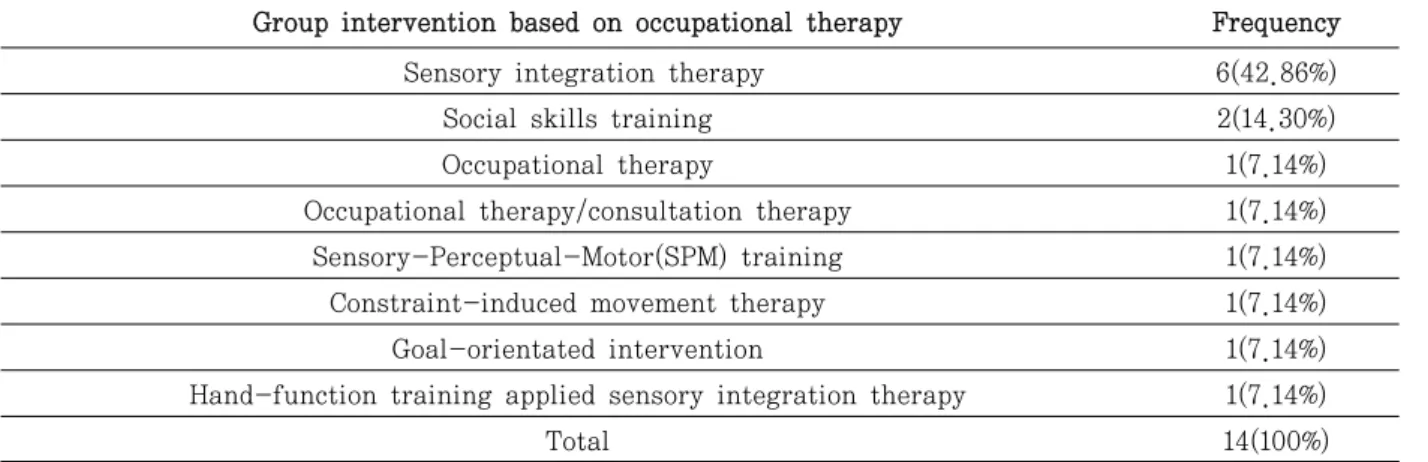
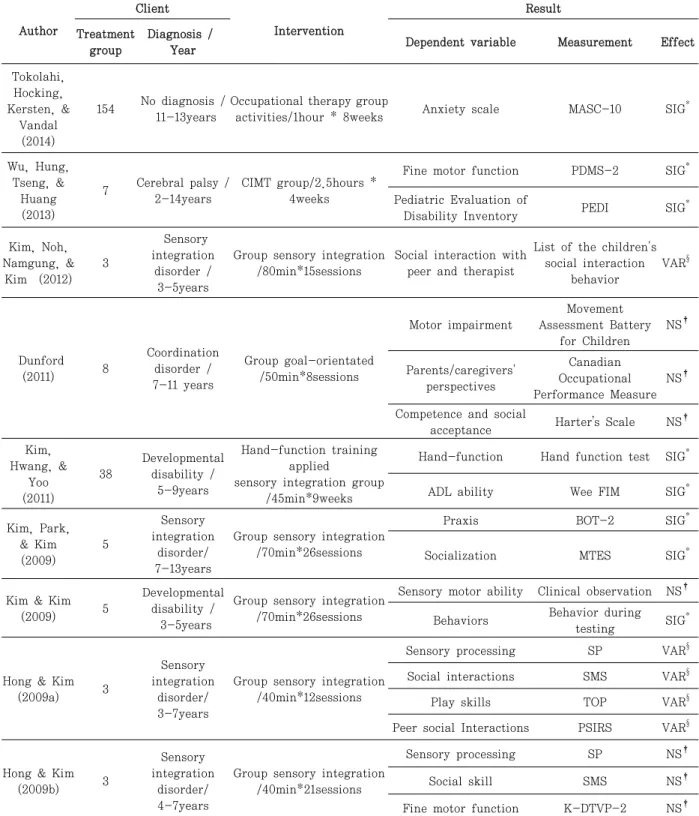
그룹치료의 효과를 알아보기 위해 사용된 작업치료기 반 중재는 총 9가지이며 하나의 논문에서 2가지 그룹치 료가 사용된 것을 포함하여 총 14개가 사용되었다.
감각통합치료가 6개(42.86%)로 가장 많이 사용되었 고, 다음은 사회성 훈련이 2개(14.30%), 작업치료, 작업 치료/상담치료, 감각지각운동훈련, 강제유도운동치료, 목표지향중재, 감각통합을 적용한 손기능 훈련이 각각1 개(7.14%)씩 사용되었다(Table 4).
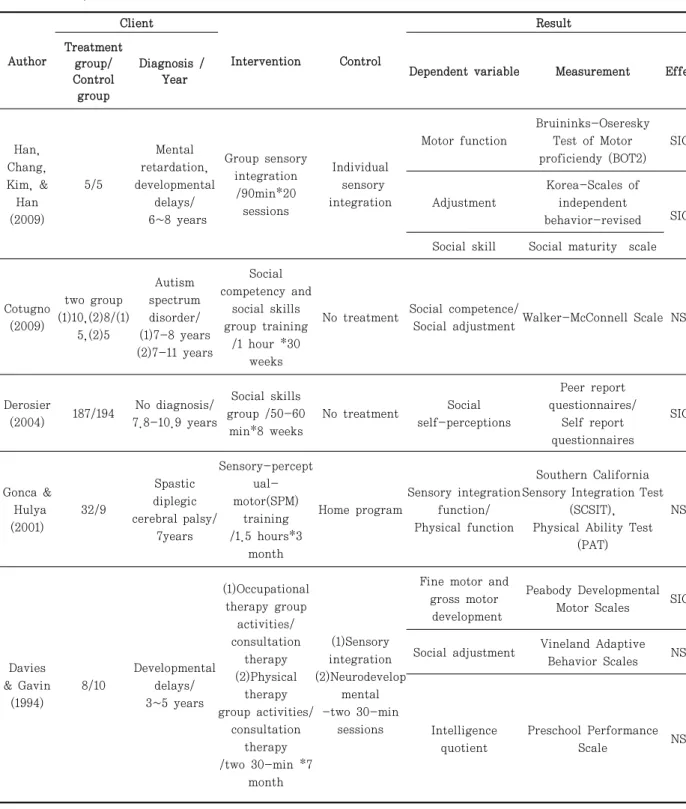
4. 근거수준Ⅱ 연구디자인에 따른 분석
근거수준Ⅱ 논문의 종속변수는 운동기능, 사회기술, 사회적 능력/사회적 적응, 사회적 자각, 감각통합기능/
신체기능, 운동 발달, 지능지수이다.
평가하고자 하는 종속변수 중 운동기능, 사회기술, 사 회적 자각, 운동발달 부분은 통계적으로 유의한 차이를 보였고, 사회적 능력/사회적 적응, 감각통합기능/신체
기능, 지능지수 부분은 통계적으로 유의한 차이를 보이 지 않았다(Table 5).
5. 근거수준Ⅲ 연구디자인에 따른 분석
근거수준Ⅲ 논문의 종속변수는 불안지수, 소근육 기 능, 일상생활기능, 또래와 치료사간의 사회적 상호작용, 운동손상, 부모/보호자 인식, 사회적 능력/사회적 적응, 손 기능, 일상생활능력, 실행, 사회화, 감각운동능력, 행 동, 감각처리, 사회적 상호작용, 놀이기술, 또래관계, 그 리고 사회기술이었다.
평가하고자 하는 종속변수 중 불안지수, 소근육 기능, 일상생활기능, 손 기능, 일상생활능력, 실행, 사회화, 행 동에서 통계적으로 유의함을 보였고, 또래와 치료사간의 사회적 상호작용, 사회적 상호작용, 놀이기술, 또래관계 에서는 통계적으로 유의하지 않았지만 중재전후에 변화 를 보였다. 나머지 운동손상, 부모/보호자인식, 사회적 능력/적응, 감각운동능력, 사회기술에서는 통계적으로 유의한 차이를 보이지 않았다. 감각처리를 중재로 사용 한 한 논문에서는 통계적으로 유의하지 않았지만 중재전 후 변화를 보였고 다른 하나의 논문에서는 통계적으로 유의한 차이를 보이지 않았다. 소근육 기능에서는 하나 의 논문에서는 통계적으로 유의한 차이를 보였고 다른 하나의 논문에서는 통계적으로 유의한 차이를 보이지 않 았다(Table 6).
Group intervention based on occupational therapy Frequency
Sensory integration therapy 6(42.86%)
Social skills training 2(14.30%)
Occupational therapy 1(7.14%)
Occupational therapy/consultation therapy 1(7.14%) Sensory-Perceptual-Motor(SPM) training 1(7.14%) Constraint-induced movement therapy 1(7.14%)
Goal-orientated intervention 1(7.14%)
Hand-function training applied sensory integration therapy 1(7.14%)
Total 14(100%)
Table 4. Intervention of the treatment group based on occupational therapy
Author
Client
Intervention Control
Result Treatment
group/
Control group
Diagnosis /
Year Dependent variable Measurement Effect
Han, Chang, Kim, &
Han (2009)
5/5
Mental retardation, developmental
delays/
6~8 years
Group sensory integration /90min*20
sessions
Individual sensory integration
Motor function
Bruininks-Oseresky Test of Motor proficiendy (BOT2)
SIG
*Adjustment
Korea-Scales of independent
behavior-revised SIG
*Social skill Social maturity scale
Cotugno (2009)
two group (1)10,(2)8/(1)
5,(2)5
Autism spectrum disorder/
(1)7-8 years (2)7-11 years
Social competency and
social skills group training
/1 hour *30 weeks
No treatment Social competence/
Social adjustment Walker-McConnell Scale NS
†Derosier
(2004) 187/194 No diagnosis/
7.8-10.9 years
Social skills group /50-60
min*8 weeks
No treatment Social self-perceptions
Peer report questionnaires/
Self report questionnaires
SIG
*Gonca &
Hulya (2001)
32/9
Spastic diplegic cerebral palsy/
7years
Sensory-percept ual- motor(SPM)
training /1.5 hours*3
month
Home program
Sensory integration function/
Physical function
Southern California Sensory Integration Test
(SCSIT), Physical Ability Test
(PAT)
NS
†Davies
& Gavin (1994)
8/10
Developmental delays/
3~5 years
(1)Occupational therapy group
activities/
consultation therapy (2)Physical
therapy group activities/
consultation therapy /two 30-min *7
month
(1)Sensory integration (2)Neurodevelop
mental -two 30-min
sessions
Fine motor and gross motor development
Peabody Developmental Motor Scales SIG
*Social adjustment Vineland Adaptive Behavior Scales NS
†Intelligence quotient
Preschool Performance
Scale NS
†*
SIG: significantly better results than contrast group
†NS: no significant differences found between groups
Table 5. Analysis of research of group treatment of children (Level of evidence Ⅱ)
Author
Client
Intervention
Result Treatment
group
Diagnosis /
Year Dependent variable Measurement Effect
Tokolahi, Hocking, Kersten, &
Vandal (2014)
154 No diagnosis / 11-13years
Occupational therapy group
activities/1hour * 8weeks Anxiety scale MASC-10 SIG
*Wu, Hung, Tseng, &
Huang (2013)
7 Cerebral palsy / 2-14years
CIMT group/2.5hours * 4weeks
Fine motor function PDMS-2 SIG
*Pediatric Evaluation of
Disability Inventory PEDI SIG
*Kim, Noh,
Namgung, &
Kim (2012) 3
Sensory integration
disorder / 3-5years
Group sensory integration /80min*15sessions
Social interaction with peer and therapist
List of the children's social interaction
behavior
VAR
§Dunford
(2011) 8
Coordination disorder / 7-11 years
Group goal-orientated /50min*8sessions
Motor impairment
Movement Assessment Battery
for Children
NS
†Parents/caregivers' perspectives
Canadian Occupational Performance Measure
NS
†Competence and social
acceptance Harter’s Scale NS
†Kim,
Hwang, &
Yoo (2011)
38
Developmental disability /
5-9years
Hand-function training applied
sensory integration group /45min*9weeks
Hand-function Hand function test SIG
*ADL ability Wee FIM SIG
*Kim, Park,
& Kim (2009)
5
Sensory integration
disorder/
7-13years
Group sensory integration /70min*26sessions
Praxis BOT-2 SIG
*Socialization MTES SIG
*Kim & Kim
(2009) 5
Developmental disability /
3-5years
Group sensory integration /70min*26sessions
Sensory motor ability Clinical observation NS
†Behaviors Behavior during
testing SIG
*Hong & Kim
(2009a) 3
Sensory integration
disorder/
3-7years
Group sensory integration /40min*12sessions
Sensory processing SP VAR
§Social interactions SMS VAR
§Play skills TOP VAR
§Peer social Interactions PSIRS VAR
§Hong & Kim
(2009b) 3
Sensory integration
disorder/
4-7years
Group sensory integration /40min*21sessions
Sensory processing SP NS
†Social skill SMS NS
†Fine motor function K-DTVP-2 NS
†*SIG: significantly better results than contrast group
†NS: no significant differences found between groups
§VAR: variable results found
Table 6. Analysis of research of group treatment of children (Level of evidence Ⅲ)
Ⅳ. 고 찰
본 연구는 아동 그룹 작업치료의 근거를 마련하고자 체계적 고찰을 실시하였다. 총 14개의 연구를 분석한 결 과 근거수준으로 나누었을 때 Ⅱ수준이 5개, Ⅲ수준이 9 개였다. Ⅰ수준인 무작위 대조군 임상실험은 실험과정에 영향을 주는 모든 위험을 차단하는 높은 근거수준이라고 했으나(Stolberg, Norman, & Trop, 2004), 본 연구에 서는 Ⅰ수준의 논문은 없었다. 두 그룹이나 단일그룹 연 구에서는 대상자 선정과정에서 무작위 추출방식이 아닌 편의에 따라 대상자를 선정한 논문들이 많았다. 포함조 건과 배제조건에 따라 대상자를 선정한 연구도 있었지만 동질성 검정이 제대로 이루어지지 않은 연구들도 있었 다. 앞으로는 아동 그룹 작업치료의 분야에서 중재효과 를 보다 객관적으로 제시 할 수 있는 높은 근거 수준인 무작위 대조군 임상실험 설계가 필요할 것이다.
대상자를 분석한 결과 아동의 진단군은 지적장애, 발 달지연, 자폐, 뇌성마비, 감각통합장애, 협응장애로 다 양하였다. 대부분 진단이 없는 일반 정상 아동을 대상으 로 실시하기보다는 다양한 진단을 가진 발달에 어려움을 보이는 아동들이였다. 실제로 언어나 정서, 인지적 행동 발달에 문제를 가진 아동들은 혼자만의 가정생활을 벗어 나 그룹으로 구성된 그룹집단 활동을 할 수 있도록 경험 을 부여하는 것이 필요하다(Lee, 1996). 따라서 발달에 어려움을 보이는 아동들에게 그룹치료의 필요성을 제시 한다고 볼 수 있다.
평가도구를 분석한 결과 사회성을 알아보기 위한 측 정이 총9회(31%)로 가장 많이 이루어졌다. 사회성을 중 재의 종속변수로 사용한 논문은 3개, 다른 종속변수와 함께 사용된 논문은 4개, 종속변수는 아니지만 부가적으 로 사용된 논문은 2개였다. 그룹치료는 개개인간의 상호 작용 및 의사소통의 기회를 제공하며 또래와의 사회성을 향상시킨다(Cole, 1993). 사회성은 그룹 치료의 특성상 기본적으로 기대되는 효과이기 때문에 가장 빈번히 사용 된 평가도구로 볼 수 있다. 그 다음으로는 운동기능을 알 아보기 위한 측정이 총6회(20.7%), 감각통합기능을 알 아보기 위한 측정이 총4회(14.3%), 소근육 운동기능을 알아보기 위한 측정이 총2회(6.9%)를 보였다. 신체적 기 능, 지능지수, 부모 보호자 인식, 일상생활 능력, 행동,
놀이 기술, 적응, 불안지수를 알아보기 위한 측정으로 각 각 1회(3.45%)씩 이루어졌다. 평가도구는 중재의 효과를 측정하기 위한 것이므로 평가도구를 영역별로 살펴보는 것은 중요하다(Geyh et al., 2004). 본 연구에서 사용된 평가도구는 아동들의 신체적인 구조나 기능적 손상을 중 점으로 많이 실시되었다. 앞으로의 연구에서는 작업수행 의 개선과의 연관성을 제시할 수 있는 평가가 진행되어 야 할 것이다.
분석된 연구에서 그룹 작업치료의 중재내용을 분석한 결과 국외논문에서는 사회기술훈련, 감각-지각-운동 훈련, 강제유도운동치료, 감각통합치료, 작업치료/상담 치료, 목표지향그룹중재, 손 기능 훈련으로 비교적 다양 한 접근법을 사용하였다. 아동작업치료는 자세조절, 손 기술, 감각통합, 시지각, 심리사회적 및 감정, 먹기, 자 조기술과 적응, 놀이, 글쓰기 기술, 보조공학 및 이동성 영역의 중재를 실시한다(Case-smith, 2001). 하지만, 국내논문에서는 모두 감각통합치료를 사용하였다. 이는 국내 7개 논문 중에서 5개의 논문이 감각통합장애가 있 는 아동을 대상으로 중재를 사용하여 대상자가 편중되어 있는 것으로 볼 수 있다. 감각통합장애가 있는 아동의 경 우 감각통합 중재를 통해 감각정보를 처리하고 통합하는 능력을 향상시켜 일상생활활동, 사회적인 참여를 포함한 놀이, 학교에서의 참여와 독립심을 향상시키는데 그 목 표를 두고 있다(Schaaf & Miller, 2005). 이후의 연구에 서는 좀 더 포괄적인 진단군으로 다양한 작업치료의 중 재를 그룹치료에 적용하는 것이 필요하리라 생각된다.
중재효과를 측정하기 위해 근거수준에 따른 두 그룹 비교 연구 분석결과 운동기능, 사회기술, 사회적 자각, 운동발달 부분은 통계적으로 유의한 차이를 보였고, 단 일그룹 전후 비교 연구 분석결과 불안지수, 소근육 운동 기능, 실행, 사회화, 행동에서 통계적으로 유의한 향상 을 보였다. 이는 아동 그룹 작업치료의 효과를 알 수 있 는 결과이다. 또한 통계적으로 유의한 향상을 보이지는 않았지만 중재전후 변화만을 보인 경우도 있었다.
이러한 결과를 종합해 보았을 때 현재 임상에서 치료 의 목적으로 사용이 점차 증가되고 있는(Bell, Corfield, Davies, & Richardson, 2010; Miller et al., 2008) 아 동 그룹 작업치료에 긍정적인 영향을 미치는 것으로 볼 수 있다.
Ⅳ. 결 론
본 연구는 아동을 대상으로 실시한 그룹 작업치료의 효과에 관한 근거기반 마련을 위하여 체계적 고찰을 실 시하였다. 총 14개의 연구가 분석되었고 분석결과는 다 음과 같다.
1. 아동을 대상으로 실시한 그룹 작업치료와 관련된 논문 의 대상자는 정상아동보다 진단을 받은 아동이 많았 다. 진단군은 감각통합장애 아동이 가장 많았고, 다음 으로는 발달지연, 뇌성마비, 자폐성장애, 협응장애 순 이었다.
2. 아동을 대상으로 실시한 그룹 작업치료의 효과 측정 을 위해 실시된 평가도구는 사회성을 알아보기 위한 측정이 31%, 운동기능을 알아보기 위한 측정이 20.7%, 감각통합기능을 알아보기 위한 측정이 14.3%, 소근육 운동기능을 알아보기 위한 측정이 6.9%, 신체적 기능, 지능지수, 부모 보호자 인식, 일 상생활 능력, 행동, 놀이 기술, 적응, 불안지수를 알아 보기 위한 측정이 각각 3.45% 이루어졌다.
3. 아동을 대상으로 실시한 그룹 작업치료의 중재내용은 감각통합치료가 42.86%, 사회성이 14.30%, 작업치 료, 작업치료/상담치료, 감각지각운동훈련, 강제유도 운동치료, 목표지향중재, 감각통합을 적용한 손기능 훈련이 각각 7.14% 사용되었다.
4. 중재 효과는 통계학적으로 유의한 결과가 전체 40.7%
이었다.
앞으로 아동을 대상으로 실시한 그룹 작업치료는 다양 한 진단군을 대상으로 폭 넓은 중재내용을 통해 높은 근거수준으로 효과가 입증 되어야 할 것이다. 본 연구 를 통해 아동을 대상으로 실시한 그룹 작업치료의 연 구 경향을 알 수 있었으며 차후 연구 방향을 제시하였 다는 데 의의가 있다.
참 고 문 헌
Bell, A., Corfield, M., Davies, J., & Richardson, N.
(2010). Collaborative transdisciplinary interven- tion in early years-putting theory into
practice. Child: Care, Health and Development, 36(1), 142-148. http://dx.doi.org/10.1111/j.1365- 2214.2009.01027.x
Case-Smith, J. (2001). Occupational Therapy for Children. London: Mosby.
Chantal, C., Sylvie, T., & Bonnie, S. (2011).
Increasing the use group interventions in a pediatric rehabilitation program: Perceptions of administrators, therapists, and parents.
Physical & Occupational Therapy in Pediatrics, 32(2), 120-135. http://dx.doi.org/10.3109/019 42638.2011.616267
Chen, Y. N., Lin, C. K., Wei, T. S., Liu, C. H., &
Wuang, Y. P. (2013). The effectiveness of multimedia visual perceptual training groups for the preschool children with developmental delay. Research in Developmental Disabilities, 34(12), 4447-4454. http://dx.doi.org/10.1016/
j.ridd.2013.09.023
Cole, M. B. (1993). Group dynamics in occupational therapy. NJ: Slack.
Cotugno, A. J. (2009). Social competence and social skills training and intervention for children with autism spectrum disorders. Journal of Autism and Developmental Disorders, 39(9), 1268-1277. http://dx.doi.org/10.1007/s10803- 009-0741-4
Coulter, C. L., Weber, J. M., & Scarvell, J. M. (2009).
Group physiotherapy provides similar outcomes for participants after joint replacement surgery as 1-to-1 physiotherapy: A sequential cohort study. Archives of Physical Medicine and Rehabilitation, 90(10), 1727-1733. http://dx.doi.
org/10.1016/j.apmr.2009.04.019
Davies, P. L., & Gavin, W. J. (1994). Comparison of individual and group/consultation treatment methods for preschool children with develop- mental delays. American Journal of Occupational Therapy, 48(2), 155-161. http://dx.doi.org/10.5014/
ajot.48.2.155
Derosier, M. E. (2004). Building relationships and combating bullying: Effectiveness of a school- based social skills group intervention. Journal of Clinical Child & Adolescent Psychology, 33(1), 196-201. http://dx.doi.org/10.1207/s15 374424jccp3301_18
Dunford, C. (2011). Goal-orientated group interven- tion for children with developmental coordination disorder. Physical & Occupational Therapy In Pediatrics, 31(3), 288-300. http://dx.doi.org/
10.3109/01942638.2011.565864
Evans, D. (2001). Systematic reviews of nursing research. Intensive Critical Care Nursing, 17(1), 51-57. http://dx.doi.org/10.1054/iccn.
2000.1550
Geyh, S., Kurt, T., Brockow, T., Cieza, A., Ewert, T., Omar, Z. et al. (2004). Identifying the concepts contained in outcome measures of clinical trials on stroke using the international classification of functioning, disability and Health as a reference. Journal of Rehabilitation Medicine, 36(44), 56-62. http://dx.doi.org/
10.1080/16501960410015399
Gonca, B., & Hulya, K. (2001). Effectiveness of two different sensory-integration programmes for children with spastic diplegic cerebral palsy.
Disability and Rehabilitation, 23(9), 394-399.
http://dx.doi.org/10.1080/09638280010008843 Graham, M. S., & Avent, J. (2004). A discipline-
wide approach to group treatment. Topics in Language Disorders, 24(2), 105-117. http://
dx.doi.org/10.1097/00011363-200404000-000 03
Han, M. Y., Chang, K. H., Kim, J. Y., & Han, S.
Y. (2009). The effect of group sensory integration therapy on motor skill and social function of children with developmental disorder. The Journal Korean Academy of Sensory Integration, 7(2), 23-35.
Hong, C. S., & Howard, L. (2002). Occupational
Therapy in Childhood. London: Whurr.
Hong, E. K., & Kim, K. M. (2009a). The effect of group sensory integrative intervention for play skill and social interaction. The Journal Korean Academy of Sensory Integration, 7(1), 13-25.
Hong, E. K., & Kim, K. M. (2009b). The effects of group sensory integration intervention for sensory processing, fine motor skill, and social skill. The Journal Korean Academy of Sensory Integration, 7(2), 1-12.
Kim, E. Y., Noh, S., Namgung, Y., & Kim, K. M.
(2012). The effects of group sensory integrative intervention on the sensory integration dysfunction children’s social interaction with peer and therapist. The Journal Korean Academy of Sensory Integration, 10(1), 1-10.
Kim, E. Y., Park, Y. Y., & Kim, K. M. (2009). The effects of sensory integration group program on praxis and socialization for school-aged children with sensory integration dysfunction.
The Journal Korean Academy of Sensory Integration, 7(2), 37-48.
Kim, H. H., Hwang, B. G., & Yoo, B. K. (2011). The effects of the hand-function training applied sensory integration group treatment program on the hand-function and ADL ability of children with developmental disability. Korean Journal of Physical and Multiple Disabilities, 54(1), 127-143.
Kim, J. M., & Kim, K. M. (2009). The effects of group sensory integrative intervention for sensory motor ability and behaviors for children with developmental delay. The Journal Korean Academy of Sensory Integra- tion, 7(2), 13-22.
Laforme, A. C., & Effgen, S. K. (2007). Use of groups in pediatric physical therapy: Survey of current practices. Pediatric Physical Therapy,
19(2), 154-159. http://dx.doi.org/10.1097/pep.
0b013e31804a57d3
Law, M., & Baum, C. (1998). Evidence-based occupational therapy practice. Canadian Journal of Occupational Therapy, 65, 131-135.
Lee, E. J., & Kim, Y. T. (2009). A literature review of imitation ability in children with autism spectrum disorders. Special Education Research, 8(2), 239-258.
Lee, S. H. (1996). The activity of the small group and the change of the behavior for the group participation. Child study, 5, 61-73.
Miller, A. R., Armstrong, R. W., Masse, L. C., Klassen, A. F., Shen, J., & O'Donnell, M. E.
(2008). Waiting for child developmental and rehabilitation services: An overview of issues and needs. Developmental Medicine &
Rehavilitation, 50(11), 815-821. http://dx.doi.
org/10.1111/j.1469-8749.2008.03113.x
Sackett, D. L., Rosenberg, W. M. C., Gray, J. A.
M., Haynes, R. B., & Richardson, W. S. (1996).
Evidence-based medicine: What it is and what it isn't. British Medical Journal, 312(7023), 71-72. http://dx.doi.org/10.1136/bmj.312.7023.71 Schaaf, R. C., & Miller L. J. (2005) Occupational therapy using a sensory integrative approach for children with developmental disabilities.
Mental Retardation and Developmental Disabilities Research Reviews, 11, 143-148.
http://dx.doi.org/10.1002/mrdd.20067 Schwartzberg, S. L., & Howe, M. C., & Barnes, M.
A. (2008). Groups applying the functional group model. Philadelphia, PA: F.A. Davis Company.
Seo, Y. S., & Lee, G. W. (1995). Social education for children. Seoul: Gyomoonsa.
Stolberg, H.O., Norman, G., & Trop, I.(2004).
Randomized controlled trials. American Journal of Roentgenology, 183(6), 1539-1544.
Tickle-Degnen, L. (1999). Evidence-based practice forum: Organizing, evaluating, and using evidence in occupational therapy practice.
American Journal of Occupational Therapy, 53, 537-539. http://dx.doi.org/10.5014/ajot.
53.5.537
Tokolahi, E., Hocking, C., Kersten, P., & Vandal, A. C. (2014). Cluster-randomised controlled trial of an occupational therapy group intervention for children designed to promote emotional wellbeing: Study protocol. BioMed Central Psychology, 2(1), 1-11. http://dx.doi.
org/10.1186/2050-7283-2-16
Wu, W. C., Hung, J. W., Tseng, C. Y., & Huang, Y.
C. (2013). Group constraint-induced movement therapy for children with hemiplegic cerebral palsy: A pilot study. American Journal of Occupational Therapy, 67(2), 201-208. http://
dx.doi.org/10.5014/ajot.2013.004374
Abstract
The Effect of Group Treatment Based on Occupational Therapy for Children : A Systematic Review
Lee, Ga-Young*, B.S., O.T., Lee, Ji-Ho**, B.S., O.T., Kim, Bo-Ram***, B.S., O.T.
Kim, Kyeong-Mi****, Ph.D., O.T.
*Dept. of Sensory Integration Therapy, Solinala Speech Development Therapy Center
**Dept. of Occupational Therapy, Yangsan Seoul Hospital
***Dept. of Occupational Therapy, Purme Rehabilitation center
****Dept. of Occupational Therapy, College of Biomedical Science and Engineering, Inje University
Objective : The purpose of this article is to study the effectiveness of a group occupational therapy for children via systematic review, and to provide clinical evidences.
Methods : The systematic review initially included articles in Pubmed, Ovid, RISS, KISS, and DBpia, published until 2014. Total 14 articles have been chosen, using different keyword of each domestic/foreign studies.
Selected articles were divided depending on the level of evidence, and eventually been organized into group PICO (Patient, Intervention, Comparison, Outcome).
Results : The results indicated that there are more diagnosed children than normal in participants and especially children with sensory integration disorder (28.6%) appeared to be the most common. In intervention, group sensory integrative intervention had the largest frequency, and instruments measuring social skills were used most for analyzing the intervention results. The effectiveness of interventions showing statistically significant results were 40.7% of Total.
Conclusion : Group occupational therapy for children should be provided to various diagnosis with widely better quality of interventions providing the enough support for the evidence level.
Key words : group intervention for child, occupational therapy, systematic review