ABSTRACT
Purpose: This systematic review and meta-analysis was conducted to assess the effects of
glycine powder air-polishing (GPAP) in patients during supportive periodontal therapy (SPT) compared to hand instrumentation and ultrasonic scaling.
Methods: The authors searched for randomized clinical trials in 8 electronic databases
for relevant studies through November 15, 2019. The eligibility criteria were as follows:
population, patients with chronic periodontitis undergoing SPT; intervention and comparison, patients treated by GPAP with a standard/nozzle type jet or mechanical instrumentation; and outcomes, bleeding on probing (BOP), patient discomfort/pain (assessed by a visual analogue scale [VAS]), probing depth (PD), gingival recession (Rec), plaque index (PI), clinical attachment level (CAL), gingival epithelium score, and subgingival bacteria count. After extracting the data and assessing the risk of bias, the authors performed the meta-analysis.
Results: In total, 17 studies were included in this study. The difference of means for BOP
in patients who received GPAP was lower (difference of means: −8.02%; 95% confidence interval [CI], −12.10% to −3.95%; P<0.00001; I
2=10%) than that in patients treated with hand instrumentation. The results of patient discomfort/pain measured by a VAS (difference of means: −1.48, 95% CI, −1.90 to −1.06; P<0.001; I
2=83%) indicated that treatment with GPAP might be less painful than ultrasonic scaling. The results of PD, Rec, PI, and CAL showed that GPAP had no advantage over hand instrumentation or ultrasonic scaling.
Conclusions: The findings of this study suggest that GPAP may alleviate gingival
inflammation more effectively and be less painful than traditional methods, which makes it a promising alternative for dental clinical use. With regards to PD, Rec, PI, and CAL, there was insufficient evidence to support a difference among GPAP, hand instrumentation, and ultrasonic scaling. Higher-quality studies are still needed to assess the effects of GPAP.
Keywords:
Glycine; Meta-analysis; Periodontitis; Systematic review; Ultrasonics
Research Article
Received: Apr 27, 2019 Revised: Jul 16, 2020 Accepted: Nov 9, 2020
*Correspondence:
Jinlin Song
College of Stomatology, Chongqing Medical University, Chongqing Key Laboratory for Oral Diseases and Biomedical Sciences, Chongqing Municipal Key Laboratory of Oral Biomedical Engineering of Higher Education, #426 Songshibei Road, Yubei District, Chongqing 401147, China.
E-mail: [email protected] Tel: +86-23-8886-0026
Fax: +86-23-8886-0026
†Mengyuan Zhu and Meilin Zhao equally contributed to this study.
Copyright © 2021. Korean Academy of Periodontology
This is an Open Access article distributed under the terms of the Creative Commons Attribution Non-Commercial License (https://
creativecommons.org/licenses/by-nc/4.0/).
ORCID iDs Mengyuan Zhu
https://orcid.org/0000-0003-4825-4168 Meilin Zhao
https://orcid.org/0000-0002-3823-5118 Bo Hu
https://orcid.org/0000-0002-2125-6967 Yunji Wang
https://orcid.org/0000-0002-2691-8042 Yao Li
https://orcid.org/0000-0002-4741-6279 Jinlin Song
https://orcid.org/0000-0002-0224-6640
Mengyuan Zhu
†, Meilin Zhao
†, Bo Hu , Yunji Wang , Yao Li , Jinlin Song
*College of Stomatology, Chongqing Medical University, Chongqing Key Laboratory of Oral Diseases and Biomedical Sciences, Chongqing Municipal Key Laboratory of Oral Biomedical Engineering of Higher Education, Chongqing, China
Efficacy of glycine powder air-
polishing in supportive periodontal therapy: a systematic review and meta-analysis
Periodontal Science
Author Contributions
Conceptualization: Meilin Zhao, Jinlin Song;
Data curation: Mengyuan Zhu; Formal analysis: Mengyuan Zhu, Meilin Zhao, Bo Hu; Funding acquisition: Meilin Zhao, Jinlin Song; Investigation: Mengyuan Zhu, Bo Hu; Methodology: Mengyuan Zhu, Meilin Zhao, Jinlin Song; Project administration:
Meilin Zhao, Bo Hu; Resources: Meilin Zhao;
Software: Mengyuan Zhu, Bo Hu, Yao Li;
Supervision: Yunji Wang, Yao Li; Validation:
Mengyuan Zhu, Yao Li; Visualization:
Mengyuan Zhu, Meilin Zhao, Bo Hu, Yunji Wang, Jinlin Song; Writing - original draft:
Mengyuan Zhu, Meilin Zhao; Writing - review
& editing: Mengyuan Zhu, Meilin Zhao, Bo Hu, Yunji Wang, Yao Li, Jinlin Song.
Conflict of Interest
No potential conflict of interest relevant to this article was reported.
INTRODUCTION
Supportive periodontal therapy (SPT) is considered an essential part of the 4 phases of contemporary periodontal therapy in maintaining periodontal health by removing both supragingival and subgingival biofilm, thereby reducing the risk of periodontal inflammation [1-3]. This kind of therapy includes debridement, removal of bacterial biofilm from sulcular and pocket areas, and oral hygiene instruction [4]. The most significant step is debridement, which can effectively remove supragingival and subgingival biofilm, as well as maintaining the clinical attachment level (CAL). Debridement by hand and ultrasonic instruments is generally used to remove biofilm during the maintenance phase [3]. However, removing biofilm using hand instruments has limited efficiency, as there is only point-line contact during the procedure, and simultaneously, hard tissue is damaged to some extent [5].
Ultrasonic scaling is considered to have advantages over hand instrumentation since it is less time-consuming and more ergonomic [6]. However, the high-frequency oscillation of ultrasonic scaling may cause some damage to the cementum, similar to the damage caused by hand instruments [5]. Since SPT is a long process, repeated root planing and hard tissue damage during the process can cause tooth sensitivity and even pain, resulting in patient discomfort [7-9]. Furthermore, the above 2 methods are labour-intensive [10,11]. Therefore, it is necessary to develop a new technology that is both effective and comfortable.
Air-polishing devices (APDs) were introduced for clinical use as an alternative to
conventional techniques of biofilm removal, and are considered to be less time-consuming and capable of removing supragingival and subgingival biofilm effectively. Furthermore, APDs can reach and polish areas that are difficult for hand instrumentation and ultrasonic scaling [8,12]. The original material used in air-polishing was sodium bicarbonate, which is an efficient agent to remove supragingival biofilm, and air-polishing appeared to be less time-consuming compared to conventional methods [13,14]. However, the mean particle size, hardness, and shape of the sodium bicarbonate powders used in APDs made the powders very abrasive, leading to tooth (especially dentin) substance removal and sometimes also causing soft tissue injury [15,16]. Recently, the indications of APDs have expanded from supragingival applications, utilizing highly abrasive sodium bicarbonate powders, to subgingival applications. A special nozzle was designed to be placed subgingivally, deep in a periodontal pocket, with 3 outlets that direct 1 air-polishing jet toward the root surface, 1 toward the pocket epithelium, and 1 tangential to the periodontal pocket. The water outlet is located at the tip of the nozzle. The use of this specially designed nozzle effectively reduced the working pressure in comparison with supragingival air-polishing. In order to facilitate the removal of biofilm from root surfaces while minimizing trauma, a minimally abrasive air- polishing powder, consisting of an amino acid glycine salt, was introduced [16]. Compared to sodium bicarbonate, glycine is less abrasive and highly water-soluble [17]. In addition, glycine has been proven to have immunomodulatory, anti-inflammatory, and cytoprotective effects on periodontal tissue, making it an ideal material for periodontal air-polishing [18].
Air-polishing using a powder formulation of the amino acid glycine is referred to as glycine
powder air-polishing (GPAP). Several investigators have proven the efficacy of GPAP in
reducing subgingival biofilm and microbial load and showed that it was more acceptable to
patients than other forms of air-polishing [16,19]. However, others have found no statistically
significant differences between GPAP and hand instrumentation or ultrasonic scaling after
treatment. This inconsistency has hindered the clinical adoption of GPAP [20,21]. A previous
meta-analysis investigated whether air-polishing was equally effective or superior compared
with conventional methods [22]. The preliminary findings of their study provided some evidence that air-polishing could be an alternative to conventional debridement during SPT, and that air-polishing seemed to be as effective as conventional treatments. However, they did not conduct a meta-analysis of patient discomfort/pain level, the plaque index (PI), or gingival recession (Rec) due to the limited number of studies they included. Besides, they compared the efficacy of air-polishing and conventional methods without making a distinction among various powders, while we only studied the efficacy of glycine powder for air-polishing as compared to conventional methods. Therefore, the objective of this study was to conduct a meta-analysis of randomized controlled trials (RCTs) to evaluate the effectiveness of GPAP for patients undergoing SPT compared to hand instrumentation and ultrasonic scaling using a broad range of clinical parameters and treatment discomfort/pain levels.
MATERIALS AND METHODS
The study was conducted and reported in accordance with the Preferred Reporting Items for Systematic Review and Meta-Analysis (PRISMA) guidelines.
Search strategy
Searches for randomized controlled trials were conducted in the following electronic databases: PubMed, Embase, Cochrane CENTRAL, Web of Science, Science Direct, China National Knowledge Infrastructure (CNKI), Chinese Medicine Premier's Wanfang database, and the Chinese Scientific Journals database (VIP). The last search was updated on November 15, 2019. The main MeSH terms included “dental polishing” and “glycine.” For example, when searching in PubMed, the search strategy used (air polishing) AND (“glycine” OR
“Aminoacetic Acid” OR “Glycine, Copper Salt” OR “Copper Salt Glycine” OR “Glycine, Monosodium Salt” OR “Monosodium Salt Glycine” OR “Salt Glycine, Monosodium”). The strategy was modified appropriately, considering differences in controlled vocabulary and syntax rules in each database. Additionally, the reference lists of the relevant studies were also scanned without language restriction, in case any studies could have been missed. Two review authors (Zhu M Y and Zhao M L) searched and checked the electronic databases separately. If there was any disagreement, those 2 authors turned to a third author (Song J L) for consensus.
Inclusion and exclusion criteria
The inclusion criteria of this study were as follows: 1) population: patients with chronic periodontitis, having completed comprehensive periodontal therapy; 2) intervention:
patients undergoing SPT with APDs; 3) comparison: patients undergoing SPT with hand instruments or ultrasonic scalers; 4) outcomes: bleeding on probing (BOP), patient discomfort/pain, probing depth (PD), Rec, PI, CAL, gingival epithelium (GE) score and subgingival bacteria count; and 5) study type: RCTs.
Studies were excluded if: 1) they included patients who were pregnant women or lactating
mothers, who had taken antibiotics or anti-inflammatory medication in the past 6 months,
who were allergic to glycine, and who had diabetes mellitus, cancer, or HIV; or 2) they were
not RCTs.
Study selection
Two reviewers (Zhu MY and Zhao ML) selected the titles and abstracts of the articles in the electronic databases to choose suitable studies. Duplicates were then removed from the resulting list. After carefully reading the full text of each remaining study, reviewers removed articles that were not RCTs or in vivo experiments. Seventeen studies were eventually included. If there was any disagreement, the 2 primary reviewers discussed the issue with a third author (Song JL) for consensus.
Data extraction and risk of bias assessment
Data from each study were extracted by 2 independent investigators (Zhu MY and Zhao ML), and included: name of the first author and year of publication, study design, characteristics of patients, number, sex, age, country, treatment type, outcome measures, and follow-up. The investigators discussed any disagreements within the group until they reached consensus.
The risk of bias assessment was independently performed by 2 investigators (Zhu MY and Zhao ML) according to the Cochrane handbook [23], which included the following items:
1) random sequence generation (selection bias); 2) allocation concealment (selection bias);
3) blinding of participants and personnel (performance bias); 4) blinding of outcome assessment (detection bias); 5) incomplete outcome data (attrition bias); 6) selective reporting (reporting bias); and 7) other bias.
The authors evaluated all the included studies according to the above items and estimated the risk of bias: 1) low risk of bias if 6 domains were deemed to have a low risk of bias; 2) moderate risk of bias if 1 or more domains were considered to have a unclear risk of bias; and 3) high risk of bias if 1 or more domains were determined to have a high risk of bias.
Statistical analysis
Zhu MY and Zhao ML performed a meta-analysis using RevMan 5.3 (the Nordic Cochrane Centre, the Cochrane Collaboration, Copenhagen, Denmark) when at least 2 studies shared the same index. Mean and standard deviation (SD) values were extracted to report the results of continuous outcomes with 95% confidence intervals (CIs). A random-effects model was selected to calculate the outcomes of the pooled data [24]. Heterogeneity was analysed using I
2, and the level of significance was set at α=0.1. I
2<50% was defined as low heterogeneity, and I
2>50% as high heterogeneity [25]. A subgroup analysis was performed according to specific time points, smoking status and PD before treatment (initial PD) if high heterogeneity existed. The statistical significance level was set at P<0.05.
RESULTS
Search selection
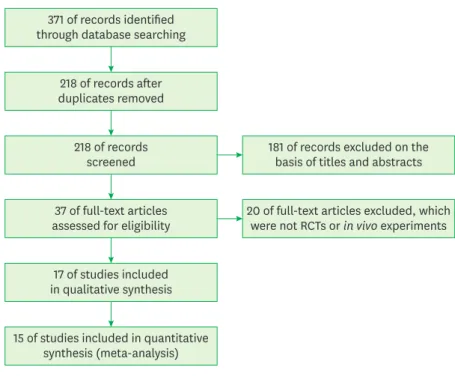
After a comprehensive search of PubMed, Embase, Cochrane CENTRAL, Web of Science, Science Direct, China National Knowledge Infrastructure (CNKI), Chinese Medicine Premier's Wanfang, and Chinese Scientific Journals database (VIP), 371 articles were initially selected. After removing the duplicates using Endnote X8, 218 articles remained. Thirty- seven articles were qualified for full-text scanning after screening the titles and abstracts.
Since 20 articles were not RCTs or in vivo experiments, a total of 17 articles [5,8,9,20,21,26-
37] were identified as meeting the inclusion criteria. Figure 1 shows the flowchart for the
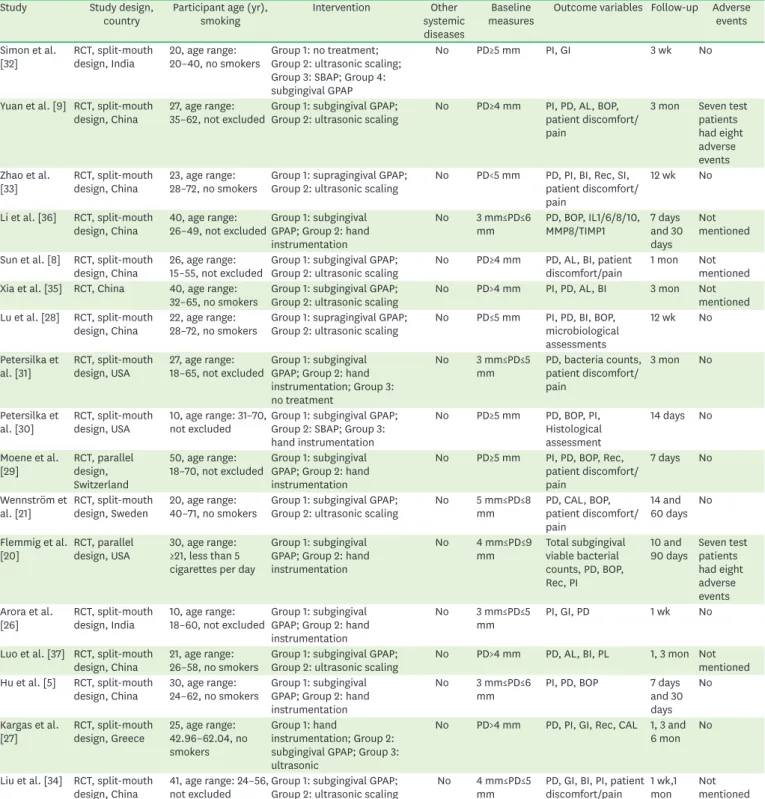
inclusion process. Table 1 specifies the main characteristics of the 17 included articles.
Characteristics and risk of bias assessment of included studies
The characteristics of the 17 included studies [5,8,9,20,21,26-37] are presented in Table 1.
All included RCTs were conducted among adults, from 18 to 72 years old. The investigators in 9 studies [5,9,20,21,28-30,33,36] chose BOP as an outcome measure, 9 studies
[8,9,20,21,26,29,31,33,34] used a visual analogue scale (VAS) to evaluate the patients' discomfort/pain during treatment, ranging from 0 (very comfortable) to 10 (extremely painful), 16 studies [5,8,9,20,21,26-31,33-37] analysed PD, 4 studies [20,27,29,33] measured Rec, 12 studies [9,20,26-30,32-35,37] studied PI, and 5 studies [8,9,21,27,35] analysed CAL, 5 studies [20,21,27-29] reported viable bacteria counts, and only 1 study [30] conducted a histological analysis (GE scores). The follow-up period in the 17 studies [5,8,9,20,21,26-37]
varied. A follow-up period of less than 6 months was defined as short-term. Fourteen studies [5,8,9,21,26-28,30-34,36,37] used a split-mouth design, 2 studies [20,29] used a parallel design, and 1 study [35] did not mention the study design.
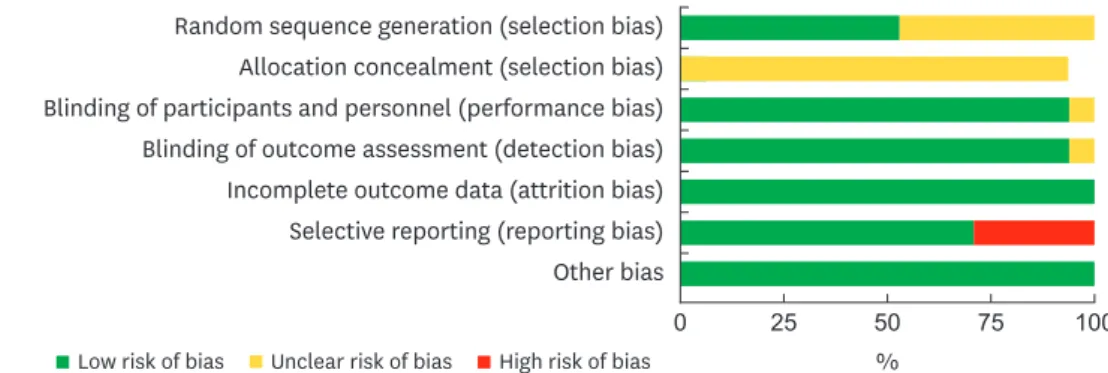
Figure 2 shows the results for the risk of bias across all studies, according to the Cochrane Handbook for Systematic Reviews of Interventions. Figure 3 shows the risk of bias for each study. Of the 17 included studies, 12 exhibited a moderate risk of bias, with 1 or more domains having an unclear risk of bias, and the remaining 5 studies were considered to have a high risk of bias because of reporting bias (specifically, the absence of SD values for the VAS or PI). Because the number of the included studies was small, a funnel plot could not be made to measure publication bias.
Meta-analysis
After extracting and pooling the statistical data, a meta-analysis was conducted to assess the efficacy of GPAP compared to hand instrumentation and ultrasonic scaling. Since the data were continuous, a random-effects model was adopted. Considering the limited data and discrepancies among studies, it was not appropriate to perform a meta-analysis of outcome measures such as GE scores and bacteria counts.
371 of records identified through database searching
218 of records after duplicates removed
181 of records excluded on the basis of titles and abstracts 218 of records
screened
20 of full-text articles excluded, which were not RCTs or in vivo experiments 37 of full-text articles
assessed for eligibility
17 of studies included in qualitative synthesis
15 of studies included in quantitative synthesis (meta-analysis) Figure 1. Study selection flow diagram.
BOP
As shown in Figure 4, GPAP had a lower BOP (difference of means, −8.02%; 95% CI, −12.10%
to −3.95%; P<0.00001) than the use of hand instruments. Both hand instrumentation and GPAP significantly reduced BOP at the sites treated, but GPAP may be preferable.
Table 1. Characteristics of the included studies (n=17)
Study Study design,
country Participant age (yr),
smoking Intervention Other
systemic diseases
Baseline
measures Outcome variables Follow-up Adverse events Simon et al.
[32] RCT, split-mouth
design, India 20, age range:
20–40, no smokers Group 1: no treatment;
Group 2: ultrasonic scaling;
Group 3: SBAP; Group 4:
subgingival GPAP
No PD≥5 mm PI, GI 3 wk No
Yuan et al. [9] RCT, split-mouth
design, China 27, age range:
35–62, not excludedGroup 1: subgingival GPAP;
Group 2: ultrasonic scaling No PD≥4 mm PI, PD, AL, BOP, patient discomfort/
pain
3 mon Seven test patients had eight adverse events Zhao et al.
[33] RCT, split-mouth
design, China 23, age range:
28–72, no smokers Group 1: supragingival GPAP;
Group 2: ultrasonic scaling No PD<5 mm PD, PI, BI, Rec, SI, patient discomfort/
pain
12 wk No
Li et al. [36] RCT, split-mouth
design, China 40, age range:
26–49, not excludedGroup 1: subgingival GPAP; Group 2: hand instrumentation
No 3 mm≤PD≤6
mm PD, BOP, IL1/6/8/10,
MMP8/TIMP1 7 days
and 30 days
Not mentioned
Sun et al. [8] RCT, split-mouth
design, China 26, age range:
15–55, not excluded Group 1: subgingival GPAP;
Group 2: ultrasonic scaling No PD≥4 mm PD, AL, BI, patient
discomfort/pain 1 mon Not mentioned Xia et al. [35] RCT, China 40, age range:
32–65, no smokers Group 1: subgingival GPAP;
Group 2: ultrasonic scaling No PD>4 mm PI, PD, AL, BI 3 mon Not mentioned Lu et al. [28] RCT, split-mouth
design, China 22, age range:
28–72, no smokers Group 1: supragingival GPAP;
Group 2: ultrasonic scaling No PD≤5 mm PI, PD, BI, BOP, microbiological assessments
12 wk No
Petersilka et
al. [31] RCT, split-mouth
design, USA 27, age range:
18–65, not excluded Group 1: subgingival GPAP; Group 2: hand instrumentation; Group 3:
no treatment
No 3 mm≤PD≤5
mm PD, bacteria counts, patient discomfort/
pain
3 mon No
Petersilka et
al. [30] RCT, split-mouth
design, USA 10, age range: 31–70,
not excluded Group 1: subgingival GPAP;
Group 2: SBAP; Group 3:
hand instrumentation
No PD≥5 mm PD, BOP, PI, Histological assessment
14 days No
Moene et al.
[29] RCT, parallel design, Switzerland
50, age range:
18–70, not excluded Group 1: subgingival GPAP; Group 2: hand instrumentation
No PD≥5 mm PI, PD, BOP, Rec, patient discomfort/
pain
7 days No
Wennström et
al. [21] RCT, split-mouth
design, Sweden 20, age range:
40–71, no smokers Group 1: subgingival GPAP;
Group 2: ultrasonic scaling No 5 mm≤PD≤8
mm PD, CAL, BOP,
patient discomfort/
pain
14 and 60 days No Flemmig et al.
[20] RCT, parallel
design, USA 30, age range:
≥21, less than 5 cigarettes per day
Group 1: subgingival GPAP; Group 2: hand instrumentation
No 4 mm≤PD≤9
mm Total subgingival viable bacterial counts, PD, BOP, Rec, PI
10 and
90 days Seven test patients had eight adverse events Arora et al.
[26] RCT, split-mouth
design, India 10, age range:
18–60, not excluded Group 1: subgingival GPAP; Group 2: hand instrumentation
No 3 mm≤PD≤5
mm PI, GI, PD 1 wk No
Luo et al. [37] RCT, split-mouth
design, China 21, age range:
26–58, no smokers Group 1: subgingival GPAP;
Group 2: ultrasonic scaling No PD>4 mm PD, AL, BI, PL 1, 3 mon Not mentioned Hu et al. [5] RCT, split-mouth
design, China 30, age range:
24–62, no smokers Group 1: subgingival GPAP; Group 2: hand instrumentation
No 3 mm≤PD≤6
mm PI, PD, BOP 7 days
and 30 days
No
Kargas et al.
[27] RCT, split-mouth
design, Greece 25, age range:
42.96–62.04, no smokers
Group 1: hand
instrumentation; Group 2:
subgingival GPAP; Group 3:
ultrasonic
No PD>4 mm PD, PI, GI, Rec, CAL 1, 3 and 6 mon No
Liu et al. [34] RCT, split-mouth
design, China 41, age range: 24–56,
not excluded Group 1: subgingival GPAP;
Group 2: ultrasonic scaling No 4 mm≤PD≤5
mm PD, GI, BI, PI, patient discomfort/pain 1 wk,1
mon Not
mentioned USA: United States of America, RCT: randomized clinical controlled trials, SBAP: sodium bicarbonate air-polishing, GPAP: glycine powder air-polishing, PD:
probing depth, PI: plaque index, GI: gingival index, AL: attachment loss, BOP: bleeding on probing, BI: bleeding index, Rec: gingival recession, SI: staining index, CAL: clinical attachment level, IL: interleukin, MMP: matrix metalloproteinases, TIMP: tissue inhibitors of metalloproteinase.
Patient discomfort/pain
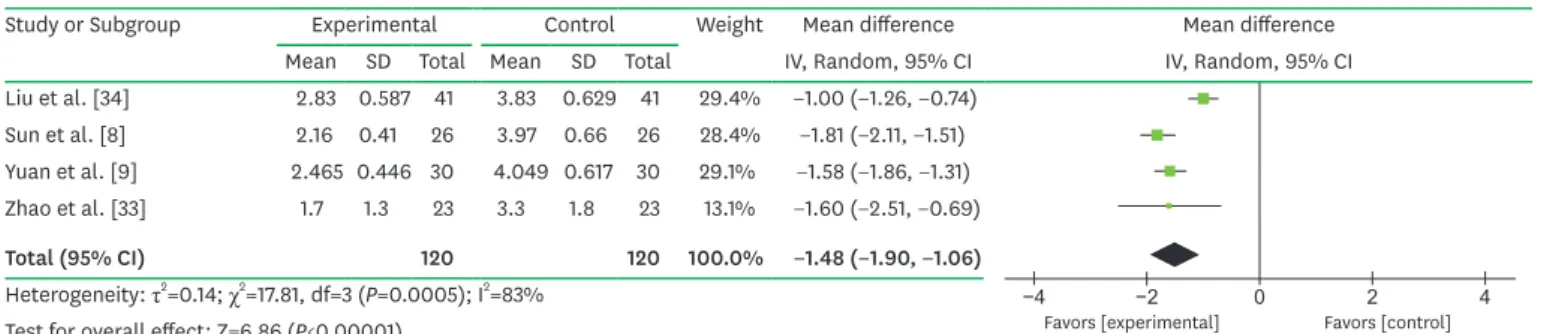
In 9 studies [8,9,20,21,26,29,31,33,34], the subjects were asked to use a VAS to rate the discomfort that they felt following their treatment. Due to incomplete data from 5 studies [20,21,26,29,31], VAS results (Figure 5) were analysed based on the other 4 studies [8,9,33,34], which revealed that the subjects perceived the treatment with GPAP to be significantly more comfortable (difference of means, −1.48; 95% CI, −1.90 to −1.06; P<0.00001) than treatment with ultrasonic instruments. Substantial heterogeneity was observed (I
2=83%).
Low risk of bias Unclear risk of bias High risk of bias Random sequence generation (selection bias)
Allocation concealment (selection bias) Blinding of participants and personnel (performance bias) Blinding of outcome assessment (detection bias) Incomplete outcome data (attrition bias) Selective reporting (reporting bias) Other bias
0 25 50 75 100
%
Figure 2. Risk of bias graph. The review authors' judgements about each item assessing risk of bias are presented as percentages across all included studies. Green, yellow, and red refer to low risk of bias, unclear risk of bias, and high risk of bias, respectively.
Arora et al. [26]
Flemmig et al. [20]
Hu et al. [5]
Kargas et al. [27]
Li et al. [36]
Lu et al. [28]
Luo et al. [37]
Liu et al. [34]
Moene et al. [29]
Petersilka et al. [30]
Petersilka et al. [31]
Simon et al. [32]
Sun et al. [8]
Wennström et al. [21]
Yuan et al. [9]
Xia et al. [35]
Zhao et al. [33]
? ? + + + − +
? + + + + − + + ? + + + + + + ? + + + − +
? ? + + + + +
? ? + + + + + + ? + + + + +
? ? + + + + +
? ? + + + − + + ? ? ? + + + + ? + + + + + + ? + + + + +
? ? + + + + + + ? + + + − +
? ? + + + + + + ? + + + + + + ? + + + + +
Random sequence generation (selection bias) Allocation concealment (selection bias)
Blinding of participants and personnel (performance bias) Blinding of outcome assessment (detection bias)
Incomplete outcome data (attrition bias) Selective reporting (reporting bias)
Other bias
Figure 3. Risk of bias summary. The review authors' judgements about each item assessing risk of bias are presented for each included study. Green, yellow, and red refer to low risk of bias, unclear risk of bias, and high risk of bias, respectively.
In the subgroup analysis based on the initial PD (Figure 6), less heterogeneity was shown in the subgroup of patients with an initial PD<5 mm (χ
2=1.55; df=1; P=0.21; I
2=35%) as well as in the subgroup of patients with an initial PD≥5 mm (χ
2=1.20; df=1; P=0.27; I
2=17%).
−20 −10 0 10 20
Favors [experimental] Favors [control]
Study or Subgroup Experimental Control Weight Mean difference Mean difference
Mean SD Total Mean SD Total IV, Random, 95% CI IV, Random, 95% CI
Hu et al. [5] 43.3 23.1 30 44 21.3 30 12.0% −0.70 (−11.94, 10.54) Li et al. [36] 35.12 4.58 40 44.28 7.14 40 86.0% −9.16 (−11.79, −6.53) Petersilka et al. [30] 18 30 10 21 35 10 2.0% −3.00 (−31.57, 25.57)
Total (95% CI) 80 80 100.0% −8.02 (−12.10, −3.95)
Heterogeneity: τ2=3.23; χ2=2.21, df=2 (P=0.33); I2=10%
Test for overall effect: Z=3.86 (P=0.0001)
Figure 4. Forest plot of BOP, comparing GPAP (experimental group) with hand instrumentation (control group).
BOP: bleeding on probing, GPAP: glycine powder air-polishing, SD: standard deviation, CI: confidence interval, IV: inverse variance.
−4 −2 0 2 4
Favors [experimental] Favors [control]
Study or Subgroup Experimental Control Weight Mean difference Mean difference
Mean SD Total Mean SD Total IV, Random, 95% CI IV, Random, 95% CI
Liu et al. [34] 2.83 0.587 41 3.83 0.629 41 29.4% −1.00 (−1.26, −0.74) Sun et al. [8] 2.16 0.41 26 3.97 0.66 26 28.4% −1.81 (−2.11, −1.51) Yuan et al. [9] 2.465 0.446 30 4.049 0.617 30 29.1% −1.58 (−1.86, −1.31) Zhao et al. [33] 1.7 1.3 23 3.3 1.8 23 13.1% −1.60 (−2.51, −0.69)
Total (95% CI) 120 120 100.0% −1.48 (−1.90, −1.06)
Heterogeneity: τ2=0.14; χ2=17.81, df=3 (P=0.0005); I2=83%
Test for overall effect: Z=6.86 (P<0.00001)
Figure 5. Forest plot of the VAS of patient discomfort/pain, comparing GPAP (experimental group) with ultrasonic scaling (control group).
VAS: visual analogue scale, GPAP: glycine powder air-polishing, SD: standard deviation, CI: confidence interval, IV: inverse variance.
−4 −2 0 2 4
Favors [experimental] Favors [control]
Study or Subgroup Experimental Control Weight Mean difference Mean difference
Mean SD Total Mean SD Total IV, Random, 95% CI IV, Random, 95% CI
2.3.1 initial PD<5 mm
Liu et al. [34] 2.83 0.587 41 3.83 0.629 41 29.4% −1.00 (−1.26, −0.74) Zhao et al. [33] 1.7 1.3 23 3.3 1.8 23 13.1% −1.60 (−2.51, −0.69)
Subtotal (95% CI) 64 64 42.5% −1.14 (−1.63, −0.64)
Heterogeneity: τ2=0.06; χ2=1.55, df=1 (P=0.21); I2=35%
Test for overall effect: Z=4.52 (P<0.00001) 2.3.2 initial PD≥5 mm
Sun et al. [8] 2.16 0.41 26 3.97 0.66 26 28.4% −1.81 (−2.11, −1.51) Yuan et al. [9] 2.465 0.446 30 4.049 0.617 30 29.1% −1.58 (−1.86, −1.31)
Subtotal (95% CI) 56 56 57.5% −1.69 (−1.91, −1.47)
Heterogeneity: τ2=0.00; χ2=1.20, df=1 (P=0.27); I2=17%
Test for overall effect: Z=14.99 (P<0.00001)
Total (95% CI) 120 120 100.0% −1.48 (−1.90, −1.06)
Heterogeneity: τ2=0.14; χ2=17.81, df=3 (P=0.0005); I2=83%
Test for overall effect: Z=6.86 (P<0.00001)
Test for subgroup differences: χ2=4.01, df=1 (P=0.05); I2=75.1%
Figure 6. Forest plot of the subgroup meta-analysis evaluating the difference in the VAS of patient discomfort/pain among selected studies for different initial PD values, comparing GPAP (experimental group) with ultrasonic scaling (control group).
VAS: visual analogue scale, PD: probing depth, GPAP: glycine powder air-polishing, SD: standard deviation, CI: confidence interval, IV: inverse variance.
PD
1) GPAP versus hand instrumentation
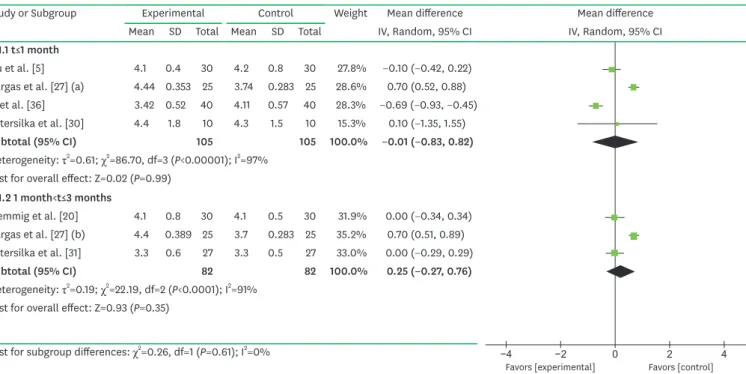
According to the results, the difference of means for PD in the GPAP group was 0.01 mm (95% CI, −0.83 to 0.82 mm; P>0.05; I
2=97%) lower than that in the control group with an evaluation time point of no more than 1 month, and was 0.25 mm (95% CI, −0.27 to 0.76 mm; P>0.05; I
2=91%) higher than that in the hand instrumentation group at evaluation time points of 1–3 months (Figure 7). Substantial heterogeneity existed (I
2=97%; I
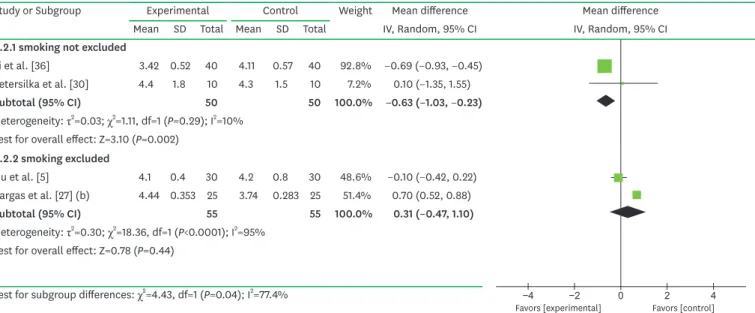
2=91%). In a subgroup analysis based on different smoking status, a low degree of heterogeneity was found (Figures 8 and 9).
2) GPAP versus ultrasonic scaling
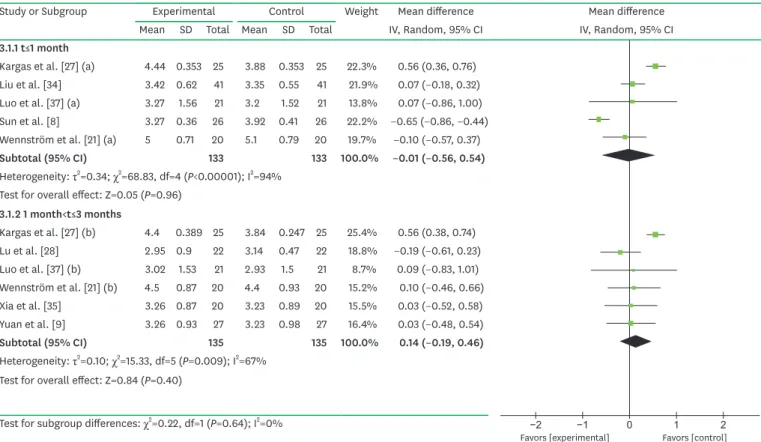
Comparing GPAP and ultrasonic scaling, the results showed that when the follow-up period was no more than 1 month, the PD in the GPAP group was lower (Figure 10) than that in the ultrasonic scaling group. When the follow-up period was between 1 month and 3 months, the difference of means of PD was higher (Figure 10) in the GPAP group than in the ultrasonic group.
Rec
1) GPAP versus hand instrumentation
The results showed that the difference of means of Rec was slightly higher (difference of means, 0.04 mm; 95% CI, −0.40 to 0.49 mm; P>0.05) in the GPAP group than in the control group (Figure 11), although there was no significant difference between the 2 groups.
2) GPAP versus ultrasonic scaling
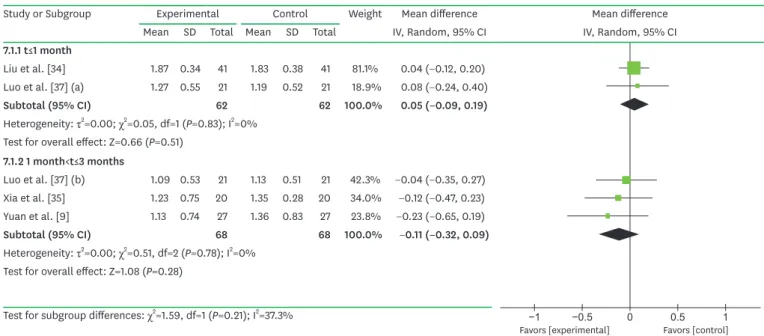
The GPAP group had 0.05 mm (95% CI, −0.15 to 0.25 mm; P>0.05) more Rec than the ultrasonic scaling group (Figure 12).
−4 −2 0 2 4
Favors [experimental] Favors [control]
Study or Subgroup Experimental Control Weight Mean difference Mean difference
Mean SD Total Mean SD Total IV, Random, 95% CI IV, Random, 95% CI
4.1.1 t≤1 month
Hu et al. [5] 4.1 0.4 30 4.2 0.8 30 27.8% −0.10 (−0.42, 0.22)
Kargas et al. [27] (a) 4.44 0.353 25 3.74 0.283 25 28.6% 0.70 (0.52, 0.88) Li et al. [36] 3.42 0.52 40 4.11 0.57 40 28.3% −0.69 (−0.93, −0.45) Petersilka et al. [30] 4.4 1.8 10 4.3 1.5 10 15.3% 0.10 (−1.35, 1.55)
Subtotal (95% CI) 105 105 100.0% −0.01 (−0.83, 0.82)
Heterogeneity: τ2=0.61; χ2=86.70, df=3 (P<0.00001); I2=97%
Test for overall effect: Z=0.02 (P=0.99) 4.1.2 1 month<t≤3 months
Flemmig et al. [20] 4.1 0.8 30 4.1 0.5 30 31.9% 0.00 (−0.34, 0.34) Kargas et al. [27] (b) 4.4 0.389 25 3.7 0.283 25 35.2% 0.70 (0.51, 0.89) Petersilka et al. [31] 3.3 0.6 27 3.3 0.5 27 33.0% 0.00 (−0.29, 0.29)
Subtotal (95% CI) 82 82 100.0% 0.25 (−0.27, 0.76)
Heterogeneity: τ2=0.19; χ2=22.19, df=2 (P<0.0001); I2=91%
Test for overall effect: Z=0.93 (P=0.35)
Test for subgroup differences: χ2=0.26, df=1 (P=0.61); I2=0%
Figure 7. Forest plot of PD, comparing GPAP (experimental group) with hand instrumentation (control group).
PD: probing depth, GPAP: glycine powder air-polishing, SD: standard deviation, CI: confidence interval, IV: inverse variance.
PI
The difference of means of PI (Figure 13) was almost the same in the experimental group as in the control group (difference of means, 0.00; 95% CI, −0.12 to 0.11; P>0.05), with no significant difference observed in this study.
CAL
The difference of means of CAL in the patients receiving GPAP was 0.3 mm (95% CI, −0.15 to 0.75 mm; P>0.05) higher than that of patients in the hand instrumentation group (Figure 14).
Because of the small number of trials included in the meta-analysis, publication bias could not be assessed.
−4 −2 0 2 4
Favors [experimental] Favors [control]
Study or Subgroup Experimental Control Weight Mean difference Mean difference
Mean SD Total Mean SD Total IV, Random, 95% CI IV, Random, 95% CI
4.2.1 smoking not excluded
Li et al. [36] 3.42 0.52 40 4.11 0.57 40 92.8% −0.69 (−0.93, −0.45) Petersilka et al. [30] 4.4 1.8 10 4.3 1.5 10 7.2% 0.10 (−1.35, 1.55)
Subtotal (95% CI) 50 50 100.0% −0.63 (−1.03, −0.23)
Heterogeneity: τ2=0.03; χ2=1.11, df=1 (P=0.29); I2=10%
Test for overall effect: Z=3.10 (P=0.002) 4.2.2 smoking excluded
Hu et al. [5] 4.1 0.4 30 4.2 0.8 30 48.6% −0.10 (−0.42, 0.22)
Kargas et al. [27] (b) 4.44 0.353 25 3.74 0.283 25 51.4% 0.70 (0.52, 0.88)
Subtotal (95% CI) 55 55 100.0% 0.31 (−0.47, 1.10)
Heterogeneity: τ2=0.30; χ2=18.36, df=1 (P<0.0001); I2=95%
Test for overall effect: Z=0.78 (P=0.44)
Test for subgroup differences: χ2=4.43, df=1 (P=0.04); I2=77.4%
Figure 8. Forest plot of the subgroup meta-analysis evaluating the difference in PD (t≤1 month) among selected studies for different smoking statuses, comparing GPAP (experimental group) with hand instrumentation (control group).
PD: probing depth, GPAP: glycine powder air-polishing, SD: standard deviation, CI: confidence interval, IV: inverse variance.
−2 −1 0 1 2
Favors [experimental] Favors [control]
Study or Subgroup Experimental Control Weight Mean difference Mean difference
Mean SD Total Mean SD Total IV, Random, 95% CI IV, Random, 95% CI
4.3.1 smoking not excluded
Flemmig et al. [20] 4.1 0.8 30 4.1 0.5 30 43.2% 0.00 (−0.34, 0.34) Petersilka et al. [31] 3.3 0.6 27 3.3 0.5 27 56.8% 0.00 (−0.29, 0.29)
Subtotal (95% CI) 57 57 100.0% 0.00 (−0.22, 0.22)
Heterogeneity: τ2=0.00; χ2=0.00, df=1 (P=1.00); I2=0%
Test for overall effect: Z=0.00 (P=1.00) 4.3.2 smoking excluded
Kargas et al. [27] (b) 4.4 0.389 25 3.7 0.283 25 100.0% 0.70 (0.51, 0.89)
Subtotal (95% CI) 25 25 100.0% 0.70 (0.51, 0.89)
Heterogeneity: not applicable
Test for overall effect: Z=7.28 (P<0.00001)
Test for subgroup differences: χ2=22.19, df=1 (P<0.00001); I2=95.5%
Figure 9. Forest plot of the subgroup meta-analysis evaluating the difference in PD (1 month<t≤3 months) among selected studies for different smoking statuses, comparing GPAP (experimental group) with hand instrumentation (control group).
PD: probing depth, GPAP: glycine powder air-polishing, SD: standard deviation, CI: confidence interval, IV: inverse variance.
DISCUSSION
As a new device for periodontal treatment during SPT, GPAP has the advantage of being less time-consuming and less abrasive than conventional methods, making it a promising potential alternative [31]. However, some discrepancies regarding this issue exist, as some investigators have reported no significant differences between GPAP and conventional methods. This inconsistency has hindered the promotion of GPAP. Therefore, we conducted this meta-analysis to evaluate the effectiveness of GPAP for SPT compared to hand
instrumentation and ultrasonic scaling.
The meta-analysis in the current study showed that compared to hand instrumentation, the BOP for the GPAP group was reduced by 8.02% (95% CI, −12.10% to −3.95%; P<0.00001).
BOP refers to bleeding that is induced by gentle manipulation of the tissue at the depth of
−2 −1 0 1 2
Favors [experimental] Favors [control]
Study or Subgroup Experimental Control Weight Mean difference Mean difference
Mean SD Total Mean SD Total IV, Random, 95% CI IV, Random, 95% CI
3.1.1 t≤1 month
Kargas et al. [27] (a) 4.44 0.353 25 3.88 0.353 25 22.3% 0.56 (0.36, 0.76) Liu et al. [34] 3.42 0.62 41 3.35 0.55 41 21.9% 0.07 (−0.18, 0.32) Luo et al. [37] (a) 3.27 1.56 21 3.2 1.52 21 13.8% 0.07 (−0.86, 1.00) Sun et al. [8] 3.27 0.36 26 3.92 0.41 26 22.2% −0.65 (−0.86, −0.44) Wennström et al. [21] (a) 5 0.71 20 5.1 0.79 20 19.7% −0.10 (−0.57, 0.37)
Subtotal (95% CI) 133 133 100.0% −0.01 (−0.56, 0.54)
Heterogeneity: τ2=0.34; χ2=68.83, df=4 (P<0.00001); I2=94%
Test for overall effect: Z=0.05 (P=0.96) 3.1.2 1 month<t≤3 months
Kargas et al. [27] (b) 4.4 0.389 25 3.84 0.247 25 25.4% 0.56 (0.38, 0.74) Lu et al. [28] 2.95 0.9 22 3.14 0.47 22 18.8% −0.19 (−0.61, 0.23) Luo et al. [37] (b) 3.02 1.53 21 2.93 1.5 21 8.7% 0.09 (−0.83, 1.01) Wennström et al. [21] (b) 4.5 0.87 20 4.4 0.93 20 15.2% 0.10 (−0.46, 0.66) Xia et al. [35] 3.26 0.87 20 3.23 0.89 20 15.5% 0.03 (−0.52, 0.58) Yuan et al. [9] 3.26 0.93 27 3.23 0.98 27 16.4% 0.03 (−0.48, 0.54)
Subtotal (95% CI) 135 135 100.0% 0.14 (−0.19, 0.46)
Heterogeneity: τ2=0.10; χ2=15.33, df=5 (P=0.009); I2=67%
Test for overall effect: Z=0.84 (P=0.40)
Test for subgroup differences: χ2=0.22, df=1 (P=0.64); I2=0%
Figure 10. Forest plot of PD, comparing GPAP (experimental group) with ultrasonic scaling (control group).
PD: probing depth, GPAP: glycine powder air-polishing, SD: standard deviation, CI: confidence interval, IV: inverse variance.
−2 −1 0 1 2
Favors [experimental] Favors [control]
Study or Subgroup Experimental Control Weight Mean difference Mean difference
Mean SD Total Mean SD Total IV, Random, 95% CI IV, Random, 95% CI
Flemmig et al. [20] 0.5 0.9 30 0.2 0.4 30 44.5% 0.30 (−0.05, 0.65) Kargas et al. [27] (b) 0.98 0.389 25 1.14 0.283 25 55.5% −0.16 (−0.35, 0.03)
Total (95% CI) 55 55 100.0% 0.04 (−0.40, 0.49)
Heterogeneity: τ2=0.09; χ2=5.09, df=1 (P=0.02); I2=80%
Test for overall effect: Z=0.20 (P=0.84)
Figure 11. Forest plot of Rec, comparing GPAP (experimental group) with hand instrumentation (control group).
Rec: gingival recession, GPAP: glycine powder air-polishing, SD: standard deviation, CI: confidence interval, IV: inverse variance.
the gingival sulcus or interface between the gingiva and a tooth. BOP is a sign of gingival inflammation and indicates some degree of destruction and erosion of the linking of the gingival sulcus [38] or ulceration of the epithelium. The reduction of BOP in response to GPAP may have resulted from the ability of GPAP to alleviate gingival inflammation effectively. First, bacterial biofilms initiate periodontal inflammation, and GPAP can effectively remove bacterial biofilms. Second, the powder used in GPAP is glycine, which has immunomodulatory, anti-inflammatory, and cytoprotective effects on periodontal tissue [18]. However, no significant differences were found in PD, Rec, PI, or CAL between the
−1 −0.5 0 0.5 1
Favors [experimental] Favors [control]
Study or Subgroup Experimental Control Weight Mean difference Mean difference
Mean SD Total Mean SD Total IV, Random, 95% CI IV, Random, 95% CI
7.1.1 t≤1 month
Liu et al. [34] 1.87 0.34 41 1.83 0.38 41 81.1% 0.04 (−0.12, 0.20) Luo et al. [37] (a) 1.27 0.55 21 1.19 0.52 21 18.9% 0.08 (−0.24, 0.40)
Subtotal (95% CI) 62 62 100.0% 0.05 (−0.09, 0.19)
Heterogeneity: τ2=0.00; χ2=0.05, df=1 (P=0.83); I2=0%
Test for overall effect: Z=0.66 (P=0.51) 7.1.2 1 month<t≤3 months
Luo et al. [37] (b) 1.09 0.53 21 1.13 0.51 21 42.3% −0.04 (−0.35, 0.27) Xia et al. [35] 1.23 0.75 20 1.35 0.28 20 34.0% −0.12 (−0.47, 0.23) Yuan et al. [9] 1.13 0.74 27 1.36 0.83 27 23.8% −0.23 (−0.65, 0.19)
Subtotal (95% CI) 68 68 100.0% −0.11 (−0.32, 0.09)
Heterogeneity: τ2=0.00; χ2=0.51, df=2 (P=0.78); I2=0%
Test for overall effect: Z=1.08 (P=0.28)
Test for subgroup differences: χ2=1.59, df=1 (P=0.21); I2=37.3%
Figure 12. Forest plot of Rec, comparing GPAP (experimental group) with ultrasonic scaling (control group).
Rec: gingival recession, GPAP: glycine powder air-polishing, SD: standard deviation, CI: confidence interval, IV: inverse variance.
−2 −1 0 1 2
Favors [experimental] Favors [control]
Study or Subgroup Experimental Control Weight Mean difference Mean difference
Mean SD Total Mean SD Total IV, Random, 95% CI IV, Random, 95% CI
Kargas et al. [27] 5.38 0.424 25 4.76 0.389 25 44.6% 0.62 (0.39, 0.85) Xia et al. [35] 4.34 1.03 20 4.35 0.92 20 26.4% −0.01 (−0.62, 0.60) Yuan et al. [9] 4.42 1.05 27 4.34 0.99 27 29.0% 0.08 (−0.46, 0.62)
Total (95% CI) 72 72 100.0% 0.30 (−0.15, 0.75)
Heterogeneity: τ2=0.11; χ2=6.07, df=2 (P=0.05); I2=67%
Test for overall effect: Z=1.29 (P=0.20)
Figure 13. Forest plot of PI, comparing GPAP (experimental group) with ultrasonic scaling (control group).
PI: plaque index, GPAP: glycine powder air-polishing, SD: standard deviation, CI: confidence interval, IV: inverse variance.
−0.5
−1 0 0.5 1
Favors [experimental] Favors [control]
Study or Subgroup Experimental Control Weight Mean difference Mean difference
Mean SD Total Mean SD Total IV, Random, 95% CI IV, Random, 95% CI
Kargas et al. [27] (b) 0.98 0.389 25 0.92 0.389 25 87.8% 0.06 (−0.16, 0.28)
Zhao et al. [33] 0 1 23 0 1 23 12.2% 0.00 (−0.58, 0.58)
Total (95% CI) 48 48 100.0% 0.05 (−0.15, 0.25)
Heterogeneity: τ2=0.00; χ2=0.04, df=1 (P=0.85); I2=0%
Test for overall effect: Z=0.51 (P=0.61)
Figure 14. Forest plot of clinical attachment level (CAL), comparing GPAP (experimental group) with ultrasonic scaling (control group).
GPAP: glycine powder air-polishing, SD: standard deviation, CI: confidence interval, IV: inverse variance.
GPAP and control groups, possibly due to variation in the follow-up period among different studies. Thus, further studies are still needed to prove the efficacy of GPAP.
Patients strongly prefer a higher comfort level during the treatment process. Furthermore, since SPT requires a long treatment cycle, good treatment experiences of patients contribute to their long-term follow-up, which is beneficial to the prognosis of periodontitis. Therefore, in this study, discomfort/pain levels were assessed using a VAS (patients were required to complete a VAS, ranging from extremely comfortable [value of 0] to extremely painful [value of 10]). The results for VAS scores (difference of means, −1.48; 95% CI, −1.90 to −1.06; P<0.00001) between the GPAP group and the ultrasonic scaling group confirmed that patients felt less discomfort/
pain when using the new devices. This may be due to the minimally abrasive nature of glycine powder, as well as the specially designed delivery tip and handpiece used in GPAP, which may lead to less hard tissue damage and reduced tooth sensitivity.
In this present study, for results that could be quantitatively assessed, such as BOP, patient discomfort/pain (measured by VAS), PD, Rec, PI and CAL, RevMan 5.3 was used to calculate the P values, while a qualitative analysis was conducted for GE scoring and subgingival bacteria counts to maximize the reliability of the results.
Over the years, GPAP has also been used in the treatment of peri-implantitis due to the safety of glycine powder. Professional cleaning of implant prostheses was recommended because of the rebound of bacterial levels, and the use of glycine powder abrasion was suggested at each visit rather than plastic curettes [39]. Proper use of air-polishing is important to minimize the risk of air emphysema. It has been estimated that the risk of air emphysema following GPAP is approximately 1 in 666,666 [40].
At the same time, there were some limitations to our current study. First, the investigators of the included studies only evaluated short-term efficacy, which cannot fully prove the difference between GPAP and mechanical instrumentation. Second, according to the Cochrane Handbook for Systematic Reviews of Interventions, 12 of the included studies had a moderate risk of bias, and 5 were considered to have a high risk of bias. Those biases were associated with random sequence generation, allocation concealment, blinding of participants, blinding of outcome assessors, incomplete outcome data, selective reporting, and other biases. However, a certain level of bias existed in most meta-analysis[23]. Third, there was substantial heterogeneity among some studies, possibly because of the differences noted with initial PD and the exclusion of smoking or not. Finally, researchers did not detect the clinical parameters and patient discomfort/pain at the same time point, and high heterogeneity was possible when doing a meta-analysis.
Because of the substantial heterogeneity among some studies, subgroup analyses were
conducted. The subgroup meta-analysis suggested that initial PD had some association with
the degree of heterogeneity for VAS and PD between GPAP and ultrasonic scaling. Moreover,
smoking status showed a significant degree of heterogeneity for PD between the GPAP
and hand instrumentation groups. Although the subgroup analysis of PD showed that in
non-smokers, hand instrumentation might be more effective than GPAP, the evidence was
insufficient to prove the superiority of hand instrumentation over GPAP, since only 1 study
was included in this subgroup.
In the light of the results and limitations mentioned above, some suggestions can be made for further research. First, investigators should devote more attention to the long-term efficacy of GPAP. Moreover, the experimental design of further studies should be more rigorous. For example, investigators should detect the outcome measures at the same time point, and the inclusion criteria should be consistent.
In conclusion, this study demonstrated that GPAP might alleviate gingival inflammation more effectively and be less painful. Since GPAP is more expensive than hand
instrumentation and ultrasonic scaling because of the instruments needed and glycine powder used, practitioners should carefully balance the costs that patients can afford and the benefits that patients may obtain when deciding to use GPAP for SPT. With regards to PD, Rec, PI, and CAL, the evidence was insufficient to support a difference between GPAP and mechanical instrumentation during SPT. More studies with a longer evaluation period are urgently needed to further analyse the efficacy of GPAP.
ACKNOWLEDGEMENTS
The authors gratefully acknowledge Professor Qin Liu, associate professor from the School of Public Health and Management, Chongqing Medical University, for making helpful suggestions about this paper. This study was supported by the Program for Innovation Team Building at Institutions of Higher Education in Chongqing in 2016 (grant no.
CXTDG201602006) and the Natural Science Foundation of Chongqing (2015msxm055).
REFERENCES
1. Listed N. Supportive periodontal therapy (SPT). J Periodontol 1998.69:502-6.
PUBMED
2. Axelsson P, Lindhe J. The significance of maintenance care in the treatment of periodontal disease. J Clin Periodontol 1981;8:281-94.
PUBMED | CROSSREF
3. Lindhe J, Nyman S. Long-term maintenance of patients treated for advanced periodontal disease. J Clin Periodontol 1984;11:504-14.
PUBMED | CROSSREF
4. Kerry GJ. Supportive periodontal treatment. Periodontol 2000 1995;9:176-85.
PUBMED | CROSSREF
5. Hu CJ, Yin YZ, Guan DP. Comparison of subgingival debridement efficacy of air polishing and manual scaling. Shanghai Kou Qiang Yi Xue 2015.24:602-6.
PUBMED
6. Walmsley AD, Lea SC, Landini G, Moses AJ. Advances in power driven pocket/root instrumentation. J Clin Periodontol 2008;35 Suppl:22-8.
PUBMED | CROSSREF
7. Alves RV, Machion L, Casati MZ, Nociti FH Jr, Sallum EA, Sallum AW. Clinical attachment loss produced by curettes and ultrasonic scalers. J Clin Periodontol 2005;32:691-4.
PUBMED | CROSSREF
8. Sun K, Gui G, Wang F. Evaluation of the efficacy of subgingival air-polishing during periodontal maintenance phase. Jiangsu Medical Journal 2016;42:2268-70.
9. Yuan Y, Jia X, Shao J, Xu X. Effect of subgingival air-polishing in supportive periodontal treatment for chronic periodontitis. J Dent Prev Treat 2015:383-5.
10. Zappa U, Smith B, Simona C, Graf H, Case D, Kim W. Root substance removal by scaling and root planing. J Periodontol 1991;62:750-4.
PUBMED | CROSSREF
11. Ritz L, Hefti AF, Rateitschak KH. An in vitro investigation on the loss of root substance in scaling with various instruments. J Clin Periodontol 1991;18:643-7.
PUBMED | CROSSREF
12. Flemmig TF, Hetzel M, Topoll H, Gerss J, Haeberlein I, Petersilka G. Subgingival debridement efficacy of glycine powder air polishing. J Periodontol 2007;78:1002-10.
PUBMED | CROSSREF
13. Weaks LM, Lescher NB, Barnes CM, Holroyd SV. Clinical evaluation of the Prophy-Jet as an instrument for routine removal of tooth stain and plaque. J Periodontol 1984;55:486-8.
PUBMED | CROSSREF
14. Berkstein S, Reiff RL, McKinney JF, Killoy WJ. Supragingival root surface removal during maintenance procedures utilizing an air-powder abrasive system or hand scaling. An in vitro study. J Periodontol 1987;58:327-30.
PUBMED | CROSSREF
15. Atkinson DR, Cobb CM, Killoy WJ. The effect of an air-powder abrasive system on in vitro root surfaces. J Periodontol 1984;55:13-8.
PUBMED | CROSSREF
16. Petersilka GJ, Bell M, Häberlein I, Mehl A, Hickel R, Flemmig TF. In vitro evaluation of novel low abrasive air polishing powders. J Clin Periodontol 2003;30:9-13.
PUBMED | CROSSREF
17. Bozbay E, Dominici F, Gokbuget AY, Cintan S, Guida L, Aydin MS, et al. Preservation of root cementum: a comparative evaluation of power-driven versus hand instruments. Int J Dent Hyg 2018;16:202-9.
PUBMED | CROSSREF
18. Schaumann T, Kraus D, Winter J, Wolf M, Deschner J, Jäger A. Potential immune modularly role of glycine in oral gingival inflammation. Clin Dev Immunol 2013;2013:808367.
PUBMED | CROSSREF
19. Petersilka GJ, Steinmann D, Häberlein I, Heinecke A, Flemmig TF. Subgingival plaque removal in buccal and lingual sites using a novel low abrasive air-polishing powder. J Clin Periodontol 2003;30:328-33.
PUBMED | CROSSREF
20. Flemmig TF, Arushanov D, Daubert D, Rothen M, Mueller G, Leroux BG. Randomized controlled trial assessing efficacy and safety of glycine powder air polishing in moderate-to-deep periodontal pockets. J Periodontol 2012;83:444-52.
PUBMED | CROSSREF
21. Wennström JL, Dahlén G, Ramberg P. Subgingival debridement of periodontal pockets by air polishing in comparison with ultrasonic instrumentation during maintenance therapy. J Clin Periodontol 2011;38:820-7.
PUBMED | CROSSREF
22. Ng E, Byun R, Spahr A, Divnic-Resnik T. The efficacy of air polishing devices in supportive periodontal therapy: a systematic review and meta-analysis. Quintessence Int 2018;49:453-67.
PUBMED
23. Higgins J, Green S. Cochrane handbook for systematic reviews of interventions. Version 5.1.0. Oxford:
The Cochrane Collaboration; 2011.
24. Jones HE. Introduction to meta-analysis. Paediatr Perinat Epidemiol 2010;24:139.
CROSSREF
25. Higgins JP, Thompson SG. Quantifying heterogeneity in a meta-analysis. Stat Med 2002;21:1539-58.
PUBMED | CROSSREF
26. Arora K, Dodwad V, Kukreja BJ, Nagpal S. A comparative evaluation of the efficacy of glycine air polishing following scaling and root planing & scaling and root planing alone in the treatment of chronic periodontitis: a clinical study. J Dent Spec 2013;1:42-6.
27. Kargas K, Tsalikis L, Sakellari D, Menexes G, Konstantinidis A. Pilot study on the clinical and
microbiological effect of subgingival glycine powder air polishing using a cannula-like jet. Int J Dent Hyg 2015;13:161-9.
PUBMED | CROSSREF
28. Lu H, He L, Zhao Y, Meng H. The effect of supragingival glycine air polishing on periodontitis during maintenance therapy: a randomized controlled trial. PeerJ 2018;6:e4371.
PUBMED | CROSSREF
29. Moëne R, Décaillet F, Andersen E, Mombelli A. Subgingival plaque removal using a new air-polishing device. J Periodontol 2010;81:79-88.
PUBMED | CROSSREF
30. Petersilka G, Faggion CM Jr, Stratmann U, Gerss J, Ehmke B, Haeberlein I, et al. Effect of glycine powder air-polishing on the gingiva. J Clin Periodontol 2008;35:324-32.
PUBMED | CROSSREF
31. Petersilka GJ, Steinmann D, Häberlein I, Heinecke A, Flemmig TF. Subgingival plaque removal in buccal and lingual sites using a novel low abrasive air-polishing powder. J Clin Periodontol 2003;30:328-33.
PUBMED | CROSSREF
32. Simon CJ, Munivenkatappa Lakshmaiah Venkatesh P, Chickanna R. Efficacy of glycine powder air polishing in comparison with sodium bicarbonate air polishing and ultrasonic scaling - a double-blind clinico-histopathologic study. Int J Dent Hyg 2015;13:177-83.
PUBMED | CROSSREF
33. Zhao Y, He L, Meng H. Clinical observation of glycine powder air-polishing during periodontal maintenance phase. Zhonghua Kou Qiang Yi Xue Za Zhi 2015;50:544-7.
PUBMED
34. Liu W, Tang X, Zhao Y, Ma C, Zhang F, Liu D, et al. The efficacy of subgingival air-polishing in comparison with ultrasonic scaling in supportive periodontal therapy. J Oral Sci Res 2015;31:522-3.
35. Xia J. Evaluation of the efficacy of subgingival air-polishing for chronic periodontitis. Gen J Stomatol 2017;4:30-1.
36. Li L. Clearance effect of sandblasting and hand scaling on subgingival plaque and on inter- leukin and MMP8/TIMP1 levels. Hainan Yixueyuan Xuebao 2016;22:2132-5.
37. Luo W, Liu M, Mo L. Effect of subgingival polishing on the clinical parameters of chronic periodontal diseases. J Dent Prev Treat 2014;22:641-4.
38. Newman MG, Takei HH, Klokkevold PR, Carranza F. Carranza's clinical periodontology. 11th ed. St. Louis (MO): Elsevier/Saunders; 2012.
39. Bidra AS, Daubert DM, Garcia LT, Gauthier MF, Kosinski TF, Nenn CA, et al. A systematic review of recall regimen and maintenance regimen of patients with dental restorations. Part 2: implant-borne restorations. J Prosthodont 2016;25 Suppl 1:S16-31.
PUBMED | CROSSREF
40. Flemmig TF, Arushanov D, Daubert D, Rothen M, Mueller G, Leroux BG. Randomized controlled trial assessing efficacy and safety of glycine powder air polishing in moderate-to-deep periodontal pockets. J Periodontol 2012;83:444-52.
PUBMED | CROSSREF