* To whom correspondence should be addressed.
E-mail: [email protected] 청정환경기술
Large Scale Treatment of Perfluorocompounds Using a Thermal Plasma Scrubber
Sung-Han Han, Hyun-Woo Park, Tae-Hee Kim, and Dong-Wha Park*
Department of Chemical Engineering and RIC-ETTP (Regional Innovation Center for Environmental Technology of Thermal Plasma), INHA University, 253 Yonghyun-dong, Nam-gu, Incheon, 402-751, Korea
(Received for review June 10, 2011; Accepted August 12, 2011)
Abstract
Thermal plasma has been presented for the decomposition of perfluorocompounds (PFCs) which are extensively used in the semiconductor manufacturing and display industry. We developed pilot-scale equipment to investigate the large scale treatment of PFCs and called it a “thermal plasma scrubber”. PFCs such as CF
4, C
2F
6, SF
6, and NF
3used in experiments were diluted with N
2. There were two different types of experiment setup related to the water spray direction inside the thermal plasma scrubber. The first type was that the water was sprayed directly into the gas outlet located at the exit of the reaction section. The second type was that the water was sprayed on the wall of the quenching section. More effective decomposition took place when the water was sprayed on the quenching section wall. For C
2F
6, SF
6, and NF
3the maximum destruction and removal efficiency was nearly 100%, and for CF
4was up to 93%.
Keywords : Thermal plasma, PFCs, C
2F
6, CF
4, SF
6, NF
3, Scrubber
1. Introduction
Perfluorocompounds (PFCs) are widely used as etching and cleaning gases in the semiconductor manufacturing and display industry[1-5]. PFCs have an enormous effect on global war- ming because although their emission amount is relatively lower than carbon dioxide (CO
2), they have high global warming po- tentials (GWPs) which are about several thousands times higher compared to CO
2[5]. Table 1 shows the lifetimes and GWPs of PFCs[7]. The emissions of perfluorocarbons and sulphur hexafluoride (SF
6) with high GWPs have been regulated inter- nationally by the Kyoto Protocol and the Bali Roadmap[8-10].
Voluntary efforts to decrease PFCs emissions are now under way in the semiconductor industry. The industry’s activities for the reduction of PFCs can be largely divided into 3 classes.
The first is to replace PFCs with gases which are not regulated by the Kyoto Protocol such as nitrogen trifluoride (NF
3). The second is to improve the manufacturing process efficiency to reduce the amount of PFCs. The last is to treat the exhausted gases. Treatment of exhaust gases has been considered as a very effective way to abate PFCs directly. Therefore, many studies related to the treatment of these gases have been carried out.
The treatment of PFCs can be achieved via the combustion system[11], catalytic decomposition[12], or by the plasma tech- nique[8,13-17]. In the plasma technique, there are two kinds:
low-temperature plasma processing and high-temperature plasma processing. It is difficult for cold plasma processing to be used practically in industry since large scale treatment of PFCs in our evaluation was found to be unsuitable. Meanwhile, the abate- ment technique using combustion has been attempted, but its decomposition efficiency was evaluated by us to be relatively lower than that of a high-temperature plasma technique. How- ever, it may be expected that the combustion method can be also applied to the large-scale treatment of PFCs. In addition, it seems that for catalytic destruction system to be effective, more investigation is needed before commercialization. There- fore, it may be concluded that among the three methods, hot- plasma processing can be expected to be installed in an actual
Table 1. Atmospheric lifetimes GWP100 of greenhouse gases[6]
Greenhouse gases Atmospheric lifetime (year) GWP100
CO
250-200 1
CF
450000 6500
C
2F
610000 9200
SF
63200 23900
C
3F
82600-7000 7000
CHF
3250-390 11700
C
4F
83200 8700
CH
412 21
N
2O 120 310
NF
350-740 8000
250
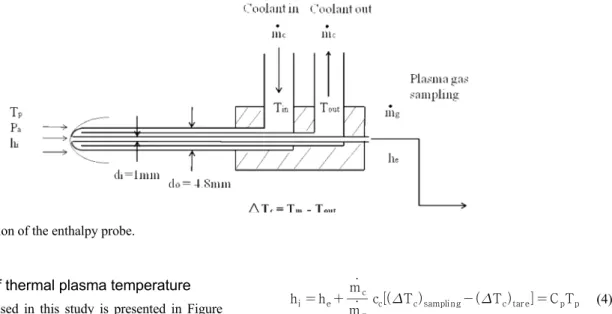
composition using the software program, Factsage [19] was performed and the temperature of the plasma was measured by an enthalpy probe.
2. Experimental 2.1. Decomposition of PFCs
Figure 1 schematically illustrates the experimental setup of the pilot-scale equipment. We developed the pilot-scale equip- ment for the large-scale treatment of PFCs and called it a
“thermal plasma scrubber”. The thermal plasma scrubber was composed of a DC power supply, a torch, a mixing chamber, a reaction section, a quenching section, a water scrubber, and a blower. The anode of the torch was a copper nozzle and the cathode was a tungsten rod. Pure SF
6, CF
4, NF
3, and C
2F
6gases were diluted with nitrogen (N
2) at a mixing chamber, and then those gases were injected into the reaction section through four injection tubes. N
2was used as the plasma gas, and the flow rates of each PFC and the reactive injection gases including hydrogen (H
2) and oxygen (O
2) were controlled by mass flow controllers. The gas flow rate of N
2was increased from 100 L/min to 300 L/min while the PFCs also increased from 0.5 L/min to 1.5 L/min. When the total treated gas flow rate was 100 L/min, PFCs flow rate was 0.5 L/min. In other words, the
Figure 1. Schematic diagram of the thermal plasma scrubber for removal of PFCs gases.
Figure 2. Schematic diagram of type A and type B.
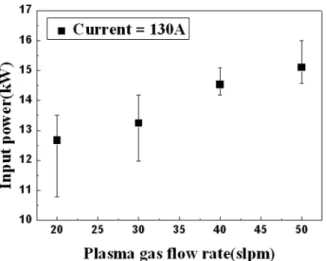
concentration of PFCs was 5,000 ppm. For the water spraying, in order to increase the contact surface area between the gas and the liquid, cylindrical materials were packed inside the water scrubber. The arc current was 130 A, and the power ranged from 12 to 15 kW. Exhausted gases, such as fluorine (F
2), hydrogen fluoride (HF), nitrogen oxide (NO
x), and sulfur oxide (SO
x), were removed through the water scrubber. Table 2 shows the operating conditions in detail.
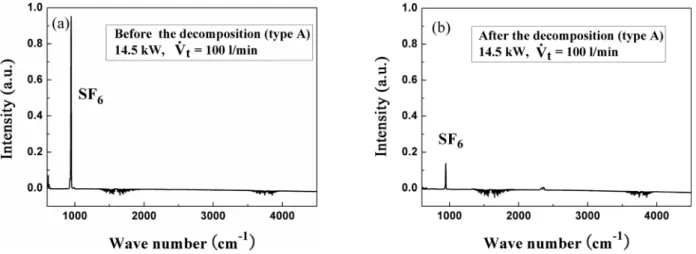
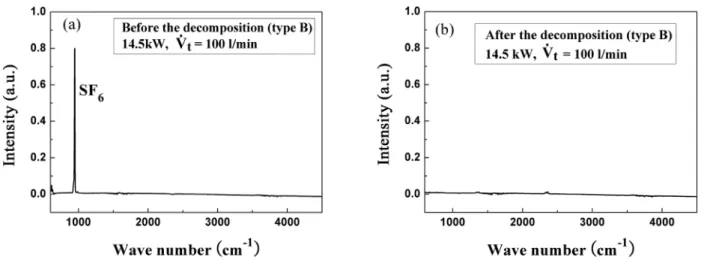
Figure 2 shows the two different types of setup in this study:
type A and type B. In the case of type A, the water was sprayed directly into the gas outlet located at the exit of the reaction section. For type B, the water was sprayed onto the walls of the quenching section to preserve the equipment from the over- heating. The reaction section was 56 mm inside diameter, and the exhausted gases were analyzed by Fourier transform in- frared spectrometer (FT-IR). The destruction and removal effi- ciency (DRE) of PFCs was calculated by Eq (1).
DRE of PFCs C i
PFCs
C i
PFCs
C f
PFCs
![Table 1. Atmospheric lifetimes GWP100 of greenhouse gases[6]](https://thumb-ap.123doks.com/thumbv2/123dokinfo/4962654.300360/1.892.462.822.886.1121/table-atmospheric-lifetimes-gwp-of-greenhouse-gases.webp)