서 론
배스 Micropterus salmoides는 농어목(Perciformes) 검정우럭 과(Centrarchidae)에 속하며 원산지는 미국의 남동부 지역으로 양식 및 낚시를 목적으로 전 세계에 이식되었다(Kim and Park, 2002; Yodo and Iguchi, 2004; Oscoz et al., 2005). 우리나라에 서 배스는 자원 조성용으로 수산청에서 1973년 6월 15일 미국 의 Louisiana 주의 States of Louisiana wild life and fisheries Comition에서 처음 도입되었고 시험 연구를 통해 포식성과 방 류 시 생태계에 끼칠 영향성에 대해 논의된 바 있다(Kim and Kim, 1976). 국내에 도입된 후 배스는 1973년 토쿄지(철원)와 팔당호에 방류되었으며 그 이후 주요 대형댐 등에 수자원 조성 을 목적으로 방류되어 전국의 저수지와 하천 등에 유입되었다 (Byeon et al., 1997; Son and Byeon, 2001). 도입된 배스는 많 은 포란수(10,000~100,000), 산란 후 알과 치어를 보호하는 생 태적 특성과 뚜렷한 천적의 부재로 인해 방류 후 포식자의 생태 적 지위를 갖게 되었고 그 분포 범위 또한 급격히 증가하여 현 재는 우리나라 하천과 저수지에 넓게 분포하고 있다(Kim et al.,
1996; Lee et al., 2002).
하천에 출현하는 것으로 알려진 외래어종은 이스라엘 잉 어 Cyprinus carpio, 떡붕어 Carassius auratus, 초어 Cteno
pharyngodon idella 등 27종 내외로 보고된 바 있으며(NIE, 2014) 이들은 수중생태계에 많은 영향을 미치고 있다(Ko et al., 2008; Lee et al., 2008). 이 중 배스가 도입된 생태계는 어 류의 종다양성이 감소하게 되고 그로 인해 저서 생물과 조류 (algae)가 풍부해지면서 먹이사슬 구조와 생태계의 에너지 흐 름 그리고 서식처 변화 등에 직·간접적인 영향을 미쳐 생태 계 교란을 유발한다고 보고된 바 있다(Carpenter and Kitchell, 1993; GarciaBerthou and MorenoAmich, 2000; Takaharu et al., 2015). 이와 같은 이유로 배스는 환경부에서 1998년 2월 19 일부터 생태계 교란생물로 지정되었고 법적으로 관리되고 있다 (ME, 1998).
담수생태계는 호수, 저수지, 습지대와 같은 정수, 하천과 같 은 유수로 구분되며 하천과 달리 호수나 저수지는 흐름이 없고 물이 가둬진 형태로 단일 군집구조를 가진다(Dobson and Frid, 2009). 외래종의 도입으로 인한 가장 큰 문제는 생물다양성의 감 소이며(Vitousek et al., 1996) 호수나 저수지에서 어류 종다양성 이 크게 떨어지는 것으로 보고되었다(Maezono and Miyashita,
—39 — http://www.fishkorea.or.kr
* Corresponding author: Hyeong Su Kim Tel: 82555402720, Fax: 82555466292, Email: [email protected]
서식처 유형에 따른 배스 Micropterus salmoides 식성의 차이
박종성·김수환1·김현태2·김재구2·박종영2·김형수
*
국립수산과학원 중앙내수면연구소 내수면양식연구센터, 1국립생태원 생태연구본부, 2전북대학교 생명과학과
Study on Feeding Habits of Micropterus salmoides in Habitat Types from Korea by Jong Sung Park, Su Hwan Kim1, Hyun Tae Kim2, Jae Goo Kim2, Jong Young Park2 and Hyeong Su Kim* (Inland Aquaculture Research Center, National Institute of Fisheries Science, Changwon 51688, Republic of Korea; 1Division of Ecological Conservation, National Institute of Ecology, Seocheon 33657, Republic of Korea; 2Department of Biological Science, College of Natural Science, Chonbuk National University, Jeonju 54896, Republic of Korea)
ABSTRACT In order to compared the feeding habits of Micropterus salmoides according to the habitat types, the stomach content of a total of 306 M. salmoides were investigated from April to September 2016 in the stream and reservoir. As a result, the highest IRI(Index of relative importance) value in M. salmoides inhibiting the stream and reservoir were identified as fishes. However, the IRI value of crustaceans and insects as well as fishes in M. salmoides inhibiting the reservoir were high, showing a difference in IRI value of M. salmoides inhibiting the stream.
Key words: Micropterus salmoides, feeding habit, stream, reservoir
Fig. 1. Map showing the collection stations of Micropterus salmoides in Korea. A: Hangang river water system, B: Seomjingang river water system, C: Geumgang river water system, D: Yeongsangang river water system, E: Tamjingang river water system, F: Jeju Island. ●: appearance stations, ○: no appearance stations.
(A) (B)
(C) (D)
(E) (F)
2003; Maezono et al., 2005). 따라서 도입된 배스의 영향을 파 악하는 연구들은 주로 정수역에서 많이 수행되었다(Braun and Walser, 2011). 국내에서도 각각 하천, 호를 대상으로 한 배스 의 식성 연구가 진행된 바 있으나(Jang et al., 2006; Lee et al., 2009) 배스가 유입된 유수역에서의 연구는 미진한 실정으로 옥 정호와 유입하천에 배스의 식성을 비교한 연구(Ko et al., 2008) 가 진행된 바 있으나 다양한 조사지점을 통해 하천 유형에 따른 배스의 영향을 더 면밀히 파악하기 위한 연구는 진행된 바 없다.
따라서 본 연구의 목적은 배스 서식실태 조사의 일환으로 광 주광역시와 전라남도, 세종특별시와 충청북도, 제주특별자치도 지역을 중심으로 저수지와 호수의 정수역과 하천의 유수역을 구분하여 배스의 식성을 조사하고 배스가 각각의 수중생태계에 서 미치는 영향에 대해 논의하고자 한다.
재료 및 방법
1. 표본 채집
분석에 사용된 배스는 2016년 4월 6일부터 9월 30일까지 광 주광역시, 전라남도, 세종특별시, 충청북도, 제주특별자치도 지 역 일대에서 이루어졌다. 조사지점은 지역별로 1~5개 지점씩 하천과 저수지를 나누어 선정하였으며 조사 지점의 행정 구역 명칭 및 하천명 그리고 GPS좌표는 부록과 같다. 전체 123개의 조사지점 중 59개의 조사지점에서 배스를 확인하였으며, 충청북 도, 세종특별시 지역의 한강, 금강, 단양천 등 18개 하천과 강 그 리고 8개의 저수지와 전라남도와 광주광역시 지역의 영산강, 탐 진강, 옥과천 등 14개의 하천과 강 그리고 7개의 저수지에서 배 스의 출현을 확인하였다(Fig. 1). 배스의 출현이 확인된 지점에 서 동서출현종은 Kim and Park(2002)에 따라 동정하였다.
채집은 투망(망목, 7×7mm)과 루어 낚시를 이용하였으며 채 집된 개체는 현장에서 마취제(MS222)로 마취하여 안락사 시 킨 후 10% 포르말린용액으로 고정하였다. 고정된 표본은 실험 실로 가져와 전장, 체장과 체중을 측정하였다.
2. 먹이생물의 분석
소화관 내용물은 위를 절개하여 먹이생물을 꺼낸 후 분류군 의 종류와 무게를 조사하였다. 어류는 Kim and Park(2002)에 따라 동정하였으며, 수서곤충의 동정은 Kim et al.(2013)에 따 랐으며, 먹이생물의 분류는 동정이 가능한 수준까지 분석하였 다. 먹이생물의 분석 결과는 먹이생물의 상대풍부도(Relative abundance, RA), 생체량비, 출현빈도, 상대중요성지수 순으로 나타내었고 출현빈도(Fi)와 상대중요성지수(Index of relative importance, IRI)(Pinkas et al., 1971)는 다음의 식을 이용하여 구하였다.
Fi=Ai /N×100
(Ai: i 먹이생물이 발견된 어류의 개체수, N: 먹이생물이 발견 된 어류의 총 개체수)
IRI=(N+W)×F
(N: 위 내용물에서 발견된 총 먹이 개체수 중 해당 먹이생물이 차지하는 백분율, W: 위 내용물의 전체 무게 중 해당 먹이생물 의 무게가 차지하는 백분율, F: 해당 먹이 생물의 출현빈도)
결 과
1. 체장 분포
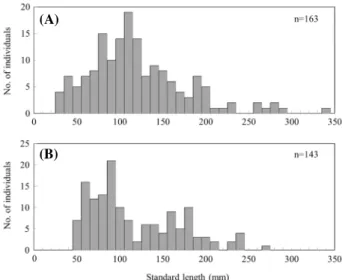
채집된 배스는 총 306개체로 하천에서는 163개체(체장 범 위 30~340mm)가 채집되었고 저수지에서는 143개체(체장 범 위는 50~270mm)가 확인되었다. 하천과 저수지 모두 50~150 mm 범위의 집단이 각각 116개체(71.2%), 104개체(63.8%)로 대부분을 차지하였다(Fig. 2).
2. 하천의 먹이생물 분석
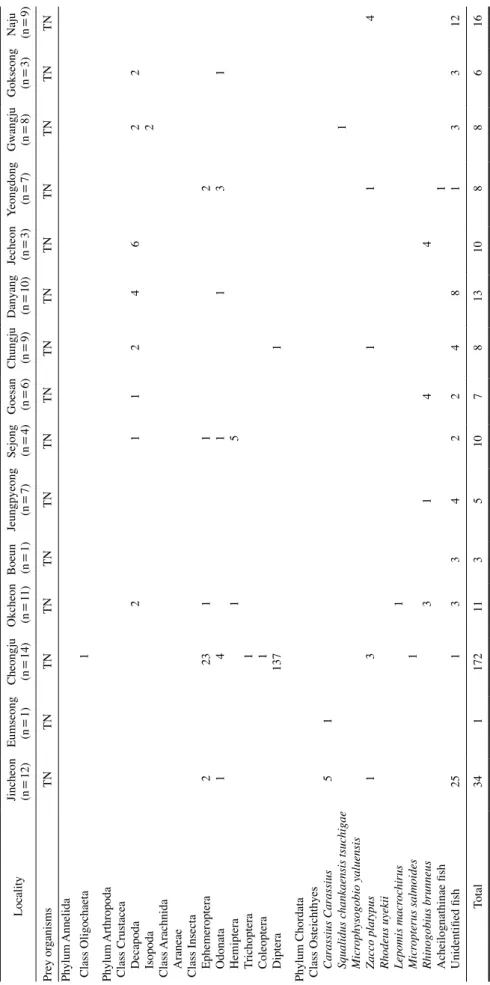
하천에 서식하는 배스는 모두 163개체가 채집되었고 114개 체에서 먹이생물이 관찰되어 공복률은 30.1%로 나타났으며 먹 이 생물의 수는 397개체(1개체 당 평균 3.5개체)였다. 먹이생물 분석 결과는 Table 1과 같다. 개체수에 대한 상대풍부도(relative abundance)는 곤충류(Insecta)가 65.3%로 가장 높았고 어류 (fishes) 29.0%, 갑각류(Crustacea) 5.4%, 거미류(Araneae), 빈 모류(Oligochaeta)가 각각 0.2% 순이었다. 생체량 분석에서는
(A)
(B)
Fig. 2. Standard length frequency of Micropterus salmoides in the stream(A) and reservior(B) from 2016.
Table 1. Stomach content of Micropterus salmoides by frequency of total number(TN), total weight(TW), total occurrence(TO) and index of relative importance(IRI) in the stream from 2016 Locality
Jincheon (n=12)
Eumseong (n
=1)
Cheongju (n=14)
Okcheon (n=11)
Boeun (nJeungpyeong ==1)(n7)
Sejong (n=4)
Goesan (n=6)
Chungju (n=9)
Danyang (n=10)
Jecheon (nYeongdong ==3)(n7)
Gwangju (n=8)
Gokseong (n
=3)
Naju (n=9) Prey organismsTNTNTNTNTNTNTNTNTNTNTNTNTNTNTN Phylum Annelida Class Oligochaeta1
Phylum Arthropoda Class Crustacea Decapoda21124622 Isopoda2
Class Arachnida Araneae Class Insecta Ephemeroptera
223112 Odonata141131 Hemiptera15 Trichoptera1 Coleoptera1 Diptera 1371
Phylum Chordata Class Osteichthyes Carassius Carassius 5 1 Squalidus chankaensis tsuchigae1 Microphysogobio yaluensis Zacco platypus13 114
Rhodeus uyekii Lepomis macr
ochirus1 Micropterus salmoides1 Rhinogobius brunneus3144 Acheilognathinae fish1 Unidentified fish25 1 334224813312 Total341172 11351078131088616 +: less than 0.1%
Table 1. Continued LocalityGwangyang (n=1) Damyang (n
=12)
Muan (n=9)
Suncheon (n
=6)
Yeosu (n=10)
Yeongam (n=1)
Jangseong (n=12)
Jangheung (n
=1)Hampyeong (n=5)Total(n=163) Prey organismsTNTNTNTNTNTNTNTNTNTNTN (%)TW (%)TO (%)
IRI (%)
Phylum Annelida Class Oligochaeta
10.2+0.7+
Phylum Arthropoda Class Crustacea Decapoda20 5.0 2.9 9.22.8 Isopoda20.5+1.3+
Class Arachnida Araneae
110.2+0.7+
Class Insecta Ephemeroptera
42155012.4 0.3 13.86.7 Odonata1155235.7 2.2 10.53.2 Hemiptera286.9 0.1 2.00.5 Trichoptera13161.5 0.1 3.90.2 Coleoptera1130.7 0.3 2.00.1 Diptera123115438.1 0.29.213.5
Phylum Chordata Class Osteichthyes Carassius Carassius61.5 16.7 1.3 0.9 Squalidus chankaensis tsuchigae10.2 9.1 0.7 0.2 Microphysogobio yaluensis110.2 1.2 0.7 + Zacco platypus102.5 17.6 3.3 2.5 Rhodeus uyekii110.2 3.6 0.7 0.1 Lepomis macrochirus10.2 1.2 0.7 + Micropterus salmoides10.2 0.1 0.7 + Rhinogobius brunneus21153.7 7.2 7.2 3.0 Acheilognathinae fish10.2 0.7 0.7 + Unidentified fish331118019.8 36.2 30.9 66.1 Total162211402313404100100100100 +: less than 0.1%
어류가 93.6%로 가장 높았고 곤충류가 3.3%, 갑각류가 2.9% 순 으로 높았다. 출현빈도의 경우도 어류가 가장 높은 값인 46.7%, 곤충류 41.1%, 갑각류 10.5%, 거미류와 빈모류가 각각 0.7%를 기록하였다. 개체수에 대한 상대풍부도, 생체량, 출현빈도를 이 용한 상대중요성지수에 의한 결과에서 어류가 73.0%로 중요한 먹이생물이 어류임이 확인되었다. 그 밖의 먹이생물은 곤충류 24.2%, 갑각류 2.8%였다.
먹이생물 중 섭식된 어류는 미동정 어류를 제외하면 총 8종으 로 중요한 먹이생물은 밀어 Rhinogobius brunneus가 3.0%로 가 장 높았고, 피라미 Zacco platypus 2.5%로 두 번째로 높은 값을 나타냈다. 그 밖에 붕어 Carassius Carassius, 참몰개 Squalidus chankaensis tsuchigae, 돌마자 Microphysogobio yaluensis, 블 루길 Lepomis macrochirus, 배스 등을 섭식하였다.
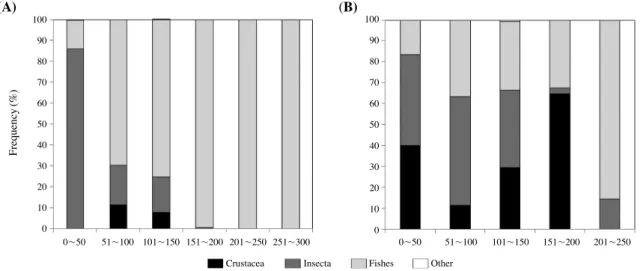
하천에서 채집된 배스 중 먹이를 섭식한 개체를 50mm 간격 으로 나누어 먹이생물의 조성변화를 분석하였다(Fig. 3A). 체장
50mm 이하에서는 곤충류가 85.8%로 가장 높았으며 체장 51 mm 이상부터는 중요한 먹이생물이 어류로 체장 51~100mm 일 때 69.8%, 101~150mm일 때 75.3%, 151~200mm일 때 99.4%로 높게 나타났다.
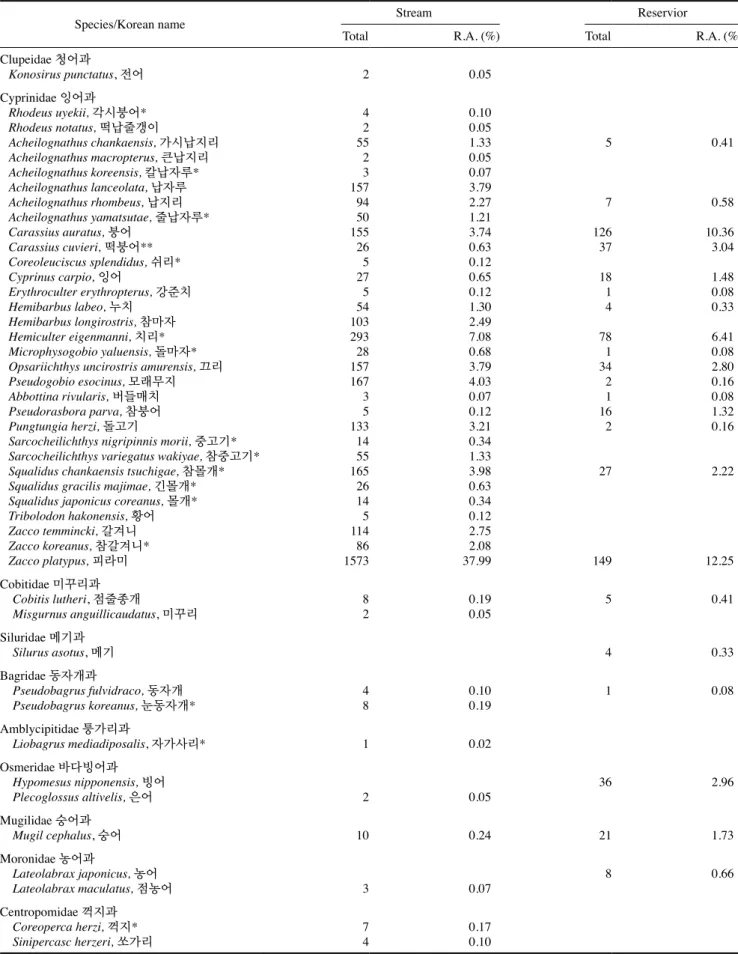
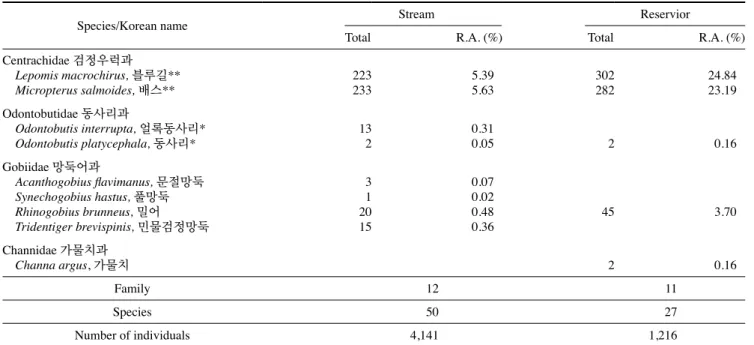
하천에서 배스가 출현한 지점의 동소출현종은 Table 2와 같 다. 채집된 어류의 우점종은 피라미 37.99%, 아우점종은 치 리 Hemiculter eigenmanni 7.08%였으며 그 다음으로 모래무지 Pseudogobio esocinus 4.03%, 참몰개 3.98% 등의 순으로 우세 하게 나타났다.
한편 섭식된 어류 중 배스의 공식이 확인된 지역은 충북 청주 의 무심천에서 배스 1개체가 확인되었다.
3. 저수지의 먹이생물 분석
저수지에 서식하는 배스는 모두 143개체가 확인되었고 114 Fig. 4. Relative abundance(body weight) of stomach contents in Micropterus salmoides between the stream and reservior from 2016.
(A) (B)
Fig. 3. Ontogenetic changes in feeding habits of Micropterus salmoides by index of relative importance(IRI) of stomach contents in stream(A) and reservior(B) from 2016.
Frequency(%)
100 90 80 70 60 50 40 30 20 10 0
100 90 80 70 60 50 40 30 20 10
0~50 51~100 101~150 151~200 201~250 251~300 0~50 51~100 101~150 151~200 201~2500 Crustacea Insecta Fishes Other
Table 2. Fish species composition investigated in the stream and reservior from 2016
Species/Korean name Stream Reservior
Total R.A. (%) Total R.A. (%)
Clupeidae 청어과
Konosirus punctatus, 전어 2 0.05
Cyprinidae 잉어과
Rhodeus uyekii, 각시붕어* 4 0.10
Rhodeus notatus, 떡납줄갱이 2 0.05
Acheilognathus chankaensis, 가시납지리 55 1.33 5 0.41
Acheilognathus macropterus, 큰납지리 2 0.05
Acheilognathus koreensis, 칼납자루* 3 0.07
Acheilognathus lanceolata, 납자루 157 3.79
Acheilognathus rhombeus, 납지리 94 2.27 7 0.58
Acheilognathus yamatsutae, 줄납자루* 50 1.21
Carassius auratus, 붕어 155 3.74 126 10.36
Carassius cuvieri, 떡붕어** 26 0.63 37 3.04
Coreoleuciscus splendidus, 쉬리* 5 0.12
Cyprinus carpio, 잉어 27 0.65 18 1.48
Erythroculter erythropterus, 강준치 5 0.12 1 0.08
Hemibarbus labeo, 누치 54 1.30 4 0.33
Hemibarbus longirostris, 참마자 103 2.49
Hemiculter eigenmanni, 치리* 293 7.08 78 6.41
Microphysogobio yaluensis, 돌마자* 28 0.68 1 0.08
Opsariichthys uncirostris amurensis, 끄리 157 3.79 34 2.80
Pseudogobio esocinus, 모래무지 167 4.03 2 0.16
Abbottina rivularis, 버들매치 3 0.07 1 0.08
Pseudorasbora parva, 참붕어 5 0.12 16 1.32
Pungtungia herzi, 돌고기 133 3.21 2 0.16
Sarcocheilichthys nigripinnis morii, 중고기* 14 0.34
Sarcocheilichthys variegatus wakiyae, 참중고기* 55 1.33
Squalidus chankaensis tsuchigae, 참몰개* 165 3.98 27 2.22
Squalidus gracilis majimae, 긴몰개* 26 0.63
Squalidus japonicus coreanus, 몰개* 14 0.34
Tribolodon hakonensis, 황어 5 0.12
Zacco temmincki, 갈겨니 114 2.75
Zacco koreanus, 참갈겨니* 86 2.08
Zacco platypus, 피라미 1573 37.99 149 12.25
Cobitidae 미꾸리과
Cobitis lutheri, 점줄종개 8 0.19 5 0.41
Misgurnus anguillicaudatus, 미꾸리 2 0.05
Siluridae 메기과
Silurus asotus, 메기 4 0.33
Bagridae 동자개과
Pseudobagrus fulvidraco, 동자개 4 0.10 1 0.08
Pseudobagrus koreanus, 눈동자개* 8 0.19
Amblycipitidae 퉁가리과
Liobagrus mediadiposalis, 자가사리* 1 0.02
Osmeridae 바다빙어과
Hypomesus nipponensis, 빙어 36 2.96
Plecoglossus altivelis, 은어 2 0.05
Mugilidae 숭어과
Mugil cephalus, 숭어 10 0.24 21 1.73
Moronidae 농어과
Lateolabrax japonicus, 농어 8 0.66
Lateolabrax maculatus, 점농어 3 0.07
Centropomidae 꺽지과
Coreoperca herzi, 꺽지* 7 0.17
Sinipercasc herzeri, 쏘가리 4 0.10
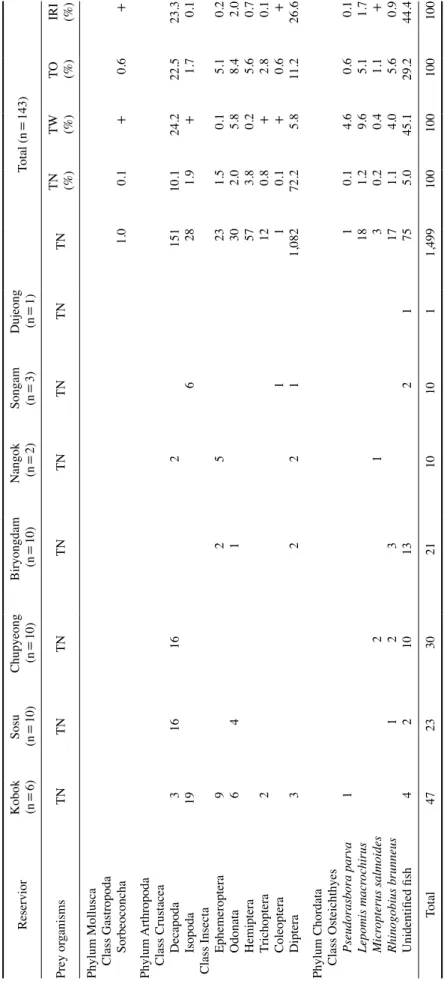
개체에서 먹이생물이 관찰되어 공복률은 20.3%로 나타났으며 먹이 생물의 수는 1,499개체(1개체 당 평균 13.1개체)였다. 먹 이생물을 분석한 결과는 Table 3과 같다. 개체수에 대한 상대 풍부도는 곤충류가 80.4%로 가장 높았고, 갑각류 11.9%, 어류 7.6%, 흡강목(Sorbeoconcha)이 각각 0.1% 순이었다. 생체량 분 석에서는 어류가 63.8%로 가장 높았고, 갑각류 24.2%, 곤충류 12.0% 순으로 높았다. 출현빈도의 경우도 어류가 가장 높은 값 인 41.6%, 곤충류 33.7%, 갑각류 24.2%, 흡강목이 0.6%를 각각 기록하였다. 특히 곤충류 개체수가 많았는데, 이는 전남 담양군 의 대흥저수지에서 채집된 체장이 작은 어린 개체(50mm 이하) 에서 파리목이 1,023개체가 확인된 결과로 개체수는 많았지만 생체량과 출현빈도는 어류에 비해 낮은 것으로 나타났다. 개체수 에 대한 상대풍부도, 생체량, 출현빈도를 이용한 상대중요성지수 에 의한 결과에서 어류가 47.0%로 중요한 먹이생물은 어류임이 확인되었다. 그 밖의 먹이생물은 곤충류 29.6%, 갑각류 23.4%
였다.
먹이생물 중 섭식된 어류는 미동정 어류를 제외하면 총 4 종으로 중요한 먹이생물은 블루길이 1.7%로 가장 높았고, 밀 어가 0.9%로 두 번째로 높은 값을 나타냈다. 그 밖에 참붕어 Pseudorasbora parva, 배스 등을 섭식하였다.
저수지에서 채집된 배스 중 먹이를 섭식한 개체를 50mm 간 격으로 나누어 먹이생물의 조성변화를 분석하였다(Fig. 3B). 체 장 200mm 이하에서는 곤충류와 갑각류가 가장 중요한 먹이생 물이었다. 체장 50mm 이하일 때 곤충류가 43.3%였으며 체장 51~100mm일 때 갑각류가 52.0%였고 체장 100~150mm일 때 갑각류가 37.0%, 체장 151~200mm일 때 곤충류가 65.0%로
높게 나타나 크기군 별 가장 중요한 먹이생물이었다. 201~250 mm에서는 중요한 먹이생물이 어류(85.6%)로 확인되었다.
저수지에서 배스가 출현한 지점의 동소출현종은 Table 2와 같 다. 채집된 어류의 우점종은 피라미 12.25%, 아우점종은 붕어 10.36%였으며 그다음으로 치리 6.41%, 밀어 3.70% 등의 순으 로 우세하게 나타났다.
한편 섭식된 어류 중 배스의 공식이 확인된 지역은 충북 충주 의 추평저수지에서 배스 2개체, 충북 영동의 난곡저수지에서 배 스 1개체가 확인되었다.
4. 하천과 저수지의 먹이생물 비교
하천과 저수지를 나누어 먹이생물을 중량비로 비교하였다 (Fig. 4). 하천에서 채집된 개체(n =163)에서는 미동정 어류 36.2%, 피라미 17.6%, 붕어 16.7%로 높게 나타났으며 참몰개 9.1%, 밀어 7.2%, 각시붕어 3.6%, 곤충류 3.3%, 갑각류 3.0%, 블루길 1.2%, 돌마자 1.2%, 납자루아과 어류 0.7%, 배스 0.1%
등의 순으로 나타났다. 저수지에서 채집된 개체(n=141)에서는 미동정 어류 45.7%, 갑각류 23.7%, 곤충류 11.9%, 블루길 9.7%, 참붕어 4.7%, 밀어 4.1%, 배스 0.2% 등의 순으로 나타났다. 하 천과 저수지에 서식하는 배스의 먹이 생물은 공통적으로 어류 가 매우 높게 나타났으나 하천에 비해 저수지의 배스는 어류의 어종이 단순하고 갑각류와 곤충류의 비율이 상대적으로 높게 나타났으며 상대중요성지수에서도 어류는 하천과 저수지에서 각각 73.0%, 47.0%로 섭식 차이가 나타났다(Fig. 5).
Table 2. Fish species composition investigated in the stream and reservior from 2016
Species/Korean name Stream Reservior
Total R.A. (%) Total R.A. (%)
Centrachidae 검정우럭과
Lepomis macrochirus, 블루길** 223 5.39 302 24.84
Micropterus salmoides, 배스** 233 5.63 282 23.19
Odontobutidae 동사리과
Odontobutis interrupta, 얼록동사리* 13 0.31
Odontobutis platycephala, 동사리* 2 0.05 2 0.16
Gobiidae 망둑어과
Acanthogobius flavimanus, 문절망둑 3 0.07
Synechogobius hastus, 풀망둑 1 0.02
Rhinogobius brunneus, 밀어 20 0.48 45 3.70
Tridentiger brevispinis, 민물검정망둑 15 0.36
Channidae 가물치과
Channa argus, 가물치 2 0.16
Family 12 11
Species 50 27
Number of individuals 4,141 1,216
*: Endemic species of Korea, **: Exotic species, RA: Relative abundance Table 2. Continued
Table 3. Stomach content of Micropterus salmoides by frequency of total number(TN), total weight(TW), total occurence(TO) and index of relative importance(IRI) in the reservior from 2016 Reservior Daeheung (n
=8)
Seodae (n=18)
Gwangi (n=5)
Geumji (n=7)
Jangseong (n
=9)
Geumgye (nGwangnyeong =10)(n=8)
Soosan (n=3)
Yongsu (nW =8)
onnam (n=1)
Ohchang (n=10)
Jonggok (n=14) Prey organismsTNTNTNTNTNTNTNTNTNTNTNTN Phylum Mollusca Class Gastropoda Sorbeoconcha1 Phylum Arthropoda Class Crustacea Decapoda851214219 Isopoda3 Class Insecta Ephemeroptera142 Odonata1510111 Hemiptera57 Trichoptera244
Coleoptera Diptera
101310429 Phylum Chordata Class Osteichthyes Pseudorasbora parva Lepomis macr
ochirus 2151 Micropterus salmoides Rhinogobius brunneus128 Unidentified fish331845127 Total1,02116261944612302937 +: less then 0.1%
Table 3. Continued Reservior
Kobok (n=6)
Sosu (n=Chupyeong Biryongdam 10)(n=10)(n=10)
Nangok (n=2)
Songam (n=3)
Dujeong (n Total (n=143) =1) Prey organismsTNTNTNTNTNTNTNTN
TN (%) TW (%)
TO (%)
IRI (%)
Phylum Mollusca Class Gastropoda Sorbeoconcha1.0 0.1 +0.6 + Phylum Arthropoda Class Crustacea Decapoda316162 151 10.1 24.2 22.5 23.3 Isopoda19628 1.9 +1.7 0.1 Class Insecta Ephemeroptera925 23 1.5 0.1 5.1 0.2 Odonata64130 2.0 5.8 8.4 2.0 Hemiptera57 3.8 0.2 5.6 0.7 Trichoptera212 0.8 +2.8 0.1 Coleoptera11 0.1 +0.6 + Diptera322 11,082 72.2 5.8 11.2 26.6 Phylum Chordata Class Osteichthyes Pseudorasbora parva 11 0.1 4.6 0.6 0.1 Lepomis macrochirus 18 1.2 9.6 5.1 1.7 Micropterus salmoides21 3 0.2 0.4 1.1 + Rhinogobius brunneus12317 1.1 4.0 5.6 0.9 Unidentified fish4210132175 5.0 45.1 29.2 44.4 Total47233021101011,499 100100100100 +: less then 0.1%
고 찰
배스는 수산 자원이나 레저를 위해 이탈리아, 케냐, 일본 등 여러 나라에 이식되었다(Britton and Harper, 2006; Takamura, 2007; Orru et al., 2010). 배스가 유입된 지역에서는 강한 포식 성으로 인해 어류종다양성이 감소되고 이에 따라 생물다양성 감 소에 영향을 미치는 것으로 보고되고 있어 여러 나라에서 배스 의 먹이생물 분석에 대한 연구가 수행되었다. 배스는 주로 어류 와 갑각류 그리고 곤충류를 섭식하고 연체동물, 양서류, 파충류, 동물플랑크톤도 섭식하는 것으로 보고되었으며 본 연구 결과에 서도 하천과 저수지 모두 배스는 주로 어류, 갑각류, 곤충류를 섭 식하는 것으로 확인되었다(Yodo and Kimura, 1998; Lee et al., 2009; Braun and Walser, 2011).
하천과 저수지에 서식하는 배스의 중요한 먹이생물은 어류로 차이가 없었으나 하천에 비해 저수지에 서식하는 배스의 먹이생 물에서 어종이 단순한 것으로 나타났다. 또한 배스가 출현한 지 점의 하천과 저수지의 동소출현종에서도 각각 50종, 27종으로 하천에 비해 저수지에서 어류의 다양성이 낮았다. 옥정호와 유입 하천에서 배스의 먹이생물을 분석한 Ko et al.(2008)의 연구결 과에서도 유입하천보다 옥정호에서 배스가 섭식한 어류의 다양 성이 낮은 것으로 확인되어 본 연구결과와 유사한 것으로 나타 났다.
체장에 따른 먹이 변화에 있어 하천에 서식하는 배스는 성장 함에 따라 갑각류와 곤충류에서 어류로의 먹이 전환이 일어났으 며 국내에서 조사된 배스의 식성연구에서 배스의 먹이생물은 성 장함에 따라 십각류, 지각류, 수서곤충에서 어류로의 먹이 전환 이 일어나는 것으로 보고된 바 있다(Ko et al., 2008; Lee et al., 2009). 그러나 저수지에 서식하는 배스에서는 이 같은 경향이 확 인되지 않았으며 배스의 먹이생물은 종 풍부도에 의해 결정되는 것으로 보고되고 있어(Lorenzoni et al., 2002) 하천에 비해 낮은
종 다양성과 풍부도를 보이는 저수지의 특성(Kim et al., 2005;
Kim et al., 2011)이 반영된 결과로 생각된다.
한편 먹이생물 중 어류가 차지하는 비율은 하천에 서식하는 배스의 중량비와 상대중요성지수가 각각 93.6%, 73.0%인 것 에 비해 저수지에 서식하는 배스에서 중량비와 상대중요성지수 는 각각 63.8%, 47.0%로 상대적으로 낮아 저수지에서는 어류 뿐 아니라 갑각류와 곤충류가 중요한 먹이원으로 이용되는 것으 로 판단되었다. 일반적으로 어류를 섭식하는 것으로 알려진 배스 는 브라질의 Joao pinheiro stream에 도입된 지 50년이 지난 후 곤충류를 주로 섭식하였고 아프리카의 Kowie river의 배스는 갑 각류가 주 먹이원이라는 연구결과가 보고되었다(Wasserman et al., 2011; Garcia et al., 2014). 또한 국내에서도 십각류가 풍부 한 용담호에서 배스 먹이생물의 70%가 십각류인 것으로 조사되 었다(Lee et al., 2009). 이처럼 배스는 영양단계에 따라 이용 가 능한 먹이원을 주로 섭식하며(Costantini et al., 2018) 배스가 댐 에 처음으로 유입되면 여기에 많이 서식하던 어류와 새우류를 주로 섭식하나 시간이 지나면서 이들의 비율이 감소하게 되어 다른 어류나 생물들을 섭식하는 것으로 변하게 되는 것으로 보 고된 바 있어(Ko et al., 2008) 저수지에서 배스의 소화관 내용물 은 갑각류와 곤충류의 비율이 하천에 비해 높게 나타난 것으로 추정된다.
배스가 도입된 생태계에는 섭식 가능한 먹이원이 부족할 때 먹이 경쟁으로 인해 동종 간 공식이 일어나는 것으로 보고된 바 있다(Hossain et al., 2013). 본 연구에서도 하천과 저수지에서 배 스의 공식현상이 확인되었다. 특히 저수지에서는 공식현상이 하 천에 비해 많았는데 이는 갑각류와 곤충류의 섭식비율이 저수지 에서 더 높게 확인된 결과와 유사하게 공간과 먹이원의 제한성 때문으로 생각된다. 저수지의 경우 하천의 청소부 역할을 하는 갑각류의 집중적인 감소로 인해 수중생태계의 자정능력 상실과 더불어 수질오염과 부영양화의 가속화로 이어지게 되며(Walsh et al., 2016), 결국 수중생태계의 건강성 악화는 더 나아가 육상 생태계의 교란으로 이어질 수 있는 잠재적 위험요인으로 작용될 수 있을 것으로 생각된다(Rivero, 1937; Zaret and Paine, 1973).
최근 국내에서는 많은 배스 퇴치 관련 연구가 진행되었다. 낚 시, 효과적인 배스의 어획을 위한 적정한 어구 활용, 인공 산란장 활용, 산란장을 지키는 수컷의 제거, 당년생 치어의 제거 등과 같 은 구제 방안이 제시되고 있다(ME, 2014; KNPRI, 2014). 퇴치 를 위한 노력뿐 아니라 우리나라 수산자원으로써 레저 낚시로의 활용 및 음식 레시피 개발 등과 같은 다방면의 활용 방안이 필요 할 것으로 생각된다.
요 약
서식처 유형에 따른 배스의 식성을 비교하기 위해 하천과 저 Fig. 5. Index of relative importance (IRI) of stomach contents in Mi-
cropterus salmoides between the stream and reservior from 2016.
수지에서 2016년 4월부터 9월까지 306개체의 배스를 채집한 후 먹이생물을 분석하였다. 그 결과 하천과 저수지에 서식하는 배스의 가장 중요한 먹이생물은 어류로 확인되었다. 그러나 저 수지에 서식하는 배스의 소화관 내용물에는 어류뿐 아니라 갑 각류와 곤충류의 비율도 높게 나타나 하천에 서식하는 배스와 섭식 차이를 보였다.
사 사
이 논문은 2019년도 국립수산과학원 수산시험연구사업 향어, 메기 품종개량 연구(R2019002)의 지원으로 수행된 연구입니 다. 지도 제작에 도움을 주신 국립생태원 윤정도 선생님께 감사 드립니다.
REFERENCES
Braun, C.D. and C.A. Walser. 2011. Distribution and diet of large
mouth bass(Micropterus salmoides) in the Lower Boise riv
er, Idaho. West. N. Am. Nat., 71: 316326.
Britton, J.R. and D.M. Harper. 2006. Lengthweight relationships of fish species in the freshwater rift valley lakes of Kenya. J.
Appl. Ichthyol., 22: 334336.
Carpenter, S.R. and J.F. Kitchell. 1993. Trophic cascade in lakes.
Cambridge University Press, Cambridge, 400pp.
Costantini, M.L., P. Carlino, E. Calizza, G. Careddu, D. Cicala, S.S.
Caputi, F. Florentino and L. Rossi. 2018. The role of alien fish(the centrarchid Micropterus salmoides) in lake food webs highlighted by stable isotope analysis. Freshw. Biol., 63: 11301142.
Dobson, M. and C. Frid. 2009. Ecology of aquatic system. Oxyford University Press Inc., New York, 321pp.
Garcia, D.A.Z., A.D.A Costa, G.L.A. Leme and M.L Orsi. 2014. Bi
ology of black bass Micropterus salmoides(Lacepede, 1802) fifty years after the introduction in a small drainage of the upper Parana river basin, Brazil. Biodiversitas, 14: 180185.
GarciaBerthou, E. and R. MorenoAmich. 2000. Introduction of exotic fish into a Mediterranean lake over a 90-year period.
Archiv für Hydrobiologie, 149: 271284.
Hossain, M.M., G. Perhar, G.B. Arhonditsis, T. Matsuishi, A. Goto and M. Azuma. 2013. Examination of the effects of large
mouth bass(Micropterus salmoides) and bluegill(Lepomis macrochirus) on the ecosystem attributes of lake Kawaha
raoike, Nagasaki, Japan. Ecol. Inform., 18: 149161.
Jang, M.H., G.J. Joo and M.C. Lucas. 2006. Diet of introduced large
mouth bass in Korean rivers and potential interaction with native fishes. Ecol. Freshw. Fish, 15: 315-320.
Jeon, S.R., Y.M. Son, H.B. Song and H.G. Byeon. 1997. Feeding habit of bluegill, Lepomis macrochirus, introduced at Lake
Paldang. Korean J. Limnol., 30: 7584.(in Korean)
Kim, C.H., W.O. Lee, J.K. Lee and K.E. Hong. 2005. The ichthyo
fauna in lake Cheongpyeong Korea. Korean J. Ichthyol., 17:
123130.(in Korean)
Kim, D.H., S.O. Hwang, H.J. Yang, S.R. Jeon, S.S. Choi, I.S. Kim and C.G. Choi. 1996. Studies on the distribution and effect of the exotic fishes in dam reservoir. K-water, 258pp.
Kim, I.S. and J.Y. Park. 2002. Freshwater fishes of Korea. Kyohak publishing, Seoul, 467pp.(in Korean)
Kim, J.D. and G.S. Kim. 1976. Experiment of the Large mouth bass (Micropterus salmoides) transplantation(I)(Studies on the feed habit and growth). Bull. Nat. Fish Hat., 1: 5375.
Kim, M.C., S.P. Cheon and J.K. Lee. 2013. Invertebrates in Korean freshwater ecosystems. Geobook publishing, Seoul, 483pp.
(in Korean)
Kim, S.G., Y.H. Kang, G.B. Hong, D.U. Yoo, H.Y. Suk, B.S. Chae, H.S. Kim and U.W. Hwang. 2011. Ichthyofauna and commu
nity structure from 21 Lakes in the yeungnam are including Gyeongsangbukdo and Gyeongsangnamdo provinces, Ko
rea. Korean J. Ichthyol., 23: 288299.(in Korean)
KNPRI(Korea National Park Research Institue). 2014. Management plan of invasive alien species(Micropterus salmoides, Lep- omis macrochirus). Korea National Park Research Institue, 140pp.(in Korean)
Ko, M.H., J.Y. Park and Y.J. Lee. 2008. Feeding habits of an intro
duced large mouth bass, Micropterus salmoides(Perciformes;
Centrachidae), and its influence on ichthyofauna in the lake Okjeong, Korea. Korean J. Ichthyol., 20: 3644.(in Korean) Lee, W.O., C.B. Kang, H.W. Park, M.C. Han, H.G. Byeon, J.K. Mey
ong, C.H. No, G.P. Hong, H.B. Song, B.S. Chae, G.H. Han, J.R. Ko and Y.P. Hong. 2002. The introduced fishes of Korea.
2002 the ichthyological society of Korea symposium, 128pp.
(in Korean)
Lee, W.O., K.H. Kim, J.H. Kim and K.E. Hong. 2008. Study of fresh
water fish fauna and distribution of introduced species of Mankyeong river, Korea. Korean J. Ichthyol., 20: 198209.(in Korean)
Lee, W.O., H. Yang, S.W. Yoon and J.Y. Park. 2009. Study on the feeding habits of Micropterus salmoides in lake Okjeong and lake Yongdam, Korea. Korean J. Ichthyol., 21: 200207.(in Korean)
Lorenzoni, M., M. Corboli, A.J.M. Dorr, G. Giovinazzo, S. Selvi and M. Mearelli. 2002. Diets of Micropterus salmoides Lac. and Esox lucius L. in Lake Trasimeno(Umbria, Italy) and their diet overlap. Bull. Fr. Pêche Piscic., 365366: 537547.
Maezono, Y., R. Kobayashi, M. Kusahara and T. Miyashita. 2005. Di
rect and indirect effects of exotic bass and bluegill on exotic and native organisms in farm pond. Ecol. Appl., 15: 638650.
Maezono, Y. and T. Miyashita. 2003. Communitylevel impacts in
duced by introduced largemouth bass and bluegill in farm ponds in Japan. Biol. Conserv., 109: 111121.
ME(Ministry of Environment). 1998. Enforcement decree of the nat
ural environment conservation act(Law no. 15639).
ME(Ministry of Environment). 2014. Study on the development of effecctive fishing method for invasive alien species(II). Min
istry of Environment, 224pp.(in Korean)
NIE(National Institute of Ecology). 2014. Present and future of inva
sive alien species. National Institute of Ecology, 237pp.(in Korean)
NIFS(National Institute of Fisheies Science). 2009. Distribution, utilization and management strategy of introduced freshwater fish. National Institute of Fisheies Science, 125pp.(in Kore
an)
Orru, F., A.M. Deiana and A. Cau. 2010. Introduction and distribution of alien freshwater fishes on the island of Sardinia(Italy): an assessment on the basis of existing data sources. J. Appl. Ich
thyol., 26: 4652.
Oscoz, J., P.M. Leunda, F. Campos, M.C. Escala, C. GarciaFresca and R. Miranda. 2005. Spring diet composition of rainbow trout, Oncorhynchus mykiss, in the Urederra river(Spain).
Int. J. Lim., 41: 2734.
Pinkas, L., M.S. Oliphant and I.K.K. Ivrson. 1971. Food habits of albacore, bluefin tuna, and bonito in California water. Calif.
Dept. Fish Game. Fish Bull., 152: 1105.
Rivero, L.H. 1937. The introduced largemouth bass, a predator upon native Cuban fishes. Trans. Am. Fish. Soc., 66: 367-368.
Son, Y.M. and H.G. Byeon. 2001. Feeding habit of main carnivirous fish(Erhthroculter erythropterus, Opsariichtys uncirostris and Micropterus salmoides) at Lake Paldang. Inst. Bas. Sci. Se
owon Univ., 15: 6178.(in Korean)
Takamura, K. 2007. Performance as a fish predator of largemouth bass(Micropterus salmoides(Lecepede)) invading Japanese freshwaters: a review. Ecol. Res., 22: 940946.
Takaharu, N., N. Takamura, M. Nakagawa, Y. Kadono, T. Tanaka and H. Mitsuhashi. 2015. Environmental and biotic charac
teristics to discriminate farm ponds with and without exotic largemouth bass and bluegill in western Japan. Limmology, 16: 139148.
Vitousek, P.M., C.M. D’Antonio, L.L. Loope and R. Westbrooks.
1996. Biological invasions as global environmental change.
Am. Sci., 84: 468477.
Walsh, J.R., S.R. Carpenter and M.J.V. Zanden. 2016. Invasive spe
cies triggers a massive loss of ecosystem services through a trophic cascade. P. N. A. S., 113: 40814085.
Wasserman, B.J., N.A. Strydom and O.L.F. Weyl. 2011. Diet of largemouth bass, Micropterus salmoides(Centrarchidae), an invasive alien in the lower reaches of an Eastern Cape river, South Africa. Afr. Zool., 46: 378386.
Yodo, T. and K. Iguchi. 2004. A review on the black bass problem re
ferring to the historical background in Japan. Bull. Fish. Res.
Agen., 12: 1024.
Yodo, T. and S. Kimura. 1998. Feeding habits of largemouth bass in lake Shorenji and Nishinoko, central Japan. Nippon Suisan Gakkaishi, 64: 2638.(in Japanese)
Zaret, T.M. and R.T. Paine. 1973. Species introduction in a tropical lake. Science, 182: 449455.
부 록
(1) 충청북도, 세종특별시
St. 1: 충북 제천시 청풍면 용곡리, 36°58ʹ55.94ʺN 128°7ʹ18.67ʺE St. 2: 충북 제천시 수안면 원대리(한강), 36°56ʹ44.29ʺN 128°13ʹ50.48ʺE St. 3: 충북 제천시 백운면 운학리(운학천), 37°12ʹ59.71ʺN 128°0ʹ13.53ʺE St. 4: 충북 제천시 백운면 애련리(제천천), 37°5ʹ49.73ʺN 128°3ʹ9.81ʺE St. 5: 충북 제천시 모산동(비룡담저수지), 37°11ʹ10.10ʺN 128°12ʹ20.58ʺE St. 6: 충북 단양군 단성면 중방리(단양천), 36°55ʹ51.71ʺN 128°19ʹ13.44ʺE St. 7: 충북 단양군 단양읍 천동리(솔티천), 36°57ʹ48.08ʺN 128°25ʹ12.28ʺE St. 8: 충북 단양군 어상천면 연곡리(어곡천), 37°4ʹ27.49ʺN 128°19ʹ57.64ʺE St. 9: 충북 단양군 가곡면 어의곡리(하일천), 36°59ʹ19.55ʺN 128°27ʹ29.00ʺE St. 10: 충북 단양군 적성면 상리(적성저수지), 36°58ʹ18.84ʺN 128°16ʹ 43.68ʺE St. 11: 충북 충주시 단월동(달천), 36°56ʹ22.99ʺN 127°55ʹ14.99ʺE St. 12: 충북 충주시 칠금동(한강), 36°59ʹ19.98ʺN 127°53ʹ31.95ʺE St. 13: 충북 충주시 대소원면 엉평리(요도천), 36°58ʹ40.94ʺN 127°48ʹ45.89ʺE St. 14: 충북 충주시 엄정면 신만리(원곡천), 37°5ʹ38.50ʺN 127°55ʹ52.44ʺE St. 15: 충북 충주시 엄정면 추평리(추평저수지), 36°57ʹ44.89ʺN 127°55ʹ8.93ʺE St. 16: 충북 음성군 감곡면 주천리(청미천), 37°5ʹ24.87ʺN 127°37ʹ9.20ʺE St. 17: 충북 음성군 음성읍 평곡리(음성천), 36°55ʹ6.20ʺN 127°42ʹ0.56ʺE St. 18: 충북 음성군 소이면 대장리(음성천), 36°55ʹ5.93ʺN 127°45ʹ11.57ʺE St. 19: 충북 음성군 원남면 삼용리(초평천), 36°53ʹ31.30ʺN 127°35ʹ43.40ʺE St. 20: 충북 음성군 원남면 조촌리(원남저수지), 36°52ʹ8.04ʺN 127°36ʹ22.07ʺE St. 21: 충북 괴산군 괴산읍 대덕리(동진천), 36°48ʹ32.59ʺN 127°48ʹ48.70ʺE St. 22: 충북 괴산군 불정면 창산리(음성천), 36°52ʹ51.98ʺN 127°50ʹ24.12ʺE St. 23: 충북 괴산군 청전면 도원리(달천), 36°40ʹ36.21ʺN 127°46ʹ40.52ʺE St. 24: 충북 괴산군 칠성면 도정리(쌍천), 36°47ʹ22.38ʺN 127°51ʹ30.70ʺE St. 25: 충북 괴산군 소수면 길선리(소수저수지), 36°52ʹ14.37ʺN 127°43ʹ10.17ʺE St. 26: 충북 증평군 증평읍 연탄리(보강천), 36°47ʹ2.00ʺN 127°34ʹ19.40ʺE St. 27: 충북 증평군 증평읍 증천리(삼기천), 36°46ʹ57.03ʺN 127°35ʹ45.38ʺE St. 28: 충북 증평군 도안면 석곡리(보강천), 36°48ʹ54.93ʺN 127°37ʹ42.71ʺE St. 29: 충북 증평군 도안면 도당리(문방천), 36°48ʹ4.46ʺN 127°37ʹ22.26ʺE St. 30: 충북 증평군 증평읍 율리(삼기저수지), 36°42ʹ56.15ʺN 127°37ʹ38.68ʺE St. 31: 충북 진천군 이월면 삼용리(미호천), 36°53ʹ34.34ʺN 127°28ʹ0.48ʺE St. 32: 충북 진천군 초평면 용정리(초평천), 36°50ʹ15.70ʺN 127°31ʹ33.80ʺE St. 33: 충북 진천군 진천읍 성석리(백곡천), 36°51ʹ9.16ʺN 127°27ʹ52.28ʺE St. 34: 충북 진천군 문백면 구곡리(미호천), 36°49ʹ34.98ʺN 127°29ʹ37.03ʺE St. 35: 충북 진천군 백곡면 사송리(백곡저수지), 36°52ʹ6.32ʺN 127°23ʹ13.85ʺE St. 36: 충북 청주시 흥덕구 오송읍 쌍청리(병천천), 36°38ʹ25.00ʺ
127°20ʹ53.60ʺE
St. 37: 충북 청주시 상당구 남일면 효촌리(무심천), 36°35ʹ13.51ʺN 127°30ʹ2.67ʺE
St. 38: 충북 청주시 서원구 현도면 시목리(외천천), 36°29ʹ37.35ʺN 127°24ʹ45.46ʺE
St. 39: 충북 청주시 청원구 오창읍 신평리(미호천), 36°41ʹ2.40ʺN 127°26ʹ4.90ʺE
St. 40: 충북 청주시 청원구 오창읍 성산리(오창저수지), 36°44ʹ3.73ʺN 127°24ʹ32.43ʺE
St. 41: 세종특별자치시 전동면 심중리(조천), 36°38ʹ47.45ʺN 127°16ʹ13.59ʺE St. 42: 세종특별자치시 연서면 월하리(미호천), 36°34ʹ24.76ʺN 127°18ʹ10.13ʺE St. 43: 세종특별자치시 연기면 세종리(용수천), 36°27ʹ54.74ʺN 127°16ʹ6.04ʺE St. 44: 세종특별자치시 연기면 세종리(금강), 36°29ʹ56.71ʺN 127°17ʹ53.95ʺE
St. 45: 세종특별자치시 연서면 고복리(고복저수지), 36°35ʹ57.97ʺN 127°13ʹ44.55ʺE
St. 46: 충북 보은군 산외면 길탕리(달천), 36°33ʹ54.70ʺN 127°42ʹ56.80ʺE St. 47: 충북 보은군 탄부면 임한리(삼가천), 36°26ʹ3.00ʺN 127°48ʹ48.00ʺE St. 48: 충북 보은군 회인면 송평리(회인천), 36°28ʹ31.70ʺN 127°36ʹ12.00ʺE St. 49: 충북 보은군 보은읍 죽전리(향건천), 36°28ʹ51.25ʺN 127°43ʹ8.63ʺE St. 50: 충북 보은군 보은읍 종곡리(종곡저수지), 36°31ʹ32.30ʺN
127°45ʹ20.02ʺE
St. 51: 충북 옥천군 청산면 예곡리(보정천), 36°21ʹ6.03ʺN 127°48ʹ52.44ʺE St. 52: 충북 옥천군 군북면 지오리(소옥천), 36°20ʹ0.60ʺN 127°33ʹ38.78ʺE St. 53: 충북 옥천군 군북면 대정리(금강), 36°23ʹ9.31ʺN 127°32ʹ32.35ʺE St. 54: 충북 옥천군 안남면 연주리(금강), 36°20ʹ46.71ʺN 127°40ʹ1.27ʺE St. 55: 충북 옥천군 안남면 서대리(서대저수지), 36°24ʹ50.31ʺN
127°39ʹ51.41ʺE
St. 56: 충북 영동군 영동읍 부용리(영동천), 36°10ʹ23.18ʺN 127°46ʹ29.18ʺE St. 57: 충북 영동군 황간면 용암리(초강), 36°14ʹ16.92ʺN 127°52ʹ23.44ʺE St. 58: 충북 영동군 심천면 각계리(영동천), 36°12ʹ30.10ʺN 127°43ʹ16.57ʺE St. 59: 충북 영동군 양산면 수두리(금강), 36°8ʹ4.26ʺN 127°39ʹ22.69ʺE St. 60: 충북 영동군 황간면 난곡리(난곡저수지), 36°15ʹ39.35ʺN
127°55ʹ46.81ʺE
(2) 전라남도, 광주광역시
St. 61: 전남 담양군 고서면 고읍리(증암천), 35°12ʹ27.20ʺN126°59ʹ1.26ʺE St. 62: 전남 담양군 담양읍 삼지리(영산강), 35°16ʹ14.91ʺN126°56ʹ18.74ʺE St. 63: 전남 담양군 수북면 대흥리(대흥저수지), 35°17ʹ46.48ʺN
126°56ʹ14.31ʺE
St. 64: 전남 장성군 황룡면 장산리(황룡강), 35°17ʹ29.64ʺN126°46ʹ10.87ʺE St. 65: 전남 장성군 장성읍 영천리(황룡강), 35°19ʹ18.35ʺN126°47ʹ32.07ʺE St. 66: 전남 장성군 북하면 약수리(장성호), 35°24ʹ15.60ʺN126°52ʹ40.32ʺE St. 67: 광주광역시 서구 마륵동(영산강), 35° 8ʹ28.00ʺN126°49ʹ40.97ʺE St. 68: 광주광역시 광산구 월곡동(풍영정천), 35°9ʹ54.70ʺN126°49ʹ13.10ʺE St. 69: 광주광역시 광산구 선암동(운수천), 35°08ʹ39.04ʺN126°47ʹ02.03ʺE St. 70: 광주광역시 광산구 신룡동(두정저수지), 35°13ʹ10.40ʺN
126°46ʹ12.37ʺE
St. 71: 전남 화순군 능주면 남정리(지석천), 34°59ʹ51.72ʺN126°57ʹ37.60ʺE St. 72: 전남 화순군 도곡면 죽청리(화순천), 35°0ʹ52.42ʺN126°56ʹ34.92ʺE St. 73: 전남 화순군 청풍면 백운리(등룡저수지), 34°52ʹ49.10ʺN
126°57ʹ13.45ʺE
St. 74: 전남 나주시 노안면 학산리(영산강), 35°03ʹ55.06ʺN126°46ʹ12.05ʺE St. 75: 전남 나주시 삼도동(영산강), 35°2ʹ8.70ʺN126°43ʹ59.80ʺE St. 76: 전남 나주시 운곡동(영산강), 34°59ʹ32.30ʺN126°42ʹ20.43ʺE St. 77: 전남 나주시 진포동(영산강), 34°58ʹ37.74ʺN126°37ʹ57.58ʺE St. 78: 전남 나주시 동강면 양지리(송암저수지), 34°58ʹ6.62ʺN126°33ʹ3.04ʺE St. 79: 전남 영광군 염산면 신성리(불갑천), 35°14ʹ54.59ʺN126°21ʹ38.70ʺE St. 80: 전남 영광군 백수읍 입암리(와탄천), 35°19ʹ26.31ʺN126°27ʹ13.78ʺE St. 81: 전남 영광군 불갑면 자비리(불갑천), 35°14ʹ46.14ʺN126°26ʹ49.66ʺE St. 82: 전남 영광군 불갑면 녹산리(불갑저수지), 35°13ʹ30.52ʺN
126°30ʹ27.35ʺE
St. 83: 전남 함평군 엄다면 학야리(함평천), 35°1ʹ9.49ʺN126°31ʹ42.60ʺE St. 84: 전남 함평군 학교면 곡창리(영산강), 34°58ʹ59.32ʺN126°32ʹ45.84ʺE