서 론
농어목(Perciformes) 까나리과(Ammodytidae)에 속하는 까 나리(Ammodytes japonicus)는 어식성 어종의 먹이생물로서 저차 생산을 고차 생산으로 연결하는 중요한 위치를 차지하고 있으며, 주로 겨울부터 초봄까지 사질 연안에 산란하는 것으 로 보고되었다(Hamada, 1983; Kim et al., 2000; Yoo, 2011). 까 나리의 발생 시기와 장소는 매우 한정적이며, 발생 후 수개월 동안 치어기에 해당되어 초기 섭식에 관한 파악이 매우 중요 한 어종임에도 불구하고, 국내에 서식하는 까나리의 초기 섭 식활동에 관한 정보는 매우 부족한 실정이다.
어류는 다량의 난을 산출하지만 초기 성장기에 먹이생물,
수온 등 서식환경의 영향으로 성장과정 중 급감하여 연급군의 강도는 생활사 초기에 결정된다(Hjort, 1926; Ahlstrom, 1954;
May, 1974; Sassa et al., 2008; Kim, 2016). 따라서 자치어기의 성장은 섭식활동과 밀접한 연관이 있기 때문에, 자치어의 식 성을 파악하는 것은 어류의 초기생활사 및 생태 파악을 위한 기초 자료가 되어 어류의 분류, 생태, 자원량의 평가 등에 있 어서 매우 중요한 부분을 차지하고 있다(Lasker et al., 1970;
Heath, 1992; Cha, 2002; Huh and Baeck, 2003).
까나리 생태에 대한 국내 선행연구로는 성어를 대상으로 하여 생물학적 연구, 성장, 식성, 산란장 분포 등의 연구가 이 루어졌으나, 까나리 자치어를 대상으로 이루어진 국내 선행 연구로는 강원 연안산 까나리 자치어의 분포 연구만 이루어 져 매우 부족한 실정이다(Chun, 1974, 1977, 1979; Jeong et al., 1997; Han et al., 1999; Kim et al., 1999, 2000; Kim et al., 2015).
따라서 이번 연구는 수산자원생태학적 가치가 높은 거제시
—97 — http://www.fishkorea.or.kr
저자 직위: 강다연(연구원), 남기문(대표), 최옥인(연구원), 박경현(연구원), 김병섭(연구원), 김윤정(연구원), 백근욱(교수)
* Corresponding author: Gun Wook Baeck Tel: 82-55-772-9156, Fax: 82-55-772-9159, E-mail: [email protected]
ISSN: 1225-8598(Print), 2288-3371(Online). DOI: https://doi.org/10.35399/ISK.32.2.9
Accepted: May 28, 2020
거제시 구조라 및 망치 연안에 출현하는 까나리 (Ammodytes japonicus) 자어의 식성
강다연·남기문1·최옥인2·박경현2·김병섭2·김윤정2·백근욱
*
경상대학교 해양식품생명의학과/해양산업연구소/해양생물교육연구센터,
1부경해양생물연구소, 2수산자원관리공단 남해본부
Feeding Habits of the Larval Ammodytes japonicus in the Coastal Waters of Gujora and Mangchi of Geoje, Korea by Da Yeon Kang, Ki-Mun Nam1, Ok-In Choi2, Kyeong Hyun Park2, Byeong Seop Kim2, Yoon Jung Kim2 and Gun Wook Baeck* (Department of Seafood & Aquaculture Science/Institute of Marine Industry/Marine Bio-Education &
Research Center, College of Marine Science, Gyeongsang National University, Tongyeong 53064, Republic of Korea; 1Pukyong Marine Life Institute, Sacheon 52540, Republic of Korea; 2Korea Fisheries Resources Agency, South Sea Branch, Yeosu, Republic of Korea)
ABSTRACT The feeding habits of larval Ammodytes japonicus were examined. A total of 208 individuals were collected by RN80 Net from January to February, 2019 in the coastal waters of Gujora and Mangchi, Geoje, Korea. Range of notochord length of larval A. japonicus was 1.46~8.00mm and fed mainly on copepods that constituted 99.9% in %IRI. The results of analysis in ontogenetic changes, divided with 3 classes(≤2mm, 3~4 mm, ≥5mm, Notochord length), was all classes mainly fed copepods. An opposite relationship was found between the calanoida and cyclopoida. When percentage of calanoida of copepods increased, cyclopoida of copepods decreased.
Key words: Ammodytes japonicus, Geoje, feeding habits, juvenile, post-larvae
구조라 및 망치 연안에 서식하는 까나리 자어의 식성 분석을 통하여 수산자원의 효율적인 관리에 필요한 자원생태학적 자 료를 제공하고자 한다.
재료 및 방법
까나리 자어는 경남 거제시 구조라 및 망치 연안에서 2019 년 1월과 2월에 채집하였다. 또한, 조사 정점은 총 3개 정점이 었으며, RN80 Net(망구 0.8m, 망목 330μm)를 표층에서 수평 인망하여 채집하였다. 각 정점당 5분, 3회 반복 채집하였으며, 채집된 까나리 자어는 99.9% 에탄올로 고정하였다.
채집된 각 개체의 척색장(Notochord length)을 0.01mm까지 측정하였고, 이후 실체현미경 아래에서 소화관 전체를 분리하 여 분석하였다. 소화관 내용물은 Yamaji(1984)와 Soh(2010) 을 이용하여 가능한 낮은 종 수준까지 동정하였다.
동정한 먹이생물은 종류별로 개체수를 계수하였고, ImageJ 1.51k를 이용하여 크기(가로, 세로)를 측정한 후, Takatsu et al.
(2007)의 부피 계산식을 참고하여 부피를 계산하였다.
소화관 내용물은 각 먹이생물의 출현빈도(%F), 개체수비 (%N) 그리고 부피비(%V)로 나타내었으며, 다음의 식을 이용 하여 구하였다.
%F=Ai / N×100
%N=Ni / Ntotal×100
%V=Vi / Vtotal×100
여기서, Ai는 소화관내용물 중 해당 먹이생물이 발견된 까나 리 자어의 개체수이고, N은 먹이를 섭식한 까나리 자어의 총 개체수, Ni(Vi)는 해당 먹이생물의 개체수(부피), Ntotal(Vtotal) 은 전체 먹이 개체수(부피)이다. 먹이생물의 상대중요도지수 (Index of relative importance, IRI)는 Pinkas et al.(1971)의 식 을 이용하여 구하였다.
IRI=(%N+%V)×%F
상대중요도지수는 백분율로 환산하여 상대중요도지수비 (%IRI)로 나타내었다.
성장에 따른 먹이생물 조성의 변화를 파악하기 위해 ≤2 mm, 3~4mm, ≥5mm의 3개 크기군으로 구분하였다. 이 를 바탕으로 크기군별 개체당 평균 먹이생물 개체수(Mean number of preys per gut, mN/Gut)와 개체당 평균 먹이생물 부 피(Mean volume of preys per gut, mV/Gut)를 구하였으며, 크 기군별 먹이생물의 개체수와 부피 차이를 분산분석(Analysis of variance, ANOVA)으로 유의성을 검정하였다.
결 과
1. 척색장 분포
총 208개체의 까나리 자어가 채집되었고, 척색장의 범위는 1.46~8.00mm로 나타났으며, 그 중 3.00mm의 크기군이 전체 의 52.7%를 차지해 가장 많이 출현하였다(Fig. 1). 1월에는 총 49개체가 채집되었고, 척색장 범위는 1.46~8.00mm로 나타났 으며, 4.00mm의 크기군이 전체의 59.2%를 차지하여 가장 많 이 출현하였다. 2월에는 총 159개체가 채집되었고, 척색장 범 위는 1.46~4.47mm였으며, 그 중 2.00mm의 크기군이 전체의 68.4%를 차지해 가장 많이 출현하였다.
2. 소화관 내용물의 조성
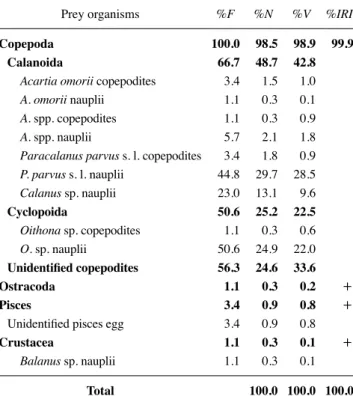
총 208개체의 까나리 자어 중 공복인 개체는 121개체로 공복률은 58.2%로 나타났다. 공복인 개체를 제외한 87개체 의 까나리 자어의 소화관 내용물을 분석한 결과(Table 1), 요
Fig. 1. Monthly and total size frequency of Ammodytes japonicus collected in the Gujora and Mangchi coastal waters of Geoje from January to February, 2019.
각류(Copepoda)가 100.0%의 출현빈도, 98.5%의 개체수비, 98.9%의 부피비를 차지하여 99.9%의 상대중요도지수비를 나 타내어 가장 우점한 먹이생물이었다. 요각류 중 긴노요각목 (Calanoida) 요각류가 66.7%의 출현빈도, 48.7%의 개체수비, 42.8%의 부피비를 차지해 가장 중요한 먹이생물이었다. 그 다
음으로 검물벼룩목(Cyclopoida) 요각류가 50.6%의 출현빈도, 25.2%의 개체수비, 22.5%의 부피비를 차지하여 자어의 두 번 째로 중요한 먹이생물이었다. 이 외에도 어류 난(Unidentified pisces egg), 패충류(Ostracoda), 갑각류(Crustacea)도 섭식하였 으나 출현량은 많지 않았다.
3. 크기군별 먹이생물 조성의 변화
까나리 자어의 크기군별 먹이생물 조성의 변화를 분석하기 위해 3개의 크기군으로(Small: ≤2mm; Medium: 3~4mm;
Large: ≥5mm) 나누어 분석하였다(Fig. 2A). Small 크기군 은 54개체, Medium 크기군은 29개체, Large 크기군은 4개체 로 구분되었다. 모든 크기군에서 요각류가 가장 우점하였으며, Small 크기군과 Medium 크기군에서는 어류 난과 갑각류도 섭 식하였으나 0.1% 미만으로 나타났다.
까나리 자어의 주먹이생물인 요각류만을 대상으로 크기군별 먹이생물 변화양상을 분석하였다(Fig. 2B). Small 크기군에서 긴노요각목 요각류가 72.9%의 상대중요도지수비를 차지하였고, 검물벼룩목 요각류는 27.1%를 차지하였다. Medium 크기군에서 는 긴노요각목 요각류가 77.1%의 상대중요도지수비를 차지하여 증가하였고, 검물벼룩목 요각류는 22.9%로 감소하였다. Large 크기군에서는 긴노요각목 요각류만 섭식하여 100%의 상대중요 도지수비를 차지하였다. 따라서 까나리 자어는 성장함에 따라 긴 노요각목 요각류의 섭식 비율은 증가하고, 검물벼룩목 요각류의 섭식 비율은 감소하는 양상이 나타났다.
크기군별 개체당 평균 먹이생물의 개체수와 부피 변화를 분 석한 결과(Fig. 3), 크기가 증가함에 따라 개체당 평균 먹이생 물 개체수는 증가하였으며(ANOVA, P>0.05), 평균 먹이생물 부피 또한 증가하는 경향이 나타났다(ANOVA, P<0.05).
Table 1. Composition of the gut contents of Ammodytes japonicus by frequency of occurrence(%F), number(%N), volume(%V) and index of relative importance(%IRI)
Prey organisms %F %N %V %IRI
Copepoda 100.0 98.5 98.9 99.9
Calanoida 66.7 48.7 42.8
Acartia omorii copepodites 3.4 1.5 1.0
A. omorii nauplii 1.1 0.3 0.1
A. spp. copepodites 1.1 0.3 0.9
A. spp. nauplii 5.7 2.1 1.8
Paracalanus parvus s. l. copepodites 3.4 1.8 0.9 P. parvus s. l. nauplii 44.8 29.7 28.5
Calanus sp. nauplii 23.0 13.1 9.6
Cyclopoida 50.6 25.2 22.5
Oithona sp. copepodites 1.1 0.3 0.6
O. sp. nauplii 50.6 24.9 22.0
Unidentified copepodites 56.3 24.6 33.6
Ostracoda 1.1 0.3 0.2 +
Pisces 3.4 0.9 0.8 +
Unidentified pisces egg 3.4 0.9 0.8
Crustacea 1.1 0.3 0.1 +
Balanus sp. nauplii 1.1 0.3 0.1
Total 100.0 100.0 100.0
+: less than 0.1
Fig. 2. Ontogenetic changes in composition of total gut contents(A) and focusing on Copepods(B) by index of relative importance(%IRI) of Ammodytes japonicus among size classes(Small: ≤2mm; Medium: 3~4mm; Large: ≥5mm). NL, Notochord length.
(A) (B)
고 찰
거제시 구조라 및 망치 연안에 우점하여 출현한 까나리 자 어의 식성을 분석한 결과, 요각류가 가장 우점한 먹이생물이 었으며, 주로 요각류 유생을 섭식하는 것으로 나타났다. 대부 분의 해산 자치어는 유영능력이 떨어지기 때문에, 난황 흡수 직후 식물플랑크톤과 요각류 난을 섭식하다 성장하면서 요각 류 유생 및 성체로 먹이전환 하는 것으로 알려져 있다(Hunter, 1981; Nakano et al., 2001). 이는 요각류의 크기가 자치어가 섭 식하기에 용이하고, 최소한의 노력으로 쉽게 섭식할 수 있기 때문이다(Huh and Kwak, 1997). 따라서 이번 연구에서 분석 된 까나리 자어는 척색장이 모두 10.00mm 미만인 개체로 유 영능력이 떨어지기 때문에, 요각류 성체보다 상대적으로 이동 성이 적은 요각류 유생을 섭식한 것으로 판단된다. 까나리 자 어는 요각류 중에서도 긴노요각목(Calanoida) 요각류에 속하 는 Paracalanus sp.와 검물벼룩목(Cyclopoida) 요각류에 속 하는 Oithona sp.의 섭식 비율이 높게 나타났다. Paracalanus sp.는 남해 연안해역의 우점하는 대표적인 연안종으로 우리 나라에 연중 분포하며, 비교적 넓은 수온범위에 걸쳐 분포한 다(Park et al., 1998; Jang et al., 2012). Oithona sp.는 우리나 라 남해와 동해, 제주해역에서 우점하여 출현하며, 긴노요각목 요각류에 비해 상대적으로 크기가 작은 것으로 알려져 있다 (Marlowe and Miler, 1975; Wang et al., 2017). 또한, Kim et al.
(2015)과 Seo et al.(2013)의 선행연구에 의하면 이번 연구 해 역의 인근 해역에서 Paracalanus sp.와 Oithona sp.가 우점하 여 출현한다고 보고하였다. 따라서 까나리 자어는 이처럼 서 식지에 풍부하게 출현하는 Paracalanus sp.와 Oithona sp.를 먹이생물로 섭식한 것으로 판단된다.
까나리 자어의 크기군별 먹이생물 변화를 분석한 결과, 모 든 크기군에서 주로 요각류를 섭식하는 것으로 나타났다. 모
든 크기군에서 가장 중요한 먹이생물인 요각류만을 대상으로 다시 크기군별 먹이생물의 변화를 분석해 본 결과, 까나리 자 어의 성장에 따라 검물벼룩목 요각류의 섭식비율은 감소하 고, 긴노요각목 요각류의 섭식비율은 증가하는 먹이전환이 나 타났다. 일반적으로 자치어의 섭식활동은 유영능력, 소화능 력, 입 크기 등의 발달과 관련이 있다고 알려져 있다(Shirota, 1970; Hunter, 1981; Young and Davis, 1990; Kim et al., 2017).
특히 까나리 자어는 척색장의 길이 5mm 이상부터 일주야수 직이동이 가능해질 만큼 유영능력이 증가하는 것으로 알려져 있다(Yamashi et al., 1985). 따라서 이번 연구에서 먹이를 섭 식한 까나리 자어는 모두 난황 흡수가 끝난 직후의 까나리 후 기 자어로, 작은 크기군에서는 유영능력이 미약하고 입 크기 가 작으며 소화기능이 떨어지기 때문에 상대적으로 크기가 작 은 검물벼룩목 요각류를 섭식하다 성장함에 따라 유영능력이 발달하고 입 크기가 커져 비교적 크기가 큰 긴노요각목 요각 류를 섭식한 것으로 판단된다.
까나리 자어의 크기군별 먹이생물의 평균 개체수와 부피 변 화를 분석한 결과, 크기가 증가함에 따라 먹이생물 평균 개 체수와 부피 모두 증가하는 경향이 나타났다. 일본 연안해역 에서 이루어진 까나리 자치어 식성 선행연구 결과에서도 주 로 요각류 전기 유생(nauplius)을 섭식하다 성장함에 따라 요 각류 후기 유생(copepodites)을 섭식하여 먹이생물의 크기가 증가하였다(Nagano et al., 2001). 어류의 성장에 따른 먹이생 물의 평균 개체수와 부피 변화 양상은 일반적으로 크게 3가 지 경향으로 나타나는데, 평균 개체수와 부피가 모두 증가하 는 경향, 평균 먹이생물 개체수는 증가하지만 부피는 감소하 는 경향, 평균 먹이생물의 개체수는 감소하고, 부피는 증가하 는 경향으로 나뉜다(Kim et al., 2017). 이는 영양학적 효율성 을 높이기 위한 섭식전략의 한 양상으로, 까나리 자어는 성장 함에 따라 먹이생물의 개체수와 부피 모두 증가시켜 먹이생물 의 효율을 높이는 것으로 판단된다.
요 약
거제시 구조라 및 망치 연안에서 우점하여 출현한 까나리 (Ammodytes japonicus) 자어는 조사기간인 2019년 1월과 2월 동안 총 208개체가 채집되었고 척생장의 범위는 1.46~8.00 mm였다. 까나리 자어의 주먹이생물은 요각류가 가장 우점하 였고, 그 중 긴노요각목 요각류를 가장 많이 섭식하였으며, 검 물벼룩목 요각류를 그 다음으로 많이 섭식하였다. 요각류 외 에도 어류 난, 패충류, 갑각류 유생도 섭식하였으나 그 양은 많지 않았다. 까나리 자어의 성장에 따른 먹이생물 변화양상 을 알아보기 위해 3개의 크기군으로 나누어 분석한 결과(≤2 mm, 3~4mm, ≥5mm, Notochord length), 성장함에 따라 긴 Fig. 3. Variation of mean number of preys per gut(mN/Gut, individu-
als/gut) and mean volume of prey per gut(mV/Gut, mm3/gut) of Am- modytes japonicus among size classes(Small: ≤2mm; Medium: 3~4 mm; Large: ≥5mm). NL, Notochord length.
mN/Gut(inds.) mV/Gut(mm3)
노요각목 요각류의 섭식비율은 점차 증가하고 검물벼룩목 요 각류는 감소하였으며, 평균 먹이생물의 개체수와 부피 모두 증가하는 경향이 나타났다.
REFERENCES
Ahlstrom, E.H. 1954. Distribution and abundance of egg and larval populations of the Pacific sardine. Fish. Ball., 56: 83-140.
Cha, S.S. 2002. Review on the Studies of Ecology of Fish in their Early Life Stages off Korea. Korean J. Ichthyol., 14: 76-82.
Chun, C.I. 1974. Biological studies on the sand-eel, Ammodytes per- sonatus GIRARD. Bull. Korean Fish. Soc., 7: 215-220.
Chun, C.I. 1977. Biological Studies on the Sand-eel, Ammodytes per- sonatus GIRARD. Bull. Kor. Fish. Tech. Soc., 13: 5-7.
Chun, C. I. 1979. Variation in the Vertebral Number of Sand-eel, Am- modytes personatus GIRARD. Bull. Kor. Soc. Fish. Tech., 15: 1-3.
Hamada, T. 1985. Fishery biology of the sand-lance(Ammodytes personatus GIRARD) in Japan. Japan Fisheries Resource Conservation Association, Tokyo, Japan, 1-85.
Han, K.H., B.K. Kim, S.H. Choi, K.Y. Kim, Y.U. Kim and J.K. Cho.
1999. Distribution of Larva and Juvenile of Sand Eel, Am- modytes personatus in Kangwon-do Coast, Korea. Korean J.
Ichthyol., 11: 155-162.
Heath, M.R. 1992. Field investigations of the early life stages of ma- rine fish. Adv. Mar. Biol., 28: 1-174. https://doi.org/10.1016/
s0065-2881(08)60039-5.
Hjort, J. 1926. Fluctuations in the year classes of important food fishes. J. du. Conseil., 1: 5-38. https://doi.org/10.1093/ices- jms/1.1.5.
Huh, S.H. and G.W. Baeck. 2003. Feeding habits of Repomucenus valenciennei collected in the coastal waters of Gadeok-do, Korea. Korean J. Ichthyol., 15: 289-294.
Huh, S.H. and S.N. Kwak. 1997. Feeding habits of Pholis nebulosa.
Korean J. Ichthyol., 9: 22-29.
Hunter, J.R. 1981. Feeding ecology and predation of marine fish lar- vae. In: Marine fish larvae: morphological, ecology, and rela- tion to fisheries. In: Lasker, R.(ed.), Marine fish larvae mor- phology, ecology and relation to fisheries. Washington Sea Grant, U.S.A., pp. 343-355. https://doi.org/10.1016/0044- 8486(83)90215-6.
Jang, M.C., S.H. Baek, P.G. Jang, W.J. Lee and K.S. Shin. 2012. Pat- terns of Zooplankton Distribution as Related to Water Masses in the Korea Strait during Winter and Summer. Ocean Polar Res., 34: 37-51. https://doi.org/10.4217/opr.2012.34.1.037.
Jeong, D.S, K.H. Choi, C.S. Park and J.H. Park. 1997. Age growth and maturity of the sand eel, Ammodytes personatus in the East Sea, Korea. Bull. Nat’l. Fish. Res. Dev. Inst., 53: 37-42.
Kim, H.J. 2016. Characteristics of the distribution and dominant spe- cies of feeding habits with larval fishes in the eastern Jinhae Bay, Korea. Ph. D. dissertation, Gyeongsang National Uni-
versity, Tongyoung, Korea, 21pp.
Kim, H.Y., B.K. Kim, E.K. Kim, C.D. Kim, J.B. Jeong and C.R. Lee.
2015. Spatial and Temporal distribution of Mesozooplankton Communities in Hallyeohaesang National Park and South Eastern Sea of Korea in 2014. J. Nat. Park Res., 6: 91-102.
Kim, J.K., S.E. Bae, S.J. Lee and M.G. Yoon. 2017. New insight into hybridization and unidirectional introgression between Ammodytes japonicus and Ammodytes heian(Trachiniformes Ammodytidae). PLoS ONE, 12: e0178001. https://doi.
org/10.1371/journal.pone.0178001.
Kim, J.K., S.J. Lee, W.C. Lee, J.B. Kim and H.C. Kim. 2015. Re- stricted separation of the spawning areas of the two lineages of sand lance, Ammodytes personatus, in the Yellow and East Seas and taxonomic implications. Biochem. Syst. Ecol., 61:
319-328. https://doi.org/10.1016/j.bse.2015.06.038.
Kim, Y.H., Y.J. Kang and D.K. Ryu. 1999. Growth of Ammodytes personatus in Korean waters, Daily Growth Increment, Early Growth and Spawning Time in Juvenile Stage. J. Korean Fish. Soc., 32: 550-555.
Kim, Y.H., Y.J. Kang and D.K. Ryu. 2000. Growth of Ammodytes personatus in the South Sea, Korea. Korean J. Ichthyol., 12:
166-172.
Lasker, R., H. Feder, G. Theilacker and R. May. 1970. Feeding, Growth, and survival of Engraulis mordax larvae reared in the laboratory. Mar. Biol., 5: 345-353.
Marlowe, C.J. and C.B. Miller. 1975. Patterns of vertical distribu- tion and migration of zooplankton at Ocean Station “P”.
Limnol. Oceanogr., 20: 824-844. https://doi.org/10.4319/
lo.1975.20.5.0824.
May, R.C. 1974. Larval mortality in marine fishes and the critical pe- riod concept. In: Blaxter, J.H.S.(ed.), The early life history of fish. Springer-Verlag Berlin, Heidelberg, New York, U.S.A., pp. 3-20. https://doi.org/10.1007/978-3-642-65852-5_1.
Nakano, N., Y. Iwatsuki, Y. Okazaki and H. Nakata. 2001. Feeding strategy of Japanese sand lance larvae in relation to ciliated protozoa in the vicinity of a thermohaline front. J. Oceanogr., 57: 155-163.
Park, C., C.R. Lee and J.C. Kim. 1998. Zooplankton Community in the Front Zone of the East Sea(the Sea of Japan), Korea: 2.
Relationship between Abundance Distribution and Seawater Temperature. J. Korean Fish. Soc., 31: 749-759.
Pinkas, L., M.S. Oliphant and I.L.K. Iverson. 1971. Food habits of albacore, bluefin tuna and bonito in California waters. Fish.
Bull., 152: 1-105.
Sassa, C., Y. Tsukamoto and Y. Konishi. 2008. Diet composition and feeding habits of Trachurus japonicus and Scomber spp.
larvae in the shelf break region of the East China Sea. Bull.
Mar. Sci., 82: 137-153.
Seo, M.H., K.S. Shin, M.C. Jang and H.Y. Soh. 2013. Occurrence Patterns of Zooplankton Present in Ports of Korea during Summer. Korean J. Environ. Biol., 31: 448-457. https://doi.
org/10.11626/kjeb.2013.31.4.448.
Soh, H.Y. and S.Y. Moon. 2010. Invertebrate fauna of Korea-Marine
Planktonic Copepods. National Institute of Biological Re- sources, Incheon, Korea, 21: 1-199.
Takatsu, T., Y. Suzuki, A. Shimizu, K. Imura, Y. Hiraoka and N. Shi- ga. 2007. Feeding habits of stone flounder Platichthys bicol- oratus larvae in Mutsu Bay, Japan. Fish. Sci., 73: 142-155.
https://doi.org/10.1111/j.1444-2906.2007.01312.x.
Wang, L., F. Du, Z. Wang, Y. Li and J. Ning. 2017. Distribution and role of the genus Oithona(Copepoda: Cyclopoida) in the South China Sea. Oceanologia., 107: 1-11. https://doi.
org/10.1016/j.oceano.2017.03.009.
Yamaji, I. 1984. Illustration of the Marine Plankton of Japan. Hoiku- sha Publishing Co. Ltd., Osaka, Japan, 470pp.
Yamashita, Y, D. Kitagawa and T. Aoyam. 1985. Diel vertical migra- tion and feeding rhythm of the larvae of the Japanese sand- eel Ammodytes personatus. Bull. Jap. Soc. Sci. Fish., 51: 1-5.
https://doi.org/10.2331/suisan.51.1.
Yoo, C.W. 2011. Sand mining and marine benthic environment. In:
Yoon, Y. H., H.Y. Soh, H.S. Yang and S.J. Oh(eds.), Chon- nam National University, Yeosu, Korea, 252pp.
Young, J.W. and T.L.O. Davis. 1990. Feeding ecology of larvae of southern bluefin, albacore and skipjack tunas(Pisces: Scomb- ridae) in the Eastern Indian. Mar. Ecol. Prog. Ser., 6: 17-29.
https://doi.org/10.3354/meps061017.