Received October 16, 2014, Revised July 29, 2015, Accepted for publication July 29, 2015
Corresponding author: Sang Hyun Cho, Department of Dermatology, The Catholic University of Korea, Incheon St. Mary’s Hospital, 56 Dongsu-ro, Bupyeong-gu, Incheon 21431, Korea. Tel: 82-32-510-5528, Fax: 82-32- 506-9514, E-mail: [email protected]
Jong Tae Kim, Department of Neurosurgery, The Catholic University of Korea, Incheon St. Mary’s Hospital, 56 Dongsu-ro, Bupyeong-gu, Incheon 21431, Korea. Tel: 82-32-280-5973, Fax: 82-32-280-5991, E-mail: kjtns@
olmh.cuk.ac.kr
This is an Open Access article distributed under the terms of the Creative Commons Attribution Non-Commercial License (http://creativecommons.
org/licenses/by-nc/4.0) which permits unrestricted non-commercial use, distribution, and reproduction in any medium, provided the original work is properly cited.
Copyright © The Korean Dermatological Association and The Korean Society for Investigative Dermatology
Ann Dermatol Vol. 28, No. 3, 2016 http://dx.doi.org/10.5021/ad.2016.28.3.314
ORIGINAL ARTICLE
Analysis of Dermatologic Diseases in Neurosurgical In-Patients: A Retrospective Study of 463 Cases
Kyung Min Kim, Hei Sung Kim, Jeesuk Yu1, Jong Tae Kim2, Sang Hyun Cho
Department of Dermatology, College of Medicine, The Catholic University of Korea, Seoul, 1Department of Pediatrics, Dankook University Medical College, Cheonan, 2Department of Neurosurgery, College of Medicine, The Catholic University of Korea, Seoul, Korea
Background: Both the skin and the neurologic system are de- rived from the ectoderm during embryogenesis, and thus pa- tients with neurologic disorders may have accompanying dermatologic diseases. For example, seborrheic dermatitis is more frequently observed in patients with Parkinsonism and other neurologic disorders. To date, however, there has been limited review on dermatologic diseases in neurosurgical in-patients. Objective: The purpose of this study was to char- acterize dermatological problems encountered in a neuro- surgery unit and to compare these data to previous reports of in-patient dermatologic consultations. Methods: A retro- spective review was conducted over all in-patient dermatol- ogy consultations from the neurosurgery unit during a 3-year period. Results: Of 2,770 dermatology consultations, 463 (16.7%) came from the department of neurosurgery. The most frequent age group was the 6th decade of life, and the ratio of men to women was 1.07. Consults were most fre- quently placed from patients with intracranial hemorrhage (23.8%). Eczema/dermatitis (36.5%; n=204) and cutaneous infections (27.0%; n=151) accounted for more than half of
all dermatological consultations, followed by cutaneous ad- verse drug reactions (11.8%; n=66). Additionally, sebor- rheic dermatitis was significantly more frequent (p=0.048, odds ratio=1.96) in patients with intracranial hemorrhage.
Conclusion: This study characterizes the distribution of skin disorders in patients admitted to the neurosurgery service based on the consultations that have been made for dermato- logic evaluation. Collaboration between the neurosurgeons and dermatologists may improve the quality of patient care and help to better predict the occurrence of these conditions.
(Ann Dermatol 28(3) 314∼320, 2016) -Keywords-
Dermatology, Neurosurgery, Referral and consultation
INTRODUCTION
Dermatologic issues may represent primary cutaneous dis- orders or underlying systemic disease. While dermatologic practice occurs primarily in the out-patient setting, derma- tologists also provide essential consultative services for in-patients admitted to other disciplines.
Several studies on the characteristics of dermatologic con- sultations have been reported. Although internal medicine (IM) was found to place the most requests for in-patient dermatologic services1-4, we observed that patients from the neurosurgery (NS) unit also accounted for a significant portion of referrals as reported by Lyu et al.5 The epidemi- ology of in-patient skin diseases and the impact of in-pa- tient consultation has been described in the fields of ob- stetrics and gynecology6, rheumatology7, pediatrics8, hem- atology9, and the intensive care unit10, in order of frequency.
However, data describing dermatology consults for NS in-patients are limited.
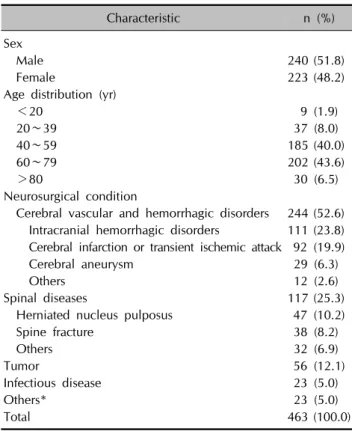
Table 1. Demographic characteristics
Characteristic n (%)
Sex
Male 240 (51.8)
Female 223 (48.2)
Age distribution (yr)
<20 9 (1.9)
20∼39 37 (8.0)
40∼59 185 (40.0)
60∼79 202 (43.6)
>80 30 (6.5)
Neurosurgical condition
Cerebral vascular and hemorrhagic disorders 244 (52.6) Intracranial hemorrhagic disorders 111 (23.8) Cerebral infarction or transient ischemic attack 92 (19.9)
Cerebral aneurysm 29 (6.3)
Others 12 (2.6)
Spinal diseases 117 (25.3)
Herniated nucleus pulposus 47 (10.2)
Spine fracture 38 (8.2)
Others 32 (6.9)
Tumor 56 (12.1)
Infectious disease 23 (5.0)
Others* 23 (5.0)
Total 463 (100.0)
*Seizure, facial palsy, hydrocephalus, Parkinson’s disease, headache, wound dehiscence, back pain, coccyx cyst, peripheral neuropathy.
The epidermal and neuronal tissues are derived from a common neuroectodermal precursor11. It is well known that neurologic and dermatologic abnormalities occur concurrently in hereditary disorders such as tuberous scle- rosis, neurofibromatosis, and xeroderma pigmentosum.
Moreover, much evidence has accumulated supporting an association between acquired neurological disturbances, Parkinsonism, or spinal cord injury and changes on skin such as seborrheic dermatitis (SD) or fungal infections oc- curring below the neurologic level of injury12,13.
The aim of our study was to analyze the care provided by consultant dermatologists to hospitalized NS patients.
MATERIALS AND METHODS
Study subjects and methods
This was a retrospective study conducted at a 764-bed multidisciplinary tertiary hospital (Incheon St. Mary’s Hospital, Korea). All cases were evaluated and reviewed by dermatology trainees and a senior consultant der- matologist. The diagnoses were made according to the International Classification of Disease, 10th Revision.
We reviewed all in-patient referrals for dermatology con- sultations made from the department of NS between July 1, 2010 and June 30, 2013. Data were extracted from electronic medical records and included the clinical re- cord number, age, gender, requesting service, date of ap- plication, reason for admission to the hospital, and the fi- nal dermatological diagnosis. If the patient was not hospi- talized, or had no apparent skin lesion or clinical symp- toms related to the skin at the time of the visit, the case was excluded. Neurosurgical conditions were divided into ten categories, as shown in Table 1. Diagnoses made by the consulting dermatologist were divided into twenty cat- egories (Table 2). In addition to the number of con- sultations, we also determined the relative frequency of consultations made for NS in-patients compared with oth- er specialties.
Statistical analysis and ethics statement
Statistical analyses were performed using PASW Statistics ver. 18.0 (IBM Co., Armonk, NY, USA), and p-values <0.05 were considered to be statistically significant. Comparisons of dermatologic variables between the groups (patients with specific neurosurgical disorders and without those diseases) were performed using chi-squared tests and Fisher’s exact tests, as appropriate. Characteristics of pa- tients with SD were evaluated using univariate analyses, chi-squared tests, or Fischer’s exact tests to compare cate- gorical parameters between groups, and t-tests for compar- isons of continuous variables.
This study was approved by the institutional review board of Incheon St. Mary’s Hospital, The Catholic University of Korea (IRB No. OC14RISI0079).
RESULTS
Characteristics of patients and of the departments requesting consultations
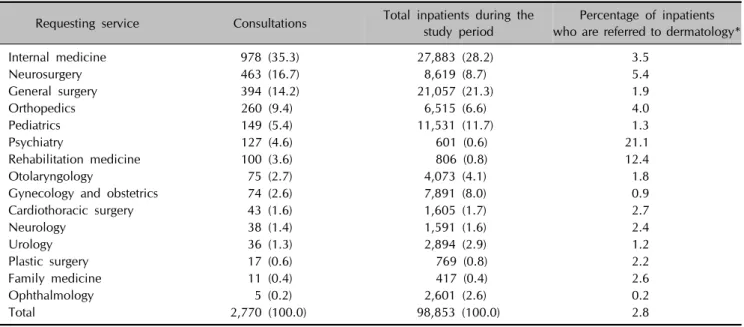
A total of 2,770 in-patient referrals were made to the der- matology department during the study period. Considering the total number of in-patients during this time, a derma- tology consultation was made for 2.8% of patients. The department of IM had the largest number of referrals (n=978, 35.3%), followed by the department of NS (n=463, 16.7%). During the 3-year period, the ratio of consultations to NS in-patients runs from 4.7% to 6.4%.
The mean percentage of NS patients who required a der- matology consult was 5.4%, which is far higher than the ratio of total consultations to total in-patients, 2.8% (Table 3). The mean admission duration of NS patients was 12.7 days, which was the third longest duration. With respect to it, the number of NS patients requiring dermatology consultation ranked seventh.
Table 2. Dermatologic conditions diagnosed in neurosurgery in-patients
Diagnosis n (%) Comments
Dermatitis 204 (36.5)
Eczematous dermatitis (not contact dermatitis or seborrheic dermatitis)
100 (17.9) Includes xerotic eczema (21), lichen simplex chronicus (10), nummular eczema (7), atopic dermatitis (3), hand eczema (15), prurigo simplex (21), and unspecified eczema (23)
Contact dermatitis 63 (11.3)
Seborrheic dermatitis 41 (7.3)
Infectious skin disorders 151 (27.0)
Mycoses 88 (15.8) Included superficial fungal infection (84), yeast infection (4) Viral disease 50 (8.9) Included herpes simplex (22), herpes zoster (21), wart (3), chickenpox
(2), and viral exanthem (2)
Bacterial disease 7 (1.2) Included abscess (2), carbuncle (2) and cellulitis (3) Syphilis and rickettsioses 6 (1.1)
Drug eruption 66 (11.8)
Urticaria 34 (6.1)
Folliculo-sebaceous/eccrine diseases 21 (3.8) Included acne and folliculitis (20), miliaria (1) Cutaneous vascular diseases 19 (3.4)
Papulosquamous diseases 10 (1.8) Included psoriasis (5), pityriasis lichenoides chronica (2), palmoplantar pustulosis (3)
Nevus and neoplasm 10 (1.8)
Hair disorders 5 (0.9) Included telogen effluvium (1), alopecia areata (4) Connective tissue diseases 2 (0.4) Scleroderma
Subcutaneous fat diseases 1 (0.2) Erythema nodosum
Pigment anomalies 1 (0.2) Vitiligo
Vesicullocullous disease 1 (0.2) Pemphigus vulgaris
Nail disorders 0 (0)
Mucous disorders 0 (0)
Miscellaneous* 33 (5.9)
Total 558 (100.0)
*Abrasion, friction blister, corn and callus, pediculosis, insect bite, chronic ulcer, petechiae.
Table 3. In-patient services consulting dermatology
Requesting service Consultations Total inpatients during the study period
Percentage of inpatients who are referred to dermatology*
Internal medicine 978 (35.3) 27,883 (28.2) 3.5
Neurosurgery 463 (16.7) 8,619 (8.7) 5.4
General surgery 394 (14.2) 21,057 (21.3) 1.9
Orthopedics 260 (9.4) 6,515 (6.6) 4.0
Pediatrics 149 (5.4) 11,531 (11.7) 1.3
Psychiatry 127 (4.6) 601 (0.6) 21.1
Rehabilitation medicine 100 (3.6) 806 (0.8) 12.4
Otolaryngology 75 (2.7) 4,073 (4.1) 1.8
Gynecology and obstetrics 74 (2.6) 7,891 (8.0) 0.9
Cardiothoracic surgery 43 (1.6) 1,605 (1.7) 2.7
Neurology 38 (1.4) 1,591 (1.6) 2.4
Urology 36 (1.3) 2,894 (2.9) 1.2
Plastic surgery 17 (0.6) 769 (0.8) 2.2
Family medicine 11 (0.4) 417 (0.4) 2.6
Ophthalmology 5 (0.2) 2,601 (2.6) 0.2
Total 2,770 (100.0) 98,853 (100.0) 2.8
Values are presented as number (%). *(Total consults/total in-patients)×100.
Table 4. Characteristics of patients with seborrheic dermatitis
Variable Value p-value OR (95% CI)
Sex (n, %) 0.004 2.75 (1.34∼5.64)
Male 30 (73.2)
Female 11 (26.8)
Age (yr) 0.717
Mean±SD 57.8±16.7
Median 61
Range 7∼81
Neurosurgical conditions (n, %)
Intracranial hemorrhage 15 (36.6) 0.048 1.96 (1.00∼3.85)
Cerebral infarction 6 (14.6) 0.379 0.67 (0.27∼1.64)
Other cerebral vascular disorders 4 (9.8) 0.774 1.13 (0.38∼2.96)
Tumor 4 (9.8) 0.804 0.77 (0.26∼2.24)
Spinal fracture 4 (9.8) 0.763 1.23 (0.42∼3.63)
Herniated nucleus pulposus 2 (4.9) 0.412 0.43 (0.10∼1.84)
Other spinal diseases 2 (4.9) 1.000 0.67 (0.15∼2.91)
Infectious disease 3 (7.3) 0.445 1.59 (0.45∼5.53)
Others 1 (2.3) 0.710 0.46 (0.06∼3.46)
Total patients 41 (100.0)
OR: odds ratio, 95% CI: 95% confidence interval, SD: standard deviation.
There were slightly more male (n=240, 51.8%) than fe- male (n=223, 48.2%) patients (Table 1). The patients ranged in age from 6 to 98 years, with an average age of 58.67±15.43 years (median=60). The most frequent pa- tient age group encountered was the 6th decade of life.
For 386 (83.4%) patients, the presenting problem was im- proved after a single encounter, while 1 patient required 5 visits. Although there was no appreciable seasonal trend, the greatest number of consultations was placed during the summer, from June to August (n=125, 27%).
Reason for admission
Our patient population was a heterogeneous group with various underlying neurosurgical disorders (Table 1).
Cerebral vascular and hemorrhagic disorders accounted for over half of the hospital admissions (n=244, 52.6%) followed by spinal disease (n=117, 25.3%). The most common underlying neurologic disease was intracranial hemorrhage (ICH) (n=111, 23.8%).
Dermatologic conditions
A total of 558 dermatologic conditions were diagnosed in 463 patients (Table 2). There were cases with multiple dermatologic conditions, with 77 (16.6%) patients having two dermatologic diseases and 8 (1.9%) patients having three diseases. The most common diagnosis type was der- matitis (n=204, 36.5%), followed by skin infection (n=151, 27.0%), and drug eruption (DE) (n=66, 11.8%).
Among the eczema types, contact dermatitis (CD) was the
most common (n=63, 11.3%). This was followed by SD (n=41, 7.3%). Dermatomycosis was the most common in- fection of the skin in our study (n=88, 15.8%). The ma- jority of referrals identified as viral infections (n=50, 8.9%) were herpes simplex (22 patients) and herpes zoster (21 patients).
Characteristics of patients with seborrheic dermatitis Thirty (73.2%) of the 41 patients diagnosed with SD were male, and 11 (26.8%) were female (p=0.004). The most common underlying neurologic condition within this cat- egory was ICH (n=15, 36.6%). Overall, SD was diag- nosed in 13.5% of ICH patients, as compared with 7.4%
of patients without ICH (p=0.048, odds ratio [OR]=1.96) (Table 4).
In the group of ICH patients diagnosed with SD, there were also more male (n=10, 66.7%) than female (n=5, 33.3%) patients, 7 (46.7%) of whom had hypertension.
Eight (53.3%) patients were referred in winter or early spring, from November to March.
Characteristics of patients with dermatomycosis
Superficial fungal infections with a dermatophyte ac- counted for 95.5% of cases in mycoses category (n=84).
Tinea pedis was the most frequently diagnosed skin in- fection, accounting for the third largest proportion of spe- cific dermatologic diagnoses (n=44, 9.5%). None of the associations between this and spinal diseases (p=0.116) including subcategories, herniated nucleus pulposus
(p=0.110), spinal fracture (p=0.344), and other neuro- logic conditions related to spinal problems (p=0.067) were found to be statistically significant. Yeast infection, Candidiasis, pityriasis versicolor, and Malassezia folli- culitis, were diagnosed in 4 cases. No deep fungal skin in- fections were diagnosed during the study period.
Characteristics of patients with drug eruptions
Ten cases (15.2%) of the 66 consultations for DE were due to contrast media-related reactions. The prevalence of DE was not significantly higher in patients with aneurysms (p=0.050). DE was significantly associated with neuro- logic infectious disease (p=0.009, OR=3.51). The most common form was morbilliform DE (n=36, 54.5%).
DISCUSSION
In recent years, the field of dermatology has evolved into a predominantly out-patient practice, with increasing em- phasis on cosmetics and surgical procedures14. While the number of patients admitted to dermatology services is de- creasing, the need for dermatologists as consultants in the hospital setting is increasing15.
Although the type and number of referrals from other serv- ices varies according to factors such as the healthcare sys- tem and the proportion of beds allocated to each depart- ment, previous studies have reported a lower proportion of referrals from the department of NS compared with our study results, accounting for 1.9%14, 3.0%4 and 11.9%2 of all referrals. Interestingly, one study found that NS patients were the most frequently referred5. Several other reports have shown that neurology patients also require frequent dermatology consults4,16. This high number of con- sultations from NS and/or neurology patients likely reflects the fact that these patients are often bed-ridden4 and thus have a greater need for dermatologic care3.
Eczema and cutaneous infections were the two most com- mon dermatologic disorders referred for management, ac- counting for over half of all consultations. This is con- sistent with previous findings5,8-10,14.
The two most common individual ‘dermatitis’ diagnoses encountered in this study were CD and SD. A previous re- port suggested that sweating caused by inappropriate hos- pital room temperature, detergents used to clean bed clothes, and soaps are factors that can cause CD4. In addi- tion, antiseptics in general, and specifically those used in surgical washing preparations, occlusive dressings for sur- gical wounds, confinement to the hospital bed for patients with delirium, athetotic movements or seizures, and use of catheters tend to contribute to dermatologic issues, partic- ularly among NS in-patients.
In our study, SD had various underlying neurosurgical dis- eases, from cerebral vascular disorders, tumors, to spinal disease. Although the pathogenesis of SD remains un- known, the frequent presentation of SD with Parkinsonism and other neurologic disorders such as epilepsy, cere- brovascular infarcts, quadriplegia, and other facial nerve palsies has attracted considerable attention with respect to neurologic theory of the etiopathogenesis of SD17.
Reed et al.18 previously reported a high incidence of SD after spinal cord injury due to altered sebaceous secretion, dermatophytosis, and changes in sweat secretion. Similarly, Wilson and Walshe19 identified SD in 65% of recently in- jured quadriplegic patients. The accumulation of sebum and scales on inadequately scrubbed skin resulting from a prolonged period of immobilization were suggested as the possible cause of SD. In addition, the histopathologic find- ings of less differentiated sebaceous glands and thickened germinated layers in affected area of ipsilateral SD oc- curred after syringomyelia also suggest that a neuro- cutaneous mechanism may involve the sebaceous and im- mune pathways20.
But, among the neurosurgical disorders, ICH only has been significantly associated with SD (p=0.048). Proceeding from these findings and quadriplegic state seen in ICH pa- tients, it seems reasonable to assume that SD is linked to abnormal neurologic condition of ICH, just in overall perspective. However, there are no studies to date which directly address the specific relationship between ICH and SD.
Additional factors including seasonal fluctuations, age, sex, facial trauma, and drugs, can affect statistical sig- nificance of association between ICH and SD as potential confounders17. Actually, our study showed that there were more referrals in SD patients with ICH during winter and early spring compared with SD patients with other neuro- surgical conditions (ICH patients: 53.3%, cerebral in- farction patients: 33.3%, the remainder: 0%). This point may explain the discrepancy of relation between indi- vidual neurosurgical conditions and SD, and incon- sistency in previous finding. One of the remarkable fea- tures is that patients with ICH and SD had a high preva- lence of hypertension (46.7%). Aside from its association with ICH21,22, this feature was consistent with the previous study showing a positive association between SD and hy- pertension23. So, a clear understanding of the association between ICH and SD requires further researches assessing the possible interplay of these confounders.
Infectious skin disorders were one of the 3 most common dermatologic diagnoses encountered in this study. Con- tributing factors for skin infection in neurosurgical in-pa- tients are an altered skin barrier due to decreased sweat
production24, increased sebum excretion25, and immuno- logic changes including a decrease in immune function via alterations in natural-killer cells, T-cells, and inter- leukin receptor levels26-28. In contrast to a previous report that suggested an increased rate of fungal infections below the level of spinal cord injury12, we did not identify a sig- nificant correlation between spinal disease and fungal skin infections. This discrepancy is possibly due to transfer of these patients to the rehabilitation medicine unit.
DE was the third most frequent reason for consultation, which is consistent with that reported in previous stud- ies1,2,4,9,10. Notably, 10 patients (15.2%) developed DE af- ter exposure to contrast media, of which the most com- mon adverse reaction was skin eruption29, for compu- terized tomography or angiography. However, none of the individual neurosurgical conditions were significantly as- sociated with DE except for cerebral aneurysm (p=0.05).
There was a greater likelihood of an infectious neuro- surgical condition (p=0.009) in patients diagnosed with DE. The findings are natural as the major putative drugs implicated in cases of DE among dermatology referrals were antibiotics (50%) and antiepileptics (13%)14.
The wide spectrum of dermatologic conditions seen in in-patient multidisciplinary hospitals can pose diagnostic and therapeutic challenges to non-dermatologists in pa- tient care. Falanga et al.30 reported a mean diagnostic ac- curacy for dermatologic diagnoses made by non-dermatol- ogists to be 48%. In our study, 86.4% of referred in-pa- tients were managed with a single consultation, and this result is in agreement with previously reported data rang- ing from 71.8%4 to 85.7%16. This suggests that clinical di- agnosis with appropriate treatment by a dermatologist is a crucial step in resolving the dermatologic problem.
Our results enhance understanding of in-patient neuro- surgical dermatology consultations and may be helpful in developing educational materials and management guide- lines. But this study has some potential limitations. Limita- tion of the study is its retrospective design, with all the at- tendant limitations of a retrospective study. And we re- viewed the electronic medical records only, so its reliance also is potential limitations. The paucity of histological in- formation also limited the interpretation of our data which was not adequately recorded and incomplete. When eval- uating the statistical result of this study, we also should bear in mind a point. It is the vagueness of a control group because this study was conducted in in-patients only.
Comparing the dermatological findings in our NS patients and the general population may make up for this weak point in case of need. And larger prospective studies may help to shed light on useful clinical features that may de- termine the relationship between underlying NS disorders
and dermatologic conditions such as ICH and SD.
REFERENCES
1. Choi MR, Park HS, Byun HJ, Cho KH. Clinical evaluation of dermatology consultation in inpatients. Korean J Dermatol 2010;48:163-170.
2. Kim MJ, Cho SY, Whang KK, Hahm JH. A statistical analysis of dermatologic consultation in nondermatologic inpatients.
Korean J Dermatol 2000;38:1007-1015.
3. Marcus EL, Fischer M. Analysis of dermatologic consul- tations in a general hospital. J Dtsch Dermatol Ges 2013;
11:181-184.
4. Peñate Y, Guillermo N, Melwani P, Martel R, Borrego L.
Dermatologists in hospital wards: an 8-year study of der- matology consultations. Dermatology 2009;219:225-231.
5. Lyu SM, Byun JY, Choi YW, Choi HY. Clinical features of dermatology-consulted inpatients: focus on the differences between individual departments. Korean J Dermatol 2014;52:215-221.
6. Noh TK, Haw S, Won CH, Chang SE, Lee MW, Choi JH, et al. A statistical analysis and clinical evaluation of der- matologic consultations in obstetrics and gynecologic inpatients. Korean J Dermatol 2012;50:951-958.
7. Won JH, Park JS, Chung H, Jang HC. Analysis of der- matologic consultations in rheumatologic inpatients. Korean J Dermatol 2009;47:891-895.
8. McMahon P, Goddard D, Frieden IJ. Pediatric dermatology inpatient consultations: a retrospective study of 427 cases. J Am Acad Dermatol 2013;68:926-931.
9. Koh H. A retrospective analysis of dermatological problems in a hematology ward. Clin Cosmet Investig Dermatol 2013;6:145-149.
10. Lee HS, Yoo DJ, Park HW, Yang DH, Myung SJ, Yang SK, et al. Is a stricter colonoscopy screening protocol necessary in liver transplant recipients? Comparison with an average-risk population. Dis Colon Rectum 2014;57:976-982.
11. Aberdam D, Gambaro K, Medawar A, Aberdam E, Rostagno P, de la Forest Divonne S, et al. Embryonic stem cells as a cellular model for neuroectodermal commitment and skin formation. C R Biol 2007;330:479-484.
12. Rubin-Asher D, Zeilig G, Klieger M, Adunsky A, Wein- garden H. Dermatological findings following acute trau- matic spinal cord injury. Spinal Cord 2005;43:175-178.
13. Mastrolonardo M, Diaferio A, Logroscino G. Seborrheic dermatitis, increased sebum excretion, and Parkinson's disease: a survey of (im)possible links. Med Hypotheses 2003;60:907-911.
14. Tay LK, Lee HY, Thirumoorthy T, Pang SM. Dermatology referrals in an East Asian tertiary hospital: a need for inpatient medical dermatology. Clin Exp Dermatol 2011;
36:129-134.
15. Chren MM. Dermatologic consultations--how can we know if we are effective? Initial methodologic considerations for the critical assessment of medical interventions performed by physicians. Arch Dermatol 1994;130:1052-1054.
16. Fischer M, Bergert H, Marsch WC. The dermatologic
consultation. Hautarzt 2004;55:543-548.
17. Collins CD, Hivnor CM. Seborrheic dermatitis. In: Gold- smith LA, Katz SI, Gilchrest BA, Paller AS, Leffell DJ, Wolff K, editors. Fitzpatrick's dermatology in general medicine.
8th ed. New York: McGraw-Hill, 2012:259.
18. Reed WB, Pidgeon J, Becker SW. Patients with spinal cord injury. Clinical cutaneous studies. Arch Dermatol 1961;
83:379-385.
19. Wilson CL, Walshe M. Incidence of seborrhoeic dermatitis in spinal injury patients. Br J Dermatol 1988;119:48.
20. Chen TM, Fitzpatrick JE. Unilateral seborrheic dermatitis after decompression of Chiari I malformation and syrin- gomyelia. J Am Acad Dermatol 2006;55:356-357.
21. van Asch CJ, Luitse MJ, Rinkel GJ, van der Tweel I, Algra A, Klijn CJ. Incidence, case fatality, and functional outcome of intracerebral haemorrhage over time, according to age, sex, and ethnic origin: a systematic review and meta-analysis.
Lancet Neurol 2010;9:167-176.
22. Lovelock CE, Molyneux AJ, Rothwell PM; Oxford Vascular Study. Change in incidence and aetiology of intracerebral haemorrhage in Oxfordshire, UK, between 1981 and 2006:
a population-based study. Lancet Neurol 2007;6:487-493.
23. Linder D, Dreiher J, Zampetti A, Sampogna F, Cohen AD.
Seborrheic dermatitis and hypertension in adults: a
cross-sectional study. J Eur Acad Dermatol Venereol 2014;
28:1450-1455.
24. Yaggie JA, Niemi TJ, Buono MJ. Adaptive sweat gland response after spinal cord injury. Arch Phys Med Rehabil 2002;83:802-805.
25. Thomas SE, Conway J, Ebling FJ, Harrington CI. Mea- surement of sebum excretion rate and skin temperature above and below the neurological lesion in paraplegic patients. Br J Dermatol 1985;112:569-573.
26. Nash MS. Known and plausible modulators of depressed immune functions following spinal cord injuries. J Spinal Cord Med 2000;23:111-120.
27. Cruse JM, Lewis RE, Roe DL, Dilioglou S, Blaine MC, Wallace WF, et al. Facilitation of immune function, healing of pressure ulcers, and nutritional status in spinal cord injury patients. Exp Mol Pathol 2000;68:38-54.
28. Dahl MV. Dermatophytosis and the immune response. J Am Acad Dermatol 1994;31:S34-S41.
29. Jung KE, Chung J, Park BC, Jee KN, Jee YK, Kim MH. A clinical study of cutaneous adverse reactions to nonionic contrast media in Korea. Ann Dermatol 2012;24:22-25.
30. Falanga V, Schachner LA, Rae V, Ceballos PI, Gonzalez A, Liang G, et al. Dermatologic consultations in the hospital setting. Arch Dermatol 1994;130:1022-1025.