서 론
잉어목(Cypriniformes)에 속하는 미꾸리과(Cobitidae)는 유 럽과 아시아, 아프리카 북부 담수역에 널리 분포하는 저서성 어류로서 전 세계에 25속 177종이 알려져 있다(Nelson, 2006).
그중 한국의 미꾸리과 어류는 미꾸리속 Misgurnus, 새코미꾸 리속 Koreocobitis, 기름종개속 Cobitis, 참종개속 Iksookimia, 좀수수치속 Kichulchoia 총 5속 16종이 보고되었다(Kim, 2009). 본 연구종인 남방종개 I. hugowolfeldi는 한국고유종으 로 종전에 왕종개 I. longicorpa로 간주되었던 영산강 집단이 신종으로 기재된 것이며(Nalbant, 1993), Kim(1997)은 참종개 속에 속하는 종들이 지리적으로 격리되어 분포하는 것으로 보 고한 바 있다.
우리나라 미꾸리과의 서식지에 관한 연구로는 참종개 I. ko
reensis(Kim, 1978; Ko et al., 2009), 부안종개 I. pumila(Kim and Lee, 1984), 새코미꾸리 K. rotundicaudata(Byeon, 2007), 북방종개 I. pacifica(Choi and Byeon, 2009; Ko, 2015), 왕종개 I. longicorpa(Kim and Ko, 2005; Ko, 2009)와 기름종개 C.
hankugensis(Ko, 2009), 줄종개 C. tetralineata(Kim et al., 2006), 점줄종개 C. lutheri(Ko et al., 2009), 얼룩새코미꾸리 K.
naktongensis(Hong et al., 2011), 미호종개 C. choii(Ko et al., 2012) 등이 보고되었다.
남방종개에 관한 연구로는 난막구조(Park and Kim, 2001), 생식소(Park, 1996), 핵형에 관한 연구(Kim et al., 2003)가 진 행되었으며, Choi(2003)는 영산강과 탐진강에 서식하는 남방 종개 서식처의 특성을 하상 구조, 서식밀도, 동소출현종 등에 대하여 보고한 바 있다.
하천의 서식하는 어류는 물리, 화학 및 생물학적 특성에 따 라 직·간접적으로 영향을 받고(Arthington et al., 2006), 하천 의 수심, 유속, 하상구조 등의 서식처 특성은 어류군집 및 생 활사에 중요한 요인으로 작용한다(Hur et al., 2009). 따라서 본
—35 — http://www.fishkorea.or.kr
* Corresponding author: Jong Young Park Tel: 82632703344, Fax: 82632703362, Email: [email protected]
ISSn: 1225-8598(Print), 2288-3371(online)
accepted: March 25, 2016
거금도와 장흥에 서식하는 한국고유종 남방종개
Iksookimia hugowolfeldi의 미소서식처 특성
박철우·김형수·김재구·윤승운·김현태·박종성·최웅선·조윤정·박종영
*
전북대학교 자연과학대학 생물학과, 전북대학교 생물다양성연구소
Microhabitat Characteristics of the Korean Endemic Cobitid Species Iksookimia hugowolfeldi Inhabited at Geogeum Island and Jangheung-gun in Korea by Cheol Woo Park, Hyeong Su Kim, Jae Goo Kim, Seung Woon Yun, Hyun Tae Kim, Jong Sung Park, Woong Sun Choi, Yun Jeong Cho and Jong Young Park* (faculty of Biological Science and institute for Biodiversity research, college of natural Sciences, chonbuk national university, Jeonju 54896, Korea)
ABSTRACT The microhabitat of Iksookimia hugowolfeldi was surveyed in two sites, Geogeum Island and Jangheung. I. hugowolfeldi in Geogeum Island inhabits mainly pool. This water system consists of sand and cobble and has a shallow water(0.1~0.8m depth) with slow currents(0.1m/s).
0+ years old inhabits pool consist of sand and lives in a less than 0.3m depth. I. hugowolfeldi in Jangheung population inhabits mainly pool consists of sand and cobble and lives in a shallow water (0.1~0.8m depth) with slow currents(0.1m/s) compared to the stream of Geogeum Island. With some different fish species, sympatric species collected at Geogeum Island and Jangheung population are 7 species in 4 family identically in the two sites.
Key words: Iksookimia hugowolfeldi, microhabitat, water velocity, water depth, bottom structure
연구는 전라남도 장흥군 안양면과 고흥군 금산면 거금도에 서 식하는 남방종개의 서식지 특성을 조사하여 그 특징과 유연종 과의 차이를 논의함으로써 종의 보존과 복원의 기초자료로 활 용하고자 한다.
재료 및 방법
본 연구는 비교적 수변 식생이 잘 발달되어 있고, 주변에 오 염원이 적어 남방종개 개체군의 크기가 큰 전라남도 장흥군 안양면 수문리(34°38ʹ19ʺN; 127°01ʹ25ʺE)와 전라남도 고흥군 금산면 어전리 거금도(34°26ʹ15ʺN; 127°09ʹ42ʺE)에서 2015년 2월부터 10월까지 이루어졌다(Fig. 1).
어류의 채집은 투망(망목, 6×6mm)과 족대(4×4mm), 뜰 채(1×1mm)를 사용하였고, 동소서식종의 동정과 분류는 Kim and Park(2002)에 따랐다. 서식지 특징을 밝히기 위해 유폭, 하폭, 유속, 수심, 하상구조 등의 수문학적 환경요인을 조사하 여 분석하였다. 유폭과 하폭은 위성지도로(Google earth, USA), 유속은 Tachometer(FP101, Korea)로 측정하였고, 수심과 하상 크기는 줄자를 이용하였다. 하상구조는 Cummins(1962), 하천 형태는 Kani(1944)의 방법을 응용하였다.
결과 및 고찰
1. 서식처 환경
전남 고흥군 금산면 거금도 지역의 하천은 총 길이 2.3km
소하천으로 조사지점은 하천의 중·하류부이며 하폭이 10~
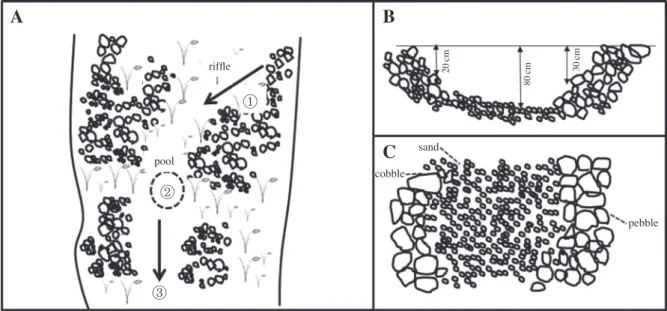
50m, 유폭 0.5~3m의 완만한 여울과 소가 반복되는 AaBb 형을 나타냈다(Fig. 2A). 서식처의 수심은 0.1~1m 였고, 하상 은 펄(<0.1mm), 모래(0.1~2mm), 잔자갈(16~2mm), 자갈 (64~16mm), 작은돌(256~64mm), 큰돌(>256mm)이 각각 10, 30, 20, 20, 10, 10%의 비율로 구성되었다(Table 1). 유속은 여울부에서 최대 1.5m/s, 소에서 최소 0m/s를 나타냈다. 이러 한 서식환경에서 남방종개는 흐름이 거의 없고 모래와 잔자갈 로 이루어진 소에서 집단으로 서식하였다(Fig. 2B, C, Table 2).
그러나 일부의 개체들은 하상이 모래가 아닌 자갈과 돌로 이 루어진 곳에서도 존재하였으며, 유속이 비교적 빠른 여울부에 서도 서식을 확인하였다. 당년생 치어는 집단 서식처의 수심 이 0.3m 이하인 곳에 주로 서식하는 것으로 확인되었다.
전남 장흥군 안양면 수문리 지역의 하천은 총 길이 5.2km 의 소하천으로 조사지점은 하천의 하폭이 40~60m, 유폭, 0.3
~10m의 유속이 정체된 소와 매우 짧은 여울이 존재하는 Aa
Bb형을 나타냈다(Fig. 3A). 하상은 펄, 모래, 잔자갈, 자갈, 작은 돌, 큰돌이 각각 10, 20, 20, 20, 20, 10%의 비율로 구성되었다 (Table 1). 유속은 여울부에서 최대 5.7m/s, 소에서 최소 0m/s 를 보였으며, 수문리 지역 역시 거금도와 마찬가지로 물의 흐 름이 있는 여울보다는 정체된 흐름을 보이고 하상이 모래와 잔자갈로 이루어진 수심 0.1~1m 내외 소를 선호하는 경향을 나타냈다(Fig. 3B, C, Table 3). 또한 당년생 치어는 집단 서식 처의 수심 0.3m 이하인 곳에 주로 서식하였다.
2. 동소종
전남 고흥군 금산면 거금도는 장마 또는 홍수시 남해와 연결
Fig. 1. A map showing the study sites of Iksookimia hugowolfeldi. A, Geogeum Island, Eojeonri, Geumsanmyeon, Goheunggun, Jeollanamdo;
B, Sumunri, Anyangmyeon, Jangheunggun, Jeollanamdo, Korea.
N
B
A
Haenamgun 36°
34°
126° 128°
Jangheunggun
Goheunggun
되는 지점으로 출현한 어류는 총 4과 7종 426개체였으며, 우 점종 남방종개 I. hugowolfeldi 45.07%, 아우점종 갈겨니 Zacco temminckii 23.94%, 밀어 Rhinogobius brunneus 12.44%, 꾹저 구 Chaenogobius urotaenia 10.09% 순으로 나타났다(Fig. 4A).
전남 장흥군 안양면 수문리는 거금도와 달리 순 담수역 으로서 총 4과 7종 249개체가 확인되었으며, 우점종 갈겨니 53.23%, 아우점종 남방종개 29.03%, 민물검정망둑 Tridentiger brevispinis 8.06%, 밀어 6.45%의 순으로 나타났다(Fig. 4B).
3. 선행된 미꾸리과 연구와의 비교 및 고찰
미꾸리과는 저서성 어류로서 선호하는 서식처 특성은 종마 다 큰 차이가 있다고 알려져있다(Kim, 1997; Kottelat, 2006).
기존 Choi(2003)의 연구에서 영산강과 탐진강의 남방종개 는 집단내에서 우점하였으며 하천 중·하류의 흐름이 느리고 하상이 모래와 자갈로 구성된 곳에서 관찰되었고, 이 중 영산 강 집단은 월동기에 모래속에서 집단을 형성하여 서식한다 보 고하였다. 거금도와 장흥 집단의 남방종개는 유속이 0.1m/s,
수심 0.8m 이하의 하상이 모래와 잔자갈로 이루어진 소에서 서식하여, 서식처의 하상구조와 유속은 기존의 연구결과와 유 사하게 나타났다. 추후 유속, 수심 등의 특성들과 월동서식처 의 특징에 대해 각 집단별로 분석된다면 남방종개 고유의 서 식처를 밝혀낼 수 있을 것으로 판단된다.
우리나라의 미꾸리과 어류인 얼룩새코미꾸리(Hong et al., 2011)와 북방종개(Ko, 2015), 점줄종개(Ko et al., 2009), 줄종 개(Kim et al., 2006)의 서식처는 유속이 0.2m/s 이하로 비교 Table 2. Water velocity and water depth at the study site at Geogeum Island, Eojeonri, Geumsanmyeon, Goheunggun, Jeollanamdo, Korea
Fig. 2 Water velosity
(m/s) Water depth
(m) No. of
I. hugowolfeldi
1 0.1 0.5 21
2 1.2 0.3 12
3 0.1 0.8 98
4 0.3 1.0 18
5 1.5 0.3 13
Table 1. Comparison of the habitats from two populations of Iksookimia hugowolfeldi, Korea Sites River width
(m) Water width
(m) Water velocity
(m/s) Water depth (m)
Bottom structure(%)* River type**
B C P G S M
Geogeum Island 10~50 0.5~3 0.0~1.5 0.1~1 10 10 20 20 30 10 AaBb
Jangheung 40~60 0.3~10 0.0~5.7 0.1~1 10 20 20 20 20 10 AaBb
*Cummins(1962): B(boulder, >256mm), C(cobble, 256~64mm), P(pebble, 64~16mm), G(gravel, 16~2mm), S(sand, 0.1~2mm), M(mud, <0.1mm)
**River type: Kani(1944)
Fig. 2. The diagram showing the microhabitat of Iksookimia hugowolfeldi at the study site in Geogeum Island, Korea. A, structure of habitat area;
B, cross section of the ground of the collective habitat(dotted circle) of A; C, the feature of the collective habitat(dotted circle) of A. Arrows, wa
terflows; dotted circle, collective habitat.
A B
C
riffle
riffle
cobble sand
35cm 80cm 30cm
pebble pool
① ②
③
④
⑤
적 느린 곳, 미호종개(ME, 2011), 새코미꾸리(Byeon, 2007), 참종개(Kim, 1978)와 왕종개(Kim and Ko, 2005)는 유속이 0.2 m/s 이상으로 비교적 빠른 곳을 선호하였다. 미호종개(ME, 2011), 줄종개(Kim et al., 2006), 북방종개(Ko, 2015)는 하상이 주로 모래로 이루어진 곳에 서식하였으며, 새코미꾸리(Byeon, 2007), 얼룩새코미꾸리(Hong et al., 2011), 참종개(Kim, 1978), 부안종개(Kim and Lee, 1984), 왕종개(Kim and Ko, 2005), 점 줄종개(Ko et al., 2009)는 자갈과 돌로 이루어진 하상을 선호 한다고 알려졌다. 이 중 줄종개, 점줄종개, 북방종개의 서식처 의 유속과 하상구조 특성은 본 연구결과와 유사하였다. 추후 다른 미꾸리과 어류들의 추가적인 서식처 선호도가 분석된다 면 유연종 간의 차이를 비교할 수 있을 것으로 판단된다.
각 미꾸리과 어류들에서 서식처 내 상대풍부도는 부안종개 가 51.31%로 우점하였으나(Kim and Lee, 1984) 얼룩새코미꾸 리(Hong et al., 2011), 줄종개(Kim et al., 2006), 왕종개(Kim and Ko, 2005), 참종개(Kim, 1978), 점줄종개(Ko et al., 2009) 는 10% 미만으로 개체군의 크기가 상대적으로 작았다. 부안종 개와 남방종개의 경우 조사 지점에 포식자가 존재하지 않았고,
얼룩새코미꾸리, 줄종개, 왕종개, 참종개, 점줄종개는 조사지점 에 꺽지 Coreoperca herzi, 동사리 Odontobutis platycephala, 배스 Micropterus salmoides 등의 다양한 포식종이 보고된 바 Fig. 3. The diagram showing the microhabitat of Iksookimia hugowolfeldi at the study site in Jangheung population, Korea. A, structure of gen
eral habitat area; B, cross section of the he ground of the collective habitat(dotted circle) of A; C, the feature of the collective habitat(dotted cir
cle) of A. Arrow, waterflows; dotted circle, collective habitat.
A B
C
①
②
③
riffle
pool cobble
pebble sand
20cm 80cm 30cm
Table 3. Water velocity and water depth at the study site at Sumun
ri, Anyangmyeon, Jangheunggun, Jeollanamdo, Korea Fig. 3 Water velosity
(m/s) Water depth
(m) No. of
I. hugowolfeldi
1 5.7 0.2 2
2 0.1 0.8 36
3 0.4 1.0 3
Fig. 4. Relative abundance of the sympatric fishes. A, collected at Geogeum Island, Eojeonri, Geumsanmyeon, Goheunggun, Jeol
lanamdo, Korea; B, collected at Sumunri, Anyangmyeon, Jang
heunggun, Jeollanamdo, Korea.
A
B
I. hugowolfeldi Z. temminckii R. brunneus C. urotaenis L. somjinensis C. auratus M. anguillicaudatus
45.07 23.94
12.44 10.09 4.23 2.35 1.88
0.81 0.81 1.61
6.45 8.06
29.03
53.23
0 10 20 30 40 50
0 10 20 30 40 50 60
Relative abundance(%) Z. temminckii
I. hugowolfeldi T. brevispinis R. brunneus M. anguillicaudatus P. altivelis S. gracilis majimae
있다. 미꾸리과 어류 간의 상대풍부도의 차이는 포식자의 유 무, 서식처 주변의 환경오염원, 조사 방법, 조사 시기 등의 요 인으로 인하여 차이가 있을 것으로 생각된다.
요 약
잉어목 미꾸리과에 속하는 한국고유종 남방종개의 하상구 조, 유속, 유폭, 하폭 등의 서식처 특성을 전라남도 고흥군 금 산면 거금도와, 전라남도 장흥군 안양면 수문리 지점에서 조 사하였다. 거금도 개체군은 유속이 0.1m/s, 수심 0.8m 이하의 하상이 모래와 잔자갈로 이루어진 소에서 집단으로 서식하였 다. 또한 당년생 치어는 수심이 0.3m 이하인 모래 하상의 소 에 대부분 분포하였다. 장흥 개체군 또한 유속이 0.1m/s, 수심 0.8m 이하의 하상이 모래와 잔자갈로 이루어진 소를 선호하 였다. 거금도와 장흥의 동소서식종은 각각 4과 7종으로 나타 났으며 집단내에서 남방종개는 우점 및 아우점하는 것으로 확 인되었다.
REFERENCES
Arthington, A.H., S.E. Bunn, N.L. Poff and R.J. Naiman. 2006. The challenges of providing envirionmental flow rules to sustain river ecosystem, Ecol. Appl., 16: 13111318.
Byeon, H.K. 2007. Ecology of Koreocobitis rotundicaudata(Cobit
idae) in the Naerin Stream, Korea. Korean J. Ichthyol., 19:
299305.(in Korean)
Choi, E.K. 2003. Biology of the Southern spined loach, Iksookimia hugowolfeldi(Pisces, Cobitidae). Dissertation, Chonbuk National Univ., pp. 2324.(in Korean)
Choi, J.K. and H.K. Byeon. 2009. Ecological characteristics of Co
bitis pacifica(Cobitidae) in the Yeongok Stream, Korea.
Korean J. Ichthyol., 19: 299305.(in Korean)
Cummins, K.W. 1962. An evolution of some techniques for the col
lection and analysis of benthic smaples with special empha
sis on lotic waters. Amer. Midl. Nat’l., 67: 477504.
Hong, Y.K., H. Yang and I.C. Bang. 2011. Habitat, reproduction and feeding habit of endangered fish Koreocobitis naktongensis (Cobitidae) in the Jaho Stream, Korea. Korean J. Ichthyol., 23: 234241.(in Korean)
Hur, J.W., J.W. Park, S.U. Kang and J.K. Kim. 2009. Estimation of fish fauna and habitat suitability index in the Geum River basin. Kor. J. Env. Eco., 23(6): 516527.(in Korean) Kani, T. 1944. Ecology of Torrnetinhabiting Insects. In: Furukawa,
H.(ed.), Insect 1, Kenkyusha, Tokyo, pp. 171317.(in Jap
anese)
Kim, I.S. 1978. Ecological studies of cobotid fish, Cobitis koreensis
in Jeonjucheon Creek, Jeonrabugdo province, Korea. Ko
rean J. Ecol., 2: 914.(in Korean)
Kim, I.S. 1997. Illustrated encyclopedia of fauna & flora of Korea, Vol. 37, Freshwater fishes. Ministry of education, Yeongi, 629pp.(in Korean)
Kim, I.S. 2009. A review of the spined loaches, Family Cobitidae (Cypriniformes) in Korea. Korean J. Ichthyol., 21: 728.
Kim, I.S., E.K. Choi, H. Yang and M.H. Koh. 2003. Karyotype ana
lysis of Southern spined loach, Iksookimia hugowolfeldi (Pisces, Cobitidae). Korean J. Ichthyol., 15(2): 127129.
Kim, I.S. and J.Y. Park, 2002. Freshwater fishes of Korea. Kyo-hak publishing Co., Ltd., Korea. 465pp.(in Korean)
Kim, I.S. and M.H. Ko. 2005. Ecology of Iksookimia longicorpa (Cobitidae) in the Seomjin River, Korea. Korean J. Icthyol., 17: 112122.(in Korean)
Kim, I.S., M.H. Ko and J.Y. Park. 2006. Population ecology of Ko
rean sand loach Cobitis teralineata(Pisces; Cobitdae) in the Seomjin River, Korea. J. Ecol. Field Biol., 29: 277286.(in Korean)
Kim, I.S. and W.O. Lee. 1984. Morphological and ecological as
pects on the population of Cobitis koreensis Kim(Pisces:
Cobitdae) in the Begchon Stream, Puangun, Chollabugdo, Korea. Korean J. Ecol., 7: 1020.(in Korean)
Ko, M.H. 2009. Reproductive mechanisms of the unisexual diploid
triploid hybrid complex of between the spined loach Cobitis hankugensis and Iksookimia longicorpa(Teleostei, Cobit
idae) in Korea. Dissertation, Chonbuk National Univ., pp.
8993.(in Korean)
Ko, M.H. 2015. Habitat characteristics and feeding ecology of the Korean endemic species, Iksookimia pacifica(Pisces: Cobit
idae) in the Bukcheon(stream), Korea. Korean J. Ichthyol., 27: 275283.(in Korean)
Ko, M.H., I.R. Lee and I.C. Bang. 2012. Distribution status and es
timation of population size of endangered species, Cobitis Choii(Pisces: Cobitidae) in Geum River, Korea. Korean J.
Ichthyol., 24: 5661.(in Korean)
Ko, M.H., J.Y. Park and S.H. Kim. 2009. Habitat environment and feeding habitat of Iksookimia koreensis and Cobotis lutheri (Pisces: Cobitidae) in the Mangyeong River, Korea. Korean J. Ichthyol., 21: 253261.(in Korean)
Kottelat, M. 2006. Fishes of Mongolia: A checklist of the fishes known to occur in Mongolia with comments on systematics and nomenclature. Environment and social development sec
tor, East Asia and Pacific Region, The World Bank, Wash
ington, xii+103pp.
ME(Ministry of environment). 2011. Development of culture tech
niques and construction of monitoring system for released seed of an endangered fish Koreocobitis naktongensis. Soon
chunhyang University, Asan, 250pp.(in Korean)
Nalbant, T.T. 1993. Some problems in the systematics of the genus Cobitis and its relative(Pisces: Ostariophysi, Cobitidae).
Rev. Roum. Biol.(Biol. Anim.), 38: 101110.
Nelson, J.S. 2006. Fishes of the world. John Wiley & Sons, Inc., pp.
139143.
Park, J.Y. 1996. A Morphological study on the gonad of species in the Family Cobitidae(Pisces: Cypriniformes) from Korea.
Dissertation, Chonbuk National Univ., pp. 1342
Park, J.Y. and I.S. Kim. 2001. Fine structure of oocyte envelopes of three related cobitid species in the genus Iksookimia(Cobit
idae). Ichthyological Research, 48: 7175.