160
Copyright © 2014 The Korean Society of Fisheries and Aquatic Science pISSN:0374-8111, eISSN:2287-8815
서 론
갯골은간조시담수와해수를연결하여영양염류와같은에 너지를해양환경으로공급하는 이동통로의기능
(Mitsch and Gosselink, 1993)
을가지고있으며,
조수의영향으로인해물리 적변화가큰생물학적조건을가진생태계로보고되었다(Hae- drich, 1983; Kneib, 1997).
민물두줄망둑
(Tridentiger bifasciatus)
은농어목(Perciformes)
망둑어과(Gobiidae)
에 속하는어류로한국,
일본,
중국,
타이 완등주로아시아에분포하는종으로보고되었지만(Kikuchi and Yamashita, 1992; Wu et al., 1999; Wonham et al., 2000),
동부태평양에서는외래유입종(Invasive species)
으로구분되었으며
,
하구역과 담수에서식한다고 알려져있다(Scott and Larry, 2005).
망둑어과어류는세계에약212
속1,875
종,
국내 에는27
속59
종으로현존하는어류들중가장큰분류군으로서(Nelson, 1984)
다양한생태학적연구가진행되어져왔으며,
이 중국내에출현하는Tridentiger
속어류는6
종으로알려져있다(Kim et al., 2005).
이러한망둑어과어류는상업적으로중요한 어종은아니지만,
물리적인변화가큰환경에뛰어난적응능력(Akihisa and Seiichi, 2005)
으로인하여광범위하게분포하고 있으며,
연안에출현하는상업성어종에게에너지를전달하는 매개체로써중요한위치를차지하고있다(Kwak et al., 2010).
민물두줄망둑의선행연구로는샌프란시스코하구역에출현 하는민물두줄망둑의식성연구
(Scott and Larry, 2005)
가있었순천 상내리 갯골에 출현하는
민물두줄망둑(Tridentiger bifasciatus)의 식성
예상진, 정재묵, 김현지, 박주면
1, 허성회
2, 백근욱*
경상대학교 해양생명과학과/해양산업연구소, 1부경대학교 해양과학공동연구소, 2부경대학교 해양학과
Feeding Habits of Tridentiger bifasciatus in the Tidal Creek at Sangnae-ri, Suncheon, Korea
Sang Jin Ye, Jae Mook Jeong, Hyeon Ji Kim, Joo Myun Park
1
, Sung-Hoi Huh2
andGun Wook Baeck*Department of Marine Biology & Aquaculture/Institue of Marine Industry, Gyeongsang National University, Tongyeong 650 -160, Korea
1
Korea Inter-University Institute of Ocean Sciences, Pukyong National University, Busan 608-737, Korea
2
Department of Oceanography, Pukyong National University, Busan 608-737, Korea
The feeding habits of Tridentiger bifasciatus were studied using 733 individuals collected in the tidal creek at Sangnae-ri, Suncheon, Korea, using a push net, monthly, from April 2011 to March 2012. The standard length (SL) of the specimens ranged from 1.5 to 8.2 cm. The stomach content analysis indicated that T. bifasciatus con- sumed mainly amphipods, such as Corophium sp., while copepods, polychaetes, and shrimps were other im- portant prey species. In addition T. bifasciatus ate small quantities of crab larvae, fish, gastropod larvae, and in- sects. T. bifasciatus is a generalist that feeds on various zoobenthos, including fish. T. bifasciatus underwent an ontogenetic dietary shift. Smaller individuals (1-2 cm SL) fed mainly on amphipods. The proportion of amphi- pods decreased as body size increased, whereas the consumption of polychaetes increased gradually. The sea- sonal variation in the diet composition of T. bifasciatus was significant. Insects were common prey during sum- mer, while the amounts of other prey, including polychaetes, were similar during spring, autumn, and winter.
Key words: Tridentiger bifasciatus , Tidal creek, Feeding habits, Suncheon
This is an Open Access article distributed under the terms of the Creative Commons Attribution Non-Commercial Licens (http://creativecommons.org/licenses/by-nc/3.0/)which permits unrestricted non-commercial use, distribution, and reproduction in any medium, provided the original work is properly cited.
http://dx.doi.org/10.5657/KFAS.2014.0160 Kor J Fish Aquat Sci 47(2) 160-167, April 2014
Received 26 November 2013; Revised 7 January 2014; Accepted 6 February 2014
*Corresponding author: Tel: +82. 55. 772. 9156 Fax: +82. 55. 772. 9159
E-mail address: [email protected]
민물두줄망둑(Tridentiger bifasciatus)의 식성
161
을뿐
,
국내에민물두줄망둑의생태에관한연구는전무한실정 이다.
그리고민물두줄망둑은IUCN
의Red List
에최소관심종(Least Concern)
으로등재(IUCN Red List, 2009)
되어있어,
이 들의생태적연구가필요하다.
식성연구는 연구 대상종이 서식하는 생태계의 먹이망 구 조
(Huh and Kwak, 1998a)
와 기능적인 면(Huh and Kwak,
1998b)
을파악하기위한정보를제공하기에중요하다.
그러므로본연구의목적은갯골에출현하는민물두줄망둑의위내용 물분석을통하여주요먹이생물
,
크기와계절에따른위내용물 조성,
섭식전략을확인하여특수한환경에성공적으로적응한 민물두줄망둑의식성을알아보고자한다.
재료 및 방법
본연구에사용된민물두줄망둑은
2011
년4
월부터2012
년3
월까지매월1
회전라남도순천시해룡면상내리갯골에서간 조시에입구크기가로120 cm,
세로100 cm,
전체길이225 cm,
그물코크기5 mm
의push net
을이용하여5
분씩3
회예 인하였다(Fig. 1).
채집된민물두줄망둑은현장에서즉시10%
중성포르말린에고정하여실험실로운반한후
,
각개체의체장(standard length)
과체중(weight)
을각각0.1 cm
와0.1 g
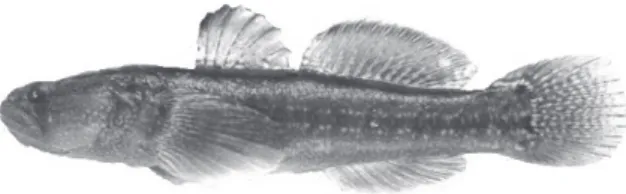
까지 측정하였다(Fig. 2).
민물두줄망둑과같은Tridentiger
속에속 하는두줄망둑과비교하여형태적으로매우유사하지만Kim
(1995)
에의한분류학적고찰및종분화연구를참고하여민물두줄망둑과두줄망둑을구분하였다
.
이후,
각개체의위를적출 하여해부현미경아래에서위내용물을분석하였고,
먹이생물 은가능한한종수준까지동정(Yamaji, 1996; Seo, 2010; Kim et al., 2005)
하였으며,
개체수를계수한후,
초정밀전자저울을 이용하여습중량을0.0001 g
까지측정하였다.
위내용물분석결과는각먹이생물의출현빈도
(%F),
개체수 비(%N)
그리고습중량비(%W)
로나타내었으며,
다음식을이 용하여구하였다.
%F= A
i/N×100
%N= N
i/N
total×100
%W= W
i/W
total× 100
여기서
, A
i는 위내용물 중해당 먹이생물이 발견된민물두 줄망둑의개체수이고, N
은먹이를섭식한민물두줄망둑의총 개체수, N
i와W
i는해당먹이생물의개체수와습중량, N
total과W
total은전체먹이개체수와습중량이다.
먹이생물의 상대중요성지수
(index of relative importance, IRI)
는Pinkas et al. (1971)
의식을이용하여구하였다.
IRI=(×100 %N+%W)×%F
상대중요성지수는 백분율로 환산하여 상대중요성지수비
(%IRI)
로나타내었다.
민물두줄망둑의 먹이중요도
(dominant or rare),
섭식전략(specialist or generalist),
섭식폭(niche width)
은 도해적방법(graphical method)
을사용하여나타내었다(Amundsen et al., 1996).
이방법은출현빈도(%F)
에대하여prey- specific abun- dance
를도식화함으로써나타내며, prey-specific abundance
는 는다음과같이구하였다.
Pi=(∑S
i/∑S
ti)×100
Fig. 2. Photograph of Tridentiger bifasciatus.Fig. 1. Location of the study area (○).
여기서
, P
i는먹이생물i
의prey -specific abundance, S
i는위내 용물중먹이생물i
의중량, S
ti는먹이생물i
를섭식한개체의위 내용물중전체먹이생물중량이다.
성장과계절에따른민물두줄망둑의먹이생물 변화를파악 하기위해서채집된시료를
1 cm
간격, 4
개의크기군(1-2 cm, n=38; 3-4 cm, n=472; 5-6 cm, n=201; 7-8 cm, n=22)
으로나 누었으며,
계절은춘계(3-5
월, n=134),
하계(6-8
월, n=68),
추 계(9-11
월, n=365),
동계(12-2
월, n=166)
사계절로 구분하여 총733
개체중에서위내용물이발견된706
개체를이용하여먹 이생물의조성을확인하였다.
크기와계절에따른우점먹이생 물조성의통계적차이를분석하기위하여카이검정(x
2-test)
을 실시하였고,
체장에따른먹이섭식특성을파악하기위해크기 군별개체당먹이의평균개체수(mean number of preys per stomach, mN/ST)
와개체당먹이의평균중량(mean weight of preys per stomach, mW/ST)
을구하였으며,
분산분석(analysis of variance, ANOVA)
을이용하여유의성을검정하였다.
계절 별섭식율(stomach content index, SCI)
을확인하기위해Wata- nabe et al. (2004)
의식을이용하여다음과같이구하였다.
SCI=SCW/BW×100
여기서
BW (body weight)
는체중, SCW (stomach content weight)
는위내용물중량이다.
체장과계절의먹이생물의중복도
(Schoener, 1970)
는dietary overlap index
를이용하여다음과같이구하였다.
C
xv=1-0.5(∑│P
xi-P
xy│)
여기서
, P
xi와P
yi는x, y
그룹에서먹이생물i
의습중량비(%W)
이다.
중복도지수값의범위는0
에서1
까지이고, 1
에가까울 수록먹이생물의중복도가높아지는것으로볼수있다.
중복도값이
0.6
이상이면유의하게중복되는 것으로간주하였다(Wallace, 1981).
결 과
체장분포
본연구에사용된민물두줄망둑은총
733
개체로체장(Stan- dard length)
은1.5-8.2 cm
의범위를보였으며, 3-4 cm
크기군의개체가전체개체수의
57.6%
를차지하여가장많이채집되었다
. 1
월에가장작은크기인1.5 cm
개체가채집되었으며, 11
월에8.7 cm
의가장큰개체가채집되었다(Fig. 3).
위내용물 조성
총
733
개체의민물두줄망둑중위내용물이전혀발견되지않 은개체는27
개체로3.7%
의공복율을나타냈다.
위내용물이발0 50 100
0.5
Frequence of occurrence
Prey-specific abundance (%)
0
Ma (A)
1 Pol
Pi Br
Am
In Co
Ga
0.5 0
(B)
(i) High BPC
Rare Generalization High WPC Specialization Dominant
(ii) (iii)
1
0 50 100
Standard length (cm)
percentage of wet weight (%)
Pisces Macrura Brachyura Polychaeta Gastropoda Amphipoda Copepoda Insecta Other
1-2 3-4 5-6 7-8
0 50 100
Season
percentage of wet weight (%)
Fish Macrura Brachyura Polychaeta Gastropoda Amphipoda Copepoda Insecta Other
Spring Summer Autumn Winter
Season
3
2
1
0
SCI
Spring Summer Autumn Winter
0 6
2 4 8 10
Standard length (cm)
mN/ST
mN/ST
mW/ST(g)
mW/ST
1-2 3-4 5-6 7-8
0 0.06
0.02 0.04 0.08 0.12 0.1
Frequency (%)
Standard length (cm)
0 30 60
1 2 3 4 5 6 7 8
Mar., n=102 Feb., n=9 2012.Jan., n=49 Dec., n=108 Nov., n=166 Oct., n=174 Sep., n=25 Aug, n=41 Jul., n=16 Jun., n=11 May., n=20 2011.Apr., n=12
Frequence of occurrence
Fig. 3. Monthly variation in standard length frequency of Triden- tiger bifasciatus.
민물두줄망둑(Tridentiger bifasciatus)의 식성
163
견된
706
개체의위내용물분석결과(Table 1),
민물두줄망둑의 가장중요한먹이생물은출현빈도41.6%,
개체수비27.1%,
습 중량비7.3%,
상대중요성지수비44.2%
를차지한단각류(Am- phipoda)
였다.
단각류중에서는Corophium sp.
의개체수비가21.3%,
습중량비는7.0%
로가장중요한먹이생물임을확인할 수 있었다.
그다음으로중요한먹이생물은출현빈도15.3%,
개체수비8.5%,
습중량비48.8%,
상대중요성지수비27.0%
를 차지한갯지렁이류(Polychaeta)
와출현빈도18.0%,
개체수비23.4%,
습중량비0.2%,
상대중요성지수비13.1%
를차지한요 각류(Copepoda)
였다.
갯지렁이류에서는 참갯지렁이(Nereis japonica)
의개체수비와습중량비가5.4%
와37.0%
로가장높 았으며,
요각류중에서는개체수비11.7%,
습중량비0.1%
를차 지한 중국노벌레(Calanus sinicus)
가 가장높게나타났다.
새 우류(Macrura),
게유생(Brachyura larvae),
어류(Pisces)
는각 각 상대중요성지수비6.4%, 4.0%, 2.4%
를차지하였으며,
그 외 복족류 유생(Gastropoda larvae),
곤충류(Insecta),
규조류(Bacillariophyceae),
유종섬모충류(Tintinina)
등도 섭식하였 지만그양은많지않았다.
본연구에서민물두줄망둑의먹이 생물은단각류를포함한요각류,
새우류,
게유생과같은갑각 류(Crustacea)
를주로섭식하였지만,
저서동물인갯지렁이류를 비롯한복족류유생,
망둑어과어류를섭식한것으로보아갑각 류를비롯한저서동물을섭식하는육식성어류(Carnivore)
임을 확인할수있었다.
민물두줄망둑의섭식형태와섭식특성을조사한결과
(Fig. 4),
비교적단각류를섭식하는경향을나타냈지만,
좁은섭식폭에 비하여새우류를비롯한갯지렁이류,
어류,
게류등다양하게섭 식하는것으로보아generalists
임을확인할수있었다. 성장별 먹이조성의 변화
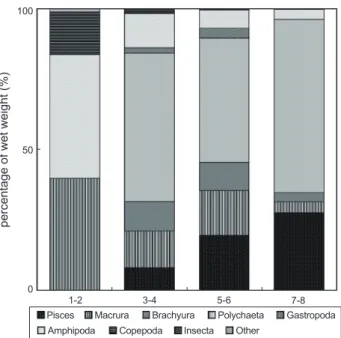
민물두줄망둑의성장에따른먹이조성의 변화분석한결과
(Fig. 5), 1-2 cm
인가장작은크기군에서는단각류와새우류 가각각습중량비43.9%
와39.8%
로가장중요한먹이생물이 었으며,
그다음으로요각류가습중량비15.2%
를차지하였다. 3-4 cm
크기군에서는1-2 cm
크기군에서출현하지않았던갯 지렁이류의습중량이52.8%
로가장높게나타났으며,
어류,
게 유생,
복족류유생또한출현하였다.
그러나단각류와요각류 의습중량은12.1%
와0.7%
로급격히감소하였으며,
새우류또한감소한것을확인할수있었다
. 5-6 cm
크기군에서는갯지렁이류의습중량이
44.2%
로가장높았으며,
어류의습중량은19.5%
로증가하였다. 7-8 cm
크기군또한갯지렁이류의습중 량이61.7%
로가장높았다.
어류또한27.6%
로비교적증가하 였지만,
단각류,
새우류,
게유생의경우습중량이5%
이하로감 소하였으며,
복족류유생과요각류는출현하지않았다.
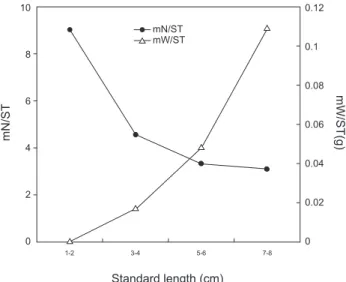
민물두줄망둑의 크기군별 먹이생물의 변화는 유의한 차이 를보이지않았다
(P>0.05).
하지만성장에따른먹이생물의평 균개체수(mN/ST, P<0.05)
와먹이생물의평균중량(mW/ST,
Table 1. Composition of the stomach contents of Tridentiger bifas-ciatus by frequency of occurrence, number, wet-weight and index
of relative importance (IRI)Prey organisms %F %N %W %IRI
Bacillariophyceae 2.8 20.3 - 1.8
Bacillariophyceae 2.8 20.3 -
Tintinnina 4.7 2.3 - 0.3
Tintinnopsis spp. 4.7 2.3 -
Polychaeta 15.3 8.5 48.8 27.0
Neresis japonica spp. 8.9 5.4 37.0 Heteromastus filifarmis 0.7 0.2 0.1
Sternaspis scutata 0.1 - 1.1
Unidentified Polychaeta 5.8 2.9 10.5
Amphipoda 41.6 27.1 7.3 44.2
Corophium sp. 35.6 21.3 7.0
Pontogeneia sp. 4.2 2.9 -
Unidentified Amphipoda 5.0 2.9 0.2
Copepoda 18.0 23.4 0.2 13.1
Calanus sinicus 3.1 11.7 0.1
Tigriopus japonicus 13.3 8.5 -
Temora sp. 1.8 2.6 -
Oncaea sp. 0.4 0.2 -
Unidentified Copepoda 1.0 0.4 -
Macrura 10.9 5.4 13.5 6.4
Exopalaemon orientis 7.1 4.1 10.7 Exopalaemon orientis larvae 0.6 0.2 - Unidentified Macrura 3.3 1.2 2.8
Brachyura 8.9 5.5 9.0 4.0
Brachyura larvae 8.9 5.5 9.0
Insecta 1.8 0.7 0.5 0.1
Diptera spp. 0.3 0.1 0.1
Chironomidae larvae 0.4 0.1 0.2 Unidentified Insecta 1.3 0.4 0.1
Gastropoda 3.7 4.0 2.6 0.7
Gastropoda larvae 3.7 4.0 2.6
Pisces 4.0 1.3 18.2 2.4
Oryzias latipes 0.1 - 1.1
Pseudogobius masago 2.0 0.7 7.2 Unidentified Gobiidae 1.1 0.4 3.2 Unidentified Pisces 0.7 0.3 6.7
Unidentified 1.8 1.3
-0.1
Unidentified eggs 1.8 1.3 -
Total 100.0 100.0 100.0
- : less than 0.1%
예상진
ㆍ
정재묵ㆍ
김현지ㆍ
박주면ㆍ
허성회ㆍ
백근욱164
0 50 100
0.5
Frequence of occurrence
Prey-specific abundance (%)
0
Ma (A)
1 Pol
Pi Br
Am
In Co
Ga
0.5 0
(B)
(i) High BPC
Rare Generalization High WPC Specialization Dominant
(ii) (iii)
1
0 50 100
Standard length (cm)
percentage of wet weight (%)
Pisces Macrura Brachyura Polychaeta Gastropoda Amphipoda Copepoda Insecta Other
1-2 3-4 5-6 7-8
0 50 100
Season
percentage of wet weight (%)
Fish Macrura Brachyura Polychaeta Gastropoda Amphipoda Copepoda Insecta Other
Spring Summer Autumn Winter
Season
3
2
1
0
SCI
Spring Summer Autumn Winter
0 6
2 4 8 10
Standard length (cm)
mN/ST
mN/ST
mW/ST(g)
mW/ST
1-2 3-4 5-6 7-8
0 0.06
0.02 0.04 0.08 0.12 0.1
Frequency (%)
Standard length (cm)
0 30 60
1 2 3 4 5 6 7 8
Mar., n=102 Feb., n=9 2012.Jan., n=49 Dec., n=108 Nov., n=166 Oct., n=174 Sep., n=25 Aug, n=41 Jul., n=16 Jun., n=11 May., n=20 2011.Apr., n=12
Frequence of occurrence
0 50 100
0.5
Frequence of occurrence
Prey-specific abundance (%)
0
Ma (A)
1 Pol
Pi Br
Am
In Co
Ga
0.5 0
(B)
(i) High BPC
Rare Generalization High WPC Specialization Dominant
(ii) (iii)
1
0 50 100
Standard length (cm)
percentage of wet weight (%)
Pisces Macrura Brachyura Polychaeta Gastropoda Amphipoda Copepoda Insecta Other
1-2 3-4 5-6 7-8
0 50 100
Season
percentage of wet weight (%)
Fish Macrura Brachyura Polychaeta Gastropoda Amphipoda Copepoda Insecta Other
Spring Summer Autumn Winter
Season
3
2
1
0
SCI
Spring Summer Autumn Winter
0 6
2 4 8 10
Standard length (cm)
mN/ST
mN/ST
mW/ST(g)
mW/ST
1-2 3-4 5-6 7-8
0 0.06
0.02 0.04 0.08 0.12 0.1
Frequency (%)
Standard length (cm)
0 30 60
1 2 3 4 5 6 7 8
Mar., n=102 Feb., n=9 2012.Jan., n=49 Dec., n=108 Nov., n=166 Oct., n=174 Sep., n=25 Aug, n=41 Jul., n=16 Jun., n=11 May., n=20
Frequence of occurrence
Fig. 4. (A) Graphical representation of feeding pattern of Tridentiger bifasciatus (Am, Amphipoda; Co, Copepoda; Ma, Marcrura; Pol, Polychaeta; Pi, Pisces; Br, Brachyura; In, Insecta; Ga; Gastropoda), (B) Explanatory diagram for interpretation of niche-width contribution (axis i, within-phenotypic component (WPC) or between-phenotypic component (BPC)) of the study population, feeding strategy (axis ii), and prey importance (axis iii).
Fig. 5. Ontogenetic changes in composition of stomach contents by wet-weight of Tridentiger bifasciatus.
0 50 100
0.5
Frequence of occurrence
Prey-specific abundance (%)
0
Ma (A)
1 Pol
Pi Br
Am
In Co
Ga
0.5 0
(B)
(i) High BPC
Rare Generalization High WPC Specialization Dominant
(ii) (iii)
1
0 50 100
Standard length (cm)
percentage of wet weight (%)
Pisces Macrura Brachyura Polychaeta Gastropoda Amphipoda Copepoda Insecta Other
1-2 3-4 5-6 7-8
0 50 100
Season
percentage of wet weight (%)
Fish Macrura Brachyura Polychaeta Gastropoda Amphipoda Copepoda Insecta Other
Spring Summer Autumn Winter
Season
3
2
1
0
SCI
Spring Summer Autumn Winter
0 6
2 4 8 10
Standard length (cm)
mN/ST
mN/ST
mW/ST(g)
mW/ST
1-2 3-4 5-6 7-8
0 0.06
0.02 0.04 0.08 0.12 0.1
Frequency (%)
Standard length (cm)
0 30 60
1 2 3 4 5 6 7 8
Mar., n=102 Feb., n=9 2012.Jan., n=49 Dec., n=108 Nov., n=166 Oct., n=174 Sep., n=25 Aug, n=41 Jul., n=16 Jun., n=11 May., n=20 2011.Apr., n=12
Frequence of occurrence
P<0.05)
은유의한차이를나타냈다(Fig. 6).
크기군별먹이중복도결과
(Table 2), 3-4 cm
크기군, 5-6 cm
크기군, 7-8 cm
크기군사이의값은0.7
이상의중복도값을나 타냈으며, 3-4 cm
와5-6 cm
크기군사이의값이0.84
로가장높 게나타났다.
하지만1-2 cm
크기군과의사이의값은0.2
이하 로낮게나타났으며,
가장작은크기군인1-2 cm
와가장큰크기 군인7-8 cm
의사이의값은0.07
로가장낮은중복도를보였다. 계절별 먹이조성의 변화
민물두줄망둑의계절별먹이조성결과
(Fig. 7)
를살펴보면,
하 계를제외한춘계,
추계,
동계에는갯지렁이류의습중량비가전 체먹이생물습중량비의40%
이상을차지하여가장중요한먹 이생물이었으며,
어류를비롯한새우류,
단각류,
요각류가지속 적으로출현하여유사한먹이조성결과를보였다.
하지만추계 에경우,
게유생과복족류유생이민물두줄망둑의먹이생물로 나타났으며,
그습중량비는전체먹이생물습중량비의16.2%
와
4.9%
를차지하였다.
하계에경우에는갯지렁이류의습중량이
14.9%
로현저히감소하는한편,
곤충류의습중량이51.8%
를차지하여가장중요한먹이생물이었으며
,
단각류의습중량비또한
22.0%
로비교적증가하였지만,
어류는섭식되지않았다
.
계절별먹이중복도결과
(Table 3),
하계를제외한춘계,
추계,
동계의사이의값은
0.7
이상으로나타났으며,
춘계와동계사이의값이
0.87
로가장높은중복도값을보였다.
하계를포함한나머지계절에사이의값은
0.19
이하의값을보였으며,
하계 와추계사이의값이0.14
로가장낮은중복도값을나타냈다.
민물두줄망둑의계절별섭식율을확인한결과
(Fig. 8),
춘계가민물두줄망둑(Tridentiger bifasciatus)의 식성
165
2.5
로가장높은섭식율을보였으며,
하계는0.1
로가장낮은섭 식율을나타냈다.
이후춘계에차츰증가하였다가동계에는비 교적감소하는경향을나타냈다.
고 찰
본연구에서민물두줄망둑은다른많은망둑어과어류와마찬 가지로다양한먹이생물을섭식하는
generalists
임을알수있었 다(Magnhagen and wiederholm, 1982; Miller, 1984; Mesa et
al., 2008).
국내에출현하는망둑어과어류의공복율을살펴보면
,
점줄망둑(Acentrogobius pellidebilis) 3.9% (Kwak et al., 2010),
날개망둑(Favonigobius gymnauchen) 3.6% (Huh and Kwak, 1998b),
문절망둑(Acanthogobius flavimanus) 2.6%
(Huh and Kwak, 1999)
의낮은공복율을확인할수있었는데,
민물두줄망둑의공복율역시3.7%
로낮게나타났다.
민물두줄망둑의가장중요한먹이생물은단각류였는데
,
단각 류중에서Corophium sp.
를가장많이섭식하였다. Corophium
sp.
는갯벌연안역을비롯한담수와하구역에주로서식하는저Fig. 6. Variation of mean number of preys per stomach (mN/ST) and mean wet-weight of preys per stomach (mW/ST) of Triden- tiger bifasciatus among size classes.
서성단각류로광염성이며
,
분포지역이광범위하다고보고되었 다(Crawford, 1937; Meadows and Reid, 1966).
샌프란시스 코하구역에서이루어진민물두줄망둑의식성연구(Scott and Larry, 2005)
에서Corophium sp.
가사계절모두출현하여가 장중요한먹이생물이었으며, Wasserman (2012)
의온난대하 구역상류의망둑어과어류두종의섭식생태연구에서도Co- rophium sp.
가중요한먹이생물이었다.
이러한연구결과로미 루어보아,
본조사지역은물리적인환경변화가크지만연성퇴 적물과담수로부터유입되는영양염등이Corophium sp.
의대 량번성으로이어져, generalists
인민물두줄망둑이Corophium sp.
를많이섭식한것으로판단된다.
요각류중우점하였던중국 노벌레는 부유성요각류로연중출현한다고알려져있다(Seo,
2010).
민물두줄망둑이부유성요각류인중국노벌레를섭식할수있었던이유는본연구대상갯골이간조시에수심이약
30 cm
로얕았기때문인것으로생각된다.
민물두줄망둑과같은망 둑어과어류인Economidichthys pygmaeus
또한저서에서표 층으로이동하며섭식활동을한다고보고되었으며(Gkenas et
Fig. 7. Seasonal variation in composition of stomach contents by wet-weight of Tridentiger bifasciatus.0 50 100
0.5
Frequence of occurrence
Prey-specific abundance (%)
0
Ma (A)
1 Pol
Pi Br
Am
In Co
Ga
0.5 0
(B)
(i) High BPC
Rare Generalization High WPC Specialization Dominant
(ii) (iii)
1
0 50 100
Standard length (cm)
percentage of wet weight (%)
Pisces Macrura Brachyura Polychaeta Gastropoda Amphipoda Copepoda Insecta Other
1-2 3-4 5-6 7-8
0 50 100
Season
percentage of wet weight (%)
Fish Macrura Brachyura Polychaeta Gastropoda Amphipoda Copepoda Insecta Other
Spring Summer Autumn Winter
Season
3
2
1
0
SCI
Spring Summer Autumn Winter
0 6
2 4 8 10
Standard length (cm)
mN/ST
mN/ST
mW/ST(g)
mW/ST
1-2 3-4 5-6 7-8
0 0.06
0.02 0.04 0.08 0.12 0.1
Frequency (%)
Standard length (cm)
0 30 60
1 2 3 4 5 6 7 8
Mar., n=102 Feb., n=9 2012.Jan., n=49 Dec., n=108 Nov., n=166 Oct., n=174 Sep., n=25 Aug, n=41 Jul., n=16 Jun., n=11 May., n=20 2011.Apr., n=12
Frequence of occurrence
0 50 100
0.5
Frequence of occurrence
Prey-specific abundance (%)
0
Ma (A)
1 Pol
Pi Br
Am
In Co
Ga
0.5 0
(B)
(i) High BPC
Rare Generalization High WPC Specialization Dominant
(ii) (iii)
1
0 50 100
Standard length (cm)
percentage of wet weight (%)
Pisces Macrura Brachyura Polychaeta Gastropoda Amphipoda Copepoda Insecta Other
1-2 3-4 5-6 7-8
0 50 100
Season
percentage of wet weight (%)
Fish Macrura Brachyura Polychaeta Gastropoda Amphipoda Copepoda Insecta Other
Spring Summer Autumn Winter
Season
3
2
1
0
SCI
Spring Summer Autumn Winter
0 6
2 4 8 10
Standard length (cm)
mN/ST
mN/ST
mW/ST(g)
mW/ST
1-2 3-4 5-6 7-8
0 0.06
0.02 0.04 0.08 0.12 0.1
Frequency (%)
Standard length (cm)
0 30 60
1 2 3 4 5 6 7 8
Mar., n=102 Feb., n=9 2012.Jan., n=49 Dec., n=108 Nov., n=166 Oct., n=174 Sep., n=25 Aug, n=41 Jul., n=16 Jun., n=11 May., n=20 2011.Apr., n=12
Frequence of occurrence
Table 2. Proportional food overlap coefficients (Schoener's index) of the diet among Tridentiger bifasciatus size classes
Size class
(cm, SL) 1-2 3-4 5-6 7-8
1-2
3-4 0.26
5-6 0.22 0.84
7-8 0.07 0.72 0.74
Table 3. Proportional food overlap coefficients (Schoener's index) of the Tridentiger bifasciatus diet among season
Season Spring Summer Autumn Winter
Spring
Summer 0.19
Autumn 0.76 0.14
Winter 0.87 0.15 0.70
예상진
ㆍ
정재묵ㆍ
김현지ㆍ
박주면ㆍ
허성회ㆍ
백근욱166
al., 2012),
서해연안조간대에서식하는두줄망둑(Tridentiger trigonocephalus)
에관한연구(Kim and Noh, 1996)
또한중국 노벌레가가장중요한먹이생물이었다.
민물두줄망둑은단각 류다음으로갯지렁이류,
새우류,
게류를주로섭식하였는데,
이 와같은먹이생물은갯벌주변환경에출현하는다른망둑어과 어류들의먹이생물과유사하였다(Mesa et al., 2008; Gkenas et al., 2012; Wasserman, 2012).
민물두줄망둑은복족류를섭식 하였지만그양은매우적었다.
망둑어과어류의섭식생태에관 한연구에서복족류를비롯한이매패류의출현량이적은이유 는복족류의껍질을소화하기용이하지않기때문에섭식을기 피한다고설명하였다(Zander, 1979).
크기군별먹이조성의차이를확인한결과
,
전크기군에서유 의한차이를보이지않았다.
하지만가장작은크기군인1-2 cm
는단각류,
새우류유생,
요각류를주로섭식하였는데,
이는잘피밭에출현하는같은망둑어과어류인점줄망둑
1-2 cm
크기군의먹이생물과유사하였다
(Kwak et al., 2010).
가장작은크 기군을제외한모든크기군에서는갯지렁이류가중요한먹이생 물이었는데, Salgado et al. (2004)
은갯지렁이류가단각류,
요 각류와비교하였을때,
더높은열량을충족시키기때문에망 둑어과어류가선호한다고설명하였다.
본연구지역은주변환 경이갯벌인특성상갯지렁이류의풍부도가높아1-2 cm
의크 기군을제외한나머지3
개의크기군모두에서갯지렁이류의비 율이높은것으로생각된다.
일반적인어류에서체장의증가에 따른먹이전환은에너지효율적측면에서일반화된사실이며(Wainwright and Richard, 1995),
종내경쟁을감소시키기위해 서동일한먹이라도양을달리하거나먹이를전환한다고알려 져있다(Mesa et al., 2008).
계절에따른먹이조성을살펴보면하계를제외한전계절에서 먹이생물의중복도는높은값을보였지만
,
하계와는낮은중복 도를보였다.
이는하계에곤충류를많이섭식하였기때문인것 으로생각된다.
갯벌서식지와지류에출현하는다른망둑어과 어류의위내용물에서도곤충류가출현한것으로보아(Hempel and Cattrijsse, 2004; Bob-Manuel, 2011),
담수의유입이있는서식지에는이곳에서식하는어류들에게곤충류가비교적쉽 게섭식되어지는먹이생물인것으로생각된다
.
곤충류중깔다 구과유생(Chironomidae larvae)
의비율이높았는데,
본조사 지역은직접적인담수의유입으로인해민물두줄망둑이깔다구 과유생을많이섭식하였던것으로생각된다.
이러한깔다구과 유생은담수생태내에서중요한구성요소로보고되었다(Yoon and Chun, 1992).
계절별섭식율을조사한결과,
하계에0.1
의 낮은섭식율을나타냈으며,
춘계와추계에는각각2.5
와1.6
의 높은섭식율을나타냈다.
하계에가장낮은섭식율을보인이유 는어소를보호하는등산란활동에집중하기위한것으로판단 되며(Daoulas et al., 1993),
춘계와추계에섭식율이높게보인 이유는산란을위한높은영양상태를유지하고,
산란후부족한 영양을회복하기위한것으로생각된다.
이러한경향은같은망 둑어과어류인별망둑(Chaenogobius gulosus)
에서도확인할 수있었다(Baeck et al., 2010).
하지만민물두줄망둑의생식생 태를비롯한생태학적인연구가부족하기때문에추가적인연 구가더필요할것으로판단된다.
References
Akihisa I and Seiichi H. 2005. Environmental assessment of the shimanto estuary based on biodiversity of gobioid fishes.
Aquabiology 27, 39-46.
Amundsen PA, Gable HM and Staldvik FJ. 1996. A new ap- proach to graphical analysis of feeding strategy from stom- ach contents data modification of Costello (1990) method. J Fish Biol 48 607 -614.
Baeck GW, Park CI, Jeong JM, Kim MC, Huh SH and Park JM.
2010. Feeding habits of Chaenogobius gulosus in the Coast- al Waters of Tongyeong, Korea. Kor J Ichthyol 22, 41-48.
Bob-manuel FG. 2011. Food and feeding ecology of the MUD- SKIPPER Periopthalmus koelreuteri (PALLAS) Gobiidae at Rumuolumeni Creek, Niger Delta, Nigeria. Agric Biol J N Am 2, 897-901.
Crawford GI. 1937. Areview of the amphipod genus Corophi- um, with notes on the British species. J Mar Biol Assoc U.K.
21, 589-630.
Daoulas CH, Economou AN, Psarras TH and Barbieri TR.
1993. Reproductive strategies and early development of three freshwater gobies. J Fish Biol 42, 749-776.
Gkenas CH, Malavasi S and Leonardos I. 2012. Diet and feed- ing habits of Economidichthys pygmaeus (Perciformes:
Gobiidae) in Lake Pamvotis, NW Greece. J Appl Ichthyol 28, 75-81.
Hempel H and Cattrijsse A. 2004. Temporal variation in feeding rthythms in a tidal marsh population of the common goby
Pomatoschistus microps (Kroyer, 1838). Aquat Sci 66, 315-
Haedrich RL. 1983. Estuarine fishes. In: Estuaries and Enclosed 326.Seas. Ketchum BK, ed. Elsevier Scientific, New York, US, Fig. 8. Seasonal variation in SCI value of Tridentiger bifasciatus.
0 50 100
0.5
Frequence of occurrence
Prey-specific abundance (%)
0
Ma (A)
1 Pol
Pi Br
Am
In Co
Ga
0.5 0
(B)
(i) High BPC
Rare Generalization High WPC Specialization Dominant
(ii) (iii)
1
0 50 100
Standard length (cm)
percentage of wet weight (%)
Pisces Macrura Brachyura Polychaeta Gastropoda Amphipoda Copepoda Insecta Other
1-2 3-4 5-6 7-8
0 50 100
Season
percentage of wet weight (%)
Fish Macrura Brachyura Polychaeta Gastropoda Amphipoda Copepoda Insecta Other
Spring Summer Autumn Winter
Season
3
2
1
0
SCI
Spring Summer Autumn Winter
0 6
2 4 8 10
Standard length (cm)
mN/ST
mN/ST
mW/ST(g)
mW/ST
1-2 3-4 5-6 7-8
0 0.06
0.02 0.04 0.08 0.12 0.1
Frequency (%)
Standard length (cm)
0 30 60
1 2 3 4 5 6 7 8
Mar., n=102 Feb., n=9 2012.Jan., n=49 Dec., n=108 Nov., n=166 Oct., n=174 Sep., n=25 Aug, n=41 Jul., n=16 Jun., n=11 May., n=20