Escherichia coli is one of the bacteria that cause food poisoning outbreaks worldwide. This study presents a complete genome sequence of Escherichia coli strain MFDS1006657 isolated from the barbecue beef rip in 2015 from a restaurant in Gwangju, South Korea. The complete genome sequence of Escherichia coli strain MFDS1006657 contained 5,024,654 bp length chromosomal DNA and a 122,855 bp length plasmid, with 50.8% and 48.7% of G + C contents, respectively. As a result of gene prediction, this strain possesses 4,884 CDSs, 93 tRNAs, and 22 rRNAs in the chromosome and 130 CDSs in a plasmid.
Keywords: Escherichia coli, barbecue beef rip, complete genome
Shiga toxin-producing Escherichia coli (STEC) is a strain of the bacterium Escherichia coli that causes food poisoning outbreaks worldwide (Scallan et al., 2011). STEC carries an assortment of virulence genes including the Shiga-like toxin genes. Infection of STEC gives human illnesses such as hemorrhagic colitis and hemolytic uremic syndrome (Boerlin et al., 1999; Bardiau et al., 2010). The different strains of pathogenic E. coli have been classified by their antigens (O-, K-, H-, and F-), serotype. The well-known STEC serotypes that is related to food poisoning outbreaks are known as O26, O45,
O103, O111, O121, O145, and O157 (Bosilevac et al., 2011;
Mellor et al., 2016). In this study, we demonstrate a complete genome sequence of an uncommon STEC serotype collected from Gwangju, South Korea in 2015.
STEC MFDS1006657 was detected and isolated from the food poisoning investigation managed by the Ministry of Food and Drug (MFDS, South Korea) after food poisoning accidents reported in Gwangju, 2015. The strain of MFDS1006657 was isolated from the barbecue beef rib, and the same strain was also detected from food poisoning patients and restaurant cookers. MFDS1006657 isolate was then incubated overnight on tryptic soy broth at 37°C. The isolate was centrifuged for 10 min at 4,000 rpm to collect the cells for genomic DNA extraction. As high-quality genomic DNA is needed for the complete genome sequencing, it was extracted using a Genomic DNA prep kit for the bacterium (Solgent). A NanoDrop 2000 UV-visible spectrophotometer (Thermo Fisher) and a Qubit 3.0 Fluorometer (Invitrogen) were used to measure the genomic DNA qualitatively and quantitatively, respectively. The qualified genomic DNA was sheared using G-tube device (Covaris) into approximately 8 to 15 kb fragments and the sheared genomic DNA was used to perform PacBio library utilizing the template preparation kit 2.0 (Pacific Biosciences). The prepared library was sequenced using Sequel Binding kit 3.0 and Sequencing
Korean Journal of Microbiology (2021) Vol. 57, No. 2, pp. 129-131 pISSN 0440-2413
DOI https://doi.org/10.7845/kjm.2021.1033 eISSN 2383-9902
Copyright ⓒ 2021, The Microbiological Society of Korea
Complete genome sequence of Shiga toxin-producing Escherichia coli MFDS1006657 isolated from food
Hyunwoo Zin , Woojung Lee , Hyo Ju Choi, Eun Sook An, Jinhee Hwang, and Soon Han Kim*
Food Microbiology Division, Ministry of Food and Drug Safety, Cheongju-si 28159, Republic of Korea
식품에서 분리된 Shiga toxin-producing Escherichia coli MFDS1006657 의 유전체 서열 분석
진현우 ・ 이우정 ・ 최효주 ・ 안은숙 ・ 황진희 ・ 김순한*
식품의약품안전처 식품의약품안전평가원 미생물과
(Received April 29, 2021; Revised June 23, 2021; Accepted June 23, 2021)
*For correspondence. E-mail: [email protected];
Tel.: +82-43-719-4301; Fax: +82-43-719-4300
130
∙ Zin et al.미생물학회지 제57권 제2호
kit 3.0 on a single-molecule real-time (SMRT Cell 1M v3) cell.
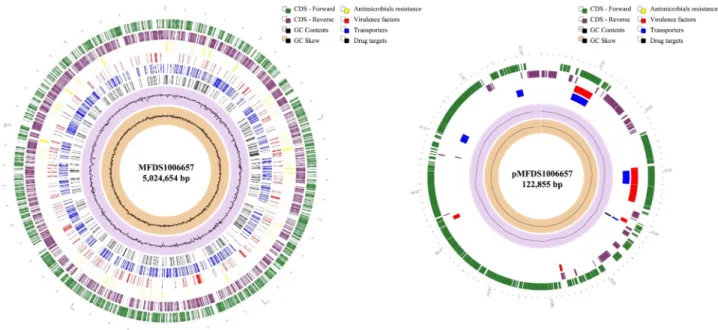
A total of 493,594 sequence reads were assembled into two contigs. Raw sequence reads were de novo assembled using the PacBio SMRT analysis system by HGAP2 assembler (version 8; Pacific Bioscience) and the final assembly showed coverage of 501X. The NCBI prokaryotic genome annotation pipeline was used for genome annotation (Tatusova et al., 2016). The complete genome sequence of Escherichia coli strain MFDS 1006657 contained 5,024,654 bp length of chromosomal DNA and a 122,855 bp length of plasmid with 50.8% and 48.7% of G + C contents, respectively. As a result of gene prediction, this strain was found to possess 4,884 CDSs, 93 tRNAs, and 22 rRNAs in the chromosome and 130 CDSs in a plasmid. A
whole genome sequence based on a multi-locus sequence typing MLST ver. 2.0.4 (Larsen et al., 2012) showed that this strain belongs to the sequence type ST7616. Also, in silico serotyping SerotypeFinder version 2.0.1 (Joensen et al., 2015) predicted the antigenic profile of this strain as O6 which is scarce compared to the noted outbreak-related serotypes so far (Bosilevac et al., 2011; Mellor et al., 2016). Furthermore, the Virulence Factor Database (Liu et al., 2019) detected that a strain of Shiga toxin-producing Escherichia coli MFDS1006657 possessing the stx2 and hlyA genes and negative for eae gene.
Unlike universal food poisoning accidents, which possessed intimin related gene (eae), these results were rare and showed a similar tendency to food poisoning outbreak that occurred in Europe, 2011 (King et al., 2012).
This uncommon STEC complete genome information would be useful for the investigation of potential possibilities for understanding the food-borne pathogen as well as provide the genetic basis for a more detailed analysis of virulence factors.
Nucleotide sequence accession number(s)
Nucleotide sequence accession numbers. The complete
Fig. 1. Genome map of Shiga toxin producing Escherichia coli (STEC) MFDS1006657 chromosomal DNA and plasmid DNA. The graphical circular maps above are shown of the alignment of genes and other genomic data. The tracks on the viewer are displayed as concentric rings, from outermost to innermost:
Forward CDS, Reverse CDS, GC Skew, GC contents, AMR genes, VF genes, transporters and drug target. Genes with specialized functions labeled with different colors as virulence-related genes in red, and other functional genes such as antimicrobials resistance, transporters, drug target as yellow, blue, and black.
Table 1. Genome features of Escherichia coli MFDS1006657
Feature Chromosome Plasmid
Size (bp) 5,024,654 122,855
G + C contents (%) 50.8% 48.7%
Total number of
CDSs 4,884 130
rRNA genes (5S, 16S, 23S) 22 (8, 7, 7) -
tRNA genes 93 -
GenBank Accession No. CP073589 CP073590
Shiga toxin-producing Escherichia coli MFDS1006657 genome ∙
131
Korean Journal of Microbiology, Vol. 57, No. 2 genome sequence of Escherichia coli MFDS1006657 has been
deposited at the NCBI GenBank database under the accession numbers CP073589 (chromosome, MFDS1006657) and CP 073590 (plasmid, pMFDS1006657), and the strain has been deposited in the Korean Culture Collection for foodborne Pathogens under the strain number MFDS1006657.
적 요
대장균은 전 세계적으로 식중독을 일으키는 세균 중 하나 이다. 본 연구에서는 2015년 광주에 있는 한 식당에서 일어난 식중독 사고의 원인 식품으로 추정되는 갈비살로부터 분리된 Escherichia coli (MFDS1006657)의 유전체 분석을 수행하였 다. Escherichia coli MFDS1006657는 한 개의 chromosome (5,024,636 bp)과 plasmid (122,855 bp)로 구성되어 있었고, 각 각의 G + C contents는 50.8%와 48.7%로 확인되었다. 또한, chromosome과 plasmid DNA에 예측된 유전자의 총 수는 5,014 (4,884 + 130)개의 단백질 코딩유전자, 93개 tRNA, 그리고 22 개의 rRNA로 확인할 수 있었다.
Acknowledgments
This research was financially supported by the Ministry of Food and Drug Safety, Republic of Korea (20161MFDS030).
Conflict of Interest
The authors have no conflicts of interest to report.
References
Bardiau M, Szalo M, and Mainil JG. 2010. Initial adherence of EPEC, EHEC and VTEC to host cells. Vet. Res. 41, 57.
Boerlin P, McEwen SA, Boerlin-Petzold F, Wilson JB, Johnson RP, and Gyles CL. 1999. Associations between virulence factors of Shiga toxin-producing Escherichia coli and disease in humans.
J. Clin. Microbiol. 37, 497–503.
Bosilevac JM and Koohmaraie M. 2011. Prevalence and characterization of non-O157 Shiga toxin-producing Escherichia coli isolates from commercial ground beef in the United States. Appl.
Environ. Microbiol. 77, 2103–2112.
Joensen KG, Tetzschner AMM, Iguchi A, Aarestrup FM, and Scheutz F. 2015. Rapid and easy in silico serotyping of Escherichia coli using whole genome sequencing data. J. Clin. Microbiol. 53, 2410–2426.
King LA, Nogareda F, Weill FX, Mariani-Kurkdjian P, Loukiadis E, Gault G, Jourdan-DaSilva N, Bingen E, Macé M, Thevenot D, Ong N, et al. 2012. Outbreak of Shiga toxin–producing Escherichia coli O104:H4 associated with organic fenugreek sprouts, France, June 2011. Clin. Infect. Dis. 54, 1588–1594.
Larsen MV, Cosentino S, Rasmussen S, Friis C, Hasman H, Marvig RL, Jelsbak L, Sicheritz-Pontén T, Ussery DW, Aarestrup FM, et al. 2012. Multilocus sequence typing of total genome sequenced bacteria. J. Clin. Micobiol. 50, 1355–1361.
Liu B, Zheng D, Jin Q, Chen L and Yang J. 2019. VFDB 2019: a comparative pathogenomic platform with an interactive web interface. Nucleic Acids Res. 47, D687–D692.
Mellor GE, Fegan N, Duffy LL, McMillan KE, Jordan D, and Barlow RS. 2016. National survey of Shiga toxin-producing Escherichia coli serotypes O26, O45, O103, O111, O121, O145, and O157 in Australian beef cattle feces. J. Food Prot. 79, 1868–1874.
Scallan E, Hoekstra RM, Angulo FJ, Tauxe RV, Widdowson MA, Roy SL, Jones JL, and Griffin PM. 2011. Foodborne illness acquired in the United States-major pathogens. Emerg. Infect. Dis. 17, 7–
15.
Tatusova T, DiCuccio M, Badretdin A, Chetvernin V, Nawrocki EP, Zaslavsky L, Lomsadze A, Pruitt KD, Borodovsky M, and Ostell J. 2016. NCBI prokaryotic genome annotation pipeline. Nucleic Acids Res. 44, 6614–6624.