Halioglobus sp. RR3-57 was isolated from a biofilter of a seawater recirculating aquaculture system and its complete genome sequence was obtained using the PacBio RS II platform.
Two circular contigs were assembled and considered as a chromosome and a plasmid (size of 4,847,776 bp and 155,799 bp, and G+C content of 57.5% and 53.2%, respectively).
Genomic analysis showed RR3-57 had 18 denitrification- related genes and an incomplete prophage.
Keywords: Halioglobus, complete genome, denitrification, seawater recirculating aquaculture system
Recirculating aquaculture systems (RASs) are closed-loop aquaculturing facilities where waste water from rearing tanks is removed by mainly microbial community and nitrogenous compounds are degraded and transformed by nitrifying and denitrifying bacteria in biofilters (Leonard et al., 2000). In that process, nitrate is reduced to nitrogen (N
2) or nitrous oxide (N
2O) through a process called denitrification (Ward, 1996).
For identification of denitrifying bacteria, bacteria were isolated from biofilters in a seawater RAS operated in National Institute of Fisheries Science (NIFS), Busan, South Korea (Lee et al.,
2016). Bacterial strains were cultivated on a modified denitrifi- cation medium (Wu et al., 2013) at 25°C for 7 days. Among isolated strains, a Gram-negative, aerobic bacterium, the strain RR3-57 showed 96.2% of 16S rRNA gene similarity with Halioglobus pacificus S1-72
T. The genomic DNA of the Halioglobus sp. RR3-57 was extracted and purified using MagAttract
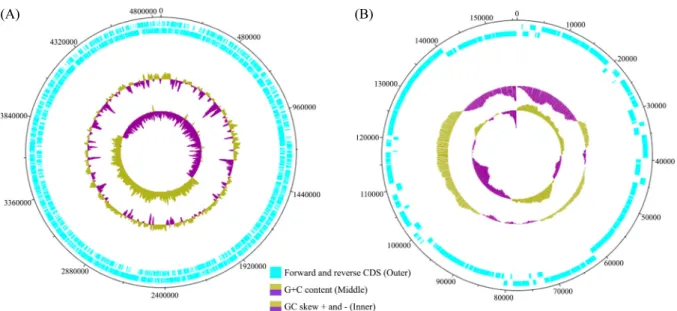
®High-Molecular-Weight Genomic DNA Kit (QIAGEN) and PacBio RS II platform (Pacific Biosciences) was used for whole genome sequencing. Sequence reads obtained were assembled by PacBio Hierarchical Genome Assembly Process (HGAP, Version 3.0) and two contigs were generated (Chin et al., 2013). Total 5,003,575 bp were obtained with two circular structures representing a chromosome and a plasmid (Fig. 1). Total 4,599 coding sequences including 43 tRNAs and 6 rRNAs were annotated by the Rapid Annotation using Subsystem Technology (RAST) pipeline (Aziz et al., 2008). The genome of Halioglobus sp. RR3-57 (contig 1) encoded 37 predicted nitrogen metabolism-related genes and among them, 18 genes were associated with denitrification, such as respiratory nitrate reductase, cytochrome cd1 nitrite reductase and nitricoxide reductase which reduce nitrate to nitrite, nitrite to nitric oxide and nitric oxide to dinitrogen oxide sequentially. However, nitrous oxide reductase gene was missing.
Korean Journal of Microbiology (2017) Vol. 53, No. 1, pp. 58-60 pISSN 0440-2413
DOI https://doi.org/10.7845/kjm.2017.7003 eISSN 2383-9902
Copyright ⓒ 2017, The Microbiological Society of Korea
Genome Announcement
Complete genome of a denitrifying Halioglobus sp. RR3-57 isolated from a seawater recirculating aquaculture system
Young-Sam Kim
1, Eun Soo Noh
2, Da-Eun Lee
1, and Kyoung-Ho Kim
1*
1
Department of Microbiology, Pukyong National University, Busan 48513, Republic of Korea
2
Biotechnology Research Division, National Institute of Fisheries Science, Busan 46083, Republic of Korea
순환여과양식시스템으로부터 분리된 Halioglobus sp. RR3-57의 유전체 분석
김영삼
1・ 노은수
2・ 이다은
1・ 김경호
1*
1
부경대학교 미생물학과,
2국립수산과학원 생명공학과
(Received February 1, 2017; Revised February 7, 2017; Accepted February 7, 2017)
*For correspondence.
E-mail: [email protected];Tel.: +82-51-629-5611; Fax: +82-51-629-5619
Complete genome of Halioglobus sp. RR3-57∙
59
Korean Journal of Microbiology, Vol. 53, No. 1 The PHAge Search Tool (PHAST) web server was used to
identify prophage (Zhou et al., 2011) and one incomplete prophage was detected with 13.2 kb in size and 47.8% G+C content containing 13 CDS.
Complete genome analysis of Halioglobus sp. RR3-57 will provide us a useful approach for understanding nitrogen metabolism in the RAS, but also additional tests will be required to fully appreciate this strain.
Acknowledgements
This work was supported by a Research Grant of Pukyong National University (2015 year).
Accession numbers of Halioglobus sp.
RR3-57
The strain was deposited in KCTC under the deposit number KCTC 52652. The sequences for the chromosome and the plasmid of Halioglobus sp. RR3-57 are accessible in GenBank under the accession number CP019046 and CP019045, respectively.
적 요
Halioglobus sp. RR3-57는 해수순환여과양식시스템의 생 물여과조에서 순수분리되었으며, PacBio RS II 서열분석법 을 이용하여 전체 유전체 서열이 해독되었다. 그 결과 길이 4,847,776 bp, G+C함량 57.5%인 염색체와 155,799 bp, 53.2%
인 플라스미드로 구성된 유전체 서열을 획득하였다. 유전체 분석결과 탈질작용에 관련된 18개의 유전자와 불완전한 프로 파지(prophage)로 추정되는 유전자서열이 확인되었다.
References
Aziz, R.K., Bartels, D., Best, A.A., DeJongh, M., Disz, T., Edwards, R.A., Formsma, K., Gerdes, S., Glass, E.M., Kubal, M., et al.
2008. The RAST Server: rapid annotations using subsystems technology. BMC Genomics 9, 75.
Table 1. Genome features of Halioglobus sp. RR3-57
Genome features Value
Contig 1 2
Sequencing depth (X) 285 315
Genome size (bp) 4,847,776 155,799
G+C content (%) 57.5 53.2
Protein coding sequences 4,410 140
tRNAs 43 0
rRNAs 6a 0
Coding percentageb 89.6 82.0
a Two operons of 16S rRNA genes
b (Total length for coding sequences)/(length of each contig)
(A) (B)
Fig. 1. Circular map of contig 1 (A), contig 2 (B). Marked characteristics are shown from outside to the center: CDS on forward strand, CDS on reverse strand, GC content, and GC skew.
60
∙Kim et al.미생물학회지 제53권 제1호
Chin, C.S., Alexander, D.H., Marks, P., Klammer, A.A., Drake, J., Heiner, C., Clum, A., Copeland, A., Huddleston, J., Eichler, E.E., et al. 2013. Nonhybrid, finished microbial genome assemblies from long-read SMRT sequencing data. Nat. Methods 10, 563– 569.
Lee, D.E., Lee, J., Kim, Y.M., Myeong, J.I., and Kim, K.H. 2016.
Uncultured bacterial diversity in a seawater recirculating aquaculture system revealed by 16S rRNA gene amplicon sequencing. J. Microbiol. 54, 296–304.
Leonard, N., Blancheton, J., and Guiraud, J. 2000. Populations of heterotrophic bacteria in an experimental recirculating aquaculture
system. Aquacul. Engineer. 22, 109–120.
Ward, B.B. 1996. Nitrification and denitrification: probing the nitrogen cycle in aquatic environments. Microb. Ecol. 32, 247–261.
Wu, Z., Huang, S., Yang, Y., Xu, F., Zhang, Y., and Jiang, R. 2013.
Isolation of an aerobic denitrifying bacterial strain from a biofilter for removal of nitrogen oxide. Aerosol Air Qual. Res.
13, 1126–1132.
Zhou, Y., Liang, Y., Lynch, K.H., Dennis, J.J., and Wishart, D.S. 2011.
PHAST: a fast phage search tool. Nucleic Acids Res. 39, W347–
352.