Anti-Inflammatory Effect of Essential Oils Extracted from Wood of Four Coniferous Tree Species 1KORAPP
Jiyoon YANG
2,3⋅Won-Sil CHOI
4⋅Jae-Woo KIM
2⋅Sung-Suk LEE
2⋅Mi-Jin PARK
2,†ABSTRACT
1)The aim of this study was to evaluate the anti-inflammatory effects of essential oils extracted from the wood of Chamaecyparis obtusa, Pinus densiflora, Pinus koraiensis, and Larix kaempferi. Essential oils were extracted by hydrodistillation, and their chemical components were determined by GC/MS. Major chemical components of these essential oils were α-cadinol (19.25%), τ-muurolol (14.20%), and α-pinene (13.74%) in C. obtusa; α-pinene (47.16%), longifolene (14.31%), β-phellandrene (11.78%), and β-pinene (11.02%) in P. densiflora; α-pinene (13.49%) and longifolene (10.79%) in P. koraiensis, and geranyl linalool (23.58%) and α-pinene (18.57%) in L. kaempferi. To evaluate the anti-inflammatory effects of essential oils, lipopolysaccharide (LPS)-induced RBL-2H3 mast cells were treated with these essential oils;
then, the changes in the mRNA expression level of the cytokines IL-4 and IL-13 were examined. Further, degranulation was evaluated by measuring β-hexosaminidase release. After LPS-induced RBL-2H3 mast cells were exposed to 10
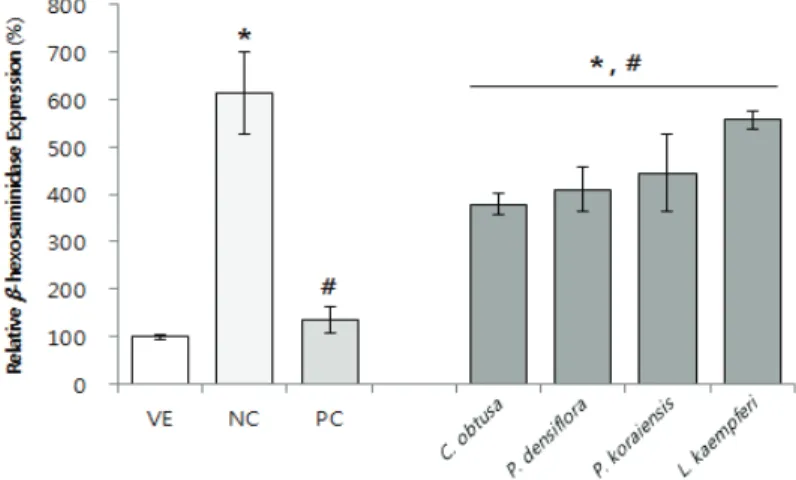
−7% of all types of essential oils, the gene expression levels of IL-4 and IL-13 within the cells remarkably decreased. The relative mRNA expression level of IL-4 was 69.6% in P. densiflora, 63.2% in P. koraiensis, 55.1% in C. obtusa, and 45.8% in L. kaempferi compared with that in the group treated with LPS. The mRNA expression level of L-13 should a similar trend. The inhibitory rate of IL-13 mRNA expression of P. densiflora, P. koraiensis, C. obtusa, and L. kaempferi was 57.8%, 57.1%, 51.1%, and 34.5%, respectively. β-Hexosaminidase release significantly decreased following the treatment with the four types of essential oils. The rate of β-hexosaminidase release were 38.1% C. obtusa; 33.0% P. densiflora;
27.4% P. koraiensis; and 9.1% L. kaempferi. Among all types of essential oils, that extracted from P. densiflora wood showed the highest anti-inflammatory activity. These results show that the tested essential oils exert an anti-inflammatory effect through the inhibition of degranulation and expression of cytokines.
Keywords: Chamaecyparis obtusa, Pinus densiflora, Pinus koraiensis, Larix kaempferi, essential oil, anti-inflammatory effect
1. INTRODUCTION
Forests account for approximately 64% (6,335,000 ha) of the national territory of Korea, of which 36.9%
(2,339,000 ha) is occupied by coniferous forest that cover a larger proportion of the land than broadleaf forest [32.0% (2,029,000 ha)] (Kong, 2004). Based on species, coniferous forest occupies a vast amount of
1
Date Received July 11, 2019, Date Accepted October 16, 2019
2
Division of Wood Chemistry, Department of Forest Products, National Institute of Forest Science, Seoul 02455, Republic of Korea
3
Division of Life Sciences, School of Life Sciences, Korea University, Seoul 02841, Republic of Korea
4
National Instrumentation Center for Environmental Management, Seoul National University, Seoul 08826, Republic of Korea
†
Corresponding author: Mi-Jin PARK (e-mail: [email protected], ORCID: 0000-0002-7748-3886)
Original Article
the land [43.7% (403971300 m
3, 172.7 m
3/ha)] (Korea Forest Service, Basic Statistics of Forests, 2016).
Among coniferous trees, cypress, pine, pine nut, and Japanese larch are used for timber (Korea Forest Service, Basic Statistics of Forests, 2016). Since cypress (Chamaecyparis obtusa Sieb. et Zucc.) was first introduced from Japan in 1904, it has been planted in the southern area as an economic species, and it has continuously been cultivated by national projects to develop more green areas (Lee et al., 2014). Cypress timber is considered high-quality wood with a unique scent; thus, it is widely used in architecture and manufacture of high-end furniture. Cypress extract contains various substances, of which bioactive substances are well known. All parts of pine (Pinus densiflora Sieb. et Zucc.), an evergreen softwood species, are very useful because its leaf, conifer cone, and pine resin are widely used. Pine are also used in home remedies for the treatment of diseases such as neuralgia, diabetes, and hypertension (Cho et al., 2009).
Among other local tree species, pine is particularly closely related to the local community. Indeed, it has been regarded as a vital tree species in terms of cultural value.
Pine nut (P. koraiensis Sieb. et Zucc.) offers double benefits because it provides timber and edible seeds.
Because of its robust tolerance to cold and resistance against damages caused by blights and harmful insects, its plantation has long been recommended by the government considering its potential as a long-term source of timber since the 1960s. Japanese larch (Larix kaempferi Lamb.) was introduced from Japan in the 1910s, it has been planted across the country, because of its rapid growth, and is used for artificial forests and is widely used in the manufacture of wooden products and architectural materials (Kang et al., 2016;
Han et al., 2017). Korea’s appreciation toward forests is deepening, and the demand for the use of these forests is diversifying. Pine, pine nut, and Japanese larch are
the tree species that are harvested across the country on a large scale. Thus, research to enhance the use of locally accumulated resources and their byproducts following woodcutting is currently required.
With many synthetic drugs and chemical preser- vatives being identified to be hazardous, natural products are drawing considerable attention. Various studies have been conducted on the use of tree extracts including essential oils for the development of antioxidants (Jung et al., 2017; Kim et al., 2017), anti-inflammatory drugs (Min et al., 2017; Yang et al., 2017), antifungal agents (Rho et al., 2014; Kim et al., 2013), anticomplements (Li et al., 2018), and biofilm inhibitors (Ham and Kim, 2018). Essential oils, secondary metabolites of plants, have various biological activities, among which soothing effect and robustness are well known. In particular, essential oils are often used in aroma therapy for their known benefits to restore mental and physical balance as well as to maintain homeostasis. These properties are induced by the substances present in them such as ketone, terpene, and phenolic ether (Carvalho-Freitas and Costa, 2002).
A study showed the antifungal effect of an essential oil extracted from leaves of coniferous trees such as pine, pine nut, cypress, and fir tree (Hong et al., 2004;
Kim et al., 2016). Ibrahim et al. evaluated the anti-inflammatory and scar-healing effects of an essential oil extracted from the cones of six types of coniferous trees belonging to the Pinaceae family.
Plants belonging to an identical family and genus
showed different degrees of anti-inflammatory and
scar-healing effects. Cedrus libani and Abies cilicica
subsp. Cilicica have anti-inflammatory effects. Further,
the herbicidal effect of essential oils extracted from
the leaves of locally bred pine, pine nut, Japanese larch,
and Khingan fir was studied (Yun et al., 2013). As
a result of verifying the in vitro herbicidal activity
of essential oils extracted from four coniferous tree
species on germination, these essential oils (except that
derived from pine leaf) showed herbicidal activity. The different degrees of herbicidal activity because of the different substances present in these essential oils and their concentrations affects cytotoxicity and the cell cycle. The importance of these tree species and their concentration in the field where they can be practically used is high (Ahn et al., 2018).
There are varied ongoing studies on the bioactivity of essential oils extracted from coniferous tree species, but limited to leaves and the studies on the bioactivity of essential oils extracted from the wood are insufficient.
Therefore, this study aimed to compare and analyze the anti-inflammatory activity of essential oils extracted from the wood of four coniferous tree species including cypress (C. obtusa), pine (P. densiflora), pine nut (P.
koraiensis), and Japanese larch (L. kaempferi), all of which are typical local tree species used for timber.
This study also aimed to verify the potential use of essential oils extracted from coniferous wood for improving or preventing allergic diseases.
2. MATERIALS and METHODS
2.1. Plant materials
Cypress (C. obtusa Sieb. et Zucc.) and pine (P.
densiflora Sieb. et Zucc.) were purchased through the Gapeyong National Forestry Cooperative Federation, which were obtained from the South Sea in December of 2014. Japanese larche (L. kaempferi Sieb. et Zucc.) was cut in Pyeongchang in December 2015, whereas pine nut (P. koraiensis Sieb. et Zucc.) was cut in Gapyeong in January 2016.
2.2. Essential oil extraction
The wood of cypress, pine, pine nut, and Japanese larch were grinded to extract essential oils through hydrodistillation. One kg of a sample was placed in a 10 L round-bottomed flask; then, 6 L distilled water
was poured and the mixture was heated to 105°C.
Vaporized substances formed an extract, which was cooled to obtain essential oils. Extraction continued until no more essential oil was obtained, which lasted for approximately 7 h. The extracted essential oil was processed to remove moisture using anhydrous Na
2SO
4(SAMCHUN,98.5). The final product was stored in a refrigerator until analysis.
The yield rate of essential oils was calculated using the following equation.
Yield rate [%(w/w)] =
{weight of extracted essential oil (g)/
oven dry weight of samples (g)} × 100%
2.3. Cell culture
To assess the level of anti-inflammatory effect of essential oils extracted from the wood of the four coniferous tree species, RBL-2H3 mast cells (CRL- 22256™; American Type Culture Collection, Manassas, Manassas, VA, USA) were purchased in lots. These cells were cultured in Dulbecco’s modified Eagle’s medium (Gibco) containing 10% fetal bovine serum (Gibco), 1% penicillin/streptomycin (Gibco), and 0.4 μL/mL mycoplasma guard in an incubator (Panasonic, MCO-19AIC) at 37°C (5% CO
2).
2.4. Chemical composition of essential oils
The essential oils extracted from the wood of the four coniferous tree species were qualitatively analyzed using GC/MS (Trace 1310/ISQ-LT, ThermoScientific, USA). The Tr-5MS capillary column (30 m × 0.25 mm
× 0.25 μm; ThermoScientific, USA) was used, and helium (1 mL/min, 25 psi) was used as the carrier gas.
Sample inlet was maintained at 250°C. Further, an oven
was maintained at 40°C for 3 min, after which the
temperature was increased by 3°C until it reached 200°C
and then was raised by 15°C until it reached 340°C for 10 min. FID and mass spectrum of detected chemicals were recorded. FID was maintained at 280°C, and the flow rate for helium was 40 mL/min. The temperatures of the interface of a mass spectrometer and ion source were maintained at 280°C and 250°C, respectively.
The analyzed substances in essential oils were selected based on the value showing the highest spectral matching when the S/N ratio reached ≥100 in total-ion chromatography at peaks with NIST library search program (ver.11). Furthermore, to confirm the chemical composition of essential oils, the Kovats retention index was calculated using n-alkanes (C
8–C
20, Sigma-Aldrich).
2.5. 3-(4,5-Dimethylthiazole-2-yl)-2,5- diphenyl tetrazolium bromide (MTT) assay
To assess the cytotoxicity of essential oils toward RBL-2H3 mast cells, the MTT assay was performed.
A 200 μL culture medium was used, and cells were seeded in a 96-well plate at a density of 8 × 10
3cells/well. Then, the plate was incubated in an incubator at 37°C with 5% CO
2for 1 day. The MTT reagent (Sigma, Cat.#. 11465007001) was added to the cells that were exposed to the essential oils at concentrations of 10
−7%–10
−5%. They were again placed in the incubator at 37°C for 6 h. The growth culture medium and MTT reagent were removed, and the mixture was washed with Dulbecco’s phosphate-buffered saline (Gibco). Next, 100 μL dimethyl sulfoxide (Sigma) was added to each well, and the mixture was stored at room temperature for 10 min. The optical density of the cells was determined at a wavelength of 540 nm using a spectrophotometer.
2.6. Quantitative mRNA analysis by real-time PCR
RBL-2H3 mast cells were seeded into a 6-well plate
at a density of 3 × 10
5cells/well, and the plate was incubated for 24 h with 1 μg/mL lipopolysaccharide (LPS). Then, the essential oils were processed. After 24 h cultivation, 500 μL TRIzol reagent (Invitrogen Life Technologies) was added to each well of the 6-well plate, and the cells were dissolved and moved into tubes.
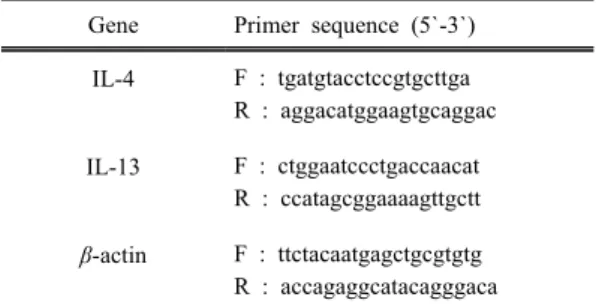
Next, 100 μL chloroform was added, and the tubes were centrifuged at 14,000 rpm for 10 min. Further, 150 μL of the obtained supernatant was collected, and isopropanol was added in the same amount. RNA was condensed at −20°C for 24 h. After centrifuging the mixture at 14,000 rpm at 4°C for 10 min, the supernatant was removed, 200 μL DEPC/EtOH was added, the mixture was centrifuged, and then the entire supernatant was removed. Next, 20 μL DEPC/DW was added, the mixture was stored at 55°C for 5 min to increase the temperature, and then RNA concentration was measured at a wavelength of 260 nm using a microplate spectrophotometer (Epoch, model Take 3; BioTek Inc., Winooski, VT, USA). cDNA was synthesized from mRNA using a quantitative method; then, real-time PCR was performed using a real-time PCR system (Applied Biosystems, Foster, CA, USA). The sequences of the oligonucleotide primers used are shown in Table 1.
The relative values for each wood essential oil were determined using the RQ software (version 1.3, Applied Biosystems).
Gene Primer sequence (5`-3`) IL-4 F : tgatgtacctccgtgcttga
R : aggacatggaagtgcaggac
IL-13 F : ctggaatccctgaccaacat R : ccatagcggaaaagttgctt
β-actin
F : ttctacaatgagctgcgtgtg R : accagaggcatacagggaca F: forward, R: reverse
Table 1. Oligonucleotide sequences for quantitative
real-time polymerase chain reaction
2.7. β-Hexosaminidase secretion assay
To analyze the changes in the rate of β-hexosami- nidase release by the essential oils in LPS-induced RBL-2H3 mast cells, cells were seeded into a 96-well plate at a density of 8 × 10
3cells/well and then sti- mulated with DNP-specific IgE (800 ng/mL, Sigma, USA). After removing the culture medium, the mix- ture was washed twice with Tyrodes’ solution [119 mM NaCl, 4.74 mM KCl, 2.5 mM CaCl
2, 1.19 mM MgSO
4, 10 mM HEPES, 5 mM glucose, 0.1% (w/v) BSA; pH 7.3] and cultivated for 15 min; a mixture of the essential oils and DNP/BSA was incubated for 1 h. Then, 50 μL supernatant was transferred to a tube, added with 200 μL of 1 mM P-nitrophenyl-N- acetyl-β-D-glucosaminide, and cultured at 37°C for 1 h. To terminate the reaction, 0.05 M sodium bicar- bonate buffer was added, and optical density was measured at a wavelength of 405 nm.
3. RESULTS and DISCUSSION
3.1. Yield and chemical composition of essential oils
The yield rate of the essential oils extracted from the wood of the four coniferous tree species was the highest for cypress (0.86%) and pine (0.75%) followed by pine nut (0.25%) and Japanese larch (0.06%).
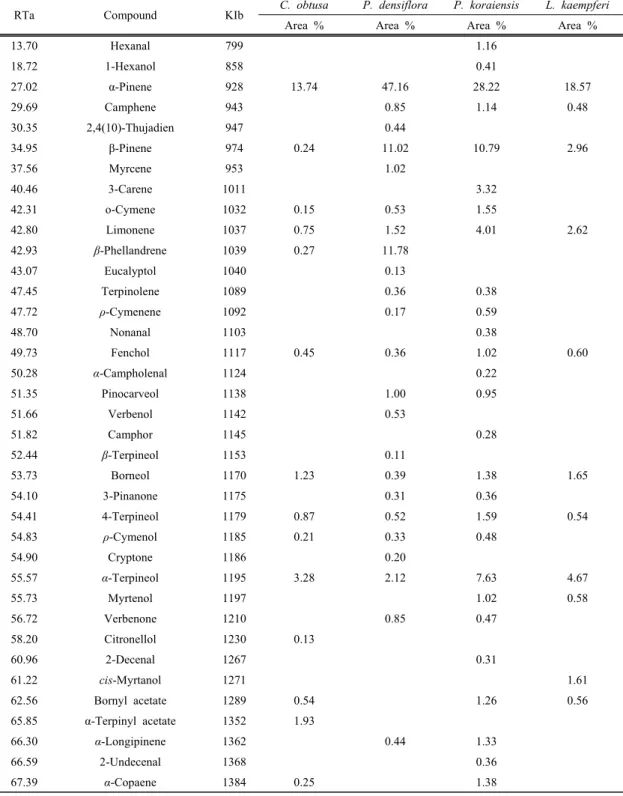
The chemical composition of these essential oils is summarized in Table 2. In brief, the essential oil extracted from cypress wood contained 23.79%
monoterpene, 76.07% sesquiterpene, and 0.13% other substances. The essential oil extracted from pine wood contained 81.49% monoterpene, 17.75% sesquiterpene, 0.55% diterpene, and 0.20% other substances. Further, the essential oil extracted from pine nut wood contained 67.90% monoterpene, 21.93% sesquiterpene 8.08%
diterpene, and 2.09% other substances. Lastly, the essential oil extracted from Japanese larch contained
34.82% monoterpene, 29.70% sesquiterpene, and 35.48% diterpene, indicating that their proportion is similar. The main substances in cypress included α -cadinol (19.25%), τ-muurolol (14.20%), α-pinene (13.74%), τ-cadinol (9.84%), δ-cadinene (7.37%), and γ-cadinene (6.52%), whereas those in pine included α -pinene (47.16%), longifolene (14.31%), β-phellandrene (11.78%), and β-pinene (11.02%). The main substances in pine nut included α-pinene (28.22%), longifolene (13.49%), β-pinene (10.79%), cembrene (8.08%), and α-terpineol (7.63%), whereas those in Japanese larch included geranyl linalool (23.58%), α-pinene (18.57%), α-cadinol (6.24%), and cembrene (6.12%). Among the detected vaporizing substances, α-pinene, β-pinene, limonene, fenchol, borneol, 4-terpineol, α-terpineol, and δ-cadinene were detected in all essential oils.
3.2. Influence on IL-4 and IL-13 gene expression
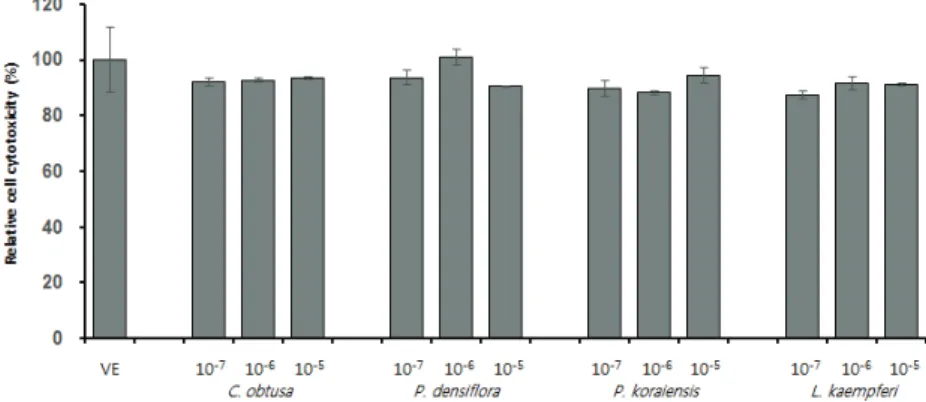
To determine the influence of essential oils extracted from the wood of the four coniferous tree species on the survival and reproduction of RBL-2H3 mast cells, these essential oils were processed at concentrations of 10
−7%–10
−5%, and then MTT assay was performed.
Cytotoxicity results are presented in Fig. 1.
When the essential oils were compared with the oils of the vehicle group (VE), cytotoxicity was not observed at concentrations of 10
−7%–10
−5%. Accordingly, further evaluation confirmed the anti-inflammatory effect of all essential oils at a concentration of 10
−7%.
RBL-2H3 mast cells, derived from basophils, play crucial roles in anti-inflammatory activity together with other mast cells. They are known to be a useful model for the study of the effects of drugs triggering the re- lease of IL-4 and IL-13, which cause inflammation by various external stimulation and regulate the immune system (Prussin and Metcalfe, 2003; Kindt et al., 2007).
IL-4 and IL-13 released following mast cell activity
RTa Compound KIb
C. obtusa P. densiflora P. koraiensis L. kaempferiArea % Area % Area % Area %
13.70 Hexanal 799 1.16
18.72 1-Hexanol 858 0.41
27.02 α-Pinene 928 13.74 47.16 28.22 18.57
29.69 Camphene 943 0.85 1.14 0.48
30.35 2,4(10)-Thujadien 947 0.44
34.95 β-Pinene 974 0.24 11.02 10.79 2.96
37.56 Myrcene 953 1.02
40.46 3-Carene 1011 3.32
42.31 ο-Cymene 1032 0.15 0.53 1.55
42.80 Limonene 1037 0.75 1.52 4.01 2.62
42.93
β-Phellandrene1039 0.27 11.78
43.07 Eucalyptol 1040 0.13
47.45 Terpinolene 1089 0.36 0.38
47.72
ρ-Cymenene1092 0.17 0.59
48.70 Nonanal 1103 0.38
49.73 Fenchol 1117 0.45 0.36 1.02 0.60
50.28
α-Campholenal1124 0.22
51.35 Pinocarveol 1138 1.00 0.95
51.66 Verbenol 1142 0.53
51.82 Camphor 1145 0.28
52.44
β-Terpineol1153 0.11
53.73 Borneol 1170 1.23 0.39 1.38 1.65
54.10 3-Pinanone 1175 0.31 0.36
54.41 4-Terpineol 1179 0.87 0.52 1.59 0.54
54.83
ρ-Cymenol1185 0.21 0.33 0.48
54.90 Cryptone 1186 0.20
55.57
α-Terpineol1195 3.28 2.12 7.63 4.67
55.73 Myrtenol 1197 1.02 0.58
56.72 Verbenone 1210 0.85 0.47
58.20 Citronellol 1230 0.13
60.96 2-Decenal 1267 0.31
61.22
cis-Myrtanol1271 1.61
62.56 Bornyl acetate 1289 0.54 1.26 0.56
65.85 α-Terpinyl acetate 1352 1.93
66.30
α-Longipinene1362 0.44 1.33
66.59 2-Undecenal 1368 0.36
67.39
α-Copaene1384 0.25 1.38
Table 2. The major constituents of four coniferous oils
RTa Compound KIb
C. obtusa P. densiflora P. koraiensis L. kaempferiArea % Area % Area % Area %
67.46 Longicyclene 1386 0.44
67.92
β-Elemene1395 1.17
68.17 (+)-Sativene 1401 0.36 0.31
68.97 Longifolene 1423 14.31 13.49
69.30
β-Caryophyllene1432 0.22 0.56 1.31
70.20
β-Farnesene1456 0.17 0.29
70.64 Humulene 1468 0.46 0.11 0.29
70.77 Ethyl cinnamate 1472 0.71
71.23
γ-Muurolene1485 2.79 0.14 1.65
71.53 Germacrene-D 1493 0.75
71.82
β-Selinene1501 0.87 0.64
72.01
α-Muurolene1507 4.16 0.78 1.67
72.20
β-Bisabolene1514 0.36
72.53
γ-Cadinene1525 6.52 0.11 2.56
72.65
δ-Cadinene1529 7.37 0.31 0.50 4.07
72.78 Calamenene 1533 1.08 0.68
73.25
α-Cadinene1549 0.78
73.42
α-Calacorene1554 0.43 0.70
73.52 3,7(11)-Selinadiene 1558 0.58
73.74 Nerolidol 1565 1.03 0.52
74.72 Gleenol 1598 0.40
74.78
γ-Eudesmol1600 0.28 0.50
75.42 Longiborneol 1623 0.52 0.43
75.61 Carotol 1630 1.21 0.99
75.71 Globulol 1634 0.28
75.95 Cubenol 1642 2.14 0.43 1.13
76.30
τ-Cadinol1655 9.84 3.00
76.36
τ-Muurolol1657 14.20 0.11 3.66
76.69
α-Cadinol1669 19.25 0.17 6.24
76.88 Juniper camphor 1676 1.08 0.79
77.19 Cadalene 1688 0.22 0.60
78.52 Falcarinol 1732 0.13
86.29 Cembrene 1956 0.55 8.08 6.12
88.24 Manoyl oxide 2024 0.66
88.38 Atiserene 2032 0.52
89.11 Thunbergol 2071 4.61
89.26 Geranyl linalool 2079 23.58
a