INTRODUCTION
The effect of temperature on egg development of aquatic insects is well known. Eggs of aquatic insects such as caddisfly, mayfly and stonefly can develop generally in a shorter time period at higher water temperatures (Brinck, 1949; Hynes, 1974; Zwick, 1980; Ward and Stanford, 1982; Jop and Szczytko, 1984; Brittain et al., 1984; Marten, 1990). A coefficient of the regression line relating the egg incubation period and water temperature has been used to compare the characteristics of egg development process of respective species.
Brittain (1990) reported that the coefficient ex- plained the necessary condition of temperature for development of the eggs. However, the regre- ssion line does not suitably reflect egg periods at higher water temperatures. Using the coefficient is not always useful for considering the life cycle of aquatic insects. Other indicator is needed in order to consider the life cycle of aquatic insects.
In this report, the total effective temperatures (TET) of 14 species in stonefly were calculated by multiplying the mean egg incubation days and the water temperature in the incubation period.
From the results of optimal water temperature for the egg development in respective species, author tries to discuss their habitat.
MATERIALS AND METHODS
Adult females of Oyamia lugubris, Oyamia seminigra, Kamimuria tibialis, and Kamimuria uenoi were collected during the oviposition sea- son in 1996; adult females of Sweltsa sp. 2, Iso- perla nipponica, Stavsolus sp., Ostrovus sp., and Amphinemura sp. were collected in 1997, and those of Sweltsa sp. 1, Sweltsa sp. 3, Stavsolus japonicus, and Kiotina pictetii were collected in 1998. The females of all the species, except for Isoperla aizuana, were observed flying for ovi- position at three stations: Aritoshi (34�23′N,
─
─ 22 ──
The Relationship Between Egg Incubation Period and Temperature in Several Species of Plecoptera
Yoshimura, Mayumi*
(Forest Biodiversity Group, Kansai Research Center, Forestry and Forest Products Research Institute, Nagaikyuutaro 68, Momoyama, Fushimi, Kyoto 612-0855, Japan)
Egg incubation periods of 14 species of plecoptera were examined at 10��~~11��C, 15��~~ 16��C, 20��C, and 23��C under dark conditions. The total effective temperature (TET) was calculated by multiplying mean egg incubation days and water temperature of incubation periods. The relation between the TET and the incubation temperature was used to compare the life cycle of respective species. Perlodid species had higher TET values with a positive relation to incubation temperature than those of other species. Perlid species had low TET values in the 14 species with negative to vari- able relation, and Chloroperlid species showed variable to positive relations to incu- bation temperature. These results suggest that the relation between the TET and the water temperature reflected on their habitat of respective species.
Key words : egg incubation period, habitat, Plecoptera, total effective temperature (TET)
* Corresponding Author: Tel: ±81-75-611-1201, Fax: ±81-75-611-1207, E-mail: [email protected]
136�00′E), Omata (34�22′N, 136�03′E), and the upper reaches of Omata (34�21′N, 136�05′E) along the Shigo River in Nara Prefecture. Individuals of respective species were collected, brought to the laboratory, and housed separately in plastic vials (ø 3×6.5 cm). Newly emerged adults of Isoperla
aizuana were collected at Kizu in Kyoto Pre- fecture (34�44′N, 135�49′E) in 1998 and brought to the laboratory; they were paired in the vials and allowed to mate naturally. The insects were fed diluted honey with water (1 : 10) soaked into cotton almost every day.
Table 1. Averaged mean egg incubation period and averaged hatching success of 14 species.
Temperature (�C) Mean egg incubation
Hatching success (%) Number of examined
period (Days) egg masses
Chloroperlidae
Sweltsa sp. 1 23 31.9 17.98 8
20 27.8 67.72 8
16 35.6 55.75 8
11 54.3 54.46 7
Sweltsa sp. 2 20 39.0 10.58 1
Sweltsa sp. 3 23 41.0 10.60 1
20 41.0 23.63 4
16 56.8 16.02 5
11 89.0 9.65 1
Perlodidae
Isoperla aizuana 23 - 0.00 3
20 164.0 85.71 2
16 175.5 43.68 2
11 189.0 21.88 1
Isoperla nipponica 15 138.0 44.84 5
10 134.0 37.48 2
Stavsolus japonicus 23 123.0 41.96 6
20 141.3 63.10 7
16 118.1 97.86 7
11 147.0 85.10 7
Stavsolus sp. 20 96.0 28.95 1
Ostrovus sp. 20 129.0 71.79 1
15 116.0 77.39 1
Perlidae
Kiotina pictetii 23 25.0 79.40 1
20 25.0 100.00 1
16 33.5 92.22 2
Oyamia lugubris 23 34.0 40.08 2
20 35.0 68.69 2
15 45.5 37.25 2
Oyamia seminigra 23 22.5 64.25 2
20 29.5 74.15 2
15 49.0 66.80 1
Kamimuria tibialis 23 17.5 59.78 4
20 20.8 78.08 5
15 35.0 70.00 4
Kamimuria uenoi 23 20.8 46.35 6
20 24.5 41.15 2
15 35.3 28.60 4
Nemouridae
Amphinemura sp. 23 - 0.00 4
20 12.0 24.59 2
15 16.2 33.64 5
10 20.0 38.69 2
Egg masses deposited at the bottoms of the vials were collected and put into a 3 or 5 cm dia- meter Petri dish filled with water. These eggs were incubated at 10~11�C, 15~16�C, 20�C, and 23�C under dark conditions. The temperature treatments for each egg mass were determined randomly. The egg masses of most of the species were incubated at three or four different temper- atures. The Sweltsa sp. 2, Isoperla nipponica, Stavsolus sp., and Ostrovus sp. egg masses were incubated under one or two temperature condi- tions owing to the small number of egg masses available for examination. Newly hatched nymphs were counted every two days and removed.
The incubation of eggs was terminated in eight months after the oviposition date if new nymphs were not found in the petri dish. The day at which half the nymphs had hatched was estimated, and the period between the hatching and the oviposi- tion date was used as the mean egg incubation period. The egg hatching rate was calculated as the total number of hatched nymphs divided by the number of total eggs per mass.
The total effective temperature (TET) was cal- culated by multiplying the mean egg incubation days and the incubation water temperature. The relations between TET and incubation tempera- ture were categorized into three classes: positive, variable, and negative. When the TET value in-
creased with water temperature, it was catego- rized as a positive. The TET value decreased with temperature categorized as a negative. A variable relation was defined as the TET value was unchanged with temperature (range: 50 days
�C).
The Sweltsa sp. 1 investigated in the present study is the same as the Sweltsa sp. recorded by Hayashi et al. (1997). Stavsolus sp. 1 and Stav- solus sp. 2 were defined by habitat and by head and abdomen patterns according to Inada (1996).
Ostrovus sp. was identified by the pattern of the head and abdomen according to Inada (1996).
Sweltsa sp. 2 and Sweltsa sp. 3 were defined by the pattern of the prothorax and parietalia of the head according to Hayashi (1996).
RESULTS
The mean egg incubation period of perlodid species was longer than 100 days regardless of water temperature, except for Stavsolus sp. at 20�C, and the period of Amphinemura sp. (Ne- mouridae) was shorter than 20 days (Table 1).
There were no intra-specific differences in the period at the same water temperature conditions in the 14 species. The period tended to decrease with temperature increased between 10�C and
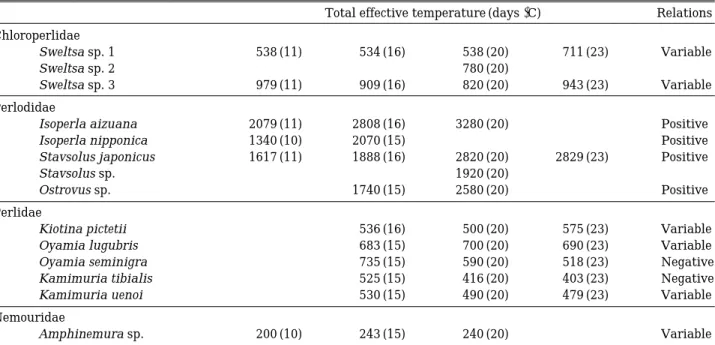
Table 2. The value of TET at each water temperature and relations of fourteen species in this study.
Total effective temperature (days �C) Relations Chloroperlidae
Sweltsa sp. 1 538 (11) 534 (16) 538 (20) 711 (23) Variable
Sweltsa sp. 2 780 (20)
Sweltsa sp. 3 979 (11) 909 (16) 820 (20) 943 (23) Variable
Perlodidae
Isoperla aizuana 2079 (11) 2808 (16) 3280 (20) Positive
Isoperla nipponica 1340 (10) 2070 (15) Positive
Stavsolus japonicus 1617 (11) 1888 (16) 2820 (20) 2829 (23) Positive
Stavsolus sp. 1920 (20)
Ostrovus sp. 1740 (15) 2580 (20) Positive
Perlidae
Kiotina pictetii 536 (16) 500 (20) 575 (23) Variable
Oyamia lugubris 683 (15) 700 (20) 690 (23) Variable
Oyamia seminigra 735 (15) 590 (20) 518 (23) Negative
Kamimuria tibialis 525 (15) 416 (20) 403 (23) Negative
Kamimuria uenoi 530 (15) 490 (20) 479 (23) Variable
Nemouridae
Amphinemura sp. 200 (10) 243 (15) 240 (20) Variable
Total Effective Temperature: TET, calculated by multiplying the mean egg incubation days times the incubation water temperature, Relations: the relations between TET and water temperature, (Number): the water temperature that each egg mass were incubated.
23�C. This decreasing trend was clearly observed in Perlidae; however, Sweltsa sp. 1, Sweltsa sp.
3, perlodid species, and Kiotina pictetii did not show a decrease in the period at higher water temperatures. Hatching success differed depen- ding on water temperature (Table 1). The hatch- ing success of chloroperlid and perlid species was highest at 20�C. In Isoperla aizuana, no eggs ha- tched at 23�C, and the success was highest at 20�C. In Stavsolus japonicus, the success was highest at 16�C.
The total effective temperature (TET) showed that perlodid species had higher values with a positive relation to water temperature (Table 2).
Perlid species had lower TET values of the 14 species and showed a negative relation in Oya- mia seminigra and Kamimuria tibialis and a variable relation in Kamimuria uenoi and Oya- mia lugubris. Chloroperlid species showed vari- able relations; when the water temperature was higher than 20�C, the value of TET increased im- mediately. In Amphinemura sp., the TET value was low, and the relation between temperature and TET was variable.
DISCUSSION
Perlodid species had higher hatching success at lower water temperature, whereas Perlid species had it at higher water temperature. This result suggests that perlid species can inhabit warmer areas than perlodid species. In fact, only perlid species inhabit tropical areas (Illies, 1964;
Zwick, 1996). In Japan, perlodid species are abundant in the northern areas and at higher altitudes, while perlid and chloroperlid species can be seen throughout Japan (Kawai, 1985;
Uchida, 1987). The eggs of Isoperla aizuana did not hatch at 23�C, also suggesting that their ha- bitats are in relatively cold areas. Besides, Stav- solus japonicus and Isoperla aizuana showed positive relations between TET and water tem- perature. So, it would indicate that the habitats of these species with a positive relation are in a relatively colder area.
Oyamia seminigra and Kamimuria tibialis exhibited a negative relation between TET and water temperature, while Oyamia lugubris and Kamimuria uenoi displayed a variable relation.
In the field, Oyamia seminigra and Kamimuria tibialis inhabit warmer areas than Oyamia lugu-
bris and Kamimuria uenoi (Uchida, 1987). There- fore, it appears that species with a negative relation are found in relatively warmer habitats than are species those with a variable relation.
The higher TET values of Kamimuria uenoi and Oyamia lugubris, as compared with those of Oya- mia seminigra and Kamimuria tibialis, would also indicate that their habitats have lower wa- ter temperatures.
The TET values calculated from the data of European species in Saltvait & Lillehammer (1984) also provide habitat information. Isoperla difformis shows a negative relation between 8�C and 20�C; thus, the optimal temperature would be higher than 20�C. Isoperla grammatica shows a variable to positive relation between 12�C and 20�C, and the optimal temperature would be between 12 and 20�C. Isoperla obscura shows a positive relation between 4�C and 12�C and has the highest TET value among the three species, making the optimal temperature lower than 4�C.
The actual habitats of these three species are consistent with the predicted habitat temper- atures. In the field, Isoperla difformis does not live above 700 m, whereas Isoperla obscura inhabits only higher altitudes. Isoperla gram- matica inhabits areas midway between the two (Saltvait and Lillehammer, 1984).
In this study, the relations between TET and incubation temperature of Oyamia seminigra and Kamimuria tibialis were negative, so that their optimal water temperature would be war- mer than the examined water temperatures. The relations of perlodid species were positive, and thus these species are considered to inhabit areas with colder water temperatures than those examined. Chloroperlid species, Amphinemura sp. and other perlid species exhibited variable re- lations, indicating that the examined water tem- peratures would be optimal for these species. I think that the value of TET helps us discern the species differences in optimal temperature and their habitat.
LITERATURE CITED
Brinck, P. 1949. Studies on Swedish stoneflies (Ple- coptera). Opuscula Entmologica, Supplement 11:
1-250.
Brittain, B.J., A. Lillehammer and S.J. Saltvei. 1984.
The effect of temperature on intraspecific varia- tion in egg biology and nymphal size in the stone-
fly, Capnia atra (Plecoptera). Journal of Animal Ecology 53: 161-169.
Brittain, J.E. 1990. Life history strategy in Epheme- roptera and Plecoptera. In: Campbell (ed) Mayflies and Stoneflies. Kluwer. Academic Publishers, Dordrecht, pp. 1-12.
Hayashi, Y. 1996. Diel periodicity of emergence and its environmental factors in Sweltsa sp. Master thesis, Graduate School of Nara Women’s Univer- sity.
Hayashi, Y., Y. Isobe and T. Oishi. 1997. Diel period- icity of emergence of Sweltsa sp. (Plecoptera;
Chloroperlidae). In: Landolt & Sartori (eds) Ephe- meroptera & Plecoptera: Biology-Ecology-Syste- matics. MTL, Fribourg, pp. 52-59.
Hynes, H.B.N. 1974. Observation on the adults and eggs of Australian Plecoptera. Australian Journal of Zoological Supplement 29: 37-52.
Illies, J. 1964. Phylogeny and zoogeography of the Plecoptera. Annual Review of Entomology 57: 117 -140.
Inada, K. 1996. Illustrated stonefly adults (Insecta, Plecoptera) of Hyogo Prefecture, Honshu, Japan, Part 1, Peltoperlidae and Perlolidae. Biology of Inland Water 11: 45-74.
Jop, K. and S.W. Szczytko. 1984. Life cycle and pro- duction of Isoperla Signata (Banks) in a central Wisconsin trout stream. Aquatic Insects 6: 81- 100.
Kawai, T. 1985. Plecoptera. In: Kawai T. (ed) An
illustrated book of aquatic insects of Japan. Tokai University, pp. 125-148.
Marten, M. 1990. Interspecific variation in tempera- ture dependence of egg development of five con- generic stonefly species (Protonemura Kempny, 1898, Nemouridae, Plecoptera). Hydrobiologia 199: 157-171.
Saltveit, S.J. and A. Lillehammer. 1984. Studies on egg development in the Fennoscandian Isoperla species (Plecoptera). Annls. Limnol. 20: 91-94.
Uchida, S. 1987. Plecopteran distribution in the Tam- agawa River system. In: Ishikawa T., Yamashita T., Kojima J. and S. Uchida. (eds) Analytic studies on the distribution of some insectgroups in the Tamagawa River system and its upper reaches.
Tokyu Foundation for Better Environment. pp. 23 -78.
Ward, J.V. and J.A. Stanford. 1982. Thermal respon- ses in the evolutionary ecology of aquatic insects.
Annual Review of Entomology 27: 97-117.
Zwick, P. 1980. Plecoptera (Steinfliegen). In Handbuch der Zoologie 26. Walter de Gruyter, Berlin. pp. 1- 115.
Zwick, P. 1996. Variable egg development of Dinocras spp. (Plecoptera, Perlidae) and the stonefly seed bank theory. Freshwater Biology 35: 81-100.
(Manuscript received 3 November 2004, Revision accepted 20 February 2005)