184
금잔디 포복경으로부터 식물체 재분화에 있어서 식물생장조절물질과 배지첨가물질의 영향
김경희1·김용구1·허성현1·배은지2·이광수2·박남창2·이병현1*
1경상대학교 응용생명과학부(BK21) 동물생명과학과, 농업생명과학연구원
2국립산림과학원 남부산림연구소
Effect of Plant Growth Regulators and Medium Supplements on Plant Regeneration from Stolon of Zoysia matrella Merr
Kyung-Hee Kim1, Yong-Goo Kim1, Sung Hyun Heo1, Eun-Ji Bae2, Kwang-Soo Lee2, Nam-Chang Park2, and Byung-Hyun Lee1*
1Division of Applied Life Science(BK21 program), IALS, Gyeongsang National University, Jinju 660-701, Korea
2Southern Forest Research Center, Korea Forest Research Institute, Jinju 600-300, Korea
ABSTRACT. To optimize tissue culture conditions for genetic transformation of Zoysia matrella (L.) Merr., we investigated the effects of different plant growth regulators and medium supplements on plant regeneration using stolon explants excised from mature plant grown in a green house. Plant regeneration frequency was 33.3% when stolon tissues with a node were cultured on the regeneration medium supplemented with 0.5 mg/L 2,4-D and 1 mg/L of kinetin. Comparing the basal media tested, MS medium showed higher plant regeneration performance than N6 or SH medium. Addition of 5 mg/L AgNO3 with 10 mg/L cysteine improved frequency of plant regeneration up to 40%. Among different carbon sources, 3% sucrose was found to show the best for regeneration frequency. This rapid and efficient plant regeneration system would be useful for using genetic transformation experiments of manilagrass without intervening callus-mediated regeneration.
Key words: Plant regeneration, Stolon, Zoysia matrella
서 론
잔디는 화본과 다년생 지피식물로 토양보존과 공해방지, 경관보호, 조경, 방목초지 및 레저용 등으로 다양하게 사용 되고 있다(전, 1987; 김, 1996; Watson et al., 1992). 또한 잔 디는 경제 발전과 더불어 국민생활수준의 향상으로 골프 장, 운동장, 조경, 공원 및 스포츠용 등으로 그 이용범위 가 더욱 다양하게 확대되고 있으며, 그로 인하여 잔디의 급격한 수요 증가와 더불어 잔디 관련 사업규모가 크게 확대되고 있다(Lee et al., 2004; Sun et al., 2010).
우리나라에 자생하고 있는 한국잔디류(Zoysia spp.)는 난 지형 잔디로 다른 난지형 잔디에 비하여 환경적응성이 높 으며, 초장이 짧아서 예초에 강하며 심근성이어서 내한성,
내서성이 강하며, 조직이 강하여 내답압성 등이 강하고 병 에 대한 내성도 강하여 관리가 쉬운 장점을 가지고 있다 (Davis, 1956; Turgeon, 1991). 그러나 종자의 발아율이 매 우 낮고 질감이 거칠며 지면을 피복하는데 많은 시간이 소요될 뿐만 아니라 예초 후 신초가 다시 자라는 회복속 도가 느리며, 서양잔디에 비해 잎의 녹색도가 연하고 음 지와 같은 환경스트레스에 약한 단점을 가지고 있다. 또 한 10월 중순부터 휴면기에 들어가 겨울철 휴면기간이 길 고 녹색 유지기간이 5월부터 9월까지로 매우 짧은 단점도 가지고 있다(Choi et al., 2008). 따라서 국민소득 증가와 더불어 급격히 증가되고 있는 잔디수요를 충족시키기 위 해서는 다양한 식재 환경에 적합한 신품종 잔디의 육종에 관한 연구가 시급히 요구되고 있다.
잔디의 신품종 개발에 관한 연구는 전통육종법은 물론 분자육종법을 이용한 내병성, 내충성, 내재해성, 제초제 저항성, 내음지성 및 녹기 연장 등과 같은 다양한 형질을 가진 품종 개발이 시도되어 왔다(Toyama et al., 2003;
*Corresponding author; Tel: +82-55-772-1882 E-mail : [email protected]
Received : Nov. 7, 2011, Revised : Nov. 19, 2011, Accepted : Nov.
30, 2011
Zhang et al., 2007; Hwang & Kim, 2009; Sun et al., 2010). 지금까지 잔디에 대한 분자육종연구는 Agrobacterium 이나 유전자총을 이용하여 미성숙 배 또는 성숙종자 유래 캘러스 조직에 유전자 형질전환을 시도한 연구가 주로 이 루어져 왔다(Al-Khayri et al., 1989; Asano, 1989; Park et al., 1994; Noh et al., 1995; Inokuma et al., 1996;
Inokumal et al., 1998; Park & Ahn, 1998; Bae et al., 2001; Rim et al., 2001; Toyama et al., 2003; Lee et al., 2004; Ge et al., 2006; Zhang et al., 2007). 그러나 이와같 은 조직들은 다루기가 까다롭고 장기간의 배양시간을 요 구하는 등의 시간적 제약을 받을 수 밖에 없으며, 종자의 경우 유전자형이 균일하지 않을 수 있으며, 사용된 종자 유래 캘러스의 종류에 따라 형질전환효율과 재현성에 있 어서 차이가 크고 형질전환체 생산에 6~9개월의 장기간의 배양기간을 요구하는 단점을 지니고 있다(Toyama et al., 2003; Sun et al., 2010). 반면에 잔디의 영양체 기관에 직 접 유전자를 도입한 후 식물체를 재분화시켜 형질전환체 를 선발하게 되면 이와 같은 단점을 보완 할 수 있을 것 이다. 따라서 잔디가 가지는 포복경조직에 직접 유전자를 도입한 후 식물체를 재분화시켜 형질전환체를 획득하게 되면 유전적으로도 완전히 동일하면서 도입유전자를 가지 는 형질전환체의 획득이 가능할 것이다. 지금까지 잔디 포 복경을 이용한 형질전환에 관한 연구로는 Ge et al. (2006) 등이 한국잔디(Z. japonica)의 포복경을 이용한 Agrobacterium 형질전환체계를 확립하였으나, 아직까지는 형질전환 효율 이 매우 낮고, 배양 조직절편체의 오염 제거가 쉽지 않은 문제점을 가지고 있다(Ge et al., 2006; Sun et al., 2010).
금잔디는 엽질이 들잔디보다 섬세하고 밀도가 높으며, 뗏장 형성능력도 강하여 많이 활용되고 있다. 그러나 내 한성이 약하여 중부이북지방에서 재배가 어려운 단점이 있어서 내한성 금잔디의 개발은 필수적이라 할 수 있다.
따라서 본 연구에서는 주요 잔디 품종(종) 중에 하나인 금 잔디(Zoysia matrella)에 있어서 포복경으로부터 식물체를 재분화 시킬 수 있는 효율적인 재분화시스템을 확립함으 로써 차후 유용유전자 도입에 의한 신품종 형질전환 잔디 를 개발할 수 있는 기반을 확립하고자 수행하였다.
재료 및 방법
식물재료 및 생육조건
식물재료로는 금잔디를 이용하였다. 식물체는 16시간 광 조건 및 8시간 암조건 주기로, 26oC에서 생장시켰다. 금잔 디로부터 식물체 재분화를 위한 포복경 표면 소독은 Kim et al. (1997)의 방법에 준하여 다음과 같이 실시하였다. 금 잔디로부터 2~3 cm 정도의 포복경을 절취 후 멸균수로 세
척하고 70% 에탄올로 1차 표면소독을 3분간 실시한 후에 0.1% HgCl2로 20분간 2차 소독을 실시한후 멸균수로 3~5 회 이상 반복하여 세척을 하였다. 소독된 포복경은 식물 체 재분화를 위한 재료로 사용하기 위하여 Ge et al. (2006) 의 방법에 준하여 각 마디의 중간을 절단한 뒤 마디로부 터 약 0.5 cm 정도의 크기로 마디사이를 절단하여 사용하 였다. 각 처리구 마다 60개의 절편체를 배양하였으며 3반 복으로 실시하였다.
식물생장조절물질의 배양효과
포복경으로 부터 적정 생장조절물질의 종류와 농도를 조사하기 위한 기본배지로는 MS배지(Murashige & Skoog, 1962)를 사용하였다. 식물체 재분화시의 생장조절제의 종 류와 농도에 따른 재분화 효율을 조사하기 위한 생장조절 물질로는 오옥신류로서 2,4-D (2,4-dichloro phenoxy acetic acid), dicamba (3,6-dichloro-o-anisic acid) 및 NAA (a- naphthaleneacetic acid)와 사이토키닌류로는 BA (6- benzyladenine) 및 kinetin (N6-furfuryladenine)을 단용 또는 혼용하여 첨가한 배지를 사용하였다. 배지에 살균된 포복 경을 치상한 다음, 24±2oC의 생장실에서 16시간 광/8시간 암 조건으로 4주간 배양하여 각각의 처리구에서 형성된 신초를 재분화된 개체로 조사하였다.
기본배지 및 첨가물질에 따른 배양효과
금잔디의 포복경으로 부터 식물체 재분화에 미치는 기 본배지의 종류에 따른 배양효과를 조사하기 위하여 0.5 mg/
L 2,4-D, 1 mg/L Kinetin, 3% sucrose 및 0.8% Agar-Agar 가 각각 첨가된 MS배지, N6배지(Chu et al., 1975) 및 SH 배지(Schenk & Hildebrandt, 1972)에 살균된 포복경을 치 상하여 4주간 배양한 후 각각의 배지에서 형성된 신초를 조사하여 비교하였다. 배지첨가물질의 효과를 조사하기 위 하여 AgNO3 (silver nitrate) 및 L-cysteine을 각각 MS 배 지를 기본으로 하는 재분화배지(0.5 mg/L 2,4-D, 1 mg/L Kinetin, 3% sucrose and 0.8% Agar-Agar)에 농도별로 첨 가하여 첨가물질에 따른 배양효과를 조사하였다.
탄소원 종류에 따른 배양효과
식물체 재분화 배지에 금잔디 포복경 배양의 탄소에너 지원으로 첨가되는 당의 종류별 배양효과를 조사하기 위 하여 MS 배지를 기본으로 하는 재분화배지(0.5 mg/L 2,4- D, 1 mg/L Kinetin, 5 mg/L AgNO3, 10 mg/L cysteine and 0.8% Agar-Agar)에 sucrose, maltose 및 glucose을 각각 1, 2, 3% 농도로 배지에 첨가하여 배양한 후, 상기와 동일한 방법으로 식물체 재분화율을 각각 조사하였다.
결과 및 고찰
식물 생장조절물질의 배양효과
금잔디의 포복경 배양에 있어서 식물체 재분화 배지에 첨가되는 생장조절물질의 종류와 적정농도에 따른 효과를 조사하기 위하여 살균된 포복경을 2,4-D, dicamba 및 NAA 가 각각 0~5 mg/L의 농도로 첨가된 식물체 재분화배지에 서 4주간 배양한 후 식물체 재분화율을 조사하였다. 그 결 과, 포복경으로 부터 재분화 신초 형성율은 0.5 mg/L 2,4- D 또는 0.5 mg/L dicamba 단용처리구가 20% 이상으로 NAA 처리구 보다 높게 나타났으며, 0.5 mg/L 2,4-D 처리구가 26.1%로 가장 높게 나타났다(Table 1). 또한 가장 좋은 신 초 형성율을 보였던 0.5 mg/L 2,4-D 처리구에 있어서 사 이토키닌류와 혼용처리 했을 때의 재분화효율을 조사해 보았다. Table 2에 나타낸 바와 같이 식물체 재분화에는 0.5 mg/L 2,4-D와 1 mg/L kinetin 혼용처리구가 신초 형성 율이 33.3%로 가장 높게 나타났으며, BA 처리구 경우 모 든 처리구에서 오히려 상대적으로 감소하였다(Table 2). 잔 디의 식물체 재분화에 있어서 2,4-D와 kinetin의 첨가가 다 른 종류의 auxin과 cytokinin의 첨가에 비해 식물체 재분 화에 보다 효과적이라는 결과가 Z. japonica의 성숙종자 배양(Rim et al., 2001) 및 포복경(Ge et al., 2006) 배양 등
의 결과에서도 본 연구결과와 유사한 경향을 나타내었다.
기본배지 및 첨가물질에 따른 배양효과
금잔디의 포복경으로부터 식물체 재분화에 미치는 기본 배지의 종류에 따른 영향을 조사하기 위하여 MS, N6 및 SH 기본배지를 사용하여 조사한 결과는 Table 3과 같다.
신초 형성율은 3종류의 기본배지 중 MS배지가 34.4%로 가장 높게 나타났으며, N6와 SH배지에 비해 비교적 높은 효율을 나타내었다. 이와 같은 결과는 다른 화본과 잔디 류의 성숙종자 배양(Han et al., 1996; Inokuma et al., 1996;
Lee et al., 2004) 및 미성숙화서 (Poeaim et al., 2005) 배 양 등에서 MS 배지가 가장 효과적이라는 연구결과와 일 치하는 결과이다.
금잔디의 포복경 배양에 있어서 AgNO3 (silver nitrate)와 Table 1. Effect of auxin on plant regeneration from Zoysia
matrella. stolons were cultured in MS basal medium supplemented 30 g/L sucrose and 0.8% agar for 4 weeks.
Growth regulators
(mg/L)
No. of stolon tested
No. of plant regenerated
Plant regeneration
rate (%)a
2,4-D
0 60 0.0 0
0.5 60 15.7 26.1±1.0
1 60 10.7 17.8±4.2
3 60 9.0 15.0±3.3
5 60 9.0 15.0±1.7
Dicamb a
0 60 0.0 0
0.5 60 14.7 24.4±2.5
1 60 9.0 15.0±1.7
3 60 8.0 13.3±1.7
5 60 5.3 8.9±2.5
NAA
0 60 0.0 0
0.5 60 8.3 13.9±5.1
1 60 7.7 12.8±3.5
3 60 5.3 8.9±4.8
5 60 5.3 8.9±2.5
a Mean± SE of three independent experiments with three replicates
Table 2. Effect of cytokinins with 2,4-D on plant regeneration from Zoysia matrella. stolons were cultured in MS basal medium supplemented with 0.5 mg/L 2,4-D, 30 g/L sucrose and 0.8% agar for 4 weeks.
Growth regulators
(mg/L)
No. of stolon tested
No. of plant regenerated
Plant regeneration
rate (%) a
BA
0 60 14.7 24.4±1.0
0.5 60 9.7 16.1±2.5
1 60 8.0 13.3±3.3
3 60 11.3 18.9±3.8
5 60 5.0 8.3±5.0
Kinetin
0 60 15.0 25.0±2.9
0.5 60 15.3 25.6±1.0
1 60 20.0 33.3±1.7
3 60 13.0 21.7±2.9
5 60 10.0 16.7±8.3
a Mean±SE of three independent experiments with three replicates
Table 3. Effect of basal medium on plant regeneration from stolon of Zoysia matrella. stolons were cultured in different basal medium containing 0.5 mg/L 2,4-D, 1 mg/L Kinetin, 30 g/L sucrose and 0.8% agar for 4 weeks.
Medium a No. of stolon tested
No. of plant regenerated
Plant regeneration
rate (%) a
MS 60 20.7 34.4±1.0
N6 60 18.0 30.0±1.7
SH 60 13.3 22.2±2.5
a Mean±SE of three independent experiments with three replicates
cysteine의 첨가효과를 조사하기 위하여 재분화 효율이 우 수했던 배지조성을 이용하여 재분화 효율을 조사한 결과 Table 4와 같이 나타났다. 식물체 재분화 배지에 5 mg/L AgNO3 첨가해 준 경우 무첨가구에 비해 식물체 재분화율 이 2% 이상 증가하였다(Table 4). 또한 5 mg/L AgNO3와 10 mg/L cysteine을 동시에 첨가해 준 경우 식물체 재분화 율이 40%로서 AgNO3 단용처리구에 비해 더 높은 재분화 효율을 나타내었다. 이러한 결과는 일반적으로 식물체의 재분화 억제작용을 나타내는 ethylene의 생리활성을 억제 하는 것으로 알려진 AgNO3 (Eapan & Goeorge, 1997)와 항산화물질로 작용하여 세포사멸을 방지하여 재분화능을 높이는 cysteine (Enriquez-Obregon et al., 1999)의 첨가로 배양 효율을 개선시키는 효과가 있음을 나타내며, 옥수수 (Songstad et al., 1988), 조(Vikrant & Rashid, 2002), 오차 드그래스(Lee et al., 2005) 및 톨페스큐(Lee et al., 2006) 등에서도 보고된 바 있다.
탄소에너지원의 종류에 따른 배양효율
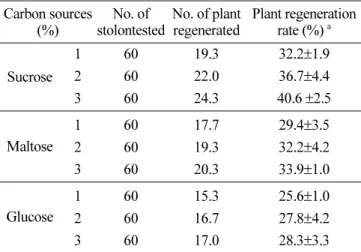
금잔디의 포복경으로부터 식물체 재분화 배지에 에너지 원으로 첨가되는 탄소원의 종류에 따른 배양효과를 조사 한 결과 Table 5와 같다. 재분화 배지에 3% sucrose를 첨 가했을 때 40.6%로 가장 높은 재분화율을 나타내었으며, 이보다 낮은 첨가구에서는 낮은 재분화율을 나타내었다.
Maltose와 glucose의 경우 전체적으로 sucrose에 비해 낮 은 재분화율을 나타내었으며, 특히 glucose의 경우 전체적 으로 가장 낮은 효율을 보였다. 이러한 결과는 배지에 첨 가되는 탄소원의 종류에 따라 재분화 효율에 미치는 영향 이 매우 크다는 것을 의미한다. 일반적으로 탄소에너지원 은 기내배양 된 식물의 에너지원으로의 역할 뿐만 아니라
삼투압 조절을 통한 세포와 조직, 기관의 생장 및 잎과 뿌 리 등의 형성에 관여한다고 알려져 있으며(Karhu, 1997), sucrose는 식물의 조직배양에서 가장 많이 사용되는 탄소 에너지원으로 알려져 있다(Fuentes et al., 2000).
본 실험을 통하여 생장조절물질과 배지첨가물질의 종류 Table 4. Effect of antinecrotic compounds on plant
regeneration from Zoysia matrella. Stolons were cultured in MS basal medium supplemented with 0.5 mg/L 2,4-D, 30 g/L sucrose and 0.8% agar for 4 weeks.
Antinecrotic Compounds (mg/L)
No. of stolon tested
No. of plant regenerated
Plant regeneration
rate (%) a
None 60 21.3 35.6±1.9
AgNO3 5 60 22.7 37.8±1.9
10 60 18.3 30.6±5.9
Cysteine 5 60 22.0 36.7±1.7
10 60 13.3 22.2±2.5
AgNO3 5 + Cysteine 10 60 24.0 40.0±1.7
a Mean±SE of three independent experiments with three replicates.
Table 5. Effect of different carbon sources on plant regeneration from Zoysia matrella. stolons were cultured in MS basal medium supplemented with 0.5 mg/L 2,4-D, 5 mg/L AgNO3, 10 mg/L Cysteine and 0.8% agar for 4 weeks.
Carbon sources (%)
No. of stolontested
No. of plant regenerated
Plant regeneration rate (%) a
Sucrose
1 60 19.3 32.2±1.9
2 60 22.0 36.7±4.4
3 60 24.3 40.6 ±2.5
Maltose
1 60 17.7 29.4±3.5
2 60 19.3 32.2±4.2
3 60 20.3 33.9±1.0
Glucose
1 60 15.3 25.6±1.0
2 60 16.7 27.8±4.2
3 60 17.0 28.3±3.3
a Mean±SE of three independent experiments with three replicates.
Fig. 1. Plant regeneration from stolon of manillagrass. A:
Stolen tissues, B: Culture of stolons on regeneration medium, C: Green shoots induced from stolon cultured on the plant regeneration medium, D: Plantlets cultured in the rooting medium.
와 농도 등의 최적의 조건을 확립함으로서 포복경으로부 터 높은 재분화 효율을 나타내는 효율적인 재분화체계를 확립하였다. 본 연구에서 확립된 재분화체계를 통하여 금 잔디 포복경을 재분화배지에서 4주 배양한 결과 신초가 형성 되었으며, 재분화된 신초는 1/2 MS로 구성된 rooting 배지에서 배양하여 완전한 식물체로 분화시킨 후 pot에 이 식하여 재배할 수 있었다(Fig. 1). 본 연구에서 확립된 효 율적인 식물체 재분화 체계는 유전자 형질전환기술을 활 용하게 되면 육종기간을 획기적으로 단축시키고 유전자형 이 모본과 동일하면서 새로운 특성을 보이는 유전자를 도 입한 형질전환 신품종 잔디 개발에 매우 유용하게 이용될 수 있을 것이다.
요 약
금잔디(Zoysia matrella (L.) Merr.)의 포복경 조직으로부 터 식물체 재분화를 위한 최적 조직배양조건을 확립하기 위하여 온실에서 재배한 식물체의 포복경 절편체로부터 식물체 재분화에 미치는 몇 가지 요인을 조사하였다. 포 복경 조직으로부터 식물체 재분화에 있어서 기본배지로는 MS배지가 N6배지나 SH배지에 비해 높은 효율을 보였으 며, 배지에 첨가되는 식물생장조절물질로는 0.5 mg/L 2,4- D와 1 mg/L of kinetin을 첨가했을 때 33.3%로 가장 높은 재분화율을 보였다. 또한 배지에 첨가되는 탄소원 종류로 는 sucrose를 3% (v/v) 농도로 첨가해 주었을 때 재분화 효율이 향상되었으며, 재분화배지에 첨가되는 항산화물질 로는 5 mg/L AgNO3와 10 mg/L cysteine을 동시에 첨가해 주었을 때 40%의 가장 높은 식물체 재분화 효율을 나타 내어 재분화효율이 향상되었다. 본 연구를 통하여 확립한 금잔디의 포복경 재분화 시스템은 캘러스 배양기간 없이 단기간 내에 재분화 식물체를 높은 효율로 얻을 수 있음 으로써 유전자 형질전환을 통한 잔디의 분자육종에 있어 서 유용하게 사용되어질 수 있을 것이다.
주요어: 금잔디, 포복경, 식물체 재분화
감사의 글
본 연구는 국립산림과학원 (남부산림연구소) 연구과제 지원 및 농촌진흥청 차세대 바이오그린21사업(과제번호:
PJ008139)의 지원에 의해 이루어진 것이며, 이에 감사드 립니다.
참고문헌
Al-Khayri, J.M., F.H. Huang, L.F. Thompson, and J.W. King.
1989. Plant regeneration of zoysiagrass from embryo-derived callus. Crop Sci. 29:1324-1325.
Asano, Y. 1989. Somatic embryogenesis and protoplast culture in Japanese lawngrass (Zoysia japonica). Plant Cell Rep. 8:141- 143.
Bae, C.H., K. Toyama, S.C. Lee, Y.P. Lim, H.I. Kim, P.S. Song, and H.Y. Lee. 2001. Efficient plant regeneration using mature seed-derived callus in Zoysiagrass (Zoysia japonica Steud.).
Kor J Plant Tiss Cult. 28:61-67.
Choi, D.K., G.M. Yang, and J.S. Choi. 2008. Flowering periods, genetic characteristics, and cross-pollination rate of Zoysia spp.
in natural open-pollination. Kor. Turfgrass Sci. 22(1):13-24.
Chu, C.C., C.C. Wang, C.C. Sun, C. Hsu, K.C. Yin, C.Y. Chu, and F.Y. Bi. 1975. Establishment of an efficient medium for anther culture of rice through comparative experiments on the nitrogen sources. Scientia Sinica 18:659-668.
Davis, R.R. 1956. Question and answers on future of meyer zoysiagrass. Ohio Fm. Home Res. 14:44-45.
Eapan, S and L. Goeorge. 1997. Plant regeneration from peduncle segments of oil seed Brassica-species: Infulence of silver nitrate and silver thio sulfate. Plant Cell Tiss. Org. Cult.
51:229-232.
Enriquez-Obregon, G.A., D.L. Prieto-Samsonv, G.A. de la Riva and R.I. Vanquez-Padron. 1999. Agrobacterium-mediated Japonica rice transformation: a procedure assisted by an antinecrotic treatment. Plant Cell Tiss. Org, Cult. 59:159-168.
Fuentes, S.R.L., M.B.P. Calheiros, J. Manetti-Filho, and L.G.E.
Vieira. 2000. The effect of silver nitrate and different carbohydrate sources on somatic embryogenesis in Coffea canephora. Plant Cell Tiss. Org. Cult. 60:5-13.
Ge, Y., T. Norton, and Z.Y. Wang. 2006. Transgenic zoysiagrass (Zoysia japonica) plants obtained by Agrobacterium-mediated transforamation. Plant Cell Rep. 25:792-798.
Han, J.G., X.Q. Ni, P.S. Mao, X.C. Pu, and G.P. Du. 1996. Method to break dormancy in Zoysia japonica seed (in Chinese). Acta Agrestia Sinca. 4:246-250.
Hwang, O.J. and J.I. Kim. 2009. Recent advances in the development of biotech bentgrass. J Plant Biotechnol. 36:327- 335.
Inokuma, C., K. Sugiura, C. Cho, R. Okawara, and S. Kaneko.
1996. Plant regeneration from protoplasts of Japanese lawngrass. Plant Cell Rep. 15:737-741.
Inokuma, C., K. Sugiura, N. Imaizumi, and C, Cho. 1998.
Transgenic Japanese lawngrass (Zoysia japonica Steud.) plants regenerated from protoplasts. Plant Cell Rep. 17:334-338.
Karhu, S.T. 1997. Sugar use in relation to shoot induced by sorbitol and cytokinin in apple. J Am Soc Hort Sci. 122:476- 480.
Kim, J.B., S.J. Park, and D.H. Kim. 1997. Callus induction and plant regeneration from stolon in Zoysiagrass. Kor Turfgrass Sci. 11(4):311-320.
Lee, K.W., S.H. Lee, D.G. Lee, H.S. Woo, D.H. Kim, M.S. Choi, K.Y. Kim, H. Lee, and B.H. Lee. 2005. Effect of plant growth regulators and antioxidants on callus induction and plant regeneration from seed culture of orchardgrass. J. Korean Grassl. Sci. 25(3):191-198.
Lee, K.W., S.H. Lee, D.H. Kim, D.G. Lee, S.H. Won, H.S. Lee, and B.H. Lee. 2006. Effect of callus type and antioxidants on plant regeneration and transformation of tall fescue. J. Korean Grassl. Sci. 26(2):77-82.
Lee, S.H., B.S. Kim, S.H. Won, J. Jo, K.Y. Kim, G.J. Park, B.R.
Sung, H.S. Lee, and B.H. Lee. 2004. Factors affecting callus induction and plant regeneration from mature seed of zoysiagrass (Zoysia japonica Steud.). J Kor Grassl Sci. 24:29- 36.
Murashige, T. and F. Skoog. 1962. A revise medium for rapid growth and bioassays with tobacco tissue culture. Physiol Plant. 15:473-497.
Noh, H.Y., J.S. Choi, and B.J. Ahn. 1995 Plant regeneration through somatic embryogenesis in zoysiagrass (Zoysia spp.). J Kor Soc Hort Sci. 36:582-587.
Park, G.H. and B.J. Ahn. 1998. Electroporation conditions for DNA transfer into somatic embryogenic cells of Zoysia japonica. Kor J Plant Tissue Culture. 25:13-19.
Park, G.H., J.S. Choi, C.H. Yun, and B.J. Ahn. 1994. DNA delivery into embryogenic cells of zoysiagrass (Zoysia japonica Steud.) and rice (Oryza sativa L.) by electroporation.
Kor J Plant Tissue Culture. 21:309-314.
Poeaim, A., Y. Matsuda, and T. Murata. 2005. Plant regeneration from immature inflorescence of zoysiagrass(Zoysia spp.). Plant Biotechnology. 22(3):245-248.
Rim, Y.W., K.Y. Kim, G.J. Choi, Y.C. Lim, and B.Y. Sung. 2001.
Callus induction and plant regeneration from seeds of Zoysia japonica Steud. J Kor Grassl Sci. 21:49-52.
Schenk, R.U. and A.C. Hildebrandt. 1972. Medium and techniques for induction and growth of monocotyledonous and dicotyledonous plant cell cultures. Can J Bot. 50:199-204.
Songst, A.D., D. Duncan, and J. Widholme. 1988. Effect of l- aminocyclopropane-l-carboxylic acid, silver nitrate, and norbornadiene on plant regeneration from maize callus cultures. Plant Cell Reports. 7:262- 265.
Sun, H.J., I.J. Song, T.W. Bae, and H.Y. Lee. 2010. Recent developments in biotechnological improvement of Zoysia japonica Steud. J Plant Biotechnol. 37:400-407.
Toyama, K., C.H. Bae, J.G. Lim, T. Adachi, K.Z. Riu, P.S. Song, and H.Y. Lee. 2003. Production of Herbicide-tolerant zoysiagrass by Agrobacterium-mediated transformation. Mol Cells. 16:19-27.
Turgeon, A.J. 1991. Turfgrass management(3th ed.). Prentice-Hall, Englewood Cliffs, New Jersey. p.77-95,139,152-154.
Vikkrant, A. and A. Rashid. 2002. Somatic embryogenesis from immature and mature embryos of a minor millet Paspalum scrobiculatum L. Plant Cell Tissue Organ Cult. 69:71-77.
Watson, J.R., H.E. Kaerwer, and D.P, Martin. 1992. The turfgrass industry (Chapter 2). In: D.V. Waddington, R.N. Carrow and R.C. Sherman(eds.), Turfgrass. ASA, CSSA and SSSA Madison, WI, USA. p.30-89.
Zhang, L., D. Wu, L. Zhang, and C. Yang. 2007. Agrobacterium- mediated transformation of Japanese lawngrass (Zoysia japonica Steud.) containing a synthetic cryIA(b) gene from Bacillus thuringiensis. Plant Breeding. 126:428-432.