* 농촌진흥청 축산과학원 (National Institute of Animal Science, RDA)
** 경상대학교 응용생명과학부 (Division of Applied Life Science (BK21 program), Gyeongsang National University)
Corresponding author : Sang-Hoon Lee, National Institute of Animal Science, RDA, Cheonan 330-801, Korea.
Tel: +82-41-580-6754, Fax: +82-41-580-6779, E-mail: [email protected]
티모시 성숙종자로부터 캘러스 유도 및 식물체 재분화
이기원*,**⋅김기용*⋅최기준*⋅임영철*⋅김원호*⋅정민웅*⋅서 성*⋅이병현**⋅이상훈*
Callus Induction and Plant Regeneration from Mature Seeds of Timothy
Ki-Won Lee*,**, Ki-Yong Kim*, Gi Jun Choi*, Young Chul Lim*, Won Ho Kim*, Min Wong Jung*, Sung Seo*, Byung-Hyun Lee** and Sang-Hoon Lee*
ABSTRACT
Timothy (Phleum pratense L.) is an important grass species as forage. In order to optimize tissue culture conditions of timothy, the effects of plant growth regulators on callus induction and plant regeneration was investigated with mature seeds of colt cultivar. The optimal concentration of 2,4-D for the induction of primary callus from mature seeds was 3 mg/L. The highest embryogenic callus frequency (25%) was observed when the mature seed were cultured on MS medium supplemented with 3 mg/L 2,4-D and 0.1 mg/L BA. The highest plant regeneration frequency was observed when type B callus was transferred to N6 medium supplemented with 1 mg/L 2,4-D and 3 mg/L BA. Regenerated plants were grown normally when shoots were transplanted to the soil. A short tissue culture period and regeneration system would be beneficial for molecular breeding of timothy by the production of transgenic plant.
(Key words : Timothy, Callus, Plant regeneration, Tissue culture)
Ⅰ. 서 론
티모시 (Phleum pratense L.)는 다년생의 화본 과 목초로서 내한성이 우수하여 추운지방에서 도 생육이 양호하며 가축의 기호성이 좋고 사 료가치가 우수하여 양질의 건초 제조에 많이 이용되고 있다. 그러나 한지형 목초인 티모시 는 건조한 토양과 더위에 약하여 우리나라에서 재배할 경우 고온 건조한 여름철에는 생육이 불량하며 수량이 감소한다. 이러한 단점을 극 복하기 위하여 국내 환경에 적응 가능한 신품 종 육성이 시급한 실정이다.
최근 축산선진국을 중심으로 목초 및 사료작 물에 대한 분자육종 연구가 활발히 진행되고 있으며, 알팔파 (Week, 2008; Montague et al, 2008), 톨 페스큐 (Dong and Qu, 2005; Chen et al, 2003; Bettany et al, 2003), 페레니얼 라이그 라스 (Sato and Takamizo, 2006; Wu et al, 2005;
Hisano et al, 2005), 켄터키 블루그라스 (Chai et al, 2003) 등의 형질전환에 의한 신품종 개발에 관한 많은 연구 결과가 보고되고 있다. 국내에 서도 오차드그라스 (Lee et al, 2006), 이탈리안 라이그라스 및 톨 페스큐 (Lee et al, 2004; Lee et al, 2007)의 형질전환에 관한 연구가 활발하
게 진행되고 있다. 그러나 유용유전자 도입에 의한 목초 형질전환 효율은 초종에 따라 상당 한 차이가 있으며 일부 목초는 아직 그 중요성 을 인식하지 못하여 형질전환의 선행연구인 재 분화 체계에 관한 연구도 미미한 실정이다.
지금까지 티모시의 조직배양에 관한 보고는 현탁배양 세포로부터 식물체 재분화에 관한 연 구 (Guo and Pulli, 2001; Plazek et al, 1999)는 있으나 성숙종자를 이용한 식물체의 재분화에 관한 연구는 거의 없는 실정이다.
따라서 본 연구에서는 티모시의 조직배양 효 율 향상에 있어 가장 중요한 요인중의 하나인 배양배지 내 첨가되는 생장조절물질의 종류와 농도에 대한 일련의 연구를 통해 성숙종자로부 터 캘러스를 유도하여 완전한 식물체로 재분화 시킬 수 있는 효율적인 재분화 시스템을 확립 하고자 하였다.
Ⅱ. 재료 및 방법
1. 식물재료 및 종자소독
식물재료로는 티모시의 colt 품종을 사용하였 다. 성숙종자를 70% ethanol에서 30초간 표면 살균하고 멸균수로 3회 세정한 후, 다시 5%
sodium hypochlorite 용액을 첨가하여 30분간 교반하면서 표면살균 하였다. 살균된 종자를 멸균수로 3회 이상 세정한 다음 멸균된 filter paper로 옮겨 물기를 완전히 제거한 후, 캘러스 유도배지에 치상하였다.
2. 배양배지
성숙종자로부터 캘러스 유도시 첨가되는 생 장조절물질의 종류와 농도에 따른 배발생 캘러 스 유도 효율을 조사하기 위하여 1~9 mg/L의 2,4-D (2,4-Dichlorophenoxyacetic acid)와 0.1~1 mg/L의 BA (6-benzyladenine)를 단용 또는 혼용 하여 첨가한 MS (Murashige and Skoog, 1962)
기본배지에 30 g/L sucrose, 3 g/L Gelrite를 첨가 한 배지를 사용하였다. 배지에 살균된 종자를 치상한 다음, 24 ± 2℃의 생장실에서 암조건으 로 4주간 배양한 후 성숙종자로부터 유도된 캘 러스 유도율을 조사한 다음 형성된 캘러스 조 직만을 취하여 동일 배지에 계대하여 동일한 조건에서 4주간 배양한 다음 재분화 유도 실험 에 사용하였다.
식물체 재분화 실험을 위하여 N6 (Chu et al, 1975) 기본배지에 2,4-D와 BA를 단용 또는 혼 용으로 처리하여 30 g/L sucrose와 3 g/L Gelrite 를 첨가한 배지를 사용하였다. 8주령의 캘러스 를 재분화 배지에 옮겨 24 ± 2℃, 16 h light/8 h dark 조건에서 3주간 배양한 다음 동일한 새 배지에 1회 계대 배양하여 형성된 2 cm 이상으 로 자란 신초를 재분화 개체로 조사하였다.
재분화 된 신초는 1/2 MS 배지에 이식, 뿌리 발생을 유도하여 완전한 식물체로 분화시킨 후 토양에 이식하여 순화시킨 다음 온실에서 재배 하였다.
Ⅲ. 결과 및 고찰
1. 캘러스 유도효율
기내배양을 통한 캘러스 유도는 식물의 종에 따라 다르며 같은 종의 식물도 배양에 사용되 는 생장조절물질 및 배양조건과 방법에 따라 그 양상이 달라진다. 티모시 colt 품종의 캘러 스 유도를 위하여 캘러스 유도배지에 첨가되는 2,4-D의 최적농도를 조사한 결과 3 mg/L 2,4-D 처리구에서 캘러스 유도율이 78%로 가장 높게 나타났다. 1 mg/L 저농도의 2,4-D 처리구에서도 대체적으로 캘러스 형성이 높게 나타났으나, 고농도의 2,4-D 처리구에서 오히려 캘러스 형 성이 저하되고 형성된 캘러스가 갈변화 되는 현상이 많이 나타났다 (Fig. 1A).
티모시 성숙종자를 암상태에서 배양한지 7일 후에 캘러스가 형성되기 시작하였으며 배양 4
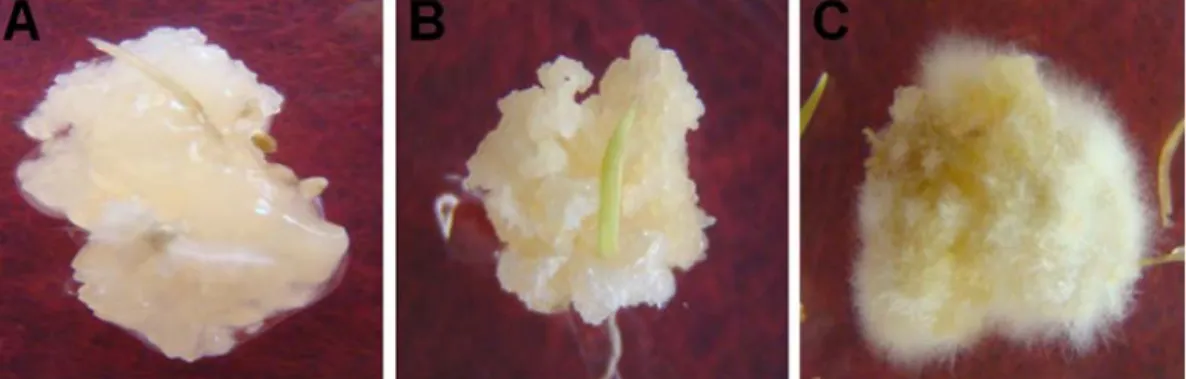
Fig. 2. Morphological phenotypes of calli induction from mature seeds of timothy. A, Type A (Whitish yellow, watery), B, Type B (Embryogenic calli, compact), C, Type C (Yellowish brown, non-friable).
Fig. 1. Effects of different concentrations of 2,4-D on primary callus induction (A) and 3 mg/L 2,4-D and different concentr- ations of BA on embryogenic callus induction from mature seed culture of timothy (B).
주 후 육안으로 캘러스 조직을 관찰했을 때 Fig. 2와 같이 백색의 물기가 많은 캘러스 (Type A), 조직적으로 치밀한 배발생 캘러스 (Type B), 황색의 단단한 캘러스 (Type C) 등으 로 다양한 형태의 캘러스가 유도되었다. 이러 한 결과는 동일한 조건의 배지에서 유도된 캘 러스 배양효율의 차이와 다양한 형태의 캘러스 유도는 종자에서 유래된 캘러스 자체에 여러 가지 형태의 세포가 혼재되어 있거나, 종자 자
체의 활력의 차이 또는 기내배양시 변이 등에 기인한 결과로 추측된다. 최근 화본과 작물에 있어서 옥신류의 단용 처리 보다 BA를 첨가해 주는 것이 배발생 캘러스 유도율을 향상시켜 재분화 효율을 개선시킨다는 결과가 옥수수 (Carvalho, 1997) 미숙배 배양과 켄터키 블루그 래스 (Miki 등, 2003) 종자배양 등에서도 보고 된 바 있다.
조직적으로 치밀한 Type B 형태의 배발생 캘러스 선발은 식물체 재분화 효율을 향상시키 는 중요한 요인중의 하나이다. 따라서, 2,4-D와 BA를 혼용으로 처리하여 배발생 캘러스유도를 위한 최적의 농도를 조사한 결과 Fig. 1B와 같 이 나타났다. 캘러스 유도가 가장 높았던 3 mg/L의 2,4-D에 BA를 0.1, 0.5, 1 mg/L로 각각 첨가하여 배양하였을 경우 전체적으로 2,4-D 단용처리구에 비해 캘러스 유도율은 저하되었 으나 재분화능이 높은 Type B 형태의 배발생 캘러스 형성이 높게 나타났다. 3 mg/L의 2,4-D 에 0.1 mg/L BA를 혼용 첨가하여 배양했을 때 배발생 캘러스 유도율이 25%로 가장 높게 나 타났으며 0.5 mg/L BA를 첨가하여 배양했을 때는 20.3%로 나타났다.
이상의 결과를 바탕으로 티모시의 성숙종자 를 이용하여 캘러스를 유도함에 있어서 3 mg/L 2,4-D를 단용 첨가한 처리구에서 캘러스 의 형성율이 가장 높게 나타났으며, 동일한 조
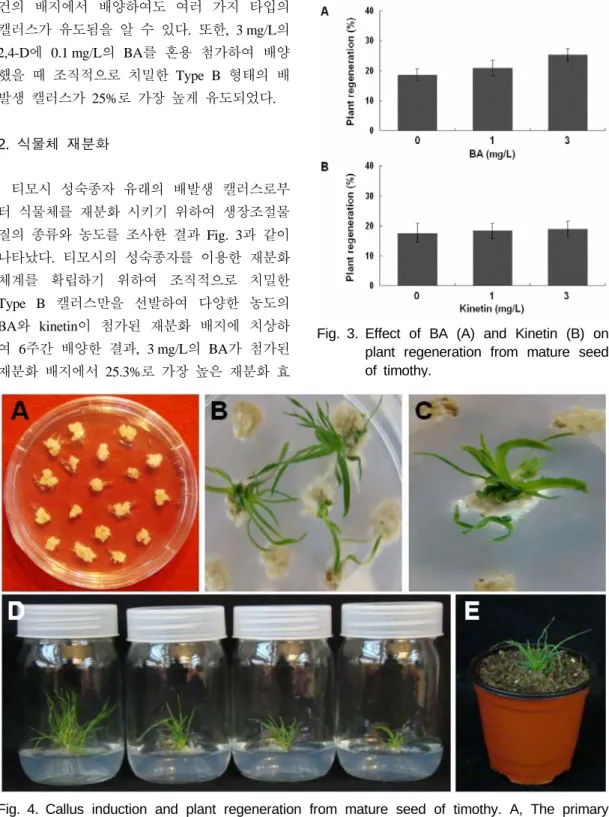
Fig. 4. Callus induction and plant regeneration from mature seed of timothy. A, The primary calli on subculture medium. B, Green shoots of embryogenic calli forming on regeneration medium. C, The plantlets grown on regeneration medium. D, Green plantlets 2 weeks after transferring on rooting medium. E, The regenerated plant growing in pot.
Fig. 3. Effect of BA (A) and Kinetin (B) on plant regeneration from mature seed of timothy.
건의 배지에서 배양하여도 여러 가지 타입의 캘러스가 유도됨을 알 수 있다. 또한, 3 mg/L의 2,4-D에 0.1 mg/L의 BA를 혼용 첨가하여 배양 했을 때 조직적으로 치밀한 Type B 형태의 배 발생 캘러스가 25%로 가장 높게 유도되었다.
2. 식물체 재분화
티모시 성숙종자 유래의 배발생 캘러스로부 터 식물체를 재분화 시키기 위하여 생장조절물 질의 종류와 농도를 조사한 결과 Fig. 3과 같이 나타났다. 티모시의 성숙종자를 이용한 재분화 체계를 확립하기 위하여 조직적으로 치밀한 Type B 캘러스만을 선발하여 다양한 농도의 BA와 kinetin이 첨가된 재분화 배지에 치상하 여 6주간 배양한 결과, 3 mg/L의 BA가 첨가된 재분화 배지에서 25.3%로 가장 높은 재분화 효
율을 보였다 (Fig. 3A). 그러나 BA 첨가가 이보 다 낮거나 높은 처리구에서는 재분화율이 오히 려 저하되는 것으로 나타났다. Kinetin 처리구 에서는 BA 처리구에 비해 모든 처리구에서 재 분화율이 저조하였다 (Fig. 3B). 따라서 티모시 성숙종자유래의 배발생 캘러스로부터 식물체 재분화에는 3 mg/L BA 첨가가 재분화에 가장 효율적인 것으로 판단되었다. 식물체의 재분화 에 생장조절물질로서 BA를 첨가해주는 것이 배발생 캘러스의 유도율과 재분화율을 개선시 킨다는 결과가 켄터키블루그래스 (Griffi et al, 1995; Griffin and Dibble, 1995), 크리핑 밴트그 라스 (Zhong and Stickle, 1991), 버뮤다그래스 (Chaudhury and Rongda, 2000) 등의 화본과 목 초에서도 보고된 바가 있다.
본 실험을 통하여 티모시 성숙종자로부터 캘 러스를 유도함에 있어 2,4-D의 적정 농도, 캘러 스 Type 선발, 식물체 재분화에 첨가되는 최적 의 생장조절물질 종류와 농도를 조사함으로서 성숙종자유래의 캘러스로부터 재분화 체계를 확립할 수 있었다. 본 실험에서 확립한 조건으 로 티모시의 성숙종자를 배양했을 때 캘러스는 캘러스 유도배지에서 배양 7일째부터 형성되기 시작하여 4주 후 70% 이상 형성되었으며 (Fig.
4A, B), 재분화 배지에 이식했을 때 배양 6주 후 높은 빈도로 신초가 재분화 되었다 (Fig.
4C). 재분화 된 신초는 1/2 MS로 구성된 rooting 배지에서 배양하여 완전한 식물체로 분 화시킨 후 (Fig. 4D) pot에 이식하여 재배할 수 있었다 (Fig. 4E).
Ⅳ. 요 약
티모시의 colt 품종을 이용하여 최적 조직배 양조건을 확립하기 위하여 성숙종자를 배양함 에 있어 첨가되어지는 식물 생장조절 물질의 종류와 농도가 배발생 캘러스 유도 및 식물체 재분화에 미치는 영향을 조사하였다. 배발생 캘러스 유도시 첨가되는 2,4-D는 3 mg/L 첨가
구에서 78%로 캘러스 유도율이 가장 높았으며, 3 mg/L 2,4-D와 0.1 mg/L의 BA를 첨가하여 배 양했을 때 형성된 캘러스는 조직적으로 치밀하 며 유백색의 배발생 캘러스가 가장 많이 형성 되었다. Type B 캘러스만을 이용하여 식물체 재분화에는 1 mg/L 2,4-D와 3 mg/L BA가 첨가 된 배지에 캘러스를 배양했을 때 25.3%의 재분 화율을 나타내었다. 본 연구를 통하여 확립된 효율적인 재분화 시스템은 분자육종을 통한 신 품종 티모시의 개발에 유용하게 이용될 수 있 을 것이다.
Ⅴ. 인 용 문 헌
1. Bettany, A.J.E., S.J. Dalton, E. Timms, B.
Manderyck, M.S. Dhanoa and P. Morris. 2003.
Agrobacterium tumefaciens-mediated transformation of Festuca arundinacea (Schreb.) and Lolium multiflorum (Lam.). Plant Cell Rep. 21:437-444.
2. Bregitzer P. 1992. Plant regeneration and callus in barley: effects of geno and culture medium.
Crop Sci. 32:1108-1112.
3. Carvalho, C.H.S., N. Bohorova, P.N. Bordallo, L.
L. Abreu, F.H. Valicente, W. Bressan and E.
Paiva. 1997. Type II callus production and plant regeneration in tropical maize genotypes. Plant Cell Rep. 17:73-76.
4. Chai, B.F., A.H. Liang, W. Wang and W. Hu.
2003. Agrobacterium-mediated transformation of kentucky bluegrass. Acta Bot. Sinica. 45: 966-973.
5. Chaudhury, A. and Q. Rongda. 2000. Somatic embryogenesis and plant regeneration of turf- Bermuda grass: effect of 6-benzyladenine in callus induction medium. Plant Cell. Tiss Org. Cult. 60:
113-120.
6. Chen, L., C.K. Auh, P. Dowling, J. Bell, F.
Chen, A. Hopkins, R. A. Dixon and Z.Y. Wang.
2003. Improved forage digestibility of tall fescue (Festuca arundinacea) by transgenic down- regulation of cinnamyl alcohol dehydrogenase.
Plant Biotechnol. J. 1:437-449.
7. Chu, C.C., C.S. Wang, C.C. Sun, C. Hsu, K.C.
Yin, C.Y. Chu and F.Y. Bi. 1975. Establishment
of an efficient medium for anther culture of rice through comparative experiments on the nitrogen sources. Scienta Sinic. 18:659-668.
8. Dong, S. and R. Qu. 2005. High efficiency transformation of tall fescue with Agrobacterium tumefaciens. Plant Science 168:1453-1458.
9. Griffin, J.D. and M.S. Dibble. 1995. High frequency plant regeneration from seed-derived callus cultures of Kentucky bluegrass (Poa pratensis L.). Plant Cell Report. 14:721-724.
10. Guo, Y.D. and S. Pulli. 2001. Somatic embryogenesis and plant regeneration from suspension cultures of timothy (Phleum pratense L.). Act Agr Scand B-S P. 51: 160-166.
11. Hisano, H, A. Kanazawa, A. Kawakami, M.
Yoshida, Y. Shimamoto and T. Yamada. 2004.
Transgenic perennial ryegrass plants expressing wheat fructosyltransferase genes accumulate increased amounts of fructan and acquire increased tolerance on a cellular level to freezing. Plant Science. 167:861-868.
12. Lee, S.-H., D.-G. Lee, H.-S. Woo and B.-H. Lee.
2004. Development of transgenic tall fescue plants from mature seed-derived callus via Agrobacterium- mediated transformation. Asian-Aust. J. Anim. Sci.
17:1390- 1394.
13. Lee, S.-H., D.-G. Lee, H.-S. Woo, K.-W. Lee, D.-H. Kim, S.-S. Kwak, J.-S. Kim, H. Kim, N.
Ahsan, M.S. Choi, J.-K. Yang and B-H Lee.
2006. Production of transgenic orchardgrass via Agrobacterium-mediated transformation of seed- derived callus tissues. Plant Science, 171:408- 414.
14. Lee, S.-H., N. Ahsan, K.-W. Lee, D.-H. Kim, D.-G. Lee, S.-S. Kwak, S.-Y. Kwon, T.H. Kim and B.-H. Lee. 2007. Simultaneous overexpression of both CuZn superoxide dismutase and ascorbate peroxidase in transgenic tall fescue plants confers increased tolerance to a wide range of abiotic stresses. J Plant Physiol. 164:1626-1638.
15. Lee, K.-W., S.-H. Lee, D.-H. Kim, D.-G. Lee,
S.-H. Won, H. Lee and B.-H. Lee. 2006. Effect of callus and antioxidants on plant regeneration and transformation of tall fescue. Journal of the korean society of grassland science. 26:77-82.
16. Miki, K., T. Koichi, C.H, Bae and H.Y. Lee.
2003. Plant regeneration and transformation of kentucky bluegrass (Poa pratensis L.) via the plant tissue culture. Korea J. plant biotech. 30:115-121.
17. Montague, A., A. Ziauddin, R. Lee, W.M. Ainley and J. Strommer. 2008. High-efficiency phos- phinothricin-based selection for alfalfa. trans- formation. Plant Cell Tissue Organ Culture. DOI 10.1007/s11240-007-9274-8.
18. Murashige, T. and Skoog, F. 1962. A revise medium for rapid growth and bioassays with tobacco tissue cultures. Physiol Plant. 15:473-497.
19. Plazek, A., M. Filek and M. Wfdzony. 1999.
Improvement of regeneration ability in Phleum pratense L. in vitro culture by dicamba. Acta Physiologiae Plantarum. 21:397-403.
20. Sato, H. and T. Takamizo. 2006. Agrobacterium tumefaciens-mediated transformation of forage- perennial ryegrass (Lolium perenne L.). Grassland Science. 52:95-98.
21. Weeks, J.T., J. Ye and C.M. Rommens. 2008.
Development of an in planta method for transformation of alfalfa. Transgenic Research.
10.1007/s11248-007-9132-9.
22. Wu, Y.-Y., Q.-J. Chen, M. Chen, J. Chen and X.-C. Wang. 2005. Salt-tolerant transgenic perennial ryegrass (Lolium perenne L.) obtained by Agrobacterium tumefaciens-mediated transformation of the vacuolar Na+/H+ antiporter gene. Plant Science. 169: 165-173.
23. Zhong, H. and M. B. Sticklen. 1991. Plant regeneration via somatic embryogenesis in creeping bentgrass. Plant Cell Report. 10:453- 456.
(접수일: 2008년 6월 30일, 수정일 1차: 2008년 7월 23일, 수정일 2차 7월 28일, 게재확정일: 2008년 8월 8일)