Platycodon grandiflorum (PG) is an important traditional medicinal plant found in North East Asia (including China, Japan, and Korea.). The extract and some of the major components of PG, such as platycodin D (PD) and platycodin D3, have been found to have diverse pharmacological activities, including anti-inflammatory activity (Ashok et al., 1999; Finkel et al., 2000), anti-allergy activity (Halliwell et al., 2006), the ability to augment immune responses (Halliwell et al., 2007), the ability to stimulate apoptosis in skin cells (Tiwari et al., 2001), antiobesity and hyper-
lipidemia effects (Han et al., 2002; Zhao et al., 2008), and a protective effect against oxidative hepatotoxicity (Evans et al., 2001). In addition, the pharmacological properties of PG are mainly due to the presence of saponins called platycodin that that may act individually, additively, or in synergy to improve human health (Choi et al., 2010).
Plant cell or organ cultures are the attractive source to whole plant for the production of high-value secondary metabolites (Rao & Ravishankar, 2002). However, the production of secondary metabolites in cell or organ cultures
Effects of Medium Compositions and Plant Growth Regulators on in vitro Organogenesis in Cultured Explants of Platycodon grandiflorum Species
Soo Jeong Kwon
1, Swapan Kumar Roy
2, Hye-Rim Kim
2, Young-Ja Moon
1, Ki-Hong Yoon
3, Sun Hee Woo
2, Hee Ock Boo
4, Jin-Woog Koo
5, and Hag Hyun Kim
1,†ABSTRACT Platycodon grandiflorum (Bell flower) is an important plant that has traditionally been used as herbal medicine for the treatment of cough, phlegm, sore throats, lung abscesses, chest pains, dysuria, and dysentery. The present study was initiated to investigate the feasibility of inducing shoot and root organogenesis in cultured explants of P. grandiflorum in a range of culture media and through use of various plant growth regulators (PGRs). The plantlets (Stem containing one node) were isolated and cultured on different concentrations of Murashige and Skoog (MS) medium supplemented with PGRs. We found that proliferation and elongation of shoots and roots could be achieved on ¼ MS for P. grandiflorum with wild and green petals and on ⅛ MS for P. grandiflorum with double petals. The highest levels of development and elongation of adventitious shoots and roots were observed when petal explants were cultured on ¼ MS (pH 3.8) supplemented with 5% sucrose. Increasing the agar concentration reduced shoot growth and rooting potential; nevertheless, the highest number of shoots and roots was observed on 0.6% agar. In the case of growth regulators, ¼ MS supplemented with 1 mg L
-16-benzylaminopurine (BA) was found to be best for shooting, although higher concentrations of BA tended to reduce shoot and root elongation. The highest number of shoots was achieved on 0.5 mg ․ L
-1thidiazuron (TDZ) from double petal explants grown on ⅛ MS. However, root and shoot elongation were found to decrease when TDZ concentrations were increased. Low concentrations of kinetin, naphthalene acetic acid, indole acetic acid, and 3-indole butyric acid induced shoot and root proliferation and elongation. Taken together, our study showed that low concentrations of PGRs induced the greatest root formation and elongation, showing that the optimal concentration of PGRs for shoot proliferation was species-dependent.
Keywords : growth regulators, medium concentration, petal, Platycodon grandiflorum, shoot and root organogenesis
한작지(Korean J. Crop Sci.), 62(3): 259~274(2017)DOI : https://doi.org/10.7740/kjcs.2017.62.3.259
Original Research Article
ⓒ 본 학회지의 저작권은 한국작물학회지에 있으며, 이의 무단전재나 복제를 금합니다.
This is an Open-Access article distributed under the terms of the Creative Commons Attribution Non-Commercial License (http://creativecommons.org/licenses/by-nc/3.0) which permits unrestricted non-commercial use, distribution, and reproduction in any medium, provided the original work is properly cited.
1)
Dept. of Food Nutrition and Cookery, Woosong College, Daejeon 34606, Korea
2)
Dept. of Crop Science, Chungbuk National University, Cheong-ju 28644, Korea
3)
Dept. of Food Science and Biotechnology, Woosong University, Daejeon 34606, Korea
4)
AGROLEAD Co, Ltd., 995-24 1do 2-dong, Jeju City 63265, Korea
5)
NOTHING dESIGN GROUP [GWANGJU], Gwangsan-gu, Gwangju 62224, Korea
†
Corresponding author: Hag Hyun Kim; (Phone) +82-42-629-6988; (E-mail) [email protected]
<Received 12 August, 2017; Revised 4 September, 2017; Accepted 7 September, 2017>
ISSN 0252-9777(Print) ISSN 2287-8432(Online)
한작지(KOREAN J. CROP SCI.), 62(3), 2017
260
is comparatively low. By proper manipulation of culture medium and conditions it is possible to obtain valuable secondary metabolites in larger scale. The level of sucrose has been shown to affect the induction and growth of shoots (Gurel & Gulsen, 1998). The pH affects nutrient uptake as well as enzymatic and hormonal activities in plants (Bhatia & Ashwath, 2005). The pH also influences the status of the solidifying agent in medium, a pH higher than 6 produces a very hard medium and a pH lower than 5 does not sufficiently hard medium (Bhatia & Ashwath, 2005).
Tissue culture has been used as one of the potential methods to achieve mass production of homogeneous plant from various tissues in short period of time (Kim & Kim, 1999; Suh et al., 2000). In vitro shoot proliferation and multiplication is largely based on media formulations with cytokinins as a major plant growth regulator (Hoque, 2010). In tissue culture, cytokinins play an important role as they promote cell division and develop meristematic centers leading to the formation of organs, mainly shoots (Peeters et al., 1991). Regeneration of P. grandiflorum via the organogenic process has been reported in earlier reports (Kwon et al., 2014). Auxins and other growth regulators such as gibberellins play important roles in the growth and differentiation of cultured cells and tissues (Alexandrova et al., 1996; Bohidar et al., 2008). Auxins such as Naphtalene acetic acid (NAA) have been reported to promote plant rooting in vitro (Vuylsteke et al., 1989;
Hussein et al., 2012).
Taken into account, it is necessary to determine the optimum conditions for their growth in order to conserve this genetic resource and improve the propagation medicinal or horticultural plants. However, effects of medium composition coupled with various plant growth regulators on shoot and root regeneration in various cultivars have not been worked out. Even, no reports were found in P.
grandiflorum on the organogenesis of petal explants using various cultivars. Therefore, the present work reports, the effect of varying medium compositions and growth regulators on shoot and root regeneration from petal explants of various cultivars of Platycodon grandiflorum.
MATERIALS AND METHODS Plant materials
Platycodon grandiflorum with wild, green and duplex petal were used as testing materials. For P. grandiflorum with wild petal, seeds of were grown in-vitro aseptically, and for P. grandiflorum with green and duplex petal, in-vitro cuttings were grown one year and then cultured on MS medium. Stem segment (0.8 cm
2) containing one node of in-vitro-grown P. grandiflorum cultured on MS (Murashige
& Skoog, 1962) basal medium supplemented with different levels of plant growth regulators.
Medium composition and growth regulators
In regards to optimum concentration (½ MS, ¼ MS, ⅛ MS, MS, 2 MS) of MS medium composition among culture medium compositions, agar (0.8%) was added after controlling sucrose and pH as 3% and 5.8 respectively. For the sucrose experiment, the concentrations of sucrose (1, 3, 5, 7%), agar (0.8%) was added after adjusting the pH of MS culture medium at 5.8; whereas, for the P. grandiflorum duplex petal, the culture medium was maintained at ⅛ MS. For pH (3.8, 4.8, 5.8, 6.8, 7.8) and agar concentration experiment (0.4, 0.6, 0.8, 1.0 1.2%), ¼ MS culture medium was selected as reference culture medium supplemented with sucrose (3%) and agar (0.8%) to wild and green petal explant respectively whereas ⅛ MS was maintained as reference culture medium for double petal experiment (Table 1).
Plant Growth Regulators (PGRs)
MS media supplemented with different plant growth
regulators (PGRs) were used as multiplication medium. The
effects of 6-benzylaminopurine (BA), Thidiazuron (TDZ),
Kinetin (Kn), and auxins; α-naphthalene acetic acid (NAA),
3- indole butyric acid (IBA) and Indoleacetic acid (IAA)
were investigated separately. However, ¼ MS and ⅛ MS
culture medium supplemented with sucrose (5%) and agar
(0.6%) was selected as reference culture medium for wild,
green and double petal respectively. The concentrations of
growth regulators were maintained at 0, 0.1, 0.5, 1, 5, 10
mg ․ L
-1(Table 1).
Effects of Medium Compositions and Plant Growth Regulators on in vitro Organogenesis in Cultured Explants of Platycodon grandiflorum Species 261
Culture condition
The explants were cultivated for 8 weeks. For all experiments, it was carried out with 6 segments per Petri dish. Comparison and analysis were conducted after 10 replications of experiment based on completely random design. Culture condition was 16 hours of lighting under the light of 25±1ºC, 40 μmol·m
-2·s
-1and number, length, and others of shoot and adventitious root were examined after 8 weeks of cultivation.
RESULTS AND DISCUSSION
Effect of basal medium on shoot and root organogenesis The results obtained from the present study regarding various concentrations of MS medium compositions are presented in Fig. 1. The highest shoot number was obtained at the concentration of ⅛ MS medium from double petal P. grandiflorum. Though, no significance differences were observed among the various concentrations of MS culture medium. However, the shoot elongation was found to be decreased as the highest concentration of salt. The same trend was found in the adventitious root. The highest growth (3.1 cm) was observed from ¼ MS medium. The
adventitious root formation also exhibited similar inhibition with that of shoot formation. The highest root formation (12.6) was found from ⅛ MS medium from double petal P. grandiflorum and the root growth was decreased gradually with the high concentration of MS culture medium. The root length also showed the highest inhibition at the high concentration of MS medium, and no root development and elongation was observed from the 2 MS medium.
Sucrose Concentration
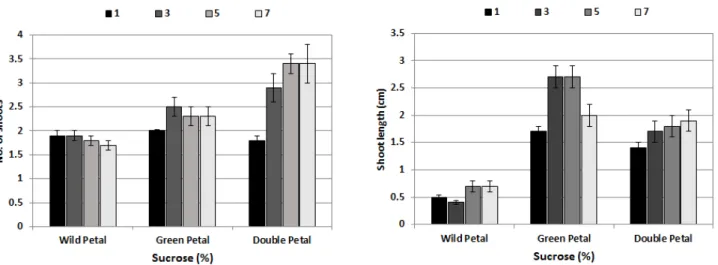
The results obtained from in-vitro cultured P. grandiflorum with various concentration of sucrose (1, 3, 5, 7%) are presented in Fig. 2. Sucrose concentrations had a significant effect on shoots and root organogenesis. Shoot proliferation from double petal P. grandiflorum exhibited favorable result at higher concentration. The highest number of adventitious shoots was observed with explants cultured on medium containing 5% sucrose (3 shoots), followed by medium with 3% sucrose (2 shoots). In the case of wild P. grandiflorum petal, no significance differences were observed regarding the sucrose the concentrations. For shoot elongation, the highest elongation rate (2.7 cm) was achieved on 3 and 5
% sucrose concentration the green petal plantlets were Table 1. Composition of the media used in this study.
Materials Treatments* Basal medium composition
Platycodon grandiflorum with wild petal
MS medium 3% Sucrose, pH 5.8, agar 0.8%
Sucrose 1/4MS, pH 5.8, agar 0.8%
Agar 1/4MS, 3% sucrose, pH 5.8
pH 1/4MS, 3% sucrose, agar 0.8%
PGRs 1/4MS, 5% sucrose, pH 5.8, agar 0.6%
Platycodon grandiflorum with green petal
MS medium 3% Sucrose, pH 5.8, agar 0.8%
Sucrose 1/4MS, pH 5.8, agar 0.8%
Agar 1/4MS, 3% sucrose, pH 5.8
pH 1/4MS, 3% sucrose, agar 0.8%
PGRs 1/4MS, 5% sucrose, pH 5.8, agar 0.6%
Platycodon grandiflorum for. duplex
MS medium 3% Sucrose, pH 5.8, agar 0.8%
Sucrose 1/8MS, pH 5.8, agar 0.8%
Agar 1/8MS, 3% sucrose, pH 5.8
pH 1/8MS, 3% sucrose, agar 0.8%
PGRs 1/8MS, 5% sucrose, pH 5.8, agar 0.6%
* The concentrations of MS culture medium, Sucrose, Agar, pH and PGRs were mentioned in the materials and methods section.
한작지(KOREAN J. CROP SCI.), 62(3), 2017
262
Fig. 1. Effects of different culture media on shoot and adventitious root formation from the nodes of three P. grandiflorum species after 8 weeks in culture. Vertical bar represents standard error (SE) of the mean of 10 replicates.
Fig. 2. Effects of varying sucrose concentration on shoot and adventitious root formation from the nodes of three P.
grandiflorum species after 8 weeks in culture. Vertical bar represents SE of the mean of 10 replicates. (Continued)
Effects of Medium Compositions and Plant Growth Regulators on in vitro Organogenesis in Cultured Explants of Platycodon grandiflorum Species 263
grown on ¼ MS medium.
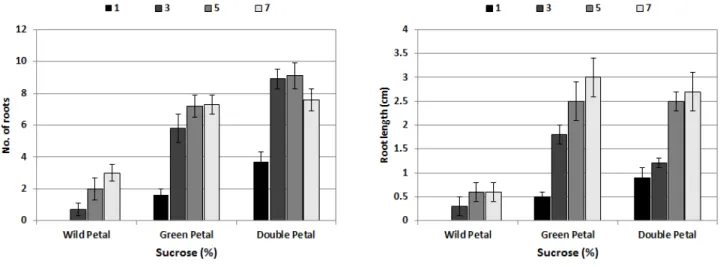
The root formation and elongation was suppressed at the low concentrations of sucrose. The highest number of roots was obtained from the high concentrations of sucrose.
However, the highest numbers of adventitious roots (3.0 cm) were observed from the 7% sucrose with ¼ MS medium.
Although, the root elongation was gradually increased for green and double petal P. grandiflorum, there were no significant differences (0.3~0.6 cm) for wild petal P.
grandiflorum. In the previous study, MS basal medium supplemented with 3% sucrose (Bergmann & Friedt, 1997) has been used for elongation of shoots from flax anther culture. In Eucomis autumnalis number of shoots increases at 4% sucrose and decreases at lower sucrose concentration (Taylor & van Staden 2001). But in Amygdalus communis shoot proliferation was observed only with 5 and 6%
sucrose (Gurel & Gulsen 1998).
Several studies reported that favorable shoot formation was obtained at 3% concentration for Rhodiola sachalinensis (Bae et al., 2009) and 5% for Veronica rotunda var.
subintegra (Cha et al., 2007). Taken together, favorable organogenesis and growth were induced at high concentrations sucrose, and shoot and root proliferation and elongation were notably induced in double petal P. grandiflorum compared to wild petal P. grandiflorum.
Effects of medium pH concentration on organogenesis The results of the effects of pH (3.8~7.8) on culture medium observed from the present study are presented in Fig. 3. The double petal of P. grandiflorum explants rege- nerated optimal shoots (3 shoots) cultured on ⅛ MS medium supplemented with 3% sucrose and agar 0.8% at pH set to 3.8. However, no consistent differences of shoot formation and elongation were observed among the pH ranges. Except the pH 3.8, the adventitious root formation also presented similar trend with shoot formation which is higher formation with lower pH. Adventitious root growth exhibited a little higher result (3.3 cm) at pH 3.8 from the green petal P. grandiflorum, but no significant differences were observed in other treatment group with the range of 1.1~1.7 cm.
To evaluate the effect of pH, the actual pH in the medium is important. Various studies have shown that the pH of tissue culture media is poorly controlled and shifts both during autoclaving and during culture (Skirvin et al.
1986; Vacin & Went 1949). In tomato better shoot regen- eration occurred at acidic pH rather than at alkaline pH (Bhatia & Ashwath 2005). However, it was reported that the range of pH 5.3~5.8 is appropriate for P. grandiflorum (Chung & Cho, 2002; Choi et al., 2005), and pH 6.8 is adequate for adventitious root and shoot formation of Hypericum perforatum (Hwang et al., 2009).
Fig. 2. Effects of varying sucrose concentration on shoot and adventitious root formation from the nodes of three P. grandiflorum
species after 8 weeks in culture. Vertical bar represents SE of the mean of 10 replicates. (Continued)
한작지(KOREAN J. CROP SCI.), 62(3), 2017
264
Effects of various agar concentrations on organogenesis Number and growth rate of the shoots was greatly influenced by the agar concentration. The results observed from the present study with various agar concentrations are presented in Fig. 4. The highest numbers of shoots (3 shoots) were obtained at 0.6% agar from the double petal followed by green and wild petal P. grandiflorum. Regarding the shoot length, 0.6% agar showed the potential results compared to other agar concentrations. However, the higher concentrations of agar induced the lower number of shoot length. Furthermore, no significance differences were found in the agar concentration ranges from 0.8-1.2%.
Highest number of adventitious root formation was obtained from the higher concentration of agar compared to the lower concentrations. However, double petal of P.
grandiflorum with 0.6% agar showed the highest number (13 roots) of regenerated roots. Adventitious root growth was the highest (4.5 cm) in 0.4% agar concentration, and there was no difference in other concentrations of agar with the range of 1.6~2.5 cm. It was reported that adventitious root formation and growth exhibited favorable trend at lower agar concentration in the case of P.
grandiflorum A. DC. with yellow green petals (Kwon et al., 2014). Several studies demonstrated that growth rate inhibition with increasing agar concentration has been reported in many medicinal plant including apical meristems of Picea abies (Romberger et al., 1971) and Dianthus caryophyllus (Hakkaart et al., 1983), buds of Cynara scolymus (Debergh et al., 1983). This revealed the fact that there is a difference in solidity of culture medium Fig. 3. Effects of varying pH on shoot and adventitious root formation from the nodes of three P. grandiflorum species after
8 weeks in culture. Vertical bar represents SE of the mean of 10 replicates.
Effects of Medium Compositions and Plant Growth Regulators on in vitro Organogenesis in Cultured Explants of Platycodon grandiflorum Species 265
with influence on adventitious root formation and growth based on polyploidy even in the same specifies.
Plant growth regulator effects on shoot and root proliferation in P. grandiflorum
Effects of BA on organogenesis
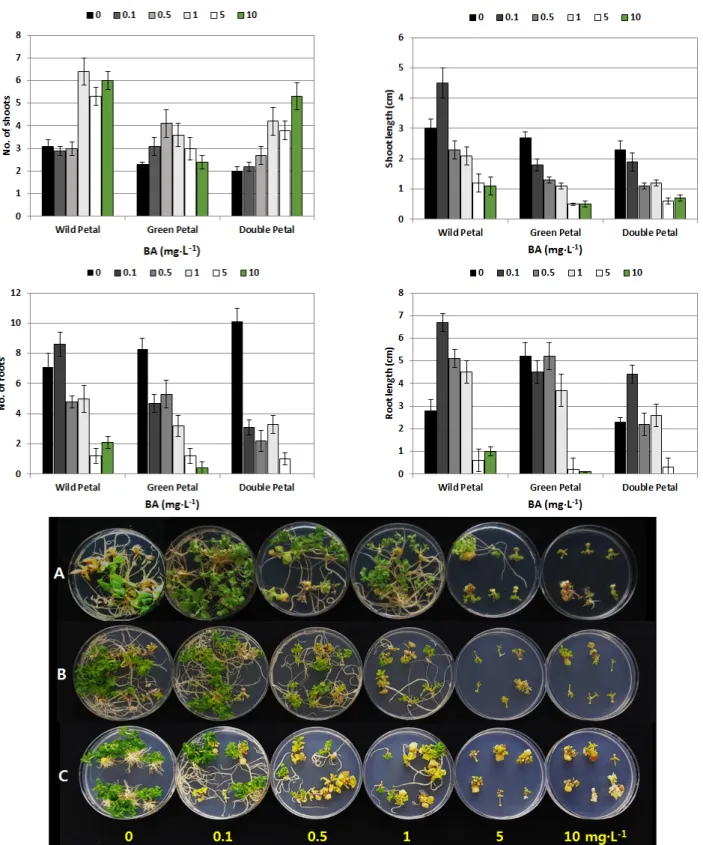
All the concentrations of BA facilitated shoot and root bud differentiation, and the results obtained from this study are shown in Fig. 5. Benzyl adenine (BA) at 1 mg ․ L
-1showed the maximum number of shoots (6 shoots) produced with shoot length (2.1 cm), whereas BA at 0.1 mg ․ L
-1produced the highest shoot length (4.5 cm). The regeneration frequencies of shoots number and height declined with an increase in cytokinin concentration beyond the optimal level. Reduction in number of shoots
in the concentrations higher than optimal level has also been reported for several woody plants (Rai et al., 2009).
BA concentration at higher level led to a decrease in the number of roots and root length per rooted explant and rooting rate. However, the BA at 0.1 mg ․ L
-1showed the highest root length from wild petal P. grandiflorum. BA has been the most popular and widely used cytokinin for stimulating shoot multiplication in a broad range of species (Gaspar et al., 1996).
Effects of TDZ on organogenesis
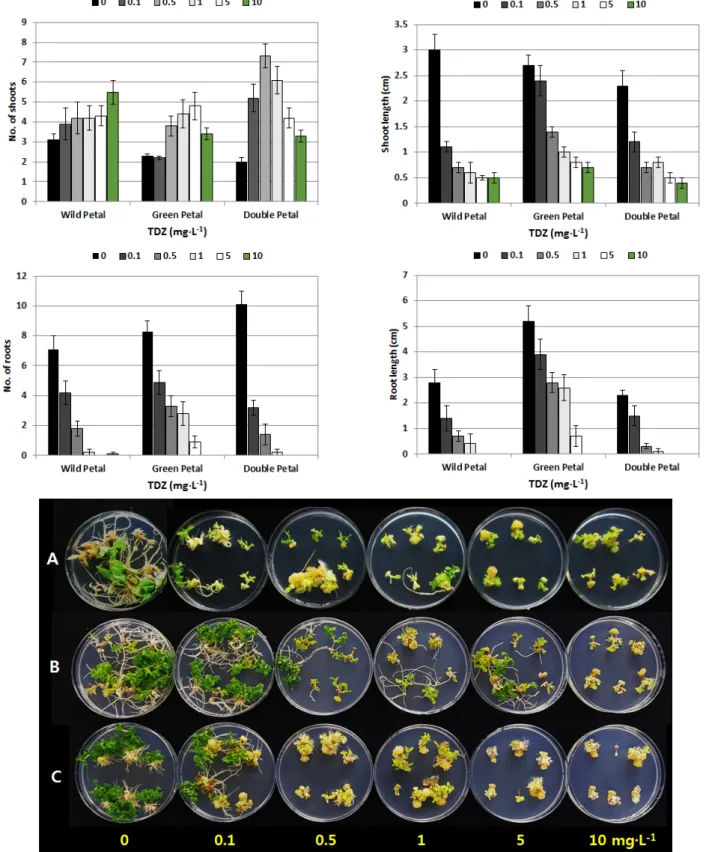
The results of effects of TDZ obtained from the present are demonstrated in Fig. 6. Shoot proliferation occurred notably only when the medium was supplemented with 0.5 and 1 mg ․ L
-1TDZ. However, TDZ at 0.5 mg ․ L
-1induced Fig. 4. Effects of varying agar concentrations on shoot and adventitious root formation from the nodes of three P. grandiflorum
species after 8 weeks in culture. Vertical bar represents SE of the mean of 10 replicates.
한작지(KOREAN J. CROP SCI.), 62(3), 2017
266
Fig. 5. Effect of different BA concentration on shoot and adventitious root formation from the nodes of three P. grandiflorum species after 8 weeks in culture. Shoot and root formation are illustrated in Petridish; A: P. grandiflorum wild B: P.
grandiflorum with green petal, C: P. grandiflorum for. duplex. Each bar represents the mean ± SE of triplicate
experiments.
Effects of Medium Compositions and Plant Growth Regulators on in vitro Organogenesis in Cultured Explants of Platycodon grandiflorum Species 267
Fig. 6. Effect of different TDZ concentration on shoot and adventitious root formation from the nodes of three P. grandiflorum species after 8 weeks in culture. Shoot and root formation are illustrated in Petridish; A: P. grandiflorum wild B: P.
grandiflorum with green petal, C: P. grandiflorum for. duplex. Each bar represents the mean ± SE of triplicate
experiments.
한작지(KOREAN J. CROP SCI.), 62(3), 2017
268
the greatest number of shoots per explant from the duplex P. grandiflorum. In the case of wild petal P. grandiflorum, there was no significant difference in the number of shoots per explant. On the other hand, shoot length was greatly influenced on the different concentrations of TDZ. Shoot length decreased significantly when the medium was supplemented with high concentrations of TDZ. Though, no significant differences were observed between the 1 to 10 mg ․ L
-1TDZ.
Root formation was observed on MS medium containing 0 to 1 mg ․ L
-1TDZ. TDZ at 5 and 10 mg ․ L
-1failed to induce root formation in-vitro. The highest number of root (10 roots per explant) was obtained on the control medium from duplex P. grandiflorum. For the root length, the effects of TDZ showed the similar trend with the root number. However, the highest root elongation rate (5.2 cm) was obtained on the control medium from green petal P.
grandiflorum. There was no significant difference in number of roots per explant and root length at 0.5 to 5 mg ․ L
-1TDZ.
It has been reported that TDZ at low concentration was effective in stimulating axillary proliferation, whereas higher concentrations induced callus formation or somatic emb- ryogenesis (Lu, 1993; Mithila et al., 2003). In contrast, our study showed that 0 and 0.1 mg ․ L
-1TDZ induced the greatest root formation and elongation, showing that the optimal concentration of TDZ for shoot proliferation was species and explant tissue-dependent.
Effects of Kinetin (Kn) on organogenesis
The plant growth regulators are widely used for callus, rooting and shoot induction in tissue culture studies.
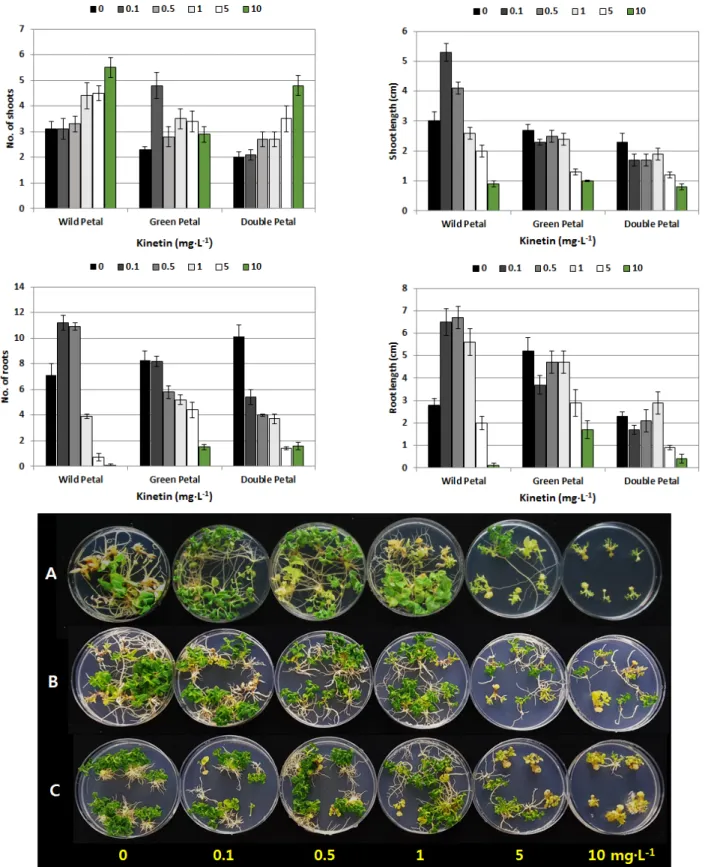
Therefore, we studied the effect of Kn on shoot and rooting of P. grandiflorum. The results of the effects of Kn are shown in the Fig. 7. The explants from wild P.
grandiflorum showed the best performance towards maximum concentrations of Kn. However, the medium supplemented with 10 mg ․ L
-1Kn resulted in the best shoot number (6 shoots per explants) and Kn at 0.1 mg ․ L
-1showed the highest (5.3 cm) shoot length. The number of shoots induced remarkably in the higher concentrations of Kn while shoot length decreased with increasing of Kn concentrations.
The number was greatly decreased with the high con- centrations of Kn. Explants from wild P. grandiflorum showed the highest number of rooting (11 roots per explants) when the medium was supplanted with 0.1 mg ․ L
-1Kn. The root length showed the similar trend with the number of roots whereas Kn at 0.5 mg ․ L
-1exhibited the highest (6.7 cm) root length compared to other treatments.
Similar to our findings, many researchers showed that Kn induced multiple shoot formation (Sajina et al., 1997b;
Mini et al., 1997; Luo et al., 2009).
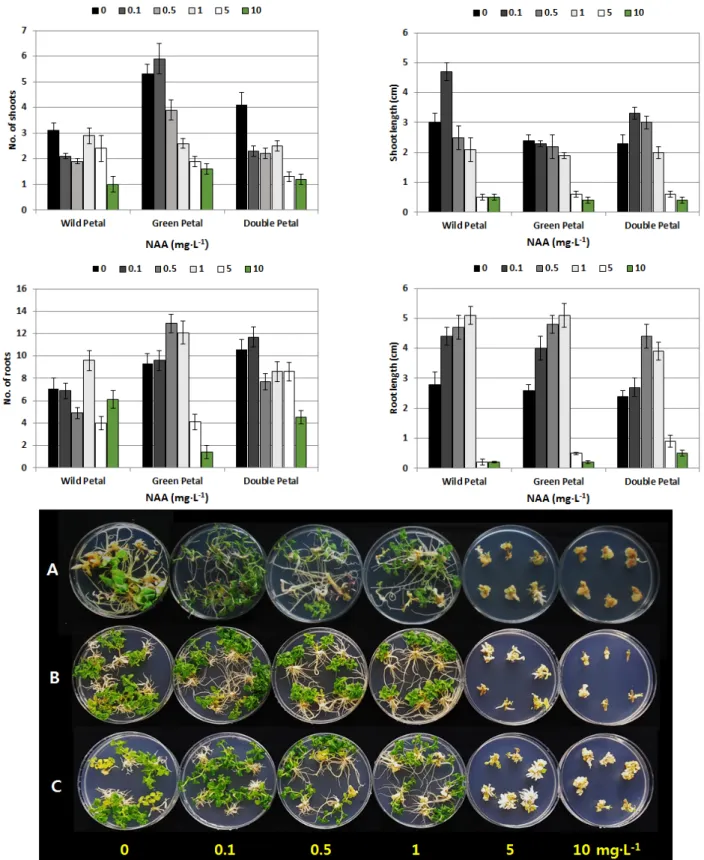
Effects of Auxins (NAA, IAA and IBA) on organogenesis The effects of auxins (NAA, IAA and IBA) obtained from the present study are shown in the Fig. 8-10. For NAA concentrations, the number of shoots and shoot length remarkably decreased with the increasing concent- rations of NAA. The highest number of shoots and shoot length was achieved at 0.1 mg ․ L
-1from the green and wild petal explants of P. grandiflorum respectively. The medium supplemented with 0.5 and 0.1 mg ․ L
-1showed the best results (13 roots per explant and 5.1 cm) for root proliferation and root elongation respectively. However, high concentrations of NAA showed the higher inhibition of root proliferation and root elongation (Fig. 8).
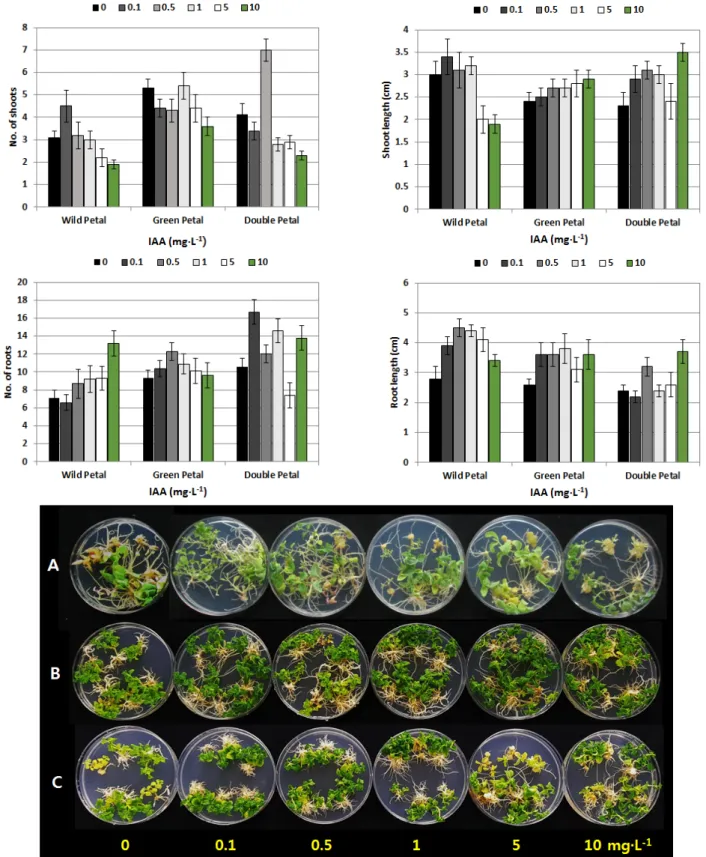
For IAA experiment, the highest number of regenerated shoots (7 shoots per explant) was observed at 0.5 mg ․ L
-1IAA from the duplex petal explant of P. grandiflorum. In the case of shoot length, there were no significant differences among the different concentrations of IAA.
Duplex petal explant of P. grandiflorum showed the best responses regarding the root proliferation. However, MS medium supplemented with 0.1 mg ․ L
-1showed the highest number of roots (17 roots per explants). For the root proliferation, wild petal explant of P. grandiflorum showed the potential results, though no significant differences were found among the various concentrations of IAA (Fig. 9).
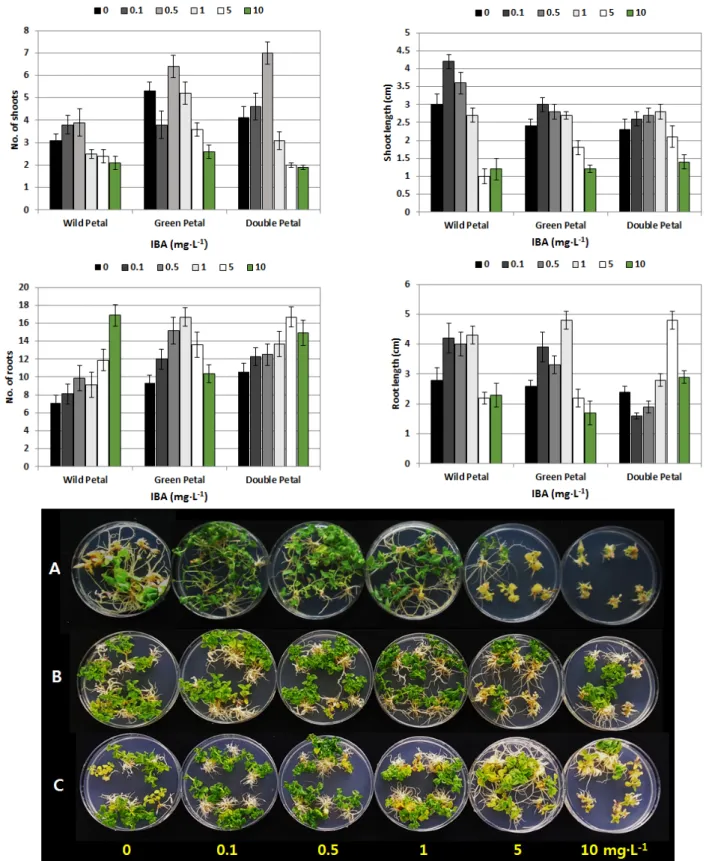
For the IBA experiments, the various concentrations of
IBA were greatly influenced on the shoot proliferation and
shoot elongation. The highest number of regenerated
shoots (7 shoots per explant) was achieved on 0.5 mg ․ L
-1IBA from duplex petal explant of P. grandiflorum. Shoot
elongation showed potential results towards wild petal
Effects of Medium Compositions and Plant Growth Regulators on in vitro Organogenesis in Cultured Explants of Platycodon grandiflorum Species 269
Fig. 7. Effect of different kinetin concentration on shoot and adventitious root formation from the nodes of three P. grandiflorum species after 8 weeks in culture. Shoot and root formation are illustrated in Petridish; A: P. grandiflorum wild B: P.
grandiflorum with green petal, C: P. grandiflorum for. duplex. Each bar represents the mean ± SE of triplicate
experiments.
한작지(KOREAN J. CROP SCI.), 62(3), 2017
270
Fig. 8. Effect of different NAA concentration on shoot and adventitious root formation from the nodes of three P. grandiflorum species after 8 weeks in culture. Shoot and root formation are illustrated in Petridish; A: P. grandiflorum wild B: P.
grandiflorum with green petal, C: P. grandiflorum for. duplex. Each bar represents the mean ± SE of triplicate
experiments.
Effects of Medium Compositions and Plant Growth Regulators on in vitro Organogenesis in Cultured Explants of Platycodon grandiflorum Species 271
Fig. 9. Effect of different IAA concentration on shoot and adventitious root formation from the nodes of three P. grandiflorum species after 8 weeks in culture. Shoot and root formation are illustrated in Petridish; A: P. grandiflorum wild B: P.
grandiflorum with green petal, C: P. grandiflorum for. duplex. Each bar represents the mean ± SE of triplicate
experiments.
한작지(KOREAN J. CROP SCI.), 62(3), 2017
272
Fig. 10. Effect of different IBA concentration on shoot and adventitious root formation from the nodes of three P. grandiflorum species after 8 weeks in culture. Shoot and root formation are illustrated in Petridish; A: P. grandiflorum wild B: P.
grandiflorum with green petal, C: P. grandiflorum for. duplex. Each bar represents the mean ± SE of triplicate
experiments.
Effects of Medium Compositions and Plant Growth Regulators on in vitro Organogenesis in Cultured Explants of Platycodon grandiflorum Species 273
explant of P. grandiflorum, whereas IBA at 0.1 mg ․ L
-1showed the highest length of elongated shoots (4.2 cm). In the case of root proliferation, the higher concentrations of IBA showed the good results, whereas IBA at 10 mg ․ L
-1showed the highest number (17 shoots per explant) of regenerated shoots. For root elongation, IBA at 1 and 5 mg ․ L
-1showed the highest elongation (4.8 cm) from green and double petal explant of P. grandiflorum respectively (Fig. 10).
Auxins are an important factor involved in rooting because they promote adventitious root formation in the vast majority of species (De Klerk, 2002). There are mainly three types of auxins used for root induction:
naturally occurring IAA, synthetic NAA, and IBA. However, plants respond quite differently to these auxins in regard to adventitious root formation (De Klerk et al., 1997). Parra et al. (1996) investigated that rooting decreased at the high concentrations of NAA which was consistent with our present findings. Previous results revealed that NAA at 0.1 mg ․ L
-1appeared as the best choice for shoot proliferation (Bohorova et al., 1985; Power et al., 1987). These results were supported by our findings.
CONCLUSIONS
Taken together, the overall results obtained from the present study revealed that medium composition and PGRs have a potential influence for organogenesis from in-vitro cultured P. grandiflorum. In can be postulated that medium supplemented with various medium compositions, including sucrose, pH, agar may affect shoot and root regeneration.
Furthermore, we demonstrated that PGRs can be included among the factors affecting shoot proliferation and root induction of P. grandiflorum. So, tissue culture of P.
grandiflorum high activity of kinetin and low activity of auxins could enhance induction of adventitious shoot formation. However, shoot proliferation rates and adventitious root formation ability are relatively low compared with many other species. In addition, the proliferation and elongation degree of shoot and root are cultivar-dependent.
ACKNOWLEDGEMENTS
This work was supported by Korea Institute of Planning and Evaluation for Technology in Food, Agriculture, Forestry (IPET) through Export Promotion Technology Development Program, funded by Ministry of Agriculture, Food and Rural Affairs (MAFRA) (116121-03-1-HD020).
REFERENCES
Alexandrova, K. S., P. D. Denchev, and B. V. Conger. 1996.
Micropropagation of switchgrass by node culture. Crop Sci. 36(6) : 1709-1711.
Ashok, B. T. and R. Ali. 1999. The aging paradox: free radical theory of aging. Exp. Gerontol. 34 : 293-303.
Bae, K. H., E. S. Yoon, and Y. E. Choi. 2009. In vitro culture of adventitious root from Rhodiola sachalinensis. Korean J. Plant Res. 22(4) : 281-286.
Bergmann, R. and W. Friedt. 1997. Haploidy and related bio- technological methods in linseed (Linum usitatissimum L.).
In vitro haploid production in higher plants. Springer Netherlands, pp. 1-16.
Bhatia, P. and Ashwath, N. 2005. Effect of medium pH on shoot regeneration from the cotyledonary explants of tomato.
Biotechnology 4(1) : 7-10.
Bohidar S., M. Thirunavoukkarasu, and T. V. Rao. 2008.
Effect of Plant Growth Regulators on in Vitro Micro Propagation of ‘Garden Rue’ (Ruta graveolens L.). Int. J.
Integr. Biol. 3(1) : 36-43.
Bohorova, N., A. Atanassov, and J. Georgieva-Todorova. 1985.
In vitro organogenesis, androgenesis and embryo culture, in the genus Helianthus L. J. Plant Breed. 95 : 35-44 Cha, M. J., S. J. Kwon, U. D. Shin, S. S. Hur, and H. H.
Kim. 2007. Effect of culture materials amd medium compo- sition on organogenesis in Veronica rotunda var. subintegra.
Kor. J. Hort. Sci. Technol. 16 (suppl. ll) : 108.
Choi, Y. H., D. S. Yoo, M. R. Cha, C. W. Choi, Y. S. Kim, S. U. Choi, K. R. Lee, and S. Y. Ryu. 2010. Antipro- liferative effects of saponins from the roots of Platycodon grandiflorum on cultured human tumor cells. J. Nat. Prod.
73(11) : 1863-1867.
Chung, J. H. and S. H. Cho. 2002. Tissue cultures of Platycodon grandiflours DC. J. 'J. Agric & Life Sci. 36(4) : 9-18.
De Klerk, G. J. 2002. Rooting of microcuttings: theory and practice. In Vitro Cell. Dev. Biol. Plant 38(5) : 415-422.
De Klerk, G. J., J. Ter Brugge, and S. Marinova, 1997.
Effectiveness of indoleacetic acid, indolebutyric acid and naphthaleneacetic acid during adventitious root formation in vitro in Malus ‘Jork 9’. Plant Cell, Tissue Organ Cult.
49(1) : 39-44.
한작지(KOREAN J. CROP SCI.), 62(3), 2017