83
-P1-36
Shoot organogenesis and plant regeneration of P olygonum multiflorum Woo Tae Park, Md Romij Uddin, Xiaohua Li, Pham Anh Tuan, Sang Un Park Department of Crop Science, College of Agriculture and Life Sciences, Chungnam National University, 220 Gung-dong, Yuseong-gu, Daejeon 305-764, Korea
Objectives
Propagation of P. multiflorum is achieved either by division of the tuberous roots or by planting seeds. Seed propagation is difficult because of the low propagation rate and the delay implicit in root harvesting. An efficient method for the regeneration of intact plants from tissue culture is essential for establishment of a micropropagation system and a genetic transformation protocol. In this study, we developed a method
for plant regeneration and micropropagation from stem node cultures of P.
multiflorum.
Materials and Methods
Regenerated shoots (approximately 1 cm long; 4 shoots per vessel) were placed in MS medium solidified with 3g/L Gelrite(,St.Louis,MO.,USA) and dispensed at 30mL per culturevessel. Regenerated shoots were incubated for 5weeks in a growth chamber as described above. After five weeks, rooted plants were washed with sterile water to remove Gelrite, transferred to pots containing autoclaved vermiculite, and covered with polyethylene bags for one week to maintain high humidity. The plants were then transferred to soil and maintained in a growth chamber with a 16-h photoperiod, and a night/day temperature of 18/20°C for 2 weeks.
Results
We developed and optimized a rapid protocol for efficient shoot organogenesis and normal plant regeneration from stem node cultures of P. multiflorum. The continuous production of P. multiflorum regenerated plants without the loss of morphogenetic capacity is important, as this technique has potential in micropropagation systems and regeneration of transgenic plants. Every year, conventional cultivators remove some tuberous roots from the harvest for the purpose of future mass propagation; however, our system has a higher throughput: it can produce approximately 4 plantlets in vitro from 1 stem-node explant culture of P. multiflorum irrespective of season.
84
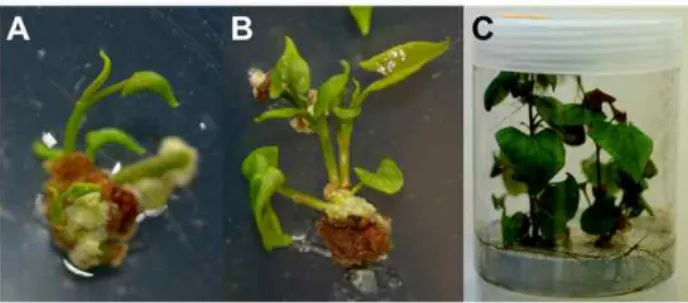
-Figure 1. In vitro plant regeneration and micropropagation of Polygonum multiflorum.
(A) Shoot primordia emerging from a stem node explant of P. multiflorum 3 weeks after cultivation on MS solid media supplemented with 0.5 mg/L BAP (5×). (B) After 6 weeks of culture, fully developed shoots were produced from the stem node culture (3×). (C) The rooted plants in a culture vessel (0.5×).
Table 1. Effect of different concentrations of cytokinins on shoot regeneration and growth from meristem cultures of Polygonum multiflorum after 6 weeks of culture.
Cytokinin (mg/L) Shoots per explants Shoot length (mm)
BAP 0.1 1.8 ± 0.08 23.0 ± 1.05 0.5 2.0 ± 0.12 21.4 ± 0.84 1.0 1.4 ± 0.11 21.6 ± 1.17 2.0 1.2 ± 0.09 20.4 ± 1.17 4.0 1.3 ± 0.12 17.9 ± 1.10 Kinetin 0.1 0.6± 0.05 18.1 ± 0.57 0.5 0.5 ± 0.05 17.8 ± 0.92 1.0 0.8 ± 0.08 20.5 ± 0.85 2.0 0.8 ± 0.09 22.6 ± 0.84 4.0 1.1 ± 0.06 22.2 ± 0.92 TDZ 0.1 0.9 ± 0.06 19.9 ± 0.99 0.5 0.8 ± 0.06 17.9 ± 0.99 1.0 0.9 ± 0.07 20.7 ± 0.68 2.0 1.4 ± 0.10 24.4 ± 0.84 4.0 1.2 ± 0.06 24.0 ± 0.82 Zeatin 0.1 1.3 ± 0.07 24.4 ± 0.97 0.5 1.4 ± 0.07 27.6 ± 0.84 1.0 1.2 ± 0.08 28.2 ± 0.79 2.0 0.9 ± 0.07 29.3 ± 1.16 4.0 0.7 ± 0.07 27.7 ± 0.82
Table 2. Effect of BAP 0.5 mg/L and different concentrations of auxins on shoot regeneration and growth from meristem cultures of P. multiflorum after 6 weeks of culture.
Auxin (mg/L) Shoots per explant Shoot length (mm)
BAP 0.5 mg/L Control 0.0 2.1±0.10 22.3±0.92 IAA 0.1 2.2±0.10 24.5±1.16 0.5 2.4±0.12 23.8±1.22 1.0 3.1±0.14 22.1±0.99 IBA 0.1 2.0±0.11 26.3±1.85 0.5 2.3±0.12 35.3±2.45 1.0 2.4±0.13 48.6±2.47 NAA 0.1 2.2±0.12 51.4±2.61 0.5 2.1±0.09 56.7±2.86 1.0 1.9±0.09 62.1±3.12