국화 ‘백마’의 잎 절편체로부터 신초 기관형성을 통한 식물체 재생에 적합한 배지조성 및 배양방법
김지현 ・ 형남인*
상명대학교 식물식품공학과
The Optimal Medium Composition and Culture Method for Plant Regeneration via Adventitious Shoot Formation from Leaf Segment Explants
of Chrysanthemum morifolium ‘Baekma’
Ji Hyun Kim, and Nam-In Hyung*
Department of Plant and Food Sciences, Sangmyung University, Cheonan 330-720, Korea
Abstract : Plant regeneration protocols via adventitious shoot organogenesis from leaf segments of Chrysanthemum morifolium
‘Baekma’ were developed. The effects of plant growth regulators (BA, NAA, IBA, IAA and 2,4-D) and AgNO3 were tested to figure out the optimal condition for shoot bud induction and shoot formation from leaf explants. On the combination treatment of plant growth regulators and AgNO3, bud induction was obtained but shoot formation was not. Therefore, two-stage treatment of leaf explants was subsequently experimented for the respective improvement of adventitious bud induction and shoot formation. When leaf explants were cultured on bud induction medium (MS medium supplemented with 0.2 mg/L BA, 1.0 mg/L IAA and 1.0 mg/L 2,4-D) for 4 weeks in darkness and were transferred to shoot formation medium (MS medium supplemented with 1.0 mg/L BA, 1.5 mg/L IBA and 5.0 mg/L AgNO3) for 4 weeks under the 16/8h photoperiod condition, shoot formation efficiency reached up to 50.0% and 1.6 shoots per explant were acquired. At 12 weeks after culture, the regenerated shoots were elongated and rooted on MS medium. The plantlets were acclimatized successfully and the regenerated plants exhibited normal phenotypes.
Keywords : Chrysanthemum, ‘Baekma’, Shoot organogenesis, Two-stage culture method, Plant regeneration
*Corresponding author (E-mail: [email protected], Tel: +82-41- 550-5293, Fax: +82-41-550-5296)
(Received on July 21, 2014. Revised on August 2, 2014.
Accepted on August 4, 2014.)
218
http://dx.doi.org/10.9787/KJBS.2014.46.3.218 Print ISSN: 0250-3360
Copyright ⓒ 2014 by the Korean Society of Breeding Science
This is an Open-Access article distributed under the terms of the Creative Commons Attribution Non-Commercial License (http://creativecommons.org/licenses/by-nc/3.0) which permits unrestricted non-commercial use, distribution, and reproduction in any medium, provided the original work is properly cited.
서 언
국화(Chrysanthemum morifolium)는 장미, 카네이션과 더 불어 세계 및 국내의 3대 절화작물 중 하나이다. 우리나라의 절화 국화 재배면적은 527ha이며, 이는 전체 절화 재배면적 의 약 30%에 해당된다(MIFAFF 2012). 그러나 국내 재배되 는 대부분의 국화는 해외에서 도입된 품종을 재배하여 수출 하고 있어 매년 상당한 금액의 로열티가 지불되고 있기에 국 내 신품종 육성이 절실한 상황이다(Shin 2012).
국화 ‘백마’는 국립원예특작과학원에서 2004년도에 육성
한 품종으로, 9월 하순에 자연 개화하는 순백색의 대국 품종 이다. 일장, 온도 조절로 연중 재배가 가능하고 꽃잎 수는 250 장 내외로 많아 노심현상이 발생하지 않으며 개화 초기에 꽃 의 중앙부가 옅은 녹색을 나타낸다(Shin et al. 2005). 국화
‘백마’는 2007년 처음 농가로 보급된 이후, 국내와 일본을 포 함한 국외에서 기호도가 높아 국내 재배면적이 점차 확대되 고 있으며, 앞으로 대일 수출이 증가할 것으로 예상된다(Choi et al. 2009). 그러나 관리 미숙에 의한 미개화, 조기노화, 비 정상적인 화색발현 등이 나타나고 있어 이러한 문제점들을 해결할 수 있는 방안이 요구되고 있다(Suh et al. 2011). 우수 한 절화 품종인 ‘백마’의 장점은 살리고 문제점들을 개선할 수 있는 방안으로 형질전환 및 분자육종을 통한 생명공학 육 종 기술이 필요하다. 형질전환을 통한 생명공학 육종을 위해 서는 식물 조직배양을 기반으로 한 효율적인 식물체 재생 체
Fig. 1. Plant regeneration via adventitious shoot organogenesis from leaf explant in chrysanthemum ‘Baekma’. (A, D) Mother cultures and inoculated explants. (B, E) Callus and bud formation from leaf explant(s) after 4 weeks in MS medium supplemented with 0.2 mg/L BA, 1.0 mg/L IAA and 1.0 mg/L 2,4-D. (C, F) Shoot formation from leaf explants cultured on MS medium with 1.0 mg/L BA, 1.5 mg/L IBA and 5.0 mg/L AgNO3 after 4 weeks (totally 8 weeks). (G) Shoot development after 8 weeks (totally 16 weeks) in culture. (H) Rooting of regenerated shoot in MS medium. (I) Acclimated plant in greenhouse. Scale bar:
1 cm.
계의 확립이 선행되어야 하며, 기관형성을 통한 식물체 재생 기술은 미세번식뿐만 아니라 돌연변이 육종에도 적용될 수 있다(Choi et al. 2001).
국화의 기내 식물체 재생은 주로 잎(Lee et al. 1999), 줄기 (Kaul et al. 1990), 꽃잎(Kumari & Verghese 2003) 등의 절 편체로부터 기관형성을 통하여 성공적으로 이루어졌으며, 일 부 체세포배 형성을 통해서도 이루어졌다(Lim et al. 2005;
May & Trigiano 1991). 국화의 신초 기관형성은 절편체의 종류와 상태, 식물생장조절제와 배지 첨가물의 종류 및 농도, 배지 조성, 그리고 pH 등의 요인에 의해 많은 영향을 받는다 (Bahttacharya et al. 1990; Teixeira da Silva 2004; Waseem et al. 2009). 특히 식물생장조절제가 신초 기관형성에 중요한 역할을 하는데, auxin과 cytokinin의 비율과 농도는 신초 기 관형성에 큰 영향을 미친다(Panicker et al. 2007). 이와 같이
국화의 식물체 재생에 대한 다양한 연구가 여러 품종을 대상 으로 성공적 이루어졌음에도 불구하고, 국화 ‘백마’의 식물체 재생에 대한 보고는 거의 이루어진 바 없다.
따라서 본 연구에서는 국내 주요 품종인 국화 ‘백마’의 기 내 배양된 잎 절편으로부터 신초 기관형성을 유도하기 위한 식물생장조절제와 AgNO3를 포함한 배지조성 및 배양기간의 적정 조건을 알아보고자 하였으며, 이를 통하여 효율적인 식 물체 재생 체계를 확립하고자 하였다.
재료 및 방법
식물재료 및 신초배양
국화(Chrysanthemum morifolium) ‘백마’의 기내 신초배양 (Fig. 1A)에서 얻어진 잎 절편체를 식물체 재생 실험의 재료로
Table 1. Effects of plant growth regulators and AgNO3 on shoot regeneration from leaf explants of 8 weeks after culture in chrysanthemum ‘Baekma’.z
Plant growth regulators (mg/L) AgNO3
(mg/L)
Survival rate (%)
Callus formation
(%)
Bud formation
(%)
No. of buds / explants
Shoot formation
(%)
No. of shoots / explants BA NAA IBA IAA 2,4-D
- - - - - - 36.7 ± 3.3y 26.7 ± 8.5 0 0 0 0
1.0 0.5 - - - 5.0 90.0 ± 10.0 90.0 ± 10.0 26.7 ± 10.0 1.1 ± 0.1 0 0
1.0 0.5 - - - 10.0 96.7 ± 3.3 86.7 ± 9.7 26.7 ± 4.1 1.0 ± 0.0 0 0
1.0 0.5 - - - 15.0 76.7 ± 10.0 76.7 ± 10.0 36.7 ± 8.2 1.1 ± 0.1 0 0
1.0 1.0 - - - 5.0 100.0 ± 0.0 100.0 ± 0.0 23.3 ± 10.0 1.2 ± 0.5 0 0
1.0 - 0.5 - - 5.0 76.7 ± 6.7 76.7 ± 6.7 16.7 ± 7.5 1.2 ± 0.7 0 0
1.0 - 1.0 - - 5.0 96.7 ± 3.3 96.7 ± 3.3 30.0 ± 8.2 1.4 ± 0.4 0 0
1.0 - 1.5 - - 5.0 100.0 ± 0.0 100.0 ± 0.0 53.3 ± 9.7 1.9 ± 0.2 0 0
1.0 - 2.0 - - 5.0 100.0 ± 0.0 100.0 ± 0.0 43.3 ± 8.5 1.4 ± 0.2 0 0
0.2 - - 1.0 1.0 - 100.0 ± 0.0 100.0 ± 0.0 96.7 ± 3.3 4.1 ± 0.8 0 0
0.2 - - 1.0 2.0 - 100.0 ± 0.0 100.0 ± 0.0 66.7 ± 17.5 2.4 ± 0.7 0 0
zExplants were cultured in the dark for 4 weeks and then cultured under the light for 4 weeks
yMean ± SE
이용하였다. 기내 신초배양은 MS 염류와 비타민(Murashige and Skoog 1962), sucrose 30 g/L와 agar 8 g/L를 첨가한 후, pH를 5.8로 조정한 배지를 사용하였다. 배양은 25±2℃인 배양실에서 형광등을 이용한 32 μmol·m-2·s-1, 16/8h 광주기 조명하에서 이루어졌으며, 4-6주 간격으로 계대배양을 실시 하였다.
잎 절편체로부터의 신초 기관현성
기내 배양된 신초에서 채취한 잎 절편체로부터 신초 재생 에 적합한 조건을 구명하기 위하여 식물생장조절제 종류와 AgNO3의 농도에 따른 배지조성 및 배양기간을 달리하여 실 험을 수행하였다. 4-6주 동안 배양된 기내 식물체의 상부에서 완전히 전개된 잎을 절취한 후 주맥을 포함하여 8-10 mm2 크 기로 4면 절단한 절편체를 만들어 항축면이 배지에 닿게 치상 하였다(Fig. 1D). 모든 배양은 25±2℃에서 이루어졌으며, 명 조건은 32 μmol·m-2·s-1, 16/8h 광주기 조명하에서 실시하였다.
식물생장조절제와 AgNO3를 첨가한 단일배지에서의 신초 기관형성 유도
잎 절편체로부터의 신초 기관형성에 미치는 식물생장조절 제와 AgNO3의 영향을 알아보기 위하여 MS 기본배지(MS 염
류와 비타민, sucrose 30 g/L, agar 8 g/L)에 6-benzyladnine (BA) 0.2, 1.0 mg/L, α-naphthaleneacetic acid(NAA) 0.5, 1.0 mg/L, indole-3-butyric acid(IBA) 0.5, 1.0, 1.5, 2.0 mg/L, 2,4-dichlorophenoxyacetic acid(2,4-D) 1.0, 2.0 mg/L와 AgNO3 5.0, 10.0, 15.0 mg/L 조합 처리하여 실험을 수행하 였다(Table 1). 잎 절편체를 배지에 치상하여 4주 동안 암조 건에서 배양 한 후 명조건으로 옮겨 배양하면서 bud 유도 및 신초 형성을 유도하였다.
Bud 유도 및 신초 형성을 위한 2단계 배지의 배지조성 및 배양기간에 따른 신초 기관형성 유도
잎 절편체로부터 bud 유도와 신초 형성을 위한 2단계 배지 를 사용하여 실험을 수행하였다. Bud 유도에서는 MS 기본배 지(MS 염류와 비타민, sucrose 30 g/L, agar 8g/L)에 BA 0.2 mg/L, IAA 1.0 mg/L, 2,4-D 1.0 mg/L를 첨가한 배지를 사 용하였고, 신초 형성에서는 MS 기본배지에 식물생장조절제 무첨가, BA 1.0 mg/L, IBA 1.5 mg/L, AgNO3 5.0 mg/L 및 BA 1.0 mg/L, NAA 1.0 mg/L, AgNO3 5.0 mg/L를 조합처 리한 3종류 배지의 효과를 비교하였다. 잎 절편체를 bud 유도 배지에 치상하여 암조건에서 배양하면서 1-4주 간격으로 각 각 3종류의 신초 형성 배지로 절편체를 옮겨주었다. 초기 4주
Table 2. Effects of culture medium and culture period on shoot regeneration from leaf explants of 8 weeks after culture in chrysanthemum ‘Baekma’.z
Bud induction medium Shoot formation medium
Survival rate (%)
Callus formation
(%)
Bud formation
(%)
No. of buds / explants
Shoot formation
(%)
No. of shoots / explants Composition
(mg/L)
Culture periods (weeks)
Composition (mg/L)
Culture periods (weeks)
BA 0.2 IAA 1.0 2,4-D 1.0
1
-
7 50.0 ± 5.3y 50.0 ± 5.3 16.7 ± 9.1 0.7 ± 0.3 0 0
2 6 60.0 ± 13.5 56.7 ± 15.5 13.3 ± 6.2 0.8 ± 0.4 0 0
3 5 76.7 ± 10.0 73.3 ± 11.3 16.7 ± 5.3 0.9 ± 0.2 0 0
4 4 63.3 ± 8.2 63.3 ± 8.2 36.7 ± 14.3 1.0 ± 0.3 0 0
1
BA 1.0 IBA 1.5 AgNO3 5.0
7 100.0 ± 0.0 100.0 ± 0.0 63.3 ± 8.2 2.1 ± 0.2 0 0
2 6 100.0 ± 0.0 100.0 ± 0.0 70.0 ± 6.2 2.2 ± 0.4 0 0
3 5 100.0 ± 0.0 100.0 ± 0.0 86.7 ± 8.2 3.0 ± 0.4 16.7 ± 0.3 0.7 ± 0.3 4 4 100.0 ± 0.0 100.0 ± 0.0 100.0 ± 0.0 4.2 ± 0.5 50.0 ± 7.5 1.6 ± 0.2 1
BA 1.0 NAA 1.0 AgNO3 5.0
7 100.0 ± 0.0 100.0 ± 0.0 40.0 ± 8.5 1.6 ± 0.3 0 0
2 6 100.0 ± 0.0 100.0 ± 0.0 63.3 ± 6.2 1.8 ± 0.3 0 0
3 5 100.0 ± 0.0 100.0 ± 0.0 66.7 ± 7.5 1.9 ± 0.3 16.7 ± 5.3 1.0 ± 0.4 4 4 100.0 ± 0.0 100.0 ± 0.0 96.7 ± 3.3 2.6 ± 0.3 33.3 ± 5.3 1.0 ± 0.3
zExplants were cultured in the dark for 4 weeks and then cultured under the light for 4 weeks
yMean ± SE
간 암조건에서 배양한 후 절편체가 치상된 신초 형성배지를 명조건으로 옮겨 4주간 배양하였다(Table 2).
실험구 및 조사
모든 처리는 배양 용기당 절편체 6개씩 치상한 것을 1반복 으로 하여 처리당 5반복으로 하였으며, 완전임의배치법으로 배치하여 배양하였다. 배양 8주 후 절편체 생존율, 캘러스 형 성율, bud 형성율, 절편체당 bud 수, 신초 형성율, 절편체당 신초 수를 각각 조사하였으며, 신초 수는 눈으로 식별이 가능 한 약 2 mm 크기 이상의 신초를 집계하여 표시하였다.
발근 및 활착
재생된 신초 중 1 cm 이상 신장한 신초를 절편체에서 분리 하여 신초 배양배지(MS 염류와 비타민, sucrose 30 g/L, agar 8g/L)로 옮겨 신장과 발근을 유도하였다. 기내에서 성공적으 로 발근된 소식물체를 꺼내어 뿌리에 붙어있는 배지를 제거 한 후, 배양토(뚝심이, ㈜농우바이오)가 들어있는 128공 플러 그트레이에 이식하여 장일조건(16/8h)에서 활착을 유도하였 다. 2주 후 활착된 식물체를 배양토가 담겨진 직경 12 cm 화 분에 정식하여 온실에서 재배하였다.
결 과
잎 절편체로부터의 신초 기관현성
국화 ‘백마’의 잎 절편체로부터의 기관형성을 통한 식물체 재생을 유도하기 위하여 식물생장조절제와 AgNO3를 포함한 배지조성 및 배양기간을 달리하여 실험을 수행하였다. 신초 기관형성 배지에 치상하여 암조건에서 배양한 잎 절편체에서 는 배양 2-3주 후부터 주로 절단면을 따라 옅은 노란색을 띠 는 캘러스가 형성되기 시작하였다. 배양 4주 후부터 명조건에 서 배양하였으며, 배양 6주 후 bud가 형성된 것을 확인 할 수 있었다(Fig. 1B, E).
식물생장조절제와 AgNO3를 첨가한 단일배지에서의 신초 기관형성 유도
MS 기본배지에 식물생장조절제와 AgNO3를 조합처리한 11가지 배지에 잎 절편체를 치상하여 배양 8주 후 절편체로 부터의 반응을 조사한 결과, 식물생장조절제 무첨가 배지를 제외한 나머지 처리구의 절편체들은 전반적으로 높은 생존율 을 보였으며 캘러스 형성율은 모든 처리구에서 70.0% 이상으 로 나타났다(Table 1). Bud 형성율 및 절편체당 bud 수에 있
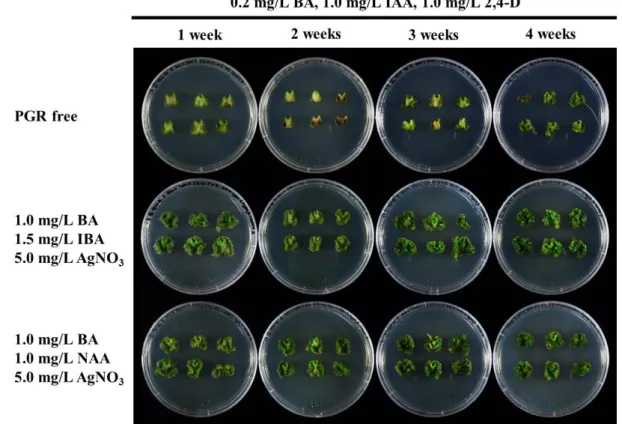
Fig. 2. Comparisons of shoot regeneration from leaf explants according to the different culture periods on bud formation medium in chrysanthemum ‘Baekma’. Leaf explants were cultured on bud induction medium, composed of MS medium containing 0.2 mg/L BA, 1.0 mg/L IAA and 1.0 mg/L 2,4-D for 1 to 4 weeks, and transferred and cultured for 4 to 7 weeks on shoot formation medium, composed of PGR-free MS medium and MS medium containing 1.0 mg/L BA, 1.5 mg/L IBA and 5.0 mg/L AgNO3, or 1.0 mg/L BA, 1.0mg/L NAA and 5.0 mg/L AgNO3, respectively.
어서는 처리간에 큰 차이가 나타났으며, auxin으로 2,4-D를 사용한 처리구에서 bud 형성율이 60.0% 이상으로 높게 나타 났다.
모든 처리구 중, MS 기본배지에 BA 0.2 mg/L, IAA 1.0 mg/L, 2,4-D 1.0 mg/L를 첨가한 처리구에서 bud 형성율 96.7%, 절편체당 bud 수 4.1개로 가장 높게 나타났다(Table 1). 그러나 모든 처리에서 다수의 bud가 형성되었음에도 불구 하고 신초로 발달하지 못하였으며 이는 식물생장조절제와 AgNO3를 농도별로 처리한 단일 배지에서는 잎 절편체로부 터의 신초 형성을 유도하는 것이 어렵다는 것을 나타낸다.
Bud 유도 및 신초 형성을 위한 2단계 배지조성 및 배양 기간에 따른 신초 기관형성 유도
Bud 유도 및 신초 형성을 위한 서로 다른 2단계 배지의 조 성과 배양기간의 적정조건을 알아보고자, bud 유도배지(BA 0.2 mg/L, IAA 1.0 mg/L, 2,4-D 1.0 mg/L 첨가 MS 배지)
에 잎 절편체를 1-4주간 배양하여 bud 형성을 유도한 후, 3종 류의 신초 형성배지(식물생장조절제 무첨가, BA 1.0 mg/L, IBA 1.5 mg/L와 AgNO3 5.0 mg/L 또는 BA 1.0 mg/L, NAA 1.0 mg/L와 AgNO3 5.0 mg/L를 첨가한 MS 배지)로 절편체를 옮겨 4-7주간 배양하면서 신초 형성을 유도하였다.
Bud 유도배지에서의 배양기간에 관계없이 식물생장조절제 무첨가 배지로 옮겨준 절편체에서는 bud 형성율이 낮았으며 신초 형성은 전혀 이루어지지 않았다. Bud 유도배지에서 배 양한 후 식물생장조절제를 포함한 신초 형성배지로 옮겨준 처리구에서는 bud 형성율 및 절편체당 bud 수가 증가하였다.
Bud 유도배지에서 4주간 배양한 후 MS 기본배지에 BA 1.0 mg/L, IBA 1.5 mg/L, AgNO3 5.0 mg/L를 첨가한 배지로 절 편체를 옮겨주었을 때 bud 형성율 100.0%, 절편체당 bud 수 4.2개로 가장 좋은 결과를 얻었다(Table 2). 또한 bud로부터 의 신초 형성은 bud 유도배지에서 3주 이상 배양 후 식물생 장조절제가 첨가된 신초 형성배지로 옮겨주었을 때 이루어졌
다(Fig. 1C, F). Bud 유도배지에서의 배양기간을 비교해 보 면 3주에 비해 4주 동안 배양한 처리구에서 식물생장조절제 조성에 관계없이 신초 형성율 및 절편체당 신초수가 전반적 으로 증가하였다. 모든 처리 가운데, 절편체를 bud 유도배지 에서 4주간 배양한 후, MS 기본배지에 BA 1.0 mg/L, IBA 1.5 mg/L, AgNO3 5.0 mg/L를 첨가한 신초 형성배지에서 4 주간 배양한 처리구에서 신초 형성율 50.0%와 절편체당 신초 수 1.6개로 가장 높게 나타났다(Table 2, Fig. 2).
신초 증식 및 활착
잎 절편체로부터 bud 유도단계를 거쳐 신초 형성배지에서 신초가 형성된 후 계대배양 없이 8주간 배양하였을 때 신초가 신장하였고, 일부 신초에서는 발근이 이루어졌다(Fig. 1G). 1 cm 이상 신장된 신초를 절편체로부터 분리하여 신초 배양배 지에서 배양하였을 때, 배양 1주 후부터 뿌리가 발달하기 시 작하였으며, 2주 후에는 신초의 신장과 발근이 이루어진 소식 물체를 획득할 수 있었다(Fig. 1H). 기내에서 5 cm 이상 신장 한 소식물체를 토양에 이식하여 2주간의 순화과정을 거쳐 성 공적으로 활착이 이루어졌다(Fig. 1I). 활착된 식물체를 배양 토가 들어있는 화분에 정식하여 온실에서 재배하였을 때, 식 물체는 정상적인 표현형을 나타내었다.
고 찰
국화의 식물체 재생 프로토콜을 보면, 일반적으로 신초 기 관형성 배지에서 신초를 유도한 다음 재생된 신초를 분리하 여 신장 및 발근 유도배지에서 소식물체를 얻은 후 활착과정 을 거쳐 정상적인 재배가 이루어진다. 이러한 식물체 재생에 서 신초 유도 단계가 전체 과정의 효율성을 결정하는 중요한 역할을 하기 때문에, 다양한 유전형에서 auxin과 cytokinin의 조합을 기반으로 신초 기관형성 유도에 대한 많은 연구를 통 하여 성공적인 결과가 보고되었다(Lee et al. 2008; Panicker et al. 2007; Teixeira da Silva 2004). 또한, 식물의 기내 배 양에서의 반응은 유전형에 따라 상당한 차이를 나타내는데 (Sharma & Rajam 1995; Choi et al. 2012), 기내 배양을 통 한 신초 재생이 비교적 용이한 국화에서도 유전형에 따라 신 초 기관형성 반응에서 차이가 큰 것으로 알려져 있다(Lee et al. 1999). Song et al. (2011)은 국화 6개 품종에서 여러 부 위의 절편체를 이용하여 신초 재생을 유도하였는데, 3개 품종 에서는 20.0% 정도의 재생률을 얻었으나 2개 품종에서는 재
생이 이루어지지 않았다고 보고한 바 있다.
본 실험에서 국화 ‘백마’는 auxin과 cytokinin의 11가지 조 합 처리에서 잎 절편체로부터 식물생장조절제가 포함된 모든 처리에서 bud 유도는 이루어졌지만 bud가 신초로 발달하지 못하였다. 또한 bud 형성율은 식물생장조절제 조성에 따라 상당한 차이를 보여주었는데, 저농도 cytokinin(BA 0.2 mg/L)과 고농도의 auxin(IAA 1.0 mg/L, 2,4-D 1.0 mg/L)이 첨가된 배지에서 bud 유도율이 96.7%로 가장 높았다. 이로 보아 ‘백마’에서 잎 절편체로부터의 bud 유도는 cytokinin에 비해 높은 농도의 auxin이 필요하고 IAA와 2,4-D의 조합처 리가 효과적인 것을 알 수 있었으며, 유도된 bud를 신초로 발 달시키기 위한 별도의 단계가 필요하다고 판단되었다.
기내배양 반응이 우수한 식물이나 유전형에서는 절편체로 부터의 신초 기관형성 과정에서 일반적으로 단일 종류의 배 지를 사용한다. 그러나 고추에서는 자엽 절편체로부터의 신초 기관형성을 위한 단일 단계의 배양에서는 신초를 얻는 것이 어려웠기 때문에, bud 유도, bud 확장, 신초 발달, 신초 신장 등의 4단계로 나누어진 실험을 수행하여 신초 기관형성을 거 쳐 식물체 재생에 성공하였다(Hyde & Phillips 1996). 또한 국화에서도 2,4-D를 포함한 1단계 배지에서 캘러스 또는 shoot primordia를 형성시킨 후 이를 2단계 배지로 옮겨 신초 형성에 성공한 바 있다(Bhattacharya et al. 1990; Sherman et al. 1998).
본 실험에서는 신초 기관형성을 위하여 bud 유도배지에 이 어 신초 형성배지를 사용하는 2단계 실험을 수행하였다. Bud 유도배지는 BA 0.2 mg/L, IAA 1.0 mg/L와 2,4-D 1.0 mg/L 를 첨가한 MS배지를 사용하였고, MS 기본배지에 식물생장 조절제 무첨가, BA 1.0 mg/L, IBA 1.5 mg/L와 AgNO3 5.0 mg/L 및 BA 1.0 mg/L, NAA 1.0 mg/L, AgNO3 5.0 mg/L 를 각각 조합 처리한 3종류의 신초 형성배지의 효과를 비교하 였다. 모든 배지에서 bud 유도는 이루어졌으나, 식물생장조절 제 무첨가 배지에서는 bud 유도율이 낮았고 신초 형성이 이 루어지지 않았다. 식물생장조절제 첨가 배지에서는 신초가 형 성되었는데, bud 유도배지에서 3주 이상의 배양이 필요하였 다. Bud 유도배지에서 4주 배양 후 BA 1.0 mg/L, IBA 1.5 mg/L와 AgNO3 5.0 mg/L를 포함한 MS 배지에서 4주간 배 양하였을 때 신초 형성율 50.0%, 절편체당 신초수 1.6개로 가장 좋은 결과가 얻어졌다.
한편, Hyde & Phillips (1996)는 고추의 신초 기관형성을 위하여 3단계 배지를 사용하였는데 첫번째 단계에서는 AgNO3
를 첨가하지 않고 이후의 단계부터 첨가하는 것이 가장 효과 적이었으며 신초 신장을 위한 세번째의 배양 단계가 필요하다 고 보고하였다. Sherman et al. (1998)은 국화 ‘Polaris’ 품종의 잎 절편체를 사용하여 2,4-D 0.5 mg/L가 포함된 배지에서 신 초 primordia를 형성시킨 다음, 고농도 cytokinin과 저농도 auxin에 GA를 첨가한 배지로 옮겨주었을 때 primordia가 신초 로 발달하여 재생 효율을 향상시켰다고 보고하였다. 이는 본 실험과 유사한 결과로서, 재생이 어려운 유전형이나 식물을 사용할 때에는 단계를 구분하여 단계별 적정 배지를 사용하 는 것이 필요하다는 것을 알 수 있다.
에틸렌 작용의 잠재적 억제제인 AgNO3는 신초 신장에 이 어 식물체 재생을 촉진하는 효과를 가지고 있는 것으로 보고 되었다(Beyer 1976; Chi et al. 1990; Purnhauser et el. 1987).
AgNO3는 절편체로부터 bud 유도 단계가 아닌 신초 발달 단 계에서 잎과 신초의 분화에 효과적이었다고 보고되었는데 (Sherman et al. 1998; Hyde & Phillips 1996), 국화 ‘백마’
를 재료로 사용한 본 실험에서 bud 유도 단계에서는 AgNO3를 첨가하지 않은 배지를 사용하고 신초 형성 단계에서 AgNO3를 첨가하는 것이 효과적이었던 것과 유사한 결과라고 판단된다.
결론적으로 본 연구를 통하여 국화 ‘백마’의 잎 절편체로부 터 신초 기관형성을 거쳐 식물체를 재생시키는 방법을 개발 하였다. 잎 절편체를 MS 기본배지에 BA 0.2 mg/L, IAA 1.0 mg/L, 2,4-D 1.0 mg/L를 첨가한 배지(1단계 배지)에서 4주 간 암조건으로 배양하여 bud를 유도한 후, MS 기본 배지에 BA 1.0 mg/L, IBA 1.5 mg/L, AgNO3 5.0 mg/L를 첨가한 배지(2단계 배지)에서 4주간 명조건으로 배양하였을 때, 신초 형성율 50.0%와 절편체당 1.6개의 양호한 결과를 얻을 수 있 었다. 또한 신초 배양배지에서 재생 신초의 발근 및 신장을 거쳐 발근된 식물체를 활착시켜 정상적인 표현형을 보이는 식물체를 생산할 수 있었다.
적 요
국화 ‘백마’의 잎 절편체로부터 신초 기관형성을 통한 식물 체 재분화 기술을 개발하고자 배지조성과 배양기간을 달리하 여 실험을 실시하였다. 잎 절편체를 식물생장조절제와 AgNO3
의 농도를 달리 한 11가지 배지에서 배양하였을 때 bud는 형 성되었으나 신초로의 발달은 이루어지지 않았다. Bud 유도 이후 신초 형성을 유도하고자, 서로 다른 식물생장조절제 조 성을 가진 배지를 이용한 2단계의 실험을 수행하였다. Bud
유도배지(BA 0.2 mg/L, IAA 1.0mg/L, 2,4-D 1.0mg/L를 첨 가한 MS 배지)에서 1-4주간 배양한 후 신초 형성배지(식물생 장조절제 무첨가, BA 1.0 mg/L, IBA 1.5 mg/L와 AgNO3
5.0 mg/L 또는 BA 1.0 mg/L, NAA 1.0 mg/L와 AgNO3 5.0 mg/L를 각각 첨가한 MS 배지)로 옮겨 배양하였다. Bud 유 도에 이어 신초 형성을 위해서는 bud 유도 배지에서 3주 이 상의 배양기간이 필요하였으며, bud 유도배지에서 4주간 배 양한 후 BA 1.0 mg/L, IBA 1.5 mg/L와 AgNO3 5.0 mg/L 를 첨가한 신초 형성배지로 옮겨 4주간 배양한 처리에서 신초 형성율은 50.0%, 절편체당 신초 수는 1.6개로 가장 양호한 결과를 얻을 수 있었다. 재생된 신초는 신초 형성배지에서 8 주간 배양 후 신장하였으며, 1 cm 이상 신장된 신초를 분리 하여 발근을 유도한 후 활착시켜 온실에서 재배하였을 때 식 물체는 정상적인 표현형을 보여주었다.
사 사
본 연구는 농촌진흥청 차세대 바이오그린21사업(과제번호:
PJ0081672014)과 농림수산식품기술기획평가원 연구사업(과 제번호: 110028-3)의 지원에 의해 이루어진 것임.
REFERENCES
1. Beyer EM. 1976. A potent inhibitor of ethylene action in plants. Plant Physiol. 58: 268-271.
2. Bhattacharya P, Dey S, Das N, Bhattacharys BC, Bhattacharya P. 1990. Rapid mass propagation of Chry- santhemum morifolium by callus derived stem and leaf explant. Plant Cell Rep. 9: 439-442.
3. Chi GL, Barfield DG, Sim GE, Pua EC. 1990. Effect of AgNO3 and aminoethoxyvinylglycine on in vitro shoot and root organogenesis from seedling explants of recalcitrant Brassica genotypes. Plant Cell Rep. 9: 195-198.
4. Choi JY, Kim HJ, Lee CH, Bae JM, Chung YS, Shin JS, Hyung NI. 2001. Efficient and simple plant regeneration via organogenesis from leaf segment cultures of persimmon (Diospyros kaki Thunb.). In Vitro Cell. Dev. Biol.-Plant 32: 72-80.
5. Choi JY, Shin JS, Chung YS, Hyung NI. 2012. An efficient selection and regeneration protocol for Agrobacterium- mediated transformation of oriental melon (Cucumis melo L. var. makuwa). Plant Cell Tissue Organ Cult. 110: 133-140.
6. Choi SY, Hur EJ, Kwon OG, Lim JH. 2009. Effect of night minimum temperature during winter season on growth and flowering in chrysanthemum ‘Baekma’. Flower Res.
J. 17: 226-230.
7. Hyde CL, Phillips GC. 1996. Silver nitrate promotes shoot development and plant regeneration of chili pepper (Capsicum annuum L.) via organogenesis. In Vitro Cell.
Dev. Biol.-Plant 32: 72-80.
8. Kaul V, Miller RM, Hutchinson JF, Richards D. 1990.
Shoot regeneration from stem and leaf explants of Dendranthema grandiflora Tzvelev (syn. Chrysanthemum morifolium Ramat.). Plant Cell Tissue Organ Cult. 21: 21-30.
9. Kumari M, Verghese TM. 2003. Efficient in vitro regeneration of plantlets from capitulum explant in chrysanthemum cultivars Miss Universe and Snowball. J.
Ornam. Hortic. 6: 316-321.
10. Lee JS, Lee GJ, Chung SJ, Kim JB, Kim DS, Kang SY.
2008. Effect of plant growth regulators on a shoot and root formation from the leaf and flower culture of a standard-type chrysanthemum ‘Jinba’. Korean J. Hortic.
Sci. Technol. 26: 320-324.
11. Lee YK, Kwon YJ, Lee KM, Hyung NI. 1999. Regeneration from leaf segment cultures of chrysanthemum (Dendranthema grandiflora Tzvelev). Korean J. Plant Tissue Cult. 26:
59-63.
12. Lim JH, Son KC, Yae BW. 2005. Factors influencing on the induction of somatic embryogenesis in the regeneration of chrysanthemum ‘Shuhonochikara’. Korean J. Hortic.
Sci. Technol. 23: 212-217.
13. May RA, Trigiano RN. 1991. Somatic embryogenesis and plant regeneration from leaves of Dendranthema grandiflora.
J. Am. Soc. Hortic. Sci. 116: 366-371.
14. Ministry for Food, Agriculture, Forestry and Fisheries (MIFAFF). 2012. The present condition of floriculture cultivation.
15. Murashige T, Skoog F. 1962. A revised medium for rapid growth and bio-assay with tobacco tissue cultures. Physiol.
Plant. 15: 473-497.
16. Panicker B, Thomas P, Janakiram T, Venugopalan R, Narayanappa SB. 2007. Influence of cytokinin levels on in vitro propagation of shy suckering chrysanthemum
‘Arka Swarna’ and activation of endophytic bacteria. In Vitro Cell. Dev. Biol.-Plant 43: 614-622.
17. Purnhauser L, Medgyesy P, Czako M, Dix PJ, Marton L.
1987. Stimulation of shoot regeneration in Triticum aestivum and Nicotiana plumbaginifolia Viv. tissue cultures using the ethylene inhibitor AgNO3. Plant Cell Rep. 6: 1-4.
18. Sharma P, Rajam MV. 1995. Genotype, explant and position effects on organogenesis and embryogenesis in eggplant. J. Exp. Bot. 46: 135-141.
19. Sherman JM, Moyer JW, Daub ME. 1998. A regeneration and agrobacterium-mediated transformation system for genetically diverse chrysanthemum cultivars. J. Am. Soc.
Hortic. Sci. 123: 189-194.
20. Shin HK. 2012. Development of domestic flower varieties for reduction of royalty payment on foreign varieties and replacement of their import. Korean J. Hortic. Sci.
Technol. 30: 42-43.
21. Shin HK, Lim JH, Kim YJ. 2005. A new standard chrysanthemum cultivar ‘Baekma’ with large white flower.
Korean J. Breed. 37: 119-120.
22. Song JY, Mattson NS, Jeong BR. 2011. Efficiency of shoot regeneration from leaf, stem, petiole and petal explants of six cultivars of Chrysanthemum morifolium Plant Cell Tissue Organ Cult. 107: 295-304.
23. Suh JK, Kim JH, Kim KO. 2011. Effect of transportation conditions and plant growth regulator on the maintenance of freshness and quality of cut chrysanthemum ‘Baekma’.
Flower Res. J. 19: 206-211.
24. Teixeira da silva JA. 2004. Ornamental chrysanthemums:
improvement by biotechnology. Plant Cell Tissue Organ Cult. 79: 1-18.
25. Waseem K, Khan MO, Jaskani J, Jilani MS, Khan MS.
2009. Effect of different auxins on the regeneration capability of chrysanthemum leaf discs. Int. J. Agric. Biol. 11: 468- 472.