The Effects of Environmental Conditions and Chemical Treatments on Seed Germination in Astilboides tabularis (Hemsl.) Engl.
Ju Sung Cho
1, Jeong Hak Jeong
2, and Cheol Hee Lee
1*1
Department of Horticultural Science, Chungbuk National University, Cheongju 361-763, Korea
2
Department of Horticulture and Breeding, Andong National University, Andong 760-749, Korea
*Corresponding author: [email protected]
Abstract
Tabulis [ Astilboides tabularis (Hemsl.) Engl.] has the potential for becoming a useful horticultural crop. This study was conducted to classify the seed dormancy types and to identify the germination conditions that improve the horticultural usefulness of this plant. We found that A. tabularis (Hemsl.) Engl. produced undifferentiated embryos and had a low germination rate of under 50%. In addition, water submersion led to moisture absorption. Therefore, A. tabularis seeds were designated as morphologically dormant. The germination rate was highest (86.3%) at 30°C under light conditions. Higher temperatures generally led to an acceleration of the germination process, regardless of light condition. To improve the germination rate, seeds were submerged in various concentrations of growth regulators, such as GA
3and kinetin, as well as minerals such as KNO
3and KCl. An analysis of germination characteristics at 30°C under light conditions revealed that treatment with 200 and 500 mg·L
-1GA
3led to an excellent germination rate of 97.0%. Treatment with 100 mg·L
-1GA
3led to a better germination rate than the control as well. However, treatment with kinetin, KNO
3, and KCl had no effect on germination, regardless of concentration.
Additional key words: Astilboides species, GA
3, germination conditions, morphological dormancy, seed propagation
Introduction
Many wild plants native to the Republic of Korea are currently being actively studied for their functionality, edibility, and ornamental values for development as horticultural crops. Astilboides tabularis is a perennial herb of the Saxifragaceae family that is found in northern Gyeonggi-do and around Gangwon-do in Korea. This plant, which is usually found underneath trees in deep ravines, is approximately 1 m in length. The stem is straight and piliferous. A. tabularis is a rosette plant with short petioles and the middle leaf separated into approximately seven parts. Particularly large leaves are approximately 75 cm in diameter and serrated. The panicles are white and neutral, and the plant
Received: September 8, 2015 Revised: February 21, 2016 Accepted: June 12, 2016
Copyrightⓒ
2016 Korean Society for Horticultural Science.
This is an Open-Access article distributed under the terms of the Creative Commons
Attribution NonCommercial License whichpermits unrestricted non- commercial use, distribution, and reproduction in any medium, provided the original work is properly cited.
Korean J. Hortic. Sci. Technol. 34(3):363-371, 2016 http://dx.doi.org/10.12972/kjhst.20160037
pISSN : 1226-8763 eISSN : 2465-8588
OPEN ACCESS
blooms in June or July. The fruit is a capsule (Lee, 2003).
The tender leaves of A. tabularis are edible, and all aboveground plant parts can be used medicinally. In addition, the rhizome is a good source of tannin (Food Materials Information, 2015). Therefore, A. tabularis has strong potential for use as a functional food and herbal source. In addition, this plant can be grown in the shade and has large, green leaves with ornamental value, suggesting that it can be used as landscaping material, particularly under tall trees. Nevertheless, A.
tabularis is one of the specific plant species of the floral region (Ministry of Environment, 2007) and is also an endangered species in Korea (Ministry of Environment, 2012). While propagation research for A. tabularis is urgently needed, no such research has been conducted.
Dormancy, the plant’s process of recognizing environmental suitability for germination, differs according to species and growth condition (Baskin and Baskin, 1998; Geneve, 2003). Dormancy types vary depending on the researcher, and each type has been further subcategorized. Each dormancy type requires different breaking methods (Baskin and Baskin, 2004b).
Little research has been performed on dormancy type for native plant seeds in Korea; such work has been limited to improving germination rates by low temperature and growth regulator treatments (Kang et al., 2014; Lee et al., 2014a;
2014b).
The current study was conducted to develop an effective seed propagation method for uniform seedling production in A.
tabularis by analyzing the seed dormancy types and germination characteristics of this plant.
Materials and Methods
Seed Materials
A. tabularis seeds were collected around Gangwon-do in July of 2012, cleaned to remove impurities, and dried indoors for 24 hours. Well-selected seeds were placed into a sealed zipper bag with silica gels (Mr. Keeper, Sungel, Korea) and stored in a low-temperature warehouse at 4 ± 1.0°C during the experiments.
The length, width, and 1,000-seed weight were measured using digital Vernier calipers (NA500-150S, Bluebird, China) and an electronic scale (IB-610S, Innotem, Incheon, Korea). Moisture content was measured based on the difference in weight before and after the seeds were dried at 70°C with hot air for 48 hours.
Dormancy Classification Method
Baskin and Baskin (2004a, 2004b) and Nicolaeva (2001) were referenced for classification of seed dormancy type. The final analyses were based on (among other methods) embryo observations in seeds, immediate sowing upon collection, and detecting any difficulties with the seed coat in terms of moisture absorption.
Well-selected seeds were cut along the major or minor axis using a stainless blade (Platinum ST-300, Dorco, Wonju, Korea). The cross-sections were photographed with an iCamScope (ICS, Sometech Inc., Seoul, Korea) and observed using IT Plus 4.0 software. The ratio of embryo length to seed length was calculated (E:S ratio, %) (Vandelook et al., 2007).
Embryo development status was distinguished by criteria such as whether the cotyledon was differentiated or developed but not differentiated and whether the embryo was immature or non-existent.
Well-selected seeds were submerged in distilled water for 24 hours and placed in Petri dishes 8.9 mm in diameter
containing two sheets of filter paper (90 mm, Advantec, Toyo, Japan) using the top of paper method. The Petri dishes were placed in growth chambers under light (continuous light of 23 ± 0.5 µmol·m
-2·s
-1) or dark conditions at a temperature of 20°C. The sheets of filter paper were moistened with sterilized water every day to avoid drying, and the germination rate (%) was calculated by totaling all seeds germinated in 30 days.
The seeds were incubated in water for 7 days, after which the ratio of moisture content to moisture absorption was calculated. The seeds were places in test tubes containing 15 mL of distilled water and stored at 4 ± 1.0°C in a low- temperature warehouse. Every 24 hours, the seeds were removed. The seed coats were wiped with filter paper, weighed, and placed in fresh distilled water. The interval moisture absorption rate was calculated based on the cumulative moisture content in addition to the average weight of the seeds, which was calculated every 24 hours.
Seed Germination Conditions
The seeds were submerged in distilled water for 24 hours and placed in Petri dishes lined with two sheets of filter paper.
The Petri dishes were then placed under various temperature and light conditions: in growth chambers at 15, 20, 25 and 30°C; light conditions, with a photosynthetic photon flux density of 23 ± 0.5 µmol·m
-2·s
-1(LI-1400, LI-COR, Lincoln, NE, USA) provided by fluorescent lights (continuous light) or dark conditions.
Chemical treatments
To accelerate germination and to encourage uniform seedling growth, the seeds were treated with different concentrations of growth regulators and minerals. The seeds were submerged in 100, 200, or 500 mg·L
-1of GA
3(≥ 90%, Acros, NJ, USA) and 10 or 20 mg·L
-1of kinetin (99.0%, Alfa Aesar, Heysham, England) as plant growth regulators, and 5, 10, 20, or 40 mM potassium nitrate (KNO
3, 99.0%, Junsei Chemical Co., Ltd., Tokyo, Japan) and 100, 200, or 500 mM potassium chloride (KCl, 99.0%, OCI Co. Ltd., Incheon, Korea) as minerals. The seeds were submerged in each solution at 4 ± 1.0°C for 24 hours and washed three times with distilled water. The germination characteristics of the seeds at 30°C under light conditions were analyzed.
Investigations and Statistical Analysis
Sterilized, distilled water was supplied every day to keep the filter paper moist, and any contaminated filter paper was immediately replaced. Germination was investigated every 24 hours, where a seed was defined as germinated if the radicle had broken through the seed coat by at least 1 mm.
Percent germination (PG, %) was calculated as the number of germinated seeds by the end of the experiment. Germination energy (GE, %) was calculated as the ratio of seeds germinated within 7 and 14 days of sowing to the total number of germinated seeds submerged in plant growth regulators and minerals, respectively. T
50indicates the number of days until 50% of the seeds had germinated.
Seed length, width, and 1,000-seed weight were measured 10 times, and all germination tests were repeated four times
with 50 seeds. Moisture content and the interval moisture absorption rate were measured in four replicates with 100 seeds
per replicate. Duncan’s multiple range test in SAS version 9.3 (SAS Institute Inc., Cary, NC, USA) was used to establish
statistical significance at the p < 0.05 level.
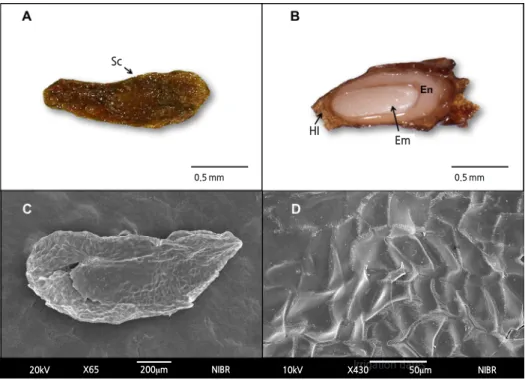
Fig. 1. Structure of an Astilboides tabularis (Hemsl.) Engl. seed. Seed exterior (A) and interior of cut seed (B). Sc, seed coat; Hi, hilum; En, endosperm; Em, embryo. Scanning electron micrographs of seed exterior (C) and seed coat surface (D).
Results
Classification of Seed Dormancy Types on Well-selected Seeds
The seed size of A. tabularis averaged 2.07 × 0.66 mm and the 1,000-seed weight was 75.3 ± 0.14 mg. The seeds contained a distinguishable embryo and endosperm but lacked a cotyledon and hypocotyl (Figs. 1A and 1B). No organ for moisture absorption was observed on the seed coat (Figs. 1C and 1D). The E:S ratio of the seeds was 34.6%, and direct sowing experiments of undifferentiated seeds led to germination within 4 weeks without fail. The germination rate, however, was only 45.9% (data not shown).
The moisture content of the seeds was 15.4%, which reached a maximum of 56.4% within 24 hours and maintained a similar level for 7 days (Fig. 2).
Irrigation dates
X65 200µm X430 50µm
0.5 mm 0.5 mm
NIBR 10kV NIBR
20kV
HI Em Sc
Fig. 2. Changes of moisture contents in Astilboides tabularis (Hemsl.) Engl. seeds during the soaking period. Bars represent standard errors (n = 4). Different letters indicate significant difference based on Duncan’s multiple range tests at p < 0.05.
Moisture contents (%)
Soaking period (Days)
0 1 2 3 4 5 6 7
0 20 bz
a a a a a a a
40 60 80 100
Seed Germination Conditions
We examined the germination rates of A. tabularis seeds in germination beds at different temperatures and light conditions.
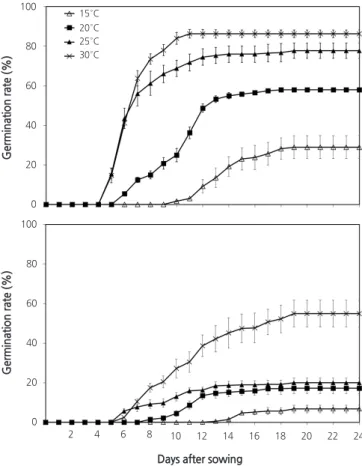
The germination rate was highest (86.3%) at 30°C under light conditions; this rate was generally higher in the light than in the dark (Fig. 3). Regardless of light conditions, the germination rates were higher at higher temperatures.
The days to germination were shorter at all temperatures under light conditions; germination was complete within 11 days at 30°C in the light. At the same temperature under dark conditions, germination continued to day 19, as dark conditions generally hampered germination.
Effects of Chemical Treatments on Seed Germination
Seeds of A. tabularis were treated with various concentrations of GA
3to improve the germination rate. Treatment with both 200 and 500 mg·L
-1of GA
3led to an excellent germination rate of 97.0%, and 100 mg·L
-1of GA
3improved the germination rate compared to the control (Table 1). GA
3treatment improved the GE of A. tabularis seeds significantly, with 500 mg·L
-1being the most effective treatment (31.5%; Table 1). Furthermore, with higher GA
3concentrations, shorter mean germination time (MGT) and T
50were observed. At 500 mg·L
-1of GA
3, the MGT and T
50were reduced by 4.8 and 2.3 days, respectively.
Fig. 3. Effects of light and temperature on seed germination in Astilboides tabularis (Hemsl.) Engl. Bars represent standard errors (n = 4).
Germination rate (%)
Days after sowing
2 4 6 8 10 12 14 16 18 20 22 24
0 0
20 20
40 40
60 60
80 80
100
100 15°C
20°C 25°C 30°C
Germination rate (%)
Kinetin treatment did not improve the germination rate, and GE was reduced by 20 mg·L
-1kinetin treatment (Table 1) . Treatment with varying concentrations of KNO
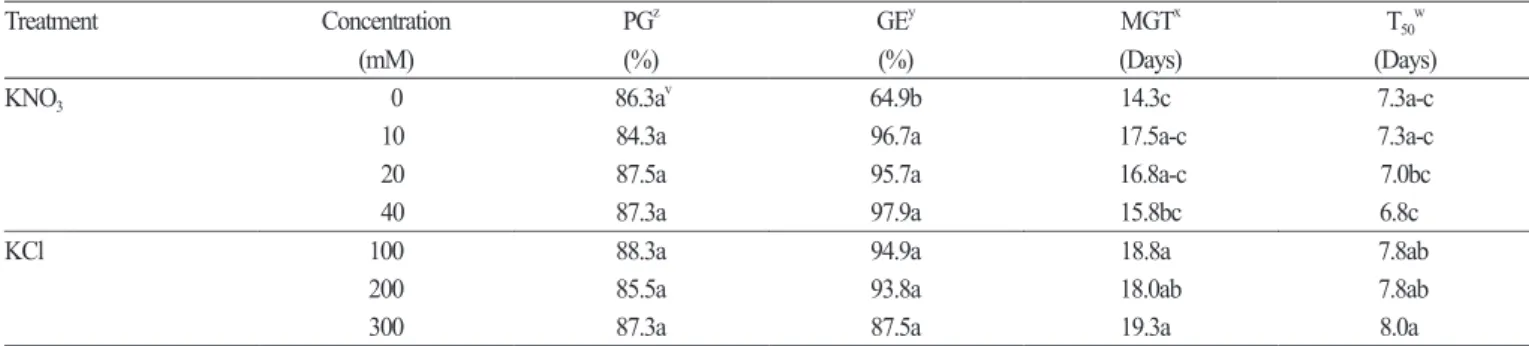
3and KCl also failed to improve the germination rate (Table 2). However, MGT and T
50were significantly reduced with increasing KNO
3concentration, and GE was improved by at least 30% at all concentrations.
Discussion
If freshly matured seeds show a germinate rate of over 80% within 4 weeks, they are classified as non-dormant seeds (ND). By contrast, seeds that have a germination rate below 80% within 4 weeks of exposure to germination conditions and an undifferentiated or underdeveloped embryo can be classified as morphologically dormant (MD) (Baskin and Baskin, 2004b). Therefore, the direct sowing germination rate and embryo development are important factors for distinguishing ND from MD.
Table 1. Effects of plant growth regulators on seed germination in Astilboides tabularis (Hemsl.) Engl. at 30°C in the light. The seeds were submerged in GA
3and kinetin solutions at 4 ± 1.0°C for 24 hours in the dark.
Treatment Concentration PG
zGE
yMGT
xT
50w(mg·L
-1) (%) (%) (Days) (Days)
GA
30 86.3b
v64.9d 14.3ab 7.3a
100 89.5ab 78.4bc 13.0b 6.0b
200 97.0a 87.7ab 12.8b 5.0c
500 97.0a 96.4a 9.5c 5.0c
Kinetin 10 86.5b 62.1d 15.8a 7.3a
20 85.5b 68.3c 15.8a 7.0a
z
Percent germination.
y
Germination energy: (Number of germinated seeds at day 7/number of total germinated seeds) × 100.
x
Mean germination time: mean of average days required for germination.
w
Days required for 50% seed germination.
v
Mean separation within columns by Duncan’s multiple range test, p < 0.05.
Table 2. Effects of minerals on seed germination in Astilboides tabularis (Hemsl.) Engl. at 30°C in the light. The seeds were submerged in KNO
3and KCl solutions at 4 ± 1.0°C for 24 hours in the dark.
Treatment Concentration PG
zGE
yMGT
xT
50w(mM) (%) (%) (Days) (Days)
KNO
30 86.3a
v64.9b 14.3c 7.3a-c
10 84.3a 96.7a 17.5a-c 7.3a-c
20 87.5a 95.7a 16.8a-c 7.0bc
40 87.3a 97.9a 15.8bc 6.8c
KCl 100 88.3a 94.9a 18.8a 7.8ab
200 85.5a 93.8a 18.0ab 7.8ab
300 87.3a 87.5a 19.3a 8.0a
z
Percent germination.
y
Germination energy: (Number of germinated seeds at day 14/number of total germinated seeds) × 100.
x
Mean germination time: mean of average days required for germination.
w
Days required for 50% seed germination.
v
Mean separation within columns by Duncan’s multiple range test, p < 0.05
The levels of MD, as distinguished by the degree of development and differentiation, can be similar in different families.
Seeds of Burmanniaceae, Ochidaceae, Orobanchaceae, and Rafflesiaceae have an undifferentiated embryo and are dispersed without the formation of a radicle and cotyledon. Certain Apiaceae and Ranunculaceae seeds have a differentiated but underdeveloped embryos. These seeds also possess a radicle and cotyledon, although they are less than 1 mm in length (Baskin and Baskin, 1998).
In this study, seeds of A. tabularis were confirmed to have a developed and undifferentiated embryo (Fig. 1) and low germination rate below 50%. Seven days of soaking allowed the seeds to reach the maximum moisture content (Fig. 2).
These findings suggest that the seed coat is not impermeable and the seeds are not in physical dormancy (Baskin and Baskin, 1998). Thus, the seeds of A. tabularis were classified as MD.
Each plant has an optimum germination temperature, which is highly related to the environment of the native habitat (Bewley and Black, 1982). Seeds native to temperate regions have an optimum germination temperature between 24 and 30°C (Hartmann et al., 1997). Seeds of A. tabularis were classified as MD in this study, and the best germination rate was obtained at 30°C under light conditions, confirming the characteristics of plants native to temperate regions. The optimum germination temperature of native Orostachys japonicus, O. iwarenge (Kang et al., 2010) is 10°C. Also, maximum germination rates for Hydrangea petiolaris (Cho et al., 2014) is obtained at 25°C and in the light, and germination is severely restrained in the dark. Therefore, optimum germination temperatures are thought to vary by species but share similarities intergenerically.
Growth regulators interact with plants at concentrations lower than 10
-6M (Bewley, 1997). The growth regulator kinetin is a type of cytokinin that affects plant cell division, as well as the formation of aboveground plant parts in tissue culture, anti-aging of plants, seed germination, and other processes (Miller, 1956; Wittwer and Dedolph, 1963). GA is a well-known growth regulator that induces physiological reactions such as dormancy breaking, germination acceleration, flower bud formation, flowering acceleration, and the activation of hydrolytic enzymes (Blázquez et al., 1998; Groot and Karssen, 1987; Gubler et al., 1995; Pharis and King, 1985; Wilson et al., 1992). GA accelerates germination in barley and rice, as GA biosynthesized in the embryo interacts with the seed’s aleurone layer and catalyzes α-amylase secretion. Activated α-amylase decomposes starch and proteins in the endosperm to accelerate embryo development, which leads to accelerated germination (Abeles, 1986; Kim et al., 2009).
In the current study, we found that GA
3improved the germination rate and shortened the days to seed germination in A.
tabularis, but relatively low concentrations of kinetin were ineffective (Table 1). KNO
3treatment was effective at reducing the period of germination. Germination of Crotalaria sessiliflora seeds can be accelerated by 12-hour-long treatment with 0.1 mM of GA
3(Kang et al., 2001), and in the native plant Primula sachalinensis, exogenous GA treatment can break seed dormancy and initiate germination (Song and Lee, 2002).
Seed priming, including hydropriming, osmopriming, and matripriming with inorganic salts, is a seed hydration technique
used to control seed absorption, thereby improving the germination rate. In addition, uniform germination can be achieved
by treatment with inorganic salts under a broad temperature range (Bittencourt et al., 2004; Fay et al., 1994; Smith and Cobb,
1991). KNO3 used in priming treatment accelerates germination of Lysimachia vulgaris var. davurica seeds at higher
concentrations (Lee et al., 2003) and is also effective at accelerating the germination of Exochorda serratifolia seeds (Lee et
al., 2006), Adenophora triphylla var. japonica seeds (Kim et al., 1996), and others. However, the germination of Caltha
palustris L. var. palustris seeds (La and Jeong, 2008) is not accelerated by treatment with inorganic salts. In Allium cepa L.
seeds, KCl priming increases the germination speed, but other inorganic substances including KNO
3, NH
4NO
3, and K
3PO
4result in low germination rates compared to non-treated seeds (Cho et al., 2006). Therefore, the germination rate is accelerated by priming treatment, although the sensitivity varies according to chemical type, concentration, soaking duration and temperature, as well as plant species.
Consequently, the effects of GA
3and KNO
3on germination acceleration were confirmed in the seeds of A. tabularis, while kinetin and KCl had little effect. These results help confirm the notion that the effects of growth regulators and minerals on germination vary by species and concentration. Furthermore, our results indicate that GA
3treatment is effective for consistent seedling growth and the preservation of A. tabularis.
Literature Cited
Abeles FB (1986) Role of ethylene in
Lactuca sativa
cv. ‘Grand Rapid’ seed germination. Plant Physiol 81:780-787. doi:10.1104/pp.81.3.780
Baskin CC, Baskin JM (1998) Seeds-ecology, biogeography, and evolution of dormancy and germination. Academic Press, San Diego, CA, USA, pp 97-98
Baskin CC, Baskin JM (2004a) Germinating seeds of wildflowers, an ecological perspective. HortTechnology 14:467-473 Baskin JM, Baskin CC (2004b) A classification system for seed dormancy. Seed Sci Res 14:1-16. doi:10.1079/SSR2003150 Bewley JD (1997) Seed germination and dormancy. Plant Cell 9:1055-1066. doi:10.1105/tpc.9.7.1055
Bewley JD, Black M (1982) Physiology and biochemistry of seeds in relation to germination. Vol 2. Viability, dormancy and environmental control. Springer-Verlag, Berlin, Germany. doi:10.1007/978-3-642-68643-6
Bittencourt MLC, Dias DCFS, Dias LAS, Araujo EF (2004) Effects of priming on asparagus seed germination and vigour under water and temperature stress. Seed Sci Technol 32:607-616. doi:10.15258/sst.2004.32.2.29
Bla´zquez MA, Green R, Nilsson O, Sussman MR, Weigel D (1998) Gibberellins promote flowering of arabidopsis by activating the
LEAFY
promoter. Plant Cell 10:791-800. doi:10.1105/tpc.10.5.791Cho JS, Jeong JH, Kim SY, Lee JY, Lee CH (2014) Several factors affecting seed germination of
Hydrangea petiolaris
Siebold & Zucc.Kor J Plant Res 27:534-539. doi:10.7732/kjpr.2014.27.5.534
Cho SK, Seo HY, Oh YJ, Shim KB, Choi KG, Lee SC (2006) Effect of priming conditions on enhancing germination of onion (
Allium cepa
L.) seeds. Kor J Crop Sci 51:191-198Fay AM, Bennett MA, Still SM (1994) Osmotic seed priming of
Rudbeckia fulgida
improves germination and expands germination range. HortScience 29:868-870Geneve RL (2003) Impact of temperature on seed dormancy. HortScience 38:336-341
Groot SPC, Karssen CM (1987) Gibberellins regulate seed germination in tomato by endosperm weakening: a study with gibberellin- deficient mutants. Planta 171:525-531. doi:10.1007/BF00392302
Gubler F, Kalla R, Roberts JK, Jacobsen JV (1995) Gibberellin- regulated expression of a
myb
gene in barley aleurone cells: evidence forMyb
transactivation of a high-pI alpha-amylase gene promoter. Plant Cell 7:1879-1891. doi:10.1105/tpc.7.11.1879Hartmann HT, Kester DE, Davies Jr FT, Geneve RL (1997) Plant propagation: Principles and practices. Ed 6, Prentice Hall, Upper Saddle River, NJ, USA, pp 157-158
Kang JS., Park EJ, Kim SH, Heo Y, Park YH, Choi YW, Son BG, Lim WT, and Suh JM (2014) Effect of seeds treatment on germinablity of
Tetragonia Tetragonides
seeds. J Environ Sci Inter 23:771-780. doi:10.5322/JESI.2014.5.771Kang JH, Jeong KH, Choi KO, Chon YS, and Yun JG (2010) Morphological characteristics and germination as affected by low temperature and GA in
Orostachys
‘Ilisan’ and ‘Ejuyeonhwa’ seeds, Korea native plant. Korean J Hortic Sci Technol 28:913-920 Kang JH, Kim YJ, Jeon BS (2001) Effects of presown cold stratification, KNO3 and acetone treatment on germination ofCrotalaria
sessiflora
L. Korean J Med Crop Sci 9:124-129Kim SD, Park SY, Kim TJ, Cheong IM, Kim SM (1996) Studies on the promoting of seed germination of
Adenophora triphylla
var.japonica
Hara. Korean J Plant Res 9:171-176Kim YH, Hamayun M, Khan AL, Na CI, Kang SM (2009) Exogenous application of plant growth regulators increased the total flavonoid content in
Taraxacum officinale
Wigg. Afr J Biotechnol 8:5727-5732La YJ, Jeong JH (2008) Effect of GA3 moist chilling storage and priming treatment on seed germination of
Caltha palustris
var.membranacea
Turcz. Flower Res J 16:174-178Lee HD, Kim SD, Kim HH, Kim JH, Lee JW, Yun T, Lee CH (2003) Effects of storage condition, growth regulator, and inorganic salt on the seed germination of
Lysimachia davurica
. Korean J Hortic Sci Technol 21:34-38Lee HD, Kim SD, Kim HH, Lee JW, Kim JH, Lee CH, Lee CH (2006) Effects of storage method, growth regulator, and inorganic salt on
the seed germination of
Exochorda serratifolia
S. Moore. Korean J Hortic Sci Technol 24:90-94Lee JH, Song CY, Hwang Y, Moon JY (2014a) Effect of temperature, light intensity, covering depth, watering frequency or GA3 on the germination of
Rhododendron brachycarpum
native to Korea. Flower Res J 22:68-73. doi:10.11623/frj.2014.22.2.5Lee SG, Kim HY, Ku JJ (2014b) Effects of seed storage methods and GA3 application on seed germination and seedling growth of
Solanum lyratum
Thunb. Korean J Plant Res 27:365-370Lee SY, Yoon NH, Gu JH, Jeong SJ, Kim KJ, Rhee JC, Lee TJ, Lee JS (2009) Effect of leaf number and rooting media on adventitious rooting of softwood cuttings in native
Hydrangea serrata
for.acuminata
. Korean J Hortic Sci Technol 27:199-204Lee TB (2003) Coloured flora of Korea. Hyangmoonsa Publishing Co, Seoul, Korea
Miller CO (1956) Similarity of some kinetin and red light effects. Plant Physiol 31:318-319. doi:10.1104/pp.31.4.318 Ministry of Environment (2007) 3rd. Natural environment survey in flora. Natl Inst Environ Res, Incheon, Korea, p 18 Ministry of Environment (2012) The biodiversity of Korea. Ministry Environ, Gwacheon, Korea, p 63
Nikolaeva MG (2001) Ecological and physiological aspects of seed dormancy and germination (review of investigations for the last century). Botanicheskii Zhurnal 86:1-14
Pharis RP, King RW (1985) Gibberellins and reproductive development in seed plants. Annu Rev Plant Physiol 36:517-568.
doi:10.1146/annurev.pp.36.060185.002505
Smith PT, Cobb BG (1991) Accelerated germination of pepper seed by priming with salt solutions and water. HortScience 26:417-419 Song JS, Lee JS (2002) Dormancy and germination characteristics of seed and plant of
Primula sieboldi
. J Kor Soc Hort Sci 43:91-94 Vandelook F, Bolle N, Van Assche JA (2007) Seed dormancy and germination of the EuropeanChaerophyllum temulum
(Apiaceae), amember of a trans-Atlantic genus. Ann Bot 100:233-239. doi:10.1093/aob/mcm090
Wilson RN, Hechman JW, Somerville CR (1992) Gibberellin is required for flowering in
Arabidopsis thaliana
under short days. Plant Physiol 100:403-408. doi:10.1104/pp.100.1.403Wittwer SH, Dedolph RR (1963) Some effects of kinetin on the growth and flowering of intact green plants. Amer J Bot 50:330-336.
doi:10.2307/2440149
Food Materials Information (2015) KFDA. http://fse.foodnara.go.kr/origin/search_data_list.jsp/. Accessed 15 June 2015