서론
고령의 환자들은 방광의 수축력이 저하되어 있고, 하부요 로 증상을 유발할 수 있는 질환이 있는 경우가 많으며, 하부 요로 기능에 영향을 줄 수 있는 여러 가지 약물을 복용하는 경우가 많으며, 약의 대사 및 약물역동학에 변화가 있어 약 의 효과 및 부작용이 다르게 나타나므로, 고령의 환자에서 하부요로 기능장애의 진단과 치료 시에는 일반인의 경우와
다르게 접근해야 한다[1-3].
하부요로의 기능장애는 나이가 들면서 점차 증가하는데, 이 는 방광기능의 변화, 신장기능의 변화, 호르몬의 변화, 남성 에서 전립선비대증, 여성에서 요도의 변화 등의 원인에서 기 인한다[4]. 나이가 들면서 배뇨근 내의 무스카린 수용체, 특히 M3 무스카린 수용체가 감소하며, 배뇨근 수축에 관여하는 운 동신경의 퇴행성 변화가 일어나고, 방광의 평활근 사이의 공 간이 증가하고, 평활근 내 미세구조 및 세포간 결합에 변화가 일어난다. 이들 변화로 인해 배뇨근 수축력이 감소하거나 방 광 과활동성이 발생하며, 이들이 동시에 발생하는 detrusor hyperreflexia with impaired contractility (DHIC)도 증가한 다[5-7]. Jeong 등[8]의 연구에 의하면 우리나라 남녀 환자에 서 나이가 증가함에 따라 배뇨근 저활동성과 배뇨근 과활동성 이 증가하며 따라서 이들이 동시에 발생하는 DHIC도 증가할 것으로 추측되며 이 경우 치료가 더욱 어려워진다.
노인의 배뇨장애 진단 및 치료 시 유의사항
김 용 태 | 한양대학교 의과대학 비뇨기과학교실
Geriatric considerations in the diagnosis and management of lower urinary tract dysfunction
Yong Tae Kim, MD
Department of Urology, Hanyang University College of Medicine, Seoul, Korea
Lower urinary tract dysfunction increases with age. Detrusor overactivity, detrusor underactivity, and detrusor hyperreflexia with impaired contractility are more common in elderly population. The elderly patients usually have cormobidities, comedications, and precipitation factors, which cause or exacerbate urinary symptoms, or aggravate subclinical lower urinary tract dysfunction to overwhelming diseases. Pharmacokinetics and pharmacodynamics changes with age. Older patients may refuse appropriate therapy because they are concerned about adverse effects, and economic burden. Thus strategy for the diagnosis and the management of lower urinary tract dysfunction in elderly might be different from those in young population. The diagnostic evaluation of these patients starts with history taking and non-invasive tests to make a plan to treat patient’s symptom. Watchful waiting with lifestyle intervention is a good treatment modality. If pharmacotheraphy is planned, it would be better to start with low dose, then escalate dose. Adverse effects of medications are more common in elderly patients not by old age, but by comorbidity and comedication. First follow up might be in a short period after prescription when adverse effects usually occur.
Key Words: Geriatrics; Lower urinary tract symptoms; Drug therapy
Received: March 25, 2015 Accepted: April 8, 2015 Corresponding author: Yong Tae Kim
E-mail: [email protected]
© Korean Medical Association
This is an Open Access article distributed under the terms of the Creative Commons Attribution Non-Commercial License (http://creativecommons.
org/licenses/by-nc/3.0) which permits unrestricted non-commercial use, distribution, and reproduction in any medium, provided the original work is properly cited.
진단
모든 환자에서 병력청취, 신체검사, 배뇨일지 작성을 시행 한다. 병력청취에서는 하부요로 증상, 가장 불편한 증상, 과 거력, 동반질환, 복용약물을 확인 하고, 국제전립선증상점수 (International Prostatic Symptom Score/Quality of Life), 과민성방광증상점수(Overactive Bladder Symptom Score) 등의 증상설문지를 작성한다. 치료방침 결정에 있어서 고려 하여야 하는 환자의 건강상태 및 예상여명도 확인한다[9].
하부요로 기능 및 치료에 영향을 줄 수 있는 동반질환, 즉, 수면장애, 파킨슨씨병[10], 뇌혈관질환[11] 등의 신경계질 환, 골반장기탈출증, 당뇨병, 대사증후군, 울혈성심부전, 고
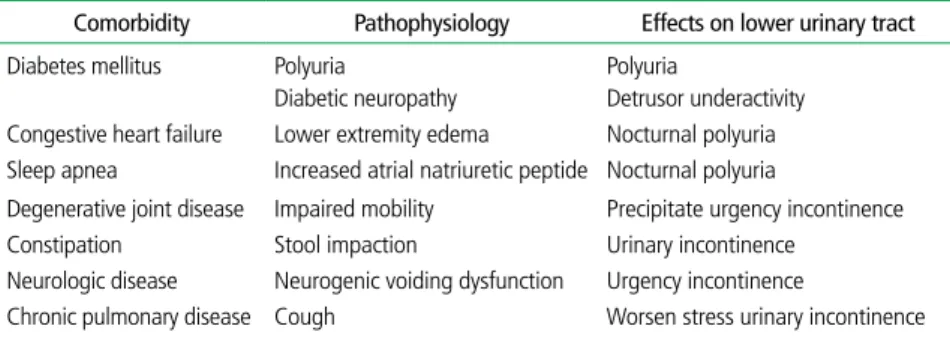
혈압, 관절염 등[12]이 있는지 확인한다 (Table 1). 당뇨병을 예로 들면 소변의 고삼투압으로 인한 다뇨, 인슐린-유사 성장인자 수용체 자극 등으로 인한 전 립선비대, 자율신경병증으로 인한 하 부요로 증상이 발생하고, 변비, 요로감 염, 하지장애, 혈관성치매, 시력저하 등 이 동반되어 하부요로 증상의 증상을 악 화시키고 치료법 선택을 제한하며, 치료 를 어렵게 한다[12-14]. 울혈성심부전 은 자율신경계 기능이상, 골반 내 허혈 등의 기전으로 하부요로 증상을 유발하 며, 흔히 동반되는 뇌혈관질환으로 인한 거동장애로 하지에 체액이 저류되고 이 로 인해 야간다뇨가 발생할 수 있다. 또 한 울혈성심부전의 치료에 흔히 사용되 는 이뇨제는 소변양을 증가 시켜 빈뇨, 야간뇨를 유발할 수 있다[15].
경미한 하부요로 기능장애를 치료가 필요한 장애로 악화시킬 수 있는 요인들 이 동반되어 있는지, 즉, 의식상태, 요로 감염, 운동능력, 동반질환, 복용 중인 약 물들, 식이습관, 변비 등과 함께 상지 기 능장애, 수면장애, 화장실의 접근성, 간 호할 수 있는 보호자의 유무, 등을 확인한다[14].
여러 가지 약을 복용하는 경우 약의 대사, 단백질 결합, 항 콜린제 다중투여 등으로 부작용이 증가할 수 있고, 안지오텐 신 전환효소억제제는 기침을 유발하여 요실금을 악화시키 며, 하지부종, 변비 등으로 약물치료를 어렵게 할 수 있으며, 동시에 여러 가지 약을 같이 사용하는 경우 약물간작용이 발 생하여 약물부작용의 가능성이 증가 할 수 있다(Table 2).
나이가 증가함에 따라 약물대사도 변화하는데 고령에서는 노화 자체 및 동반질환에 의해 연하장애, 위배출장애가 발 생하여 약물흡수가 감소할 수 있고, 무지방신체질량이 감소 하여 지방친화성 약제의 반감기를 증가시키며, 중추신경계 로 유입이 증가하고 알부민이 저하되어 부작용의 발생이 증
Table 1. Comorbidity affecting lower urinary tract function in elderly patients
Comorbidity Pathophysiology Effects on lower urinary tract Diabetes mellitus Polyuria
Diabetic neuropathy
Polyuria
Detrusor underactivity Congestive heart failure Lower extremity edema Nocturnal polyuria Sleep apnea Increased atrial natriuretic peptide Nocturnal polyuria
Degenerative joint disease Impaired mobility Precipitate urgency incontinence Constipation Stool impaction Urinary incontinence
Neurologic disease Neurogenic voiding dysfunction Urgency incontinence
Chronic pulmonary disease Cough Worsen stress urinary incontinence
Table 2. Comedications affecting lower urinary tract function in elderly patients
Comedications Pathophysiology Effects on lower urinary tract
Diuretics Polyuria Polyuria
Lithium Diabetes insipidus Polyuria
Steroids Lower extremity edema
Altered cognition
Nocturnal polyuria Urgency incontinence NSAIDs Lower extremity edema Nocturnal polyuria Alpha adrenergic antagonists Decrease urethral tone Stress urinary incontinence Calcium channel blockers Lower extremity edema
Detrusor underactivity Constipation
Nocturnal polyuria Urinary retention Urinary incontinence Anticholinergics
Antidepressant Antipsychotics
Detrusor underactivity Altered cognition Constipation
Urinary retention Urgency incontinence Urinary incontinence Antihistamine Anticholinergic activity
Altered cognition
Urinary retention Urgency incontinence Estrogen Urgency incontinence Urgency incontinence
ACE inhibitor Cough Stress urinary incontinence
NSAID, non-steroidal anti-inflammatory drug; ACE inhibitor, angiotensin converting enzyme inhibitor.
가할 수 있다[16]. 또한 노화 및 동반약물로 인하여 간대사 가 저하되어 약물대사가 변하며, 신기능이 저하되어 약물배 설이 감소한다.
신체검사로는 요폐여부를 확인하기 위한 하복부 촉진, 남 자에서 직장수지검사, 여자에서 골반검사, 스트레스검사, 그 리고 신경학적 검사, 하지부종 등을 확인한다. 진단검사로는 요검사, 요배양검사를 시행한다. 노인에서는 요로감염이 더 많이 발생하며 항생제 내성균에 의한 감염도 더 흔하다[14].
여명이 10년 이상인 남자에서 혈중 전립선특이항원을 측정 한다. 요속검사 및 잔뇨량 측정은 비침습적 검사이며 환자 의 배뇨 기능에 대한 중요한 정보를 제공하므로 모든 치료 법의 시행 전에 시행하는 것이 추천된다. 혈중 BUN (blood urea nitrogen)/creatinine, sodium, glucose, calcium, albumin, AST (aspartate transaminase)/ALT (alanine transaminase) 등의 혈액검사는 환자의 동반질환, 치료법, 사용 중인 약물, 사용 예정인 비뇨기약제에 따라 선택적으 로 시행한다.
요역동학검사는 초기 치료가 효과적이지 않거나 진단이 불확실한 경우, 신경학적 원인질환이 있는 경우, 수술을 계 획하는 경우 고려한다. 경직장전립선초음파검사는 시술이나 수술을 시행하기에 앞서 전립선의 해부학적구조가 시술이나 수술의 치료 효과에 영향이 있는 경우(예를 들면 온열요법, 요도스텐트, 전립선요도절개술 등) 시행한다. 방광경검사도 같은 이유로 필요한 경우, 또는 혈뇨가 있을 때 시행한다. 상 부요로에 대한 영상검사는 상부요로감염, 혈뇨, 결석, 신기 능저하 등의 경우 선택적으로 시행한다.
치료
치료법을 결정할 때에는 환자의 예상여명, 건강상태, 동반 질환, 하부요로질환의 병태생리, 각각의 치료법의 장단점, 비용문제[17] 등을 고려하여 치료효과와 부작용 발생 위험도 간에 균형 있게 선택한다. 가능하면 환자나 보호자가 원하는 치료법을 선택하는 것이 치료를 계속 유지할 수 있는 방법이 며 환자나 보호자들은 대부분 도뇨관을 사용하기보다는 약
물치료와 함께 시간제 배뇨, 기저귀 사용을 선호한다. 치료 목표는 증상을 개선시키고, 질병의 진행을 억제하고 합병증 의 발생을 예방하여 삶의 질을 향상시키는 것이다[18]. 하부 요로 기능에 영향을 주는 동반질환에 대하여 타과 진료를 의 뢰하고, 증상유발인자를 발견하여 제거해 준다. 특히 현재 복용 중인 약을 확인하여 하부요로 증상을 유발하거나 악화 시킬 가능성이 있는 약을 중단 또는 다른 약으로 대체하도 록 권유한다.
증상이 심하지 않은 경우 대기치료를 시행한다. 가능한 모든 환자에서 환자의 교육, 방광훈련, 생활습관 및 식이습 관 변화, 골반저근운동 등의 보존치료를 시행한다[19,20].
배뇨증상이 주된 증상인 경우 발살바 배뇨, 시간제 배뇨와 함께 알파수용체 길항제, 5-알파환원효소억제제(5-alpha reductase inhibitor), bethanechol 같은 부교감신경자극제 를 단독 또는 병합요법으로 사용하며, 5-알파환원효소억제 제는 전립선용적이 30 mL 이상이거나 혈중 PSA (prostate specific antigen) 수치가 1.5 ng/mL 이상이며 여명이 너무 짧지 않은 남자환자에서 사용할 수 있다. 알파교감신경수용 체길항제의 경우 고혈압으로 치료중인 고령의 환자에서 심 부전의 위험도를 높인다고 알려져 있다[12]. 요저장증상이 주된 증상인 경우 신속배뇨 교육과 함께 항무스카린제를 사 용한다. 고령의 환자에서는 중추신경계 내의 아세틸콜린이 저하되어 있고, 혈액 뇌 관문의 기능이 떨어져 있을 수 있으 므로, 항무스카린제를 사용하는 경우 인지기능이 저하될 수 있으며, 특히 잠재적인 인지장애가 있는 경우, 중추신경계 질환이 있는 경우, 항콜린 효과가 있는 약을 복용 중인 경우 가능성이 증가한다. 코호트연구에서 항콜린제는 인지기능을 저하시킨다고 보고되고 있다[21]. Oxybutynin은 인지기능 을 저하시킬 수 있는 것으로 알려져 있으며[22] 피하는 것이 좋다. 또한 노인에서 항무스카린제를 처방한 경우 치료 초기 에 인지장애의 발생유무를 확인하여야 한다[23].
현재 사용가능한 여러 항무스카린제는 고령의 환자에서도
일반적인 환자와 비교하여 유사한 효과와 부작용 빈도를 보
이는 것으로 보고되고 있다. 75세 이상과 이하의 환자에서
fesoterodine은 유사한 증상개선 효과를 보였으며 부작용의
빈도 및 심한 정도에서도 차이가 없었다[24]. 하지만 약물대
사 변화, 약물역동학의 변화, 동반질환, 동시에 복용하는 약 물 등의 요인으로 인해 부작용이 더 흔히, 더 심하게 발생한 다[14]. 예를 들면 항무스카린제의 흔한 부작용인 구갈은 충 치, 연하장애 등을 유발하여 환자의 삶의 질을 떨어뜨리고, 건강상태를 악화시킬 수 있다. 변비와 시력저하도 증상을 악 화시키고 치료를 어렵게 한다[25]. 노인의 경우 배뇨근 수축 력저하와 함께 변비, 의식저하 등으로 요폐가 더 흔하게 발 생한다[26]. 따라서 노인에서 항무스카린제는 잠재적으로 잔 뇨량을 증가시킬 수 있으므로 항무스카린제를 사용하는 경 우 저용량으로 시작하며 치료 초기에 증상과 잔뇨량 변화를 확인하며 용량을 증가시키는 것이 바람직하다[27].
야간뇨는 다뇨, 야간 다뇨, 배뇨량 감소 등의 원인에 따 라 치료하며, 야간다뇨에 흔히 사용되는 desmopressin은 약 22%의 환자에서 저나트륨혈증를 유발하는데 이들 대부분은 65세 이상의 고령환자이므로 치료 전 혈중 나트륨을 확인하 고, 저용량으로 치료를 시작하고, 치료 초기에 혈중 나트륨 을 확인하고, 증상의 변화에 따라 용량을 조절하는 것이 바 람직하다[28].
수술적 치료의 경우 동반질환으로 인한 수술 중 위험도는 증가할 수 있으나 나이는 수술의 위험도나 수술 결과에 영향 을 주지 않으므로 필요 시 시행할 수 있다[29,30]. 방광 내 botox 주사법은 노인에서도 일반적인 경우와 유사한 효과와 부작용을 보이나 요폐로 인한 장기간의 도뇨관 유치가 필요 할 수 있으므로 신중하게 사용한다[31].
결론
진단적 검사는 기본검사로 병력청취, 신체검사, 요검사, 배뇨일지, 그리고 요속검사와 잔뇨량측정을 시행하며, 요역 동학검사, 방광경검사, 경직장전립선초음파검사, 상부요로 영상검사는 선택적으로 시행한다. 증상을 유발, 또는 악화시 키는 요인, 동반질환이나 약물 등을 확인하여 없애준다. 동 반질환과 복용 중인 약이 많으므로 향후 중대한 합병증이 발 생할 가능성이 높지 않으면 대기치료 또는 환자나 보호자가 원하는 형태의 치료를 시행하는 것이 바람직하다. 고령의 환
자에서 약물치료의 효과와 부작용은 고령이 아닌 환자와 비 교하여 큰 차이를 보이지 않지만 동반질환과 복용 중인 약물 에 의해 부작용의 발생 가능성이 증가하므로 약물치료의 경 우 저용량으로 시작하여 효과와 부작용을 관찰하며 증량하 는 것이 바람직하다.
찾아보기말: 노인병학; 하부요로증상; 약물요법
ORCID
Yong Tae Kim, http://orcid.org/0000-0002-7646-2098
REFERENCES
1. Nuotio M, Tammela TL, Luukkaala T, Jylha M. Urgency and urge incontinence in an older population: ten-year changes and their association with mortality. Aging Clin Exp Res 2002;
14:412-419.
2. Nakagawa H, Niu K, Hozawa A, Ikeda Y, Kaiho Y, Ohmori- Matsuda K, Nakaya N, Kuriyama S, Ebihara S, Nagatomi R, Tsuji I, Arai Y. Impact of nocturia on bone fracture and mortality in older individuals: a Japanese longitudinal cohort study. J Urol 2010;184:1413-1418.
3. Brown JS, Vittinghoff E, Wyman JF, Stone KL, Nevitt MC, Ensrud KE, Grady D. Urinary incontinence: does it increase risk for falls and fractures? Study of Osteoporotic Fractures Re- search Group. J Am Geriatr Soc 2000;48:721-725.
4. Milsom I, Abrams P, Cardozo L, Roberts RG, Thuroff J, Wein AJ. How widespread are the symptoms of an overactive bladder and how are they managed? A population-based prevalence study. BJU Int 2001;87:760-766.
5. Haferkamp A, Elbadawi A. Ultrastructural changes in the aging bladder. Urologe A 2004;43:527-534.
6. Elbadawi A, Yalla SV, Resnick NM. Structural basis of geriatric voiding dysfunction. III. Detrusor overactivity. J Urol 1993;
150(5 Pt 2):1668-1680.
7. Mansfield KJ, Liu L, Mitchelson FJ, Moore KH, Millard RJ, Burcher E. Muscarinic receptor subtypes in human bladder detrusor and mucosa, studied by radioligand binding and quan- titative competitive RT-PCR: changes in ageing. Br J Pharmacol 2005;144:1089-1099.
8. Jeong SJ, Kim HJ, Lee YJ, Lee JK, Lee BK, Choo YM, Oh JJ, Lee SC, Jeong CW, Yoon CY, Hong SK, Byun SS, Lee SE. Prevalence and clinical features of detrusor underactivity among elderly with lower urinary tract symptoms: a comparison between men and women. Korean J Urol 2012;53:342-348.
9. Abrams P, Chapple C, Khoury S, Roehrborn C, de la Rosette J;
International Scientific Committee. Evaluation and treatment
of lower urinary tract symptoms in older men. J Urol 2009;181:
1779-1787.
10. Wullner U, Schmitz-Hubsch T, Antony G, Fimmers R, Spottke A, Oertel WH, Deuschl G, Klockgether T, Eggert K; KNP e.V.
Autonomic dysfunction in 3414 Parkinsonʼs disease patients enrolled in the German Network on Parkinson's disease (KNP e.V.): the effect of ageing. Eur J Neurol 2007;14:1405-1408.
11. Baztan JJ, Arias E, Gonzalez N, Rodriguez de Prada MI. New- onset urinary incontinence and rehabilitation outcomes in frail older patients. Age Ageing 2005;34:172-175.
12. DuBeau CE, Kuchel GA, Johnson T 2nd, Palmer MH, Wagg A; Fourth International Consultation on Incontinence. Incon- tinence in the frail elderly: report from the 4th International Consultation on Incontinence. Neurourol Urodyn 2010;29:165- 178.
13. Bang WJ, Lee JY, Koo KC, Hah YS, Lee DH, Cho KS. Is type-2 diabetes mellitus associated with overactive bladder symptoms in men with lower urinary tract symptoms? Urology 2014;84:670-674.
14. Dubeau CE. The aging lower urinary tract. J Urol 2006;175(3 Pt 2):S11-S15.
15. Chiu AF, Liao CH, Wang CC, Wang JH, Tsai CH, Kuo HC.
High classification of chronic heart failure increases risk of overactive bladder syndrome and lower urinary tract symp- toms. Urology 2012;79:260-265.
16. Wallin A, Sjogren M, Edman A, Blennow K, Regland B.
Symptoms, vascular risk factors and blood-brain barrier func- tion in relation to CT white-matter changes in dementia. Eur Neurol 2000;44:229-235.
17. Wodchis WP, Teare GF, Anderson GM. Cost and quality:
evidence from Ontario long term care hospitals. Med Care 2007;45:981-988.
18. Pfisterer MH, Johnson TM 2nd, Jenetzky E, Hauer K, Oster P.
Geriatric patientsʼ preferences for treatment of urinary incon- tinence: a study of hospitalized, cognitively competent adults aged 80 and older. J Am Geriatr Soc 2007;55:2016-2022.
19. Teunissen TA, de Jonge A, van Weel C, Lagro-Janssen AL.
Treating urinary incontinence in the elderly: conservative thera- pies that work: a systematic review. J Fam Pract 2004;53:25-30, 32.
20. Van Houten P, Achterberg W, Ribbe M. Urinary incontinence in disabled elderly women: a randomized clinical trial on the effect of training mobility and toileting skills to achieve independent toileting. Gerontology 2007;53:205-210.
21. Ancelin ML, Artero S, Portet F, Dupuy AM, Touchon J, Ritchie K. Non-degenerative mild cognitive impairment in elderly people and use of anticholinergic drugs: longitudinal cohort study. BMJ 2006;332:455-459.
22. Kay G, Crook T, Rekeda L, Lima R, Ebinger U, Arguinzoniz M, Steel M. Differential effects of the antimuscarinic agents darifenacin and oxybutynin ER on memory in older subjects.
Eur Urol 2006;50:317-326.
23. Wagg A, Verdejo C, Molander U. Review of cognitive impair- ment with antimuscarinic agents in elderly patients with overactive bladder. Int J Clin Pract 2010;64:1279-1286.
24. Wagg A, Khullar V, Marschall-Kehrel D, Michel MC, Oelke M, Darekar A, Bitoun CE, Weinstein D, Osterloh I. Flexible-dose fesoterodine in elderly adults with overactive bladder: results of the randomized, double-blind, placebo-controlled study of fesoterodine in an aging population trial. J Am Geriatr Soc 2013;61:185-193.
25. Laroche ML, Charmes JP, Nouaille Y, Picard N, Merle L. Is inappropriate medication use a major cause of adverse drug reactions in the elderly? Br J Clin Pharmacol 2007;63:177-186.
26. Thorne MB, Geraci SA. Acute urinary retention in elderly men.
Am J Med 2009;122:815-819.
27. Pfisterer MH, Griffiths DJ, Schaefer W, Resnick NM. The effect of age on lower urinary tract function: a study in women. J Am Geriatr Soc 2006;54:405-412.
28. Rembratt A, Riis A, Norgaard JP. Desmopressin treatment in nocturia; an analysis of risk factors for hyponatremia. Neuro- urol Urodyn 2006;25:105-109.
29. Campeau L, Tu LM, Lemieux MC, Naud A, Karsenty G, Schick E, Corcos J. A multicenter, prospective, randomized clinical trial comparing tension-free vaginal tape surgery and no treatment for the management of stress urinary incontinence in elderly women. Neurourol Urodyn 2007;26:990-994.
30. Dalpiaz O, Primus G, Schips L. SPARC sling system for treat- ment of female stress urinary incontinence in the elderly. Eur Urol 2006;50:826-830.
31. Jiang YH, Liao CH, Tang DL, Kuo HC. Efficacy and safety of intravesical onabotulinumtoxinA injection on elderly patients with chronic central nervous system lesions and overactive bladder. PLoS One 2014;9:e105989.
Peer Reviewers’ Commentary
배뇨 장애는 연령 증가에 따라 그 빈도가 급격히 증가하는 증상 으로서, 고령의 환자들은 과민성 방광, 전립선 질환 등을 비롯하 여 하부요로의 기능에 영향을 주는 많은 전신 질환들이 동반되 는 경우가 많고 다약제 복용, 약물 대사 기능 저하 등의 위험 인 자가 있기 때문에 그 진단과 치료시 특별한 고려가 필요하다. 본 논문은 노인 환자에서 배뇨 장애가 있을 시의 진단 및 치료에 대 하여 간략하면서도 포괄적으로 기술되어 있어, 초고령 사회를 바 라보고 있는 우리나라 의료 현실에서 자칫 간과하기 쉬운 노인 배뇨 장애 분야에 대하여 적절한 안내 지침으로서 그 가치가 크 다고 사료된다.
[정리: 편집위원회]