• 검색 결과가 없습니다.

Affective Factors That Contribute to the Quality of Life of Juvenile Inmates with Attention-Deficit/Hyperactivity Disorder: A Focus on Items from the Korean Youth Self Report

N/A
N/A
Protected

Academic year: 2021

Share "Affective Factors That Contribute to the Quality of Life of Juvenile Inmates with Attention-Deficit/Hyperactivity Disorder: A Focus on Items from the Korean Youth Self Report"

Copied!
7
0
0

로드 중.... (전체 텍스트 보기)

전체 글

(1)

INTRODUCTION

In recent years, media reports of juvenile crime have in- creased in Korea. Juvenile crime itself is not a newly emerging social problem, but it raises questions about the effectiveness of the social system and issues such as a lack of interest in ju- venile crime and juvenile law. According to a 2014 study on the actual conditions and characteristics of violent juvenile crimes, the percentage of juvenile offenders increased after 2007, and the proportion of violent crime offenders among juvenile offenders was higher than that among adult offenders [1]. In response to the seriousness of juvenile crime and the ever- younger age of juvenile offenders, it is necessary to revise the current system of corrective measures, including measures

taken towards juvenile inmates and the use of accurate eval- uation tools.

In particular, psychological and medical factors including male sex [2], impaired cognitive ability [3], and childhood abuse [4] have been identified as risk factors in juvenile inmates. A high proportion (40–90%) of juvenile detainees have one or more psychiatric disorders [5-11], and attention-deficit/hyper- activity disorder (ADHD) has attracted particular attention in this context. In several studies conducted in North Amer- ica, Finland, Sweden, and Canada, a high prevalence of ado- lescent ADHD was found (in 71% of male inmates), and 45%

reported persistent symptoms [12]. In addition, a 2009 study of the Scottish Detention Center by Young et al. [13] suggest- ed that ADHD may be a greater contributor to disruptive be- havior than antisocial personality disorder.

It is increasingly likely that ADHD symptoms during ad- olescence or adulthood are a contributing factor or predictor

This is an Open Access article distributed under the terms of the Creative Commons Attribution Non-Commercial License (https://creativecommons.org/licenses/by-nc/4.0) which permits unrestricted non-commercial use, distribution, and reproduction in any medium, provided the original work is properly cited.

Affective Factors That Contribute

to the Quality of Life of Juvenile Inmates

with Attention-Deficit/Hyperactivity Disorder:

A Focus on Items from the Korean Youth Self Report

Hyesoon Kim and Bongseog Kim

Department of Psychiatry, Sanggye Paik Hospital, Inje University College of Medicine, Seoul, Korea

Objectives: This study investigated quality of life in Korean juvenile inmates with attention-deficit/hyperactivity disorder (ADHD) and the impact of behavioral and emotional problems on quality of life.

Methods: In total, 200 inmates were evaluated using the Korean version of the Mini-International Neuropsychiatric Interview (K- MINI) and the Korean version of the Kiddie-Schedule for Affective Disorders and Schizophrenia-Present and Lifetime (K-SADS-PL-K).

We extracted the inmates with ADHD and evaluated their quality of life, behavioral problems, and emotional problems with the Pedi- atric Quality of Life Inventory (PedsQL) and the Korean Youth Self Report (K-YSR) scale. Descriptive statistics, Pearson correlation analysis, and multiple regression analysis were conducted.

Results: Among the 200 total inmates, 68 were diagnosed with ADHD by the K-SADS-PL-K. Most of the correlations between PedsQL scores and K-YSR items were significant. Multiple regression analysis showed that PedsQL could be predicted by affective problems (among the DSM-oriented scales of the K-YSR) and attention problems (among the syndrome scales of the K-YSR).

Conclusion: Our results demonstrate that, among juvenile inmates with ADHD, quality of life was negatively correlated with most be- havioral and emotional problems. Meanwhile, the significant influence of affective and attention problems on inmates’ quality of life suggests the necessity of comprehensive treatments for this group.

Key Words: Quality of life; Attention deficit-hyperactivity disorder; Behavioral problem; Affective symptoms.

Received: June 12, 2019 / Revision: July 13, 2019 / Accepted: July 17, 2019

Address for correspondence: Bongseog Kim, Department of Psychiatry, Sanggye Paik Hospital, Inje University College of Medicine, 1342 Dongil-ro, No- won-gu, Seoul 01757, Korea

Tel: +82-2-950-1087, Fax: +82-2-936-8069, E-mail: [email protected]

J Korean Acad Child Adolesc Psychiatry 2019;30(4):161-167

https://doi.org/10.5765/jkacap.190021

(2)

of crime. At the same time, the prognosis of individuals with ADHD should be approached not only from the perspective of symptom treatment, but also with a focus on quality of life.

Quality of life is a subjective concept that cannot be defined by a single aspect; however, it is distinct from the severity of the symptoms or the progression of the disease. The concept of quality of life emphasizes general well-being and every- day functioning in various areas of an individual’s life, and is not limited to the direct effects of the severity of ADHD symp- toms [14]. Nonetheless, the severity of symptoms in ADHD pa- tients may also affect their quality of life by impacting their daily functions and their interactions and relationships with family members [15]. Although there have been many studies on the effects of emotional states on the quality of life of ado- lescents with ADHD in Korea [16], few studies have studied juvenile inmates with ADHD, especially with a focus on their quality of life.

Therefore, in this study, the quality of life, emotions, and problem behaviors of male juvenile inmates were evaluated and analyzed with the goal of identifying mutual correlations and patterns of influence.

METHODS

Subjects

This study was conducted from December 2015 to January 2016 among 200 juvenile inmates. We selected 68 patients di- agnosed with ADHD through an evaluation using the Korean version of the Kiddie-Schedule for Affective Disorders and Schizophrenia-Present and Lifetime (K-SADS-PL). Partici- pants were provided with detailed instructions and guidance on the purpose and process of the study. Self-signed consent forms and self-report questionnaires were submitted, and for juvenile inmates under the age of 18, additional consent was provided by their parent or guardian. This study was approved by the Clinical Research Ethics Committee of Sanggye Paik Hospital (IRB No. SGPAIK-2015-06-022-002).

Procedure

All participants completed self-report questionnaires, and mental health practitioners and clinical psychologists con- ducted structured diagnostic interviews to gather informa- tion on participants’ demographic characteristics and psychi- atric diagnoses and evaluations.

Scales

Korean version of the Kiddie-Schedule for Affective Dis- orders and Schizophrenia-Present and Lifetime

The K-SADS-PL comprises semi-structured interviews for

psychiatric diagnoses. The reliability and validity of its Ko- rean version (K-SADS-PL-K) were demonstrated by Kim et al. [17] for the diagnosis of major diseases of children and ad- olescents including ADHD, oppositional defiant disorder, and tic disorder. In this study, we utilized the K-SADS-PL-K to screen for ADHD and to confirm diagnoses of oppositional defiant disorder, conduct disorder, and tic disorder.

Korean version of the Mini-International Neuropsychiatric Interview 5.0

The Mini-International Neuropsychiatric Interview (MINI) 5.0 is a structured interview for psychiatric diagnoses follow- ing the DSM-IV and ICD-10 criteria [18]. According to Yoo et al. [19], the Korean version (K-MINI) showed kappa values ranging from 0.22 to 0.93 in the diagnosis of conditions con- tained in the Korean version of the DSM-IV, with good over- all validity. In this study, we used the K-MINI 5.0 to identify comorbid diseases, such as mood disorders, in juveniles.

Korean version of the Pediatric Quality of Life Inventory 4.0 Generic Core Scales

We used the Korean version of the Pediatric Quality of Life Inventory 4.0 Generic Core Scales (PedsQL 4.0) for evaluat- ing patients’ quality of life. The PedsQL 4.0 is a tool used to measure the difficulties of patients or caregivers in four areas:

physical functioning, emotional functioning, social function- ing, and school functioning [20]. The Korean version has also been proven to have good model fit and discriminant valid- ity [21].

Korean Youth Self Report

The Korean Youth Self Report (K-YSR) youth self-assess- ment scale is based on the Youth Self Report (YSR) of Achen- bach and Rescorla [22], with its second standardization car- ried out by Oh et al. [23] in 2011. Its test reliability was good, and discriminant validity and concurrent validity were ver- ified [24]. The K-YSR is an evaluation tool that can be used to screen for problem behaviors and clinical diagnoses. This study used the K-YSR to evaluate the emotional and behav- ioral problems of juvenile inmates with ADHD.

Statistical analysis

Each item of the PedsQL 4.0 and K-YSR among the 68 juve- nile inmates with ADHD and the 132 other juvenile inmates was analyzed using descriptive statistics and the t-test. Pear- son correlation analysis was performed between the two scales.

In addition, multiple regression analysis was conducted to

examine the impact of the subscales of the K-YSR on quality

of life. Statistical analysis was performed using SPSS version

25 (IBM Corp., Armonk, NY, USA). p-values <0.05 were con-

(3)

sidered to indicate statistical significance.

RESULTS

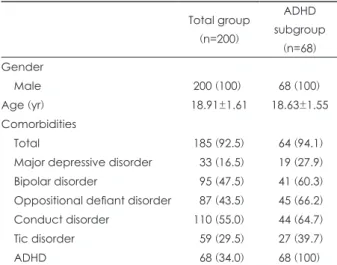
Mean age and prevalence of psychiatric disorders in all 200 juvenile inmates and in the subgroup diagnosed with ADHD

The mean age of the 200 juvenile inmates was 18.91±1.61 years, and the prevalence of psychiatric disorders was 92.5%

(n=185). Conduct disorder was the most prevalent (n=110;

55%), followed by bipolar disorder (n=95; 47.5%), and oppo- sitional defiant disorder (n=87; 43.5%) (Table 1).

The mean age of the 68 juvenile inmates diagnosed with

ADHD using the K-SADS-PL was 18.63±1.55 years. Among them, 64 (94.1%) had one or more other psychiatric disor- ders besides ADHD. Common comorbidities included oppo- sitional defiant disorder (n=45; 66.2% inmates), conduct dis- order (n=44; 64.7%) and bipolar disorder (n=41; 60.3%). In addition, the prevalence of all disorders in the ADHD sub- group was higher than in the entire group (Fig. 1).

Comparisons of quality of life and other problems ac- cording to the diagnosis of ADHD

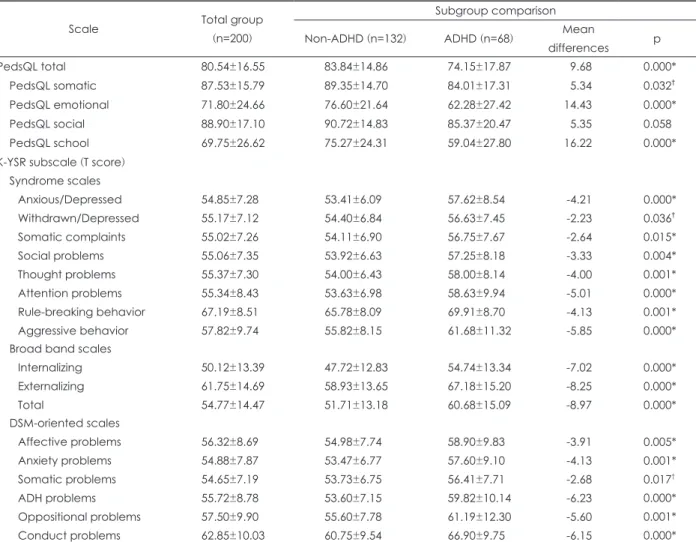
When the PedsQL and K-YSR scores were compared ac- cording to the diagnosis of ADHD, the quality of life was low- er in the ADHD subgroup for the total score and for all items (Table 2). The ADHD subgroup showed high scores for all items dealing with problem behavior. The results of the t-test showed that there was a significant difference in all items, ex- cept social functioning in the PedsQL.

Correlations between quality of life and problem be- haviors in participants with ADHD

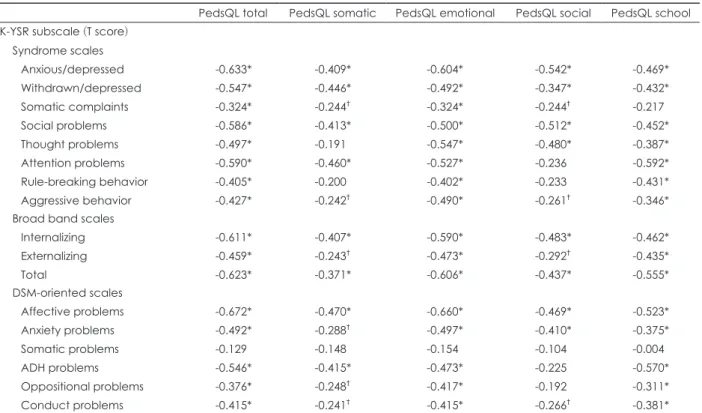
Correlations between quality of life in juvenile inmates with ADHD and their emotional and behavioral problems were evaluated (Table 3). Most of the K-YSR subscales showed sig- nificant relationships with quality of life, except for somatic problems. The PedsQL score and all four subitems showed significant correlations with emotional factors (syndrome scales: anxious/depressed, withdrawn/depressed; broad band scales: internalizing; DSM-oriented scales: affective problems, anxiety problems) and aggression-related factors (syndrome scales: aggressive behavior; broad band scales: externalizing;

Table 1. Demographic characteristics

Total group (n=200)

ADHD subgroup

(n=68) Gender

Male 200 (100) 68 (100)

Age (yr) 18.91±1.61 18.63±1.55

Comorbidities

Total 185 (92.5) 64 (94.1)

Major depressive disorder 33 (16.5) 19 (27.9) Bipolar disorder 95 (47.5) 41 (60.3) Oppositional defiant disorder 87 (43.5) 45 (66.2) Conduct disorder 110 (55.0) 44 (64.7)

Tic disorder 59 (29.5) 27 (39.7)

ADHD 68 (34.0) 68 (100)

Variables are presented as mean±standard deviation or n (%).

ADHD: attention-deficit/hyperactivity disorder

Fig. 1. Prevalence of comorbid diseases. MDD: major depressive disorder, ODD: oppositional defiant disorder, CD: conduct disorder, ADHD: attention-deficit/hyperactivity disorder

Total

MDD

Bipolar ds

ODD

CD

Tic ds

ADHD

Total ADHD group

10 20 30 40

Prevalence (%)

50 60 70 80 90 100

0

(4)

DSM-oriented scales: conduct problems). The following other significant correlations were found.

The PedsQL total score and emotional factors showed a significant correlation with all items, except DSM-oriented so- matic problems.

The physical factors of the PedsQL showed significant cor- relations with all items except thought problems and rule- breaking behavior among the syndrome scales and somatic problems among the DSM-oriented scales.

The social factors of the PedsQL showed significant cor- relations with all items except attention problems and rule- breaking behavior among the syndrome scales and somatic problems among the DSM-oriented scales.

The PedsQL factor dealing with school functioning was sig- nificantly correlated with all items except somatic complaints among the syndrome scales and somatic problems among the DSM-oriented scales.

Problem behavior factors affecting the quality of life of juvenile inmates with ADHD

After confirming the correlation between quality of life and each problem behavior factor, multiple regression analy- sis was conducted to quantify the influence of these variables on quality of life (Table 4). The PedsQL total score was used as a dependent variable and each subitem of the K-YSR was used as an independent variable. DSM-oriented affective problems and attention problems among the syndrome scales were found to have the most significant effect on the total score of qual- ity of life evaluated using the PedsQL.

In model 2, which was finally chosen by the stepwise selec- tion method, the explanatory power of the DSM-oriented af- fective scale item had the highest predictive power, with 44.4%.

The attention problems among the syndrome scales had an additional predictive power of 4.3%. Both of these findings were significant (p=0.000; p=0.013, respectively).

Table 2. Comparisons of PedsQL and K-YSR subscale T-scores between the non-ADHD and ADHD group

Scale Total group

(n=200)

Subgroup comparison Non-ADHD (n=132) ADHD (n=68) Mean

differences p

PedsQL total 80.54±16.55 83.84±14.86 74.15±17.87 9.68 0.000*

PedsQL somatic 87.53±15.79 89.35±14.70 84.01±17.31 5.34 0.032

PedsQL emotional 71.80±24.66 76.60±21.64 62.28±27.42 14.43 0.000*

PedsQL social 88.90±17.10 90.72±14.83 85.37±20.47 5.35 0.058

PedsQL school 69.75±26.62 75.27±24.31 59.04±27.80 16.22 0.000*

K-YSR subscale (T score) Syndrome scales

Anxious/Depressed Withdrawn/Depressed Somatic complaints Social problems Thought problems Attention problems Rule-breaking behavior Aggressive behavior

54.85±7.28 55.17±7.12 55.02±7.26 55.06±7.35 55.37±7.30 55.34±8.43 67.19±8.51 57.82±9.74

53.41±6.09 54.40±6.84 54.11±6.90 53.92±6.63 54.00±6.43 53.63±6.98 65.78±8.09 55.82±8.15

57.62±8.54 56.63±7.45 56.75±7.67 57.25±8.18 58.00±8.14 58.63±9.94 69.91±8.70 61.68±11.32

-4.21 -2.23 -2.64 -3.33 -4.00 -5.01 -4.13 -5.85

0.000*

0.036

0.015*

0.004*

0.001*

0.000*

0.001*

0.000*

Broad band scales Internalizing Externalizing Total

50.12±13.39 61.75±14.69 54.77±14.47

47.72±12.83 58.93±13.65 51.71±13.18

54.74±13.34 67.18±15.20 60.68±15.09

-7.02 -8.25 -8.97

0.000*

0.000*

0.000*

DSM-oriented scales Affective problems Anxiety problems Somatic problems ADH problems Oppositional problems Conduct problems

56.32±8.69 54.88±7.87 54.65±7.19 55.72±8.78 57.50±9.90 62.85±10.03

54.98±7.74 53.47±6.77 53.73±6.75 53.60±7.15 55.60±7.78 60.75±9.54

58.90±9.83 57.60±9.10 56.41±7.71 59.82±10.14 61.19±12.30 66.90±9.75

-3.91 -4.13 -2.68 -6.23 -5.60 -6.15

0.005*

0.001*

0.017

0.000*

0.001*

0.000*

Variables are presented as mean±standard deviation. *p<0.01,

p<0.05. ADHD: attention-deficit/hyperactivity disorder, DSM: Di-

agnostic and Statistical Manual of Mental Disorders, K-YSR: Korean Youth Self Report, PedsQL: Pediatric Quality of Life Inventory

version 4.0 Generic Core Scale

(5)

DISCUSSION

This study assessed the quality of life and emotional and behavioral factors reported by juvenile inmates and confirmed the presence of significant correlations between the factors.

It also examined the subjective emotional and behavioral fac- tors that affected juvenile inmates’ quality of life. Among the total 200 juvenile inmates, 68 (34%) with ADHD were iden- tified through the K-SADS-PL-K. Previous studies have re- ported a widespread prevalence of ADHD in delinquent ad- olescents, ranging from 4% to 72%, which is 3–5 times higher than in controls from the general population [25,26].

Conduct disorder, oppositional defiant disorder, and bipo-

lar disorder were the most prevalent diseases among the 200 juvenile inmates included in this study. The same results were obtained for juvenile inmates with ADHD. ADHD is known to occur in 40–60% of children and adolescents with disrup- tive disorders such as conduct disorder and oppositional de- fiant disorder [27]. Conduct disorder and oppositional defi- ant disorder were found to be present in 64.7% and 66.2% of the 68 juvenile inmates with ADHD, respectively, which is at the upper limit of prevalence among general studies of pe- diatric populations. In addition, 86.8% (n=59) of the juvenile inmates with ADHD had three or more comorbid diseases, and these individuals should receive urgent interventions.

Appropriate treatment should be provided if ADHD is sus- pected in a juvenile inmates. This is consistent with the dif- ference in the mean scores of the PedsQL and K-YSR scales between the overall sample of 200 juvenile inmates and the subgroup of 68 adolescents with ADHD.

The correlation between quality of life in the subjects with ADHD, analyzed using the PedsQL, and the subscales of the K-YSR showed that the externalization and internalization scale, depression/anxiety scale, inferiority scale, social imma- turity scale, thought problems scale, and the aggression scale, as well as the DSM-oriented emotion, anxiety, hostile rebel- lion, and behavioral disturbance scales correlated with all four subitems and total scores of the PedsQL. This association with

Table 4. Stepwise multiple linear regression analysis of the rela- tionship of PedsQL total score and K-YSR subscales among ADHD group

Model β-coefficient SE p Adj R

2

1 (Constant) 146.105 9.883 0.000 DSM-affective -1.222 0.166 0.000 0.444 2 (Constant) 147.308 10.459 0.000

DSM-affective -0.904 0.202 0.000 Attention problems -0.510 0.200 0.013 0.487 ADHD: attention-deficit/hyperactivity disorder, K-YSR: Korean Youth Self Report, PedsQL: Pediatric Quality of Life Inventory version 4.0 Generic Core Scale, SE: standard error

Table 3. Correlation of PedsQL and K-YSR subscales (ADHD group, n=68)

PedsQL total PedsQL somatic PedsQL emotional PedsQL social PedsQL school K-YSR subscale (T score)

Syndrome scales Anxious/depressed Withdrawn/depressed Somatic complaints Social problems Thought problems Attention problems Rule-breaking behavior Aggressive behavior

-0.633*

-0.547*

-0.324*

-0.586*

-0.497*

-0.590*

-0.405*

-0.427*

-0.409*

-0.446*

-0.244

-0.413*

-0.191 -0.460*

-0.200 -0.242

-0.604*

-0.492*

-0.324*

-0.500*

-0.547*

-0.527*

-0.402*

-0.490*

-0.542*

-0.347*

-0.244

-0.512*

-0.480*

-0.236 -0.233 -0.261

-0.469*

-0.432*

-0.217 -0.452*

-0.387*

-0.592*

-0.431*

-0.346*

Broad band scales Internalizing Externalizing Total

-0.611*

-0.459*

-0.623*

-0.407*

-0.243

-0.371*

-0.590*

-0.473*

-0.606*

-0.483*

-0.292

-0.437*

-0.462*

-0.435*

-0.555*

DSM-oriented scales Affective problems Anxiety problems Somatic problems ADH problems Oppositional problems Conduct problems

-0.672*

-0.492*

-0.129 -0.546*

-0.376*

-0.415*

-0.470*

-0.288

-0.148 -0.415*

-0.248

-0.241

-0.660*

-0.497*

-0.154 -0.473*

-0.417*

-0.415*

-0.469*

-0.410*

-0.104 -0.225 -0.192 -0.266

-0.523*

-0.375*

-0.004 -0.570*

-0.311*

-0.381*

*p<0.01,

p<0.05. ADHD: attention-deficit/hyperactivity disorder, K-YSR: Korean Youth Self Report, PedsQL: Pediatric Quality of

Life Inventory version 4.0 Generic Core Scale

(6)

emotional factors is consistent with previous research [16].

In addition, the results of this study showed that aggressive behavior (among the syndrome scales), externalization (among the broad band scales), and conduct problems (among the DSM-oriented scales) were significantly associated with qual- ity of life in subjects with ADHD. This is related to impaired self-regulation in individuals with ADHD. Previous studies have reported impulsive responses [28], mood instability, and low frustration tolerance [29] among ADHD-related factors.

In addition, in a study of adult male inmates in Scotland, pris- oners who had ADHD committed violent crimes eight times more often than other prisoners, and the figure was estimat- ed to be six times as high even when controlling for antisocial personality disorder [13]. Taken together, these results suggest that ADHD symptoms may be associated with sudden prob- lems and incidents in ADHD patients’ lives. Adolescents with ADHD are especially vulnerable, so the aggravation of ADHD and its symptoms may cause not only deterioration in the quality of life of inmates, but also increased costs and inci- dents within the facility [30].

Affective problems (among the DSM-oriented scales) were confirmed to be a factor affecting the quality of life of juvenile inmates with ADHD, in accordance with a previous study in which depressive symptoms were observed as a strong pre- dictor of quality of life in adolescents with ADHD. In addi- tion, the results of this study showed that ADHD participants’

self-reported attention/concentration problems were an ad- ditional predictor. A multidisciplinary approach that focuses on emotional problems and improving attention is needed for the treatment of juvenile inmates with ADHD.

CONCLUSION

In this study, the prevalence and the number of comorbid- ities among juvenile inmates with ADHD were observed, and the quality of life, emotional problems, and problem behav- iors of the juveniles with ADHD were evaluated. Compared with other juvenile inmates, the overall quality of life of those with ADHD was lower and problems involving emotional and behavioral factors were more common. The quality of life of juvenile inmates with ADHD was negatively correlated with most emotional problems and problem behaviors. Emo- tional and attention-related variables were predictors of qual- ity of life. A multidisciplinary approach focusing on the emo- tional problems of juvenile inmates with ADHD and treatments that improve attention is expected to have a larger effect on their quality of life, in addition to recovery from the disease, recovery of daily function, and social rehabilitation.

Acknowledgments

This study was supported by a grant of the Korean Mental Health Technology R&D Project, Ministry of Health & Welfare, Republic of Korea (HM15C1040).

Conflicts of Interest

The authors have no potential conflicts of interest to disclose.

Author Contributions

Conceptualization: Bongseog Kim. Data curation: Bongseog Kim.

Formal analysis: Hyesoon Kim. Funding acquisition: Bongseog Kim.

Methodology: Bongseog Kim. Project administration: Bongseog Kim.

Resources: Bongseog Kim. Supervision: Bongseog Kim. Validation: Hy- esoon Kim. Visualization: Hyesoon Kim. Writing—original draft: Hye- soon Kim. Writing—review & editing: Bongseog Kim.

ORCID iDs

Hyesoon Kim https://orcid.org/0000-0002-5075-798X Bongseog Kim https://orcid.org/0000-0002-2534-6986

REFERENCES

1) Choi SH, Park HS. A study on juvenile felony crime. Soeul: Ko- rean Institute of Criminology;2014.

2) Cheung C-K, Ngai N-P, Ngai SS-Y. Family strain and adolescent delinquency in two Chinese cities, Guangzhou and Hong Kong. J Child Fam Stud 2007;16:626-641.

3) Koolhof R, Loeber R, Wei EH, Pardini D, D’Escury AC. Inhibition deficits of serious delinquent boys of low intelligence. Crim Be- hav Ment Health 2007;17:274-292.

4) Mann EA, Reynolds AJ. Early intervention and juvenile delinquen- cy prevention: evidence from the Chicago Longitudinal Study.

Soc Work Res 2006;30:153-167.

5) Abram KM, Teplin LA, McClelland GM, Dulcan MK. Comorbid psychiatric disorders in youth in juvenile detention. Arch Gen Psy- chiatry 2003;60:1097-1108.

6) Colins O, Vermeiren R, Vreugdenhil C, van den Brink W, Dore- leijers T, Broekaert E. Psychiatric disorders in detained male ado- lescents: a systematic literature review. Can J Psychiatry 2010;55:

255-263.

7) Harzke AJ, Baillargeon J, Baillargeon G, Henry J, Olvera RL, Tor- realday O, et al. Prevalence of psychiatric disorders in the Texas Juvenile Correctional System. J Correct Health Care 2012;18:143- 8) Kim JI, Kim B, Kim BN, Hong SB, Lee DW, Chung JY, et al. Prev- 157.

alence of psychiatric disorders, comorbidity patterns, and repeat offending among male juvenile detainees in South Korea: a cross- sectional study. Child Adolesc Psychiatry Ment Health 2017;11:6.

9) Teplin LA, Abram KM, McClelland GM, Dulcan MK, Mericle AA.

Psychiatric disorders in youth in juvenile detention. Arch Gen Psy- chiatry 2002;59:1133-1143.

10) Ulzen TPM, Psych DC, Hamilton H. The nature and characteristics of psychiatric comorbidity in incarcerated adolescents. Can J Psy- chiatry 1998;43:57-63.

11) Vreugdenhil C, Doreleijers TA, Vermeiren R, Wouters LF, van den Brink W. Psychiatric disorders in a representative sample of incarcerated boys in the Netherlands. J Am Acad Child Adolesc Psychiatry 2004;43:97-104.

12) Young SJ, Adamou M, Bolea B, Gudjonsson G, Müller U, Pitts M, et al. The identification and management of ADHD offenders with- in the criminal justice system: a consensus statement from the UK Adult ADHD Network and criminal justice agencies. BMC Psychiatry 2011;11:32.

13) Young S, Gudjonsson GH, Wells J, Asherson P, Theobald D, Oli-

(7)

ver B, et al. Attention deficit hyperactivity disorder and critical in- cidents in a Scottish prison population. Pers Individ Dif 2009;46:

265-269.

14) Danckaerts M, Sonuga-Barke EJ, Banaschewski T, Buitelaar J, Döpfner M, Hollis C, et al. The quality of life of children with at- tention deficit/hyperactivity disorder: a systematic review. Eur Child Adolesc Psychiatry 2010;19:83-105.

15) Riley AW, Coghill D, Forrest CB, Lorenzo MJ, Ralston SJ, Spiel G;

ADORE Study Group. Validity of the health-related quality of life assessment in the ADORE study: Parent Report Form of the CHIP- Child Edition. Eur Child Adolesc Psychiatry 2006;15 Suppl 1:I63- I71.

16) Park BE, Lee JS, Kim HY, Bae JN, Kim WH, Kim HY, et al. The in- fluence of depression and school life on the quality of life of Ko- rean child and adolescent patients with attention-deficit/hyperac- tivity disorder: a comparison of the perspectives of the patients and their caregivers. J Korean Acad Child Adolesc Psychiatry 2019;30:

17) Kim YS, Cheon KA, Kim BN, Chang SA, Yoo HJ, Kim JW, et al. 2-8.

The reliability and validity of Kiddie-Schedule for Affective Dis- orders and Schizophrenia-Present and Lifetime Version-Korean version (K-SADS-PL-K). Yonsei Med J 2004;45:81-89.

18) Sheehan DV, Lecrubier Y, Sheehan KH, Amorim P, Janavs J, Wei- ller E, et al. The Mini-International Neuropsychiatric Interview (M.I.N.I.): the development and validation of a structured diag- nostic psychiatric interview for DSM-IV and ICD-10. J Clin Psy- chiatry 1998;59 Suppl 20:22-33.

19) Yoo SW, Kim Y, Noh JS, Oh KS, Kin CH, Namkoong K, et al. Va- lidity of Korean version of the Mini-International Neuropsychiatric Interview. Anxiety Mood 2006;2:50-55.

20) Varni JW, Seid M, Kurtin PS. PedsQL™ 4.0: reliability and valid- ity of the Pediatric Quality of Life Inventory™ version 4.0 Gener- ic Core Scales in healthy and patient populations. Med Care 2001;

39:800-812.

21) Kook SH, Varni JW. Validation of the Korean version of the Pedi- atric Quality of Life Inventory™ 4.0 (PedsQL™) Generic Core Scales in school children and adolescents using the Rasch model.

Health Qual Life Outcomes 2008;41:1-15.

22) Achenbach TM, Rescorla LA. Manual for the ASEBA school-age forms & profiles: an integrated system of multi-informant assess- ment. Burlington, VT: ASEBA;2001.

23) Oh KJ, Kim YA, Ha EH, Lee H, Hong KE. Korean version of youth self report. Seoul: Huno Consulting Inc.;2011.

24) Lee HG, Shin HS, Lee KS. Development of a self-report form of the adolescent problem behavior rating scale: tests of its reliability and validity. Kor J Clin Dev Psychol 2004;17:147-170.

25) Rösler M, Retz W, Retz-Junginger P, Hengesch G, Schneider M, Supprian T, et al. Prevalence of attention deficit-/hyperactivity disorder (ADHD) and comorbid disorders in young male prison inmates. Eur Arch Psychiatry Clin Neurosci 2004;254:365-371.

26) Vermeiren R. Psychopathology and delinquency in adolescents: a descriptive and developmental perspective. Clin Psychol Rev 2003;23:277-318.

27) Wolraich ML, Hannah JN, Pinnock TY, Baumgaertel A, Brown J.

Comparison of diagnostic criteria for attention-deficit hyperactiv- ity disorder in a county-wide sample. J Am Acad Child Adolesc Psychiatry 1996;35:319-324.

28) Young S, Morris R, Toone B, Tyson C. Planning ability in adults with attention-deficit/hyperactivity disorder. Neuropsychology 2007;21:581-589.

29) Skirrow C, McLoughlin G, Kuntsi J, Asherson P. Behavioral, neu- rocognitive and treatment overlap between attention-deficit/hy- peractivity disorder and mood instability. Expert Rev Neurother 2009;9:489-503.

30) Young S, Thome J. ADHD and offenders. World J Biol Psychiatry

2011;12 Suppl 1:124-128.

수치

Table 1. Demographic characteristics
Table 2. Comparisons of PedsQL and K-YSR subscale T-scores between the non-ADHD and ADHD group
Table 4. Stepwise multiple linear regression analysis of the rela- rela-tionship of PedsQL total score and K-YSR subscales among ADHD  group

참조

관련 문서

예를 들면 분리불안장애 separation amxiety disorder, 품행 장애 conduct disorder, 주의력결핍/과잉활동장애 attention deficit/hyperactivity, 학 습장애 learning

– standard war: to make network work and initiate positive feedback, need std(can’t use different tech to lock-in!). took-off in late 1980s), needed std protocol

◦ 전반적 발달장애 (Pervasive Developmental Disorders, PDDs)라는 범주 안에 “유아자폐증”(Early Infantile.. Autism, Diagnostic and Statistical Manual of

Key words: Tolerance, Innovation, the aged welfare policy, silver industry, improvement of quality of elderly life,

Music therapy was used in this study and participants were diagnosed with de- pressive disorder, according to the Diagnostic and Statistical Manual of Mental disorder 4 th

It considers the energy use of the different components that are involved in the distribution and viewing of video content: data centres and content delivery networks

Average of the indexed values of the following data: (1) Total value of the indexed score for disability-adjusted life years (the number of years lost due to illness,

After first field tests, we expect electric passenger drones or eVTOL aircraft (short for electric vertical take-off and landing) to start providing commercial mobility