Minor Criteria of Infectious Disease Society of America/
American Thoracic Society for Severe Community-Acquired Pneumonia Can Predict Delayed Treatment Response
The purpose of this study was to investigate the clinical aspects of patients satisfying the Infectious Disease Society of America/American Thoracic Society (IDSA/ATS) minor severity criteria, focusing on their treatment response to empirical antibiotics. In total, 381 community-acquired pneumonia (CAP) patients who did not require mechanical ventilation or vasopressors at admission were enrolled, and 50 (13.1%) satisfied the minor severity criteria (i.e., minor severe CAP [minor-SCAP]). The rates of new complication events and clinical treatment failure were significantly higher in the minor-SCAP group than in the control group (30.0% vs 2.1%, P < 0.001, and 42.0% vs 10.6%, P < 0.001, respectively), and the time to reach clinical stability was longer in the minor-SCAP group (8 days vs 3 days, P < 0.001). In a multivariate model, minor severity criteria (≥ 3) were significantly associated with treatment failure (odds ratio, 2.838; 95% confidence interval, 1.216 to 6.626), and for predicting treatment failure the value of the area under the receiver operating characteristic curve for minor criteria was 0.731, similar to other established scoring methods. The IDSA/ATS minor severity criteria can predict delayed treatment response and clinical treatment failure.
Key Words: Minor Criteria; Pneumonia; Severe; Treatment Response So Young Park1*, Sunghoon Park2*,
Myung Goo Lee1, Dong-Gyu Kim2, Gee Young Suh3, Changhwan Kim4, Chang Youl Lee1, Yong Bum Park4, and Ki-Suck Jung2
1Division of Pulmonary, Allergy and Critical Care Medicine, Department of Internal Medicine, Chuncheon Sacred Heart Hospital, Lung Research Institute of Hallym University, Chuncheon; 2Division of Pulmonary, Allergy and Critical Care Medicine, Department of Internal Medicine, Hallym University Sacred Heart Hospital, Anyang; 3Division of Pulmonary and Critical Care Medicine, Department of Medicine, Samsung Medical Center,
Sungkyunkwan University School of Medicine, Seoul; 4Division of Pulmonary, Allergy and Critical Care Medicine, Department of Internal Medicine, Kangdong Sacred Heart Hospital, Seoul, Korea
*So Young Park and Sunghoon Park contributed equally to this work.
Received: 3 March 2012 Accepted: 28 May 2012 Address for Correspondence:
Ki-Suck Jung, MD
Division of Pulmonary, Allergy and Critical Care Medicine, Department of Internal Medicine, Hallym University Sacred Heart Hospital, 22 Gwanpyeong-ro 170beon-gil, Dongan-gu, Anyang 431-070, Korea
Tel: +82.31-380-3715, Fax: +82.31-380-3973 E-mail: [email protected]
http://dx.doi.org/10.3346/jkms.2012.27.8.907 • J Korean Med Sci 2012; 27: 907-913
INTRODUCTION
Severe community-acquired pneumonia (SCAP) is associated with a high mortality rate of about 30%, and treatment failure significantly increases the risk of complications, length of hos- pital stay, and death (1-3). In 2007, the Infectious Disease Soci- ety of America/American Thoracic Society (IDSA/ATS) adopted a new definition of SCAP, with the inclusion of a new set of mi- nor criteria based on data of individual risks (4). Although it is clear that patients satisfying one of two major criteria usually present with severe illness and need intensive care unit (ICU) treatment, the clinical usefulness of minor criteria is not well known. Liapikou et al. (5) concluded that in the absence of ma- jor criteria, the value of the IDSA/ATS minor criteria is uncertain.
To date, there have been several studies on the utility of mi- nor criteria for predicting hospital outcomes. Phua et al. (6) dem- onstrated that IDSA/ATS minor criteria were more effective for predicting hospital mortality than other established scores, and Chalmers et al. (7) showed that the minor criteria were equally predictive as other methods for adverse events, such as the need for mechanical ventilation/vasopressors, ICU admission, and 30-day mortality. However, it is still unclear which clinical char- acteristics are associated with patients that satisfy only the IDSA/
ATS minor criteria. We hypothesized that CAP patients without mechanical ventilation or vasopressors, regardless of their hos- pital site of care (i.e., general ward or ICU), would present with different clinical aspects, depending on whether or not they satisfy the IDSA/ATS minor criteria.
Therefore, in the present study, we investigated the clinical characteristics of SCAP patients who satisfied the IDSA/ATS minor criteria (i.e., minor severe CAP [minor-SCAP]), focusing on their treatment response to empirical antibiotics.
MATERIALS AND METHODS Study population
Anonymous data from electronic medical records were reviewed.
We initially enrolled all adult patients (age ≥ 18 yr) admitted for CAP to Hallym University Sacred Heart Hospital between March 2007 and February 2009. CAP was defined as new pulmonary infiltrates on chest radiographs and symptoms and signs of low- er respiratory tract infection (5). Exclusion criteria included im- munosuppression (HIV infection, chemotherapy within the previous 6 months, hematologic malignancy), mycobacterial infection, discharge against medical advice, and transfer from or to other hospitals (8). We also excluded patients satisfying the IDSA/ATS major criteria; the major criteria were met when patients received mechanical ventilation or vasopressors.
Definitions
According to the 2007 IDSA/ATS guidelines, cases that met at least three of the nine minor severity criteria (i.e., respiratory rate ≥ 30 breaths/min, ratio of partial pressure of arterial oxy- gen to the fraction of inspired oxygen [PaO2/FiO2] ≤ 250, multi- lobar infiltrates, confusion and/or disorientation, blood urea nitrogen [BUN] ≥ 20 mg/dL, white blood cells [WBC] < 4,000 cells/μL, platelets < 100,000 cells/μL, core temperature < 36°C, and systolic blood pressure [BP] < 90 mmHg requiring aggres- sive fluid resuscitation) at hospital admission were defined as minor-SCAP. Pneumonia patients who did not meet the minor criteria were defined as the control group.
Clinical stability was defined as in Siegel (9); that is, when all of the following parameters were met: body temperature ≤ 37.2°C, heart rate ≤ 100 beats/min, respiratory rate ≤ 24/min, and sat- uration level of oxygen in hemoglobin (SaO2) ≥ 90% or PaO2
≥ 60 mmHg (with no exogenous oxygen supply). Treatment failure was defined as clinical deterioration, as in Menendez et al. (10), when at least one of the following existed: hemodynam- ic instability with the need for aggressive fluid resuscitation (i.e.,
> 40 mL/kg colloid or crystalloids) and vasopressors or invasive procedures, respiratory failure (SaO2 < 90% or PaO2 < 60 mmHg with FiO2 = 0.21) or need for mechanical ventilation, or radio- logic progression or new infection. Complications were classi- fied as cardiac, renal, or respiratory failure (need of noninvasive ventilation or invasive mechanical ventilation) or shock.
Data collection and analysis
We collected data on demographics, co-morbid illnesses, clini- cal symptoms, laboratory findings, and severity of illness scores,
such as CURB-65 (confusion, BUN ≥ 20 mg/dL, respiratory rate
≥ 30/min, systolic BP < 90 mmHg or diastolic BP ≤ 60 mmHg, and age ≥ 65) and pneumonia severity index (PSI) scores at hos- pital admission of all enrolled patients (11, 12). We also investi- gated the time to reach clinical stability and the rates of new com- plication events, clinical failure of empirical antibiotic treatment, and in-hospital mortality. We sought to identify independent factors for treatment failure by multivariate analysis and evalu- ated the performance of the IDSA/ATS minor criteria for predict- ing treatment failure, compared to CURB-65 and PSI scores, in CAP patients without mechanical ventilation or vasopressors.
Statistical analysis
To compare the results between groups, a one-way analysis of variance (ANOVA), Kruskal-Wallis test, or Student’s t-test was used for continuous data, while the chi-square or Fisher’s exact test was used for categorical data. Multivariate logistic regres- sion analysis was performed using covariates associated with treatment failure (P < 0.05) in univariate analyses to examine the association between the minor criteria and treatment failure.
A backward stepwise analysis (based on the likelihood ratio), with values of 0.05 to enter and 0.10 to stay in the model, was used. Receiver operating characteristic (ROC) curves for the IDSA/ATS minor criteria, PSI, and CURB-65 scores were also performed and compared. Finally, a Kaplan-Meier survival curve with a log rank test was performed to estimate and compare the time to reach clinical stability among the minor-SCAP and con- trol groups. All reported P values were two-sided and P < 0.05 was considered statistically significant. Statistical analyses were conducted using SAS statistical software, EG version (SAS Insti- tute Inc., Cary, NC, USA).
Ethics statement
The study protocol was approved by the institutional review
Excluded patients (n = 42) Pulmonary tuberculosis (n = 9) NTM lung disease (n = 1) Chemotherapy (n = 12) Interstitial lung disease (n = 2) Diffuse alveolar hemorrhage (n = 1) Immunocompromised patients (n = 2) Discharge against medical advice (n = 4) Transfer from or to other hospitals (n = 11) Non-severe CAP (n = 331)
Severe CAP by minor criteria (n = 50) Severe CAP by major
criteria (n = 44)
Included patients (n = 425)
Patients with suspected pneumonia
(n = 467)
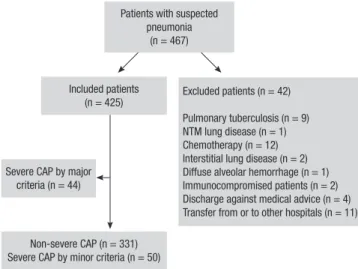
Fig. 1. Flowchart of the patient population. CAP, community-acquired pneumonia;
ICU, intensive care unit; NTM, nontuberculous mycobacteria.
board (IRB) of Hallym University Sacred Heart Hospital (IRB No. 2012 I016). Informed consent was waived by the IRB be- cause of the retrospective nature of this study.
RESULTS
Patient characteristics
Of the 467 total patients diagnosed as having CAP, 425 were ini- tially eligible for enrollment into our study. Among them, 44 pa- tients with SCAP based on major criteria were excluded, and 381 patients who did not receive mechanical ventilation or vasopres- sors were enrolled (Fig. 1). The mean patient age was 61.2 ± 19.3 yr, and 55.1% of patients were male. Of the 381 patients, 13.1%
(n = 50) satisfied the minor criteria of SCAP.
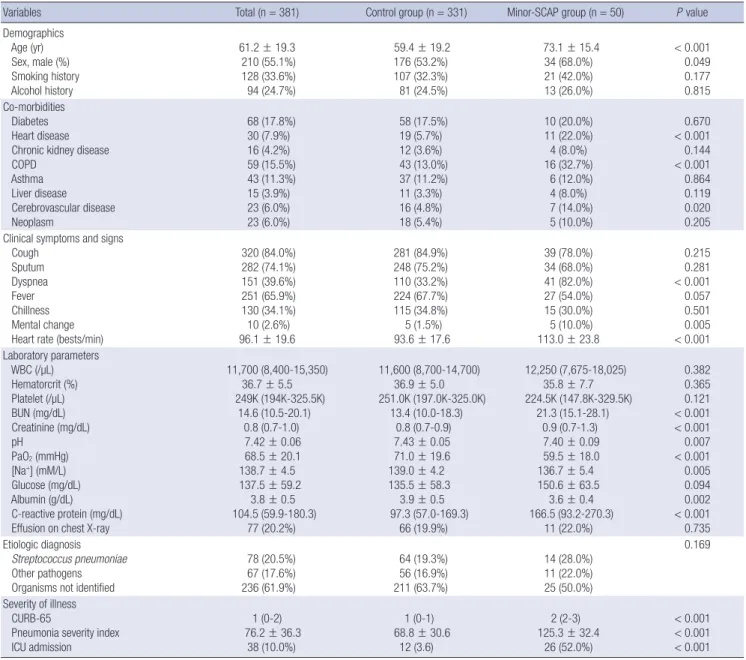
Diabetes and chronic obstructive pulmonary disease were the most common co-morbid illnesses (Table 1). Among the causal organisms, Streptococcus pneumoniae was the most fre- quent (20.5%, 78/381), and other organisms were identified in 67 patients (Mycoplasma pneumoniae, 37; Pseudomonas aeru- ginosa, 11; Klebsiella pneumoniae, 6; Staphylococcus aureus, 3;
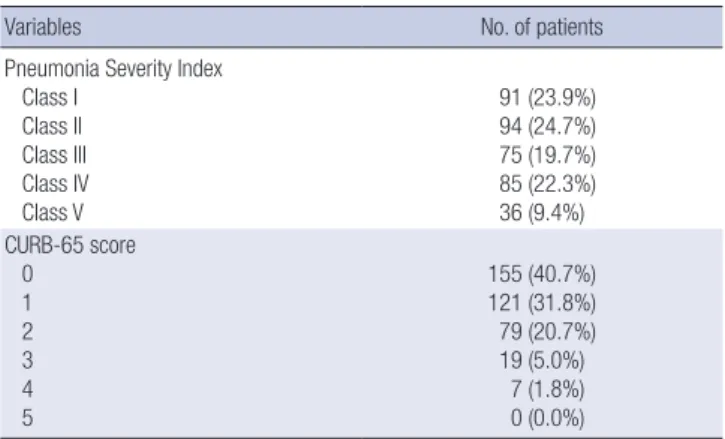
Moraxella catarrhalis, 1; Legionella spp., 1; Hemophilus influen- zae, 2; Streptococcus viridians, 2; other organisms, 4). In terms of antibiotic treatment, adherence to the IDSA/ATS guidelines was achieved in 370 (97.1%) patients, and 38 (10.0%) were ad- mitted to the ICU. Disease severity scores (CURB-65 and PSI scores) for all enrolled patients are included in Table 2.
Table 1. Comparisons of clinical characteristics among the study population
Variables Total (n = 381) Control group (n = 331) Minor-SCAP group (n = 50) P value
Demographics Age (yr) Sex, male (%) Smoking history Alcohol history
61.2 ± 19.3 210 (55.1%) 128 (33.6%) 94 (24.7%)
59.4 ± 19.2 176 (53.2%) 107 (32.3%) 81 (24.5%)
73.1 ± 15.4 34 (68.0%) 21 (42.0%) 13 (26.0%)
< 0.001 0.049 0.177 0.815 Co-morbidities
Diabetes Heart disease Chronic kidney disease COPD
Asthma Liver disease Cerebrovascular disease Neoplasm
68 (17.8%) 30 (7.9%) 16 (4.2%) 59 (15.5%) 43 (11.3%) 15 (3.9%) 23 (6.0%) 23 (6.0%)
58 (17.5%) 19 (5.7%) 12 (3.6%) 43 (13.0%) 37 (11.2%) 11 (3.3%) 16 (4.8%) 18 (5.4%)
10 (20.0%) 11 (22.0%) 4 (8.0%) 16 (32.7%) 6 (12.0%) 4 (8.0%) 7 (14.0%) 5 (10.0%)
0.670
< 0.001 0.144
< 0.001 0.864 0.119 0.020 0.205 Clinical symptoms and signs
Cough Sputum Dyspnea Fever Chillness Mental change Heart rate (bests/min)
320 (84.0%) 282 (74.1%) 151 (39.6%) 251 (65.9%) 130 (34.1%) 10 (2.6%) 96.1 ± 19.6
281 (84.9%) 248 (75.2%) 110 (33.2%) 224 (67.7%) 115 (34.8%) 5 (1.5%) 93.6 ± 17.6
39 (78.0%) 34 (68.0%) 41 (82.0%) 27 (54.0%) 15 (30.0%) 5 (10.0%) 113.0 ± 23.8
0.215 0.281
< 0.001 0.057 0.501 0.005
< 0.001 Laboratory parameters
WBC (/µL) Hematorcrit (%) Platelet (/µL) BUN (mg/dL) Creatinine (mg/dL) pH
PaO2 (mmHg) [Na+] (mM/L) Glucose (mg/dL) Albumin (g/dL) C-reactive protein (mg/dL) Effusion on chest X-ray
11,700 (8,400-15,350) 36.7 ± 5.5 249K (194K-325.5K)
14.6 (10.5-20.1) 0.8 (0.7-1.0) 7.42 ± 0.06 68.5 ± 20.1 138.7 ± 4.5 137.5 ± 59.2
3.8 ± 0.5 104.5 (59.9-180.3)
77 (20.2%)
11,600 (8,700-14,700) 36.9 ± 5.0 251.0K (197.0K-325.0K)
13.4 (10.0-18.3) 0.8 (0.7-0.9) 7.43 ± 0.05 71.0 ± 19.6 139.0 ± 4.2 135.5 ± 58.3
3.9 ± 0.5 97.3 (57.0-169.3)
66 (19.9%)
12,250 (7,675-18,025) 35.8 ± 7.7 224.5K (147.8K-329.5K)
21.3 (15.1-28.1) 0.9 (0.7-1.3) 7.40 ± 0.09 59.5 ± 18.0 136.7 ± 5.4 150.6 ± 63.5
3.6 ± 0.4 166.5 (93.2-270.3)
11 (22.0%)
0.382 0.365 0.121
< 0.001
< 0.001 0.007
< 0.001 0.005 0.094 0.002
< 0.001 0.735 Etiologic diagnosis
Streptococcus pneumoniae Other pathogens Organisms not identified
78 (20.5%) 67 (17.6%) 236 (61.9%)
64 (19.3%) 56 (16.9%) 211 (63.7%)
14 (28.0%) 11 (22.0%) 25 (50.0%)
0.169
Severity of illness CURB-65
Pneumonia severity index ICU admission
1 (0-2) 76.2 ± 36.3
38 (10.0%)
1 (0-1) 68.8 ± 30.6
12 (3.6)
2 (2-3) 125.3 ± 32.4
26 (52.0%)
< 0.001
< 0.001
< 0.001 BUN, blood urea nitrogen; COPD, chronic obstructive pulmonary disease; ICU, intensive care unit; SCAP, severe community-acquired pneumonia; WBC, white blood cell; CURB- 65 denotes confusion, blood urea nitrogen ≥ 20 mg/dL, respiratory rate ≥ 30/min, systolic blood pressure (BP) < 90 mmHg or diastolic BP ≤ 60 mmHg, and age ≥ 65 yr; Con- trol group denotes patients with non-SCAP; Minor-SCAP denotes SCAP based on the IDSA/ATS minor criteria.
Clinical characteristics at admission
Differences in the clinical characteristics at hospital admission between the minor-SCAP and control groups are shown in Ta- ble 1. Compared to the control group, males were more preva- lent, the patients were older, and underlying diseases (heart dis- ease, chronic obstructive pulmonary disease, and cerebrovas- cular accidents) were more common in the minor-SCAP group.
In addition to several clinical symptoms (i.e., dyspnea and men- tal changes), there were also significant differences in laborato- ry parameters, such as renal function, pH, oxygenation, serum sodium concentration ([Na+]), albumin, and C-reactive protein.
With regard to etiologic organisms, there were no significant differences between the two groups; however, disease severity was greater and the ICU admission rate was higher in the mi- nor-SCAP group.
Treatment response and hospital outcomes
Table 3 compares the frequency of new complication events and treatment outcomes between the two groups. New compli- cation events during the hospital stay, especially renal and re- spiratory failures, were significantly more common in the mi-
nor-SCAP group than in the control group (P < 0.001). In addi- tion, the time to clinical stability was longer (P < 0.001), and the rates of both clinical failure of empirical antibiotic treatment and in-hospital mortality were higher in the minor-SCAP group (P < 0.001 and P < 0.001, respectively).
Association between the IDSA/ATS minor criteria and treatment outcomes
We analyzed the association of clinical parameters, including the IDSA/ATS minor criteria for SCAP, with the response to em- pirical antibiotic treatment in patients without mechanical ven- tilation or vasopressors (Table 4). In univariate analyses, 16 in- dependent variables were significantly associated with treatment failure, including age, dyspnea, fever, mental change, cerebro- vascular accident, pleural effusion, heart rate, WBC, BUN, [Na+] (i.e., hyponatremia), glucose, albumin, PaO2, IDSA/ATS minor
Table 2. Pneumonia severity of the study population (n = 381)
Variables No. of patients
Pneumonia Severity Index Class I
Class II Class III Class IV Class V
91 (23.9%) 94 (24.7%) 75 (19.7%) 85 (22.3%) 36 (9.4%) CURB-65 score
0 1 2 3 4 5
155 (40.7%) 121 (31.8%) 79 (20.7%) 19 (5.0%) 7 (1.8%) 0 (0.0%)
CURB-65 denotes confusion, blood urea nitrogen ≥ 20 mg/dL, respiratory rate ≥ 30/
min, systolic blood pressure (BP) < 90 mmHg or diastolic BP ≤ 60 mmHg, and age
≥ 65 yr.
Table 3. Comparisons of the treatment outcomes
Variables Control group
(n = 331) Minor-SCAP
group (n = 50) P value Complications during hospital stay*
Renal failure Cardiac failure Shock Respiratory failure At least one failure
3 (0.9%) 0 (0.0%) 3 (0.9%) 4 (1.2%) 7 (2.1%)
3 (6.0%) 1 (2.0%) 10 (20.0%) 12 (24.0%) 15 (30.0%)
0.032 0.131
< 0.001
< 0.001
< 0.001 Time to clinical stability (days) 3 (1-5) 8 (6-10) < 0.001 Treatment failure 35 (10.6%) 21 (42.0%) < 0.001 In-hospital mortality 2 (0.6%) 10 (20.0%) < 0.001
30-day mortality 2 (0.6%) 9 (18.0 %) < 0.001
*Number of patients. ICU, intensive care unit; SCAP, severe community-acquired pneu- monia; Control group denotes patients with non-SCAP; Minor-SCAP denotes SCAP based on the IDSA/ATS minor criteria.
Table 4. Univariate analyses of predictors for treatment failure to empirical antibiotics
Variables Treatment success
(n = 325) Treatment failure
(n = 56) P value
Age (yr) 60.1 ± 19.6 67.9 ± 15.8 0.001
Sex (male:female) 174:151 36:20 0.135
Smoking 110 (33.8%) 18 (33.1%) 0.803
Alcohol 79 (24.3%) 15 (26.8%) 0.691
Diabetes 54 (16.6%) 14 (25.0%) 0.130
COPD 46 (14.2%) 13 (23.2%) 0.085
Bronchial asthma 37 (11.4%) 6 (10.7%) 0.884 Congestive heart failure 7 (2.2%) 3 (5.4%) 0.170
Chronic liver disease 15 (4.6%) 0 (0%) 0.141
Chronic renal disease 11 (3.4%) 5 (8.9%) 0.069
Cerebrovascular accident 15 (4.8%) 8 (14.3%) 0.011
Neoplasm 17 (5.2%) 6 (10.7%) 0.127
Dyspnea 117 (36.0%) 34 (60.7%) < 0.001
Fever 221 (68.0%) 30 (53.6%) 0.047
Mental change 5 (1.5%) 5 (8.9%) 0.008
Heart rate (beats/min) 94.7 ± 19.5 104.5 ± 18.0 0.001
WBC (/µL) 12231 ± 5600 14036 ± 6393 0.030
Hematocrit (%) 37.0 ± 5.2 35.2 ± 6.6 0.067
Platelet (/µL) 268.6 ± 111.8 K 289.9 ± 141.8 K 0.208
PaO2 (mmHg) 68.9 ± 18.9 62.7 ± 23.8 0.018
pH 7.43 ± 0.05 7.42 ± 0.08 0.233
BUN (mg/dL) 14.2 (10.1-18.9) 16.8 (12.3-26.2) 0.001 Creatinine (mg/d:) 0.8 (0.7-0.9) 0.8 (0.7-1.1) 0.329 [Na+](mM/L) 139.0 ± 4.1 136.8 ± 5.9 0.007
Glucose (mg/dL) 133.5 ± 55.6 160.9 ± 72.7 0.001
Albumin (g/dL) 3.9 ± 0.5 3.6 ± 0.5 < 0.001
C-reactive protein (mg/dL) 102.0 (57.4-175.5) 115.0 (79.0-205.0) 0.138
Pleural effusion 57 (17.5%) 20 (35.7%) 0.003
Organisms identified, No. (%) 121 (37.2%) 24 (42.9%) 0.423
Bacteremia 3 (0.9%) 1 (1.8%) 0.473
Minor criteria ≥ 3* 29 (8.9%) 21 (37.5%) < 0.001
CURB-65 1 (0-1) 1 (1-2) < 0.001
Pneumonia severity index 71.3 ± 34.2 104.4 ± 35.2 < 0.001
*Minor criteria for severe community-acquired pneumonia by IDSA/ATS. BUN, blood urea nitrogen; COPD, chronic obstructive pulmonary disease; WBC, white blood cell;
CURB-65 denotes confusion, blood urea nitrogen ≥ 20 mg/dL, respiratory rate ≥ 30/
min, systolic blood pressure (BP) < 90 mmHg or diastolic BP ≤ 60 mmHg, and age
≥ 65 yr.
criteria ≥ 3, and CURB-65 and PSI scores. Among these, pleural effusion, PSI score, and IDSA/ATS minor criteria ≥ 3 were sig- nificantly associated with treatment failure in the multivariate model (Hosmer-Lemeshow goodness-of-fit test, P = 0.111; Table 5); PaO2 was excluded from the multivariate model due to many missing data (n = 101). The odds ratio (OR) of the IDSA/ATS minor criteria ≥ 3 for treatment failure was 2.838 (95% confi- dence interval [CI], 1.216 to 6.626). The time to reach clinical stability was significantly longer in the minor-SCAP group than in the control group by Kaplan-Meier survival curve analysis (log rank = 28.6, P < 0.001; Fig. 2). The value of the area under the ROC curve for the IDSA/ATS minor criteria for the predic- tion of treatment failure was 0.731 (95% CI, 0.660 to 0.802), sim- ilar to the PSI (0.751; 95% CI, 0.688 to 0.814) and CURB-65 scores (0.688; 95% CI, 0.614 to 0.762; Fig. 3).
DISCUSSION
We found that among hospitalized CAP patients who did not require mechanical ventilation or vasopressors, those who sat- isfied the minor IDSA/ATS criteria for SCAP had different clini- cal characteristics, both at hospital admission and during treat- ment, compared with those who did not satisfy these criteria.
Patients who met the minor criteria were more likely to have higher rates of new complications and clinical treatment failure, and their time to clinical stability was much longer. In addition, IDSA/ATS minor criteria were independent factors for treatment failure, and their predictive value was not inferior to that of PSI or CURB-65 scores.
The IDSA/ATS minor criteria for SCAP include variables that are also included in the CURB-65 and ATS minor criteria (4), and the usefulness of the IDSA/ATS minor criteria has been investi- gated by several authors. Liapikou et al. (5) and Phua et al. (6) investigated the association with the IDSA/ATS minor criteria and hospital mortality and then focused on its prediction rule for ICU admission. However, in the present study, we investi- gated the clinical response to empirical antibiotics and found that the IDSA/ATS minor criteria were associated with delayed treatment response and a higher clinical failure rate, which are the most striking features of our study.
In univariate analyses (Table 3), the rates of new complica- tions, treatment failure, and in-hospital mortality were signifi- cantly higher in the minor-SCAP group than in the control group.
Therefore, our results indicate that among CAP patients with- out mechanical ventilation or vasopressors, those who meet the IDSA/ATS minor criteria are at high risk of poor outcomes.
As shown in Table 6, the severity of illness scores and the out- come parameters of the minor-SCAP group fell between those of the control group and major-SCAP patients that had been ex- cluded based on major criteria. Thus, we can say that the minor- SCAP group in the present study had intermediate disease se- verity among all CAP patients. In addition, although it is reason- able to assume that more severe pneumonia is associated with a higher incidence of treatment failure, few studies have dem- onstrated the relationship between severity scores and treatment Table 5. Multivariate analysis of predictors for treatment failure
Variables P value OR 95% CI
Glucose 0.082 1.004 0.999-1.008
Albumin 0.062 0.516 0.258-1.035
Pleural effusion 0.030 2.144 1.076-4.274
Pneumonia severity index 0.016 1.013 1.002-1.024
Minor criteria ≥ 3* 0.016 2.838 1.216-6.626
*Minor criteria for severe community-acquired pneumonia by IDSA/ATS. CI, confidence interval; OR, odds ratio; PSI, pneumonia severity index.
Cummulative rate
Time (days) to clinical stability
0 10 20 30 40
1.0 0.8 0.6 0.4 0.2 0.0
Control group Minor-SCAP group
Fig. 2. Kaplan-Meier survival curves for the time to reach clinical stability. The time to reach clinical stability was longer in the minor-SCAP than in the control (i.e., non-SCAP) groups (log rank = 28.6, P < 0.001).
Sensitivity
1-specificity
0.0 0.2 0.4 0.6 0.8 1.0
1.0
0.8
0.6
0.4
0.2
0.0
CURB 65
IDSA/ATS minor criteria PSI score
Fig. 3. ROC curves for prediction of clinical treatment failure. The AUC values for the minor criteria, CURB-65 and PSI scores were 0.731 (95% CI, 0.660-0.802), 0.688 (95% CI, 0.614-0.762), and 0.751 (95% CI, 0.688-0.814), respectively.
response. Menendez and Torres (13) reported that the median time to clinical stability in CAP patients was 4 days, and PSI score, treatment failure, and ICU admission were all associated with an increased time to reach clinical stability. In the present study, the median time to reach clinical stability was 3.0 days (inter- quartile range [IQR], 1-6 days) for all enrolled (n = 381) patients, and it was significantly longer in the minor-SCAP group than in the control group (8 days [6-10 days] vs 3 days [1-5 days]).
The in-hospital mortality rate of the enrolled patients was just 3.1%. Therefore, we used empirical antibiotic treatment failure as the outcome variable in multivariate analysis. In these analy- ses, pleural effusion, PSI score, and minor criteria ≥ 3 were sig- nificantly associated with treatment failure. In particular, pa- tients satisfying ≥ 3 minor criteria for SCAP had a greater than two-fold risk of treatment failure. CURB-65 scores were not sig- nificantly associated with treatment failure in the multivariate model. This may be due to its incorporation of few variables and/or the fact that it does not include some important param- eters, such as hypoxemia (4, 14, 15). Hypoxemia, which is in- cluded in the IDSA/ATS minor criteria, is considered very im- portant to the hospitalization decision for CAP patients, and the implementation of oxygenation assessment immediately im- proves the prognosis of CAP patients (16). In 2006, Espana et al.
(14) and Yandiola et al. (17) developed another prediction rule for SCAP (PS-CURXO80), and the hypoxemia variable was in- cluded as one of their six minor criteria. Recently, Guo et al. (18) reported that among the individual minor criteria, PaO2/FiO2
≤ 250 was correlated with the length of hospital stay, sequential organ failure assessment (SOFA) score, and treatment costs.
As shown in Table 2, patients with PSI class IV and V and CURB-65 scores ≥ 3 comprised only 31.8% and 6.8% of all pa- tients in the present study, respectively. Therefore, the patients enrolled in our study mostly represented the low-to-moderate risk group. Although the PSI score was designed to identify and assess low-risk pneumonia patients, the OR of the IDSA/ATS minor criteria ≥ 3 for treatment failure in the present study was higher than that of the PSI score. Furthermore, the PSI score is fairly complex and time-consuming to use. Therefore, based on the results of our study, the IDSA/ATS minor criteria for SCAP
could be more useful for disease severity assessment and the prediction of clinical response of hospitalized CAP patients who do not require mechanical ventilation or vasopressors, com- pared with established scoring systems. However, we did not evaluate the predictive value of using ≥ 4 minor criteria, as did Brown et al. (19), due to the limited number of patients; only 10 (2.6%) patients with ≥ 4 minor criteria were included in our study.
Therefore, care should be taken when interpreting our results.
With regard to the analysis of ROC curves for predicting treat- ment failure, minor criteria were not inferior to PSI or CURB65 scores in this study. Brown et al. (19) also reported that using four minor criteria may be superior to the PSI or CURB-65 scores for predicting severe pneumonia. They used the receipt of inten- sive therapy in the ICU as the reference value rather than the in- hospital mortality rate. In the present study, we did not use ICU treatment as the reference because it may be highly dependent on local guidelines and individual physicians’ practices.
Our study has several limitations. First, this was a single-cen- ter study, and the number of patients was limited. Second, due to the retrospective design of our study, there might be uniden- tified selection bias. Finally, as mentioned above, because the mortality rate of all enrolled patients was low, we could not as- sess the relationship between the minor criteria and in-hospital mortality. However, because few studies have focused on the clinical aspects of the IDSA/ATS minor criteria for SCAP in hos- pitalized patients without mechanical ventilation or vasopres- sors, our results are meaningful and can add to the previously reported body of work. We believe that patients who satisfy the IDSA/ATS minor criteria have different clinical characteristics among those without mechanical ventilation or vasopressors, and that these minor criteria will be very helpful for physicians to identify patients at high-risk for delayed treatment response and empirical antibiotic treatment failure.
In conclusion, satisfying IDSA/ATS minor criteria for SCAP (i.e., ≥ 3 minor criteria) can predict delayed time to reach clini- cal stability and high rates of clinical failure of empirical antibi- otics in hospitalized patients who do not require mechanical ventilation or vasopressors.
Table 6. Comparisons of the disease severity and hospital outcomes (n = 425)
Variables Control group (n = 331) Minor-SCAP group (n = 50) Major-SCAP group (n = 44) P value
CURB-65 score 1 (0-1) 2 (2-3) 4 (3-4) < 0.001*
Pneumonia severity index 68.8 ± 30.6 125.3 ± 32.4 165.5 ± 36.5 < 0.001†
ICU admission 12 (3.6%) 26 (52.0%) 44 (100%) < 0.001
Time to clinical stability (days) 3 (1-5) 8 (6-10) 16 (8-26) < 0.001*
Treatment failure 35 (10.6%) 21 (42.0%) 31 (70.5%) < 0.001
In-hospital mortality 2 (0.6%) 10 (20.0%) 19 (43.2%) < 0.001
30-day mortality 2 (0.6%) 9 (18.0%) 19 (43.2%) < 0.001
*Kruskal-Wallis and †one-way ANOVA were performed to compare values among the three groups. ICU, intensive care unit; SCAP, severe community-acquired pneumonia;
CURB-65 denotes confusion, blood urea nitrogen ≥ 20 mg/dL, respiratory rate ≥ 30/min, systolic blood pressure (BP) < 90 mmHg or diastolic BP ≤ 60 mmHg, and age ≥ 65;
Control group denotes patients with non-SCAP; Minor-SCAP denotes SCAP based on the IDSA/ATS minor criteria; Major-SCAP denotes SCAP based on the IDSA/ATS major criteria.
ACKNOWLEDGMENT
We thank Dr. Young-Soo Ju, Department of Occupational and Environmental Medicine, Hallym University Sacred Heart Hos- pital for statistical contribution to this study.
REFERENCES
1. Hoogewerf M, Oosterheert JJ, Hak E, Hoepelman IM, Bonten MJ. Prog- nostic factors for early clinical failure in patients with severe community- acquired pneumonia. Clin Microbiol Infect 2006; 12: 1097-104.
2. Menendez R, Torres A, Zalacain R, Aspa J, Martin Villasclaras JJ, Borde- rias L, Benitez Moya JM, Ruiz-Manzano J, Rodriguez de Castro F, Blan- quer J, et al. Risk factors of treatment failure in community acquired pneumonia: implications for disease outcome. Thorax 2004; 59: 960-5.
3. Restrepo MI, Mortensen EM, Velez JA, Frei C, Anzueto A. A compara- tive study of community-acquired pneumonia patients admitted to the ward and the ICU. Chest 2008; 133: 610-7.
4. Mandell LA, Wunderink RG, Anzueto A, Bartlett JG, Campbell GD, Dean NC, Dowell SF, File TM Jr, Musher DM, Niederman MS, et al. Infectious Diseases Society of America/American Thoracic Society consensus guide- lines on the management of community-acquired pneumonia in adults.
Clin Infect Dis 2007; 44: S27-72.
5. Liapikou A, Ferrer M, Polverino E, Balasso V, Esperatti M, Piner R, Mensa J, Luque N, Ewig S, Menendez R, et al. Severe community-acquired pneu- monia: validation of the Infectious Diseases Society of America/Ameri- can Thoracic Society guidelines to predict an intensive care unit admis- sion. Clin Infect Dis 2009; 48: 377-85.
6. Phua J, See KC, Chan YH, Widjaja LS, Aung NW, Ngerng WJ, Lim TK.
Validation and clinical implications of the IDSA/ATS minor criteria for severe community-acquired pneumonia. Thorax 2009; 64: 598-603.
7. Chalmers JD, Taylor JK, Mandal P, Choudhury G, Singanayagam A, Akram AR, Hill AT. Validation of the Infectious Diseases Society of Amer- ica/American Thoratic Society minor criteria for intensive care unit ad- mission in community-acquired pneumonia patients without major cri- teria or contraindications to intensive care unit care. Clin Infect Dis 2011;
53: 503-11.
8. Hilbert G, Gruson D, Vargas F, Valentino R, Gbikpi-Benissan G, Dupon M, Reiffers J, Cardinaud JP. Noninvasive ventilation in immunosuppressed patients with pulmonary infiltrates, fever, and acute respiratory failure.
N Engl J Med 2001; 344: 481-7.
9. Siegel RE. Time to clinical stability for patients with community-acquired pneumonia. JAMA 1999; 281: 231-2.
10. Menendez R, Torres A, Rodriguez de Castro F, Zalacain R, Aspa J, Martin Villasclaras JJ, Borderias L, Benitez Moya JM, Ruiz-Manzano J, Blanquer J, et al. Reaching stability in community-acquired pneumonia: the effects of the severity of disease, treatment, and the characteristics of patients.
Clin Infect Dis 2004; 39: 1783-90.
11. Lim WS, van der Eerden MM, Laing R, Boersma WG, Karalus N, Town GI, Lewis SA, Macfarlane JT. Defining community acquired pneumonia severity on presentation to hospital: an international derivation and validation study. Thorax 2003; 58: 377-82.
12. Fine MJ, Auble TE, Yealy DM, Hanusa BH, Weissfeld LA, Singer DE, Coley CM, Marrie TJ, Kapoor WN. A prediction rule to identify low-risk patients with community-acquired pneumonia. N Engl J Med 1997; 336:
243-50.
13. Menendez R, Torres A. Treatment failure in community-acquired pneu- monia. Chest 2007; 132: 1348-55.
14. Espana PP, Capelastegui A, Gorordo I, Esteban C, Oribe M, Ortega M, Bilbao A, Quintana JM. Development and validation of a clinical pre- diction rule for severe community-acquired pneumonia. Am J Respir Crit Care Med 2006; 174: 1249-56.
15. Levin KP, Hanusa BH, Rotondi A, Singer DE, Coley CM, Marrie TJ, Kapoor WN, Fine MJ. Arterial blood gas and pulse oximetry in initial manage- ment of patients with community-acquired pneumonia. J Gen Intern Med 2001; 16: 590-8.
16. Blot SI, Rodriguez A, Sole-Violan J, Blanquer J, Almirall J, Rello J. Effects of delayed oxygenation assessment on time to antibiotic delivery and mortality in patients with severe community-acquired pneumonia. Crit Care Med 2007; 35: 2509-14.
17. Yandiola PP, Capelastegui A, Quintana J, Diez R, Gorordo I, Bilbao A, Zalacain R, Menendez R, Torres A. Prospective comparison of severity scores for predicting clinically relevant outcomes for patients hospitalized with community-acquired pneumonia. Chest 2009; 135: 1572-9.
18. Guo Q, Li HY, Zhou YP, Li M, Chen XK, Liu H, Peng HL, Yu HQ, Chen X, Liu N, et al. Weight of the IDSA/ATS minor criteria for severe communi- ty-acquired pneumonia. Respir Med 2011; 105: 1543-9.
19. Brown SM, Jones BE, Jephson AR, Dean NC. Validation of the Infectious Disease Society of America/American Thoracic Society 2007 guidelines for severe community-acquired pneumonia. Crit Care Med 2009; 37:
3010-6.