폐암 한약제제 임상시험 가이드라인 개발을 위한 한약제제 무작위배정 대조군 임상시험 고찰
한가진1,2*, 조민지1, 박은주1,2, 성신1, 김성수1, 김관일3, 정희재3, 이범준3, 임정태4,5
1소람한방병원, 2소람한의약연구소, 3경희대학교 한의과대학 폐계내과학 교실, 4청연중앙연구소, 5동신한방병원 Review article
⋅Received:4 March 2019 ⋅Revised:13 March 2019 ⋅Accepted:13 March 2019
⋅Correspondence to:한가진(Gajin Han) 서울 강남구 봉은사로 462, 소람한의약연구소
Tel:+82-70-4803-6648, Fax:+82-70-8282-7001, E-mail:[email protected]
Analysis of Existing Guidelines and Randomized, Controlled, Clinical Trials for Development of [Guideline of Clinical Trial with Herbal Medicinal
Product for Lung Cancer]
Gajin Han1,2*, Minji Cho1, Eunjoo Park1,2, Sin Seong1, Sungsu Kim1, Kwan-Il Kim3, Hee-Jae Jung3, Beom-Joon Lee3, Jungtae Leem4,5
1Soram Hospital of Korean Medicine, 2Soram Korean Medicine Research Institute,
3Division of Allergy, Immune and Respiratory System, Department of Internal Medicine, College of Korean Medicine, Kyung Hee University, 4Chung-Yeon Central Institute,
5Dongshin Korean Medicine Hospital
Objectives: This study aimed to ascertain what should be considered in the “Guideline for Clinical Trials with Herbal Medicinal Products for Lung Cancer” by analyzing the existing guidelines and clinical trials.
Methods: The committee searched guidelines and clinical trials about herbal medicine for lung cancer. The searched trials were analyzed in terms of inclusion and exclusion of participants, intervention, comparator, outcomes and trial design. Then, we compared the results of our analysis with the guidelines to identify the issues we will have to consider when making the “Guideline for Clinical Trials with Herbal Medicinal Products for Lung Cancer”. Several guidelines for anti-tumor agents and clinical trials with herbal medicine were searched on the national institution homepage.
The search terms were as follows: ‘lung neoplasm', 'herbal medicine’, 'Medicine, Korean traditional', ‘Medicine, Chinese Traditional' etc.
Results: There was no guideline for clinical trial with herbal medicine for lung cancer. In addition, 7 articles were searched through database searching. All the participants had non-small cell lung cancer. The type of intervention was decoction. Comparators included conventional treatments such as chemotherapy. The outcome measurements used in the studies were quality of life, tumor response, and survival duration, etc. Safety was evaluated by recording adverse events and blood test.
Conclusions: Findings were made by reviewing existing guidelines and comparing them with clinical trials for lung cancer and herbal medicinal products. These results will be utilized in the development of “Guideline for Clinical Trials with Herbal Medicinal Products for Lung Cancer”.
Key Words : lung neoplasms, herbal medicinal product, clinical trial, guideline
서 론
2018년 발표된 국가 암 정보센터 통계에 따르면 2016년 한 해 동안 폐암의 발생률은 남자에서는 2위, 여자에서는 5위로 남녀를 합했을 때 위, 대장, 갑상선 에 이어 4위였으나, 2012년-2016년 5년 상대 생존률 은 췌장암에 이어 두 번째로 낮았고, 2017년 사망률과 사망자수는 남녀 모두에서 1위였다1). 또한 2018년 미 국에서 발표된 통계에 따르면 폐암이 단일 암종으로는 유방암에 이어 두 번째로 많이 발생하였으며 사망자수 는 모든 암을 통틀어 가장 많아 전세계적으로 암으로 인한 사망원인 1위를 차지하고 있는 치명적인 암이다2).
폐암의 종류는 암세포의 크기와 형태를 기준으로 비 소세포 폐암과 소세포 폐암으로 구분한다. 폐암 가운데 80~85%는 비소세포 폐암인데, 이것은 다시 선암(샘 암), 편평상피세포암, 대세포암 등으로 나뉜다. 그 나 머지인 소세포 폐암은 전반적으로 악성도가 높아서, 발 견 당시에 이미 림프관 또는 혈관을 통하여 다른 장기 나 반대편 폐, 종격동(縱隔洞, 양쪽 폐 사이의 공간으 로 심장, 기관, 식도, 대동맥 등이 위치함)으로 전이되 어 있는 수가 많다1).
폐암의 표준치료는 Tumor-Node-Metastasis (TNM) 병기에 따라 수술, 방사선 요법, 항암화학요법 분자표적치료 등이 행해지고 있다3),4). 폐암의 최선의 치료방법은 수술이 가능할 경우 완전 절제를 하는 것 이나 조기병변이라 할지라도 수술 후 재발율이 높으며, 진단 당시에 이미 절반 이상의 환자에게서 전이 소견 을 보여 수술이 불가능한 경우가 많아 대부분의 폐암 환자는 항암화학요법을 받는다5),6). 그런데 항암화학요 법은 암세포뿐 아니라 모공세포, 위장관내 점막세포, 피부, 구강 내 상피세포, 골수와 같은 성장이 빠른 정 상세포에 악영향을 끼치는 부작용을 초래하여7) 항암화 학요법 중인 폐암 환자는 호흡곤란, 피로, 통증, 식욕 부진, 수면장애, 변비, 오심과 구토, 설사 등을 호소한 다8). 그러나 서양의학의 기존 의료 체계 내에서는 이 러한 부작용에 대한 적절한 치료 및 전문적인 관리가 부족한 상황으로9), 많은 암환자들이 암 치료 과정에서 겪게 되는 심각한 부작용의 해결을 위해 효과가 있다
고 알려진 보완대체 의학을 사용하고 있다10). 2006년 에 발표된 우리나라의 암환자 1,150명을 대상으로 한 연구에 따르면 암환자의 보완요법 사용률이 75%에 달 했다11). 한의학계에서도 암에 대한 관심이 높아지고 있 고, 실제 다양한 암환자들의 진료가 이루어지고 있으 며, 한약을 이용한 기초 실험 연구부터 환자를 대상으 로 하는 임상연구까지 다양한 연구가 이루어지고 있다.
하지만 발표된 거의 대부분의 기초 실험이 임상연구로 연결되지 못하고 있으며, 임상 논문들 또한 대부분이 근거중심의학에서 근거가 낮은 편에 속하는 증례보고 라는 한계가 있어 폐암 치료에 있어 한의학을 활용하 는데 필요한 객관적 근거를 확보하기 위해서는 체계적 이고 근거 수준이 높은 임상연구가 필요하다12).
그러나 현재 근거 수준이 높은 폐암 관련 한의약 임 상시험은 본격적으로 수행되고 있지 않으며, 또한 국내 가이드라인 부문에서도 서양의학에서 사용하는 항암제 에 초점을 맞춘 임상시험 가이드라인 외에는 폐암 특 이적인 한약제제 임상시험 가이드라인은 존재하지 않 는 실정이다.
이에 저자는 추후 폐암치료를 위한 한약제제 임상시 험을 설계, 수행하고 이의 근거가 될 수 있는 가이드라 인 개발을 위한 사전 작업을 다음과 같이 진행하고자 한다. 첫째, 국내의 현존하는 가이드라인을 검색하여 한의약 임상시험에 적용할 수 있는 부분을 분석하고, 보완해야 하는 부분을 탐색한다. 두 번째로, 최근 수행 된 폐암관련 한약임상시험의 방법론을 고찰하여, 향후 임상시험 수행에서 필요한 잘 설계된 임상시험계획서 의 고려사항을 제시하고자 하는 바이다.
연구방법 및 절차
1. 가이드라인 관련 문헌검색 및 분석
1) 폐암 한약제제 임상시험 가이드라인 개발팀 구성 폐암 한약제제 임상시험 가이드라인 개발팀이 구성 되었으며, 본격적인 개발 전의 사전 작업을 진행하였 다. 개발팀은 총 9명으로, 임상시험 가이드라인 개발 경험이 있는 암 전문 한방병원 연구소 소속 연구원 2
인, 폐암치료 경험이 있는 암 전문 한방병원 소속 임상 의 3인, 한의과대학 폐계내과학 교수 3인, 한방내과전 문의로서 임상연구 가이드라인 제작경험이 있는 한의 약임상연구 전공자 1인으로 구성되었다.
2) 기존 국내 가이드라인 검색 및 분석
개발팀원 중 2인이 식품의약품안전처 홈페이지 (http://www.mfds.go.kr)와 국가과학기술정보센터 (NDSL) 홈페이지(www.ndsl.kr) 그리고 임상진료지 침 정보센터(www.guideline.or.kr)를 독립적으로 검 색하여 한약제제 관련 가이드라인과 암/폐암관련 가이 드라인을 검색하였으며, 검색된 가이드라인을 분석하 여 한약제제 임상시험에 적용 가능한지 고찰하였다.
2. 기존 임상시험 관련 문헌검색 및 분석 1) 문헌검색
① PubMed에서 폐암, 한의학, 한약에 해당하는 검 색어를 이용해 검색하였다. 2009년 이후에 출판
된 영어와 한국어로 된, 폐암치료를 위하여 한약 을 이용한 무작위 대조군 임상시험 논문을 선정 기준으로 하였다. 임상시험 중 예비연구는 제외 하였다. 자세한 검색식은 Table 1에 제시하였 다. (Table 1)
② 전통의학정보포털(https://oasis.kiom.re.kr), 한국전통지식포털(http://www.koreantk.com), 한국학술정보포털(http://kiss.kstudy.com), 과학기술학회마을(http://society.kisti.re.kr),
한국교육학술정보원 학술연구정보서비스
(http://www.riss.kr), 국가과학기술정보센터 (http://www.ndsl.kr)에서는 ‘폐암’, ‘한의’,
‘임상시험’으로 검색하였다.
2) 선정된 임상시험 분석
임상시험 설계 시 필수적인 요소인 P (Participants), I (Intervention), C (Comparator), O (Outcome) 를 중심으로 분석하였으며, 그 외 임상시험설계에 대해 서도 비교하였다.
No. Search items
1 Lung Neoplasms”[MH]
2 Medicine, Korean Traditional[MH]
3 Medicine, Chinese Traditional[MH]
4 Medicine, East Asian Medicine[MH]
5 medicine, Kampo[MH]
6 integrative medicine[MH]
7 herbal medicine[MeSH Terms]
8 herb*[Text Words]
9 tang[Text Words]
10 san[Text Words]
11 dection[ALL]
12 tang[Text Words]
13 san[Text Words]
14 dection[ALL]
15 #2 OR #3 OR #4 OR #5 OR #6 OR #7 OR #8 OR #9 OR #10 OR #11 OR #12 16 #1 AND #15
Filter Text availability: full text, Publication dates: 10 years, Languages: English Table 1. Search Strategy Used in PubMed
Publisher,
Year Title Characteristics
Korean Association for the Study of Lung Cancer,
2010
Korean clinical practice guidelines for lung cancer13
1. clinical practice guideline of conventional medicine
2. related to lung cancer
3. multidisciplinary clinical guideline in Korea
SH Kim, 2006
Study on development of assessment guideline and endpoints for clinical trial with antitumor natural product14
1. specific to assessment tool for clinical trial 2. related to antitumor natural product 3. a research report
Korea Food & Drug Administration,
2006
Guideline for evaluation of clinical trial of anticancer drug15
1. related to anticancer agents which have toxicity against cancer cell or function of inhibition of cancer cell growth
Korea Food & Drug Administration,
2010
Guidelines for the review of nonclinical test data for approval of anti-cancer drug’s clinical trial plan and item authorization16
1. description of the minimum considerations for clinical testing of anticancer drugs aimed at treating progressive cancer patients based on the type and timing of nonclinical studies National Institute of food
and drug safety evaluation, 2015
Guidelines for clinical trial of anti-cancer drugs 17
1. related to anticancer agents which have toxicity against cancer cell or function of inhibition of cancer cell growth
National Institute of food and drug safety evaluation,
2015
Guidelines for non-clinical trial of anti-cancer drugs18
1. recommendations for nonclinical evaluation to support clinical trials in the development of anticancer drugs
National Institute of food and drug safety evaluation,
2015
Guidelines for exemption of anti-cancer drug data in Korean population19
1. guidelines for exemption from submission of clinical trial data about Koreans
Ministry of Food and Drug Safety,
2018
Guideline for the use of clinical trial medicines for therapeutic purposes20
1. guideline for the use of clinical trial medicines to patients with life-threatening conditions without other treatment
Lee HJ, 2012
Korean Society of Thoracic Radiology Guideline for Lung Cancer Screening with Low-Dose CT21
1. guideline for the use of screening with low-dose CT for lung cancer
Korea Institute of Oriental Medicine,
2005
A study on the clinical trial guidelines of herbal medicinal drug22
1. related to general herbal medicinal drug 2. a research report
Korea Institute of Oriental Medicine,
2005
A study on the clinical trial guideline of herbal medical drug(Ⅱ)23
1. analysis of guidelines for clinical research of new medication in Chinese medicine 2. related to general herbal medicinal drug Industry-Academia
Collaboration Foundation, Kyung Hee University,
2006
Research on outcome indicators for clinical trials of herbal medicinal products 24
1. related to assessment tool 2. related to cough, phlegm, asthma 3. a research report
Korea Food & Drug Administration,
2007
General considerations for clinical trials in herbal medicine25
1. related to general herbal medicine
2. general principles and methods of clinical trials 3. a research report
National Institute of food and drug safety evaluation,
2017
Quality guidelines of herbal medicine for clinical trial26
1. recommendations for chemistry, manufacturing and control information on herbal medicines used in clinical trials
Table 2. The List of Searched Guidelines Related to Lung Cancer and Clinical Trial for Herbal Medicinal Product
결과
A. 가이드라인 관련 문헌검색 및 분석 1. 가이드라인 관련 문헌검색결과
국내 가이드라인 검색 결과는 Table 2와 아래에 기 술하였다. 폐암 치료를 위한 한약제제 임상시험 가이드 라인 및 침구 임상시험가이드라인은 존재하지 않았다.
한약제제임상시험 관련 가이드라인 검색결과 중 개별 질환에 대한 가이드라인은 제외하였다. (Table 2)
1) 암/폐암 관련 가이드라인
① 폐암 진료지침13) ② 천연물 항암제제 임상시험 평가지표 개발연구14) ③ 항암제 임상시험 평가지침
15) ④ 항암제임상시험계획(IND) 및 품목허가(NDA) 승인을 위한 비임상시험 자료 심사 지침16) ⑤ 항암 제 임상시험 가이드라인17) ⑥ 항암제 비임상시험 가 이드라인18) ⑦ 항암제 가교자료 면제를 위한 가이드 라인 개정판19) ⑧ 임상시험용의약품의 치료 목적 사용을 위한 가이드라인20) ⑨ 저선량 CT를 이용한 폐암 검진21)
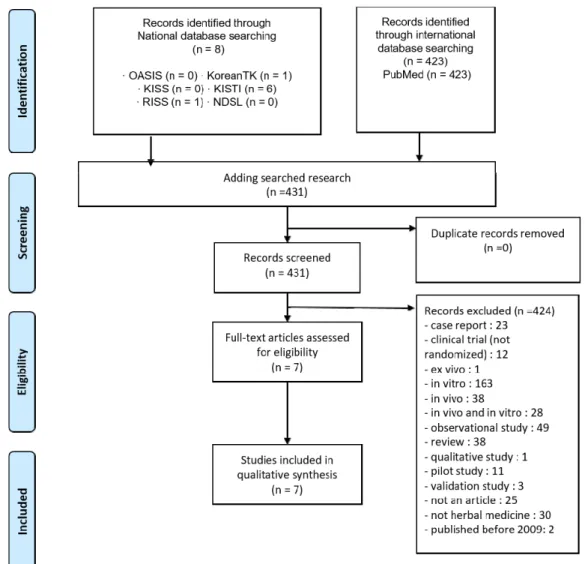
Fig. 1. The flowchart of study selection
2) 한약제제 임상시험 관련 가이드라인
① 천연물신약・한약제제임상시험가이드라인 연구22)
② 한약제제 등의 임상시험 가이드라인 제정연구(Ⅱ)23)
③ 한약제제의 임상시험 평가지표개발에 관한 연구24)
④ 생약한약제제 임상시험의 일반적 고려사항25) ⑤ 임 상시험용 한약(생약)제제의 품질 가이드라인26)
2. 검색된 가이드라인 분석 및 한의약 임상시험에의 적용은 고찰부분에서 논의하였다.
B. 기존 임상시험 관련 문헌검색 및 분석 1. 문헌 검색 결과
PubMed에서는 423건, 오아시스 0건, KoreanTK 1건, KISTI 6건, KISS 0건, RISS 1건, NDSL 0건이 검색되어 총 431건의 문헌을 검토하였다. 431편 중 중복된 논문은 없었으며, 제목과 초록을 살펴 선정기준 에 맞지 않은 424편을 제외하여, 7개 연구가 최종 포 함되었다27)-33). (Fig. 1)
2. 문헌 분석
1) 임상시험 개요 및 설계
7건 모두 최근 10년 이내 중국에서 수행된 폐암 관련 한약제제 임상시험이었고27)-33), 한국에서 수행된 폐암 관련 한약제제 임상시험은 존재하지 않았다. 단 일기관 임상시험은 6건27)-30),32),33), 다기관 임상시험은 1건이었다31). 이중 맹검을 시행한 논문은 없었으며, 위약을 사용한 연구도 존재하지 않았다. 포함된 연구 논문들의 기본적인 특성은 Table 3에 제시하였다.
(Table 3)
2) 임상시험대상자 (Participants)
(1) 임상시험 대상자의 연령은 하한이 18세 이상이 었고, 상한은 정해져 있지 않은 경우도 있었다. 시험대 상자수는 33명에서 136명까지 다양했다.
(2) 임상시험대상자는 모두 비소세포 폐암이었다.
폐암으로 인해 수술을 했거나 수술예정인 환자들을 대 상으로 한 문헌이 2편이었고30),31), 그 중 수술기 주위 기간 (perioperational)에 있는 환자를 대상으로 한 연구는 1편이었다28). 수술여부에 대한 언급이 없는 문 헌은 4편이었다27),29),32),33)
. 방사선 치료의 부작용인 방 사선 폐렴의 발생률을 낮추기 위한 연구에서는 비소세 포폐암을 진단받고 방사선 치료 대기 중인 환자들을 대상으로 하였다28). 5편의 문헌에서는 전이성 폐암 환 자를 대상으로 하였고, 나머지 2편에서는 전이여부에 대한 기술은 없었다. 자세한 임상시험 대상자의 특성은 Table 4에 나타내었다. (Table 4)
(3) 선정기준
암의 병기 측면에서는 1-4기를 대상으로 한 연구 1 편29), 1-3기를 대상으로 한 연구 1편28), 3-4기를 대 상으로 한 연구 5편이었다27),30)-33). 병기 진단 근거는 American Joint Committee on Cancer (AJCC) 를 기준으로 한 연구 1편33), Union for Cancer Control (UICC)30),32)를 기준으로 한 문헌 2편이었다.
그 외 문헌에서는 병기에 대한 언급은 없었다. 환자 상 태에 대해 Eastern Cooperative Oncology Group performance status (ECOG)로 평가한 논문은 4건 이었다27),30),32),33)
. 항암화학요법을 받는 환자군을 대상 으로 한 논문은 4건으로, Guo27), Xue31), Xu32)의 연 구에서는 중재군과 대조군 모두 화학요법을 받는 설 계인 반면, Jiang30) 연구에서는 대조군만 항암화학요 법을 받는 설계였다. 특이한 선정기준을 제시한 몇 개 의 연구가 있었는데, Xue31)의 연구에서는 65세 이상 의 환자만 선정하여 노인 환자들에게 한의학 치료의 증상 개선 효과를 평가한 연구가 있었다. 자세한 선정 기준은 Table 4에 제시하였다. (Table 4)
(4) 제외기준
제외 기준으로는 다음과 같은 것을 제시하였다: 심 혈관, 간 혹은 신기능 질환자와 같은 시험에서 제외되 어야한다고 판단되는 심각한 질병자, 시험약에 알레르 기 반응이 있는 자. 자세한 제외기준은 Table 4에 제 시하였다. (Table 4)
Table 3. The Characteristics of Included Study
ST: standardized therapy, IT: individualized therapy, TCM: traditional Chinese medicine, BSC: best supportive care, CHM: Chinese herbal medicine, EHFT: extracorporeal high frequency thermotherapy
Title Author Journal, Year Nation Design Group
Efficacy of auxiliary therapy with Danggui Buxue Decoction No.1 in treating patients of non-small cell lung cancer at peri-operational
stage.
Du QC Chin J Integr
Med, 2009 China randomized controlled trial
A: Conventional treatment +Danggui Buxue Decoction No.1(DB1)
B: Conventiona ltreatment
The study of early application with Dixiong Decoction (地芎汤) for non-small cell lung cancer to
decrease the incidence and severity of radiation pneumonitis:
A prospective, randomized clinical trial.
Dou YQ Chin J Integr Med, 2010 China
prospective, randomized clinical trial
A: radiotherapy+ Dixiong Decoction
B: radiotherapy+ a decoction with the effects of supplementing qi and nourishing yin, clearing heat and detoxifying
Astragalus polysaccharide injection integrated with vinorelbine and cisplatin for patients with advanced non-small cell lung cancer: effects on quality
of life and survival.
Guo L Med Oncol, 2012 China
open-label,prospec tive,randomizedcon trolled study
A: vinorelbine and cisplatin + Astragalus
polysaccharideinjection B: vinorelbine and cisplatin
Traditional Chinese Medicine treatment as maintenance therapy
in advanced non-small-cell lung cancer: A randomized controlled
trial.
Jiang Y
Complement Ther Med,
2016
China
randomized, controlled, open-label trial
A: traditional Chinese medicine B: chemotherapy
(treated with pemetrexed (non-squamous
NSCLC,500mg/m2,d1),doceta xel(75mg/m2,d1)orgemcitabi ne(1250mg/m2,d1andd8) Comprehensive geriatric
assessment and traditional Chinese medicine intervention benefit symptom control in elderly patients with advanced non-small
cell lung cancer.
Xue D Med Oncol,
2015 China randomized controlled trial
A: ST B: ST+TCM C: IT D: IT+TCM E: BSC+TCM
Treatment of advanced non-small-cell lung cancer with Chinese herbal medicine by stages
combined with chemotherapy.
Xu ZY
J Cancer Res Clin Oncol,
2011
China
prospective, randomized, controlled, multi-centered trial
A: chemotherapy + CHM (Kangliuzengxiao decoction during
chemotherapy and Feiyanning decoction after chemotherapy)
B: chemotherapy
Treatment of advanced non-small cell lung cancer with extracorporeal high frequency thermotherapy combined with
Chinese medicine.
Wu WY
Chin J Integr Med,
2010
China
a prospective, small sample and randomized controlled method
A: the treatment of EHFT combined with Chinese medicine
B: only Chinese medicine
Table 4. The Characteristics of Participants and Inclusion/Exclusion Criteria of Included Studies
Study Age Sample
size Patients Inclusion Criteria Exclusion Criteria
Du QC, 2009
A:54.02 B:52.56 82
The diagnosis of non-small-cell lung cancer (NSCLC) was
confirmed After operation by
pathological examination
(1) patients of the thoracic department of the Wujing Shandong Zongdui Hospital (2) who were hospitalized
from2003to2007
(3) The diagnosis of NSCLC was confirmed after operation by pathological examination.
nonspecific
Dou YQ, 2010
A: 65.2±8.4 B:
61.8±13.5 46
NSCLC patients who were planning
to receive radiotherapy
(1) who were clearly diagnosed with non-small cell lung cancer and made the decision to receive radiotherapy
(2) Karnofsky Performance Status score>60
(KPS score, which measures the performance status of cancer patients with respect to activities of daily living and is used to measure quality of life), (3) patients whose expected survival
time was more than six months
(1) patients who were simultaneously Receiving
chemotherapy, fasting, or opposed to taking Chinese herbal medicine
(2) subjects participating in other clinical trials
Guo L, 2012
A: 47-78 B: 47-77 136
NSCLC; measurable or assessable Stage IIIB or IV
disease
(1) histologically or cytologically confirmed NSCLC; measurable or assessable stageIIIB or IV disease
(2) Eastern Cooperative Oncology Group performance status score (ECOGPS) of 0–2
(3) No previous history of malignant disease
Patients were required to read without aid.
(1) Patients with active infections
(2) who had received previous chemotherapy
Jiang Y, 2016
A:
60.38±9.55 B:
58.41±10.3 6
64 advanced (stage IIIB/IV) NSCLC
(1) diagnosis with primary bronchogenic carcinoma confirmed NSCLC via cytological or pathological examination who were at TNM stageIIIB/IV
(2) patients with postoperative recurrence and metastasis;
patients who were atanage equal or older than 18 years old but equal or less than 80 years old
(3) TCM syndromes were Yin defiiency, Qi deficiency or Qi and Yin deficiency
Who had completed four cycles of first-line chemotherapy (4) achieving a maximum tumor
response, including complete response (CR)/ partial response (PR)/stable disease(SD)
(1) disease progression after first-line chemotherapy (2) received radiotherapy
or targeted therapy (3) allergy to the drug in the study
(4) participating other drug trials
(5) suffering from other primary malignant tumors
(6) serious problem of heart, liver or kidney with severe dysfunction pregnancy or
breastfeeding
(7) existence of any severe unstable concurrent medical illness likely to interfere with the study
Study Age Sample
size Patients Inclusion Criteria Exclusion Criteria
(5) Eastern Cooperative Oncology Group(ECOG)PS of two or less;
life expectancy of at least 6 months
(6) normal hematological function with total neutrophil
count>1.5×10⁹/Land platelets>80×109/L (7) normal liver function and kidney function.
protocol
Xue D, 2015
73.0 ± 5.3 (65–83) 33
elderly patients with advanced
NSCLC
(1) histopathologically confirmed advanced NSCLC
(2) American Joint Committee on Cancer (AJCC) stageIIIB, IV (3) ≥65yearsold
(4) capable of reading (5) understanding the
questionnaires and ˜informed consent"
(1) unable to understand the questionnaires (2) unwilling to participate in this study
(3) unable to complete the research
Xu ZY, 2011
A:
60.0±8.24 (41-75)
B:
62.15±8.70 (45-76)
121
Patients with NSCLC of
stage III or IV
(1) aged from 18 to 78 years (2) inoperable patients with stage
IIIA, IIIB, or IV, histologically confirmed NSCLC, measurable disease either by computed tomography (CT) or magnetic resonance imaging (MRI) (3) could complete 4 courses of chemotherapy
(4) predicted life expectancy>4months, (5) Karnofsky performance status(PS)≥60
(6) provided signed informed consent
(1) Patients with serious heart, liver or kidney disease,
(2) hematopathy, unrespectable liver or brain metastases, serious infection (3) rejecting to
chemotherapy or whole chemotherapy courses uncompleted
Wu WY,
2010 44 - 84 66 advanced NSCLC
(1) aged 30-85 years old (2) pathological diagnosis of
NSCLC at stagesⅢB
(3) ECOG performance status (PS) of 0 to 3
(4) life expectancy of at least three months
(5) no prior radiotherapy or chemotherapy within two months
(6) normal liver, kidney and heart function
(7) signed informed consent forms prior to participating in this clinical trial
(1) patients had comorbid diseases such as active tuberculosis or severe infectious diseases, other active refractory tumors and severe cardiovascular disease or psychological disease.
(2) patients should not have had an artificial cardiac pace maker, metallic stent, metallic prosthesis implant, neurogenic bladder dysfunction, thermos regulation dysfunction or perceptions dysfunction.
(3) patients with severe chestwall skin damage
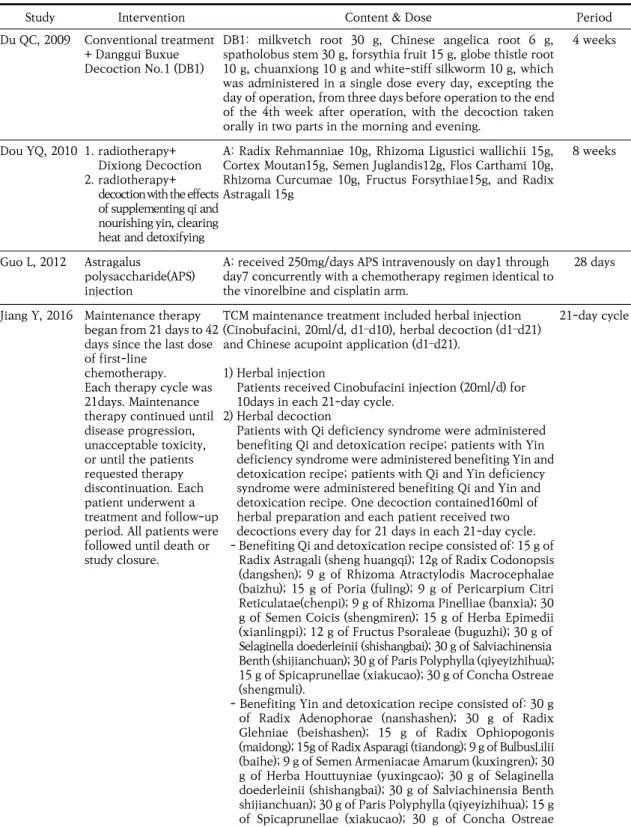
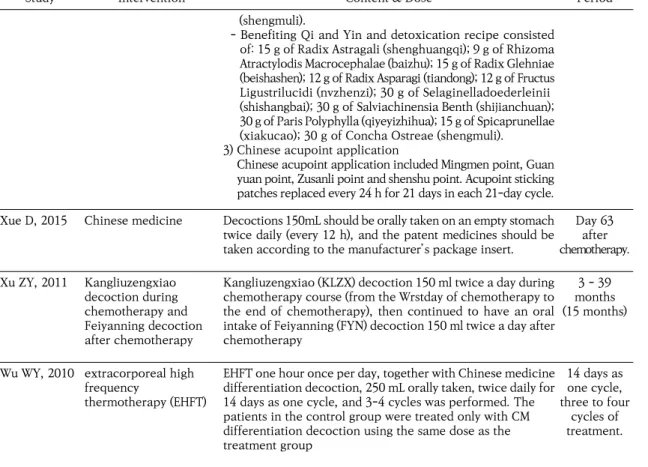
Table 5. The Interventions of Included Studies
Study Intervention Content & Dose Period
Du QC, 2009 Conventional treatment + Danggui Buxue Decoction No.1 (DB1)
DB1: milkvetch root 30 g, Chinese angelica root 6 g, spatholobus stem 30 g, forsythia fruit 15 g, globe thistle root 10 g, chuanxiong 10 g and white-stiff silkworm 10 g, which was administered in a single dose every day, excepting the day of operation, from three days before operation to the end of the 4th week after operation, with the decoction taken orally in two parts in the morning and evening.
4 weeks
Dou YQ, 2010 1. radiotherapy+
Dixiong Decoction 2. radiotherapy+
decoction with the effects of supplementing qi and nourishing yin, clearing heat and detoxifying
A: Radix Rehmanniae 10g, Rhizoma Ligustici wallichii 15g, Cortex Moutan15g, Semen Juglandis12g, Flos Carthami 10g, Rhizoma Curcumae 10g, Fructus Forsythiae15g, and Radix Astragali 15g
8 weeks
Guo L, 2012 Astragalus
polysaccharide(APS) injection
A: received 250mg/days APS intravenously on day1 through day7 concurrently with a chemotherapy regimen identical to the vinorelbine and cisplatin arm.
28 days
Jiang Y, 2016 Maintenance therapy began from 21 days to 42 days since the last dose of first-line
chemotherapy.
Each therapy cycle was 21days. Maintenance therapy continued until disease progression, unacceptable toxicity, or until the patients requested therapy discontinuation. Each patient underwent a treatment and follow-up period. All patients were followed until death or study closure.
TCM maintenance treatment included herbal injection (Cinobufacini, 20ml/d, d1–d10), herbal decoction (d1–d21) and Chinese acupoint application (d1–d21).
1) Herbal injection
Patients received Cinobufacini injection (20ml/d) for 10days in each 21-day cycle.
2) Herbal decoction
Patients with Qi deficiency syndrome were administered benefiting Qi and detoxication recipe; patients with Yin deficiency syndrome were administered benefiting Yin and detoxication recipe; patients with Qi and Yin deficiency syndrome were administered benefiting Qi and Yin and detoxication recipe. One decoction contained160ml of herbal preparation and each patient received two decoctions every day for 21 days in each 21-day cycle.
- Benefiting Qi and detoxication recipe consisted of: 15 g of Radix Astragali (sheng huangqi); 12g of Radix Codonopsis (dangshen); 9 g of Rhizoma Atractylodis Macrocephalae (baizhu); 15 g of Poria (fuling); 9 g of Pericarpium Citri Reticulatae(chenpi); 9 g of Rhizoma Pinelliae (banxia); 30 g of Semen Coicis (shengmiren); 15 g of Herba Epimedii (xianlingpi); 12 g of Fructus Psoraleae (buguzhi); 30 g of Selaginella doederleinii (shishangbai); 30 g of Salviachinensia Benth (shijianchuan); 30 g of Paris Polyphylla (qiyeyizhihua);
15 g of Spicaprunellae (xiakucao); 30 g of Concha Ostreae (shengmuli).
- Benefiting Yin and detoxication recipe consisted of: 30 g of Radix Adenophorae (nanshashen); 30 g of Radix Glehniae (beishashen); 15 g of Radix Ophiopogonis (maidong); 15g of Radix Asparagi (tiandong); 9 g of BulbusLilii (baihe); 9 g of Semen Armeniacae Amarum (kuxingren); 30 g of Herba Houttuyniae (yuxingcao); 30 g of Selaginella doederleinii (shishangbai); 30 g of Salviachinensia Benth shijianchuan); 30 g of Paris Polyphylla (qiyeyizhihua); 15 g of Spicaprunellae (xiakucao); 30 g of Concha Ostreae
21-day cycle
Table 6. The Comparator and Outcomes of Included Studies
Study Intervention Content & Dose Period
(shengmuli).
- Benefiting Qi and Yin and detoxication recipe consisted of: 15 g of Radix Astragali (shenghuangqi); 9 g of Rhizoma Atractylodis Macrocephalae (baizhu); 15 g of Radix Glehniae (beishashen); 12 g of Radix Asparagi (tiandong); 12 g of Fructus Ligustrilucidi (nvzhenzi); 30 g of Selaginelladoederleinii (shishangbai); 30 g of Salviachinensia Benth (shijianchuan);
30 g of Paris Polyphylla (qiyeyizhihua); 15 g of Spicaprunellae (xiakucao); 30 g of Concha Ostreae (shengmuli).
3) Chinese acupoint application
Chinese acupoint application included Mingmen point, Guan yuan point, Zusanli point and shenshu point. Acupoint sticking patches replaced every 24 h for 21 days in each 21-day cycle.
Xue D, 2015 Chinese medicine Decoctions 150mL should be orally taken on an empty stomach twice daily (every 12 h), and the patent medicines should be taken according to the manufacturer’s package insert.
Day 63 after chemotherapy.
Xu ZY, 2011 Kangliuzengxiao decoction during chemotherapy and Feiyanning decoction after chemotherapy
Kangliuzengxiao (KLZX) decoction 150 ml twice a day during chemotherapy course (from the Wrstday of chemotherapy to the end of chemotherapy), then continued to have an oral intake of Feiyanning (FYN) decoction 150 ml twice a day after chemotherapy
3 - 39 months (15 months)
Wu WY, 2010 extracorporeal high frequency
thermotherapy (EHFT)
EHFT one hour once per day, together with Chinese medicine differentiation decoction, 250 mL orally taken, twice daily for 14 days as one cycle, and 3-4 cycles was performed. The patients in the control group were treated only with CM differentiation decoction using the same dose as the treatment group
14 days as one cycle, three to four
cycles of treatment.
Study Comparator Outcomes
Du QC, 2009
Conventional treatment: anti-inflammatory, Symptomatic and supportive therapies,
1. T-lymphocyte subsets 2. Natural Killer (NK) cell activity
3. serum levels of immunoglobulin (IgA, IgM, IgG) 4. interleukin-2 (IL-2)
5. tumor necrosis factor α (TNF-α) 6. cytokeratin fragment 19 (CYFRA21-1) 7. carcinoembryonic antigen(CEA)
Dou YQ, 2010
Radix Codonopsis 15 g, Radix Angelicae Sinensis 15 g, Semen Armeniacae Amarum 15 g, Herba Hedyotis Diffusae 15g, Rhizoma Atractylodis Macrocephalae
15 g, Raidix Ophiopogonis 15 g, Radix Sophorae Flavescentis 15 g, Radix Glehniae 10 g
1. incidence of radiation pneumonitis after radiotherapy
2. Watters clinical radiographic physiologic (CRP) dyspnea score
3. Radiation Therapy Oncology Group (RTOG) grading score
4. Karnofsky Performance Status (KPS) score 5. application of corticosteroids.
Guo L, 2012
vinorelbine (20mg/m2) on days 1, 8, and 15 while cisplatin (80mg/m2) was administered on day 15.
1. Response and survival 2. Toxicity and tolerability 3. QOL analysis
3) 시험약 (Intervention) (Table 5)
시험약으로 당귀보혈탕(1편)28), 지궁탕(1편)29), 황기 다당주사액(1편)27), 변증에 따라 처방된 한약(1편)28), Kangliuzengxiao(1편)32), 육군자탕와 과루해백반하 탕(1편)30)이 사용되었고, 어떤 한약을 사용했는지 언급 없는 논문이 1편31) 있었다. 한편, 시험군으로 항암화학 요법, 방사선 치료 혹은 영양공급 등의 기존 치료방법 과 함께 한약을 투여한 경우는 6편이었으며27)-32), 한약 단독투여는 1편이었다33). 투약기간의 범위는 4주에서 부터 39개월까지 다양했다.
4) 대조군 (Comparator) (Table 6)
항암화학요법을 대조군으로 둔 문헌은 3편이었다
29),30),32). Dou의 연구에서는 방사선 치료를 수행하면서
시험군과는 성분이 다른 한약을 대조군 사용하였다28).
5) 유효성 평가 지표 (Outcome) (Table 6) (1) 종양반응
종양자체의 반응을 Response Evaluation Criteria in Solid Tumors (RECIST)에 따라 평가한 논문은
2편이었다31),33).
(2) 삶의 질
삶의 질은 5편의 연구에서 평가되었다. 삶의 질 측 정 도구는 Karnofsky performance status scale (2편)28),32), European Organisation for Research and Treatment of Cancer Quality of Life Questionnaire – Cancer 30 (EORTC QLQ-C30, Chinese version 3.0)과 QLQ-Lung Cancer (LC) 13 (Chinese version) (2편)29),30), QoL [trial outcome index (TOI)](1편)31)이 사용되었다. 그 외 에 Comprehensive geriatric assessment(1편)31) 이 사용되었다.
(3) 혈액학적 검사
1편의 연구28)에서 혈액학적 검사가 사용되었는데, 림프구, 자연살해세포, Immunogloblin A (Ig A), Ig M, Ig G, Interleukin-2, Cytokeratin 19 fragment (CYFRA) 21-1, Carcinoembryonic antigen (CEA)를 측정하였다.
Study Comparator Outcomes
Jiang Y, 2016
treated with pemetrexed, 500 mg/m2, day1), docetaxel (75 mg/m2, d1) or gemcitabine (1250 mg/m2, day 1 and day 8),
1. TTP (the interval time from the first date of randomization to that of disease progression) 2. QOL
3. overall survival (OS) 4. 1-year survival rate
Xue D, 2015
without traditional Chinese medicine for symptom control
1. QoL 2. OS
3. median survival time (MST)
4. Comprehensive geriatric assessment (CGA) 5. WHO or Response Evaluation Criteria in Solid Tumors (RECIST).
Xu ZY, 2011
treated only with combination of Navelbine (Laboratories Pierre Fabre, France) 25–30 mg/m2 on days 1 and 8 and cisplatin (Qilu Pharmaceutical Factory, China) 70–80 mg/m2 on days 1, 2, and 3 (NP) given four weekly for four cycles
1. survival time, 2. Karnofsky score 3. main clinical symptoms 4. adverse reactions
Wu WY, 2010
Only with Chinese medicine differentiation decoction using the same dose as the treatment group.
1. RECIST
2. Progression free survival 3. OS, 1-year survival rate 4. Adverse event
(4) 생존률, 생존기간
생존과 관련된 지표로는 중앙생존기간 (2편)29),31), 전체생존기간 (2편)30),31), 1년 내 생존률 (3편)이 사용 되었다3)-5).
6) 안전성 평가지표 (1) 이상 반응 평가
이상반응은 총 3개 논문에서 평가되었으며, 'WHO Anti-cancer drugs in acute and subacute toxicity grading standards'에 따른 이상반응 평가 를 Xu의 연구에서 확인하였고32), Guo의 연구에서 독 성을 조사하였는데 기준에 대한 별다른 언급은 없었다
29). Wu의 연구에서는 NCI-CTC 3.0을 이용해 조사 하였다33).
(2) 진단검사
Jiang의 연구에서 간, 신기능 등의 혈액검사와 심 전도 검사를 통해 안전성을 평가하였고, 중대한 이상 반응은 없었으며, 약과 관련된 사망도 없었다고 보고 하였다30).
앞서 언급한 바와 같이, 현재 한약제제를 이용한 폐암 임상시험을 수행하고자 할 때 참고할만한 가이 드라인은 존재하지 않는 상황이다. 따라서 본 연구는 폐암 한약제제 임상시험 가이드라인 개발을 위한 사 전 연구의 성격으로 기존 가이드라인과 최근 10년 이 내 임상 시험 검색・분석이라는 두 부분으로 나누어 진행하였다.
우선 가이드라인을 검색한 결과, 폐암과 관련된 것 으로는 ‘천연물 항암제제 임상시험 평가지표 개발연 구’, ‘항암제 임상시험 평가지침’, ‘항암제 임상시험계 획(IND) 및 품목허가(NDA) 승인을 위한 비임상시험 자료 심사 지침’, ‘항암제 임상시험 가이드라인’, ‘항암 제 비임상시험 가이드라인’, ‘항암제 가교자료 면제를 위한 가이드라인 개정판’, ‘임상시험용의약품의 치료
목적 사용을 위한 가이드라인’, ‘폐암 진료지침’, ‘저선 량 CT를 이용한 폐암 검진: 대한흉부영상의학회 의견 제안’이 검색되었다. 한약제제 임상시험 관련 가이드라 인으로는 ‘천연물신약・한약제제 임상시험가이드라인 연구’, ‘한약제제 등의 임상시험 가이드라인 제정연구 (Ⅱ)’, ‘한약제제의 임상시험 평가지표개발에 관한 연 구’, ‘생약한약제제 임상시험의 일반적 고려사항’, ‘임 상시험용 한약(생약)제제의 품질 가이드라인’이 검색되 었다. 먼저, 폐암과 관련된 내용을 살펴보면 한의진료 가이드라인은 존재하지 않았다. 한편 양의진료 가이드 라인은 2편이 있었는데, 1편은 대한폐암학회가 발행한 진료권고안이었고, 다른 1편은 대한영상의학회가 발행 한 가이드라인으로 각각 진료와 진단검사를 위한 것이 었다.
가이드라인 중에서 본 연구와 관련성이 높은 것은 2005년 발표된 ‘한약제제 임상시험 가이드라인 제정 연구(II)’, ‘천연물신약・한약제제 임상시험가이드라인 연구’와 2006년에 수행된 ‘한약제제의 임상시험 평가 지표개발에 관한 연구’, ‘천연물 항암제제 임상시험 평 가지표 개발연구’이다.
‘천연물신약・한약제제 임상시험가이드라인 연구’는 천연물신약이라는 용어가 삭제되기 이전의 연구로서 현 상황과 맞지 않는 부분도 있으나, 한약제제에 대한 부분은 참고할 만하여 분석하였다. 그 내용으로는 중국 과 대만의 중약신약 임상시험에 대한 내용과 한약제제 임상시험 실시원칙(안)을 제시하고 있다. ‘한약제제 임 상시험 가이드라인 제정연구(II)’에서는 향후 임상시험 가이드라인이 필요한 질환 선정 시 한약제제의 장점을 잘 살릴 수 있는 질환을 설정해야 함을 피력하였다. 이 에 따라, 주요 사망원인별 통계, 건강보험 심사 평가 통계 등을 통하여 목표질병을 ①중풍, ②종양 (②위암,
③폐암, ④간암, ⑤대장암, ⑥유방암, ⑦자궁경부암),
⑧당뇨 ⑨고혈압 ⑩요통 등을 1위군으로 설정하였다.
그리고 세부적으로 악성 종양 환자 중 방사선 치료를 받는 군을 대상으로 한 임상시험 가이드라인을 제시하 였다. 즉, 질병명, 진단기준, 임상시험대상자의 선정 및 제외기준, 관찰 및 예후지표, 치료효과 판정기준, 이상반응의 평가 기준 및 방법 등을 기술하였다. 한의 고찰
학적 관찰지표․평가항목 및 측정 부분에서는 ‘기성 한 의서 등 기존의 한의학 문헌에는 기재되어 있지 않으 므로 한방의료기관에서의 축적된 임상정보와 논문 등 연구발표자료를 통해 그 증상들을 채집하고 한의학적 으로 해석하여 지표로 활용할 수 있다’고 기술되어 있 다. 이를 미루어 볼 때, 증례논문에서부터 무작위배정 대조군 임상시험까지 다양한 임상정보 및 논문 등의 근거수집이 필요함을 알 수 있다. 또한 한의학적 치료 효과 판정기준으로 언급된 내용 중 ‘방사선 부작용 증 상 혹은 방사선 효과의 증진반응 등을 채집하여 한의 학적으로 해석된 지표를 설정하고 이를 이용해 치료효 과를 판정한다.’라는 것이 있었다. 방사선 치료는 폐암 환자의 중요한 치료수단이며 고식적 혹은 적극적 치료 목적으로 사용되고 있다34). 따라서 관련된 폐암 임상 시험을 수행하거나 가이드라인을 제정할 때 해당 내 용을 적용할 수 있을 것으로 사료된다. 그 외에 ‘방 사선감작요법의 경우, 그 지표에 특별히 의학분야와 큰 구별이 없을 수 있다. 의학적 지표 중 ‘임상증후 의 치료효과판정지표’나 ‘일상생활능력의 변화에 대 한 판정지표’ 등은 거의 한의학적인 지표와 일치할 것으로 여겨진다.’라는 내용도 있었는데, Eastern Cooperative Oncology Group (ECOG) 혹은 Functional Assessment of Cancer Therapy – Lung cancer (FACT-L)과 같은 척도를 활용해보는 것으로 적용할 수 있겠다. 한편, 한의학적 근거 문헌 부족 문제도 언급되었는데, ‘한의학 원전이 쓰여진 시 기에는 방사선 요법에 대한 개념이 없어 실질적 문헌 근거를 찾기 힘들었던 것이 사실이었다. 그러나 현대 한의학계 내에서 방사선요법의 부작용에 대해 인식하 고 이를 완화하기 위한 연구를 활발히 진행하고 있으 므로, 이 자료들이 축적된다면 방사선요법 부작용에 대 한 치료평가지표를 설정할 근거가 될 수 있을 것으로 예견된다’는 내용이었다. 원전에서 찾아볼 수 있는 현 대 치료 개념은 많지 않을 것이라 생각한다. 따라서 위 에 언급한 바와 같이, 현대 한의학계에서 폐암 관련 치 료의 부작용 완화 연구를 진행하여 자료를 축적하는 것이 치료평가지표를 포함한 ‘폐암 한약제제 임상시험 가이드라인’ 개발 측면에서 필요하며, 이는 표준치료
부작용 완화를 위해 내원하는 환자가 많은 한의임상 실제와도 부합한다. 한편, 2006년에 수행된 ‘천연물 항암제제 임상시험 평가 지표 개발 연구’ 또한 천연물 신약이라는 용어가 법령에서 삭제되기 이전의 연구이 지만, 평가지표 개발 측면에서 활용할 수 있는 내용들 이 많다. 일반적인 평가지표의 고려사항과 더불어 천연 물제제(한약)로서의 특징을 잘 평가할 수 있는 지표를 개발하고자 하였다. 이에 한의변증진단표준을 포함시 켰으나 임상적으로 검증하고 확인할 필요성이 있음을 언급하였다. 또한 원발성 기관지 폐암 임상시험 평가지 표에 대해 제시하였는데, 서의진단표준, 한의변증진단 표준 (기허담습증, 음허열독형, 기음양허증, 기혈어체 증), 시험환자선택원칙, 배제원칙, 관측지표, 유효성 판 정, 삶의 질 평가(EORTC QLQ-C30), 표준치료 부작 용 억제작용 평가하는 지표 등에 대해 기술하였다. 제 시된 내용들은 추후 변증을 적용한 폐암 임상시험 시 참고할 수 있으며, 표준치료 부작용 억제와 관련된 내 용도 유용하게 적용될 것이라 생각한다.
특이적인 것은 가이드라인의 대부분은 개별질환 중 심이 아닌, 항암제를 중심으로 한 것이었다. 앞으로 개 발되는 한약제제 가이드라인의 경우에는 항암제에 초 점을 맞추기 보다는 개별 암종에 초점을 맞추어야 할 것이다. 그 이유는 첫째로, 인체전반의 상태 및 개별 장기를 중시하는 한의학의 특성 때문이다. 예를 들면, Pembrolizumab는 미국 FDA에서 승인을 받은 면역 항암제로, 비소세포폐암, 두경부암, 호지킨 림프종, 요 로상피암에서 모두 사용 가능하다35). 이와 같이, 암종 과는 별개로 기전이 동일하다면 사용 가능한 것이 항 암제의 장점이긴 하다. 또한 Pembrolizumab와 같은 면역항암제는 면역체계를 활성화 시킨다는 점이 한의 학의 이론과 유사하긴 하나, 결국 이러한 방식의 항암 제 사용은 궁극적인 개인별 맞춤치료에는 부합하지 않 는 면이 있다. 이런 기존 항암제와는 달리, 폐암 한의 치료 시 타 암종과는 달리 동충하초와 같은 폐 관련 한약재를 사용하게 된다36). 두 번째 이유로는, 실제 임상에서 폐암환자에게 행해지는 한의 치료 수요는 종 양의 크기를 줄이거나 없애는 것보다는 한양방 병용 치료를 통한 표준치료의 부작용으로 나타나는 증상을