© 2017 The Korean Academy of Medical Sciences.
This is an Open Access article distributed under the terms of the Creative Commons Attribution Non-Commercial License (http://creativecommons.org/licenses/by-nc/4.0) which permits unrestricted non-commercial use, distribution, and reproduction in any medium, provided the original work is properly cited.
pISSN 1011-8934 eISSN 1598-6357
A Pediatric Case of Severe Fever with Thrombocytopenia Syndrome in Korea
Severe fever with thrombocytopenia syndrome (SFTS) is an emerging infectious disease and elderly people living in rural areas have the greatest risk of infection. We report the first pediatric case of SFTS in Korea and the clinical characteristics and disease progression in children. A 10-year-old child from Chonnam province visited the hospital with myalgia and a history of fever over the previous 8 days. Her father noticed a tick on her head and removed it before fever developed. Because the symptoms continued, her father consulted the community health center and SFTS virus was detected both from the tick
(Haemaphysalis longicornis) and the patient’s blood. On hospitalization, fever and severe myalgia were improved and no gastrointestinal and hemorrhagic symptoms were observed.
The patient was successfully treated with a combination of steroids, IVIG, and ribavirin. In this report, a pediatric case of SFTS presents a mild clinical course but close attention must be paid to the screening of children with mild symptoms consisting of SFTS.
Keywords: Severe Fever with Thrombocytopenia Syndrome Bunyavirus; Phlebovirus;
Child; Korea Tae Yang Song, Eun Mi Yang,
and Chan Jong Kim
Department of Pediatrics, Chonnam National University Hospital, Chonnam National University Medical School, Gwangju, Korea
Received: 17 November 2015 Accepted: 1 March 2016 Address for Correspondence:
Eun Mi Yang, MD
Department of Pediatrics, Chonnam National University Hospital, Chonnam National University Medical School, 42 Jebong-ro, Dong-gu, Gwangju 61469, Republic of Korea E-mail: [email protected]
https://doi.org/10.3346/jkms.2017.32.4.704 • J Korean Med Sci 2017; 32: 704-707
INTRODUCTION
Between March and July of 2009, an emerging infectious disease characterized by acute severe fever and thrombocytopenia of unknown etiology was reported in the rural areas of Central Chi- na (1). The cause of this illness was identified in 2010, and de- fined as the severe fever with thrombocytopenia syndrome vi- rus (SFTSV) by the China Center for Disease Control and Pre- vention (2). Outside of China, severe fever with thrombocyto- penia syndrome (SFTS) cases were reported in Japan (3), South Korea (4), and the United States in 2012 (5). Recent surveillance data has shown an increasing incidence of SFTS, with widespread distribution of the SFTSV in Korea (6). This disease usually pres- ents with fever, thrombocytopenia (platelet count < 100,000 per cubic millimeter of blood), and leukopenia, which often prog- ress to multiple organ failure. SFTS has an average mortality rate of 7.3% to 16.0% (2,7), and up to 46.0% in a 2013 Korean study (8). The major risk group consists of those living in rural areas working as farmers, particularly elderly patients (median age of 58 years) (2). Thus, most previous studies have been based on adult data, with little pediatric data available. Through 2014, SFTS was diagnosed in 91 individuals in South Korea (9), but pediat- ric patients have not been reported and no clinical study on chil- dren has been performed. Here, we describe a pediatric case of SFTS, and the clinical characteristics and disease progression in children.
CASE DESCRIPTION
In mid-August, 2015, a 10-year old girl from Chonnam Province visited the hospital with myalgia and a history of fever over the previous 8 days. She spent time with the animals on her family farm (in a rural area), and her father noticed a tick on her head before the fever developed. Because the abrupt onset high fever and myalgia were not improved with medical care, her father consulted the community health center. The patient’s blood and the tick were evaluated to determine if she suffered from a tick borne disease. In both the tick (Haemaphysalis longicornis) and the patient’s blood sample, medium and small segment of the SFTS viral RNA was detected by reverse transcriptase-poly- merase chain reaction. In addition, SFTSV was isolated from the tick. Based on these results, SFTSV infection was confirmed and patient was referred to a tertiary hospital. Her physical ex- amination upon admission revealed a temperature of 36.1°C, pulse of 88 beats/min, respiration rate of 20/min, and blood pressure of 90/60 mmHg. Additionally, painless small lymph nodes were palpable in the neck. Although, she complained of severe myalgia, general weakness, and the inability to walk, no gastrointestinal or hemorrhagic symptoms were observed in the patient.
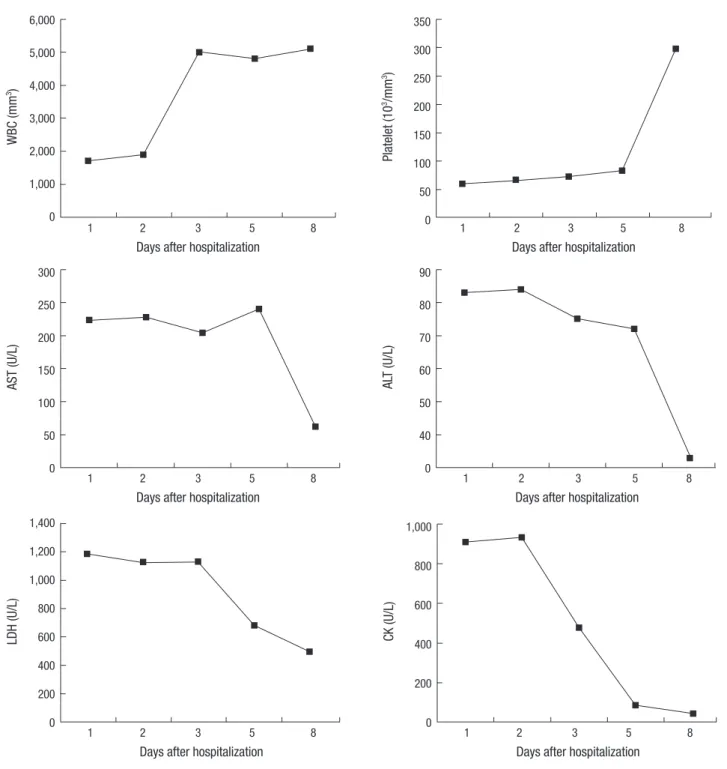
The laboratory tests revealed a white blood cell (WBC) count of 1.7 × 10³/mm3, platelet count of 60 × 103/mm3, aspartate ami- notransferase level of 224 U/L, lactate dehydrogenase level of 1,183 U/L, and creatine kinase level of 905 U/L. The coagulation CASE REPORT
Pediatrics
Song TY, et al. • SFTS in a Korean Child
http://jkms.org 705
https://doi.org/10.3346/jkms.2017.32.4.704
profile, kidney function test, and urinalysis were non-specific.
She was treated with a broad spectrum antibiotic, intravenous immunoglobulin (IVIG, 0.5 mg/kg/day for 2 days), dexametha- sone (10 mg/m2/day), and ribavirin (400 mg/day).
The general weakness and myalgia were relieved and her body temperature was normalized after the initiation of the treatment, and remained normal. After treatment, the patient was drowsy, but fully oriented and responsive. Because drowsiness could be a possible side effect of ribavirin, it was discontinued on the 6th
day. Since then her mental state improved with no other neuro- logical symptoms. Restoration of the WBC and platelet counts was observed 3 days and 8 days after hospitalization, respective- ly. The normalization of the other abnormal laboratory findings occurred over 5 to 8 days (Fig. 1). On the 9th day, patient was discharged with no medical problems, and she needed no fur- ther medication. At the 2-month follow-up, she remained heal- thy without sequelae.
Fig. 1. Time course of laboratory parameters.
WBC = white blood cells, AST = aspartate aminotransferase, ALT = alanine transaminase, LDH = lactate dehydrogenase, CK = creatine kinase.
WBC (mm3 )
Days after hospitalization
1 2 3 5 8
6,000 5,000 4,000 3,000 2,000 1,000 0
Platelet (103/mm3)
Days after hospitalization 1 2 3 5 8 350
300 250 200 150 100 50 0
AST (U/L)
Days after hospitalization
1 2 3 5 8
300 250 200 150 100 50 0
ALT (U/L)
Days after hospitalization
1 2 3 5 8 90
80 70 60 50 40 0
LDH (U/L)
Days after hospitalization
1 2 3 5 8
1,400 1,200 1,000 800 600 400 200 0
CK (U/L)
Days after hospitalization
1 2 3 5 8
1,000
800
600
400
200
0
Song TY, et al. • SFTS in a Korean Child
706 http://jkms.org https://doi.org/10.3346/jkms.2017.32.4.704
DISCUSSION
In this article, we have described the first pediatric case of SFTS in Korea. Overall, the clinical manifestation appeared to be mild- er than in an adult case, and the patient was successfully treated with a combination of steroids, IVIG, and ribavirin. Results from several epidemiological investigations have indicated that SFTS patients are most often elderly individuals living in rural areas (8,10,11). Most data are based on adult populations, and a very few pediatric SFTS cases have been documented (12,13). Avail- able data on pediatric patients indicate common symptoms of fever, leukopenia, throbocytopenia, and gastrointestinal symp- toms. They did not exhibit any symptoms of dyspnea, conscious- ness disorder, dizziness, or hemorrhage (12). However, adult patients more frequently present with hemorrhage, central ner- vous system symptoms, or multiple organ dysfunction syndrome (8,10,14). Among the pediatric cases, no death occurred and clinical course seemed to be milder than that in adults. For this reason, recognition of pediatric SFTS is more difficult than in adults solely based on clinical symptoms.
In order to diagnose SFTS, clinical suspicion based on symp- toms and hematological abnormalities is critical along with his- tory and inspection of the tick bite. A tick bite is not always evi- dent, and a history of outdoor activity or contact with animals should be investigated. In the present case, the patient was bit- ten by a tick while she was playing with the animals on the farm.
Hematologically, SFTS patients present with both thrombocy- topenia and leukopenia. Previous studies on pediatric patients showed delayed onset and early recovery of thrombocytopenia compared to adult patients (12,13). Of the 4 pediatric patients, 3 patients presented with delayed onset of thrombocytopenia (5 to 6 days after disease onset compared to 1 to 2 days for adults).
In addition, thrombocytopenia reverted to normal earlier for pediatric patients than in adults (5 to 9 days vs. 10 days, respec- tively) (12). However, our patient’s thrombocytopenia lasted more than 10 days. A study with a larger sample size should be conducted to determine if there are significant differences in onset and recovery of thrombocytopenia between pediatric and adult cases with SFTS.
As mentioned above, pediatric patients present vague symp- toms and less aggressive clinical course (12,13). The disease se- verity depends on multiple factors, including viral replication, access to the healthcare system, and the host’s immune response, as well as other unknown reasons. Ding et al. (11) suggested that age was a critical risk factor for SFTS, because most hospitalized SFTS patients were elderly. Shin et al. (8) also found an associa- tion between age and prognosis, and those patients who died were older than the survivors (73.5 years vs. 61.0 years, respec- tively). The incomplete maturation of the immune system in children could pose a possible mechanism for milder disease manifestation (12). This mechanism has been previously report-
ed to explain a milder clinical course for Crimean-Congo hem- orrhagic fever in children than in adults (15). Difference in pro- inflammatory and anti-inflammatory cytokine networks in adults and children may be due to variation in host-dependent factors including genetic diversity or immunological response (15). Ad- ditionally, children often have easier access to the healthcare system.
Here, to the best of our knowledge, we report the first pediat- ric case of SFTS in Korea. Since SFTSV is endemic in Korea, close attention must be paid to the screening of children with mild symptoms consisting of SFTS.
DISCLOSURE
The authors have no potential conflicts of interest to disclose.
AUTHOR CONTRIBUTION
Conceptualization: Yang EM. Data curation: Song TY. Investiga- tion: Song TY. Writing - original draft: Song TY. Writing - review
& editing: Kim CJ.
ORCID
Tae Yang Song http://orcid.org/0000-0001-5543-8745 Eun Mi Yang http://orcid.org/0000-0001-9410-5855 Chan Jong Kim http://orcid.org/0000-0001-6519-2427
REFERENCES
1. Xu B, Liu L, Huang X, Ma H, Zhang Y, Du Y, Wang P, Tang X, Wang H, Kang K, et al. Metagenomic analysis of fever, thrombocytopenia and leukope- nia syndrome (FTLS) in Henan Province, China: discovery of a new bun- yavirus. PLoS Pathog 2011; 7: e1002369.
2. Yu XJ, Liang MF, Zhang SY, Liu Y, Li JD, Sun YL, Zhang L, Zhang QF, Popov VL, Li C, et al. Fever with thrombocytopenia associated with a novel bun- yavirus in China. N Engl J Med 2011; 364: 1523-32.
3. Takahashi T, Maeda K, Suzuki T, Ishido A, Shigeoka T, Tominaga T, Kamei T, Honda M, Ninomiya D, Sakai T, et al. The first identification and retro- spective study of severe fever with thrombocytopenia syndrome in Japan.
J Infect Dis 2014; 209: 816-27.
4. Kim KH, Yi J, Kim G, Choi SJ, Jun KI, Kim NH, Choe PG, Kim NJ, Lee JK, Oh MD. Severe fever with thrombocytopenia syndrome, South Korea, 2012. Emerg Infect Dis 2013; 19: 1892-4.
5. McMullan LK, Folk SM, Kelly AJ, MacNeil A, Goldsmith CS, Metcalfe MG, Batten BC, Albariño CG, Zaki SR, Rollin PE, et al. A new phlebovirus as- sociated with severe febrile illness in Missouri. N Engl J Med 2012; 367:
834-41.
6. Park SW, Song BG, Shin EH, Yun SM, Han MG, Park MY, Park C, Ryou J.
Prevalence of severe fever with thrombocytopenia syndrome virus in Hae- maphysalis longicornis ticks in South Korea. Ticks Tick Borne Dis 2014; 5:
975-7.
7. Zhang YZ, He YW, Dai YA, Xiong Y, Zheng H, Zhou DJ, Li J, Sun Q, Luo
Song TY, et al. • SFTS in a Korean Child
http://jkms.org 707
https://doi.org/10.3346/jkms.2017.32.4.704
XL, Cheng YL, et al. Hemorrhagic fever caused by a novel Bunyavirus in China: pathogenesis and correlates of fatal outcome. Clin Infect Dis 2012;
54: 527-33.
8. Shin J, Kwon D, Youn SK, Park JH. Characteristics and factors associated with death among patients hospitalized for severe fever with thrombocy- topenia syndrome, South Korea, 2013. Emerg Infect Dis 2015; 21: 1704-10.
9. Korea Centers for Disease Control and Prevention. Prevention of severe fever with thrombocytopenia syndrome [Internet]. Available at http://
is.cdc.go.kr/dstat/index.jsp [cited 22 Sep 2015].
10. Liu Q, He B, Huang SY, Wei F, Zhu XQ. Severe fever with thrombocytope- nia syndrome, an emerging tick-borne zoonosis. Lancet Infect Dis 2014;
14: 763-72.
11. Ding S, Niu G, Xu X, Li J, Zhang X, Yin H, Zhang N, Jiang X, Wang S, Liang M, et al. Age is a critical risk factor for severe fever with thrombocytope-
nia syndrome. PLoS One 2014; 9: e111736.
12. Wang LY, Cui N, Lu QB, Wo Y, Wang HY, Liu W, Cao WC. Severe fever with thrombocytopenia syndrome in children: a case report. BMC Infect Dis 2014; 14: 366.
13. Ma T, Sun JM, Chen LF, Shi XG, Liu K, Gong ZY, Chen J, Zhang R, Ren JP, Jiang JM. A pediatric case of severe fever with thrombocytopenia syndrome in Zhejiang Province, China. J Clin Virol 2015; 72: 85-7.
14. Cui N, Yang ZD, Wang BJ, Fan XJ, Yuan C. The clinical characteristics of 169 cases of severe fever with thrombocytopenia syndrome. Zhonghua Nei Ke Za Zhi 2012; 51: 755-8.
15. Ozsurekci Y, Arasli M, Karadag Oncel E, Caglayik DY, Kaya A, Icagasioglu FD, Engin A, Korukluoglu G, Elaldi N, Ceyhan M. Can the mild clinical course of crimean-congo hemorrhagic fever in children be explained by cytokine responses? J Med Virol 2013; 85: 1955-9.