Ji-Hun Song and Gi-Sik Min 182
INTRODUCTION
The genus Symmius Richardson, 1904, is one of among 12 genera belonging to the family Chaetiliidae Dana, 1849.
Five species have been recorded in the genus Symmius: S.
azumi Nunomura, 2008, S. caudatus Richardson, 1904, S.
philippinensis Poore, 1991, S. planus Nunomura, 1984, S. yamaguchiensis Shimomura, 2008 (Poore and Schotte 2015c). The family Chaetiliidae and genus Symmius is new to South Korea.
The genus Colanthura Richardson, 1902 is one of seven genera belonging to the family Paranthuridae Menzies &
Glynn, 1968 that is currently comprises of ten species (Poore and Schotte 2015a). This genus is also new to South Korea.
The genus Synidotea Harger, 1878, is one of 22 genera belonging to the family Idoteidae Samouelle, 1819. Curren
tly, it comprises 61 species (Poore and Schotte 2015b). Two species of Synidotea: S. laevidorsalis (Miers, 1881) and S.
hikigawaensis Nunomura, 1974 have previously been re
corded in South Korea (Kwon 1986).
We provide descriptions of the diagnostic characteristics, illustrations, and partial sequences of the mitochondrial cy
tochrome c oxidase subunit 1 (CO1) of three species.
MATERIALS AND METHODS 1. Sample collection
The specimens of C. pigmentata and S. nipponensis were collected with light traps from Yokjido Island and Sageun
jinbeach in South Korea, respectively. The specimen of S.
yamaguchiensis is collected with small dredge from Soyado Island in South Korea. They were preserved directly in 95%
ethyl alcohol after collection. All examined specimens were deposited in the National Institute of Biological Resources (NIBR) and Inha University, South Korea.
2. Morphological analysis
Specimens were observed and dissected under a stereomi
croscope (Model SZX7; Olympus, Tokyo, Japan). Illust
rations of appendages were made with a drawing tube con
nected to a light microscope (Model DM 2500; Leica, X50
630, Wetzlar, Germany). Drawings of whole bodies were
* Corresponding author: GiSik Min, Tel. 0328607692, Fax. 0328746737, Email. [email protected]
ⓒ2015. Korean Society of Environmental Biology.
New Record of Three Isopod Species
(Crustacea: Malacostraca: Isopoda) from South Korea
JiHun Song and GiSik Min*
Department of Biological Sciences, Inha University, Incheon 402-751, Korea
Abstract - Three marine isopods, Symmius yamaguchiensis Shimomura, 2008, Colanthura pigmen
tata Kensley, 1980 and Synidotea nipponensis Nunomura, 1985 are reported for the first time in South Korea. The family Chaetiliidae, and genera Symmius and Colanthura are new to South Korea. We provide descriptions of the diagnostic characteristics, illustrations of three species and their partial sequences of the mitochondrial cytochrome c oxidase subunit 1 (CO1) for molecular characteristics.
Keywords: Colanthura, Chaetiliidae, Symmius, Synidotea, isopoda, South Korea
Korean J. Environ. Biol. 33(2) : 182~188
(2015)
http://dx.doi.org/10.11626/KJEB.2015.33.2.182(Olympus SZX12). Measurements of appendages and whole body lengths were taken using a stage micrometer (Leica, Germany) and an ocular micrometer.
3. DNA sequencing
The CO1 sequences were determined according to the method used in the Song and Min (2015) with two primers:
jgLCO1490 5′TITCIACIAAYCAYAARGAYATTGG3′
and jgHCO2198 5′TAIACYTCIGGRTGICCRAARAAY CA3′ (Geller et al. 2013).
RESULTS AND DISCUSSION Order Isopoda Latreille, 1817 등각목
Family Chaetiliidae Dana, 1849 두엽벌레과 ( 신칭 ) Genus Symmius Richardson, 1904 창벌레속 ( 신칭 ) 1. Symmius yamaguchiensis Shimomura, 2008
야마구치창벌레 ( 신칭 ) (Fig. 2)
Synonyms: Symmius yamaguchiensis Shimomura, 2008:
61, figs. 25.
Material examined: Korea: 2 females (NIBRIV00003161 48, NIBRIV0000316149), Soyado Island, Incheonsi, 37˚
12′N, 126˚10′E, Sep 21 2012, depth 0.5~1 m, collected with small dredge by Song JH (Fig. 1).
Diagnosis: Body elongate, 2.4 times as long as wide, dor
soventrally flattened, length 12.35 mm. Eyes small, situated ocular lobes. Head, pereonites and pleonite 2 with middor
sal projections. Coxal plates large and distinctly visible dor
sally on pereonites 5~7. Pleon 0.42 of total length, com
posed of 2 segments and pleotelson, pleonite 1 without mid
dorsal projection. Pleotelson triangular, tapering to sharply rounded apex.
Remarks: Symmius yamaguchiensis was described by Shi
momura (2008) based on the specimens collected from the off Yamaguchi Prefecture, Japan. This species has been pre
vious reported from type locality only. Symmius yamaguchi- ensis has a similar external appearance as Symmius cauda- tus Richardson, 1904. However, S. yamaguchiensis differs from S. caudatus in having wider body (2.5 times as long as
wide in S. yamaguchiensis versus 3.1 times as long as wide in S. caudatus) and pereonites 1~7 with middorsal projec
tion (pereonites without middorsal projection in S. cauda- tus).
In general, S. yamaguchiensis from the South Korea is well agreed with the original descriptions and illustrations of Shimomura (2008). However, Korean specimen has some variation from those of type locality in the following cha
racteristics: (1) anterior angle of ocular lobe slightly pro
jecting anteriorly; (2) maxillipedal endite with two coupling hooks. As a result of this study, distribution of S. yamaguchi- ensis is more widened, and provides information of genus Symmius from South Korea for the first time.
Habitat: There is no information on habitat at the type lo
cality. This species collected from the South Korea on san
dy bottom with sea grass community at 0.5~1 m depth.
World distribution: Japan (Shimomura 2008), Korea.
Deposition: NIBR No. NIBRIV0000316148, NIBRIV0000 316149 (2 females).
Molecular characteristic: GenBank accession number:
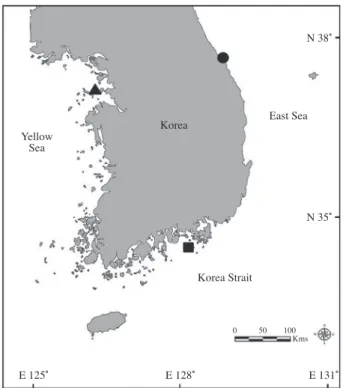
Fig. 1. The collection locality of three isopod species in this study:
Symmius yamaguchiensis, Soyado Island, Incheonsi(▲);
Colanthura pigmentata, Yokjido Island, Tongyeongsi, Gyeongsangnamdo(); Synidotea nipponensis, Sageun
jinbeach, Gangneungsi, Gangwondo().
Korea Yellow
Sea
East Sea
Korea Strait
E 125˚ E 128˚ E 131˚
0 50 100 Kms
N 38˚
N 35˚
KR493001, KR493002 (2 females).
Identifiers: JiHun Song, GiSik Min.
2. Symmius azumai Nunomura, 2008
Synonyms: Symmius yamaguchiensis Shimomura, 2008:
15, figs. 2, 3.
3. Symmius caudatus Richardson, 1904
Synonyms: Symmius caudatus Richardson, 1904: 39, figs.
1115.
4. Symmius philippinensis Poore, 1991
Synonyms: Symmius philippinensis Poore, 1991: 149, figs.
7, 8.
5. Symmius planus Nunomura, 1984
Synonyms: Symmius planus Nunomura, 1984: 60, figs. 3, 4.
Family Paranthuridae Menzies & Glynn, 1968 오목꼬리마디벌레과
Genus Colanthura Richardson, 1902 배마디벌레속 ( 신칭 ) 6. Colanthura pigmentata Kensley, 1980
깜장배마디벌레 ( 신칭 ) (Fig. 3)
Synonyms: Colanthura pigmentata Kensley, 1980: 5, figs.
2, 3; Poore, 1981: 70; Poore, 1984: 708.
Material examined: Korea: 3 males, 5 females, Yokjido Island, Tongyeongsi, Gyeongsangnamdo, 34˚38′N, 128˚
A B C
A, B
C
Fig. 2. Symmius yamaguchiensis, female. A, body, dorsal view; B, body, lateral view; C, pereopod 7. Scale bars: A, B=1mm, C=0.2mm.
14′E, September 10, 2012, depth 2~3 m, collected with light traps by Song JH (Fig. 1).
Diagnosis: Body with dark brown pigmentation, almost 8 times longer than greatest width, 4.8 mm. Pereonite 7 very short and seventh pair of pereopod absent. Pleonites 1~6 free, pleonite 1 about twice length of pleonite 2; pleonites 2~5 subequal; pleonite 6 longer, with a middorsal cleft on posterior margin. Palm of pereopod 1 with proximal trian
gular process. Pleotelson with no serration.
Remarks: Colanthura pigmentata is distinguished from other species of Colanthura by several characteristics: (1)
distinct projection on pereonites 1~5 lateral margin in male specimens; (2) body with dark brown pigmentation; (3) uropodal exopod and endopod with serrate margin; (4) ros
trum equal in extent to anterolateral angles of cephalon.
Colanthura pigmentata is very similar to C. nigra Nunomu
ra, 1975 in external features. However, the serrate margin on pleotelson is absent in C. pigmentata, while present in C.
nigra. Additionally, C. pigmentata has a strong triangular proximal process on pereopod 1, while no proximal process on pereopod 1 in C. nigra (Nunomura and Nishimura 1975;
Kensley 1980). In general, C. pigmentata specimens from
B C
A
B
C
Fig. 3. Colanthura pigmentata, female. A, body, dorsal view; B, pereopod 1; C, pleotelson. Scale bars: A=1mm, B=0.2mm, C=0.1mm.
South Korea are well agreed with the illustrations and origi
nal description of Kensley (1980).
Habitat: Habitat information is not available for the type locality. Korean specimens were collected on sandy and gravel bottom with some green algae at 2~3 m depth.
World distribution: Madagascar (Kensley 1980), Korea.
Deposition: NIBR No. NIBRIV0000307755 (1 female).
Molecular characteristic: GenBank accession number:
KR095339 (1 female).
Identifiers: JiHun Song, GiSik Min.
Family Idoteidae Samouelle, 1819 주걱벌레과 Genus Synidotea Harger, 1878 둥근주걱벌레속 7. Synidotea nipponensis Nunomura, 1985
일본둥근주걱벌레 ( 신칭 ) (Fig. 4)
Synonyms: Synidotea nipponensis Nunomura, 1985: 127, figs. 5, 6.
Material examined: Korea: 5 females, Sageunjinbeach, Gangneungsi, Gangwondo, 37˚48′N, 128˚53′E, July 4, 2014, depth 2~3 m, collected with light traps by Song JH
A B, C
Fig. 4. Synidotea nipponensis, female. A, body, dorsal view; B, antennule; C, maxilliped. Scale bars: A=1mm, B, C=0.2mm.
A
B C
Diagnosis: Body flattened, about 3.4 times as long as wide.
Anterior margin of cephalon straight. Pereonites 1~3 with emarginated margin, but 4~7 with parallel margin. Pleotel
son with an incomplete suture. Color dull yellow or grey.
Posterior margin of pereonite 1 is hardly emarginated and lateral margins of pereonites 4~7 are rounded.
Remarks: Synidotea nippponensis is very similar to S. hiki- gawaensis Nunomura, 1974 in external features. However, S. nipponensis differs from S. hikigawaensis in the relative length of pereopods and the shape of pereonites. Pereopods 2~7 are long, especially pereopod 7; posterior margin of pereonite 1 is hardly emarginated; lateral margins of pere
onites 4~7 are rounded (S. nipponensis). Pereopods are short; posterior margin of pereonite 1 is very emarginated;
lateral margins of pereonites 4~7 are angulated (S. hikiga- waensis).
In general, S. nipponensis specimens from South Korea are well agreed with the illustrations and original descrip
tion of Nunomura (1985).
Habitat: Habitat information is not available for the type locality. South Korean specimens were collected from a sandy bottom with numerous algae at 1~2 m depth.
World distribution: Japan (Nunomura 1985), Korea.
Deposition: NIBR No. NIBRIV0000307759 (1 female).
Molecular characteristic: GenBank accession number:
KR095340 (1 female).
Identifiers: JiHun Song, GiSik Min.
8. Synidotea hikigawaensis Nunomura, 1974 히키가와둥근주걱벌레
Synonyms: Synidotea hikigawaensis Nunomura, 1974: 9, figs. 6, 7.
9. Synidotea laevidorsalis (Miers, 1881) 둥근주걱벌레 Synonyms: Edotia hirtipes var. laevidorsalis Miers, 1881:
69, pl. III, figs. 1, 2.
Synidotea laevidorsalis (Miers, 1881): Benedict, 1897: 404;
Kwon, 1986: 117, fig. 8A.
Key to the Korean species of the genus Synidotea 1. Pleotelson shorter than one and a quarter times the proxi
mal width ···S. laevidorsalis
width···2 2. Pereonite 1 with very emarginated margin; pereonites
4~7 with angulated margin ···S. hikigawaensis - Pereonite 1 with hardly emarginated margin; pereonites
4~7 with rounded margin ···S. nipponensis
ACKNOWLEDGEMENT
This work was supported by a grant from the National Institute of Biological Resources (NIBR), funded by the Ministry of Environment (MOE) of the Republic of Korea (NIBR No. 201302001; 201402001) and the program on Management of Marine Organisms causing Ecological Dis
turbance and Harmful Effects, funded by KIMST/MOF.
REFERENCES
Benedict JE. 1897. A revision of the genus Synidotea. Proc.
Acad. Nat. Sci. Phila. 53:389404.
Geller J, C Meyer, M Parker and H Hawk. 2013. Redesign of PCR primers for mitochondrial cytochrome c oxidase sub
unit I for marine invertebrates and application in alltaxa biotic surveys. Mol. Ecol. Resour. 13:851861.
Kensley BF. 1980. Anthuridean isopod crustaceans from the international Indian Ocean Expedition, 19601965, in the Smithsonian Collections. Smithsonian Institution Press, 1980.
Kwon DH. 1986. Some Idoteid Isopods (Crustacea) from Ko
rea. Inje Journal 2:107121.
Miers EJ. 1881. Revision of the Idoteidae, a family of sessile
eyed Crustacea. J. Linn. Soc. Lond. Zool. 16:188.
Nunomura N. 1974. Marine Isopoda from the coast of Hiki
gawa Town, Kii Peninsula, Middle Japan (1). Bull. Osaka.
Mus. Nat. Hist. 28:112.
Nunomura N. 1984. Two new idoteid Isopoda from Otsuchi Bay, northern Japan. Bull. Toyama Sci. Mus. 6:5764.
Nunomura N. 1985. Marine Isopod Crustaceans in the Coast of Toyama Bay. Mem. Natl. Sci. Mus. 18:121139.
Nunomura N. 2008. Marine isopod crustaceans collected from Shijiki Bay, Western Japan (1) Valvifera, Cymothoida, Sphaeromatidea, Limnoriidea and Oniscidea. Bull. Toyama Sci. Mus. 344:1343.
Nunomura N and S Nishimura. 1975. Marine Isopoda from the
rocky shore of Osaka Bay, Middle Japan. Bull. Osaka. Mus.
Nat. Hist. 30:1926.
Poore GCB. 1984. Colanthura, Califanthura, Cruranthura and
Cruregens, related genera of the Paranthuridae(Crustacea:
Isopoda). J. Nat. Hist. 18:697715.
Poore GCB. 1991. Crustacea Isopoda: Deepsea Chaetiliidae (Valvifera) from New Caledonia and the Philippines In:
Crosnier A (ed.). Resultats des campagnes MUSORSTOM, Volume 9. Mem. Mus. Nat. Hist. Nat. Paris (A) 152:139
Poore GCB and M Schotte. 2015a. Colanthura Richardson, 153.
1902. In: Schotte M, CB Boyko, NL Bruce, GCB Poore, S Taiti & GDF Wilson (eds.) (2015) World Marine, Freshwa
ter and Terrestrial Isopod Crustaceans database. Accessed through: World Register of Marine Species at http://www.
marinespecies.org/aphia.php?p=taxdetails&id=175108 on 20150504.
Poore GCB and M Schotte. 2015b. Synidotea. In: Schotte M, CB Boyko, NL Bruce, GCB Poore, S Taiti & GDF Wilson, (eds.) (2015) World Marine, Freshwater and Terrestrial Iso
pod Crustaceans database. Accessed through: World Reg
ister of Marine Species at http://marinespecies.org/aphia.
php?p=taxdetails&id=118456 on 20150504.
Poore GCB and M Schotte. 2015c. Symmius. In: Schotte M, CB Boyko, NL Bruce, GCB Poore, S Taiti & GDF Wilson (eds.) (2015) World Marine, Freshwater and Terrestrial Iso
pod Crustaceans database. Accessed through: World Reg
ister of Marine Species at http://marinespecies.org/aphia.
php?p=taxdetails&id=249369 on 20150504.
Richardson H. 1902. The marine and terrestrial isopods of the Bermudas, with descriptions of new genera and species.
Trans. Conn. Acad. Arts. Sci. 11:277310.
Richardson H. 1904. Contributions to the natural history of the Isopoda. Proc. Unit. States. Natl. Mus. 27:189.
Shimomura M. 2008. A new species of Symmius Richardson (Crustacea: Isopoda: Chaetiliidae) from Japan. Zootaxa 1719:6168.
Song JH and GS Min. 2015. Two new species, Caenanthura
koreana sp. nov. and Apanthura koreaensis sp. nov.(Crus
tacea: Isopoda: Anthuridae) from South Korea. Zootaxa 3937:362376.
Received: 6 May 2015 Revised: 10 June 2015 Revision accepted: 11 June 2015