Korean J. Malacol. 28(3): 275-276, 2012
- 275 -
Received: June 18, 2012 ; Accepted: June 24, 2012 Corresponding author: Hyun-Jong Kil
Tel: +82 (32) 590-7108 e-mail: [email protected] 1225-3480/24450
The first record of Bouchetriphora consfera (Caenogastropoda, Triphoridae) from Korean
Waters
Hyun-Jong Kil and Jun-Sang Lee1
National Institute of Biological Resources, Incheon 404-708
1Institute of Environmental Research, Kangwon National University, Chunchon 200-701
ABSTRACT
The specimens of triphorid snail, Bouchetriphora consfera were collected from Jeju-do, Korea and diagnostic characters were analysed. As a result, the genus Bouchetriphora is reported for the first time in Korean malacol fauna and the family Triphoridae in Korea turned out to be 15 species of 10 genera.
Key words: Caenogastropoda, Triphoridae, Bouchetriphora consfera.
INTRODUCTION
The triphorid snails occur world-wide in tropical to arctic seas from the intertidal zone to a depth of about 1,000 m and all species apparently feed on sponges (Kosuge, 1966). The main characteristic of the Triphoridae from shell features alone is the sinistral coiling, accompanied by an elongate, many-whorled shell (Laseron, 1954). Approximately 600 names have been proposed for recent species and there are probably at least 1,000 extant species (Marshall, 1983). Lee and Min (2002) reported 14 triphorid species of 9 genera in Korea. The genus Bouchetriphora consist of 7 species reported from Asia (Philippines, Taiwan, Japan) and Australia. In this study, the unrecorded Bouchetriphora consfera discovered from Jeju-do at the subtidal zone in depth of 25 m is described.
SYSTEMATIC ACCOUNTS Class Gastropoda Cuvier, 1791 복족강
Superorder Caenogastropoda Cox, 1959 신생복족상목 Order Sorbeoconcha Ponder and Lindberg, 1997 흡강목
Family Triphoridae Gray, 1847 띠줄고둥과
Genus Bouchetriophora Marshall, 1983 송곳띠줄고둥 속 (신칭)
Bouchetriphora consfera (E.A. Smith, 1875) 분홍염주송곳띠줄고둥 (신칭) (Fig. 1).
Trhiphoris conspersus E.A. Smith, 1875, p. 106;
Pilsbry, 1895, p. 58.
Thiphoris purpuratus Pilsbry, 1895, p. 58.
Triphora consfera Higo et al., 1999, p. 168.
Bouchetriphora consfera Okutani, 2000, p. 315.
Type locality. Shima peninsula, Mie prefecture (Japan).
Materials examined. 2 individuals, 21 February 2009, depth 25 m, Oidolgae, Seohong-dong, Seogwipo-si, Jeju-do (33°14'19.55"N, 126°32'50.
60"E).
Measurement. 5.8 mm in height; 1.7 mm in width.
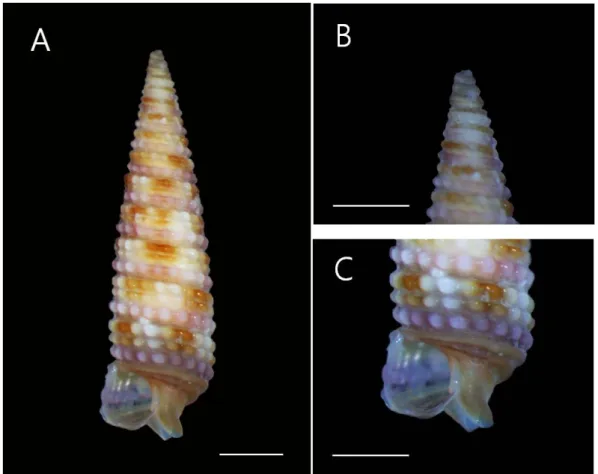
Description. Shell small, sinistral, solid, elongate cylindrical, narrow but slightly inflated. Suture deep and distinct. Protoconch 4 whorls, pale yellowish brown, bearing single spiral keel crossed by fine axial threads. Teloconch 10 whorls, upper and median lows yellowish brown with reddish brown and white specks by turns, lower row pink with irregular white specks. Sculpture consists of 3 rows of granules. Each granule round, equal in size only in body whorl and penultimate whorl, median row is diminished as it ascends the spire. Aperture rectangular, with rather deep posterior canal.
http://dx.doi.org/10.9710/kjm.2012.28.3.275 단보 [Short Communication]
The first record of Bouchetriphora consfera (Caenogastropoda, Triphoridae) from Korean Waters
- 276 -
Fig. 1. Bouchetriphora consfera. A. Ventral view; B. Protochonch; C. Aperture. Scale Bar = 10 mm.
Habitat. Gravel bottom about 50 m deep.
Distribution. Korea, Japan, Philippines, Taiwan.
Acknowledgment
This study was supported by Discovery of Korean Indigenous Species Project, NIBR (National Institute of Biological Resources).
REFERENCES
Higo, S., P. Callomon and Y. Goto. (1999) Catalogue and bibliography of the marine shell bearing mollusca of Japan. Elle Scientific Publications, Osaka, Japan.
749 pp.
Kosuge, S. (1966) Triphoridae and its systematic position, Malacologia, 4(2): 297-324.
Laseron, C.F. (1954) Revision of the New South Wales Triphoridae. Records of the Australian Museum, 23:
139-158.
Lee, J.S. and D.K. Min. (2002) A catalogue of molluscan fauna in Korea. Korean Journal of Malacology, 18(2): 93-217.
Marshall, B.A. (1983) A revision of recent Triphoridae of Southern Australia. Records of Australian Museum, Supplement, 1: 119 pp.
Okutani, T. (2000) Marine mollusks in Japan. Tokai Univ. Tokyo. pp. 1-1171. [In Japanese and English].
Pilsbry, H.A. (1895) Catalogue of the marine mollusks of Japan with descriptions of new species and notes on others collected by Frederick Stearns. Viii +196pp, 11pls.
Smith, E.A. (1875) A list of Gastropoda collected in Japanese Seas by commander H.C. St. John, R.N.
Annals and Magazine of Natural History, 4(15):
414-427; 4(16): 103-115.