Pil Joon Kang, Jae Woo An and Ki Wan Nam
314Korean J. Environ. Biol. 36(3) : 314~318(2018) https://doi.org/10.11626/KJEB.2018.36.3.314
INTRODUCTION
The Delesseriaceae is a large red algal family that includes about 100 genera inhabiting the intertidal and subti dal zone (Lin et al. 2001; Wynne 2001; Nam and Kang 2012; Guiry and Guiry 2018). This family has been divided into three sub
families, Delesserioideae, Nitophylloideae and Phycodryoi
deae, based on molecular analyses (Lin et al. 2001). In the subfamily Delesserioideae procarps are located on primary axes (except in Pseudophycodrys Skottsberg) near the blade tip, whereas in the Nitophylloideae the procarps are scattered on the blade surface and a fusion cell is lacking and the pit connections between gonimoblasts cells broaden (Maggs and Hommersand 1993; Wynne 1996; Lin et al. 2001; Nam and Kang 2012). In the Phycodryoideae, the procarps are scat
tered and a large fusion cell is formed by the progressive incorporation of neighboring gametophytic and inner goni
moblast cells around the pit connections (Lin et al. 2001).
The Delesserioideae consists of several tribes, including the Delesserieae (Kylin 1956; Lin et al. 2001; Wynne 2001).
Membranoptera Stackhouse (1809) belongs to the tribe Delesserieae within the subfamily Delesserioideae and was established based on three entities, M. alata, M. angustifo
lia and M. costata, all of which are representative of Fucus alatus Hudson (1762) (Papenfuss 1950). This genus has the following features: growth by a transversely dividing apical cell, discoid holdfast, monostromatic to polystromatic blades, branching from margin, presence of midrib, presence or ab
sence of macroscopic or microscopic veins, absence of inter
calary cell division, spermatangial sori scattered, procarps borne on both sides of blade near apex and tetrasporangia produced from surface cells, and is distinguished from other members of the tribe Delesserieae by those combined fea
tures (Wynne 1985; Maggs and Hommersand 1993; Nam and Kang 2012). It is distributed on both sides of the North At
lantic and in the northeastern North Pacific (Wynne and Saunders 2012). Eleven species are currently accepted in this
* Corresponding author: Ki Wan Nam, Tel. 0516295922, Fax. 0516295922, Email. [email protected]
ⓒ2018. Korean Society of Environmental Biology.
New Record of a Marine Algal Species, Membranoptera alata (Delesseriaceae) in Korea
Pil Joon Kang, Jae Woo An and Ki Wan Nam*
Department of Marine Biology, Pukyong National University, Busan 48513, Republic of Korea
Abstract - A marine algal species was collected from Sacheonjin, Gangneung located on the east- ern coast of Korea during a survey of marine algal flora. This alga shares the generic features of
Membranoptera belonging to the subfamily Delesserioideae and is characterized by the presence ofcombined features of membranous, monostromatic thalli attached by a solid discoid holdfast, blades with a conspicuous terete stipe-like midrib and microscopic lateral veins, entire margins, irregu- larly alternate to dichotomous branching, and obtuse apices growing apically. In a phylogenetic tree based on rbcL sequences, the Korean alga nests in the same clade with M. alata from the east- ern North Atlantic. The genetic distance between both the sequences within the clade was calcu- lated as 0.0%. Based on the morphological and molecular analyses, this Korean species is identi- fied as the generic type, M. alata. This is the first record in the list of Korean marine algal flora.
Keywords : Membranoptera alata, Delesseriaceae, marine alga, first record, Korea
<Original article>
In Korea, only Membranoptera robbeniensis Tokida, orig
inally described from Robben Island (Sea of Okhotsk), has been reported (Kang 1966; Nam and Kang 2012). During a survey of marine algal flora, a red algal species belonging to the family Delesseriaceae was collected from Sacheonjin, Gangneung on the east coast of Korea. This alga was identi
fied based on morphological and molecular analyses and is newly recorded in Korea herein.
MATERIALS AND METHODS
Specimens for this study were collected from Sacheonjin, Gangneung on the east coast of Korea. Taxonomic data were obtained from fresh, liquidpreserved and herbarium speci
mens. Liquidpreserved material was stored in a 10% solu
tion of formalin/seawater. Blades dissected from the cleared materials were handsectioned, transferred to a slide with distilled water, and mounted in pure glycerin. Measurements are given as width and length. For permanent slides, the gly
cerin was exchanged with 10-20% corn syrup.
Total genomic DNA was extracted from silicagelpreserv
ed samples using the DNeasy Plant Mini Kit (Qiagen, Hilden, Germany) according to the manufacturer’s protocol. Before extraction, dried material was crushed with liquid nitrogen using a mortar and pestle. Extracted DNA was used for the amplification of ribulose1, 5bisphosphate carboxylase large subunit (rbcL) regions. For rbcL, the gene was amplified in three overlapping parts with the primer pairs FrbcL start (5ʹTGTGTTGTCGACATGTCTAACTCTGTAGAAG3ʹ) R753 (5ʹGCTCTTTCATACATATCTTCC3ʹ), F492 (5ʹCG TATGGATAAATTTGGTCG3ʹ) R1150 (5ʹGCATTTGTC CGCAGTGAATACC3ʹ), and F993 (5ʹGGTACTGTTGTA GGTAAATTAGAAGG3ʹ) RrbcS (5ʹTGTGTTGCGGCC GCCCTTGTGTTAGTCTCAC3ʹ) (Freshwater and Rueness 1994). PCR amplifications were performed in a TaKaRa PCR Thermal Cycler Dice (TaKaRa Bio Inc., Otsu, Japan). PCR was performed with an initial denaturation step at 94°C for 4 min, followed by 35 cycles of 1 min at 94°C, 1 min at 50°C, and 2 min at 72°C, with a final 7min extension at 72°C. The PCR products were moved to the Macrogen Sequencing Ser
vice for sequencing (Macrogen, Seoul, Korea). Sequences for the rbcL region were aligned using BioEdit (Hall 1999).
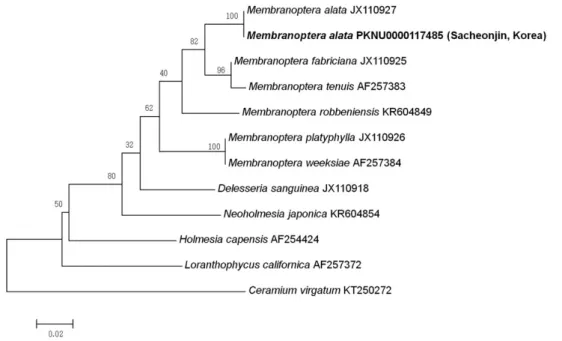
ing and maximumlikelihood methods. Bootstrap values were calculated with 1,000 replications. RbcL sequences of other species were obtained from GenBank. Ceramium vir
gatum Roth was used as an outgroup.
RESULTS AND DISCUSSION
Membranoptera alata(Hudson) Stackhouse 1809 Korean name: Nalgaegeumurip nom. nov. (
신칭: 날개 그물잎).
Type locality: ?
Specimens examined: NIBR00002113415 (Sacheonjin, Gangneung, Korea: 03.vii.2017), MGARBb000752 (Sacheon
jin, Gangneung, Korea: 03.vii.2017).
Habitat: Epilithic in upper to lower intertidal.
Morphology: Thalli up to 1-5 cm high, membranous, monostromatic except for midrib, irregularly alternately to dichotomously branched in one plane, bright to dark red in color, attached by a solid discoid holdfast (Fig. 1A); blades 0.5-2.0 mm wide, without intercalary cell division, with a conspicuous midrib 0.1-0.5 mm in width, with microscopic lateral veins and dentate margins, with 12 celllayered cor
tex around midrib in middle and lower portion (Fig. 1B-E);
apical cell obtuse, hemispherical, transversely dividing, 10- 15 μm in diameter (Fig. 1F). Sexual and tetrasporangial plants were not found during the present study.
Membranoptera was lectotypified with M. alata (Papen
fuss 1950). Previously, the type species had been recognized on both sides of the North Atlantic (Rosenvinge 1923, 1924;
Taylor 1962; Bird and McLachlan 1992; Maggs and Hom
mersand 1993; Sears 1998; Loiseauxde Goer and Noailles 2008; Wynne 2013). However, Wynne and Saunder (2012) reported that the type species is restricted to Europe, as sug
gested by Hommersand and Lin (2009). They clarified that M. alata from the North American Atlantic coast is geneti
cally distinct from the European entity and is conspecific with Pantoneura fabriciana (Lyngbye) M.J. Wynne, one of two species of Pantoneura Kylin which was usually recog
nized in that region, but it was difficult to separate it from
Membranoptera. Thus, it has been known with the combined
name M. fabriciana (Lyngbye) Wynne et Saunder (Guiry and
Guiry 2018). M. alata appears to be distinct from M. fabri
ciana in having relatively wide blades, axillary laterals and cystocarp with nonprojecting ostiole (Maggs and Hommer
sand 1993; Wynne 1997). It also distinguished from M. spi
nulosa (Rup recht) Kuntze with syntype localities in the Sea of Okhotsk and Bering Sea, but recently occurring in the northeastern Atlantic (Mathieson et al. 2009), by branching type, axillary tufts and cystocarp shape (Wynne 1970; Maggs
Fig. 1. Membranoptera alata. A. The habit of vegetative plant. B. Cell arrangement without intercalary cell division in the upper portion of the branch. C. Branch with a conspicuous midrib(asterisk). D. The dentate margin of the branch. E. Initial cell(arrowheads) of cortex around midrib in the middle portion of the blade. F. Branch apex with a distinct hemispherical apical cell dividing transversely.A B
C D
E F
and Hommersand 1993). Membranoptera platyphylla (Set
chell et N.L. Gardner) Kylin, which had been previously recognized as several species in Membranoptera populations from the northeastern North Pacific (Wynne and Saunders 2012), is distinct from M. alata, but it is needed to examine the characters used to distinguish it from M. multiramosa N.L.
Gardner and M. spinulosa (Gabrielson et al. 2004, 2006).
The Korean alga collected from Sacheonjin in the pre sent study shares the generic features of Membranoptera (Fig. 1) and fits the description of M. alata by Maggs and Hommer
sand (1993). This is supported by molecular data (Fig. 2).
In a phylogenetic tree based on rbcL sequences, the Korean alga nests in the same clade with M. alata from Ireland in the eastern North Atlantic as a sister clade of M. fabriciana and M. tenuis (Fig. 2). In general, the value of interspecific divergence in the family Delesseriaceae varies from 5.6%
to 15.95% (Lin et al. 2001), and in Membranoptera it was calculated as 3.4-11.6% (the present study). The genetic dis
tance between both sequences within the clade was 0.0%.
Based on these morphological and molecular analyses, this Korean species is identified as the generic type, M. alata, the distribution of which is currently known as being restrict
ed to Europe (Hommersand and Lin 2009; Wynne and Saun
der 2012). This is the first record of M. alata in Korea.
ACKNOWLEDGEMENTS
This work was supported by a grant from the National In
stitute of Biological Resources (NIBR) funded by the Minis
try of Environment (MOE) of the Republic of Korea (NIBR 201801205), and by the Marine Biotechnology Program of the Korea Institute of Marine Science and Technology Pro
motion (KIMST) funded by the Ministry of Oceans and Fish
eries (MOF) (No. 20170431).
REFERENCES
Bird CJ and JL McLachlan. 1992. Seaweed Flora of the Mari
times 1. Rhodophytathe red algae. Biopress, Bristol.
Freshwater DW and J Rueness. 1994. Phylogenetic relationships of some European Gelidium(Gelidiales, Rhodophyta) spe
cies based upon rbcL nucleotide sequence analysis. Phyco
logia 33:187-194.
Gabrielson PW, TB Widdowson and SC Lindstrom. 2004. Keys to the seaweeds and seagrasses of Oregon and California.
Phycological Contrib. 6:1-181.
Gabrielson PW, TB Widdowson and SC Lindstrom. 2006. Keys to the seaweeds and seagrasses of southeast Alaska, British Columbia, Washington and Oregon. Phycological Contrib.
7:1-209.
Fig. 2. Phylogenetic tree of Membranoptera species obtained from a maximumlikelihood method based on rbcL sequences. Bootstrap pro
portion values(1,000 replicates samples) are shown above the branches. Scale bar=0.02 substitutions/site.
Guiry MD and GM Guiry. 2018. AlgaeBase. Worldwide elec
tronic publication, National University of Ireland, Galway.
http://www.algaebase.org. Accessed 6 August 2018.
Hall TA. 1999. BioEdit: a userfriendly biological sequence alignment editor and analysis program for Windows 95/98/
NT. Nucl. Acids Symp. Ser. 41:95-98.
Hommersand MH and SM Lin. 2009. Phylogeny and systemat
ics of species of Phycodrys and Membranoptera(Delesse
riaceae, Rhodophyta) that exhibit transArctic distributions between the North Pacific and North Atlantic oceans. In 48th Annual Northeast Algal Symposium(Wilce B, B Johan
sen and C Schneider eds.). University of Massachusetts, Amherst.
Hudson W. 1762. Flora Anglica; exhibens plantas per regnum angliae sponte crescentes, distributas secundum systema sexuale: cum differentiis specierum, synonymis auctorum, nominibus incolarum, solo locorum, tempore florendi, ofììci
nalibus pharmacopoeorum. Impensis auctoris: Prostant ve
nales apud J. Nourse in the Strand, et C. Moran in Covent
Garden, London.
Kang JW. 1966. On the geographic distribution of marine algae in Korea. Bull. Pusan Fish. Coll. 7:1-123.
Kylin H. 1956. Die Gattungen der Rhodophyceen. C.W.K.
Gleerups, Lund.
Lin SM, S Fredericq and MH Hommersand. 2001. Systematics of the Delesseriaceae(Ceramiales, Rhodophyta) based on large subunit rDNA and rbcL sequences, including the Phy
codryoideae, subfam. nov. J. Phycol. 37:881-899.
Loiseauxde Goër S and MC Noailles. 2008. Algues de Roscoff.
Editions de la Station Biologique de Roscoff, Roscoff.
Maggs CA and MH Hommersand. 1993. Seaweeds of the British Isles. Volume 1. Rhodophyta. Part 3A. Ceramiales. HMSO, London.
Mathieson AC, CJ Dawes, EJ Hehre and LG Harris. 2009. Flo
ristic studies of seaweeds from Cobscook Bay, Maine. North
east. Nat. 16:1-48.
Nam KW and PJ Kang. 2012. Algal Flora of Korea. Volume 4, Number 7. Rhodophyta: Florideophyceae: Ceramiales: De
lesseriaceae: 22 genera including Acrosorium. National In
stitute of Biological Resources, Incheon.
Papenfuss GF. 1950. Review of the genera of algae described by Stackhouse. Hydrobiologia 2:181-208.
Rosenvinge LK. 1924. The marine algae of Denmark. Contri
butions to their natural history. Part III. Rhodophyceae III.
(Ceramiales). K. Danske Vidensk. Selsk. Skr. 7. Raekke, Nat. Math. Afd. 7:285-487.
Sears JR. 1998. List of Taxa. pp. 1-163. In NEAS Keys to Ben
thic Marine Algae of the Northeastern Coast of North Amer
ica from Long Island Sound to the Start of Belle Isle(Sears JR ed.). The Northeast Algal Society Fall River, MA.
Stackhouse J. 1809. Tentamen marinocryptogamicum, ordinem novum; in genera et species distributum, in Classe XXIVta Linnaei sistens. Mem. Soc. Imp. Nat. Mos. 2:50-97.
Taylor WR. 1962. Marine algae from the tropical Atlantic Ocean:
V. Algae from the Lesser Antilles. Contrib. U. S. Nati. Herb.
36:43-62.
Wynne MJ. 1970. Marine algae of Amchitka Island(Aleutian Islands). I. Delesseriaceae. Syesis 3:95-144.
Wynne MJ. 1985. Taxonomic notes on some Delesseriaceae (Rhodophyta) occurring in southern California and Mexico.
Bull. South. Calif. Acad. Sci. 84:164-171.
Wynne MJ. 1996. A revised key to genera of the red algal fam
ily Delesseriaceae. Nova Hedwigia 112:171-190.
Wynne MJ. 1997. Taxonomic and nomenclatural notes on the Delesseriaceae(Rhodophyta). Contr. Univ. Michigan Herb.
21:319-334.
Wynne MJ. 2001. The tribes of the Delesseriaceae(Ceramiales, Rhodophyta). Contr. Univ. Michigan Herb. 23:407-417.
Wynne MJ. 2013. The red algal families Delesseriaceae and Sar
comeniaceae. Koeltz Scientific Books, Königstein.
Wynne MJ and GW Saunders. 2012. Taxonomic assessment of North American species of the genera Cumathamnion, De
lesseria, Membranoptera and Pantoneura(Delesseriaceae, Rhodophyta) using molecular data. Algae 27:155-173.
Received: 20 August 2018 Revised: 6 September 2018 Revision accepted: 6 September 2018