and P. shikokuensis H. Kawai, K. Miyoshi & T. Hanyuda in Northern hemisphere(Kawai et al. 2016). Until now, only Papenfussiella kuromo has been reported in Korea.
Papenfussiella densa was described as Papenfussiella ku- romo f. densa by Inagaki in 1958. Kawai et al.(2016) reap- praised as an independent species, P. densa after compari- son of type materials based on molecular analyses(Kawai et al. 2016). However, Kawai et al.(2016) could not be examined the detailed morphological characters of P. densa because he did not have fresh materials from the field and it was difficult to examine the anatomy using the original voucher specimens collected by Inagaki. Although Papen- fussiella densa is accepted as valid species, its detailed char- acters have not been described.
Dok-do is an island located 200km east coast of the Ko- rea Peninsula. The currents affecting Dok-do are known
https://doi.org/10.11626/KJEB.2020.38.1.160
INTRODUCTION
The brown algal genus, Papenfussiella, was described by Kylin(Kylin 1940). It is characterized by having multiaxial, terete thalli without transition zones between their medul- lary and cortical tissues(Kylin 1940). They generally have long and short assimilatory filaments and form rhizoidal filaments from the base of assimilatory filament(Kylin 1940). Currently, eleven Papenfussiella species are report- ed worldwide(Kylin 1940; Levring 1941; Inagaki 1958;
Womersley and Bailey 1987; Kawai et al. 2016). Among them, P. extensa Womersley & A. Bailey, P. gracilis Kylin, P.
laxa Kylin, P. lutea Kylin, P. moseleyi Levring, and P. tristan- ensis Kylin, are distributed in Southern hemisphere, and P. callitriche(Rosenvinge) Kylin, P. densa H. Kawai & T.
Hanyuda, P. kuromo(Yendo) Inagaki, P. iemasae H. Kawai,
Note
A new record of brown algae, Papenfussiella densa from Dok-do, Korea
Boo Yeon Won*
Department of Life Science, Chosun University, Gwangju 61452, Republic of Korea
Korean J. Environ. Biol.
38(1) : 160-164(2020) ISSN 1226-9999(print) ISSN 2287-7851(online)
* Corresponding author Boo Yeon Won Tel. 062-230-7983
E-mail. [email protected]
Received: 12 February 2020 Revised: 12 March 2020
Revision accepted: 12 March 2020
Abstract: Papenfussiella densa was described as Papenfussiella kuromo f. densa from Japan by Inagaki in 1958. P. densa has been recognized as an endemic and independent species based on the molecular analyses of type material without detailed morphological observations. In this study, Papenfussiella densa is reported as a new record from Dok-do, South Korea, based on morphological and molecular analyses.
Papenfussiella densa is mainly characterized as having narrow, branched, slimy, and tomentose thalli with branchlets, partially hollow in the medulla of the middle part. The molecular analyses of the chloroplast rbc L-rbc S DNA sequence of the Papenfussiella densa sample from Korea revealed that it matched that of P. densa from Japan and was nested in the clade of Papenfussiella. There was only a 0.02% gene sequence divergence between the Korean and Japanese samples. We report P. densa as a new record from Korea and add this species to the list of Korean macroalgal flora.
Keywords: morphology, Chordariaceae, Papenfussiella densa, chloroplast rbc L - rbc S DNA, Phaeophyceae
as the high-temperature and high-salt Tsushima warm current, North Korean cold current and the Liman current (Yoon et al. 2007). Its alga flora study was begun in 1960 and its marine vegetation was similar to that of the south coast although it located in the East Sea geographically (Kang 1966).
We collected an unidentified brown alga from Dok-do, Ulleung-gun, Gyeongsangbuk-do, Korea. We observed the detailed morphology and analyzed molecular data based on the chloroplast rbcL-rbcS DNA gene for the phyloge- netic relationships. In this study, we add this unidentified brown alga as Papenfussiella densa to the Korean marine algal inventory.
MATERIALS AND METHODS 1. Morphology
Samples of unidentified brown alga were collected from Dok-do in the East Sea of Korea. They were sorted into voucher herbarium specimens, silica gel samples, and for- malin samples. Formalin samples were preserved in 4-5%
formalin/seawater. Photomicrographs were taken using an Olympus BX51TRF microscope(Olympus, Tokyo, Japan) and an Olympus DP71 camera. Permanent slides were mounted in 70% karo syrup. Representative specimens examined in this study were deposited in the herbarium of Chosun University(CUK) and National Institute of Bio- logical Resources(NIBR), Korea.
2. Molecular study
Genomic DNA was manually extracted from silica-gel samples using extracted using a NucleoSpin Plant II Kit (Macherey-Nagel, Düren, Germany). The extracted DNA was stored at -20°C and used to amplify chloroplast rbcL-rbcS DNA. The rbcL-rbcS DNA was amplified using a pair of RS1+RS2 primer was used for each reaction(RS1:
50GCC AAA TGC ACC AACTTC TT 30, RS2: 50AGA CCC CAT AAT TCC C 30)(Yoon and Boo 1999) with HelixAmp Ready-2x-Go Series(NanoHelix Co., Ltd., Daejeon, Korea). All PCR amplifications were carried out with a Veriti 96 well Thermal cycler(Applied Biosystem).
PCR products were purified using a PCRquick-spinTM PCR product purification kit(iNtRON Biotechnology, Inc, Seongnam, Korea). All rbcL-rbcS DNA sequence data were compiled by the present study and obtained from
GenBank and aligned with ClustalW(Thompson et al.
1994). New rbcL-rbcS DNA sequences obtained from Pa- penfussiella densa have been deposited in EMBL/GenBank under the accession numbers MT000921(CUK9549) and from Papenfussiella kuromo under the Accession numbers MT000919and MT000920(CUK9587 and CUK18784).
Proselachista taeniaeformis were selected as outgroup.
Phylogenetic analyses were conducted using raxml- GUI1.5b2(Silvestro and Michalak 2012). Maximum like- lihood analyses were conducted using the GTR+G+I model, with 1000 bootstrap replicates. Bayesian inference was performed using MrBayes 3.2.6(Huelsenbeck and Ronquist 2001; Ronquist and Huelsenbeck 2003). Mar- kov chain Monte Carlo runs were conducted for 2 million generations, each with one cold chain and three heated chains using the GTR+Γ+I evolutionary model and sam- pling and printing every 1,000 generations. Summary trees were generated using a burn-in value of 800.
RESULTS AND DISCUSSION
Papenfussiella densa H. Kawai & T. Hanyuda 독도연두털말(신칭)(Figs. 1, 2)
Heterotypic Synonyms.
Papenfussiella kuromo f. densa Inagaki, 1958 Papenfussiella kuromo f. gracilis Inagaki, 1958 Holotype. SAP 058308.
Material examined. CUK9549(=MBRB0098TC9549 H1-H3) & NIBROR0000001762(National Institute of Bi- ological Resources(NIBR) Dongdo, Dok-do, Ulleung-gun, Gyeongsangbuk-do, Korea(37°14′24.37″N, 131°52′5″E), 95 April 22, 2013, T. O. Cho, at 1m depth by hand.
Habitat. epilithic or epiphytic in shallow and calm waters.
Morphological observation. Plants are olive or green- ish-brown in color, erect, cylindrical, solitary to caespitose, highly branched, slimy, and tomentose. The main branches are 10-30cm long, 614±174μm in diameter(Fig. 1A), and slightly narrower towards the apices(Fig. 1B). Branch- es are sparse or abundant with branchlets, irregularly al- ternately or laterally divided in 1-4 order(Fig. 1A-E).
Branches are composed of medullary filaments and corti- cal pigmented assimilatory hairs(Fig. 1G-I). Each apical filament is extended to the assimilating hair at the apex of the young branch(Fig. 1A), and the assimilating hairs on the old branch gradually become progressively shorter(Fig.
1E). Medullar is composed of medullary filaments, hollow
Fig. 1. Papenfussiella densa(CUK9549) from Dok-do, Ulleung-gun, Gyeongsangbuk-do, Korea. A. Gross morphology of representative specimens. B. Apex with assimilatory filaments. C & D. Middle of the thallus showing branches and branchlets. E. Basal part of the plant showing thalli from holdfast. F. Long assimilatory filaments. G. Longitudinal section view of the thallus. H. Cross-sectional view of the mid- dle part of the thallus showing partial hollow in the medulla. I. Cross-sectional view of the basal part of the thallus showing long and short assimilatory filaments. Scale bars: A=3cm; B=300mm; C-E=500μm; F-H=50μm; I=100μm.
A B C D
E F G
H I
in the middle part of the thallus(Fig. 1H), and not hollow in the basal part(Fig. 1I). The medullary filaments are mul- tiaxial, composed of a bundle of many parallel longitudinal cell lines(Fig. 1G), tightly compact pseudo-parenchyma- tous(Fig. 1H). The subcortical layer is absent between the medullary layer and cortical ones(Fig. 1H). There are two different forms of assimilating filament: the long ones are not imbedded in gelatinous substance, elongated like hairs, about 112±95mm long, somewhat thicker in the middle portion, but in age often filling off(Fig. 1F, G, I); the short one imbedded in gelatinous substance, considerably short- er than former, composed of 3-6 or more cells, about 1.7±
1.3mm long, club-shaped(Fig. 1G-I).
World distribution. Japan and Korea.
Identifier. Boo Yeon Won.
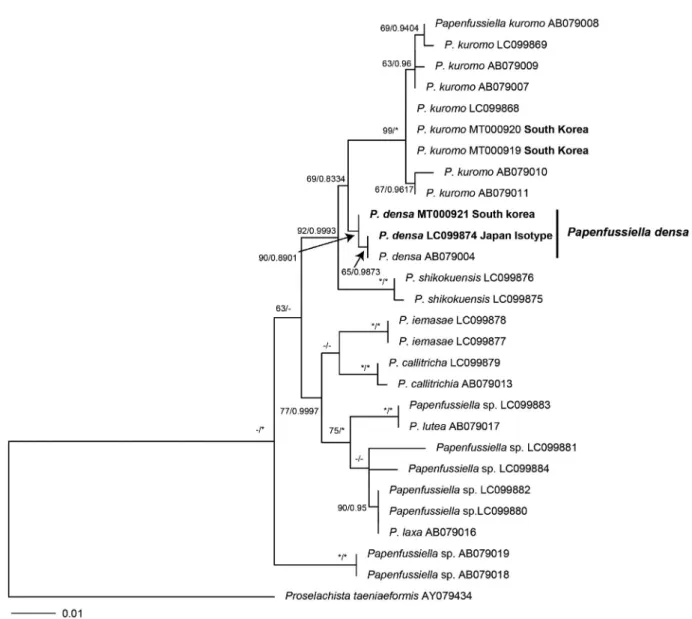
Phylogenetic analyses. The 466-nucleotide of the rbcL- rbcS gene was aligned for P. densa. Phylogenetic analyses revealed that our Papenfussiella densa sample from Dok-do, Korea was placed within a clade P. densa in the rbcL-rbcS gene(Fig. 2). There was only a 0.02% gene sequence di- vergence between Genbank and our collection of P. densa.
Papenfussiella densa was a sister group of Papenfussiella ku- romo. Also, P. densa differs from P. callitricha by 2.8-3.2%, from P. iemasae by 3.0-3.4%, from P. kuromo by 1.5-2.4%,
Fig. 2. Phylogenetic tree of Papenfussiella species based on ML and Bayesian analysis of rbc L-rbc S gene sequences. Value above the branches are maximum-likelihood bootstrap(BS) values with >50% Bayesian posterior probabilities(BPP) >0.75. Values lower than BS 50 or BPP 0.75 are indicated by hyphens(-). Values of BS 100 or BPP 1.00 are indicated by asterisks(*).
from P. laxa by 2.9-3.2%, from P. lutea by 3.3-3.7% and from P. shikokuensis by 1.9-2.2% gene sequence divergence respectively.
Remarks. Papenfussiella densa was a new species based on Papenfussiella kuromo f. densa(Inagaki 1958; Kawai et al.
2016). It has been reported as endemic species only from Japan(Kawai et al. 2016). Papenfussiella densa sample from Korea matched with P. densa from Japan and was nested in the clade of Papenfussiella. Although it was not recognized in the original description, partially hollow in the medulla of middle thallus may be a diagnostic character for this spe- cies. In this study, P. densa is reported as a new record from Korea and add this species in the list of Korean macroalgal flora.
ACKNOWLEDGEMENTS
This study was supported by a grant from the National Institute of Biological Resources(NIBR), funded by the Ministry of Environment(MOE) of the Republic of Ko- rea(NIBR 201501204) and by a grant from the research fund of Chosun University 2018. This research was also supported by Basic Science Research Program through the National Research Foundation of Korea(NRF) fund- ed by the Ministry of Education, Science and Technology (2019R1F1A1060346) and a grant from Marine Bio- technology Program(20170431) funded by Ministry of Oceans and Fisheries of Korean Government.
REFERENCES
Huelsenbeck JP and F Ronquist. 2001. MrBayes: Bayesian infer- ence of phylogeny. Bioinformatics 17:754-755.
Inagaki K. 1958. A systematic study of the order Chordariales from Japan and its vicinity. Sci. papers Inst. Algol. Res., Fac.
Sci., Hokkaido Univ. 4:87-197.
Kang JW. 1966. On the geographical distribution of marine algae in Korea. Bull. Pusan Fish. Coll. 7:1-125.
Kawai H, K Miyoshi and T Hanyuda. 2016. Taxonomic revision of Papenfussiella species(Chordariaceae, Phaeophyceae) in the Northern Hemisphere. Phycologia 55:308-317.
Kylin H. 1940. Die Phaeophyceen ordnung Chordariales, Lunds Univ. Arsskr. N. F. Avd. 2. 36:1-67.
Levring T. 1941. Die Meeresalgen der Juan Fernandez-Inseln.
The natural history of Juan Fernandez and Easter Island, vol.
2. Ed. By C. Skottsberg. Uppsala, Sweden. p. 624.
Ronquist F and JP Huelsenbeck. 2003. MrBayes 3: Bayesian phylogenetic inference under mixed models. Bioinformatics 19:1572-1574.
Silvestro D and I Michalak. 2012. raxmlGUI: a graphical front-end for RaxML. Org. Divers. Evol. 12:335-337.
Thompson JD, DG Higgins and TJ Gibson. 1994. Clustal W:
improving the sensitivity of progressive multiple sequence alignment through sequence weighting, position-specific gap penalties and weight matrix choice. Nucleic Acids Res.
22:4673-4680.
Womersley HBS and A Bailey. 1987. Family Chordariaceae Gre- ville. pp. 103-127. In: The Marine Benthic Flora of Southern Australia(Womersley HBS, ed.). South Australian Govern- ment Printing Division. Adelaide, Australia.
Yoon HS and SM Boo. 1999. Phylogeny of Alariaceae(Phaeophy- ta) with special reference to Undaria based on sequences of the RuBisCo spacer region. Hydrobiologia 398/399:47-55.
Yoon YY, SJ Jung and SC Yoon. 2007. Characteristics and long term variation trend of water mass in the coastal part of the East Sea, Korea. J. Korean Soc. Mar. Environ. Energy 10:59- 65.