1)
1. Introduction
Increased impervious surfaces and engineered waterways alter natural suspended solids (TSS) transport processes (Taylor and Owens, 2009). Several studies have found that the increase in TSS and heavy metals wash off in urban areas was attributed
†To whom correspondence should be addressed.
Dept. of Civil & Environ. Engineering, Kongju National University E-mail: [email protected]
to several rainfall characteristics including longer rainfall duration, greater rainfall intensity, and greater antecedent dry days (ADD) (Vogel and Moore, 2016). Understanding the factors affecting the transportation of TSS and heavy metals in highly urbanized land uses is critical to assess and anticipate risk situations affecting drainage networks and water bodies (Peraza-Castro et al., 2016). TSS and heavy metals were usually generated by weathering and human and vehicular activities, which eventually settled and built up especially in highly urbanized land uses including roads, parking lots, sidewalks,
Transport and management of diffuse pollutants using low impact development technologies applied to highly urbanized land uses
F. K. F. Geronimo・H.S. Choi・L. H. Kim†
Dept. of Civil & Environ. Engineering, Kongju National University
고도화 도시지역에 적용된 LID 기법의 비점오염물질 관리 및 이동
F. K. F. Geronimo・최혜선・김이형† 공주대학교 건설환경공학과
(Received : 03 May 2019, Revised: 21 May 2019, Accepted: 21 May 2019)
Abstract
This study was conducted to understand factors affecting TSS and heavy metals transport on the road, parking lot and roof. During storm events, heavy metals, which were mostly attached to TSS, were also transported when TSS was washed off in the road, parking lot and roof. This finding may be supported by the significant correlations between TSS load and total and soluble heavy metals load including Cr, Fe, Cu, and Pb (Pearson r value: 0.52 to 0.73; probability p value<0.01).
Generation and transport of TSS and heavy metals were greater in the road and parking lot compared to the roof due to vehicular activities, slope and greater catchment areas of these sites. It was found that TSS transport during peak flows of storm events ranges from 65% to 75% implying that by controlling peak flows, TSS transportation to nearby water bodies may be decreased. Depending on the target TSS and heavy metal reduction, sizing of low impact development (LID) technologies and green infrastructures (GI) such as infiltration trench, tree box filter, and rain garden may be calculated.
Future researchers were recommended to assess the limitations of the systems and determine the design considerations for these types of facilities.
Key words : Heavy metals, low impact development, peak flow attenuation, total suspended solids, urban stormwater management
요 약
본 연구는 도로, 주차장 및 지붕에서 발생된 TSS와 중금속의 거동을 분석하기 위해 수행되었다. 강우시 도로, 주차장, 지붕에 서 발생되는 중금속은 입자상 물질(TSS)에 부착되어 이동된다. 이는 TSS 부하량과 Cr, Fe, Cu 및 Pb의 입자상 중금속 및 용존성 중금속의 부하량의 상관관계로 판단 가능하다(r =0.52~0.73, p <0.01). 일반적으로 도로 및 주차장에서 발생된 TSS 및 중금속은 지붕에 비해 더 높은 것으로 분석되었는데, 이는 차량에 의해 중금속이 많이 발생하며, 집수면적 또한 도로 및 주차장이 넓기 때문으로 보여진다. 첨두유출발생시까지 TSS 부하량의 65~75%가 유출되는 것으로 나타났으며, 이는 인근 수계로 유출되는 TSS를 제거하기 위해서는 첨두유출을 제어하는 것이 가장 효과적인 것을 의미한다. 또한 비용경제적인 LID 시설의 규모를 산정하기 위해 시설의 적정 크기(시설의 표면적/배수구역 면적)에 따른 TSS와 중금속 제거율을 평가하였 다. 본 연구는 LID 시설의 설계시 참고 가능한 기초데이타로 중요한 의미가 있는 것으로 사료된다.
핵심용어 : 도시 강우유출수 관리, 저영향개발기법, 중금속, 첨두유출저감, 총 부유물질
174
and roof. During storm events, these TSS and heavy metals were washed off from impervious surfaces causing stormwater runoff to be contaminated. The contaminated stormwater runoff was directed to receiving water bodies which can be detrimental to urban aqua eco-system.
In order to address the increasing environmental concern of urban development and diffuse pollution from stormwater runoff, best management practices (BMP), stormwater low impact development (LID) technologies and green stormwater infrastructures (GSI) are being studied in USA and in European countries (Houdeshel et al., 2011; Lafortezza et al., 2013).
The concept of BMPs includes source control wherein a treatment system is used to intercept stormwater pollutants before entering the combined sewer systems and eventually discharging these to nearby surface water bodies (Barrett, 2005).
Thus, increasing urban water quality issues and its impact on the receiving water bodies has resulted in an increase in the use of stormwater BMPs compared to conventional drainage approaches (Scholes et al., 2008; Huang et al., 2011). While LID techniques are comparable to traditional stormwater BMPs, LID offers an overall design philosophy that implements and embodies multiple small-scale controls throughout the development of the site (Clary et al., 2009). GSI, on the other hand, is an improved approach which allows the full development of areas, while maintaining the essential site hydrologic functions and providing social and ecosystem benefits (Coffman, 2000; Gonzalez-Duque and Panagopoulos, 2013).
As such, this study was conducted to understand and investigate the factors affecting TSS and heavy metals transport in urban land uses during storm events. Specifically, this study identified hydrologic and hydraulic parameters affecting the transport of TSS and heavy metals in urban areas and inside LID facilities. This study also analyzed the pollutant load accumulation at varying parts of the monitored storm events.
Finally, a design method for LID technologies considering pollutant removal by the systems was derived.
2. Materials and Methods
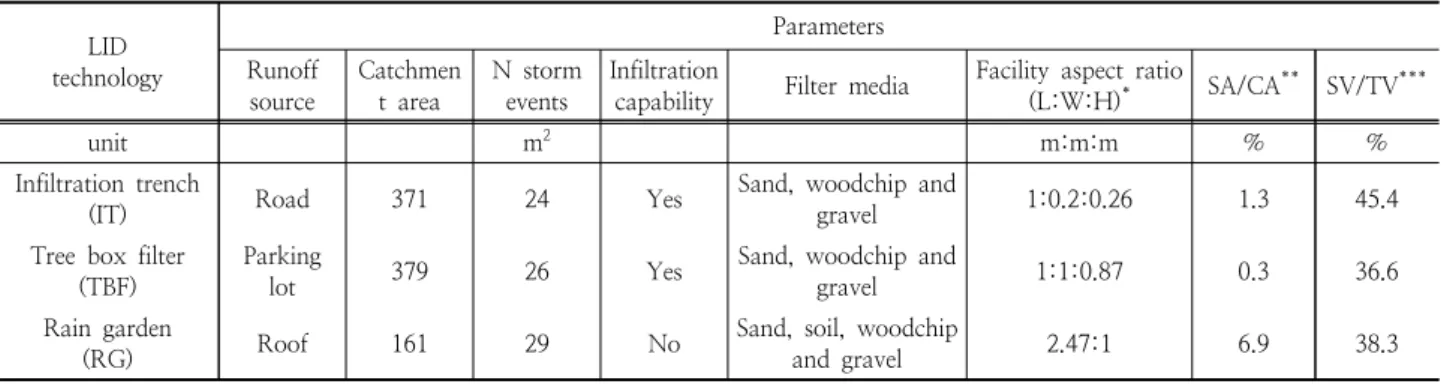
The catchment and design characteristics of LID technologies were summarized in Table 1. A total of 24, 26 and 29 storm events were monitored in the highly impervious road, parking lot (pl) and roof, respectively from 2009 to 2016. The monitored road, parking lot, and roof located in Kongju National University in Cheonan city, South Korea have catchment areas of 371 m, 379 m and 161 m, respectively. The schematics of LID and GSI used to control TSS and heavy metals from the road, parking lot and roof included an infiltration trench (IT), tree box filter (TBF) and rain garden (RG), respectively were shown in Fig. 1. The soil used in RG was mainly composed of 28%, 27%, 43% and 2% coarse sand, medium sand, fine sand, and silt, respectively. The soil uniformity coefficient was 5. Other filter media used in this study were sand, gravel, white pebbles and woodchip which has sizes ranging from 2 to 5 mm, 20 to 30 mm, 20 to 30 mm and 10 to 20 mm, respectively. In addition, the porosity of the sand, gravel, white pebbles and woodchip used in the study were 40%, 46%, 48%, and 43%, respectively. Following the typical sampling scheme in South Korea, flow in the inflow and discharge sampling points were manually measured every 5 minutes. Water samples were collected in the inflow and discharge sampling points as soon as there was runoff and discharge from the catchment and LID technologies, respectively and after 5, 10, 15, 30, 60 minutes and every 60 minutes after the first hour. The frequency of water sample collection during the first hour of sampling was due to the possible observance of the first flush phenomenon in the initial runoff time. Water samples were analytically analyzed tested for total suspended solids (TSS), soluble heavy metals including and total heavy metals according to the standard methods for the examination of water and wastewater.
Soluble heavy metals including chromium (Cr), copper (Cu), zinc (Zn), cadmium (Cd) and lead (Pb), and total heavy metals including total chromium (TCr), total copper (TCu), total zinc (TZn), total cadmium (TCd) and total lead (TPb) were the
Table 1. Catchment and design characteristics of LID technologies LID
technology
Parameters Runoff
source
Catchmen t area
N storm events
Infiltration
capability Filter media Facility aspect ratio
(L:W:H)* SA/CA** SV/TV***
unit m2 m:m:m % %
Infiltration trench
(IT) Road 371 24 Yes Sand, woodchip and
gravel 1:0.2:0.26 1.3 45.4
Tree box filter (TBF)
Parking
lot 379 26 Yes Sand, woodchip and
gravel 1:1:0.87 0.3 36.6
Rain garden
(RG) Roof 161 29 No Sand, soil, woodchip
and gravel 2.47:1 6.9 38.3
***(Length:Width:Height)
***Facility surface area to catchment area ratio
***Facility storage volume to total volume ratio
heavy metal parameters testing in water samples.
The event mean concentration (EMC) represents a flow-weighted average concentration computed by dividing the total pollutant mass by the total runoff volume for an event duration. The amounts of inflow and outflow pollutant loads in the low impact development technologies were determined using the inflow and outflow EMCs, and flow volumes. Aside from EMC, calculating the inflow and outflow pollutant load is also one way of evaluating a treatment facility’s pollutant removal efficiency. The pollutant mass reduction of the system was calculated by dividing the difference of the summation of influent and summation of effluent loading with the summation of influent loading, also known as summation of loads method (Maniquiz et al., 2010a). Results were statistically analyzed using SYSTAT 12 and OriginPro 8 package software including correlation analysis, normality test, and analysis of variance. Pearson correlation coefficient (r) was used to determine the dependence between each water quality parameter. One-way ANOVA was used to analyze the difference between the variance of each water quality parameters. Significant correlations and difference between parameters were accepted at 95% confidence level, signifying that probability (p) value was less than 0.05.
3.1 Characteristics of monitored storm events and water quality
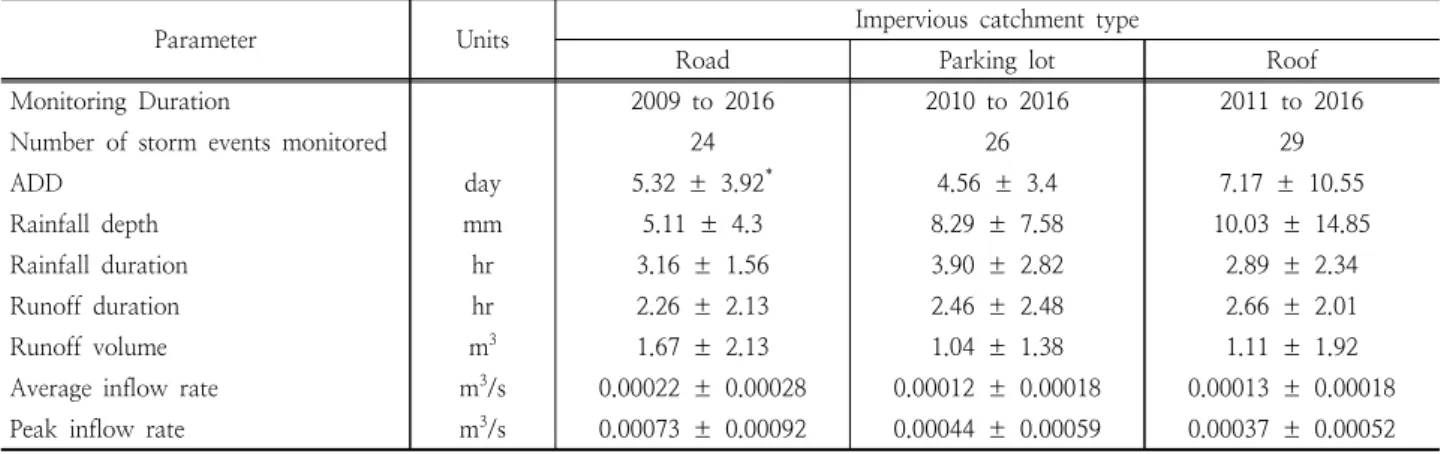
Antecedent dry days (ADD) in between monitored storm events were ranging from 0.2 to 46.31 with the shortest usually occurring in the summer season and the longest between winter to spring season as demonstrated in Table 2. Storm events with rainfall depth ranging from 1 to 90.5 mm were monitored in the LID technologies. 86% of the monitored rainfall events were less than 20 mm which was almost similar to the 80%
to 90% of the rainfall depth occurring in Cheonan city, South Korea. Hydrologic parameters of the three LID technologies were not significantly different (p<0.05) attributed to the proximity of each LID technology subjecting them to the same environmental conditions (Maniquiz-Redillas & Kim, 2016).
EMC was used to quantify concentrations in various studies as a measure of treatment facilities’ efficiency (Flores at al., 2016; Geronimo et al., 2013; Maniquiz et al., 2010b; Mercado et al., 2012). Fig. 2 exhibited the inflow and outflow EMC from the three LID technologies. Inflow TSS EMC of road catchment was found to be 2.5 and 2 times greater than parking lot and roof, respectively. Similarly, heavy metals including Cr, Zn, Cd, Zn, and TCd were found to have greater inflow Fig. 1. Schematic of the LID technologies to control TSS and heavy metals Results and Discussion.
176
EMC from the road and parking lot runoff compared to roof runoff. This finding is similar to the study conducted by Shajib et al., 2019 wherein transportation land uses have higher concentration of heavy metals compared to the roof (Shajib et al., 2019). These findings were attributed to higher traffic activities in the road and parking lot compared to the roof which usually obtain pollutants from weathering. Another factor that might have affected the difference in influent concentration were the slope of the catchment amounting to 3%, 2% and 1% for road, parking lot and roof, respectively.
Among the water quality parameters analyzed, only inflow TSS EMC (EMCin) ranging from 1.56 to 1222 mg/L was significantly reduced to outflow TSS EMC (EMCout) 2.19 to
494 mg/L attaining 54% to 100% reduction by the three LID technologies (p < 0.05). Full TSS reduction by the systems equivalent to 100% removal was attributed to rainfall depths which was not able to produce discharged volume from the LID technologies. These rainfall depths were less than 10 mm for both IT and TBF and less than 40 mm for RG. Among the heavy metals, IT was able to significantly reduce TZn and TPb EMCin amounting to 0.59 ± 0.53 and 0.20 ± 0.31 mg/L to TZn and TPb EMCout of 0.31 ± 0.24 and 0.13 ± 0.12 mg/L. The average EMC removal efficiencies of IT for other heavy metals ranges from 56% to 74%. Similarly, while no significant difference was observed between the inflow and outflow heavy metal EMC in TBF, 61 to 73% EMC removal Table 2. Characteristics of monitored storm events
Parameter Units Impervious catchment type
Road Parking lot Roof
Monitoring Duration 2009 to 2016 2010 to 2016 2011 to 2016
Number of storm events monitored 24 26 29
ADD day 5.32 ± 3.92* 4.56 ± 3.4 7.17 ± 10.55
Rainfall depth mm 5.11 ± 4.3 8.29 ± 7.58 10.03 ± 14.85
Rainfall duration hr 3.16 ± 1.56 3.90 ± 2.82 2.89 ± 2.34
Runoff duration hr 2.26 ± 2.13 2.46 ± 2.48 2.66 ± 2.01
Runoff volume m3 1.67 ± 2.13 1.04 ± 1.38 1.11 ± 1.92
Average inflow rate m3/s 0.00022 ± 0.00028 0.00012 ± 0.00018 0.00013 ± 0.00018 Peak inflow rate m3/s 0.00073 ± 0.00092 0.00044 ± 0.00059 0.00037 ± 0.00052
*Mean ± standard deviation
Fig. 2. Event mean concentrations before the LID and after the LID.
was observed for all heavy metal parameters. Among the three LID technologies monitored, it was found that RG significantly reduced most heavy metals including Cr, Zn, Pb, TCd and TPb with removal efficiency ranging from 92% to 98% EMC removal. This finding was attributed to the number of storm events which produced discharge in RG where in only 22%
of the monitored storm events was able to produce discharge in RG compared to IT and TBF which have outflow in 73%
and 59%, respectively of the monitored storm events. Among the heavy metals analyzed in the three LID technologies, soluble Pb was found to leach in the systems developed which was due to high rainfall intensity evident in a storm event monitored in IT last August 10, 2010, where in the rainfall intensity amounted to 10.5 mm/day. The difference in pollutant reduction efficiency of the systems developed was attributed to the difference in inflow concentration from different catchment types, catchment areas, rainfall characteristics, sizes of treatment technologies and filter media configuration of each technology.
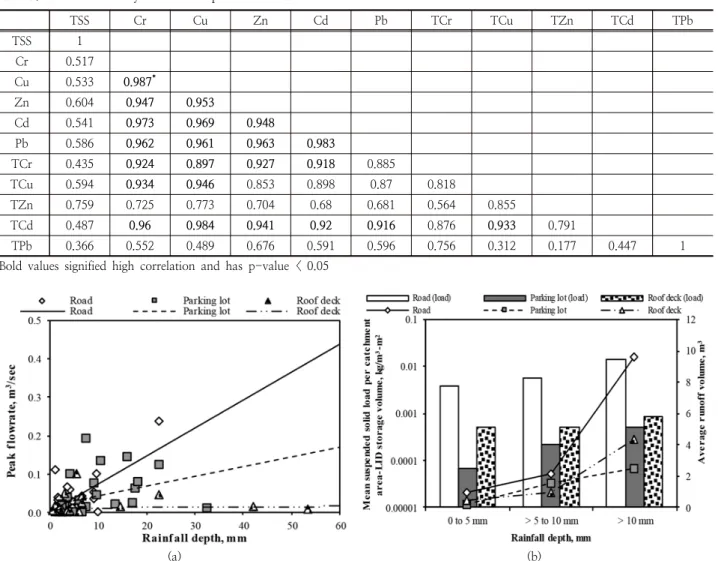
Apparent in Table 3, TSS load was found to be significantly correlated with total and soluble heavy metals load including
Cr, Fe, Cu, and Pb (Pearson r value: 0.52 to 0.73; probability p value<0.01). This finding implied that heavy metals which were mostly attached to TSS were also transported when TSS was washed off in the road, parking lot and roof. Among the hydrologic and hydraulic parameters, only the runoff volume and average inflow rate were found to be significantly different with inflow pollutant loads with Pearson r value ranging from 0.52 to 0.91 and 0.54 to 0.88, respectively (p < 0.05). Flooding was apparent in highly urbanized land uses due to high rainfall depth during storm events producing high runoff volume and peak flows since these catchments were highly impervious.
Apparently, the TSS load is directly proportional to the rainfall depth and runoff volume in the monitored sites exhibited in Fig. 3. At 5 mm rainfall, the ratio of TSS load from the road is four times greater than the parking lot and 31 times greater than the roof. As the rainfall depth and runoff volume increases, the ratio of TSS load collected from road and parking lot decreases while the ratio of TSS collected from the road to roof increases. The average TSS loads generated from the road (511 ± 734 g) and parking lot (111 ± 172 g) were Table 3. Correlation analysis of inflow pollutant loads
TSS Cr Cu Zn Cd Pb TCr TCu TZn TCd TPb
TSS 1
Cr 0.517
Cu 0.533 0.987*
Zn 0.604 0.947 0.953
Cd 0.541 0.973 0.969 0.948
Pb 0.586 0.962 0.961 0.963 0.983
TCr 0.435 0.924 0.897 0.927 0.918 0.885
TCu 0.594 0.934 0.946 0.853 0.898 0.87 0.818
TZn 0.759 0.725 0.773 0.704 0.68 0.681 0.564 0.855
TCd 0.487 0.96 0.984 0.941 0.92 0.916 0.876 0.933 0.791
TPb 0.366 0.552 0.489 0.676 0.591 0.596 0.756 0.312 0.177 0.447 1
*Bold values signified high correlation and has p-value < 0.05
(a)
(b)
Fig. 3. Relationship of a. peak flow rate, b. runoff volume and sediment load with rainfall depth.
178
greater than the TSS loads from the roof (16 ± 28 g) due to the vehicular activity and larger catchment area.
3.2 Variation of pollutant load accumulation at selected points of storm events
As shown in Fig. 4, TSS loads per catchment area generated right after peak flow rates in the road, parking lot and roof were 65 ± 15%, 76 ± 24% and 65 ± 23%, respectively.
These findings implied that transport of TSS directly to waterways may be reduced by mitigating stormwater runoff peak flows. Since most of the heavy metals were found to be attached to TSS, this finding suggested that the transport of heavy metals were dependent on the TSS movement. In a study conducted by Maniquiz et al., 2009, it was found that the degree of association of heavy metals to suspended
Fig. 4. Comparison of TSS load accumulation during storm events.
solids was highly affected by the size and shape of particles present in stormwater runoff (Maniquiz et al., 2009). Fig. 5 exhibited the relationship of accumulated pollutant load with accumulated runoff volume at selected points of storm events.
By designing LID technologies based on first flush runoff which usually occurs in the initial 30 minutes to 1 hour, approximately 15% to 45% of accumulated runoff volume may be controlled.
Consequently, 15% to 55% of accumulated pollutant load may be controlled. 55% to 65% accumulated runoff volume and its corresponding 45% to 95% accumulated pollutant load may be controlled by designing LID facilities considering peak flow occurrence. Considering peak flow attenuation may be advantageous for pollutant removal of the system also.
However, this consideration may also have an implication on the required surface area of the treatment technologies thereby affecting the cost and economics of LID technologies.
3.3 LID Design criteria
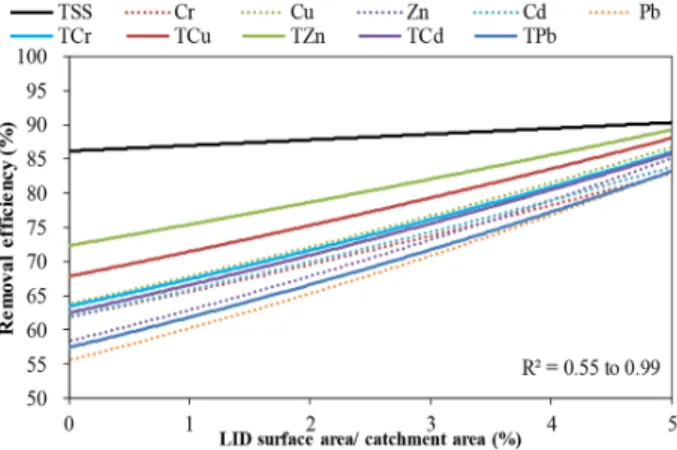
Land use and land use changes including urbanization have lead to increased surface imperviousness and quick production of diffuse pollutants. An economical way of controlling and managing stormwater peak flows and TSS from highly urbanized land uses were through the use of LID and GI such as infiltration trenches, tree box filters, and rain gardens. Based on the exponential regression analysis considering the LID surface area to catchment area (SA/CA) of the three technologies exhibited in Fig. 6, 86% to 88% of TSS loads may be reduced through media filtration considering LID SA/CA ratio of 1%
to 5%. Similarly, 55% to 86% and 57% to 87% of the soluble
Fig. 5. Relationship of accumulated pollutant load with accumulated runoff volume at selected points of storm events,
Fig. 6. Exponential relationship between pollutant removal efficiency and LID surface area to catchment area.
and total heavy metals, respectively may also be reduced by considering 1% to 5% LID SA/CA. By increasing the SA/CA ratio, peak flow reduction may also be increased.
Depending on the target TSS or heavy metals reduction, a specific LID SA/CA ratio may be selected using the regression model developed which may be used in sizing and designing LID technologies to control both pollutants and peak flow.
4. Conclusion
Generation and transport of TSS and heavy metals were greater in the road and parking lot compared to the roof due to vehicular activities, slope and greater catchment areas of these sites. At 5 mm rainfall, the ratio of TSS load from the road is four times greater than the parking lot and 31 times greater than the roof. As the rainfall depth and runoff volume increases, the ratio of TSS loads collected from the road and parking lot decreases while the ratio of TSS collected from the road to roof increases. Based on the results, pollutant load transport during peak flows of storm events ranges from 65%
to 95% implying that by controlling peak flows, pollutant transportation to nearby water bodies may be decreased. Since most of the heavy metals were found to be attached to TSS, transport of heavy metals was found to be dependent on the TSS movement. LID technologies including infiltration trenches, tree box filters, and rain gardens were identified as an economical way of controlling TSS and heavy metals transport in urban areas wherein greater than 86% TSS reduction may be attained by installing these technologies occupying only 1% to 5% of the catchment area. Future researchers were recommended to assess the limitations of the systems and determine the design considerations for these types of facilities. The findings of this research are especially useful for designing LID technologies considering both flow attenuation and pollutant load reduction in the future.
Acknowledgements
This research was supported by Global Infrastructure Program through the National Research Foundation of Korea(NRF) funded by the Ministry of Science and ICT(NRF-2018K1A3A1A21042927). The authors are grateful for their support.
References
Barrett, M. E. (2005). Performance comparison of structural stormwater best management practices. Water Environment Research, 78-86. DOI: 10.2175/106143005X41654 Clary, J., Quigley, M., Earles, A., Leisenring, M., Strecker,
E., & Jones, J. (2009). Integration of Low Impact Development Studies into the International Stormwater BMP Database. Proceedings of World Environmental and Water Resources Congress, 1-10. DOI: 10.1061/41036 (342)124
Coffman, L. (2000). Low-impact development design strategies, an integrated design approach, EPA 841-B- 00-003. Department of Environmental Resources, Programs and Planning Division, Prince George's County, Maryland.
Flores, P. E. D., Maniquiz-Redillas, M. C., Geronimo, F. K.
F., Alihan, J. C. P., & Kim, L. H. (2016). Transport of nonpoint source pollutants and stormwater runoff in a hybrid rain garden system. Journal of Wetlands Research, 18(4), 481-487. DOI: 10.17663/JWR.2016.18.4.481 Geronimo, F. K. F., Maniquiz-Redillas, M. C. & Kim, L.
H. (2013). Treatment of parking lot runoff by a tree box filter. Desalination and Water Treatment 51,4044-4049.
DOI: 10.1080/19443994.2013.781099
Gonzalez-Duque. J. A & Panagopoulos, T. (2013). Evaluation of the urban green infrastructure using landscape modules, gis and a population survey: linking environmental with social aspects in studying and managing urban forests.
Journal of Spatial and Organizational Dynamics 1-2, 82-95.
Houdeshel, C. D., Pomeroy, C.A., Hair, L. & Moeller, J.
(2011). Cost estimating tools for low-impact development best management practices: Challenges, Limitations and Implications. Journal of Irrigation and Drainage 137-3, 183-189. DOI: 10.1061/(ASCE)IR.1943-4774.0000179 Huang, J. , Ho, M. & Du, P. (2011). Assessment of temporal
and spatial variation of coastal water quality and source identification along Macau peninsula. Stochastic Environmental Research and Risk Assessment25-3, 353-361. DOI: 10.1007/s00477-010-0373-4
Lafortezza, R., Davies, C., Sanesi, G. & Konijnendijk, C. C.
(2013). Green Infrastructure as a tool to support spatial planning in European urban regions. iForest-Biogeosciences
180
and Forestry 6-1, 102. DOI: 10.3832/ifor0723-006 Maniquiz, M. C., Lee, S., Lee, E., & Kim, L. H. (2009).
Development of statistical linear regression model for metals from transportation land uses. Water Science and Technology, 59(12), 2495-2501. DOI: 10.2166/wst.2009.
247
Maniquiz, M. C., Lee, S. Y. & Kim, L. H. (2010a). Multiple linear regression models of urban runoff pollutant load and event mean concentration considering rainfall variables. Journal of Environmental Sciences 229, 946-952.
DOI: 10.1016/S1001-0742(09)60203-5
Maniquiz, M. C., Lee, S. Y. & Kim, L. H. (2010b). Long term monitoring of infiltration trench for nonpoint source control. Water Air Soil Pollution 212, 13-26. DOI:
10.1007/s11270-009-0318-z
Maniquiz, M. C., Lee, S. Y. & Kim, L. H. (2016). Evaluation of the capability of low-impact development practices for the removal of heavy metal from urban stormwater runoff.
Environmental Technology 37-18, 2265-2272. DOI:
10.1080/09593330.2016.1147610
Mercado, J. M. R., & Geronimo, F. K. F. (2012). Characteristics of stormwater runoff from urbanized areas. Journal of Wetlands Research, 14(2), 159-168.
Peraza-Castro, M., Sauvage, S., Sánchez-Pérez, J. M. &
Ruiz-Romera, E. (2016). Effect of flood events on transport of suspended sediments, organic matter and particulate metals in a forest watershed in the Basque Country (Northern Spain). Science of the Total Environment 569 – 570, 784-797. DOI: 10.1016/j.scitotenv.2016.06.203.
Scholes, L. ,Revitt, D. M. & Ellis, J. B. (2008). A systematic approach for the comparative assessment of stormwater pollutant removal potentials. Journal of Environmental Management 88-3, 467-478. DOI: 10.1016/j.jenvman.
2007.03.003
Shajib, M. T. I., Hansen, H. C. B., Liang, T., & Holm, P.
E. (2019). Metals in surface specific urban runoff in Beijing.
Environmental Pollution, 248, 584-598. doi: 10.1016/j.
envpol.2019.02.039
Taylor, K.G. & Owens, P. N. (2009). Sediments in urban river basins: a review of sediment– contaminant dynamics in an environmental system conditioned by human activities.
Journal of Soils and Sediments 9, 281-303. DOI: 10.1007/
s11368-009-0103-z
Vogel, J.R. & Moore, T. L. (2016). Urban Stormwater Characterization, Control, and Treatment. Water Environment Research, 1918-1950. DOI: 10.2175/106143016X1469 6400495938.