302
Copyright © 2017 The Korean Society of Fisheries and Aquatic Science pISSN:0374-8111, eISSN:2287-8815
서 론
Interferon regulatory factor (IRF) family
는바이러스에대한방어
,
병원체에대한초기면역반응,
세포의성장과세포자멸,
림프구의발달등의역할을하며(Barnes et al., 2002 ),
현재 까지 척추동물에서는11
개의IRF family
가 보고되어 있다(Huang et al., 2010). IRF
에의해인터페론(interferon, IFN)
과interferon stimulated genes (ISGs)
의전사가조절된다고알려 져있으며(Nguyen et al., 1997),
인터페론은사이토카인중하 나로척추동물의생체내에서항바이러스반응,
면역조절기 능,
세포의성장과분화,
세포자살등과같은중요한기능을하 고있다(Pfeffer et al., 1998).
그리고구조와기능에따라Type I
과Type II IFN
으로나뉘며(Inkpen et al., 2015),
바이러스에감염되었을때
Type I IFNs (IFNα
와IFNβ)
이생성되어Type
I IFNs
이세포의특이적수용체와결합하여하위유전자의전사를유도한다
(Mamane et al., 1999; Taniguchi et al., 2001;
Tailor et al., 2007). IRF family
는 특징적으로N-
말단~120 amino acid
에서5
개의tryptophan (Trp)
잔기가포함된helix- turn-helix motif
구조의DNA binding domain (DBD)
을가지고 있다(Nguyen et al., 1997). IRF
의DBD
은consensus DNA se- quence
인IFN-stimulated response element (ISRE)
의GAAA,
AANNNGAA
서열을특이적으로인식하여ISRE
를프로모터에갖는면역관련유전자의전자를조절하게된다
(Honda and
Taniguchi, 2006; Paun and Pitha, 2007). IRF-associated do- main (IAD)
는IRF family
에서C-
말단에존재하며IRF3-10
는IAD1
를가지며, IRF1
과IRF2
는IAD2
가존재한다(Mamane
조피볼락(Sebastes schlegelii) Interferon Regulatory Factor 8 (IRF8)의 분자유전학적 특성 및 발현 분석
양혜림·권혁재·이성도·S.D.N.K Bathige·김명진*·이제희*
제주대학교 해양생명과학과
Molecular Characterization and Expression Analysis of Interferon Regulatory Factor 8 (IRF8) in the Black Rockfish Sebastes schlegelii
Hyerim Yang, Hyukjae Kwon, Seongdo Lee, S.D.N.K Bathige, Myoung-Jin Kim*, and Jehee Lee*
Department of Marine Life Sciences, Jeju National University, Jeju 63243, Korea
Interferon regulatory factor 8 (IRF8) is essential for the development of B and T cells, as well as for the activity of den- dritic cells and macrophages. We performed molecular characterization of IRF8 from rock fish, Sebastes schlegelii ( Ss ), and investigated the spatial and temporal profile of mRNA expression after challenge with lipopolysaccharide (LPS), polyinosinic:polycytidylic acid (poly I:C), or Streptococcus iniae . The full-length cDNA sequence of SsIRF8 was 1,657 bp, containing an ORF of 1,266 bp. The gene had a predicted molecular mass of 47.7 kDa and an isoelec- tric point of 5.99. The amino acid sequence coded by this gene showed the highest degree of identity (90.8%) and similarity (96.2%) with IRF8 from Oplegnathus fasciatus . The SsIRF8 mRNA was expressed ubiquitously, at varying levels, with the highest level of expression observed in the spleen. To confirm the role of SsIRF8 in mediating the immune response, we measured SsIRF8 mRNA expression in the splenic tissue at different time points after injection with LPS, poly I:C, or S. iniae . The qRT-PCR results showed that SsIRF8 mRNA expression in the poly I:C-injected group was highly upregulated 6 hr after exposure ( P <0.05). Expression of SsIRF8 mRNA in the S. iniae- injected group peaked at 24 hr. These results suggest that SsIRF8 might be important in regulating the strength of the rockfish immune response to immunostimulatory agents.
Key words: Black rockfish, IRF8, Immune regulator, mRNA expression
This is an Open Access article distributed under the terms of the Creative Commons Attribution Non-Commercial Licens (http://creativecommons.org/licenses/by-nc/3.0/) which permits unrestricted non-commercial use, distribution, and reproduction in any medium, provided the original work is properly cited.
https://doi.org/10.5657/KFAS.2017.0302 Korean J Fish Aquat Sci 50(3) 302-310, June 2017
Received 1 June 2017; Revised 22 June 2017; Accepted 23 June 2017
*Corresponding author: Tel: +82. 64. 754. 3473 Fax: +82. 64. 756. 3493
E-mail address: [email protected] (J. Lee), [email protected] (M-J. Kim)
IRF8의 특징 및 발현분석
303
et al., 1999). IAD
는정확한프로모터타켓팅과전사조절을하 기위해다른IRFs
와다른전사인자함께homodimer
또는het- erodimer
의형태를매개한다(Eroshkin and Mushegian, 1999;
Ozato et al., 2007).
또한IRF family
안에서N-
말단DBD
서열 와C-
말단IAD
서열의보존을비교하였을때DBD
보다IAD
가상대적으로낮게나타난다(Nehyba et al., 2002).
이는IAD
서열에따라
IRF family
의기능이특이적으로나타나게되는데
,
이를통하여유전자전사를활성화시키는그룹(IRF1, IRF3, IRF7, IRF9),
억제하는그룹(IRF2, IRF8),
표적유전자에따 라유전자의전사가활성화되거나억제되는그룹(IRF2, IRF4, IRF5, IRF8)
으로나뉜다(Stellacci et al., 2004).
IRF1, IRF2
은거의대부분의세포에서발현하는반면,
이전 연구에따르면IRF8
의경우에는myeloid
또는lymphoid cell
와같은면역시스템과관련한세포에서발현한다고알려져있 다(Wang and Morse, 2009; Marecki et al., 2015).
포유류의경 우, IRF8
은IRF4
과같이hematopoietic cell
의성장을결정하는 데중요한역할을하며,
이는myeloid progenitor cell
에서분화 뿐만아니라B
세포와T
세포의발달의필수적이며(Lu, 2008), dendritic cells (DCs)
와plasmacytoid dendritic cells (pDCs)
에 서대식세포의발달과type I IFNs
의생산을위해필요하다고 알려져있다(Alter-Koltunoff et al., 2008). IRF8
은표적유전자 에존재하는Ets-IRFE motif
와같은복합적자리에결합할때는 전사를촉진하는역할을하지만ISRE motif
에결합할때전사 과정을억제하는중요한역할을한다(Lee et al., 2006).
특히포 유류에서의IRF8
는LPS-TLR4
와polyinosinic:polycytidylic acid (poly I:C)-TLR3
의 결합에 대하여Toll-like receptor
와IFN-γ signaling pathways
의상호작용을조절하는중요한인 자로알려져있으며(Zhao et al., 2006),
또한poly I:C-activated signaling pathways
에있어서plasmacytoid DCs (pDCs)
에서IFN
생산을증대하거나DCs subtype
으로발달시킬때IRF8
은 중요한역할을한다고알려져있다(Gabriele and Ozato, 2007;
Tailor et al., 2007).
현재까지어류의
IRF8
은rainbow trout (Holland et al., 2010), turbot (Chen et al., 2012), rock bream (Bathige et al., 2012), Japanese flounder (Hu et al., 2013), tongue sole (Zhang et al., 2015), atlantic cod (Inkpen et al., 2015)
등에서유전자의특징 이보고되었다.
본연구에서는in silico
분석을통하여조피볼 락, IRF8
의분자적특성을확인하였으며,
면역반응에서의역할 을규명하기위하여LPS, poly I:C, Streptococcus iniae
등의면 역자극을준후유전자의발현양상을비교하였다.
재료 및 방법
Rockfish의 IRF8 cDNA sequence 분석
454 GS FLX sequencing (Roche 454 Life science, USA)
을 이용하여 조피볼락cDNA sequence database
를 구축하였다.
DNAsist 2.2 software
를이용하여아미노산으로번역되는부 분인open reading frame (ORF)
을 예측하였다.
또한아미노 산서열을이용하여단백질이가지는물리화학적인특징을알 아보기위해Expert Protein Analysis System ProtParam tool (SIB Swiss Institute of Bioinformatics, Swiss) (http://web.
expasy.org/protparam)
을이용하여각분자량과등전점을추정 하였다.
이후, Basic Local Alignment Search Tool (BLAST) algorithm
을이용하여SsIRF8
의전체서열과이미밝혀진IRF family member
와서열을비교분석하였다. IRF family
에서보 존되는domain
과motif
를알아보기위해proteins, motif scan Pfam hidden Markov models (Local models) (SIB Swiss In- stitute of Bioinformatics, Swiss) (http://hits.isb-sib.ch/cgi-bin/
PFSCAN)
를이용하여아미노산서열을분석하였으며다른종에서기원한
IRF8
과조피볼락에서기원한IRF8
의homolog
를 비교하기위해Matgat software
와ClustalW2 server (EMBL- EBI, UK) (http://www.Ebi.ac.uk/Tools/clustalw2)
를이용하여pairwise sequence alignment
와multiple sequence alignment strategies
를수행하였다.
계통분류분석은Molecular Evolu- tionary Genetic Analysis (MEGA) software version 7.0
을이 용하여neighbor-joining (NJ)
방법을통해1,000 bootstrap
으 로분석하였다.
시험어 준비 및 조직 분리
조피볼락
(200±20g)
은수온22±1℃
로설정한400 L
수조에 서일주일동안순치한뒤실험을진행하였다.
여러조직에서의SsIRF8
의발현분포를확인하기위해다섯마리의건강한조피볼락을무작위로선별하여샘플링을진행하였다
.
건강한어체 로부터gill, heart, head kidney, spleen, liver, intestine, kidney, testis, ovary
총9
개의조직을분리하였으며분리한조직은액 체질소에급속냉각한뒤사용하기전까지-80℃
에보관하였다.
혈액샘플의경우,
꼬리부분의정맥으로부터혈액을채취하였 으며0.2% heparin sodium salt (USB, USA)
으로코팅한주사 기를사용하였다(-1 mL/fish).
혈액샘플은즉시원심분리(4℃, 3,000 g, 10
분)
후혈장으로부터peripheral blood cells (PBCs)
를분리하여-80℃
에보관하였다.
공격실험을 통한 면역자극 비교 및 조직 분리
바이러스
,
박테리아의병원체자극에대한SsIRF8
의면역반 응을확인하기위해200 μL
의1×phosphate buffered saline (PBS)
에녹인lipopolysaccharide (LPS; 1.25 μg/μL)
와200 μL
의1×PBS
에녹인polyinosinic: polycytidylic acid (poly I:C;
1.5 μg/μL, Sigma, USA), 200 μL 1×PBS
에녹인Streptococ-
cus iniae (1×10
5colony-forming units/μL)
를세개의그룹으 로 분리하여각각복강주사하였다.
대조군으로는200 μL
의1×PBS
를복강주사하였고접종후3, 6, 12, 24, 48, 72
시간마 다각그룹별로5
마리의조피볼락에서비장을분리하여RNA
추출실험전까지-80℃
에보관하였다.
RNA 추출 및 cDNA 합성
건강한다섯마리조피볼락에서 얻은조직과공격실험에서
얻은 조직을각 그룹마다 모아 제조사의 방법에따라
QIA-
zol
®(Qiagen)
을이용하여RNA
를추출하였다. RNA purity
는1.5% agarose gel
에전기영동으로확인하였으며, 260 nm
에서μDrop™ Plate (Thermo Scientific, Waltham, MA, USA)
을측 정하여확인하였다. cDNA
는분리한RNA 2.5 μg
과reaction mixture
을총볼륨20 μL
로맞추어PrimeScript™ first-strand cDNA synthesis kit (TaKaRa, Shiga, Japan)
이용하여합성하 였다.
이후,
합성한cDNA
는nuclease-free water
에40
배로희 석하여qPCR assay
를수행하기전까지−20℃
에보관하였다.
qPCR에 의한 발현분석
채취한조직으로부터
quantitative real-time PCR (qPCR)
을수 행하여조피볼락IRF8
의mRNA
발현량을비교하고자하였다. Reference gene
으로는elongation factor 1-α (EF1α)
를사용하였 고forward (5'-AACCTGACCACTGAGGTGAAGTCTG-3'), Reverse (5'-TCCTTGACGGACACGTTCTTGATGTT-3')
의oligonucleotide primer
를사용하였다.
그리고SsIRF8
의oligo- nucleotide primer
는forward (5'-CATCAATGCTTTCCCTCC- GCATCAAG-3'), reverse (5'-TGTGCATCAGCTTTCCTCC- GTAGT-3')
로사용하였다. qPCR
는Real Time System TP800 Thermal Cycler Dice™ (TaKaRa)
를 이용하여 진행하였다.
ATG TCA AAC ACT GGA GGT CGG AGA CTG AAG CAG TGG CTG GTG GAG CAG ATC CAG AGT GGC CAG TAC TCT GGA
M S N T G G R R L K Q W L V E Q I Q S G Q Y S G
CTG CAG TGG GAG GAT GAC AGC CGC ACT ATG TTC AGA ATC CCA TGG AAA CAC GCA GGC AAA CAA GAC TAC AAC
L Q W E D D S R T M F R I P W K H A G K Q D Y N
CAA GAA GTA GAC GCA TCC ATT TTC AAG GCC TGG GCT GTG TTT AAA GGC AAG TTT AAG GAG GGG GAG AAG GCT
Q E V D A S I F K A W A V F K G K F K E G E K A
GAG CCT GCC ACC TGG AAG ACC AGA CTC CGC TGT GCC CTG AAT AAA AGC CCT GAC TTT GAG GAG GTG ACT GAA
E P A T W K T R L R C A L N K S P D F E E V T E
AGG TCG CAG CTG GAC ATC TCT GAG CCC TAT AAA GTC TAC CGC ATT GTA CCT GAG GAA GAG CAG AAA AAC GGC
R S Q L D I S E P Y K V Y R I V P E E E Q K N G
AAA GGC GCA TTG ATG GCC ATG GCA GCC ACC ACC AGC TCC GGT GAT ATC AAT GAC ATG GAC TGC AGC CCT GCA
K G A L M A M A A T T S S G D I N D M D C S P A
GAG ATA GAG GAG CTC ATC AAA GAG GAG GAA GGC TGT AGT ATC CAG ACC AGT CCA GAG TAT TGG TCC CAT GGC
E I E E L I K E E E G C S I Q T S P E Y W S H G
AGC ATC AAT GCT TTC CCT CCG CAT CAA GAC CCT TTG CCA TCA GGC AAT CTC AGC ACA GCT TTC TCC CAG ATG
S I N A F P P H Q D P L P S G N L S T A F S Q M
ATG ATC AGT TTC TAC TAC GGA GGA AAG CTG ATG CAC AAC ACA CAT GTT GTT CAT CCT GAA GGC TGC CGA ATC
M I S F Y Y G G K L M H N T H V V H P E G C R I
GCC CCA CAA CAG CAC CTG GGC CGT GGC GCC CTA TAC AAT TCA GAC AGC ATG CAG AGT GTT CAC TTT CCT CCC
A P Q Q H L G R G A L Y N S D S M Q S V H F P P
GCT GAG CAC ATC GAG TAC GAC CGC CAG CGC CAT GTC ACA CGC AAG CTC CTG GGA CAC CTG GAG AGA GGT GTA
A E H I E Y D R Q R H V T R K L L G H L E R G V
CTG GTC CGT GCC AAC CAA GAG GGC ATC TTC ATC AAA AGG CTG TGC CAG AGC CGT GTC TTC TGG AGC GGG TTG
L V R A N Q E G I F I K R L C Q S R V F W S G L
GGA GAA GTG GGC TCA CAA TAT GGC TCC ATG CCT TGT AAA CTT GAG AGG GAT GCT GTA GTC AAG ATT TTT GAC
G E V G S Q Y G S M P C K L E R D A V V K I F D
ACA GGA AAG TTT CTT CAA GCT CTC CAG CTG TAC CAG GAG GGT CAG TTT CCA GCT CCT GAT CCG ACA GTG ACT
T G K F L Q A L Q L Y Q E G Q F P A P D P T V T
CTG TGT TTC GGA GAG GAG CTC CAT GAC CTC AGC AAT GCC AAG AGC AAG CTG ATC ATT GTG CAG ATC ACT GTG
L C F G E E L H D L S N A K S K L I I V Q I T V
GTG AAC TGC CAG CAG CTG CTG GAG GCA GTG AAC ATG CGT CGC TCC CAG CCT TAC TCC AAC AGC TCA AAC CTG
V N C Q Q L L E A V N M R R S Q P Y S N S S N L
GAG ATG TCT GAT AAT GTG GCC ATT GAC CAG ATG GCC CGC ATC TAC CAG GAC TTG TGC AGC TAT AGC GGC CCC
E M S D N V A I D Q M A R I Y Q D L C S Y S G P
TAC CAG GAC TTG TGC AGC TAT AGC GGC CCC CAG AGG CCA GCC TGC TAC AGG GAC AAC ATG CCC ATC ACT GCC
Y Q D L C S Y S G P Q R P A C Y R D N M P I T A
3’-UTR(324)
TGAGCCGTGAGCAGCAGCAAAACACCTGCCAGGAGCTCTTCAGCGAGTACCAGACTGACTGTACAACATATTAGGGACAGTCCTTATTTT CCTGACATACACTGACAAGGTGAATTCAGGTAAAAACCAGTATCACAATTAGTTTTGACTTTTTAAATGGAGCAAATATCTTACAGTAAGACT TTTACGCTGGAGCTCAGTATTAGGATTTTGTATACCAGTAATGTTTATGTGTCTTATATGTACAATGCTAACACAAACTCTGTGTCTAACTTC TGCTTTTTTACAATAAGAGAGTGTTATCATCCAGCTCGAGAGAAAAAG
5’-UTR(67)
AAGAGCTCAACCGCTTATCACACTGCACAAGGAAACAATCCCCAAAACGCCCTTTCTCTTCATTAAG
Miichthys miiuy Larimichthys crocea Dicentrarchus labrax Oplegnathus fasciatus
Epinephelus coioides Epinephelus coioides(2) Scophthalmus maximus
Paralichthys olivaceus Sebastes schlegelii
Gadus morhua Oncorhynchus mykiss
Scleropages formosus Danio rerio
Ctenopharyngodon idella Gymnocypris przewalskii
Gallus gallus Cathartes aura
10099 100 65
99 80
100 100
86 91 69
10031 47
0.05
Fig. 1. The cDNA and amino acid sequences of the black rockfish Sebastes schlegelii IRF8. The open reading frame from ATG to TGA is shown in the middle box. The amino acid sequence of the DNA binding domain (DBD) is shaded in gray and the IRF-association domain 1 (IAD1) is in bold, shaded in gray, and boxed. The five conserved tryptophan (W) residues in the DNA binding domain are boxed.
IRF8의 특징 및 발현분석
305
qPCR
은3 μL
의cDNA, 5 μL
의2×TaKaRa Ex Taq™ SYBR premix, 0.4 μL
의10 μM forward, reverse primer, 1.2 μL H
2O
를넣어총볼륨을10 μL
로맞췄다. qPCR
조건은95℃
에서10
초에서1 cycle, 95℃ 5
초, 58℃ 10
초, 72℃ 20
초를35 cycle, 95℃
에서15
초, 60℃
에서30
초, 95℃
에서15
초를1 cycle
로반응하였으며각반응은
3
반복으로진행하였다. 통계학적 분석
실험의유의성을살펴보기위한통계분석은
SPSS version 18 program (IBM, USA)
의one-way ANOVA
방법을사용하였 Table 1. The percentages of identity and similarity of SsIRF8 amino acid sequence with that of other species. Oplegnathus fasciatus IRF8 protein sequence showed the highest valuesScientific Name Accession Number
Sebastes schlegelii Oplegnathus fasciatus Epinephelus coioides Epinephelus coioides Miichthys miiuy Dicentrarchus labrax Scophthalmus maximus Paralichthys olivaceus Larimichthys crocea Gadus morhua Oncorhynchus mykiss Ctenopharyngodon idella Gymnocypris przewalskii Danio rerio Scleropages formosus Gallus gallus Cathartes aura
Identity (%)Sebastes schlegelii
Similarity (%)
90.8 90.5 90 90.5 90 89.1 85.8 87 73.4 73.3 67.3 64.8 64.5 64.5 51.9 51.8 Oplegnathus
fasciatus AFU81290.1 96.2 91.5 91 92.9 92.7 90.3 87 89.3 71.1 72.4 67.7 65.7 65.9 64.4 52.6 52.3 Epinephelus
coioides AND67453.1 95.5 96.9 99.1 91.2 91 89.3 86.5 87.7 72 71.5 66.4 64.3 65.2 63.7 51.9 52.3 Epinephelus
coioides AND67452.1 95 96.4 99.5 90.8 90.5 88.9 86 87.2 71.8 71.3 66.1 64.5 64.8 63.4 51.9 52.3 Miichthys miiuy AHB59740.1 95.3 96.4 96 95.5 94.1 88.6 85.3 95 72.7 72.4 67.5 65.7 65.5 64.6 52 52.5 Dicentrarchus
labrax AKC57349.1 95.7 97.6 96.9 96.4 97.9 88.9 85.8 90.5 73.1 73.1 67.7 66.1 64.8 64.4 52.1 52.1 Scophthalmus
maximus AFE88896.1 94.3 95.7 95 94.5 95 96.4 88.8 85.8 71.3 71 66.2 64.8 64.6 62.2 52.5 51.6 Paralichthys
olivaceus AFE18694.2 93.6 94.3 94.8 94.3 93.6 94.1 95 82.5 69.4 70.2 64.4 63.5 61.9 63 52.2 50.7 Larimichthys
crocea KKF19617.1 91.5 92.9 92.7 92.2 95.7 94.3 92.4 91 74.2 70.6 66.6 64.8 63.5 64.3 51.1 51.6 Gadus morhua AJR33029.1 86.5 86.7 86.7 86.3 87.7 87.7 86.5 85.5 87.4 71.6 65.5 64.7 64.5 60.6 51.3 52.8 Oncorhynchus
mykiss ALS92677.1 81.8 82 81.8 81.3 82.7 83.8 81.3 80.9 80.6 81.5 71.5 69.9 66 64.6 54.7 55.6 Ctenopharyngo-
don idella AMT92197.1 80.4 81.5 82.2 81.8 81.8 81.5 79.4 79.4 79 79.9 81.8 92.5 85.1 66 56.5 57.7 Gymnocypris
przewalskii AMB19593.1 79.4 80.8 80.8 80.6 80.4 80.4 79.7 78.5 78 79.7 81.8 94.9 82.7 63.2 56.5 57.8 Danio rerio NP_001002622.1 80.4 80.9 80.9 80.4 81.8 82 80.9 79.2 78.7 80.1 78.4 91.1 90 61.6 55.2 56.1 Scleropages
formosus KPP68827.1 78.4 77.7 77.7 77.7 78.6 79.1 77.2 77.9 77 77.2 79.1 78.2 77.2 74.7 51.4 52.9 Gallus gallus NP_990747.1 68.9 70.4 70.1 69.9 68.9 69.4 70.1 69.4 68.5 68.9 68.7 72.9 72.2 73.2 68.5 91.1 Cathartes aura KFP53072.1 68 68.9 69.2 68.9 68.7 68.5 67.8 67.8 68.2 68.2 69.6 72.4 72.4 72.2 69.7 96
양혜림
ㆍ
권혁재ㆍ
이성도ㆍ
S.D.N.K Bathigeㆍ
김명진ㆍ
이제희306
고
,
모든mRNA
상대발현량은평균(Mean)±
표준편차(Stan- dard deviation)
로나타내어면역자극에따른조피볼락IRF8
의mRNA
상대발현정도를통계분석하였다.
모든실험결과 는대조군대비통계적인유의성을나타내는P<0.05
에서판단 하였다.
결과 및 고찰
본연구에서는조피볼락에서유래한
IRF8
의full-length cDNA sequence
를확인하고분자유전학적특징과mRNA
상대발현 량을 비교분석을 통하여 면역반응을 확인하였다. SsIRF8
의full-length cDNA sequence
는총1,658 bp
로이루어져있으며, 5′-untranslated region (UTR)
는67 bp, 3′-untranslated region (UTR)
은324 bp
로나타났다. Open reading frame (ORF)
은1,266 bp
로구성되어있으며이부분은422
개의아미노산으로 번역되는것으로예측되었다(Fig. 1).
예상한아미노산서열을 이용하여단백질특성을예측하였을때47.77 kDa
의분자량으 로추정되며등전점은5.99
로나타났다.
SsIRF8
의아미노산서열은bioinformatics tool
을이용한in silico
분석을통해척추동물IRF family
에서보존되는DBD,
다섯개의
tryptophan
잔기, IAD
을 확인하였다. DBD
는IRF family
에서 관찰되며 표적 프로모터의ISRE/IRF-E consen- sus sequence
을인식하여전사를조절하는기능을한다. 5
개의tryptophan
는DBD
에서확인되며척추동물의IRF
서열에보존 되어있는motif
이다(Eroshkin and Mushegian, 1999; Nehyba et al., 2002). SsIRF8
의DNA-binding domain
은N-
말단6-113 aa
에있었으며IRF3-10
에있는IRF-association domain (IAD)
도C-
말단189-371 aa
에서확인되었다.
그리고5
개의trypto- phan
잔기는12W, 27W, 39W, 59W, 77W
의위치에서보존되 어있는것으로확인되었다(Fig. 1).
예측한아미노산서열을이용하여다른종에서기원한
IRF8
과조피볼락에서기원한
IRF8
를비교하였을때, Oplegnathus fasciatus IRF8
과동일성과유사성이각각96.2%, 90.8%
로가 장 높았으며Epinephelus coioides, Miichthys miiuy, Dicen- trarchus labrax
종에서도각각95.5%, 95.3%, 95.7%
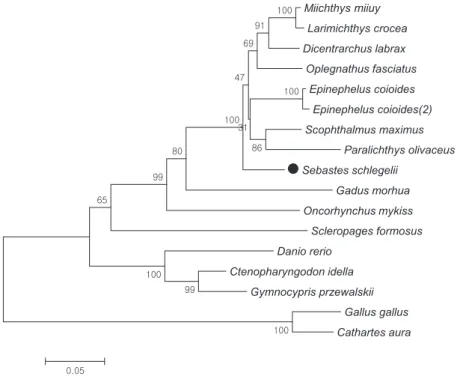
의높은 동일성을 보였다(Table 1). Phylogenetic tree
를통해SsIRF8
의 계통발생학적 분류를 비교하였다.
계통발생학적 분류를 비교하기 위해서민어(Miichthys miiuy),
부세(Larimichthys crocea),
유럽바다농어(Dicentrarchus labrax),
돌돔(Oplegna-
CTG CAG TGG GAG GAT GAC AGC CGC ACT ATG TTC AGA ATC CCA TGG AAA CAC GCA GGC AAA CAA GAC TAC AAC
L Q W E D D S R T M F R I P W K H A G K Q D Y N
CAA GAA GTA GAC GCA TCC ATT TTC AAG GCC TGG GCT GTG TTT AAA GGC AAG TTT AAG GAG GGG GAG AAG GCT
Q E V D A S I F K A W A V F K G K F K E G E K A
GAG CCT GCC ACC TGG AAG ACC AGA CTC CGC TGT GCC CTG AAT AAA AGC CCT GAC TTT GAG GAG GTG ACT GAA
E P A T W K T R L R C A L N K S P D F E E V T E
AGG TCG CAG CTG GAC ATC TCT GAG CCC TAT AAA GTC TAC CGC ATT GTA CCT GAG GAA GAG CAG AAA AAC GGC
R S Q L D I S E P Y K V Y R I V P E E E Q K N G
AAA GGC GCA TTG ATG GCC ATG GCA GCC ACC ACC AGC TCC GGT GAT ATC AAT GAC ATG GAC TGC AGC CCT GCA
K G A L M A M A A T T S S G D I N D M D C S P A
GAG ATA GAG GAG CTC ATC AAA GAG GAG GAA GGC TGT AGT ATC CAG ACC AGT CCA GAG TAT TGG TCC CAT GGC
E I E E L I K E E E G C S I Q T S P E Y W S H G
AGC ATC AAT GCT TTC CCT CCG CAT CAA GAC CCT TTG CCA TCA GGC AAT CTC AGC ACA GCT TTC TCC CAG ATG
S I N A F P P H Q D P L P S G N L S T A F S Q M
ATG ATC AGT TTC TAC TAC GGA GGA AAG CTG ATG CAC AAC ACA CAT GTT GTT CAT CCT GAA GGC TGC CGA ATC
M I S F Y Y G G K L M H N T H V V H P E G C R I
GCC CCA CAA CAG CAC CTG GGC CGT GGC GCC CTA TAC AAT TCA GAC AGC ATG CAG AGT GTT CAC TTT CCT CCC
A P Q Q H L G R G A L Y N S D S M Q S V H F P P
GCT GAG CAC ATC GAG TAC GAC CGC CAG CGC CAT GTC ACA CGC AAG CTC CTG GGA CAC CTG GAG AGA GGT GTA
A E H I E Y D R Q R H V T R K L L G H L E R G V
CTG GTC CGT GCC AAC CAA GAG GGC ATC TTC ATC AAA AGG CTG TGC CAG AGC CGT GTC TTC TGG AGC GGG TTG
L V R A N Q E G I F I K R L C Q S R V F W S G L
GGA GAA GTG GGC TCA CAA TAT GGC TCC ATG CCT TGT AAA CTT GAG AGG GAT GCT GTA GTC AAG ATT TTT GAC
G E V G S Q Y G S M P C K L E R D A V V K I F D
ACA GGA AAG TTT CTT CAA GCT CTC CAG CTG TAC CAG GAG GGT CAG TTT CCA GCT CCT GAT CCG ACA GTG ACT
T G K F L Q A L Q L Y Q E G Q F P A P D P T V T
CTG TGT TTC GGA GAG GAG CTC CAT GAC CTC AGC AAT GCC AAG AGC AAG CTG ATC ATT GTG CAG ATC ACT GTG
L C F G E E L H D L S N A K S K L I I V Q I T V
GTG AAC TGC CAG CAG CTG CTG GAG GCA GTG AAC ATG CGT CGC TCC CAG CCT TAC TCC AAC AGC TCA AAC CTG
V N C Q Q L L E A V N M R R S Q P Y S N S S N L
GAG ATG TCT GAT AAT GTG GCC ATT GAC CAG ATG GCC CGC ATC TAC CAG GAC TTG TGC AGC TAT AGC GGC CCC
E M S D N V A I D Q M A R I Y Q D L C S Y S G P
TAC CAG GAC TTG TGC AGC TAT AGC GGC CCC CAG AGG CCA GCC TGC TAC AGG GAC AAC ATG CCC ATC ACT GCC
Y Q D L C S Y S G P Q R P A C Y R D N M P I T A
3’-UTR(324)
TGAGCCGTGAGCAGCAGCAAAACACCTGCCAGGAGCTCTTCAGCGAGTACCAGACTGACTGTACAACATATTAGGGACAGTCCTTATTTT CCTGACATACACTGACAAGGTGAATTCAGGTAAAAACCAGTATCACAATTAGTTTTGACTTTTTAAATGGAGCAAATATCTTACAGTAAGACT TTTACGCTGGAGCTCAGTATTAGGATTTTGTATACCAGTAATGTTTATGTGTCTTATATGTACAATGCTAACACAAACTCTGTGTCTAACTTC TGCTTTTTTACAATAAGAGAGTGTTATCATCCAGCTCGAGAGAAAAAG
Miichthys miiuy Larimichthys crocea Dicentrarchus labrax Oplegnathus fasciatus
Epinephelus coioides Epinephelus coioides(2) Scophthalmus maximus
Paralichthys olivaceus Sebastes schlegelii
Gadus morhua Oncorhynchus mykiss
Scleropages formosus Danio rerio
Ctenopharyngodon idella Gymnocypris przewalskii
Gallus gallus Cathartes aura
10099 100 65
99 80
100 100
86 91 69
10031 47
0.05
Fig. 2. Neighbor-joining phylogenetic tree of IRF8 constructed with Mega7. The bootstrap confidence values shown at the nodes of the tree are based on 1000 bootstrap replications. Black rock fish Sebastes schlegelii IRF8 is indicated with a black dot (●) and the scientific name of the fish is in bold. GenBank accession numbers are as follows: Miichthys miiuy, AHB59740.1; Larimichthys crocea, KKF19617.1;
Dicentrarchus labrax, AKC57349.1; Oplegnathus fasciatus, AFU81290.1; Epinephelus coioides, AND67453.1, AND67452.1; Scoph- thalmus maximus, AFE88896.1, Paralichthys olivaceus AFE18694.2; Gadus morhua, AJR33029.1; Oncorhynchus mykiss, ALS92677.1;
Scleropages formosus, KPP68827.1; Danio rerio, NP_001002622.1; Ctenopharyngodon idella, AMT92197.1; Gymnocypris przewalskii, AMB19593.1; Gallus gallus, NP_990747.1; Cathartes aura, KFP53072.1.
IRF8의 특징 및 발현분석
307
thus fasciatus),
갈색둥근바리(Epinephelus coioides),
대문짝 넙치(Scophthalmus maximus),
넙치(Paralichthys olivaceus),
대서양참대구(Gadus morhua),
무지개송어(Oncorhynchus mykiss),
아시아아로와나(Scleropages formosus),
제브라피쉬(Danio rerio),
초어(Ctenopharyngodon idella), Gymnocypris
przewalskii,
적색야계(Gallus gallus),
터키콘도르(Cathartes aura)
의IRF8
서열을이용하였으며, SsIRF8
은다양한어류들 과가까운cluster
인것으로확인하였다(Fig. 2).
Multiple alignment
결과어류부터포유류의IRF8
를비교하 였을때DBD
와IAD1
모두서열간의높은homology
를보 Fig. 3. Multiple sequence alignment of SsIRF8 amino acid sequence with other known orthologs from GenBank. The alignment was con- ducted using ClustalW. The DNA binding domain (DBD) and IRF-association domain1 (IAD1) are shown with arrows. The conserved tryptophan (W) residues in the DBD are boxed and shaded in white.양혜림
ㆍ
권혁재ㆍ
이성도ㆍ
S.D.N.K Bathigeㆍ
김명진ㆍ
이제희308
였다
. SsIRF8
의DBD
서열은Oplegnathus fasciatus, Gadus morhua, Oncorhynchus mykiss, Gallus gallus, Mus musculus, Homo sapiens
에서거의차이가없는것으로확인되었으며이에비해
IAD1
에서는종간의차이가있는것으로확인되었다(Fig. 3).
IRF8
의조직발현은보통lymphomyeloid-rich
조직이나면 역과관련된조직에서 높은것으로알려져있다(Lehtonen et al., 2003; Wang and Morse, 2009).
이전연구에서lymphomy- eloid-rich
조직인비장,
신장,
두신에서IRF8
가높게발현되는 것이확인되었으며,
특히비장에서가장높은발현을나타냈었 다.
또한종마다특이적으로근육,
뇌,
정소등의기관에서높은 발현이확인되었다(Holland et al., 2010; Bathige et al., 2012;
Chen et al., 2012; Hu et al., 2013). SsIRF8
의조직별발현양상 을확인하기위해건강한조피볼락으로부터분리한9
개조직(gill, heart, head kidney, spleen, liver, intestine, kidney, testis, ovary)
과분리한PBCs
의cDNA
를사용하여qPCR
을수행하 였다. Elongation factor 1-α (EF1α)
를reference gene
으로하였으며근육조직을기준으로상대적인비교를하였다
. qPCR
결과다양한조직에서
mRNA
발현량이특이적으로발현하는것을확인하였다
.
특히근육조직에비해비장에서256
배로가장 높게발현하였고표피,
장,
아가미,
혈액세포,
두신,
신장에서도 높은발현을보이며,
간조직에서는상대적으로낮게발현하였 다(Fig. 4).
이러한발현양상은myeloid progenitor cell
의분화 와B
세포, T
세포의발달에관여하는것으로알려진IRF8
의기 능(Lu, 2008)
과관련하여SsIRF8
가비장에서가장높게발현하 는것으로보여지며,
다른lymphomyeloid-rich
조직인장,
아가미
,
혈액세포,
두신,
신장조직에서도많이분포하는것으로사 료된다(Hu et al., 2013).
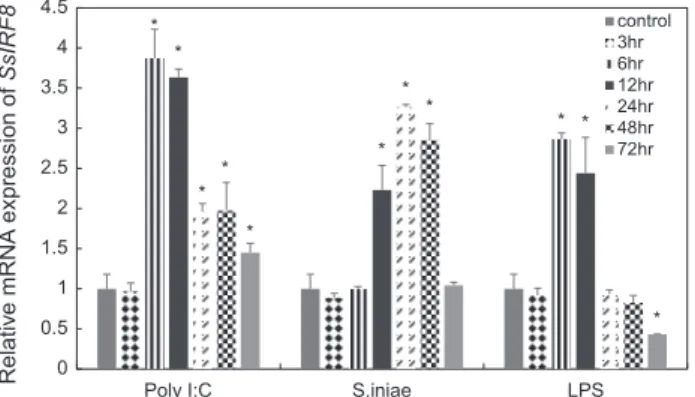
면역자극에따른
mRNA
의상대발현량을비교분석하기위해
PBS, S. iniae, poly I:C, LPS
를주사한뒤시간대별로조피 볼락의비장을샘플링하여qRT-PCR
을진행하였다. Poly I:C
를주사한뒤6
시간이후부터0
시간과비교하였을때유의적으 로상대발현량이증가하는패턴을보이고6
시간에서가장높 은발현량이관찰되었다(P<0.05).
또한S. iniae
를주사한뒤12
시간부터 상승하는패턴을보이며12
시간, 24
시간, 48
시간에 서유의적인차이가관찰되었으며24
시간에서가장많은발현 을나타냈다(P<0.05). LPS
를처리했을때도6
시간과12
시간에 서유의적차이를보였다(P<0.05).
이와같이본연구에서는다양한면역자극에의해
SsIRF8
의발현이높아짐을확인하였다(Fig. 5).
면역자극후, SsIRF8
의발현이높아지는것은LPS- TLR4
와polyinosinic:polycytidylic acid (poly I:C)-TLR3
의 결합에대하여Toll-like receptor
와IFN-γ signaling pathways
의중요조절인자로서
IRF8
이관여하기때문인것으로예상된다
(Zhao et al., 2006).
특히poly I:C
를주사한실험군의경우,
다른실험군에비해컨트롤대비발현량이급격하게증가하는 패턴을보였다.
이는poly I:C
복강주사후pathogen associated molecular pattern (PAMP)
이인식하고(Perdiguero and Este- ban, 2009; Hu et al., 2013), poly I:C-activated signaling path- ways
에관여하여SsIRF8
의발현량이급격한양상을보인것 으로사료된다(Gabriele and Ozato, 2007; Tailor et al., 2007).
본연구에서는
SsIRF8
의분자유전학적특성을비교분석하여0 50 100 150 200 250 300 350
SP SK IT GL BL HK KD HT LV St MS
R el at iv e m RN A ex pr ess ion le ve l o f Ss IR F8
Tissue type
*
*
*
* *
*
*
*
*
*
* 0
0.5 1 1.5 2 2.5 3 3.5 4 4.5
Poly I:C S.iniae LPS
R el at iv e m RN A ex pr ess ion o f Ss IR F8
Relative IRF8 expression post Poly I:C, S.iniae, LPS challenge
control 3hr6hr 12hr24hr 48hr72hr
Fig. 4. SsIRF8 mRNA expression in different tissues (SP- spleen, SK-skin, IT-intestine, GL-gill, BL-blood, HK-head kidney, LV- liver, St-stomach, MS-muscle) of the healthy black rockfish Se- bastes schlegelii as measured using real time qPCR. The relative expressions of the IRF8 are shown as a ratio to IRF8 expression in the MS. Sebastes schlegelii EF1α was used as a reference gene.
Data are shown as the mean (n=3) and the error bars represent the standard deviation.
0 50 100 150 200
SP SK IT GL BL HK KD HT LV St MS
R el at iv e m RN A ex pr ess ion Ss IR F8
Tissue type
*
*
*
* *
*
*
*
*
*
* 0
0.5 1 1.5 2 2.5 3 3.5 4 4.5
Poly I:C S.iniae LPS
R el at iv e m RN A ex pr ess ion o f Ss IR F8
Relative IRF8 expression post Poly I:C, S.iniae, LPS challenge
control 3hr6hr 12hr24hr 48hr72hr
Fig. 5 Gene expression of SsIRF8 in the spleen after challenge with either poly I:C or S. iniae or LPS. All data were normalized to that of Sebastes schlegelii EF1α. The time course of IRF8 mRNA expression in the spleen at 0, 3, 6, 12, 24, 48, 72 hr post injection is shown. Data are presented as the mean (n=3) and the error bars represent the standard deviation. Asterisks (*) represent significant differences (P<0.05).
IRF8의 특징 및 발현분석
309
건강한조피볼락의조직에서의
SsIRF8
의발현양상과여러병 원성스트레스를가했을때비장조직으로부터의SsIRF8
의발 현의차이를비교분석함으로써조피볼락의내재면역기초자 료로이용할수있을것이며이후조피볼락의IRF8
이myeloid
와lymphoid cell
에어떠한영향을주는지연구가필요할것으 로사료된다.
사 사
이논문은
2016
년해양수산부재원으로한국해양과학기술진흥원의지원을받아수행한연구임
(
수산백신연구센터).
References
Alter-Koltunoff M, Goren S, Nousbeck J, Feng CG, Sher A, Ozato K, Azriel A and Levi BZ. 2008. Innate immunity to intraphagosomal pathogens is mediated by Interferon Regu- latory Factor 8 (IRF-8) that stimulates the expression of macrophage-specific Nramp1 through antagonizing repres- sion by c-Myc. J Biol Chem 283, 2724-2733. http://dx.doi.
org/10.1074/jbc.M707704200.
Barnes B, Lubyova B and Pitha PM. 2002. On the role of IRF in host defense. J Interf cytokine Res 22, 59-71. http://dx.doi.
org/10.1089/107999002753452665.
Bathige SDNK, Whang I, Umasuthan N, Lim BS, Park MA, Kim E, Park HC and Lee J. 2012. Interferon regulatory fac- tors 4 and 8 in rock bream, Oplegnathus fasciatus: Structural and expressional evidence for their antimicrobial role in te- leosts. Fish Shellfish Immunol 33, 857-871. http://dx.doi.
org/10.1016/j.fsi.2012.07.017.
Chen X, Hu G, Dong X, Liu Q and Zhang S. 2012. Molecular cloning and expression analysis of interferon regulatory fac- tor 8 (IRF8) in turbot, Scophthalmus maximus. Vet Immunol Immunopathol 149, 143-150. http://dx.doi.org/10.1016/j.
vetimm.2012.06.008.
Eroshkin A and Mushegian A. 1999. Conserved transactiva- tion domain shared by interferon regulatory factors and Smad morphogens. J Mol Med 77, 403-405. http://dx.doi.
org/10.1007/s001090050369.
Gabriele L and Ozato K. 2007. The role of the interferon regula- tory factor (IRF) family in dendritic cell development and function. Cytokine Growth Factor Rev 18, 503-510. http://
dx.doi.org/10.1016/j.cytogfr.2007.06.008.
Holland JW, Karim A, Wang T, Alnabulsi A, Scott J, Collet B, Mughal MS, Secombes CJ and Bird S. 2010. Molecular cloning and characterization of interferon regulatory factors 4 and 8 (IRF-4 and IRF-8) in rainbow trout, Oncorhynchus
mykiss. Fish Shellfish Immunol 29, 157-166. http://dx.doi.
org/10.1016/j.fsi.2010.03.001.
Honda K and Taniguchi T. 2006. IRFs: master regulators of sig- nalling by Toll-like receptors and cytosolic pattern-recogni-
tion receptors. Nat Rev Immunol 6, 644-658. http://dx.doi.
org/10.1038/nri1900.
Hu G, Chen X, Gong Q, Liu Q, Zhang S and Dong X. 2013.
Structural and expression studies of interferon regula- tory factor 8 in Japanese flounder, Paralichthys olivaceus.
Fish Shellfish Immunol 35, 1016-1024. http://dx.doi.
org/10.1016/j.fsi.2013.06.016.
Huang B, Qi ZT, Xu Z and Nie P. 2010. Global characterization of interferon regulatory factor (IRF) genes in vertebrates:
glimpse of the diversification in evolution. BMC Immunol 11, 22. http://dx.doi.org/10.1186/1471-2172-11-22.
Inkpen SM, Hori TS, Gamperl AK, Nash GW and Rise ML.
2015. Characterization and expression analyses of five in- terferon regulatory factor transcripts (Irf4a, Irf4b, Irf7, Irf8, Irf10) in Atlantic cod (Gadus morhua). Fish Shellfish Immu- nol 44, 365-381. http://dx.doi.org/10.1016/j.fsi.2015.02.032.
Lee CH, Melchers M, Wang H, Torrey TA, Slota R, Qi CF, Kim JY, Lugar P, Kong HJ, Farrington L, van der Zouwen B, Zhou JX, Lougaris V, Lipsky PE, Grammer AC and Morse HC. 2006. Regulation of the germinal center gene program by interferon (IFN) regulatory factor 8/IFN consensus sequence-binding protein. J Exp Med 203, 63-72. http://
dx.doi.org/10.1084/jem.20051450.
Lehtonen A, Lund R, Lahesmaa R, Julkunen I, Sareneva T and Matikainen S. 2003. IFN-α and IL-12 activate IFN regula- tory factor 1 (IRF-1), IRF-4, and IRF-8 gene expression in human NK and T cells. Cytokine 24, 81-90. http://dx.doi.
org/10.1016/j.cyto.2003.07.001.
Lu R. 2008. Interferon regulatory factor 4 and 8 in B-cell de- velopment. Trends Immunol 29, 487-492. http://dx.doi.
org/10.1016/j.it.2008.07.006.
Mamane Y, Heylbroeck C, Génin P, Algarté M, Servant MJ, LePage C, DeLuca C, Kwon H, Lin R and Hiscott J. 1999.
Interferon regulatory factors: the next generation. Gene 237, 1-14. http://dx.doi.org/10.1016/S0378-1119(99)00262-0.
Marecki S, Atchison ML and Fenton MJ. 2015. Differential Ex- pression and Distinct Functions of IFN Regulatory Factor 4 and IFN Consensus Sequence Binding Protein in Macro- phages. J Immunol 163, 2713-2722.
Nehyba J, Hrdliková R, Burnside J and Bose HR. 2002. A Novel Interferon Regulatory Factor (IRF), IRF-10, Has a Unique Role in Immune Defense and Is Induced by the v-Rel On- coprotein. Mol Cell Biol 22, 3942-3957. http://dx.doi.org/
10.1128/MCB.22.11.3942-3957.2002.
Nguyen H, Hiscott J and Pitha PM. 1997. The growing family of interferon regulatory factors. Cytokine Growth Factor Rev 8, 293-312. http://dx.doi.org/10.1016/S13596101(97)00019-1.
Ozato K, Tailor P and Kubota T. 2007. The interferon regula- tory factor family in host defense: Mechanism of action. J Biol Chem 282, 20065-20069. http://dx.doi.org/10.1074/jbc.
R700003200.
Paun A and Pitha PM. 2007. The IRF family, revisited. Biochimie
89, 744-753. http://dx.doi.org/10.1016/j.biochi.2007.01.014.
Perdiguero B and Esteban M. 2009. The interferon system and vaccinia virus evasion mechanisms. J Interferon Cytokine Res 29, 581-98. http://dx.doi.org/10.1089/jir.2009.0073.
Pfeffer LM, Dinarello CA, Herberman RB, Williams BRG, Borden EC, Bordens EC, Bordens R, Walter MR, Nagab- hushan TL, Trotta PP and Pestka S. 1998. Biological prop- erties of recombinant a-interferons: 40th anniversary of the discovery of interferons. Cancer Res 58, 2489-2499.
Stellacci E, Testa U, Petrucci E, Benedetti E, Orsatti R, Feccia T, Stafsnes M, Coccia EM, Marziali G and Battistini A. 2004.
Interferon regulatory factor-2 drives megakaryocytic differ- entiation. Biochem J 377, 367-78. http://dx.doi.org/10.1042/
BJ20031166.
Tailor P, Tamura T, Kong HJ, Kubota T, Kubota M, Borghi P, Gabriele L and Ozato K. 2007. The Feedback Phase of Type I Interferon Induction in Dendritic Cells Requires Interferon Regulatory Factor 8. Immunity 27, 228-239. http://dx.doi.
org/10.1016/j.immuni.2007.06.009.
Taniguchi T, Ogasawara K, Takaoka A and Tanaka N. 2001. IRF Family of transcription factors as regulatory of host defense.
Annual Review Immunolo 19, 623-655. http://dx.doi.org/
10.1146/annurev.immunol.19.1.623.
Wang H and Morse HC. 2009. IRF8 regulates myeloid and B lymphoid lineage diversification. Immunol Res 43, 109-117.
http://dx.doi.org/10.1007/s12026-008-8055-8.
Zhang J, Li Y and Hu Y. 2015. Molecular characterization and expression analysis of eleven interferon regulatory factors in half-smooth tongue sole, Cynoglossus semilaevis. Fish Shellfish Immunol 44, 272-282. http://dx.doi.org/10.1016/j.
fsi.2015.02.033.
Zhao J, Hee JK, Li H, Huang B, Yang M, Zhu C, Bogunovic M, Zheng F, Mayer L, Ozato K, Unkeless J and Xiong H.
2006. IRF-8/interferon (IFN) consensus sequence-binding protein is involved in toll-like receptor (TLR) signaling and contributes to the cross-talk between TLR and IFN-γ signal- ing pathways. J Biol Chem 281, 10073–10080. http://dx.doi.
org/10.1074/jbc.M507788200.