조피볼락, Sebastes schlegeli에 경구투여된 oxolinic acid의 약물동태에 미치는 수온의 영향
정승희
†
⋅김진우*
⋅서정수⋅지보영*
⋅박명애 국립수산과학원 병리연구과,*
국립수산과학원 수산생물방역과Effects of temperature on pharmacokinetics of oxolinic acid in black rockfish, Sebastes schlegeli following oral administration
Sung Hee Jung
†
8), Jin Woo Kim*
, Jung Soo Seo, Bo-Young Jee*
and Myoung Ae ParkPathology Division, Aquaculture Research Institute, National Fisheries Research &
Development Institute, Busan 619-705, Korea
*Aquatic Life Disease Control Division, NFRDI, Busan, Korea
Effects of temperature (13±1.5℃, 23±1.5℃) on the pharmacokinetic properties of oxolinic acid (OA) were studied after oral administration to cultured black rockfish, Sebastes schlegeli. Serum concentrations of OA were determined using HPLC-UV detector after a single dosage of 60 ㎎/㎏ body weight (average about 500 g). The peak serum concentrations of OA at 23±1.5℃ and 13±1.5℃ were 0.60 ㎍/㎖ at 30 h and 2.22 ㎍/㎖ at 10 h post-dose, respectively. Better absorption of OA was noted at 13±1.5℃ compared to 23±1.5℃. The elimination of OA from serum was considerably faster at 23±1.5℃ than at 13±1.5℃. Both absorption and elimination of OA were affected significantly by temperature. The kinetic profile of absorption, distribution and elimination of OA in serum was analyzed by fitting to a two compartment model, with WinNonlin program. The AUC, Tmax and Cmax at 23±1.5℃
were 42.16 ㎍․h/㎖, 26.13 h and 0.43 ㎍/㎖, respectively. The AUC, Tmax and Cmax at 13±1.5℃ were 131.98 ㎍․h/
㎖, 8.81 h and 2.04 ㎍/㎖, respectively.
Key words :
Oral, Pharmacokinetics, HPLC, Oxolinic acid, Temperature, Black Rockfish우리나라에서 조피볼락은 2007년도 양식어류 전 체 생산량의 약 25%(33,000톤)를 기록하였으며 어류 양식업에서 넙치 다음으로 중요한 비중을 점하고 있 는 어종이다(옥과 이, 2007). 주요 세균성 질병으로는 비브리오병, 연쇄구균증, 활주세균증, 선회병이 발병 하고 있으며, 전국(거제, 통영, 여수, 완도, 흑산도,
†Corresponding Author : Sung Hee Jung, Tel : 051-720-2490, Fax : 051-720-2498, E-mail : [email protected]
태안, 홍성)에서 선정한 양식장의 수면적(0.25㏊∼
0.87㏊)을 기준으로 할 경우, 평균 약품비는 3,380천 원∼26,200천원으로 산정되었다(손 등, 2007). 이는 평균관리비 11,850천원∼38,270천원에 대하여 17.1
∼68.5%의 점유 비율에 해당하며, 양식과정에서 발 생한 질병 치료용으로 일정비율의 약품이 사용되고 있는 실정이다.
1세대 퀴놀론계 항균제로 1980년대부터 담수어류 의 질병치료에 사용되고 있는 oxolinic acid(OA)는
대서양 연어(Rogstad et al., 1993; Samuelsen et al., 2000; Coyne et al., 2004), 무지개송어(Hustvedt and Salte, 1991), 대구(Samuelsen et al, 2003; Samuelsen, 2006), 대서양 halibut(Samuelsen and Ervik, 1999), 농 어(Poher et al., 1997; Rigos et al., 2002a), 돔류(Rigos
et al., 2002b, 2004), corkwing wrasse (Samuelson and
Ervik, 2001), 새우(Sangrungruang et al., 2004; Uno, 2004, 2006), 잉어(정 등, 1992; 최와 박, 2005), 나일틸 라피아(김 등, 1998), 넙치(정 등, 2009; 정 등, 2010)에 서 약리연구가 수행되었으나 조피볼락에 대한 약리 연구는 거의 보고된 바 없다. 본 연구는 OA를 수온별 로 조피볼락에 경구투여 하였을 때 나타나는 흡수, 분포 및 배설정도를 HPLC로써 분석하였고 이를 토 대로 약물동태학적 특성을 조사하였다.재료 및 방법
본 연구에서 사용된 표준품 oxolinic acid(OA)는 Sigma사(USA)를 사용하였으며, 기타 acetonitrile, water, methanol 등은 HPLC grade(Fisher, USA)를 사용 하였다. 조피볼락(Sebastes schlegeli)은 경남지역의 가두리 양식장에서 사육중인 항생제 투여치료를 받 은 경력이 없는 건강개체(체중 500±30 g)로 국립수산 과학원의 사육실로 운반한 뒤, 고르게 선별하여 13±1.5℃ 및 23±1.5℃로 조절된 사육수조에서 각 20 마리씩 30일 이상 순치시켰으며 실험기간 동안 사육 수온을 일정하게 유지하였다.
실험어는 OA를 투여하기 하루 전부터 먹이를 공 급하지 않았으며, 약제의 경구 투여농도를 정 등 (2008)의 방법에 따라서 어체중 kg당 60 ㎎이 되도록 약제사료를 만들어서 투여하였다. 투약은 1회 강제 로 실시하였으며 투여가 종료된 직후를 0시간으로 간주하여 시간별로 각 실험구에서 7마리씩 시료를
채취하였는데 이 때 지느러미를 절단, 표식하는 방법 으로 번갈아 가면서 반복채혈을 실시하였다(정 등, 2008). 실험어는 마취시키지 않고 미부혈관으로부터 주사기로 혈액 0.8∼1.0 ㎖를 채취, 상법에 따라서 혈청을 분리한 후 OA의 분석에 사용하였다. 단, 분리 한 혈청은 분석할 때까지 -80℃에 보관하였다.
OA의 추출방법, HPLC의 분석, 표준곡선 작성 및 회수율은 모두 정 등(2010)의 방법에 따라서 실시하 였다. OA를 투여한 조피볼락 어체내에서의 약물 혈 중농도 측정결과를 바탕으로 two-compartment model 에 따라서 WinNonlin program(Pharsight Co., Inc., USA) 이용하여 흡수, 배설, 반감기 등 약물동태학적 매개변수(parameter)를 구하였다.
결과 및 고찰
OA의 표준곡선을 작성한 결과, 농도에 따라 peak 면적의 넓이가 비례하여 직선성이 양호한 검량선이 구해졌다(Y=5326.5X+2876.8, R2=0.999). 이때 분석 한 조건에서의 검출한계 및 정량한계는 0.01ppm이었 다. OA를 조피볼락 혈액에 0.1∼10ppm이 되게 첨가 한 각 농도에서 분석한 평균 회수율은 10ppm이 78.31%로 다소 낮았으나, 1ppm과 0.1ppm은 각각 99.68% 및 88.16%로 양호한 회수율이 얻어졌다.
OA를 60 ㎎/㎏ 농도로 조피볼락에 경구 투여한 후 수온별(23±1.5℃, 13±1.5℃), 혈청에서의 경시적 농도변화를 Fig. 1에 나타내었다. 23±1.5℃의 경우, 투여 후 최대혈중농도에 도달한 시간이 30시간(0.60
㎍/㎖)이었으며, 50시간째(0.25 ㎍/㎖), 72시간째(0.03
㎍/㎖)까지 감소하였다가 이후에 소실하였다. 13±
1.5℃의 경우, 투여 후 최대혈중농도에 도달한 시간 이 10시간(2.22 ㎍/㎖)이었으며, 24시간째(2.00 ㎍/㎖) 에도 고농도를 유지하였고, 72시간째(0.72 ㎍/㎖),
144시간째(0.41 ㎍/㎖)까지 서서히 감소하다가 432시 간째(0.012 ㎍/㎖) 이후에 소실하였다. 13±1.5℃의 조 건에서 23±1.5℃보다 최대혈중농도가 크게 증가하 였으며 도달하는 시간도 훨씬 빨랐으나, 혈중에서의
배설속도는 23±1.5℃보다 느리게 진행되었다. OA의 혈중 흡수양상(absorption phase)은 수온에 따라서 별 다른 차이가 없었으나, 대사와 배설양상(elimination phase)은 고수온에서 훨씬 신속하게 이루어졌다.
0 0.4 0.8 1.2 1.6 2 2.4
0 100 200 300 400 500
Time after administration (h)
O A c o n cen tr a ti o n ( ㎍ /㎖ )
Fig. 1. Serum concentration of oxolinic acid in black rockfish after oral feeding with dose of 60 ㎎/㎏
body weight at 23±1.5℃ and 13±1.5℃.
동일한 어종을 대상으로 조사한 혈중 경시적 농도 변화에서 투여용 OA의 조제에 따라서 혈중흡수농도 는 커다란 차이가 있는 것으로 보고되었는데, 잉어에 OA를 50 ㎎/㎏(수온 23℃)의 농도로 1회 경구투여한 후 48시간째 혈중최고농도가 1.14 ㎍/㎖에 도달하였 고(정 등, 1992), 잉어에 OA를 20 ㎎/㎏(수온 20∼
23℃)의 농도로 1회 경구투여한 경우, 12시간째 10.9
㎍/㎖의 혈중최고농도를 나타내었다(최와 박, 2005).
이와 같이 잉어를 대상으로 OA의 현탁액만을 직접 투여한 최와 박(2005)의 실험에서 OA의 흡수양상은 비교적 고농도로 빠르게 진행된 것으로 생각된다. 이와 유사하게 김 등(1998)은 agar solution에 직접 녹인 gel 상태의 OA를 나일틸라피아에 80 ㎎/㎏(수온
25℃)의 농도로 1회 경구투여한 후 10시간 이내에 12.51 ㎍/㎖의 혈중최고농도를 보고하였다.
정 등(2010)이 OA를 넙치에 수온별(23±1.5℃, 13±1.5℃)로 경구투여한 후 혈중 경시농도를 조사한 결과, 투여 후 최대혈중농도에 도달하는 시간과 농도 는 수온 23±1.5℃에서 30시간째, 1.12 ㎍/㎖이었고, 수온 13±1.5℃에서 30시간째, 1.01 ㎍/㎖를 나타내어 수온은 OA의 넙치 체내 흡수정도에 커다란 영향을 미치지 않았다. 그러나 본 연구에서는 OA의 조피볼 락에 대한 혈중 흡수정도에 수온이 커다란 영향을 미쳤으며, 저수온 영역(13±1.5℃)에서 고수온보다 (23±1.5℃) 높은 농도로 신속하게 흡수되었다. 한편
Kim et al.(2002)에 의하면, 플로르퀴놀론계인 ciprofloxacin(CIP)을 조피볼락에 20 ㎎/㎏의 농도로 1회 경구투여한 후 수온 23±1.5℃에서 24시간째 최대 혈중농도가 8.03 ㎍/㎖에 도달하였고, 수온 13±1.5℃
에서 1시간째 최대혈중농도인 4.54 ㎍/㎖를 나타내었 으며 10시간까지 4.1 ㎍/㎖로 유지되었다. 따라서 조 피볼락에 있어서 CIP는 고수온 영역이 저수온에 비 하여 높은 혈중농도를 보였으나, 최대혈중농도에 도 달하는 시간은 반대로 저수온 영역이 빨랐다. CIP의 최대혈중농도는 본 연구결과와 반대로 나타났으나 최대혈중농도까지 걸리는 시간대는 비슷한 경향을 나타내었다. 본 연구에서 나타난 조피볼락에 대한 OA의 약물대사 특성은 수온 15∼18℃가 성장을 위 한 최적 사육수온이며 12℃의 저수온에서도 사료효 율, 성장 등의 정상적인 사육이 가능한 조피볼락의 생리적 특성(손 등, 2007)과 깊은 연관성이 있는 것으 로 추정된다.
OA의 조피볼락 체내 약물동태학적 요인은 two-
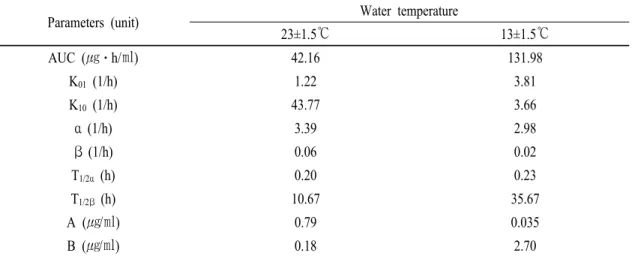
compartment 모델로 해석하여 Table 1에 나타내었다.
배설속도를 감안하여 혈중농도치가 완전히 0으로 되 는 예상소실시간(Et)이 수온 23±1.5℃에서 230시간 이었으나, 13±1.5℃에서 492시간을 나타내어 고수온 에서 신속하게 소실되었다. 약물의 분포상인 α상의 반감기(T
1/2α
)는 수온별로 커다란 차이가 없었으나, 신장으로 분포후상인 β상의 반감기(T1/2β
)와 혈중최 고농도(Cmax)는 고수온에서 감소하였고, 혈중최고 농도의 도달시간(Tmax)은 고수온에서 상당히 지연 되었다. 한편, 넙치에서 OA의 수온별 Et는 수온 23±1.5℃의 경우 936시간, 수온 13±1.5℃의 경우 1280 시간으로 나타나서(정 등, 2010), OA가 조피볼락의 혈중에서 머무르는 시간이 동일한 수온의 영역에서 조사된 넙치에 비해 훨씬 짧게 관찰되었다. 조피볼락 의 체내 OA의 잔류기간은 사육수온에 의해 크게 영 향을 받으며 고수온에서의 잔류기간이 저수온에 비 해 감소함을 알 수 있었다.Parameters (unit) Water temperature
23±1.5℃ 13±1.5℃
AUC (㎍ㆍh/㎖) 42.16 131.98
K
01
(1/h) 1.22 3.81K
10
(1/h) 43.77 3.66α (1/h) 3.39 2.98
β (1/h) 0.06 0.02
T
1/2α
(h) 0.20 0.23T
1/2β
(h) 10.67 35.67A (㎍/㎖) 0.79 0.035
B (㎍/㎖) 0.18 2.70
Table 1. Pharmacokinetic parameters for oxolinic acid in serum of black rockfish following oral feeding with dose of 60 mg/kg body weight at 23±1.5℃ and 13±1.5℃.
T
max
(h) 26.13 8.81C
max
(㎍/㎖) 0.43 2.04Et (h) 230 492
Abbreviations: AUC, area under the concentration-time curve; K
01
and K10
,distribution rate constants of central and peripheral compartments; α, β, distribution and elimination rate constants; T1/2α
, distribution half-life of the drug; T1/2β
, elimination half-life of the drug; A, B, zero time plasma drug concentration intercepts of biphasic disposition curve; Tmax
, time for maximum concentration; Cmax
, maximum concentration; Et, elimination time.약제의 치료효과가 혈중농도와 반드시 직접적인 상관관계를 가지는 것은 아니지만 Rigos et al.(2004) 에 의하면 대부분의 약물은 적어도 최소발육저지농 도(MIC)의 1배∼2배 이상의 농도로 혈중에서 일정 기간 동안 유지해야 치료효과가 나타난다고 하였다. 즉, 투여한 치료약제의 투약량이 그람음성 및 양성세 균을 살균시킬 수 있는 농도로 어류 조직내에 흡수, 분포하는지에 대해서는 MIC를 근거로 비교하면 유 용할 것이다. 그렇지만 조피볼락에서 분리된 세균을 대상으로 MIC를 조사한 연구는 거의 찾아볼 수 없어 MIC와의 직접적인 연관성을 비교할 수는 없었다.
단, 본 실험에서 도출된 OA의 조피볼락에 대한 수온 별 혈중최고농도(Fig. 1)를 근거로 살펴보면, 가두리 에서 사육중인 조피볼락이 만약 고수온기에 세균성 질병에 감염될 경우, 분리된 세균이 OA에 감수성을 나타낸다고 하여도 치료효과는 저수온기에 비해 감 소할 것으로 예상된다.
어체내에서 약물동태는 약물의 투여량, 위 공복시 간, 흡수, 약물의 생체내 대사 및 약물의 배설율과 같은 여러 인자에 의존하고(Treves-Brown, 2000), 무 엇보다 사육수온에 따라 약물동태학적 측정값들이 크게 차이가 있으며 약물의 어체내 잔류기간은 저수 온에 비해 고수온에서 현저히 짧아진다고 보고하였 다(Björklund and Bylund, 1990; Zhang and Li, 2007).
국내에서 품목허가된 OA의 제품에는 조피볼락이 사 용대상 어종으로 포함되어 있지 않지만, 약사법 제85 조(동물용의약품 등에 대한 특례) 제3항에 의하면
수의사 및 수산질병관리사의 진료 또는 처방에 따라 사용할 경우는 그 기준을 지키지 않아도 가능하도록 되어 있어, 향후 이와 같이 사용대상 어종을 변경할 경우 투여농도 및 용법 등을 설정할 수 있는 기초자료 로서 유용하게 사용될 수 있을 것이다.
요 약
Oxolinic acid를 사육수온(13±1.5℃, 23±1.5℃)에 따 라서 조피볼락(평균체중 500 g)에 60 ㎎/㎏의 농도로 1회 경구 투여한 다음, 경시적인 혈청내 잔류농도를 분석하였다. 23±1.5℃의 경우 투여 후 30시간째(0.60
㎍/㎖)에 최대혈중농도에 도달하였다. 13±1.5℃의 경 우 투여 후 10시간째(2.22 ㎍/㎖) 최대혈중농도에 도달 하였다. OA의 조피볼락 혈중내 흡수양상과 소실정도 는 사육수온에 크게 영향을 받았다. Two-compartment model로 해석하여 WinNonlin program을 이용, 약물동 태학적 매개변수(parameter)를 조사하였다. 23±1.5℃
의 경우, 혈장농도-시간곡선하 면적(AUC)은 42.16
㎍ㆍh/㎖, 혈중최고농도의 도달시간(Tmax)은 26.13 h, 혈중최고농도(Cmax)는 0.43 ㎍/㎖, 예상약물소실 시간(Et)은 230시간으로 계산되었다. 13±1.5℃의 경 우, AUC는 131.98 ㎍ㆍh/㎖, Tmax는 8.81 h, Cmax는 2.04 ㎍/㎖, Et는 492시간으로 계산되었다.
감사의 글
이 연구는 국립수산과학원(양식생물 질병 방제연 구, RP-2010-AQ-042)의 지원에 의해 운영되었습니다.
참고문헌
Björklund, H. and Bylund, G.: Temperature-related absorption and excretion of oxytetracycline in rainbow trout (Salmo
gairdneri R.). Aquaculture, 84:363-372, 1990.
Coyne, R., Bergh, Ø., Samuelsen, O., Andersen, K., Lunestad, B.T., Nilsen, H., Dalsgaard, I. and Smith, P: Attempt to validate breakpoint MIC values estimated from pharmacokinetic data obtained during oxolinic acid therapy of winter ulcer disease in Atlantic salmon (Salmo salar). Aquaculture, 238:51-66, 2004.
Hustvedt, S.O. and Salte, R.: Distribution and elimination of oxolinic acid in rainbow trout (Oncorhynchus
mykiss Walbaum) after a single rapid intravascular
injection. Aquaculture, 92:297-303, 1991.Kim, J.W., Jo, M.R., Jung, S.H., Jee, B.Y., Choi, D.L.
and QT. Jo.: Effects of temperature on the pharmacokinetics of ciprofloxacine in the cultured black rockfish (Sebastes schlegeli) and olive flounders (Paralichthys olivaceus). Fish. Sci. and Tech. 5:200-205, 2002.
Poher, I., Blanc, G. and Loussouarn, S.: Pharmacokinetics of oxolinic acid in sea bass, Dicentrarchus Iabrax (L., 1758), after a single rapid intravascular injection.
J. Vet. Pharmacol. Therap., 20:267-275, 1997.
Rigos, G., Alexis, M., Andriopoulou, A. and Nengas, I.:
Temperature-dependent pharmacokinetics and
tissue distribution of oxolinic acid in sea bass,
Dicentrarchus labrax L., after a single
intravascular injection. Aquacult. Res., 25:401-408, 2002a.Rigos, G., Alexis, M., Trypenou, A.E., Nengas, I., Piper, I. and Troisi, G.: Pharmacokinetics of oxolinic acid in gilthead sea bream, Sparus aurata L..
J. Fish. Dis., 25:401-408, 2002b.
Rigos, Tyrpenou, A.E., Nengas, I., Alexis, M., and Troisi, G.M.: The kinetic profile of oxolinic acid in sharpsnout sea bream, Diplodus puntazzo (Cetti 1777). Aquacult. Res., 35:1299-1304, 2004.
Rogstad, A., Ellingsen, O.F. and Syvertsen, C.: Pharmacokinetics and bioavailability of flumequine and oxolinic acid after various routes of administration to Atlantic salmon in seawater. Aquaculture, 110:207-220, 1993.
Samuelson, O.B.: Multiple dose pharmacokinetic study of oxolinic acid in cod, Gadus morhua L., Aquacult.
Int., 14:443-450, 2006.
Samuelson, O.B., Bergh, Ø. and Ervik, A.: A single-dose pharmacokinetic study of oxolinic acid ester, in cod, Gadus morhua L., held in sea water at 8℃
and in vitro antibacterial activity of oxolinic acid against Vibrio anguillarum strains isolated from diseased cod. J. Fish Dis., 26:339-347, 2003.
Samuelson, O.B. and Ervik, A.: A single-dose pharmacokinetic study of oxolinic acid and vetoquinol, an oxolinic acid ester, in Atlantic halibut, Hippoglossus hippoglossus L., held in sea water at 9℃. J. Fish Dis., 22:13-23, 1999.
Samuelson, O.B. and Ervik, A.: Absorption, tissue distribution and excretion of flumequine and oxolinic acid in
corkwing wrasse (Symphodus melops) following a single intraperitoneal injection or bath treatment.
J. Vet. Pharmacol. Therap., 24:111-116, 2001.
Samuelson, O.B., Ervik, A., Purse, L. and Smith, P.:
Single-dose pharmacokinetic study of oxolinic acid and vetoquinol, an oxolinic acid ester, in atlantic salmon (Salmo salar) held in sea water and in vitro antibacterial activity of against Aeromonas
salmonicida. Aquaculture, 187:213-224, 2000.
Sangrungruang, K., Endo, M. and Ueno, R.: Development of method for forced oral administration of xenobiotics in shrimp. Fish. Sci., 70:463-466, 2004.
Treves-Brown, K.M.: Tetracyclines. In Applied Fish Pharmacology. pp. 64-82. Kluwer Academic Publishers, Boston. 2000.
Uno, K.: Pharmacokinetics of oxolinic acid and oxytetracycline in kuruma shrimp, Penaeus japonicus.
Aquaculture, 230:1-11, 2004.
Uno, K., Aoki, T., Kleechaya, W., Ruangpan, L. and Tanasomwang, V.: Pharmacokinetics of oxolinic acid in black tiger shrimp, Penaeus monodon Fabricius, and the effect of cooking on residues.
Aquacult. Res., 37:826- 833, 2006.
Samuelson, O.B. and Ervik, A.: A single-dose pharmacokinetic study of oxolinic acid and vetoquinol, an oxolinic acid ester, in Atlantic halibut, Hippoglossus hippoglossus L., held in sea water at 9℃. J. Fish Diseas., 22:13-23, 1999.
Zhang, Q. and Li, X.: Pharmacokinetics and residue elimination of oxytetracycline in grass carp,
Ctenopharyngodon idellus. Aquaculture, 272:
140-145, 2007.
김명석, 박성우, 허민도, 정현도: 수온과 세균 감염이
나일틸라피아(Oreochromis niloticus)의 oxolinic acid 흡수와 배설에 미치는 영향. 한국어 병학회지, 31:677-684. 1998.
손맹현 외 9명: 조피볼락 양식 표준지침서. 국립수산과학 원 양식관리팀, 2007.
옥영수, 이창수: 조피볼락의 최근 생산 동향과 시사점.
월간해양수산, 285:55-68. 1997.
정승희, 김진우: 병용항균제의 어류질병 세균에 대한 시험관내 항균활성. 한국어병학회지, 13:45-51, 2000.
정현도, 하재이, 허민도, 정준기: 향어에서의 oxolinic acid 흡수와 배설속도. 한국어병학회지, 5:135-142, 1992.
정승희, 최동림, 김진우, 조미라, 서정수, 지보영:
Oxytetracycline의 약욕 및 경구투여에 따른 넙치 (Paralichthys olivaceus) 체내 약물동태학적 특 성. 한국어병학회지, 21:107-117, 2008.
정승희, 최동림, 김진우, 조미라, 지보영, 서정수: Oxolinic acid의 경구투여, 주사 및 약욕에 따른 넙치,
Paralichthys olivaceus 체내 약물동태학적 특
성. 한국어병학회지, 22:125-135, 2009.정승희, 김진우, 서정수, 최동림, 지보영, 박명애: 넙치,
Paralichthys olivaceus에 nalidixic acid, piromidic
acid, oxolinic acid의 경구투여 약물동태에 미치 는 수온의 영향. 한국어병학회지, 23:57-67, 2010.최민순, 박관하: 잉어에 있어서 quinolones(ciprofloxacin, norfloxacin 및 oxolinic acid)의 경구투여에 따른 장기내 분포상. 한국어병학회지, 18:269-276, 2005.
Manuscript Recevied : June 1, 2010 Revised : July 14, 2010 Accepted : July 25, 2010