• 검색 결과가 없습니다.

Molecular cloning and expression of black rockfish Sebastes schlegelii p47-phox (neutrophil cytosolic factor 1)

N/A
N/A
Protected

Academic year: 2021

Share "Molecular cloning and expression of black rockfish Sebastes schlegelii p47-phox (neutrophil cytosolic factor 1)"

Copied!
10
0
0

로드 중.... (전체 텍스트 보기)

전체 글

(1)

137 The aquaculture and fisheries industries in Korea and Japan consider the black rockfish to be very important due to its great demand among people.

Neutrophils play a prominent role in acute inflammatory reactions because they rapidly migrate to sites of infection and destroy invading microorganisms (Inoue et al., 2001). The neutrophil NADPH oxidase is a multi-protein enzyme com- plex that plays an essential role in host defense (DeLeo et al., 1995). Activation of this enzyme involves the assembly of several neutrophil pro- teins, some located on the plasma membrane, and others in the cytosol (Clark, 1999). Oxidative killing is mediated by oxygen metabolites generated upon activation of the neutrophil enzyme NADPH

oxidase (McPhail and Harvath, 1993).

Similar to the neutrophils of mammals, the neu- trophils of tilapia Oreochromis niloticus and eel Anguilla japonica and the head-kidney phagocytes of rainbow trout Oncorhynchus mykiss can con- sume oxygen and produce superoxides (Itou et al., 1996; Secombes and Fletcher, 1999; Shiibashi et al., 1999). Furthermore, the presence of flavocy- tochrome b has been indirectly or directly demon- strated in fish phagocytes using the spectrophoto- metric method and an anti-peptide antibody that reacts with human flavocytochrome b (Secombes et al., 1992; Itou et al., 1998; Shiibashi et al., 1999).

The plasma membrane associated component directly implicated in the flow of electrons from

Molecular cloning and expression of black rockfish Sebastes schlegelii p47-phox (neutrophil cytosolic factor 1)

Ki-Hyuk Kim, Gun Wook Baeck, Mu Chan Kim and Chan Il Park

Institute of Marine Industry, College of Marine Science, Gyeongsang National University, 455, Tongyeong, 650-160, Korea

The black rockfish Sebastes schlegelii neutrophil cytosolic factor components p47 phox (phagocyte oxi- dase) cDNA was cloned. The sequence of the cDNA showed that rockfish p47 phox cDNA consisted of 1,952 bp contained open reading frame encoding predicted polypeptide of 420 amino acids. Additionally analysis of the p47 phox amino acid sequence showed two potential SH3 domains. The functional domains are highly conserved in many animals, though the sequence of the components of the black rockfish showed low homology with that of mammals. The deduced amino acid sequence of the black rockfish p47 phox was similar to those of the carp (60.4%), zebrafish (59,2%), rainbow trout (68.5%), xenopus (55.2%), mouse (54.2%), rabbit (54.5%), rat (53.7%), and chicken (50.9%). The expression of the rockfish p47 phox mole- cule was induced in peripheral blood leukocytes (PBLs) from 1 to 12 h following LPS stimulation, with a peak at 6 h after the stimulation, and which increased at 1, 3, and 12 h after treated with Poly I:C compared with the control. The rockfish p47 phox gene was expressed in various tissues of healthy fish. The level of p47 phox expression was high in the PBLs, kidney and spleen.

Key words: Black rockfish, p47 phox, Leukocyte, Real-time PCR, RT-PCR

Corresponding Author : Chan Il Park, Tel : +82-55-640-3103 Fax : +82-55-642-4509 , E-mail : [email protected]

137

(2)

NADPH to O

2

is a heterodimeric flavocytochrome b, which is composed of 91 and 22 kDa subunits (gp91 phox and p22 phox, respectively) (Jesaitis, 1995). The cytosolic NADPH oxidase proteins include p40 phox, p47 phox (neutrophil cytosolic factor 1), and p67 phox (Clark, 1999; Nauseef, 1999). Upon neutrophil activation, the cytosolic phagocyte oxidase (phox) proteins and Rac2 (Diebold and Bokoch, 2001) translocate to the membrane where they associate with flavocy- tochrome b, which results in an active O

2-

generat- ing complex (Clark, 1999; Inoue et al., 2004).

The human (Volpp et al., 1989; Wientjes et al., 1993), bovine (Bunger et al., 2000) and murine (Jackson et al., 1994; Mizuki et al., 1998) p40 phox, p47 phox, and p67 phox genes have been fully char- acterized. The cloning and sequencing of rockfish p40 phox, p47 phox, and p67 phox genes have not yet been reported. EST analysis has been of great service in identifying immune-related genes in fish (Nam et al., 2000).

Our knowledge concerning the immunology of fish has increased rapidly in recent years, which is desirable because fishes comprise, in terms of species, at least one half of living vertebrates and from a phylogenetic point of view, fish serve as a good model for studying the vertebrate immune system. The aim of this study therefore is the com-

plete sequence and physical linkage of the entire lower vertebrate p47 phox gene from a cDNA library. We attempted to clone immune-related genes in the EST analysis from the black rockfish leukocyte cDNA library. And examine expression of rockfish p47 phox since the p47 phox of a teleost would provide important information for the under- standing of the fish immune system and neutrophil evolution.

Materials and Methods

Cloning and sequencing of back rockfish p47 phox cDNA

Black rockfish (200-300 g in weight) that had not been exposed to known antigenic stimulation were used as blood and tissue donors for all the in vitro experiments. The partial cDNA fragment of rock- fish p47 phox, which was isolated in a previous expressed sequence tag (EST) study, was used for the full length of its p47 phox cDNA using the 5 ’ RACE method. To obtain the complete black rock- fish p47 phox sequence, 5 ’RACE was performed with the SMART RACE cDNA Amplification Kit (Clontech Laboratories, Palo Alto, CA) according to the manufacturer ’s protocol, using primers (Phox-up) based on the determined partial sequences of the black rockfish p47 phox (Table 1).

Table 1. The oligonucleotide primers used in this study.
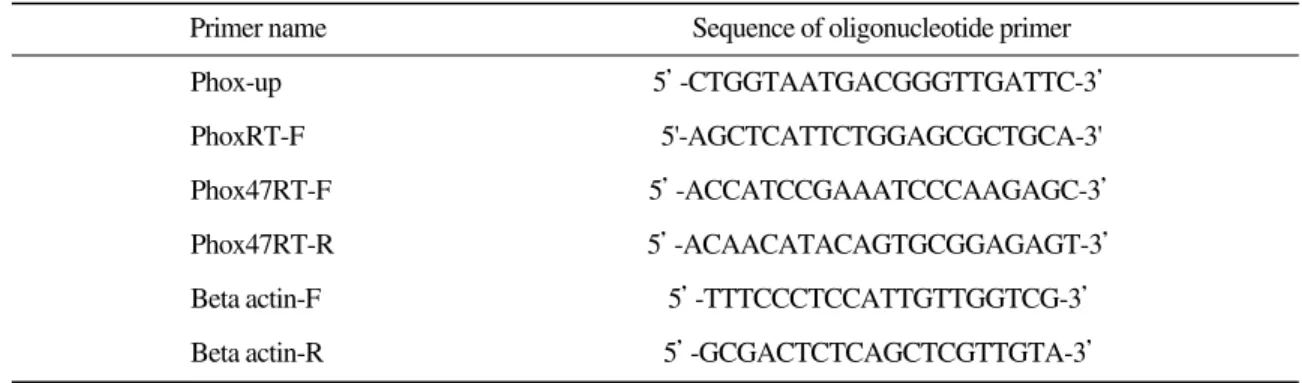
Primer name Sequence of oligonucleotide primer

Phox-up 5’ -CTGGTAATGACGGGTTGATTC-3’

PhoxRT-F 5'-AGCTCATTCTGGAGCGCTGCA-3'

Phox47RT-F 5’ -ACCATCCGAAATCCCAAGAGC-3’

Phox47RT-R 5’ -ACAACATACAGTGCGGAGAGT-3’

Beta actin-F 5’ -TTTCCCTCCATTGTTGGTCG-3’

Beta actin-R 5’ -GCGACTCTCAGCTCGTTGTA-3’

(3)

The sequencing of cDNA clones was performed using the ABI 3100 automatic DNA sequencer (PE Applied Biosystems, CA) and the ABI Prism Big Dye Terminator Cycle Sequencing Ready Reaction kit (PE Applied Biosystems).

Multiple alignment and phylogenetic analysis of black rockfish p47 phox

The determined nucleotide, deduced amino acid sequences and multiple sequence alignments were analyzed with GENETYX ver. 8.0 (SDC Software Development, Japan). The deduced amino acid sequences were compared with sequences of other species in the peptide sequence databases at the National Center for Biotechnology Information (NCBI), using the BLAST network service. Amino acid sequences with complete annotations were obtained from the following species in the Gen- Bank database: black rockfish (Accession No.

AB430583), carp (Accession No. NP_001027718), zebrafish (Accession No. CAM16641), rainbow trout (Accession No. BAD60781), mouse (Acces- sion No. BC055836), rabbit (Accession No.

NP_001075571), rat (Accession No. CH473973), chicken (Accession No. NM_001030709), and xenopus (Accession No. BC055836). Nucleotide sequence comparisons were carried out using the program BLASTX (Gish and David, 1993). Phylo- genies based on the p47 phoxs were inferred using the Mega2 software package (Kumar et al., 2001) and distance analysis was performed using the neighbor-joining method. The values that supported each node were derived from 2,000 re-samplings.

Expression analysis of black rockfish p47 phox The total RNA from the normal PBLs and the PBLs stimulated with lipopolysaccharide (LPS) (500 μ g/ml) or polyinosinic:polycytidylic acid (Poly

I:C) (5 μ g/ml) was purified as previously reported (Hirono et al., 2000). cDNAs were synthesized for real-time PCR from stimulated and non-stimulated leukocytes. The threshold cycle (Ct) values were automatically calculated as the cycle when the fluo- rescence of the sample exceeded a threshold level that corresponded to 10 standard deviations of the mean of the baseline fluorescence. The amplifica- tion was carried out as follows: 1 cycle of 94℃ for 2 min, 30 cycles of 94℃ for 30 s, 59℃ for 30 s and 72

℃ for 1 min, with a final extension step of 72℃ for 5 min. Real-time PCR was conducted as previously described (Park et al., 2003). The primers for the real-time PCR sequences (PhoxRT-F and Phox47RT-R) are summarized in Table 1. Thermal cycling and fluorescence detection were conducted using the Gene Amp 5700 sequence detection sys- tem. All the samples were run in triplicates. The ratio between the β -actin in the standard sample and the test samples were defined as the normalization factor. All the calculations were made using in MS Excel 2000 (Microsoft Corporation). Statistical comparisons were performed using ANOVA (Fisher’ s protected least squares difference). Values were considered to be significant at P < 0.05.

The total RNA (50 ng) from the brain, intestine, kidney, liver and spleen were reverse-transcribed into cDNA using an AMV Reverse Transcriptase First-strand cDNA Synthesis Kit (Invitrogen, CA).

PCR was performed on the resulting cDNA using the Phox47RT-F and Phox47RT-R specific primer sets (Table 1). β -actin was amplified as a control using the Beta actin-F and Beta actin-R primers (Table 1). The PCR mixtures were denatured at 94℃ for 2 min and then subjected to 25 cycles of 94℃ for 30 s, 54℃ for 30 s and 72℃ for 1 min.

The products were visualized by separation on a

1.5% agarose gel.

(4)

Results

Cloning and Sequencing of black rockfish p47 phox cDNA

The partial cDNA fragment of the black rockfish p47 phox was isolated via a previous expressed sequence tag (EST) analysis. Using poly I:C stimu- lated black rockfish peripheral blood leukocyte

(PBL) cDNAs as templates, 5' RACE was per- formed with the specific primer (Table 1) and the CDS primer to isolate full-length fragments of the black rockfish p47 phox cDNA.

The full-length cDNA obtained from the p47 phox was 1,952 nucleotides long and contained an ORF of 1,260 nucleotides that encoded 420 amino acids (Fig. 1). The 3’UTR contained a polyadeny-

Fig. 1. Nucleotide and deduced amino acid sequences of the black rockfish p47 phox. The arrows indicate the oligonu-

cleotide primers used in this study. The putative signal peptide are underlined. The polyadenylation signal ATTAAA is

shown in boldface.

(5)

Fig. 2. Comparison of the black rockfish p47 phox amino acid sequence with other known p47 phox sequences. The

amino acids identical to the rock sequence are indicated by an asterisk (*), and the amino acids absent are indicated by a

dash (-). Both SH3 domains are shown in boxes, and the consensus sites of the phosphorylation homologs are also indi-

cated in boldface. The solid lines indicate (a) the putative N-terminal, proline-rich SH3 domain-binding domain; (b) the

p67 phox/flavocytochrome b-binding region; and (c) the C-terminal prolinerich, p67 phox SH3 domain-binding site.

(6)

lation signal (AUUAAA) and a polyadenylation site (Fig. 1).

The gene encoded a putative amino acid protein of 48.4 kDa that contained a 20 amino acid signal sequence and conserved two potential SH3 domains as well as the potential amino-terminal proline-rich SH3 domain binding site, the potential putative p67 phox/favocytochrome b binding site and the carboxy-terminal proline-rich p67 phox SH3 domain binding site (Fig. 2), which are charac- teristics of mammalian and non-mammalian p47 phox proteins.

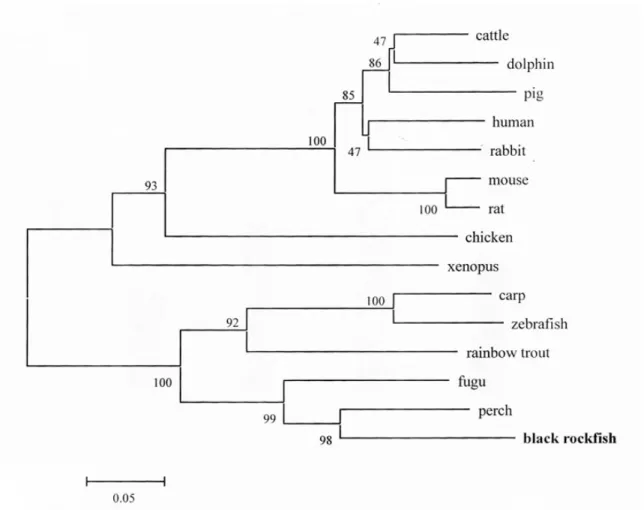
Phylogenetic analysis of black rockfish p47 phox In the phylogenetic analysis, the black rockfish p47 phox was grouped with other teleosts p47 phox pep- tides (Fig. 3). This grouping was well-supported by bootstrapping. This result is possibly due to the dif- ferences between mammalian and non-mammalian species. The phylogenetic analysis indicated that the known rainbow trout and rockfish are more closely related than the other species.

Expression analysis of black rockfish p47 phox As shown in Fig. 4, the black rockfish p47 phox levels seemed to have reached a peak in expression at 6 h after LPS post-stimulation, with a decrease at

Fig. 3. The phylogenetic tree of p47 phox proteins, including of the black rockfish p47 phox, from 15 representative

species. The positions of the black rockfish p47 phox were estimated using the neighbor-joining method of clustering in

the Mega2 package program. The sequences were obtained from the DDBJ/EMBL/GenBank.

(7)

12 h. The black rockfish p47 phox expression was induced from 1 to 12 h following the poly I:C stim- ulation and peaked at 12 h.

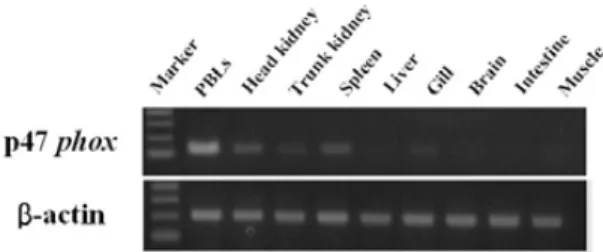
The expression of the p47 phox gene in the tis- sues of the black rockfish was detected with RT- PCR. The black rockfish p47 phox transcript was predominantly expressed in the PBLs, kidney, spleen and gills, but not in the liver, brain, intestine and muscles (Fig. 5).

Discussion

In this study, we report the cloning and sequenc- ing of black rockfish NADPH oxidase cytosolic protein, p47 phox. The comparison of the black rockfish p47 phox amino acid sequence with the other known p47 phox sequences demonstrated considerable similarity with the homologues of the carp (60.4%), zebrafish (59,2%), rainbow trout (68.5%), xenopus (55.2%), mouse (54.2%), rabbit (54.5%), rat (53.7%), and chicken (50.9%).

The phagocyte respiratory burst oxidase (NADPH oxidase) remains inactive until the phago- cyte is stimulated by engagement of receptors for chemoattractants, the receptors mediating phagocy- tosis, or responses to various cytokines. Active

NADPH oxidase appears to be a multi-component enzyme system, consisting of at least five proteins:

the heterodimeric flavocytochrome b and the cytosolic proteins, a second low molecular weight GTP-binding protein, Rac2, p40 phox, p47 phox and p67 phox (DeLeo and Quinn, 1996; Nauseef, 1993).

The rockfish p47 phox contained SH3 motif domains (NH2-terminus: Glu152-Asp215; COOH- terminus: Glu230-Gly285) similar to those seen in mammalian and non-mammalian p47 phox. The phosphorylation site included residues such as ser- ines 307, 314, 324, 346 and 352. The phosphoryla- tion site of the human p47 phox has been shown to be involved in the activation of the oxidase (Huang and Kleinberg, 1999). The serines at residues 307 in the black rockfish p47 phox are regarded as part of the protein kinase C substrate consensus sequences (K/R)X(S/T) or (S/T)X(K/R), which suggests that these kination sites in the black rockfish p47 phox play the same role in phosphorylation that they play in human (Vignais, 2002). Furthermore, a proline- rich region that conformed to a consensus SH3 domain-binding site was found. All the amino acids in the proline-rich region were conserved in the black rockfish p47 phox, as in the other species.

Inoue et al. reported that stimulation of fugu granu- locytes with LPS for 6 h resulted in a significant increase in p47 phox transcript expression (Itou et Fig. 4. Quantitative real-time PCR analysis of the p47 phox

expression in the black rockfish leukocytes stimulated with LPS (500 μ g/ml) or Poly I:C (5 μ g/ml)at 1, 3, 6, and 12 h.

Fig. 5. Detection of the black rockfish p47 phox mRNA lev-

els and βactin from various tissues of healthy black rockfish

by RT-PCR. The marker is a 100-bp ladder marker.

(8)

al., 1998). In addition, the human p47 phox mRNA level in the macrophages incubated with LPS for 24 h increased (Cassatella et al., 1991). Both the LPS and the poly I:C up-regulated the expression of the black rockfish p47 phox, but in different manners.

This might have been due to the existence of dis- tinct signal pathways activated by these two stimu- lants. All together, the findings clearly show that both LPS and poly I:C induced rockfish p47 phox expression in vitro. Phagocytosis of the phagocytes could have been an intermediate phase of this response.

Relatively large quantities of the black rockfish p47 phox transcript were expressed in the PBLs, kidney, spleen and gills could be attributed to the presence of phagocytic cells in these tissues, thus suggesting that this gene plays important roles in the immune system. In fish, phagocytic cells are abundant in the ellipsoids of the spleen, intertublar haemopoietic tissues of the kidney and blood (Ellis and Munroe, 1976).

In conclusion, the black rockfish NADPH oxi- dase component gene was found to be not highly homologous with those of mammals. The basic structures relevant to the function in particular, the sites and motifs essential for the production of oxy- gen radicals were well conserved. These structural features together with the patterns of expression in the tissues strongly suggest that the gene encoding NADPH oxidase component in the black rockfish has functions similar to those of the mammalian homologs.

Acknowledgements

This work was supported by the Korea Research Foundation Grant funded by the Korean Govern- ment (MOEHRD, Basic Research Promotion Fund;

KRF-2007-331-F00040).

References

Bunger, P.G., Swain, S.D., Clements, M.K., Siem- sen, D.W., Davis, A.R., Gauss, K.A., Quinn, M.T.: Cloning and expression of bovine p47 phox and p67 phox: comparison with the human and murine homologs. J. Leukoc.

Biol., 67: 63-72, 2000.

Cassatella, M.A., Bazzoni, F., Amezaga, M.A., Rossi, F.: Studies on the gene expression of several NADPH oxidase components.

Biochem. Soc. Trans., 19: 63-67, 1991.

Clark, R.A.: Activation of the neutrophil respiratory burst oxidase. J. Infect. Dis., 179: 309-317, 1999.

DeLeo, F.R., Yu, L., Burritt, J.B., Loetterle, L.R., Bond, C.W., Jesaitis, A.J., Quinn, M.T.:

Mapping sites of interaction of p47-phox and flavocytochrome b with random- sequence peptide phage display libraries.

Proc. Natl. Acad. Sci. USA, 92: 7110-7114, 1995.

DeLeo, F.R., Quinn, M.T.: Assembly of the phago- cyte NADPH oxidase: molecular interaction of oxidase proteins. J. Leukoc. Biol., 60:

677-691, 1996.

Diebold, B.A., Bokoch, G.M.: Molecular basis for Rac2 regulation of phagocyte NADPH oxi- dase. Nat. Immunol., 2: 211-215, 2001.

Ellis, A.E., Munroe, A.L.S.: Defence mechanisms in fish. 1. A study of the phagocytic system and the fate of intraperitoneally injected par- ticulate material in the plaice (Pleuronectes platessa L.). J. Fish. Biol., 8: 67-78, 1976.

Gish, W., David, J.S.: Identification of protein cod- ing regions by database similarity search.

Nature Genetics, 3: 266-272, 1993.

Hirono, I., Nam, B.H., Kurobe, T., Aoki, T.: Molec-

(9)

ular cloning, characterization, and expres- sion of TNF cDNA and gene from Japanese flounder Paralichthys olivaceus. J.

Immunol., 165: 4423-4427, 2000.

Huang, J., Kleinberg, M.E.: Activation of the phagocyte NADPH oxidase protein p47phox phosphorylation controls SH3 domain-dependent binding to p22phox. J.

Biol. Chem., 274: 19731-19737, 1999.

Inoue, Y., Itou, T., Jimbo, T., Sakai, T., Ueda, K., Imajoh-Ohmi, S.: Molecular cloning and identification of bottle-nosed dolphin p40phox, p47phox and p67phox. Vet.

Immunol. Immunopathol., 78: 21-33, 2001.

Inoue, Y., Suenaga, Y., Yoshiura, Y., Moritomo, T., Ototake, M., Nakanish, T.: Molecular cloning and sequencing of Japanese puffer- fish (Takifugu rubripes) NADPH oxidase.

Dev. Comp. Immunol., 28: 911-925, 2004.

Itou, T., Iida, T., Kawatsu, H.: Evidence for the existence of cytochrome b

558

in fish neu- trophils by polyclonal anti-peptide antibody.

Dev. Comp. Immunol., 20: 433-437, 1998.

Itou, T., Iida, T., Kawatsu, H.: Kinetics of oxygen metabolism during respiratory burst in Japanese eel neutrophils. Dev. Comp.

Immunol., 20: 323-330, 1996.

Jackson, S.H., Malech, H.L., Kozak, C.A., Lomax, K.J., Gallin, J.I., Holland, S.M.: Cloning and functional expression of the mouse homo- logue of p47phox. Immunogenetics, 39:

272-275, 1994.

Jesaitis, A.J.: Structure of human phagocyte cytochrome b and is relationship to microbi- cidal superoxide production. J. Immunol., 155: 3286-3288, 1995.

Kumar, S., Tamura, K., Jakobsen, I.B., Nei, M.:

MEGA2: Molecular evolutionary genetics

analysis software. Bioinformatics, 17: 1244- 1245, 2001.

McPhail, L.C., Harvath, L.: The Neutrophil. pp. 63- 91. Oxford: Oxford University Press, 1993.

Mizuki, K., Kadomatu, K., Hata, K., Itou, T., Fan, Q., Kage, Y., Fukumaki, Y., Sakaki, Y., Takesige, K., Sumimoto, H.: Functional modules and expression of mouse p40phox and p67phox, SH3-domain- containing pro- teins involved in the phagocyte NADPH oxidase complex. Eur. J. Biochem. 251: 573- 582, 1998.

Nam, B.H., Hirono, I., Aoki, T.: A survey of expressed genes in Japanese flounder, Par- alichthys olivaceus, infected with Hirame rhabdovirus. Dev. Comp. Immunol., 24: 13- 24, 2000.

Nauseef, W.M.: The NADPH-dependent oxidase of phagocytes. Proc. Assoc. Am. Physicians, 111: 373-382, 1999.

Nauseef, W.M.: Cytosolic oxidase factors in the NADPH-dependent oxidase of human neu- trophils. Eur. J. Haematol., 51: 301-308, 1993.

Park, C.I., Kurobe, T., Hirono, I., Aoki, T.: Cloning and characterization of cDNA for two dis- tinct tumor necrosis factor receptor genes from Japanese flounder Paralichthys oli- vaceus. Dev. Comp. Immunol., 27: 365-375, 2003.

Secombes, C.J., Cross, A.R., Sharp, G.J.E., Garcia, R.: NADPH oxidase like activity in rainbow trout Oncorhynchus mykiss (WALBAUM) macrophages. Dev. Comp. Immunol., 16:

405-413, 1992.

Secombes, C.J., Fletcher, C.T.: The role of phago- cytes in the protective mechanisms of fish.

Annu. Rev. Fish Dis., 2: 53-71, 1992.

(10)

Shiibashi, T., Iida, T., Itou, T.: Analysis of localiza- tion and function of the COOH-termina cor- responding site of cytochrome b

558

in fish neutrophils. Dev. Comp. Immunol., 23: 213- 219, 1999.

Shiibashi, T., Tamaki, K., Iida, T.: Oxygen-depen- dent bactericidal activity of tilapia neu- trophils. Suisanzoshoku, 47: 545-550, 1999.

Vignais, P.V.: The superoxide-generating NADPH oxidase: Structural aspects and activation mechanism. Cell. Mol. Life Sci., 59: 1428- 1459, 2002.

Volpp, B.D., Nauseef, W.M., Donelson, J.E.,

Moser, D.R., Clark, R.A.: Cloning of the cDNA and functional expression of the 47- kilodalton cytosolic component of human neutrophil respiratory burst oxidase. Proc.

Natl. Acad. Sci. USA, 86: 7195-7199, 1989.

Wientjes, F.B., Hsuan, J.J., Totty, N.F., Segal, A.W.:

p40phox, A third cytosolic component of the activation complex of the NADPH oxidase to contain Src homology 3 domains.

Biochem. J., 296: 557-561, 1993.

Manuscript Received : April 9, 2009

Revised : June 22, 2009

Accepted : July 1, 2009

수치

Table 1. The oligonucleotide primers used in this study.
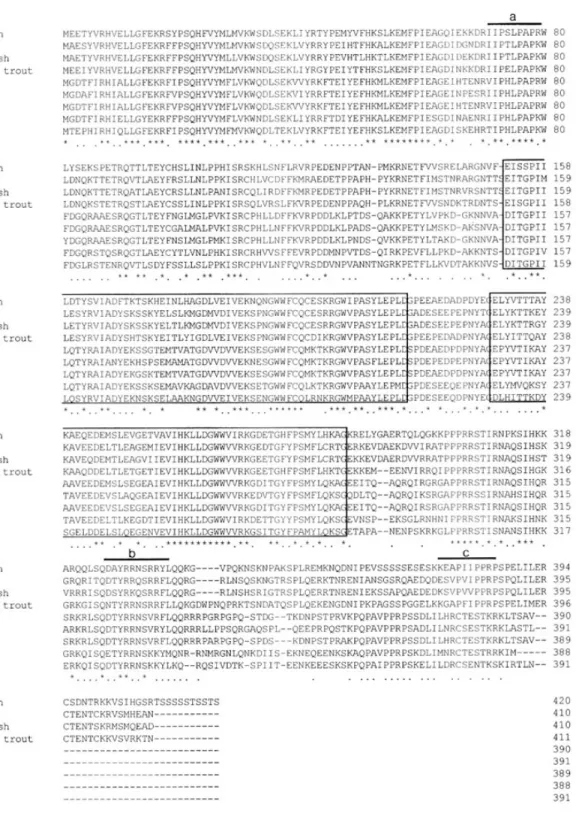
Fig. 2. Comparison of the black rockfish p47 phox amino acid sequence with other known p47 phox sequences
Fig. 3. The phylogenetic tree of p47 phox proteins, including of the black rockfish p47 phox, from 15 representative species
Fig. 5. Detection of the black rockfish p47 phox mRNA lev- lev-els and βactin from various tissues of healthy black rockfish by RT-PCR

참조

관련 문서

 Performed by multiplying the spectrum by a low-pass filter and then applying the inverse transform to obtain the

A suspension of platinum black and carbon powder in ethanol-water solutions serves to optimize the uniformity of the coating, electrical conductivity, and in the case of

The “Asset Allocation” portfolio assumes the following weights: 25% in the S&amp;P 500, 10% in the Russell 2000, 15% in the MSCI EAFE, 5% in the MSCI EME, 25% in the

1 John Owen, Justification by Faith Alone, in The Works of John Owen, ed. John Bolt, trans. Scott Clark, &#34;Do This and Live: Christ's Active Obedience as the

The set-up of the printer was performed according to the installation guide provided in the printer user’s manual. The driver supplied with the printer was used.

“The Tradition of Chinese American Women’s Life Stories: Thematics of Race and Gender in Jade Snow Wong’s Fifth Chinese Daughter and Maxine Hong

The purpose of this study was to investigate the appropriateness of the learning sequence of Science(area of matters) and Chemistry contents and

Individual temperament, Zeitgeist, or racial character determine the style of individuals, period and race... Eugene Kleinbauer, Modern Perspectives in Western