• 검색 결과가 없습니다.

Pathogenicity of Vibrio harveyi to black rockfish, Sebastes schlegeli

N/A
N/A
Protected

Academic year: 2021

Share "Pathogenicity of Vibrio harveyi to black rockfish, Sebastes schlegeli"

Copied!
10
0
0

로드 중.... (전체 텍스트 보기)

전체 글

(1)

99

Corresponding Author :

조피볼락에 대한 Vibrio harveyi의 병원성

최정현ㆍ원경미

ㆍ손새봄

��

ㆍ박효진

��

ㆍ변순규ㆍ이배익ㆍ이종하ㆍ김이청ㆍ박수일

���

국립수산과학원 동해특성화연구센터,

부경대학교 수산과학연구소,

��

부경대학교 수산생명의학과

Pathogenicity of Vibrio harveyi to black rockfish, Sebastes schlegeli

Jeong Hyun Choi, Kyoung Mi Won

, Sae Bom Sohn

��

, Hyo Jin Park

��

, Soon-Gyu Byun, Bae-Ik Lee, Jong-Ha Lee, Yi-Cheong Kim and Soo Il Park

���

East Sea Mariculture Research Center, National Fisheries Research & Development Institute, Uljin-gun, 767-863, Korea

Institute of Fisheries Science, Pukyong National University, Busan 608-737, Korea

��

Department of Aquatic Life Medicine, Pukyong National University, Busan 608-737, Korea

Vibrio harveyi, one of the major causal agent of vibriosis, affects a diverse range of marine vertebrates

and invertebrates over a wide geographical area. The organism is synonymous with Vibrio carchariae, which is also known as a fish pathogen. The aims of this study were to investigate the characteristics of the pathogenic non-luminous V. harveyi and the luminous V. harveyi. And V. harveyi isolates were examined the pathogenicity to the black rockfish, Sebastes schlegeli. Both strains of V. harveyi showed haemolytic activity, and the survival rate of non-luminous V. harveyi FR 2 was higher than other strains in the skin, gut mucus and fresh serum of olive flounder, Paralichthys olivaceus and black rockfish, Sebastes schlegeli, respectively. The virulence of non-luminous V. harveyi FR 2 was higher than that of luminous V. harveyi VIB 391 in the intraperitoneally infected black rockfish. In conclusion, the present study revealed that the pathogenicity of V. harveyi FR 2 isolated from marine fish was higher than that of V. harveyi VIB 391 iso- lated from shrimp for black rockfish. It was suggested that the pathogenicity of V. harveyi on the black rockfish was related with bacterial luminescense.

Key words: Vibrio harveyi, Pathogenicity, Black rockfish

Vibrio harveyi는 1980년대부터 새우 양식장이 밀집해 있는 인도네시아 (Sunaryanto et al., 1986), 필리핀 (Lavilla-Pitogo et al., 1990) 및 대만 (Liu et al., 1996) 등에서 새우류의 대량 폐사를 야기하는 병원성 세균으로 잘 알려져 있다 (Karunasagar et al., 1994; Pizzutto and Hirst, 1995;

Robertson et al., 1998; Vandenberghe et al., 1998).

특히, larvae와 post-larvae에 감염되면 폐사율이 100 %에 달하며 이들은 luminescence 양성 세균 으로 중감염된 새우는 형광을 나타내는 특징이

있어 luminous vibriosis로 잘 알려져 있다 (Sunaryanto et al., 1986; Lavilla-Pitogo et al., 1990;

Vandenberghe et al., 1998). 그러나, 1990년대 후 반에 들어서면서 새우류 뿐 아니라 여러 해수 어류에도 감염된다는 보고가 늘고 있어 (Kraxberger-Beatty et al., 1990; Ishimaru and Muroga, 1997; Alvarez et al., 1998), 다양한 어종 에서 대량 폐사를 유발하는 것으로 보인다. 한편 여러 해수 어류에 감염되는 V. harveyi는 새우에 서 질병을 일으키는 luminescence 양성 세균이

Corresponding Author : Soo Il Park, Tel : 051-620-6141, Fax : 051-628-7430, E-mail : [email protected]

(2)

아니라 luminescence 음성 세균인 Vibrio car- chariae인 것으로 보고되었지만 (Soffientino et al., 1999; Liu et al., 2003), Pedersen 등 (1998)이 V. carchariae를 V. harveyi의 junior synonym으로 규정함에 따라 두 종이 V. harveyi라는 단일종으 로 통합되었다.

Non-luminous V. harveyi의 다양한 해수 어류에 대한 병원성은 ECPs의 활성, 용혈능, 세포 독성 및 인위 감염 시험 등을 통해 입증되었으며 (Colwell and Grimes, 1984; Grimes et al., 1984;

Kraxberger-Beatty et al., 1990; Ishimaru and Muro- ga, 1997; Soffientino et al., 1999; Zhang and Austin, 2000; Lee et al., 2002), 이 밖에도 bacte- riophage와 세균 표면 소수성 등이 병원성 인자 로 보고되었다 (Ruangpan et al., 1999; Munro et al., 2003; Soto-Rodriguez et al., 2003). 또한 lumi- nous V. harveyi의 새우류 및 무척추 동물에 대한 병원성 연구로 ECPs의 활성, 세포 독성, LPS 및 인위 감염 시험 등이 보고되었다 (Liu et al., 1996; Liu et al., 1997; Liu et al., 1999). 그러나 lu- minous V. harveyi의 해수 어류에 대한 병원성 연 구는 아직 미흡한 실정이다.

따라서 본 연구에서는 해수 어류에 대한 lumi- nescence와 병원성의 관계를 알아보고자 non-lu-

minous V. harveyi와 luminous V. harveyi 분리 균 주의 조피볼락, Sebastes schlegeli에 대한 병원성 을 인위감염실험을 통하여 조사, LD

50

값으로 나 타내었으며, 조피볼락과 넙치의 적혈구에서 생 균의 haemolytic activity와 체표 점액 및 장 점 액, 혈청 내에서의 생존능을 병원성 인자로서 측 정하였다.

재료 및 방법

시험균주

Won 등 (2006)에 의해 조피볼락에서 분리된 non-luminous V. harveyi 분리 균주 FR 2와 Zhang and Austin (2000)에 의해 새우에서 분리된 lumi- nou V. harveyi VIB 391 균주를 영국 Herriot-Watt University에서 분양받아 사용하였다. 또한 시험 용 참조 균주는 KCCM (Korean Culture Center of Microorganisms)에서 분양 받은 ATCC 35084와 ATCC 14126을 사용하였다. 시험에 사용한 모든 균주는 1.5% NaCl 첨가 Tryptic soy agar (TSA, Difco)와 Thiosulfate Citrate Bile Salts Sucrose Agar (TCBS, Merch)에 도말한 후, 27℃, 24 시간 배양하여 swarming activity 및 luminescence 유무 를 확인하였다 (Table 1).

Table 1. Bacterial strains used in this study

Strains Origin of bacteria Remarks

FR2 Busan, Korea

(non-luminous) Kidney of black rockfish

1999 Isolated strains

VIB 391 Thailand, (n=2)

(luminous) Unnamed shrimp species

1990

ATCC Grimes et al., 1984

35084 Kidney of brown shark

V. carchariae

(non-luminous) type strain Reference strains

ATCC Baumann et al., 1980 (n=2)

14126 Dead, luminescing amphipod

V. harveyi

(luminous) type strain

(3)

시험어

Haemolytic activity와 어체 내 생존능 실험에 사용한 조피볼락, Sebastes schlegeli (평균 전장 23 ± 0.5 cm)는 부산 기장 소재의 양식장에서 분양받았으며, 넙치, Paralichthys olivaceus (평균 전장 25 ± 0.5 cm)는 경북 울진 소재의 양식장 에서 분양받아 사용하였다.

인위 감염 시험에 사용한 조피볼락 (평균 어 체중 15 ± 0.5 g)은 경남 거제 소재의 양식장과 경남 통영 소재의 양식장에서 분양받아 부경대 학교 수산과학연구소 수조실의 2 톤 사육 수조 에서 수온 23~24℃로 2 주일간 반유수식으로 순 치시킨 후 사용하였다.

Haemolytic activity

시험 균주의 haemolytic activity는 Zhang and Austin (2000)의 방법을 변형하여 실험하였다.

즉, 5%의 조피볼락 및 넙치의 적혈구가 첨가된 Columbia blood agar (Difco)를 각각 제작하여 직 경 4 mm wells을 만든 후 여기에 1×10

6

cfu/㎖

농도로 조정된 각각의 시험 균액을 100 ㎕씩 주 입하였다. 접종한 배지는 27℃, 72 시간 동안 배 양하고, well 주위의 clear zone이 형성되는 처음 시간과 크기를 측정하였다.

어체 내 생존능 어

어류 류 체 체표 표 점 점액 액 내 내에 에서 서의 의 생 생존 존능 능

시험균이 어류 점액을 유일한 영양원으로 성 장할 수 있는지를 조사하기 위해 조피볼락과 넙 치의 체표 점액을 이용하여 Kim 등 (2006)의 방 법으로 시험하였다. 점액은 체표의 수분을 paper towel로 가볍게 흡수시킨 후 채취하여 이 시료 에 2 배의 0.1 M PBS (pH 7.2)를 첨가한 다음 점 액을 균질화하였다. 그 후, 원심 분리 (4℃, 10,000 × g, 20 min)하여 상징액을 분리하고 0.2

㎛ pore size의 syringe filter (Corning Inc.)로 여과 한 것을 점액 시료로 사용하였다. 각 시험 균주 를 1.5% NaCl 첨가 Trypic soy broth (TSB, Difco)

에 27℃, 24 시간 배양한 후 원심 분리하여 집균 하고 0.1 M PBS (pH 7.2)로 3 회 세척한 다음 1

×10

6

cfu/㎖가 되도록 PBS로 조정하여 시험 균

액을 만들었다. 이 시험 균액과 어류 점액을 1 : 4로 혼합하여 점액 시험의 시험균 농도가 2×

10

5

cfu/㎖이 되도록 하였다. 이 혼합액을 25℃에 배양하면서, 0, 1, 3, 6 및 12 시간이 경과할 때마 다 단계 희석하여 Miles and Misra (1938)의 방법 에 따라 생균수를 측정하였다. 본 실험은 3 반복 으로 수행하였다.

어류 류 장 장 점 점액 액 내 내에 에서 서의 의 생 생존 존능 능

시험균이 어류 점액을 유일한 영양원으로 성 장할 수 있는지를 알고자 조피볼락과 넙치의 장을 절취한 후, 장 내용물을 제거하고 장 점액 을 채취하여 어류 체표 점액에서의 생존능 시험 과 동일한 방법으로 실시하였다.

어류 류 혈 혈청 청 내 내에 에서 서의 의 생 생존 존능 능

시험 균주의 조피볼락과 넙치 혈청에 대한 생 존능 시험은 Leong 등 (1994)의 방법으로 행하 였다. 혈청은 조피볼락과 넙치에서 혈액을 채취 하여 30 분 동안 실온 보관하고 2 시간 동안 냉 장 보관하였다. 이 후 원심 분리 (4℃, 6000 × rpm, 10 min)하여 상징액을 분리하여 준비하였 다. 그리고 1.5% NaCl 첨가 TSB에 27℃, 24 시간 배양한 각각의 균주를 원심 분리하여 집균하고 PBS (pH 7.2)로 3 회 세척하여 1×10

6

cfu/㎖가 되도록 PBS로 조정한 균액을 어류 혈청과 1 : 1 로 혼합한 다음 혈청 시험의 농도가 5×10

5

cfu/

㎖이 되도록 하였다. 이 혼합액을 25℃에 배양하 면서, 0, 1, 3, 6 및 12 시간이 경과할 때마다 단계 희석하여 Miles and Misra (1938)의 방법에 따라 생균수를 측정하였다. 본 실험은 3 반복으로 수 행하였다.

조피볼락에 대한 V. harveyi의 인위 감염 실험

시험 균주의 조피볼락에 대한 병원성을 조사

하기 위하여 시험구 3 group과 대조구는 각 10

마리씩 수용하여 3반복 시험하였다. 시험 균주

(4)

를 1.5% NaCl 첨가 TSA에 27℃, 24 시간 배양하 고 각 균주를 멸균 생리 식염수에 10

6

~10

8

cfu/㎖

의 농도 범위로 조정한 다음 희석하여 조피볼락 에 0.1 ㎖씩 복강 주사하였으며, 대조구는 멸균 생리 식염수를 0.1 ㎖씩 복강 주사하였다. 수온 은 24 ± 0.5℃로 유지하였으며, 7 일간의 폐사율 을 기록한 후 Profit 법 (醫科學硏究所學友會,

1976)에 따라 LD

50

을 구하였다. 폐사어는 폐사

즉시 해부하고 신장과 비장 조직을 무균적으로 절취하여 TCBS 배지에 도말한 후 V. harveyi를 재분리하였다.

결 과

Haemolytic activity

V. harveyi의 조피볼락과 넙치 적혈구에 대한 haemolytic activity를 분석한 결과, 조피볼락 적 혈구 첨가 배지에서의 시험은 분리 균주 VIB

391과 참조 균주 ATCC 14126의 clear zone을 형 성하는 initial time이 가장 빨랐으나 72 시간째에 분리 균주 VIB 391을 제외하고는 clear zone의 크기 차이가 뚜렷하지 않았다 (Table 2). 넙치 적 혈구 첨가 배지에서의 시험은 참조 균주 ATCC 35084의 claer zone을 형성하는 initial time이 가 장 빨랐으며 72 시간째에도 clear zone의 크기가 가장 크게 나타났다. 또한 분리 균주 VIB 391의 clear zone 크기가 모든 배지에서 가장 작았으며 72 시간째에는 모든 시험배지에서 β용혈을 나 타내었다 (Table 2).

어체내 생존능 어

어류 류 체 체표 표 점 점액 액 내 내에 에서 서의 의 생 생존 존능 능

V. harveyi의 조피볼락과 넙치 체표 점액에서 의 생존능을 조사한 결과, 두 시험은 비슷한 결 과를 나타내었다. 두 참조 균주 (ATCC 35084와 ATCC 14126)가 시험 기간 내내 사멸되거나 생

Table 2. Haemolytic activity of Vibrio harveyi after incubation of 1×10⁵

cfu/㎖ on the blood agar prepared with 5% RBCs of black rockfish, Sebastes schlegeli (A) and olive flounder, Paralichthys olivaceus (B) for 72 h

(A)

strains Time (Hours)

12 25 26 36 48 72

FR 2 - - +

w

+ ++ ++++

VIB 391 - +

w

+

w

+ ++ +++*

ATCC 35084 - - +

w

+ ++ ++++

ATCC 14126 - +

w

+

w

+ ++ ++++

(B)

strains Time (Hours)

12 17 18 20 21 24 48 72

FR 2 - - - +

w

+

w

+ ++ +++

VIB 391 - - - - +

w

+ ++ +++*

ATCC 35084 - +

w

+

w

+ + + ++ ++++

ATCC 14126 - - +

w

+ + + ++ +++

(-) no clear zone; (+

w

) diameter of zone of clearing or opalescence of ≤10 mm; (+) diameter of zone of clearing or opales-

cence of ≤20 mm; (++) diameter of zone of clearing or opalescence of ≤30 mm; (+++) diameter of zone of clearing or

opalescence of ≤40 mm; (++++) diameter of zone of clearing or opalescence of ≥40 mm; (*) βhaemolysis.

(5)

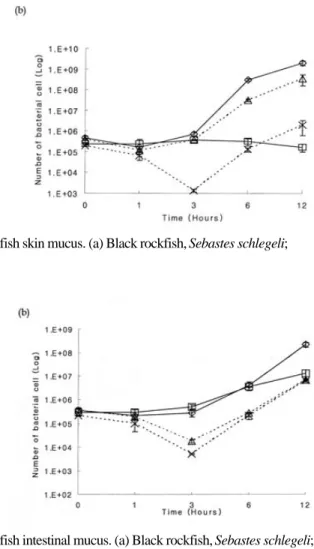
존을 유지하는 반면, 분리 균주 FR 2와 VIB 391 은 3 시간째까지 생존 후 12 시간째까지 급격히 증식할 수 있는 것으로 나타났다. 특히, 분리 균 주 FR 2 균주의 증식율이 가장 높은 것으로 나 타났다 (Fig. 1).

어류 류 장 장 점 점액 액 내 내에 에서 서의 의 생 생존 존능 능

V. harveyi의 조피볼락과 넙치의 체표 장 점액 에서의 생존능을 조사한 결과, 분리 균주 FR 2 와 참조 균주 ATCC 35084는 조피볼락 장 점액 내에서 3 시간째까지 생존을 유지하다가 3 시간 이후부터 증식을 하였으며, 분리 균주 VIB 391 과 참조 균주 ATCC 14126은 3 시간째까지 사멸

되다가 3 시간째부터 증식하였으며 6 시간째 이 후에는 생존을 유지하였다 (Fig. 2). 넙치 장 점 액 내에서 분리 균주 FR 2와 참조 균주 ATCC 35084는 3 시간째까지 생존을 유지하다가 3 시 간 이후부터 증식을 하였으며, 분리 균주 VIB 391과 참조 균주 ATCC 14126은 3 시간째까지 사멸되다가 3 시간째부터 증식하였다. 특히, 분리 균주 FR 2의 조피볼락 장 점액 내 증식이 가장 활발한 것으로 나타났다 (Fig. 2).

어류 류 혈 혈청 청 내 내에 에서 서의 의 생 생존 존능 능

V. harveyi의 조피볼락과 넙치의 혈청 내에서 생존능을 조사한 결과, 조피볼락 혈청 내에서 Fig. 1. Survival of the isolates and the reference strains in the fish skin mucus. (a) Black rockfish, Sebastes schlegeli;

(b) Olive flounder, Paralichthys olivaceus.

Fig. 2. Survival of the isolates and the reference strains in the fish intestinal mucus. (a) Black rockfish, Sebastes schlegeli;

(b) Olive flounder, Paralichthys olivaceus.

(6)

분리 균주 FR 2만이 증식하였고 분리 균주 VIB 391은 성장이 강하게 억제되었다. 또한 참조 균 주 ATCC 35084는 3 시간째까지 다소 증식하다 가 3 시간 이후 억제되었으며 참조 균주 ATCC 14126은 3 시간째까지 억제되다가 3 시간 이후 증식하였다 (Fig. 3). 넙치 혈청 내에서는 분리 균주 FR 2가 강한 증식을 나타내었으며 분리 균 주 VIB 391은 약하게 억제되었다. 또한 참조 균 주 ATCC 35084와 ATCC 14126은 조피볼락 혈 청 내에서의 생존능과 비슷한 결과를 나타내었 다 (Fig. 3).

조피볼락에 대한 V. harveyi의 인위 감염 실험 V. harveyi를 조피볼락에 복강 주사한 결과, 분 리 균주 FR 2의 LD

50

값이 4.5×10

6

cfu/fish로 높 은 병원성을 보였으며 분리 균주 VIB 391의 LD

50

값이 4.7×10

9

cfu/fish로 매우 낮은 병원성 을 나타내었다. 또한 참조 균주 ATCC 35084는 1

×10

8

cfu/fish, ATCC 14126은 1×10

10

cfu/fish을

나타내었다 (Table 3).

고 찰

V. harveyi는 새우류 뿐 아니라 다양한 해수 어 종에서 발병 보고되고 있으며 이에 대한 V. har- veyi의 병원성 기작으로는 extracellular products (ECPs) (Zhang and Austin, 2000), bacteriophage (Munro et al., 2003) , siderophore (Owens et al., 1996) 및 세균 표면의 소수성 등이 알려져 있다 (Ruangpan et al., 1999; Soto-Rodriguez et al., 2003). 또한 non-luminous V. harveyi가 다양한 해 수 어류에 병원성을 나타낸다는 것은 많은 연구 에서 입증되었으나 (Colwell and Grimes, 1984;

Grimes et al., 1984; Kraxberger-Beatty et al., 1990;

Ishimaru and Muroga, 1997; Soffientino et al., 1999; Lee et al., 2002; Zorrilla et al., 2003), lumi- nous V. harveyi의 해수 어류에 대한 병원성 연구 는 미흡한 실정이다.

Zhang and Austin (2000)은 V. harveyi E18 균주 Fig. 3. Survival of the isolates and the reference strains in the fish fresh serum. (a) Black rockfish, Sebastes schlegeli; (b) Olive flounder, Paralichthys olivaceus.

Table 3. The lethal dose (LD50
) of Vibrio harveyi in the intraperitoneally injected black rockfish, Sebastes schlegeli for 7 days

FR 2 VIB 391 ATCC 35084 ATCC 14126

LD

50

(cfu/fish) 4.5×10

6

4.7×10

9

1×10

8

1×10

10

(7)

와 M3G3 균주가 sheep 과 rabbit 등의 적혈구에 대한 haemolytic activity가 가장 높았으나 trout과 salmon에 대한 폐사율이 나타나지 않았고 V.

harveyi VIB 661 균주는 haemolytic activity가 가 장 낮았음에도 불구하고 trout과 salmon에 대한 폐사율이 60% 이상임을 보고하였다. 또한 Garcia Moreno 등 (1998)은 Vibrio vulnificus의 haemolytic activity는 병원성과 관계없음을 보고 하였다. 본 연구에서도 시험 균주나 시험 어종에 따라서 용혈능이 다양하게 나타났으며 공격 실 험에서 독성이 강하게 나타난 분리 균주 FR 2와 독성이 약한 균주 간의 용혈능에 뚜렷한 차이 가 없었으므로 V. harveyi의 병원성 기작에 haemolytic activity가 미치는 영향은 그다지 크 지 않을 것으로 생각된다.

Smith 등 (1988)에 의하면 병원체가 숙주 조직 에서 생존하고 증식할 수 있는 능력이 병원성과 매우 높은 상관성을 보인다고 하였다. 본 연구 결과, V. harveyi가 점액에서 증식할 수 있었으며, 어류의 혈청 내에서도 증식하였다. 조피볼락과 넙치의 체표와 장 점액에서의 증식능은 분리 균 주 FR 2가 가장 강한 증식을 나타내었다. 어류 혈청에서 생존할 수 있는 능력은 병원성 세균과 비병원성 세균을 구별할 수 있는 중요한 지표 가 되며, Leung 등 (1994)에 의하면 비병원성 Aeromonas hydrophila가 틸라피아의 혈청에서 기하 급수적으로 감소하는 반면에 병원성의 A.

hydrophila는 지속적으로 생존한다고 하였다. 이 러한 특성은 rainbow trout에 cold water disease를 유발하는 Flavobacterium psychrophilum에서도 동일하게 나타났다 (Wiklund and Dalsgaard, 2002). 시험 균주 V. harveyi의 어류 혈청 내 생존 능은 분리 균주 FR 2가 가장 높은 증식능을 나 타내었다. 또한 분리 균주 VIB 391은 조피볼락 혈청에서 증식이 매우 강하게 억제되었으나 넙 치 혈청에서는 매우 약하게 억제되었다. 이러한 결과, 분리 균주 VIB 391이 두 어종의 점액과 혈 청에서 증식능이 억제됨으로써 어류에 대해 독 성이 낮은 병원균일 것으로 예상된다.

조피볼락에 시험 균주 V. harveyi를 인위 감염 시켜 병원성을 확인한 결과, luminous V. harveyi 분리 균주 FR 2의 LD

50

값은 4.5×10

6

cfu/fish로 병원성이 강하게 나타났으나, non-luminous V.

harveyi 분리 균주 VIB 391은 LD

50

값이 4.7×10

9

cfu/fish, 참조 균주 ATCC 14126은 LD

50

값이 1

×10

10

cfu/fish로 매우 낮은 독성을 나타내었다.

이러한 본 연구의 결과는 Zhang and Austin (2000)이 trout과 salmon에 다양한 non-luminous V. harveyi 분리 균주와 luminous V. harveyi 분리 균주를 인위 감염 시켰을 때와 일치한다. Non- luminous V. harveyi 분리 균주에 대한 폐사율은 한 균주를 제외 하고는 trout에서 60% 이상, salmon에서는 20% 이상을 나타내어 대부분의 균주가 병원성을 나타내었으며 luminous V. har- veyi 분리 균주에 대한 폐사율은 0과 20%로 병 원성이 약하게 나타났다.

이들 결과로 미루어 볼 때, 조피볼락에서는 non-luminous V. harveyi 분리 균주 FR 2가 강한 병원성을 나타내었으며 luminous V. harveyi 분리 균주 VIB 391은 매우 약한 병원성을 나타내어 luminescence의 유무에 따라 해수 어종에 대한 병원성의 차이가 있을 것으로 생각된다.

또한 본 논문에서는 각각 하나의 균주로 실험 을 하였으나 luminescence의 유무에 따른 해수 어종에 대한 병원성 차이를 명확히 규명하기 위 해서는 다양한 non-luminous 와 luminous V. har- veyi 분리 균주를 사용하여 해수 어류에 대한 병 원성 연구가 필요할 것으로 사료된다.

요 약

본 연구는 Vibrio harveyi의 luminescence 유무

와 해수 어류에 대한 병원성의 관계를 알아보고

자 non-luminous V. harveyi 와 luminous V. harveyi

분리 균주로 조피볼락에 대한 병원성 시험을 시

행하였다. 시험 균주 V. harveyi 모두 haemolytic

activity를 나타내었으며, 어체 내 생존능은 non-

luminous V. harveyi 분리 균주 FR 2가 강한 생존

(8)

능을 나타내었다. 또한 조피볼락에 인위 감염시, non-luminous V. harveyi 분리 균주 FR 2가 강한 병원성을 나타내었으며 luminous V. harveyi 분리 균주 VIB 391은 낮은 병원성을 나타내었다. 결 론적으로 조피볼락에서는 non-luminous V. har- veyi 분리 균주 FR 2가 강한 병원성을 나타내었 으며 luminous V. harveyi 분리 균주 VIB 391은 매우 약한 병원성을 나타내어 luminescence의 유무에 따라 해수 어종에 대한 병원성의 차이가 있을 것으로 생각된다.

참 고 문 헌

Alvarez, J.J., Austin, B., Alvarez, A.M. and Reyes, H.: Vibrio harveyi: a pathogen of penaeid shrimps and fish in Venezuela. J. Fish Dis., 21: 313-316, 1998.

Colwell, R.R. and Grimes, D.J.: Vibrio disease of marine fish populations. Helgolander Meeresuntersuchunger, 37: 265-287, 1984.

Garcia Moreno, M.L. and Landgraf, M.: Virulence factors and pathogenicity of Vibrio vulnificus strains isolated from seafood. J. Appl. Mi- crobiol., 84: 747-751, 1998.

Grimes, D.J., Stemmler, J., Hada, H., May, E.B., Maneval, D., Hetrick, F.M., Jones, R.T., Stoskopf, M. and Colwell, R.R.: Vibrio species associated with mortality of sharks held in captivity. Microb. Ecol., 10: 271-282, 1984.

Ishimaru, K. and Muroga, K.: Taxonomical re-ex- amination of two pathogenic Vibrio species isolated from milkfish and swimming crab.

Fish Pathol., 32: 59-64, 1997.

Karunasagar, I., Pai, R., Malath, G.R. and Karunasagar, I.: Mass mortality of Penaeus monodon larvae due to antibiotic-resistant Vibrio harveyi infection. Aquaculture, 128:

203-209, 1994.

Kim, D.H.: Studies on probiotics and microbial di- versity in the intestine of rainbow trout (On- corhynchus mykiss). ph. D. Thesis. Heriot- watt univerity., 57-58, 2006.

Kraxberger-Beatty, T., McGarey, D.J., Grier, H.J.

and Lim, D.V.: Vibrio harveyi, an oppor- tunistic pathogen of common snook, Cen- tropomus undecimalis (Bloch), held in cap- tivity. J. Fish Dis., 13: 557-560, 1990.

Lavilla-Pitogo, C.R., Baticados, M.C.L., Cruz-Laci- erda, E.R. and de la Pena, L.D.: Occurrence of luminous bacterial disease of Penaeus monodon larvae in the Philippines. Aquacul- ture, 91: 1-13, 1990.

Lee, K.K., Liu, P.C. and Chuang, W.H.: Pathogene- sis of gastroenteritis caused by Vibrio car- chariae in cultured marine fish. Mar.

Biotechnol., 4: 267-277, 2002.

Leong, T.S. and Wong, S.Y.: Environmental in- duced mortality of cultured grouper Epi- nephelus malabaricus infected with high density of monogeneans and vibrios. In:

Programme and Abstracts of the second symposium on diseases in Asian aquaculture (Phuket). Manila: Health Section of the Asian Fisheries Society: p37, 1993.

Liu, P.C., Lee, K.K., Yii, K.C., Kou, G.H. and Chen, S.N.: Isolation of Vibrio harveyi from diseased kuruma prawns Penaeus japonicus.

Curr. Microbiol., 33: 129-132, 1996.

Liu, P.C., Lee, K.K., Tu, C.C. and Chen, S.N.: Pu- rification and characterization of a cysteine protease produced by pathogenic luminous Vibrio harveyi. Curr. Microbiol., 35: 32-39, 1997.

Liu, P.C. and Lee, K.K.: Cysteine protease is a ma-

jor extoxin of pathogenic luminous Vibrio

harveyi in the tiger prawn, Penaeus mon-

odon. Letters Appl. Microbiol., 28: 428-430,

(9)

1999.

Liu, P. C., Chuang, W. H. and Lee, K. K.: Infectious gastroenteritis caused by Vibrio harveyi (V.

carchariae) in cultured red drum, Sciaenops ocellatus. J. Appl. Ichthyol., 19: 59-61, 2003.

Miles, A.A. and Misra, S.S.: The estimate of the bacterial power of the blood. J. Hygiene, 38:

873-885, 1938.

Munro, J., Oakey, J., Bromage, E. and Owens, L.:

Experimental bacteriophage-mediated viru- lence in strains of Vibrio harveyi. Dis.

Aquat. Org., 54: 187-194, 2003.

Owens, l., Austin, D.A. and Austin, B.: Effect of strain origin on siderophore production in Vibrio harveyi isolates. Dis. Aquat. Org., 27:

157-160, 1996.

Pedersen, K., Verdonck, L., Austin, B., Austin, D.A., Blanch, A.R., Grimont, P.A.D., Jofre, J., Koblavi, S., Larsen, J.L., Tiainen, T., Vi- gneulle, M. and Swings, J.: Taxonomic evi- dence that Vibrio carchariae Grimes et al.

1985 is junior synonym of Vibrio harveyi (Johnson and Shunk 1936) Baumann et al.

1981. Int. J. Syst. Bacteriol., 48: 749-758, 1998.

Pizzutto, M. and Hirst, R.G.: Classification of iso- lates of Vibrio harveyi virulent to Penaeus monodon larvae by protein profile analysis and M13 DNA fingerprinting. Dis. Aquat.

Org., 21: 61-68, 1995.

Robertson, P.A.W., Calderon, J., Carrera, L., Stark, J.R., Zherdmant, M. and Austin, B.: Experi- mental Vibrio harveyi infections in Penaeus vannamei larvae. Dis. Aquat. Org., 32: 151- 155, 1998.

Ruangpan, L., Danayadol, Y., Kirekbusarakom, S., Siurairatana, S. and Flegel, T.W.: Lethal tox- icity of Vibrio harveyi to cultivated Penaeus

monodon induced by a bacteriophage. Dis.

Aquat. Org., 35: 195-201, 1999.

Smith, H.: The state and future of studies on bacter- ial pathogenicity. In: Rothe, J. A. (ed) Viru- lence mechanisms of bacterial pathogens.

ASM, Washington, 1998.

Soffientino, B., Gwaltney, T., Nelson, D.R., Speck- er, J.L., Mauel, M. and Gomez-Chiarri, M.:

Infectious necrotizing enteritis and mortality caused by Vibrio carchariae in summer flounder Paralichthys dentatus during inten- sive culture. Dis. Aquat. Org., 38: 201-210, 1999.

Soto-Rodriguez, S.A., Roque, A., Lizarranga-Parti- da, M.L., Guerra-Flores, A.L. and Bomez- Gil, B.: Virulence of luminous vibrios to Artemia franciscana nauplii. Dis.Aquat.

Org., 53: 231-240, 2003.

Sunaryanto, A. and Mariam, A.: Occurrence of a pathogenic bacteria causing luminescence in penaeid larvae in Indonesian hatcheries.

Bull. Brackishwater Aquacult. Devel. Cen., 8: 105-112, 1986.

Vandenberghe, J., Li, Y., Verdonck, L., Li, J., Sorgeloos, P., Xu, H.S. and Swings, J.: Vib- rio associated with Penaeus chinensis (Crus- tacea: Decapoda) larvae in Chinese shrimp hatcheries. Aquaculture, 169: 121-132, 1998.

Wiklund, T. and Dalsgaard, I.: Survival of Flavobacterium psychrophilum in rainbow trout (Oncorhynchus mykiss) serum in vitro.

Fish Shellfish Immunol., 12: 141-153, 2002.

Won, K.M., Kim, S.M. and Park, S.I.: Characteriza- tion of Vibrio harveyi, the causal agent of vibriosis in cultured marine fishs in korea. J.

Fish Sci. Technol., 9: 123-128, 2006.

Zhang, X.H. and Austin, B.: Pathogenicity of Vibrio

harveyi to salmonids. J. Fish Dis., 23: 93-

(10)

102, 2000.

Zorrilla, I., Arijo, S., Chabrillon, M., Diaz, P., Mar- tinez-Manzanares, E., Balebona, M. C. and Morinigo, M.A.: Vibrio species isolated from diseased farmed sole, Solea senegalen- sis (Kaup), and evaluation of the potential virulence role of their extracellular products.

J. Fish Dis., 26: 103-108, 2003.

醫化學硏究所學友會: 細菌學實習提要. pp 566- 568. (In Japanese), 1976.

Manuscript Received : March 27, 2007 Revision Accepted : May 17, 2007 Responsible Editorial Member : Myung-Joo Oh

(Chonnam Univ.)

수치

Table 1. Bacterial strains used in this study
Fig. 2. Survival of the isolates and the reference strains in the fish intestinal mucus
Table 3. The lethal dose (LD 50 ) of Vibrio harveyi in the intraperitoneally injected black rockfish, Sebastes schlegeli for 7 days

참조

관련 문서

암모니아 노출에 따른 조피볼락의 혈장 코티졸 및 글 루코스는 Fig. Levels of gill NKA activity in Korean rockfish, Sebastes schlegeli exposed to ammonia. Levels of

Effects of temperature (13±1.5℃, 23±1.5℃) on the pharmacokinetic properties of oxolinic acid (OA) were studied after oral administration to cultured black rockfish,

We constructed a black rockfish (Sebastes schlegeli) leukocyte cDNA library and a total of 386 expressed sequence tag (EST) clones were generated.. Gene annotation procedures

Relationship between otolith radius and ring radi- us of the black rockfish, Sebastes schlegeli in the Tongyeong marine ranching area in

containing highly unsaturated fatty acids and to study the impacts of n-3-HUFA enriched Moina on improving survival rate and fatty acid compostion of larval rockfish

Body Composition of Black Rockfish Sebastes schlegeli Fed on Diets Containing Different Levels of Turmeric Curcuma longa L.. This study investigated the effect of

Effects of dietary β-1,3 glucan on growth and immune responses in juvenile olive flounder, Paralichthys olivaceus. Immunostimulation of antibody- producing cells

Genetic Variations of Outer Membrane Protein Genes of Vibrio harveyi Isolated in Korea and Immunogenicity of OmpW in Olive Flounder,..