서 론
산소 소비율은 가장 널리 이용되고 있는 대사율의 지 표로서(Kaushik, 1998), 어류의 생존 및 성장에 필요한
─
─ 1 ──
조피볼락, Sebastes schlegeli의 산소 소비율에 미치는 수온과 체중의 영향
오승용*∙노충환∙명정구∙조재윤1
한국해양연구원 해양생물자원연구본부, 1부경대학교 양식학과
Effects of Water Temperature and Body Weight on Oxygen Consumption Rate of Black Rockfish, Sebastes schlegeli
Sung-Yong Oh*, Choong Hwan Noh, Jung-Goo Myoung and Jae-Yoon Jo1 Marine Resources Research Department, Korea Ocean Research &
Development Institute Ansan P.O. Box 29, Seoul 425-600, Korea
2Department of Aquaculture, Pukyong National University, Busan 608-737, Korea
The effect of water temperature (T) and body weight (W) on the oxygen consumption of the fasted black rockfish, Sebastes schlegeli was investigated to provide empirical data for the culture management and bioenergetic growth model of this species. The mean wet body weights of two fish groups used for the present experiment were 12.9±2.7 g (mean±SD) and 351.1±9.2 g. The oxygen consumption rate (OCR) was measured under three water tempera- ture regimes (15, 20 and 25�C) at an interval of 5 minutes for 24 hours using a continuous flow- through respirometer. In each treatment three replicates were set up and 45 fish in small size groups and 6 fish in large size groups were used. The OCRs increased with increasing water temperature in both size groups (p⁄0.001). Mean OCRs at 15, 20 and 25�C were 414.2, 691.5 and 843.8 mg O2 kg-1 h-1 in small size groups, and 182.0, 250.7 and 328.2 mg O2kg-1 h-1 in large size groups, respectively. The OCRs decreased with increasing body weights in three water temperature groups (p⁄0.001). The mass effect on metabolic rate can be expressed by the power of 0.69~0.75. The data are best described by the relationship: OCR==89.12++ 28.79T-1.17W. Q10values ranged 1.90~2.79 between 15 and 20�C, 1.49~1.71 between 20 and 25�C, and 1.80~2.03 over the full temperature range, respectively. The energy loss by meta- bolic cost increased with increasing water temperature and decreasing body weight (p⁄0.001).
Mean energy loss rates by oxygen consumption at 15, 20 and 25�C were 282.9, 472.3 and 576.3 kJ kg-1 d-1 in small size groups and 124.3, 171.3 and 224.1 kJ kg-1 d-1 in large size groups, respectively.
Key words : Sebastes schlegeli, oxygen consumption rate, water temperature, body weight
*Corresponding author: [email protected]
생체 내 물질의 생산∙유지 및 어체가 이용할 수 있는 에너지로의 전환을 위한 모든 물리∙화학적 반응에 관 한 중요한 정보를 제공한다(Degani et al., 1989). 특히 대사활동에 의한 에너지 소비는 양식 어류의 에너지 수 지의 상당한 부분을 차지하며(Adams and Breck, 1990), 성장을 예측할 수 있는 생체역학 모델에 중요한 인자로 고려된다(Bartell et al., 1986). 또한 대사율은 어류 사육 경비의 50~60% (Sveier and Lied, 1998; Okumus and Bascinar, 2001)를 차지하는 사료의 에너지 요구량을 계 산하는데 유용하게 이용할 수 있어 산업적 측면에서도 산소 소비율에 관한 자료는 중요하다(Degani et al., 1989).
어류의 산소 소비율은 개체 크기, 수온, 염분, 광주기, 먹이 공급 등과 같은 많은 생물학적∙무생물학적 요인 들의 영향을 받는다(Brett, 1987). 특히, 수온은 모든 생 리적 대사과정에 직접적인 영향을 미치는 대사 조절인 자로서(Brett and Groves, 1979), 어류의 생존과 성장에 있어 가장 중요한 환경인자들 중의 하나이다(Peck et
al., 2005). 어류는 성장함에 따라 대사작용에 필요로 하
는 에너지 소비가 다르며, 일반적으로 단위 체중 당 소 형어는 대형어에 비해 더 많은 에너지, 즉 산소를 소비 한다(Fry, 1971; Dabrowski, 1986). 따라서 소형어와 대 형어의 사육밀도는 각각의 산소 소비율에 따라 달라질 수 있어, 크기에 따른 산소 소비율의 조사는 시스템 내 적합한 밀도 산정과 산소 공급을 위한 유수량을 결정하 는데 있어 기초 자료를 제공할 수 있다(Moore and Boyd, 1984; Avnimelech et al., 1992).
본 연구는 성장이 빠르고 저수온에 대한 생존력이 높 아 월동이 가능하며, 정착성이 강해 연안 자원 증대를 위한 방류 어종으로 매우 적합한 조피볼락(Sebastes
schegeli)을 대상으로 수온과 체중에 따른 산소 소비율,
Q10값 그리고 대사에 의한 에너지 소비율을 조사하여 생 존 및 성장을 위한 안정적인 사육환경 파악 및 생체역학 모델 개발을 위한 기초 자료를 제공하는데 의의가 있다.
재료 및 방법
1. 실험어 및 순치
실험어는 통영 소재 한국해양연구원 해상 가두리에서 사육 중인 조피볼락을 사용하였다. 산소 소비율을 측정 하기 전 실험어[소형어: 8.8±2.1 g (mean±SD, 습중량), 대형어: 336.8±8.3 g]는 400 L FRP 수조 2개와 침지식 생물여과조(1×1.5×2 m, 3.0 ton)로 이루어진 실내 순환 여과식 시설 2 set에 각각 300마리와 100마리씩 옮겨 2
주 동안20.0±0.1�C 조건에서 순치시켰다. 순치기간 동 안 조피볼락은 시판용 해산어 상품사료(E-hwa Feed Co., Korea, 단백질 함량 44.2~46.7%)를 일간 어체중의 2~3%를 공급하였으며, 수온은 히터와 냉각기를 이용하 여 조절하였다. 사육수 내 용존산소는 유량 조절과 에어 레이션을 통해 80% 이상의 포화상태를 유지하였다. 순 치 기간 동안 사육수의 pH는 8.2±0.1, 염분은 33.7± 0.4 psu를 유지하였다.
2. 실험 장치
산소 소비율을 측정하기 위해 호흡실, 산소 측정실, 저 수탱크(reservoir), 공급탱크(head tank), 카트리지 필터, 자외선 살균기로 이루어진Oh and Noh (2006)의 시스템 을 이용하였다. 공급탱크와 저수탱크 내 사육수는 자동 온도 조절 장치가 연결되어 있는 히터와 냉각기를 이용 하여 실험 수온을 유지하였고, 95% 이상의 산소 포화도 를 유지하기 위해 2~3개의 에어스톤을 블로워에 연결 하여 사용하였다. 사육수는 저수탱크에서 양수되어 공급 탱크로 들어가기 전에 1µm의 카트리지 필터 2개를 연 속적으로 거치도록 하여 입자성 부유물질의 영향을 최 소화하였고, 시스템 내에 미생물에 의한 미량의 산소 소 비를 줄이기 위해 유수식 자외선 살균기(Model: P301, 처리 용량 3 ton/hr, 삼지통상)를 통과하여 재순환하도록 하였다. 호흡실을 거쳐 나간 물은 산소 probe가 설치된 산소 측정실을 통과하도록 하였고, 유속은 호흡실 유입 수와 배출수간 용존산소 농도 차이가 최소한 0.2 mg/L 이 되도록 유지하였으며(Oh and Noh, 2006), 평균 유량 은53.6±0.4 L/h이었다.
3. 실험 방법
실험은 200 L 유리수조 1개와 침지식 생물여과조(1.0
×1.2×0.5 m, 0.6 ton)로 구성된 순환여과식 시스템 6 set에서 이루어졌다. 실내 수조에 순치된 실험어는 총 6 개의 유리수조에 소형어는60마리씩 3개 수조에, 대형어 는10마리씩3개 수조에 각각 분산 수용하였다. 분산 수 용된 실험어는 지속적으로20�C로 유지되어진 후, 각 실 험 수온(15, 20 그리고25�C)에 맞추어졌다. 20�C 실험구 2 set (소형어와 대형어 각 1 set씩)를 제외하고 15�C와 25�C 실험구 각 2 set는 20�C로부터3일간에 걸쳐 서서 히5�C를 낮추거나 높였다(Oh and Noh, 2006).
수온 조절이 이루어진 후 실험어를 10일 이상 각 실험 조건에 추가 순치시켰다. 순치 기간 중 사료는 하루에 어 체중의1~1.5% 비율로 공급하였다. 실험 시작 전 2일간 실험어들을 절식시킨 후 MS-222로 마취시켜 무게를 측
정한 후 순치된 실험 조건의 호흡실(0.1×0.3×0.2 m, 6 L)에 수용하였다. 소형어와 대형어의 평균 체중은 각각 12.9±2.7 g과 351.1±9.2 g이었으며, 호흡실에 각각15마 리와2마리씩 3반복 수용하여 실험을 실시하였다.
호흡실에 수용한 후 handling에 의한 영향을 배제하 기 위하여 3시간 동안 안정시킨 후 그 후 24시간 동안 산소 소비율을 측정하였다(Oh and Noh, 2006).
4. 용존산소량 측정 및 자료 처리
용존산소량의 측정은 산소 측정 전극과 Multi Data Logger System (Oxyguard, Denmark)을 사용하였다. 측 정실의 유입수와 배출수의 용존산소량은 µLog VL 100 Software를 이용하여 5분마다 측정되었고, 측정된 산소 량은 산소 측정 판넬을 통해 Data Logger에 저장되었 다. 이들 자료를 프로그램을 통해 다운로드하여 분석에 이용하였다. 수온과 체중에 따른 산소 소비율은 Jobling (1982)이 보고한 다음과 같은 방법에 따라 구하였다.
산소 소비율(mg O2kg-1h-1)==(Ci-Co)×Q/W 여기서, Ci==어류 호흡실 유입수의 용존산소 농도
(mg/L)
Co==어류 호흡실 배출수의 용존산소 농도 (mg/L)
Q==어류 호흡실을 지나가는 시간당 유량(L/h) W==호흡실 수용 어체중(kg)
계산된 산소 소비율은 1시간 단위로 pooling하여 일 간 산소 소비율 패턴과 시간당 평균 산소 소비율을 구 하였다.
대사율의 수온에 따른 민감도를 파악하기 위하여 다음 식(Wuenschel et al., 2005)과 같이 Q10값을 구하였다.
R2 Q10==
[
mmmR1]
여기서, R1과 R2는 수온 T1과 T2일 때의 평균 산소 소 비율
대사에 의한 에너지 소비를 알아보기 위해 Elliot and Davison (1975)이 보고한 산소 소모에 따른 에너지 전환 계수(1 mL O2==19.9 J==4.776 cal)를 이용하여 구하였다. 모든 자료의 통계처리는 SPSS 11.5 (SPSS Inc., USA) 통계 프로그램으로 수온에 대한 영향은 분산분석 (ANOVA)를 실시하여 Tukey’s multiple range test로 평 균간 유의성(p⁄0.001)을 검정하였고, 체중에 대한 영향 은 T-test로 검정하였다. 각 수온과 크기에 따른 시간당 평균 산소 소비율과 두 인자의 복합 영향은 two-way
ANOVA를 통해 검정하였다.
결 과
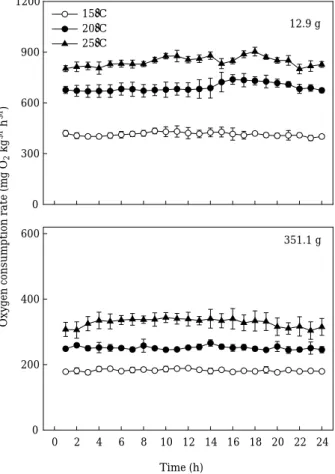
수온과 체중에 따른 조피볼락의 시간당 평균 산소 소 비율(oxygen consumption rate, OCR, mg O2kg-1h-1)의 일간 변화 패턴 및 그 결과는 Fig. 1과 Table 1에 나타 내었다. 소형어와 대형어 모두 높은 수온일수록 시간당 평균 산소 소비율은 유의하게 높았다(p⁄0.001). 소형어 (평균 무게 12.9 g)의 경우 수온이 15�C, 20�C 그리고 25�C에서 시간당 평균 산소 소비율은 각각 414.2, 691.5 그리고 843.8 mg O2kg-1h-1으로 높을수록 높았고, 대형 어(평균 무게 351.1 g) 또한 각각 182.0, 250.7 그리고 328.2 mg O2kg-1h-1으로 동일한 양상을 보였다. 수온(T) 에 따른 소형어와 대형어의 시간당 평균 산소 소비율은 각각 OCR==-209.34++42.95T (r2==0.96, p⁄0.001)와 OCR==-38.80++14.62T (r2==0.98, p⁄0.001)의 회귀식을
·mmmmmmm‚10 T2-T1
Oxygen consumption rate (mg O2 kg-1 h-1)
0 300 600 900 1200
15�C 20�C 25�C
Time (h)
0 2 4 6 8 10 12 14 16 18 20 22 24 0
200 400 600
12.9 g
351.1 g
Fig. 1. Diurnal patterns of oxygen consumption rate in fasted black rockfish Sebastes schlegeli for dif- ferent water temperatures and body weights.
Values represent mean±SE (n==3).
보였다.
동일 수온에서 체중 증가에 따라 시간당 평균 산소 소비율은 유의하게 감소하였다(p⁄0.001, Table 1). 15�C 의 경우 소형어에 비해 대형어의 시간당 평균 산소 소 비율은 평균 56.1% 낮았으며, 20�C와 25�C에서는 각각 63.7%와 61.1% 낮았다. 산소 소비율에 대한 체중의 영
향은15, 20 그리고 25�C에서 각각 0.75 (==1-0.25), 0.69 (==1-0.31) 그리고 0.71 (==1-0.29)의 지수(power)로 나 타났다(Table 1). 이상의 결과에서 조피볼락의 시간당 산소 소비율(OCR, mg O2kg-1h-1)은 수온(T) 증가와 체 중(W) 감소에 따라 증가하는 상관관계(OCR==89.12++ 28.79T-1.17W, r2==0.92, p⁄0.001, Fig. 2)를 보였다.
수온과 체중에 따른 Q10 값은 Table 2에 나타내었다. Fig. 2. Three dimensional diagram showing the relation-
ships between water temperature, body weight and oxygen consumption rate of black rockfish Sebastes schlegeli.
1000
800
600
400
Oxygen consumption rate (mg O
2kg-1h-1)
Body w
eight(g) Temperature
(�C) 200
4000 300
200 100 0
20
15
25
Water temperature (�C)
15 20 25
Energy loss (kJ kg-1 d-1)
0 200 400 600 800
12.9 g 351.1 g
A
B
C
a
b
c
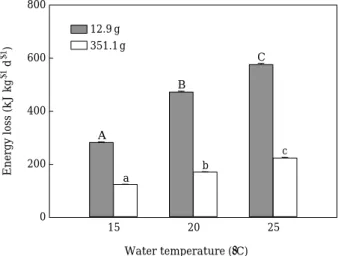
Fig. 3. Metabolic energy loss under different water tem- peratures and body weights in black rockfish Se- bastes schlegeli. Values indicate mean±SE (n==3).
Significant differences between groups are indicat- ed with different letters (p⁄0.001).
Table 1. The effect of water temperature (T) and body weight (W) on oxygen consumption rate (OCR) of the cultured black rockfish Sebastes schlegeli
W (g) 12.9 351.1
Regression
T (�C) mg O2kg-1h-1
15 414.2±2.19a*(a)** 182.0±0.74a(b) OCR==782.85W-0.25
(r2==0.99, p⁄0.001)
20 691.5±4.78b(a) 250.7±1.06b(b) OCR==1516.38W-0.31
(r2=0.99, p⁄0.001)
25 843.8±5.83c(a) 328.2±2.55c(b) OCR==1752.46W-0.29
(r2==0.99, p⁄0.001) Regression OCR==-209.34++42.95T OCR==-38.80++14.62T
(r2==0.96, p⁄0.001) (r2==0.98, p⁄0.001) Two-way ANOVA
d.f. SS MS F P
T 2 2016381 1008190 3613.42 0.000
W 1 5650839 5650839 20000.00 0.000
T×W 2 517539 258770 927.45 0.000
Error 138 38504 279
*Values (mean±SE) with different superscripts within the same column are significantly different (n==3, p⁄0.001).
**Values (mean±SE) with different superscripts in parenthesis within the same row are significantly different (n==3, p⁄0.001).
15~20�C 구간의 Q10 값은 소형어와 대형어에서 각각 2.79와 1.90이었으며, 20~25�C 구간에서는 각각1.49와 1.71로서, 소형어와 대형어 모두 15~20�C 구간에 비해 20~25�C 구간의 Q10값이 감소하였다. 전 수온 범위 (15~25�C)의 Q10값은 각각 2.03과 1.80으로 소형어에 서 높게 나타났다. 특히, 15~20�C 구간에서 소형어 (Q10==2.79)가 대형어(Q10==1.90)에 비해 수온에 대한 민 감도가 높게 나타났으며, 20~25�C 구간에서 개체 크기 간에 보인 양상과 차이를 보였다.
다양한 수온과 체중 차에 따른 조피볼락의 대사작용 에 관여한 에너지는Fig. 3에 나타내었다. 소형어의 평균 일간 대사 에너지 소비율은 수온 15, 20 그리고 25�C에 서 각각 282.9, 472.3 그리고 576.3 kJ kg-1d-1이었으며, 대형어는 각각 124.3, 171.3 그리고 224.1 kJ kg-1d-1로 나타나 수온 상승에 따라 유의하게 증가하였으며, 대형어 보다 소형어에서 높은 에너지 소비율을 보였다(p⁄0.001).
고 찰
수온은 조피볼락의 대사율에 직접적인 영향을 미치는 대사 조절인자로 작용했으며, 수온 상승에 따른 산소 소 비율 증가는 타 연구 결과들과 일치하였다(Cai and Summerfelt, 1992; Fonds et al., 1992; Lyytikäinen and Jobling, 1998; Mitsunaga et al., 1999). 일반적으로 어류 의 산소 소비율은 서식 수온 범위 내에서 온도 상승에 따라 직선적으로 증가하며(Tytler and Calow, 1985;
Kim et al., 1995), 본 실험 결과도 일치하였다. Kim et al.
(1995)은 평균3.45 g의 조피볼락을 대상으로 24시간 절 식 후 수온 15.2�C와 24�C에서 각각 52.9와 488.2 mL O2 kg-1h-1 (단위 환산75.7과698.1 mg O2kg-1h-1)의 산 소 소비율을 보여 수온(T) 상승에 따라 직선적으로 (OCR==-634.26++44.80T) 증가하였지만, 본 실험의 소형 어(12.9 g) 결과(OCR==-209.34++42.95T)와 다소 차이를 보였다. Kim and Chin (1995)은 체중 2.9~3.1 g의 조피 볼락을 대상으로 수온 24�C에서 24시간 절식 후 평균 0.84 mL O2g-1h-1(단위 환산 1,201 mg O2kg-1 h-1)의 산소 소비율을 보고하였으며, 이 수치는 본 실험의 수
온, 체중을 고려한다면 비슷한 결과로 생각된다. 체중 증가에 따른 산소 소비율 감소는 일반적인 경향 을 나타내었다(Beamish, 1964; Fry, 1971; Dabrowski, 1986; Degani et al., 1989; Cai and Summerfelt, 1992).
체중(W)에 따른 산소 소비[Oxygen consumption (OC), mg O2/h]의 회귀곡선은 OC==aWb(a, b는 상수)의 형태로 서, 양변을 체중으로 나누면 바로 산소 소비율(OCR== aWb-1)을 나타낸다. 이때 체중의 영향인 지수(b)는 대체 로 0.5~1.0사이이며, 일반적으로는 0.7~0.9 사이이다 (Fry, 1971; Paul, 1986; Paul et al., 1988). Cai and Summerfelt (1992) 또한 4~133 g의 walleye (Stizoste- dion vitreum)를 대상으로 20�C와 25�C에서 체중 증가 에 각각 64%와 77%의 산소 소비율 감소를 보고하였으 며, b 값은 각각 0.86과 0.78이었다. 본 실험 결과 역시 15, 20 그리고 25�C에서 체중 증가에 따라 각각 56.1%, 63.7% 그리고 61.1% 감소하였으며, 체중의 영향은 각각 0.75, 0.69 그리고 0.71로서 이전 연구 결과와 유사하였 다. 수온에 따른 산소 소비율 증가 역시 대형어보다 소 형어에서 높게 나타나, 뱀장어(Anguilla anguilla)를 대 상으로 한Degani (1989)의 결과와 일치하였다.
Q10값은 온도 변화에 적응하기 위한 수서 생물의 대 사량으로, 온도 상승으로 인한 체내 효소 반응과 생리학 적 작용으로 유발된 에너지 요구량을 나타낸다(Spano- poulos-Hernández et al., 2005). 본 실험 결과 소형어와 대형어 모두 20~25�C에서보다 15~20�C에서 높은 온 도 민감성을 보였으며, 특히 대형어보다는 소형어(Q10== 2.79, 15~20�C)에서 민감성이 높게 나타났다. 조피볼락 과 같은 속( ) 어류인 볼락(Sebastes inermis)을 대상으 로 한 실험에서도 역시 동일한 경향의 Q10값을 보였다 (Oh and Noh, 2006). 그러나 20~25�C 구간에서는 소형 어의 온도에 대한 민감도가 크게 떨어져 대형어보다 낮 은 수준을 보였다. 이는 수온 구간에 따른 크기별 적응 능력이 다름을 보여준다. 전 실험 수온 범위인 15~25�C 에서Q10값은 소형어에서 2.03 그리고 대형어에서 1.80 으로(Table 2), 다른 어종에서 일반적으로 알려져 있는 2~3 범위(Fry, 1971; Bridges, 1988)와 거의 유사하였 고, 낮은 Q10값을 보인 대형어의 수온 적응력이 높은 것으로 나타났다(DeSilva et al., 1986). 이상의 결과에서 수온의 상승과 먹이 공급이 증가하기 시작하는 봄철에 소형어와 대형어 모두 대사율 증가가 예상되며, 특히 소 형어가 훨씬 높아 이에 따른 적절한 용존산소의 유지 및 사육관리가 있어야 할 것으로 생각된다.
대사활동에 의한 에너지 소비는 에너지 수지에 있어 상당한 부분을 차지한다(Adams and Breck, 1990). 본 실험 결과 수온과 체중은 조피볼락의 대사 에너지 소비 Table 2. Q10value of the black rockfish Sebastes schlegeli
for different water temperature ranges and body weights
Body weight (g) Temperature interval (�C)
15~20 20~25 15~25
12.9 2.79 1.49 2.03
351.1 1.90 1.71 1.80
율에 주된 영향을 미쳤다(Fig. 3). 이것은 조피볼락의 수 온과 크기별 사료 개발(Degani et al., 1989) 그리고 에너 지 수지에 관한 생체역학 모델 구축(Bartell et al., 1986) 에 있어 중요한 자료로 활용할 수 있을 것으로 생각된다.
이상의 결과에서 조피볼락의 산소 소비율은 수온과 체중 그리고 두 인자의 상호작용에 의해 유의한 차이를 보였으며, 이들 인자의 상관관계는 조피볼락의 생존 및 성장에 관한 생화학적 자료 뿐만 아니라 사육 관리를 위한 중요한 정보를 제공할 것이다.
적 요
조피볼락의 사육 관리 및 생체역학 모델 결정을 위한 기초자료를 수집하기 위해 수온과 체중에 따른 산소 소 비율(oxygen consumption rate, OCR)을 조사하였다. 절 식한 조피볼락 소형어(습중량, 12.9±2.7 g, 135마리)와 대형어(351.1±9.2 g, 18마리)를 대상으로 세 가지 수온 (15, 20, 25�C)에 따라 유수식 형태의 호흡실을 이용하여 24시간 동안 5분 간격으로(3반복) 산소 소비율을 측정 하였다. 수온과 체중 그리고 두 인자의 상호작용 모두가 조피볼락의 산소 소비율에 유의한 영향을 미쳤다 (p⁄0.001). 수온 상승에 따라 소형어와 대형어의 산소 소비율은 모두 유의적으로 증가하였다(p⁄0.001). 15, 20 그리고 25�C에서의 시간당 평균 산소 소비율은 소형어 에서 각각 414.2, 691.5 그리고 843.8 mg O2kg-1h-1였으 며, 대형어에서 각각 182.0, 250.7 그리고 328.2 mg O2
kg-1h-1이었다. 실험 수온 조건에서 체중 증가에 따라 산소 소비율은 유의하게 감소하였으며(p⁄0.001), 대사 율에 미치는 체중의 영향은 0.69~0.75 범위의 지수였 다. 조피볼락의 산소 소비율에 미치는 수온(T)과 체중 (W)의 상관관계는 OCR==89.12++28.79T-1.17W로 나타 났다. Q10값은 15~20�C, 20~25�C 그리고 15~25�C에 서 소형어와 대형어는 각각 2.79와 1.90, 1.49와 1.71 그 리고 2.03과 1.80이었다. 대사에 의한 에너지 손실은 수 온 증가와 체중 감소에 따라 증가하였다(p⁄0.001). 15, 20 그리고 25�C에서의 호흡 대사로 인한 일간 평균 에 너지 손실은 소형어에서 각각282.9, 472.3 그리고576.3 kJ kg-1d-1였으며, 대형어에서 각각 124.3, 171.3 그리고 224.1 kJ kg-1d-1이었다.
사 사
본 연구는 해양수산부의 연구 용역 과제인 “통영해역
의 바다목장화 개발 연구”의 지원으로 수행되었으며, 이 에 감사드립니다.
인 용 문 헌
Adams, S.M. and J.E. Breck. 1990. Bioenergetics. In:
Schreck, C.B. and P.B. Moyle (eds.), Methods for Fish Biology. American Fisheries Society, Bethesda, MA, pp.
389~415.
Avnimelech, Y., N. Mozes and B. Weber. 1992. Effects of aeration and mixing on nitrogen and organic matter transformations in simulated fish ponds. Aquacul.
Eng., 11 : 157~169.
Bartell, S.M., J.E. Breck, R.H. Gardner and A.L. Brenket.
1986. Individual parameter perturbation and error analysis of fish bioenergetics models. Can. J. Fish.
Aquat. Sci., 43 : 160~168.
Beamish, F.W.H. 1964. Respiration of fishes with special emphasis on standard oxygen consumption. II. Influ- ence of weight and temperature on respiration of seve- ral species. Can. J. Zool., 42 : 177~188.
Brett, J. 1987. Environmental factors affecting growth. In:
Hoare, W.H., D.J. Randall and S.R. Brett (eds.), Fish Physiology, vol. 8. Academic Press, pp. 252~259.
Brett, J.R. and T.D.D. Groves. 1979. Physiological ener- getics. In: Hoar, W.H., Randall, D.J. and Brett, J.R.
(eds.), Bioenergetics and Growth. Fish Physiology. vol.
8. Academic Press, New York, pp. 279~352.
Bridges, C.R. 1988. Respiratory adaptations in intertidal fish. Am. Zool., 28 : 79~96.
Cai, Y. and R.C. Summerfelt. 1992. Effects of temperature and size on oxygen consumption and ammonia excre- tion by walleye. Aquaculture, 104 : 127~138.
Dabrowski, K.R. 1986. Active metabolism in larval and juvenile fish: ontogenetic changes, effect of water tem- perature and fasting. Fish Physiol. Biochem., 1 : 125~
144.
Degani, G., M.L. Gallagher and A. Meltzer. 1989. The in- fluence of body size and temperature on oxygen con- sumption of the European eel, Anguilla anguilla. J.
Fish Biol., 34 : 19~24.
DeSilva, C.D., S. Premawansa and C.N. Keembiyahetty.
1986. Oxygen consumption in Oreochromis niloticus (L.) in relation to development, salinity, temperature and time of day. J. Fish Biol., 29 : 267~277.
Elliot, J.M. and W. Davison. 1975. Energy equivalents of oxygen consumption in animal energetics. Oecologia, 19 : 195~201.
Fonds, M., R. Cronie, A.D. Vethaak and P. Van Der Puly.
1992. Metabolism, food consumption and growth of plaice (Pleuronectes platessa) and flounder (Platichthys flesus) in relation to fish size and temperature. Neth. J.
Sea Res., 29 : 127~143.
Fry, F.E.J. 1971. The effect of environmental factors on the physiology of fish. In: W.S. Hoar and D.J. Randall.
(eds.), Fish Physiology. Academic Press, New York, pp.
1~98.
Jobling, M. 1982. A study of some factors affecting rates of oxygen consumption of plaice, Pleuronectes platessa L.
J. Fish Biol., 20 : 501~516.
Kaushik, S.J. 1998. Nutritional bioenergetics and estima- tion of waste production in non-salmonids. Aqua. Liv.
Res., 11 : 211~217.
Kim, C.H. and P. Chin. 1995. The effects of dietary energy /protein ratio on oxygen consumption, ammonia nitro- gen excretion and body composition in juvenile rock- fish, Sebastes schlegeli. J. Kor. Fish. Soc., 28 : 412~
420.
Kim, I.N., Y.J. Chang and J.Y. Kwon. 1995. The patterns of oxygen consumption in six species of marine fish. J.
Kor. Fish. Soc., 28 : 373~381.
Lyytikäinen, T. and M. Jobling. 1998. The effects of tem- perature fluctuations on oxygen consumption and am- monia excretion of underyearling Lake Inari Arctic charr. J. Fish Biol., 52 : 1186~1198.
Mitsunaga, Y., W. Sakamoto, N. Arai and A. Kasai. 1999.
Estimation of the metabolic rate of wild red sea bream Pagrus major in different water temperatures. Nippon Suisan Gakk., 65 : 48~54.
Moore, J.M. and C.E. Boyd. 1984. Comparisons of devices for aerating inflow pipes. Aquaculture, 38 : 89~96.
Oh, S.Y. and C.H. Noh. 2006. Effects of water temperature and photoperiod on the oxygen consumption rate of ju-
venile dark-banded rockfish, Sebastes inermis. J. Aqua- culture, 19 : 210~215.
Okumus, I. and N. Bascinar. 2001. The effects of different numbers of feeding days on feed consumption and growth of rainbow trout [Oncorhynchus mykiss (Wal- baum)]. Aquacult. Res., 32 : 365~367.
Paul, A.J. 1986. Respiration of juvenile pollock, Theragra chalcogramma (Pallas), relative to body size and tem- perature. J. Exp. Mar. Biol. Ecol. 97 : 287~293.
Paul, A.J., J.M. Paul and R.L. Smith. 1988. Respiratory energy growth requirements of the cod Gadus macro- cephalus Tilesius relative to body size, food intake, and temperature. J. Exp. Mar. Biol. Ecol., 122 : 83~89.
Peck, M.A., L.J. Buckley and D.A. Bengtson. 2005. Effects of temperature, body size and feeding on rates of meta- bolism in young-of-the-year haddock. J. Fish Biol., 66 : 911~923.
Spanopoulos-Hernández, M., C.A. Martínez-Palacios, R.C.
Vanegas-Pérez, C. Rosas and L.G. Ross. 2005. The com- bined effects of salinity and temperature on the oxygen consumption of juvenile shrimps Litopenaeus styliro- stris (Stimpson, 1874). Aquaculture, 244 : 341~348.
Sveier, H. and E. Lied. 1998. The effects of feeding regime on growth, feed utilization and weight dispersion in large Atlantic salmon (Salmo salar) reared in seawater.
Aquaculture, 165 : 333~345.
Tytler, P. and P. Calow. 1985. Fish Energetics: New Pers- pectives. Johns Hopkins University Press. Baltimore, MD. 349 p.
Wuenschel, M.J., A.R. Jugovich and J.A. Hare. 2005. Meta- bolic response of juvenile gray snapper (Lutjanus gri- seus) to temperature and salinity: Physiological cost of different environments. J. Exp. Mar. Biol. Ecol., 321 : 145~154.
Received: January 5, 2007 Accepted: March 5, 2007