• 검색 결과가 없습니다.

Systematic investigation of heavy metals from MSWI fly ash and bottom ash samples

N/A
N/A
Protected

Academic year: 2021

Share "Systematic investigation of heavy metals from MSWI fly ash and bottom ash samples"

Copied!
10
0
0

로드 중.... (전체 텍스트 보기)

전체 글

(1)

To whom corresponding should be addressed.

Tel : +82-00-00 E-mail :

Abstract

Disposal of municipal solid waste has become a major problem in many countries around the world.

As landfill space for the disposal of ash from Municipal Solid Waste Incineration (MSWI) becomes scarce, numerous reports and researches address the various environmental issues about the municipal solid waste incineration waste management and other particulate matters with the range of 10 ~ 2.5. Although in many developing and industrialization countries landfill with the disposal of municipal solid waste, open incineration has become a common practice. Large municipal waste incinerators are major industrial facilities and have the potential to be significant sources of environmental pollution. Despite the significant volume reduction from incineration, waste recycling is important to ensuring the future welfare of mankind.

The main goal of the present work is the physical and chemical characterization of the local incineration bottom ash towards its eventual re-utilization. In this paper, we reported the studies on physical and chemical characteristics of municipal solid waste incineration (MSWI) fly ash and bottom ash containing particulate matter whose particulate sizes are lower than PM

10

, PM

2.5

and heavy metal were investigated.

Key words : coal ash, particulate matter, heavy metals, carbonation

1. INTRODUCTION

Municipal solid waste (MSW) is an inevitable by- product of civilization and a prime target for clean technology innovation. It is threat to public health and environmental security and a strategic renewable resource. This solid waste generated globally is ex- pected to grow from 1.5 billion tons in 2014 to 2.2 billion tons by 2023. 97% of waste volume growth is expected to come from Asia Pacific and Africa, primarily in developing economies across these regions. The incineration of municipal solid waste is an alternative method for sustainable environment [1].

On a global scale, calculating the amount of waste generated is challenging because many countries do not track waste generation or disposal statistics. World Bank estimates that roughly 3 billion urban residents generated an average 1.2 billion kg per capita per day (1.3 billion tonnes per year or 1.43 billion tonnes per year) in 2012. By 2025, this is expected to increase to 4.3 billion urban residents generating about 1.42 kg per capita per day of MSW (2.2 bil- lion tonnes per year or 2.4 billion tonnes per year).

This represents a 900 million tonnes (992 million tonnes) increase in a little over a decade, a near dou- bling of the total volume of MSW generated globally today [2].

Municipal Solid Waste (MSW) Management is be-

coming an integral part of the urban environment

and planning of the modern infrastructure to ensure

(2)

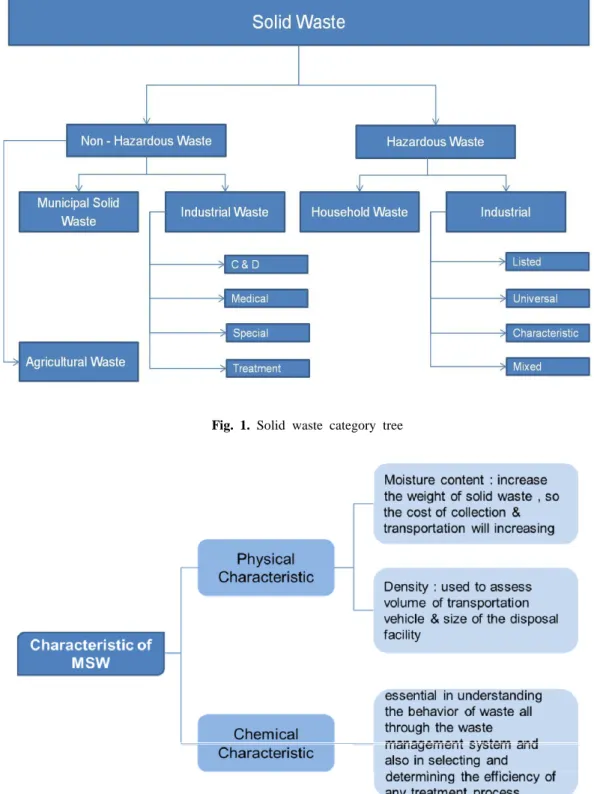
Fig. 2. Basic characteristics of municipal solid waste Fig. 1. Solid waste category tree

a safe and healthy human environment while consid- ering the promotion of sustainable economic develop- ment. In developing countries such as China, India, Malaysia, Thailand and Bangladesh severe municipal

solid waste management problems are reported [3-8].

Recently, there are several comprehensive reports

and publications are available are about global mu-

nicipal solid waste generation [9-12]. MSWI ash can

(3)

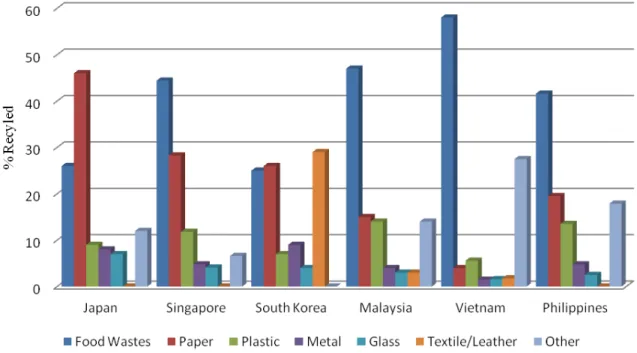
Fig. 3. MSW composition from Asia

be classified into two classes: one is bottom ash that occupies 90 % of the total MSWI ash and contains glassy materials, ceramics, mainly ferrous materials;

and the other is fly ash that has been already treated by landfill. Therefore, the development of a feasible method that enables MSWI bottom ash to be used as alternative resources is urgent. MSWI bottom ash can be utilized as aggregate substitutes in the con- struction field. However, toxic heavy metal ions con- tained in bottom ash can be easily dissolved in aque- ous solutions, and that presents severe environmental problems, and prevents bottom ash being reused.

Generally, the term solid waste refers to non-haz- ardous waste. But according to the Resource Conser- vation and Recovery Act (RCRA) and other state regulations, hazardouswaste is also a part of solid waste. Solid waste tree showed in Fig.1, based on resource conservation and recovery act, US EPA and also the characteristics of a municipal solid waste is presented in Fig.2.

The disposal of inorganic waste presents logistical, financial and environmental issues. Technologies that enable the wastes to be utilized as alternative re- sources for the synthesis of useful materials and can reduce the hazardous properties of wastes are ur-

gently required. The increasing CO

2

content and re- search on the capture and long term effect on the cli- mate has increased global interest and research on the capture and longtime storage of CO

2

.

The municipal generation by country (high income and lower middle income including) and their current data and projections for 2025 [2], showed in Fig.3.

The proportion of recyclables (paper, plastics) is high in the developed countries. The low proportion of recyclables in developing economies can be attrib- uted to the market value of recyclables.

In this paper, we reported the characteristics of

municipal solid waste (MSWI) bottom ash produced

in South Korea were investigated and studied the

feasible treatments to the MSWI samples to stabilize

heavy metal ions before recycling. The hazardous

materials can be stabilized by accelerated carbo-

nation technology. When carbonates are quickly syn-

thesized by accelerated carbonation, especially on the

surface of bottom ash, heavy metal ions are solidi-

fied. We have applied accelerated carbonation tech-

nology to the immobilize heavy metals and bottom

ash.

(4)

1st iron

separation 3.30 4.02 4.40 2.99 12.50 6.02 4.25 2.86

2

nd

iron

separation 4.00 4.88 10.15 6.91 31.45 15.16 6.05 4.06

4.75mm over 24.10 29.39 20.90 14.23 57.20 27.57 18.25 12.26

4.75~2.36 11.60 14.15 24.55 16.71 36.65 17.66 17.45 11.72

2.36~1.18 11.95 14.57 23.35 15.90 31.70 15.28 32.50 21.83

1.18~0.6 9.45 11.52 15.55 10.59 16.65 8.02 29.60 19.89

0.6~0.3 5.85 7.13 9.55 6.50 7.40 3.57 15.60 10.48

0.3~0.15 7.05 8.60 20.2 13.75 7.20 3.45 14.00 9.41

0.15 under 4.70 5.73 18.25 12.42 6.75 3.25 11.15 7.49

Total 82.0 (kg) 99.99 (%) 146.90 (kg) 100.0 (%) 207.50 (kg) 99.98 (%) 148.85 (kg) 100.0 (%)

Yang-Cheon bottom ash sample

Particle size (mm) SiO

2

Al

2

O

3

CaO MgO P

2

O

5

Na

2

O Fe

2

O

3

K

2

O TiO

2

Cl Ig loss 10.0mm/4.75

(4mesh) 45.4 7.44 21.9 1.6 6.74 6.25 1.59 1.42 0.36 0.44 4.06

4.75/2.36

(4-8mesh) 26.7 9.18 30.8 1.43 11.0 3.33 2.14 1.92 0.63 1.06 8.12

2.36/1.18

(8-16mesh) 21.4 10.6 33.3 1.21 4.47 3.09 2.71 2.02 0.93 1.60 15.5

1.18/0.6

(16-30mesh) 15 9.75 38.2 1.15 4.20 2.91 2.36 1.64 1.05 1.92 19.2

0.6/0.3

(30-50 mesh) 11.4 9.91 40.0 1.20 4.88 2.54 2.31 1.39 1.05 2.10 20.5

0.3/0.15

(50-100mesh) 8.47 10.1 40.3 1.25 4.82 2.49 2.21 1.09 1.16 2.16 23.3

0.15/0.075

(100-200mesh) 7.06 9.94 39.6 1.28 3.0 2.40 1.95 0.96 1.13 2.08 28.1

Table 2.1. Chemical composition of Yang-Cheon bottom ash samples.

(5)

0.6/0.3

(30-50 mesh) 13.2 11.6 38.3 1.21 6.17 2.04 3.33 1.25 1.14 1.37 18.1

0.3/0.15

(50-100mesh) 8.63 12.0 40.4 1.11 4.18 1.79 2.75 0.85 1.07 1.56 23.5

0.15/0.075

(100-200mesh) 6.98 12.2 41.1 1.02 2.63 1.49 2.08 0.85 0.90 1.62 27.2

No-Won bottom ash sample

Particle size (mm) SiO

2

Al

2

O

3

CaO MgO P

2

O

5

Na

2

O Fe

2

O

3

K

2

O TiO

2

Cl Ig loss 10.0mm/4.75

(4mesh) 40.8 7.15 23.9 1.46 9.51 6.96 0.27 1.45 0.48 0.33 3.53

4.75/2.36

(4-8mesh) 29.2 7.98 30.5 1.43 11.0 4.22 2.92 1.78 0.85 0.66 7.45

2.36/1.18

(8-16mesh) 24.5 10.4 31.7 1.44 7.03 3.93 3.12 2.15 1.15 0.99 11.5

1.18/0.6

(16-30mesh) 15.0 11.2 36.4 1.4 6.04 3.32 3.04 1.69 1.40 1.31 16.9

0.6/0.3

(30-50 mesh) 11.1 12.2 37.8 1.29 5.23 2.88 2.76 1.27 1.46 1.54 20.5

0.3/0.15

(50-100mesh) 6.35 12.5 39.3 1.06 3.20 2.37 1.94 0.87 1.13 1.83 27.5

0.15/0.075

(100-200mesh) 4.94 12.2 38.5 0.80 1.59 2.03 1.20 0.71 0.73 1.91 33.8

Table 2.3. Chemical composition of No-Won bottom ash samples.

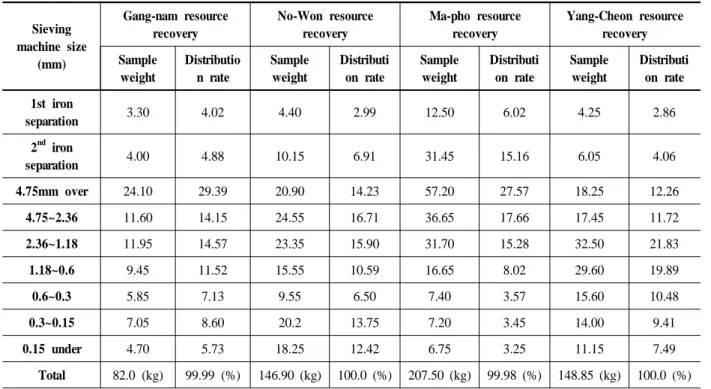
ash distribution rate by particle-size was listed.

After sieving the different sizes bottom ash sam- ples, the carbonation process was conducted to stabi- lize the high content of hazardous heavy metals in MSWI bottom ash samples. The carbonation re- actions experiments were conducted using a various

condition with a liquid-solid-ratio (0.3 and 1.0

dm

3

/kg), CO

2

was injected at a rate of 1L/min and

400rpm stirring speed at 20

o

C temperature. The ex-

periment of carbonation was terminated when the

measured pH was below 7 and sample was filtered

and dried at 80

o

C for 12h duration time.

(6)

Ma-pho bottom ash sample

Particle size (mm) SiO

2

Al

2

O

3

CaO MgO P

2

O

5

Na

2

O Fe

2

O

3

K

2

O TiO

2

Cl Ig loss 10.0mm/4.75

(4mesh) 45.8 10.4 20.3 1.64 4.65 6.17 3.43 1.34 0.84 0.26 3.5

4.75/2.36

(4-8mesh) 31.5 11.4 27.9 1.36 7.63 3.39 3.46 1.71 1.05 0.50 7.6

2.36/1.18

(8-16mesh) 26.4 12.0 30.4 1.39 6.15 2.69 3.72 1.71 1.25 0.64 11.1

1.18/0.6

(16-30mesh) 17.4 11.4 37.1 1.30 5.76 1.95 3.79 1.40 1.41 0.82 14.9

0.6/0.3

(30-50 mesh) 10.6 10.5 41.4 1.29 5.26 1.49 3.31 0.09 1.38 0.95 20.1

0.3/0.15

(50-100mesh) 8.61 10.1 42.2 1.29 4.63 1.29 3.18 0.73 1.44 0.96 22.8

0.15/0.075

(100-200mesh) 5.55 9.44 43.8 1.15 2.35 0.95 2.22 0.50 1.11 0.99 29.2

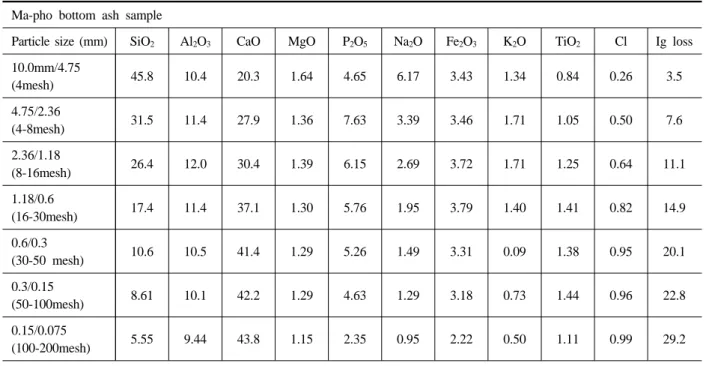
Table 2.4. Chemical composition of Ma-pho bottom ash samples.

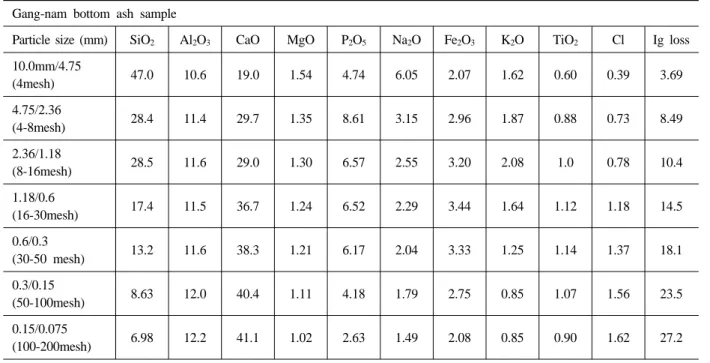
Yang-Cheon- MSWI bottom ash major components are 20 to 40% of CaO, 10 to 40% of SiO

2

and 7-10% Al

2

O

3

are present in different particle size of bottom ash samples and less amount of 1-1.5%

MgO, 3-6% P

2

O

5

and other elements are present in different MSWI bottom ash samples.

Table 2.2 shows the chemical composition of Gang-nam MSWI bottom ash major components are 19 to 41% of CaO, 10 to 47% of SiO

2

and 10-12%

Al

2

O

3

are present in different particle size of bottom ash samples and less amount of 1-1.5% MgO, 3-8%

P

2

O

5

and other elements are present in different MSWI bottom ash samples.

ash samples and less amount of 1-1.6% MgO, 2-7%

P

2

O

5

, 2-3% Fe

2

O

3

and other elements are present in different MSWI bottom ash samples.

In tables 2.1-2.4, are shows the chemical composi- tion of MSWI Bottom ash was mainly composed by SiO

2

, CaO, and Al

2

O

3

. But, the MSWI bottom ash also contain the plenty of heavy metals and chlorine.

The heavy metals and chlorine included in bottom

ash limited for its use, when recycle the bottom ash

as an aggregate. Because there are serious problems

of secondary environment pollution due to toxic

component. Therefore, the stabilization of heavy

metals and the removal of chlorine in the bottom ash

(7)

Pb 98-14,000 1,100 1,200-6,600 229.4-3,145

Cl 800-4,200 14,000 1,105-4,190 26,000-30,000

are very important process to recycle bottom ash as alternative aggregate.

3.2. Heavy metals in different MSWI bottom ash samples and leaching concentrations:

The MSWI bottom ash samples having different heavy metals such as As, Cd, Cu, Cr, Hg, Pb and Cl in different countries reported in the Table 3. In or- der to evaluate the environmental stability of MSWI bottom ash, heavy metal content and leaching test were conducted.

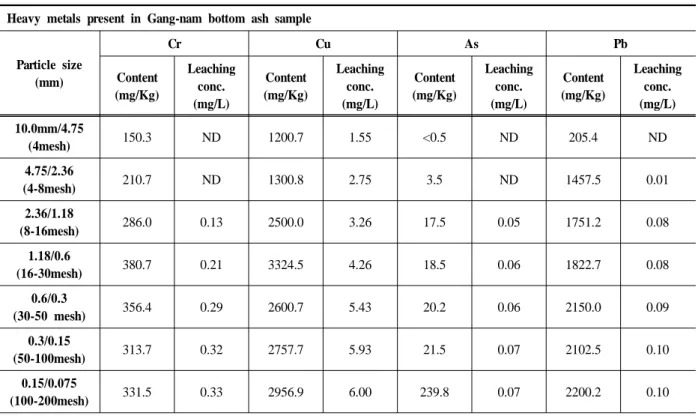
We investigated the leaching concentrations of heavy metals in different municipal solid waste ash samples. The heavy metals content is reported in mg/kg in various bottom ash samples with various particles sizes and the leaching characteristics of heavy metals in bottom ash samples also reported in the Table 4.1 for Gang-nam bottom ash samples and Table 4.2 for Ma-pho bottom ash samples.

In Table 4.1, shows the heavy metal concen- trations present in Gang-nam MSWI bottom ash sample in various particle sizes, these results in- dicated that the heavy metals such as Cu and Pb have high concentrations (>2000ppm), and these metals concentrations is high in <0.15mm size of particle containing bottom ash sample. It suggested that heavy metals concentrations is more in fine par-

ticles (<0.15mm) of MSWI bottom ash samples.

After leaching process less amount such as 0.33mg/L for Cr, 6mg/L for Cu, 0.07mg/L for As and 0.1mg/L for Pb metals are eluted, reaming high concentrated metals are not eluted from MSWI bottom ash sam- ples by these leaching process.

In Table 4.2, shows the heavy metal concentra- tions present in Ma-pho MSWI bottom ash sample in various particle sizes, in these results also indicated that the heavy metals such as Cu and Pb have high concentrations than Cr and As. These metals concen- trations is high in <0.15mm size of particle contain- ing bottom ash sample. It suggested that heavy met- als concentrations is more in fine particles (<0.15mm) of MSWI bottom ash samples. In leaching process the metals, 0.29 mg/L for Cr, 5.86 mg/L for Cu, 0.08 mg/L As and 0.09 mg/L Pb was eluted. These eluted concentration of metals from MSWI bottom ash samples were stabilized by carbonation process.

3.3 Leaching Concentrations of Heavy metals with carbonation.

We are using MSWI Gang-nam bottom ash (<0.5mm

size) samples for carbonation process with a liquid-

solid-ratio (0.3 and 1.0 dm

3

/kg), CO

2

was injected at

a rate of 1L/min and 400rpm stirring speed at 20

o

C

temperature and the carbonation process was termi-

(8)

Heavy metals present in Ma-pho bottom ash sample

Particle size (mm)

Cr Cu As Pb

Content (mg/Kg)

Leaching conc.

(mg/L)

Content (mg/Kg)

Leaching conc.

(mg/L)

Content (mg/Kg)

Leaching conc.

(mg/L)

Content (mg/Kg)

Leaching conc.

(mg/L) 10.0mm/4.75

(4mesh) 337.5 ND 1179.4 2.3 <0.5 ND 927.5 ND

4.75/2.36

(4-8mesh) 347.2 0.05 2700.9 3.10 90.0 ND 1211.8 ND

2.36/1.18

(8-16mesh) 448.3 0.15 4521.9 4.41 108.8 0.05 1436.7 0.05

1.18/0.6

(16-30mesh) 414.6 0.20 3381.8 4.96 117.8 0.08 1487.3 0.07

0.6/0.3

(30-50 mesh) 481.8 0.27 3197.4 5.86 109.9 0.05 1282.3 0.06

0.3/0.15

(50-100mesh) 582.0 0.29 2607.8 5.43 137.1 0.06 1242.8 0.09

0.15/0.075

(100-200mesh) 548.5 0.21 2885.2 4.26 237.2 0.06 1464.2 0.08

Table 4.2. Heavy metals content and the leaching characteristics of heavy metals in Ma-pho bottom ash samples (8-16mesh)

1.18/0.6

(16-30mesh) 380.7 0.21 3324.5 4.26 18.5 0.06 1822.7 0.08

0.6/0.3

(30-50 mesh) 356.4 0.29 2600.7 5.43 20.2 0.06 2150.0 0.09

0.3/0.15

(50-100mesh) 313.7 0.32 2757.7 5.93 21.5 0.07 2102.5 0.10

0.15/0.075

(100-200mesh) 331.5 0.33 2956.9 6.00 239.8 0.07 2200.2 0.10

nated when the measured pH was below 7 and sam- ple was filtered and dried at 80

o

C for 12h duration

time. These dried carbonated MSWI bottom ash was

used for leaching experiment, after these leaching

(9)

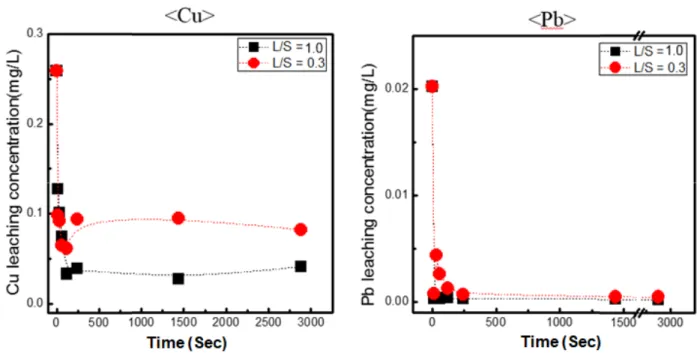
Figure 4. Effect of carbonation on leaching concentrations of heavy metals

process, Cu and Pb heavy metals is not eluted in the leaching solution results are shown in Fig. 4. These results indicated that after carbonation process by us- ing the liquid and solid ratio is 0.3 and 1.0. Both copper and lead are effectively stabilize with the car- bonation process.

4.CONCLUSIONS

The accelerated carbonation of solid wastes con- taining alkaline minerals such as Ca and Mg before their landfill treatment is effective for decreasing the mobility of heavy metals by adjusting pH to below 7 at which their solubility is lower. Worldwide trend towards encouraging carbonation treatment for waste alkaline solids emitted from various sources such as MSWI ash, coal ash and mining residues etc. Our re- search results shows the carbonation studies using MSWI bottom ash and CO

2

in order to increase the recycling percentage of the ash and reduce the con- centration of atmospheric CO

2

in Korea. Carbonation is an ecofriendly process for the removal of heavy metals municipal solid waste bottom ash samples.

ACKNOWLEDGEMENTS

This study was supported by the Energy Technolo- gy Development Project [20141010101880] of the Korea Institute of Energy Technology Evaluation and Planning, financed by the Ministry of Trade, Industry and Energy.

REFERENCES

1. P.J. Gunning, C.D.Hills, P.J. Carey, S.Greig, M.Schil- ling, Carbonation of MSWI APCr for re use as a light weight aggregate, Ash 2012, Stockholm, Sweden January 25-27, 1-7.

2. Daniel Hoornweg, Perinaz Bhada Tata, What a waste: A global review of solid waste generation.

World Bank Urban Development series knowl- edge papers, 15, 2012, 1-116.

3. H. Cheng and Y. Hu, Municipal solid waste (MSW) as a renewable source of energy: current and fu- ture practices in China, Bioresource Technology, 101(11), 2010, 3816-3824.

4. R. P. Singh, V. V. Tyagi, T. Allen, M. H. Ibrahim,

and R. Kothari, An overview for exploring the

possibilities of energy generation from municipal

(10)

Management Association, 58(5), 2008, 629-635.

7. S. H. Bhuiyan, A crisis in governance: urban solid waste management in Bangladesh, Habitat Interna- tional, 34(1), 2010,125-133.

8. K. M. Nazmul Islam, Municipal Solid Waste to Energy Generation in Bangladesh: Possible Scena- rios to Generate Renewable Electricity in Dhaka and Chittagong City, Journal of Renewable Ener- gy, 2016, 1-16.

9. Kosuke Kawai, Tomohiro Tasaki, Revisiting esti- mates of municipal solid waste generation per ca- pita and their reliability, J Mater Cycles Waste Management, 18, 2016,1-13.

10. L. Rodic, A. Scheinberg, D.C. Wilson, Compar- ing solid waste management in the world’s cities. Key-note paper at ISWA World Congress 2010, Hamburg.

11. European Environment Agency, Managing mu- nicipal solid waste - a review of achievements in 32 European countries (2013). European Environ- ment Agency, Copenhagen. http://www.eea. eu- ropa.eu/publications/managing-municipal-solid-waste.

Accessed 1 Dec 2014.

12. M.Masood, C.Y.Barlow, D.C. Wilson, An as-

sessment of the current municipal solid waste

management system in Lahore, Pakistan. Waste

Management Research, 32, 2014, 834-847.

수치

Fig. 2. Basic characteristics of municipal solid wasteFig. 1. Solid waste category tree
Fig. 3. MSW composition from Asia
Table 2.1. Chemical composition of Yang-Cheon bottom ash samples.
Table 2.3. Chemical composition of No-Won bottom ash samples.
+4

참조

관련 문서

Abstract : The object of this study was to evaluate the combined toxic interactions of the perfluorooctanoic acid (PFOA) or per- fluorooctane sulfonate (PFOS) with six heavy metals

The effect of pH on the citrate leaching behavior of heavy metal ion was investigated to develop an eco-friendly process for removing heavy metals from soil contaminated

Assessment of heavy metals in soil Descriptive statistics of heavy metal concentrations of agricultural soil samples near the industrial complexes in Jeon-Buk province in 2019

This study was carried out to find out properties and total and phytoavailable contents of heavy metals (Cd, Pb, Cu, Zn) in 21 urban agricultural soils in Seoul.. Total

Correlation coefficients between chemical composition and heavy metals concentration in rainwater samples from Taean areas(n=51).. Year Months Cd Cu Pb

In order to determine the distribution characteristics of the heavy metals in surface sediments of the eastern Yellow Sea, heavy metal concentrations (Cu, Pb, Zn, Cd, Cr, Mn,

The purpose of this study was to investigate the association among heavy metal exposure, nutrient intake status, and BMD by comparing heavy metals in serum according to status of

This study aims to stabilize industrial solid waste incineration bottom ash and fly ash containing high hazardous heavy metal content by employing accelerated carbonation, and