Korean J ournal of S oil S cience and F ertilizer
Article https://doi.org/10.7745/KJSSF.2021.54.3.311
pISSN : 0367-6315 eISSN : 2288-2162
Pollution Load Index for Heavy Metals of Agricultural Soils Adjacent to Industrial Complexes in the Jeon-Buk Regions of Korea
Sorakon Suwanmanon1 and Ki In Kim2*
1Researcher, Department of Horticultural Science, Mokpo National University, Muan 58554, Korea
2Associate Professor, Department of Horticultural Science, Mokpo National University, Muan 58554, Korea
*Corresponding author: [email protected]
A B S T R A C T Received: July 21, 2021
Revised: August 23, 2021 Accepted: August 25, 2021
ORCID
Sorakon Suwanmanon https://orcid.org/0000-0002-6162-6109 Ki In Kim
https://orcid.org/0000-0003-3084-3650
Monitoring heavy metal concentrations in agricultural soils close to industrial complexes plays a critical role in ascertaining the safe agricultural environment in Korea and its product qualities. Objective of this study was to assess the heavy metal concentrations in agricultural soils close to industrial complexes. Fifteen industrial complexes in 7 counties in Jeon-Buk Province (Gochang, Iksan, Jeongeup, Gimje, Imsil, Jangsu, and Wanju) were selected for monitoring soil heavy metal concentrations in 2019. The soil samples were analyzed for 7 heavy metals, including arsenic (As), cadmium (Cd), chromium (Cr), copper (Cu), nickel (Ni), lead (Pb), and zinc (Zn) within 500 meter and 1,000 meter radius at each industrial complex boundaries.
Heavy metal concentrations in soils ranged from 0.3 to 8.0 mg kg-1 for As, from 0.2 to 1.5 mg kg-1 for Cd, from 1.7 to 62.9 mg kg-1 for Cr, from 1.4 to 22.5 mg kg-1 for Ni, from 4.1 to 26.0 mg kg-1 for Pb, from 0.0 to 1.4 mg kg-1 for Hg, and from 25.9 to 283.5 mg kg-1 for Zn. Heavy metal concentrations in soils were lower than the levels of Soil Contamination Warning Standard (SCWS). The pollution index (PI) values of all seven heavy metals (As, Cd, Cr, Cu, Ni, Pb, and Zn) ranged from 0.1 to 0.4 for top and sub soils indicating that these soils are not polluted. The pollution load index (PLI) values using 7 heavy metals at each county ranged from 0.10 to 0.24 for top and sub soils and the number was categorized into Group 2 which is unpolluted. These results suggested that monitored agricultural soils near industrial complexes in Jeon-Buk province in 2019 were unpolluted by heavy metals and safe for agricultural activities.
Keywords: Agricultural field, Heavy metal, Pollution index, Pollution load index, Soil contamination warning standard, Soil pollution index
Descriptive statistics of heavy metal concentrations in agricultural soils near the industrial complexes in Jeon-Buk Province in Korea.
Element As Cd Cr Cu Hg Ni Pb Zn
--- (mg kg-1) ---
Soil depth Top Sub Top Sub Top Sub Top Sub Top Sub Top Sub Top Sub Top Sub
Average 3.1 3.0 0.9 0.8 14.8 14.7 16.4 15.2 0.01 0.01 9.9 9.7 12.3 12.2 73.1 68.2
Min. 0.4 0.3 0.2 0.3 1.8 1.8 3.7 3.4 0.00 0.00 1.4 1.5 4.6 4.2 25.9 31.4
Max. 8.1 8.0 1.6 1.3 48.9 63.0 45.7 43.1 0.04 0.04 22.3 22.5 25.6 26.1 283.5 199.0
Stdev. 1.7 1.6 0.2 0.2 7.4 7.8 8.4 7.5 0.01 0.01 4.8 4.6 3.7 3.5 29.6 23.3
C.V. (%) 53.7 53.9 27.8 26.6 50.1 53.2 51.4 49.2 140.2 140.7 48.3 47.3 29.9 29.1 40.5 34.2
Kurtosis -0.6 -0.6 -0.2 -0.6 1.8 8.5 2.0 2.6 3.0 6.2 -0.5 -0.5 0.6 1.5 17.5 7.4
Skewness 0.4 0.4 0.2 -0.1 0.8 1.6 1.3 1.4 1.7 2.1 0.4 0.4 0.3 0.6 3.1 2.0
SCWS† limit 25 4 n/a150 4 100 200 300
Number of above SCWS 0 0 0 0 0 0 0 0
Min., minimum; Max., maximum; Stdev., standard deviation; C.V., coefficients variations.
†Soil Contamination Warning Standard (SCWS) from Ministry of Environment (MOE) in Korea.
Ⓒ The Korean Society of Soil Science and Fertilizer. This is an Open Access article distributed under the terms of the Creative Commons Attribution Non- Commercial License (http://creativecommons.org/licenses/by-nc/4.0) which permits unrestricted non-commercial use, distribution, and reproduction in any medium, provided the original work is properly cited.
Introduction
Soil quality is a top priority for producing safe agricultural products (Kong, 2014) and the importance of soil for this purpose cannot be exaggerated. Economic expansion for the industrial sector close to agricultural farmland may deteriorate the soil (Jung et al., 2005; Lee et al., 2010). Therefore, monitoring the agricultural soil quality can provide a critical information for consumers and policy makers to support for better quality of food, health, and environment (Kloke, 1979; Sutherland, 1999; Wu et al., 2010; Ahmadi et al., 2017).
Industry expansion is another concern to exert a negative influence on the environment, that resulting in the high possibility soil, air, surface water and groundwater contamination (Lambert et al., 2000; Wang et al., 2010; Morais et al., 2012). Agricultural farmlands neighboring industrial sites can be polluted with both directly industry-related sources and other practices as well. For example, they are industrial effluents, sewage discharge, dust, and industrial wastewater. They may contain heavy metals flowing into agricultural fields from industrial complexes (Jung et al., 2005; Lee et al., 2010). Especially, heavy metals from industry near farmland are the most hazardous contaminants of agricultural soils where agricultural products grow. The human health is depending on quality of agricultural product from well managed farmland (Järup, 2003; Akoto et al., 2008).
Heavy metals are one of environmental pollutants from industrial activities. Accumulation of heavy metals in the agricultural soil can negatively influence on crops and easily transferred into food chains (Järup, 2003; Duruibe et al., 2007; Jolly et al., 2013). Toxicity of heavy metals and its residues in plants enter the human body when consumed or direct contact of soil by skin (Johansson and Campbell, 1998). Consequently, food containing heavy metals have detrimental effects on human organs such as the heart, liver, kidney for a short or long period time (Holmgren et al., 1993; Vulava et al., 1997). The most hazardous elements, such as arsenic (As) can result in serious health disorders such as epigenetics, inflammatory and neoplastic changes in skin and cancer along with their respective system (Järup, 2003; Duruibe et al., 2007; Karaca et al., 2010; Jolly et al., 2013; Mohammed Abdul et al., 2015; Prakash and Verma, 2021). Many researchers found heavy metals in soils, such as cadmium (Cd), chromium (Cr), copper (Cu), lead (Pb), nickel (Ni), and zinc (Zn) (Jung et al., 2005; Lee et al., 2010; Min et al., 2016). In South Korea, Contamination Warning Standard (SCWS) for cultivated lands (Region 1) are 25, 4, 150, 100, 200, and 300 mg kg-1 for As, Cd, Cu, Ni, Pb, and Zn, respectively.
The aim of this study was to investigate heavy metal concentrations in agricultural soils adjacent to industrial complexes in Jeon-Buk province, Korea. This study will help us understand how dense heavy metals are accumulated in soils near industrial complexes in Jeon-Buk province. Also, this research can give us some crucial information on food and soil safety issues based on heavy metal levels which is regulated by Soil Environment Conservation Law (SECL).
Materials and Methods
Site description and soil sample This study was conducted in 2019 in Jeon-Buk Province. Soil samples were
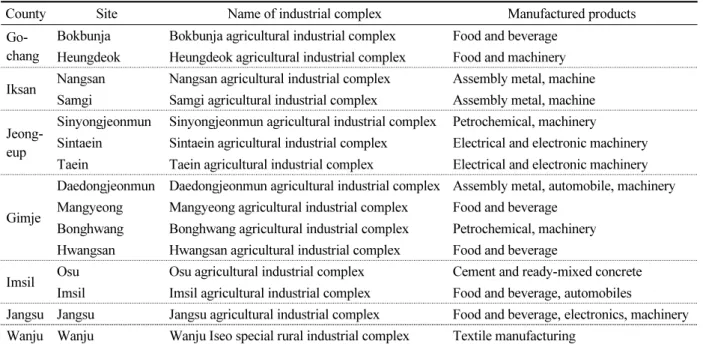
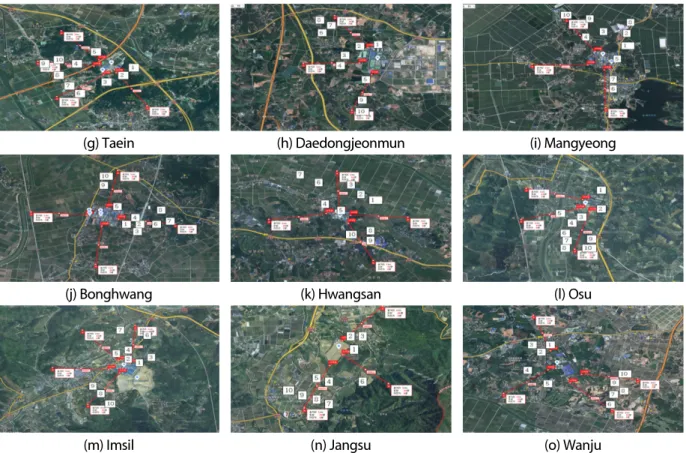
collected at agricultural fields near 15 industrial complexes in 7 counties (Gochang, Iksan, Jeongeup, Gimje, Imsil, Jangsu, and Wanju) (Table 1, Fig. 1). Ten agricultural fields near each industrial complex were randomly selected, with four directions (east, west, south, and north). Two depth soils (0 - 15 and 15 - 30 cm) were collected within 0 - 500 meter and 500 - 1,000-meter radius from the borderline of each industrial complex. Five soil cores were collected using soil auger (Eijelkamp one-piece soil auger, Gempler’s, Giesbeek, Netherlands) and combined well in a plastic bag. Total three hundred soil samples were collected (150 for 0 - 15 cm depth and 150 soil samples for 15 - 30 cm depth). These collected soil samples were air-dried and sieved with a 2 mm sieve for heavy metal analysis (MOE, 2016).
Table 1. Monitored industrial complexes in Jeon-Buk province in 2019 in Korea.
County Site Name of industrial complex Manufactured products
Go- chang
Bokbunja Bokbunja agricultural industrial complex Food and beverage HeungdeokHeungdeok agricultural industrial complex Food and machinery Iksan Nangsan Nangsan agricultural industrial complex Assembly metal, machine
Samgi Samgi agricultural industrial complex Assembly metal, machine Jeong-
eup
Sinyongjeonmun Sinyongjeonmun agricultural industrial complex Petrochemical, machinery
Sintaein Sintaein agricultural industrial complex Electrical and electronic machinery Taein Taein agricultural industrial complex Electrical and electronic machinery
Gimje
Daedongjeonmun Daedongjeonmun agricultural industrial complex Assembly metal, automobile, machinery Mangyeong Mangyeong agricultural industrial complex Food and beverage
Bonghwang Bonghwang agricultural industrial complex Petrochemical, machinery Hwangsan Hwangsan agricultural industrial complex Food and beverage
Imsil Osu Osu agricultural industrial complex Cement and ready-mixed concrete Imsil Imsil agricultural industrial complex Food and beverage, automobiles
Jangsu Jangsu Jangsu agricultural industrial complex Food and beverage, electronics, machinery Wanju Wanju Wanju Iseo special rural industrial complex Textile manufacturing
(a) Bokbunja (b) Heungdeok (c) Nangsan
(d) Samgi (e) Sinyongjeonmun (f) Sintaein
Fig. 1. Soil sampling points in Jeon-Buk Province in Korea (Google Maps, 2019).
(g) Taein (h) Daedongjeonmun (i) Mangyeong
(j) Bonghwang (k) Hwangsan (l) Osu
(m) Imsil (n) Jangsu (o) Wanju
Fig. 1. Soil sampling points in Jeon-Buk Province in Korea (Google Maps, 2019). (Continued)
Heavy metal analysis Prepared dried soil samples were finely ground with Zirconia balls (DAIHAN, Korea) by mill machine at 10,000 rpm. For heavy metal analysis, three grams of finely ground soils were mixed with 21 mL of hydrochloric acid (HCI) and 7 mL of nitric acid (HNO3), then heated for 2 hours at 120°C using heating plate (Block Heating Sample Preparation System, US/MHB-250, Ctrl-M Science), releasing arsenic (As), cadmium (Cd), chromium (Cr), cupper (Cu), nickel (Ni), lead (Pb), mercury (Hg), and zinc (Zn) in soils (NIAST, 1998;
MOE, 2016), the samples need to be digested in acid and heat, followed by its quantification by ICP-OES, (Optima 7300DV, Perkin Elmer, USA). Wet digested soil samples were filtered through filter paper No. 2 (Advantec No.2, 110 mm) and filled up to 100 mL. The standard solutions were prepared using ICP grade multi-element standard for Cd, Cr, Cu, Ni, Pb, and Zn (Inorganic ventures, USA) and single-element standard for As and Hg (Kriat Co.,Ltd., Korea). Individual heavy metal standard solutions were prepared. In detail, single-element standard As and Hg concentrations were 0.1, 0.5, 1, 5, 10, 20, 50 and 100 mg kg-1 and multi-element standard (Cd, Cr, Cu, Ni, Pb and Zn) were 0.1, 0.5, 1, 5, 10, 20, 50 and 100 mg kg-1. Calibration curve using a standard solution was obtained.
Soil pollution index (PI) and pollution load index (PLI) The assessment of the soil contamination was carried out using several evaluating methods, pollution index (PI) and pollution load index (PLI). Hakanson (1980) used the pollution index (PI) to evaluate soil quality using the modified formula.
(Eq. 1)
where, Cn is the concentration of the examined element in the soil, Bn is the geochemical background value. The background values were obtained from a study by Liao and Chao (2004). The selected reference background values are usually background concentration of heavy metals in earth’s crust. The background values for this study were averaged values from 2,070 paddy rice soil samples (Yun et al., 2018; Lee et al., 2019). The background values serve to assess contamination by comparing current and pre-industrial concentration of heavy metal concentrations (Suwanmanon and Kim, 2019) and the background concentration of As, Cd, Cu, Ni, Pb, and Zn used for this study were 3.68, 0.22, 14.9, 14.1, 16.7, and 56.8 mg kg-1 respectively. Yoon et al. (2009) reported that natural background levels of As, Cd, Cu, Ni, Pb, Cr, and Zn, from various geological units in Korea were 6.83, 0.287, 15.26, 17.68, 18.43, 25.36, and 54.27 mg kg-1, respectively, while Kwon et al. (2013) suggested that background Cr and Ni concentrations by soil parental materials in Korea were 36.4 mg kg-1 and Ni 19.8 mg kg-1.
Table 2. Classification of different soil contamination assessment of pollution index (PI).
Classification index PI value Description of class
1 PI < 1 Uncontaminated
2 1 ≤ PI < 2 Slightly polluted
3 2 ≤ PI < 3 Moderately polluted
4 3 < PI Highly polluted
Table 3. Classification of different soil contamination assessment of pollution load index (PLI).
Classification index PLI Description of class
1 PLI = 0 Background concentration
2 0 < PLI ≤ 1 Unpolluted
3 1 < PLI ≤ 2 Moderately polluted
4 2 < PLI Highly polluted
The PI values are classified into 4 classification index (Table 2). The contamination level of heavy metals was assessed by pollution load index (PLI). The pollution load index was evaluated for the extent of the metal pollution.
Where n is the number of metals studied, for in this paper is 7 elements and PI is the pollution index value from Eq.
1. The pollution load index (PLI) was calculated using the modified formula based on Angulo (1996) and Jorfi et al.
(2017). The PLI values are classified into 4 classification index (Table 3).
∙ ⋯⋯ (Eq. 2)
If PLI is less than 1, the soil is classified into index 2, which is unpolluted.
Statistical analysis All experiments data are expressed as means and standard deviation. The 0.05 p-value was considered statistically significant using SPSS program (version 12.0, IBM, USA).
Results and Discussion
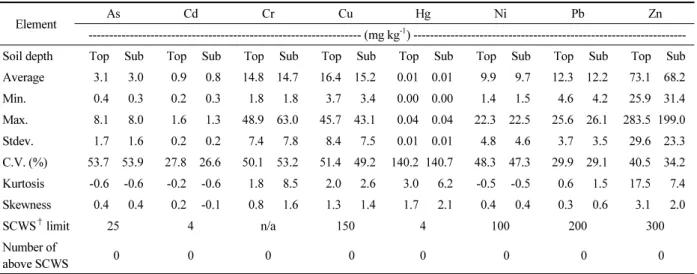
Assessment of heavy metals in soil Descriptive statistics of heavy metal concentrations of agricultural soil samples near the industrial complexes in Jeon-Buk province in 2019 are summarized and listed in Table 4. The values were average, minimum (Min.), maximum (Max.), standard deviation (stdev), coefficients of variation (C.V (%)), kurtosis, and skewness with two soil depths (0 - 15 cm depth for top soil and 15 - 30 cm depth for subsoil.
Overall, 8 heavy metals (As, Cd, Cr, Cu, Hg, Ni, Pb, and Zn, respectively) were analyzed in the soil samples that were regulated by Ministry of Environment (MOE).
Table 4. Descriptive statistics of heavy metal concentrations in agricultural soils near the industrial complexes in Jeon-Buk Province in Korea.
Element As Cd Cr Cu Hg Ni Pb Zn
--- (mg kg-1) ---
Soil depth Top Sub Top Sub Top Sub Top Sub Top Sub Top Sub Top Sub Top Sub
Average 3.1 3.0 0.9 0.8 14.8 14.7 16.4 15.2 0.01 0.01 9.9 9.7 12.3 12.2 73.1 68.2
Min. 0.4 0.3 0.2 0.3 1.8 1.8 3.7 3.4 0.00 0.00 1.4 1.5 4.6 4.2 25.9 31.4
Max. 8.1 8.0 1.6 1.3 48.9 63.0 45.7 43.1 0.04 0.04 22.3 22.5 25.6 26.1 283.5 199.0
Stdev. 1.7 1.6 0.2 0.2 7.4 7.8 8.4 7.5 0.01 0.01 4.8 4.6 3.7 3.5 29.6 23.3
C.V. (%) 53.7 53.9 27.8 26.6 50.1 53.2 51.4 49.2 140.2 140.7 48.3 47.3 29.9 29.1 40.5 34.2 Kurtosis -0.6 -0.6 -0.2 -0.6 1.8 8.5 2.0 2.6 3.0 6.2 -0.5 -0.5 0.6 1.5 17.5 7.4
Skewness 0.4 0.4 0.2 -0.1 0.8 1.6 1.3 1.4 1.7 2.1 0.4 0.4 0.3 0.6 3.1 2.0
SCWS† limit 25 4 n/a 150 4 100 200 300
Number of
above SCWS 0 0 0 0 0 0 0 0
Min., minimum; Max., maximum; Stdev., standard deviation; C.V., coefficients variations.
†Soil Contamination Warning Standard (SCWS) from Ministry of Environment (MOE) in Korea.
The percentile of these heavy metal concentration based on MOE for cultivated lands were less than 12, 22, 10, 0.3, 9.9, 6.2, 24.4% for As, Cd, Cu, Hg, Ni, Pb, and Zn, respectively. These heavy metal concentrations were below heavy metal warning levels for cultivated lands (Region 1) which were 25, 4, 150, 4, 100, 200, and 300 mg kg-1 for As, Cd, Cu, Hg, Ni, Pb, and Zn respectively.
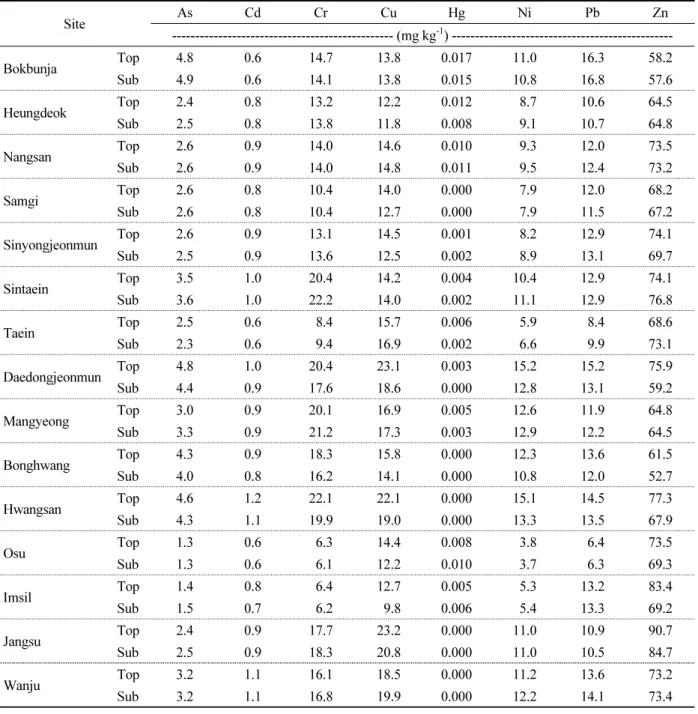
The averaged heavy metal concentrations of top and sub agricultural soils for individual industrial complexes in Jeon-Buk province were shown in Table 5. The averaged heavy metal concentrations of top soil ranged from 1.3 to 4.8 for As, from 0.6 to 1.2 for Cd, from 6.3 to 22.1 for Cr, from 12.7 to 23.2 for Cu, from 0.0000 to 0.017 for Hg, from 3.8 to 15.2 for Ni, from 6.4 to 16.3 for Pb, and from 59.2 to 90.7 for Zn, respectively (Table 5). On the other hand, the averaged heavy metal concentrations of sub soil ranged from 1.3 to 4.9 for As, from 0.6 to 1.1 for Cd, from 6.1 to 22.2 for Cr, from 9.8 to 20.8 for Cu, from 0.0000 to 0.015 for Hg, from 3.7 to 13.3 for Ni, from 6.3 to
16.8 for Pb, and from 52.7 to 84.7 for Zn, respectively.
Table 5. Heavy metal concentrations for top and sub agricultural soils near the industrial complexes in Jeon-Buk Province in Korea.
Site As Cd Cr Cu Hg Ni Pb Zn
--- (mg kg-1) ---
Bokbunja Top 4.8 0.6 14.7 13.8 0.017 11.0 16.3 58.2
Sub 4.9 0.6 14.1 13.8 0.015 10.8 16.8 57.6
Heungdeok Top 2.4 0.8 13.2 12.2 0.012 8.7 10.6 64.5
Sub 2.5 0.8 13.8 11.8 0.008 9.1 10.7 64.8
Nangsan Top 2.6 0.9 14.0 14.6 0.010 9.3 12.0 73.5
Sub 2.6 0.9 14.0 14.8 0.011 9.5 12.4 73.2
Samgi Top 2.6 0.8 10.4 14.0 0.000 7.9 12.0 68.2
Sub 2.6 0.8 10.4 12.7 0.000 7.9 11.5 67.2
Sinyongjeonmun Top 2.6 0.9 13.1 14.5 0.001 8.2 12.9 74.1
Sub 2.5 0.9 13.6 12.5 0.002 8.9 13.1 69.7
Sintaein Top 3.5 1.0 20.4 14.2 0.004 10.4 12.9 74.1
Sub 3.6 1.0 22.2 14.0 0.002 11.1 12.9 76.8
Taein Top 2.5 0.6 8.4 15.7 0.006 5.9 8.4 68.6
Sub 2.3 0.6 9.4 16.9 0.002 6.6 9.9 73.1
Daedongjeonmun Top 4.8 1.0 20.4 23.1 0.003 15.2 15.2 75.9
Sub 4.4 0.9 17.6 18.6 0.000 12.8 13.1 59.2
Mangyeong Top 3.0 0.9 20.1 16.9 0.005 12.6 11.9 64.8
Sub 3.3 0.9 21.2 17.3 0.003 12.9 12.2 64.5
Bonghwang Top 4.3 0.9 18.3 15.8 0.000 12.3 13.6 61.5
Sub 4.0 0.8 16.2 14.1 0.000 10.8 12.0 52.7
Hwangsan Top 4.6 1.2 22.1 22.1 0.000 15.1 14.5 77.3
Sub 4.3 1.1 19.9 19.0 0.000 13.3 13.5 67.9
Osu Top 1.3 0.6 6.3 14.4 0.008 3.8 6.4 73.5
Sub 1.3 0.6 6.1 12.2 0.010 3.7 6.3 69.3
Imsil Top 1.4 0.8 6.4 12.7 0.005 5.3 13.2 83.4
Sub 1.5 0.7 6.2 9.8 0.006 5.4 13.3 69.2
Jangsu Top 2.4 0.9 17.7 23.2 0.000 11.0 10.9 90.7
Sub 2.5 0.9 18.3 20.8 0.000 11.0 10.5 84.7
Wanju Top 3.2 1.1 16.1 18.5 0.000 11.2 13.6 73.2
Sub 3.2 1.1 16.8 19.9 0.000 12.2 14.1 73.4
The highest As, Cr, and Ni concentrations were shown in Gimje county. The heavy metal concentrations for top and sub soils were 4.2 and 4.0 mg kg-1 for As, 20.2 and 18.7 mg kg-1 for Cr, and 13.8 and 12.4 mg kg-1 for Ni, respectively. The highest Hg concentrations for top and sub soils were 0.015 and 0.012 mg kg-1 in Gochang county.
The greatest Cd and Pb concentrations in Wanju county were 1.1 and 1.1 mg kg-1 for Cd and 13.6 and 14.1 mg kg-1 for Pb, respectively. The highest concentration of Cu and Zn were found in Jangsu county and their averaged heavy
metal concentrations for top and sub soils were 23.2 and 20.8 mg kg-1 for Cu and 90.7 and 84.7 mg kg-1 for Pb, respectively. Although heavy metals were found in all soil sampling sites, all of the heavy metal concentrations were lower than Soil Contamination Warning Standard (SCWS) for cultivated lands, which is regulated by Soil Environment Conservation Law (SECL), Ministry of Environment (MOE) in Korea.
Contamination index of heavy metals in soil To evaluate whether soil is polluted or contaminated by heavy metals or not, some indexes such as pollution index (PI) and pollution load index (PLI) are used to determine soil’s
Table 6. Pollution index (PI) and pollution load index (PLI) for top and sub agricultural soils near the industrial complexes in Jeon-Buk Province in Korea.
Site As Cd Cr Cu Ni Pb Zn
--- (PI) --- PLI
Bokbunja Top 0.2 0.2 0.1 0.1 0.2 0.2 0.2 0.18
Sub 0.2 0.2 0.1 0.1 0.2 0.2 0.2 0.18
Heungdeok Top 0.1 0.3 0.1 0.1 0.2 0.1 0.2 0.15
Sub 0.1 0.3 0.1 0.1 0.2 0.1 0.2 0.16
Nangsan Top 0.1 0.3 0.1 0.1 0.2 0.1 0.2 0.17
Sub 0.1 0.3 0.1 0.1 0.2 0.1 0.2 0.17
Samgi Top 0.1 0.3 0.1 0.1 0.1 0.1 0.2 0.16
Sub 0.1 0.3 0.1 0.1 0.2 0.1 0.2 0.15
Sinyongjeonmun Top 0.1 0.3 0.1 0.1 0.2 0.1 0.2 0.17
Sub 0.1 0.3 0.1 0.1 0.2 0.1 0.2 0.17
Sintaein Top 0.2 0.3 0.2 0.1 0.2 0.1 0.3 0.20
Sub 0.2 0.3 0.2 0.1 0.2 0.1 0.3 0.20
Taein Top 0.1 0.2 0.1 0.2 0.1 0.1 0.2 0.13
Sub 0.1 0.2 0.1 0.2 0.1 0.1 0.2 0.14
Daedongjeonmun Top 0.2 0.3 0.2 0.2 0.3 0.2 0.3 0.24
Sub 0.2 0.3 0.2 0.2 0.3 0.1 0.2 0.20
Mangyeong Top 0.2 0.3 0.2 0.2 0.3 0.1 0.2 0.19
Sub 0.2 0.3 0.2 0.2 0.3 0.1 0.2 0.20
Bonghwang Top 0.2 0.3 0.2 0.2 0.2 0.1 0.2 0.20
Sub 0.2 0.3 0.2 0.1 0.2 0.1 0.2 0.18
Hwangsan Top 0.2 0.4 0.2 0.2 0.3 0.1 0.3 0.24
Sub 0.2 0.4 0.2 0.2 0.3 0.1 0.2 0.22
Osu Top 0.1 0.2 0.1 0.1 0.1 0.1 0.2 0.10
Sub 0.1 0.2 0.1 0.1 0.1 0.1 0.2 0.10
Imsil Top 0.1 0.3 0.1 0.1 0.1 0.1 0.3 0.13
Sub 0.1 0.2 0.1 0.1 0.1 0.1 0.2 0.12
Jangsu Top 0.1 0.3 0.2 0.2 0.2 0.1 0.3 0.19
Sub 0.1 0.3 0.2 0.2 0.2 0.1 0.3 0.19
Wanju Top 0.2 0.4 0.2 0.2 0.2 0.1 0.2 0.20
Sub 0.2 0.4 0.2 0.2 0.2 0.1 0.2 0.21
contamination by heavy metals. Pollution index (PI) and PLI for top and sub agricultural soils near the industrial complexes in Jeon-Buk province in Korea was listed in (Table 6). The averaged PI values of all seven heavy metals (As, Cd, Cr, Cu, Ni, Pb, and Zn) ranged from 0.1 to 0.4 for top and sub soils. The contamination level of heavy metal was classified into Group 1: PI < 1 (Uncontaminated) (Table 2) that identified soil is not polluted (Wu et al., 2014; Roudposhti et al., 2016; Jorfi et al., 2017; Kim et al., 2018). The highest PI values were 0.4 and 0.4 for top and sub for Cd at Hwangsan and Wanju agricultural industrial complexes. These results suggested that monitored agriculture soils near industrial complexes in Jeon-Buk province were not contaminated by heavy metals. Kim et al.
(2016) reported that PI ranged from 0.3 to 0.5 for top and sub soil.
The PLI values using 7 heavy metals at each county ranged from 0.10 to 0.24 for top and sub soils (Table 6) and they were categorized into Group 2: 0 < PLI ≤ 1 which is unpolluted (Table 3) (Jorfi et al., 2017). The highest PLI values were 0.24 for top soil at Daedongjeonmun and Hwangsan and 0.21 for sub soil at Wanju. These results suggested that agriculture soils near industrial complexes in Jeon-Buk province were unpolluted by heavy metals and safe for agricultural activities.
Conclusions
Heavy metals in soil samples near industrial complexes in Jeon-Buk province were found. However, all heavy metal concentrations were below the SCWS. Soil pollution indicators, such as PI and PLI were evaluated and showed that monitored sites near industrial complexes in Jeon-Buk province are unpolluted. The averaged PI values of all seven heavy metals (As, Cd, Cr, Cu, Ni, Pb, and Zn) ranged from 0.1 to 0.4 for top and sub soils, indicating these soils are not polluted. The PLI values using 7 heavy metals at each county ranged from 0.10 to 0.24 for top and sub soils and they were categorized into Group 2: 0 < PLI ≤ 1 which is unpolluted. These results suggested that monitored agriculture soils near industrial complexes in Jeon-Buk province in 2019 were unpolluted by heavy metals and safe for agriculture activities. Further research is needed to monitor and evaluate soil contaminations based on heavy metal concentrations.
Acknowledgement
This paper was fully supported by Rural Development Administration, National Institute of Agricultural Science.
Main project is monitoring heavy metal in agricultural land around the industrial complexes in Korea and its project number is PJ015727042021.
References
Abdul, K.S.M., S.S. Jayasinghe, E.P.S. Chandana, C. Jayasumana, and P.M.C.S. Silva. 2015. Arsenic and human health effects: A review. Environ. Toxicol. Pharmacol. 40:828-846.
Ahmadi, M., S. Jorfi, A. Azarmansuri, N. Jaafarzadeh, A.H. Mahvi, R.D.C.S. Soltani, H. Akbari, and R. Akhbarizadeh.
2017. Zoning of heavy metal concentrations including Cd, Pb and As in agricultural soils of Aghili plain, Khuzestan province, Iran. Data Brief 14:20-27.
Akoto, O., J.H. Ephraim, and G. Darko. 2008. Heavy metals pollution in surface soils in the vicinity of abundant railway servicing workshop in Kumasi, Ghana. Int. J. Environ. Res. 2:359-364.
Angulo, E. 1996. The Tomlinson Pollution Load Index applied to heavy metal, ‘Mussel-Watch’ data: a useful index to assess coastal pollution. Sci. Total Environ. 187:19-56.
Duruibe, J.O., M.O.C. Ogwuegbu, and J.N. Egwurugwu. 2007. Heavy metal pollution and human biotoxic effects. Int.
J. Phys. Sci. 2:112-118.
Google Maps. 2019. https://www.google.com/maps/
Hakanson, L. 1980. An ecological risk index for aquatic pollution control. A sedimentological approach. Water Res.
14:975-1001.
Holmgren, G.G.S., M.W. Meyer, R. Chaney, and R.B. Daniels. 1993. Cadmium, lead, zinc, copper, and nickel in agricultural soils of the United States of America. J. Environ. Qual. 22:335-348.
Järup, L. 2003. Hazards of heavy metal contamination. Br. Med. Bull. 68:167-182.
Johansson, S.A. and J.L. Campbell. 1998. “PIXE: A novel technique for elements analysis”. Campbell’s first book on PIXEL. John Wiley & Sons, Inc., New York.
Jolly, Y.N., A. Islam, and S. Akbar. 2013. Transfer of metals from soil to vegetables and possible health risk assessment.
SpringerPlus 2:385.
Jorfi, S., R. Maleki, N. Jaajarzadeh, and M. Ahmadi. 2017. Pollution load index for heavy metals in Mian-Ab plain soil, Khuzestan, Iran. Data Brief 15:584-590.
Jung, G.B., J.S. Lee, W.I. Kim, J.H. Kim, J.D. Shin, and S.G. Yun. 2005. Fractionation and potential mobility of heavy metals in tailings and paddy soils near abandoned metalliferous mines. Korean J. Soil Sci. Fert. 38:259-268.
Karaca, A., S.C. Certin, O.C. Turgay, and R. Kizilkaya. 2010. Effects of heavy metals on soil enzyme activities. p. 237- 265. In I. Sherameti and A. Varma (eds.) Soil heavy metals, Soil biology, Vol. 19, Springer, Heidelberg, Germany.
Kim, D.J., J.H. Park, and J.H. Lee. 2016. Assessment of selected heavy metal concentrations in agricultural soils around industrial complexes in southwestern areas of Korea. Korean J. Soil Sci. Fert. 49:524-530.
Kim, Y.G., H.H. Lee, H.J. Park, and C.O. Hong. 2018. Assessment of heavy metal(loid)s pollution in arable soils near industrial complex in Gyeongsang provinces of South Korea. Korean J. Soil Sci. Fert. 51:128-141.
Kloke, A. 1979. Content of arsenic, cadmium, chromium, fluorine, lead, mercury, and nickel in plants grown on con- taminated soils. p. 51-53. In Proceedings of the United Nations-ECE Symposium, Geneva, Swiss.
Kong, X.B. 2014. China must protect high-quality arable land. Nature 506(7486):7.
Kwon, S.I., G.B. Jung, W.I. Kim, S.C. Hong, M.K. Kim, M.J. Chae, and K.H. So. 2013. Background metal concent- rations of the soil by parent rocks in Korea. p. 309. In Proceedings of the Korean Society of Environmental Agriculture Conference, Jeongseon, Korea.
Lambert, M., B.A. Leven, and R.M. Green, 2000. New methods of cleaning up heavy metal in soils and water. Environ- mental Science and Technology Briefs for Citizens, Kansas State University, Manhattan, KS.
Lee, T.G., M.S. Kong, E.J. Lee, H.I. Jung, Y.H. Kim, G.B. Jung, J.E. Yang, S.C. Kim, G.I. Kim, G.R. Kim, and M.J.
Chae. 2019. Assessment of heavy metal concentrations in the arable soils near industrial complexes in Gangwon, Chungnam, Jeonnam, and Gyeongnam Provinces of South Korea. Korean J. Soil Sci. Fert. 52:541-550.
Lee, Y.H., S.T. Lee, J.Y. Heo, M.G. Kim, K.P. Hong, E.S. Kim, W.D. Song, C.W. Rho, J.H. Lee, W.T. Jeon, B.G.
Ko, K.A. Roh, and S.K. Ha. 2010. Monitoring of heavy metal contents from paddy soil in Gyeongnam Province.
Korean J. Soil Sci. Fert. 43:289-295.
Liao, G. and W. Chao. 2004. Assessment of heavy metallic ions pollution for a river near a metal mine. J. Min. Metall.
13:86-90.
Min, K.J., Y.K. Hong, W.S. Choi, D.B. Kim, and S.C. Kim. 2016. Assessment of heavy metal (loid) pollution using pollution index in agricultural field adjacent to industrial area. Korean J. Soil Sci. Fert. 49:768-775.
MOE. 2016. Soil environment conservation act. Ministry of Environment, Sejong, Korea.
Morais, S., F.G. Costa, and M.L. Pereira. 2012. Heavy metals and human health. p. 227-246. In J. Oosthuizen (ed).
Environmental Health - Emerging Issues and Practice. IntechOpen, Rijeka, Croatia.
NIAST. 1998. The analysis of soil and plant. National Institute of Agricultural Science and Technology, Suwon, Korea.
Prakash, S. and A.K. Verma. 2021. Arsenic: It’s toxicity and impact on human health. Int. J. Biol. Innovations 3: 38-47.
Roudposhti, G.M., A. Karbassi, and A. Baghvand. 2016. A pollution index for agricultural soils. Arch. Agron. Soil Sci.
62:1411-1424.
Sutherland, R.A. 1999. Distribution of organic carbon in bed sediments of Manoa Stream, Oahu, Hawaii. Earth Surf.
Processes Landforms 24:571-583.
Suwanmanon, S. and K. Kim. 2019. Heavy metals and pollution index of agricultural soils around industrial complexes in the Jeon-Buk regions of Korea. Korean J. Agric. Sci. 46:799-811.
Vulava, V.M, B.R. James, and A. Torrents. 1997. Copper solubility in Myersville B horizon soil in the presence of DTPA. Soil Sci. Soc. Am. J. 61:44-52.
Wang, Z., L. Chai, Z. Yang, Y. Wang, and H. Wang. 2010. Identifying sources and assessing potential risk of heavy metals in soils from direct exposure to children in a mine-impacted city, Changsha, China. J. Environ. Qual. 39:
1616-1623.
Wu, J., Y. Teng, S. Lu, Y. Wang, and X. Jiao. 2014. Evaluation of soil contamination indices in a mining area of Jiangxi, China. PLoS One 9: e112917.
Wu, Y.G., Y.N. Xu, J.H. Zhang, and S.H. Hu. 2010. Evaluation of ecological risk and primary empirical research on heavy metals in polluted soil over Xiaoqinling gold mining region, Shaanxi, China. Trans. Nonferrous Met. Soc.
China 20:688-694.
Yoon, J.K., D.H. Kim, T.S. Kim, J.G. Park, I.R. Chung, J.H. Kim, and H. Kim. 2009. Evaluation on natural background of the soil heavy metals in Korea. J. Soil Groundwater Environ. 14:32-39.
Yun, S.G., M.J. Chae, Y.H. Kim, M.S. Kong, H.I. Jung, S.C. Kim, M.S. Kim, S.J. Park, C.H. Kee, J.E. Yang, S.C.
Kim, G.I. Kim, G.R. Kim, and G.B. Jung. 2018. Evaluation on heavy metal contents in agricultural soils around industrial complexes in Korea. Korean J. Environ. Agric. 37:141-145.