제26권 2013년 12월
산업폐기물의 가속 탄산화법을 이용한 CO 2 고용화 및 중금속 안정화 특성 연구
Stabilization of Heavy Metal and CO
2Sequestration in Industrial Solid Waste Incineration Ash by Accelerated Carbonation
정 성 명(Seong-Myung Jung)
1·남 성 영(Seong-Young Nam)
2· 엄 남 일(Nam-Il Um)
3·서 주 범(Joobeom Seo)
2·유 광 석(Kwang-Suk Yoo)
2·
엄 태 인(Tae-In Ohm)
1·안 지 환(Ji-Whan Ahn)
2*1
한밭대학교, 환경공학과
( Hanbat University, Department of Environmental Engineering)
2
한국지질자원연구원 광물자원연구본부
(Mineral Resources Research Division, Korea Institute of Geoscience and Mineral Resources)
3
국립환경과학원, 환경자원연구부
( National Institute of Environmental Research, Department of Environmental Resources Research)
*Corresponding author : [email protected]
Abstract
In this study, an accelerated carbonation process was applied to stabilize hazardous heavy metals of industrial solid waste incineration (ISWI) bottom ash and fly ash, and to reduce CO
2emissions. The most commonly used method to stabilize heavy metals is accelerated carbonation using a high water-to-solid ratio including oxidation and carbonation reactions as well as neutralization of the pH, dissolution, and precipitation and sorption. This process has been recognized as having a significant effect on the leaching of heavy metals in alkaline materials such as ISWI ash. The accelerated carbonation process with CO
2absorption was investigated to confirm the leaching behavior of heavy metals contained in ISWI ash
including fly and bottom ash. Only the temperature of the chamber at atmospheric pressure was varied and
the CO
2concentration was kept constant at 99% while the water-to-solid ratio (L/S) was set at 0.3 and 3.0
dm
3/kg. In the result, the concentration of leached heavy metals and pH value decreased with increasing
carbonation reaction time whereas the bottom ash showed no effect. The mechanism of heavy metal-
INTRODUCTION
With the development of industrial technology and improved living standards, the amount of waste being produced is also increasing and various hazardous substances pollute the environment (Jeon et al., 2009). Wastes are broadly categorized into domestic waste and industrial waste (industrial solid waste below), and they can also be categorized according to the source, emission characteristics, and hazardousness.
Industrial solid waste is further categorized as general industrial waste, construction waste, and designated waste, and each type of waste is processed with a different method.
Industrial wastes include sludge, incineration ash, waste oil, waste acid, waste alkali, waste rubber, waste synthetic resin, and other
wastes designated by the Ministry of Health and Welfare. Among various industrial wastes (waste acid, waste oil, waste synthetic resins, sludge, etc), sludge (dust, waste molding sand, ceramic parts) is incinerated at high temperature(above 980℃) to meet the toxicity destruction rate of 99.99%. However, most of the ash generated from the incineration is buried and this can also cause environmental problems (Ministry of Environment, 2012). In addition, a technology that stabilizes hazardous substances is required, because the incineration ash contains chlorine (Cl) and heavy metal components, similar to domestic waste incineration ash (Ahn et al., 2006; Van Gerven et al., 2005).
Stabilization of wastes through a carbonation reaction is currently being researched. The carbonation reaction is an exothermic reaction stabilization is supported by two findings during the carbonation reaction. First, the carbonation reaction is sufficient to decrease the pH and to form an insoluble heavy metal-material that contributes to a reduction of the leaching. Second, the adsorbent compound in the bottom ash controls the leaching of heavy metals;
the calcite formed by the carbonation reaction has high affinity of heavy metals. In addition, approximately 5 kg/ton and 27 kg/ton CO
2were sequestrated in ISWI bottom ash and fly ash after the carbonation reaction, respectively.
Key words: industrial solid waste incineration (ISWI) fly ash, bottom ash, accelerated carbonation,
heavy metals, stabilization, CO
2sequestration
that induces leaching of calcium ions from carbonation reaction materials as CO
2is dissolved and precipitates carbonates, such as CaCO
3(Lange et al., 1997). Such carbonation reaction is a continuous reaction that occurs through the following 8 stages (Maries et al.).
1. Diffusion of CO
2into air 2. Penetration of CO
2into solids 3. Dissolution of CO
2(g) into CO
2(aq) 4. Conversion of CO
2(aq) into H
2CO
3(rate-
controlling step of carbonation reaction) 5. Ionization of H
2CO
3into H+, HCO
3-, CO
32-6. Decomposition of solids (leaching of cations
such as Ca
2+)
7. Nucleation of carbonates 8. Precipitation of carbonates
The carbonation reaction is a diffusion controlling reaction in which carbon dioxide carbonates the surface of particle as it diffuses into a solid and expands its region. Carbonate precipitation on the outer surface and interior of the solid is a conventional reaction.
Stabilization of heavy metals is classified into weathering and accelerated carbonation.
However, it is very difficult to obtain consistent carbonation conditions for the weathering method, where the reaction takes place with the CO
2in the atmosphere, due to changes in temperature, relative humidity, and rainfall with respect to the change in seasons.
Furthermore, the carbonation rate is very slow, and thus an accelerated carbonation
method, which utilizes a high concentration of CO
2, is commonly used. The concentration of CO
2, relative humidity, moisture content, temperature, and other factors are controlled in an accelerated carbonation process to yield the optimal carbonation reaction rate, and the CO
2produced from the incinerator is retained in the wastes and it also offers the opportunity of CDM (Clean Development Mechanism) projects for CO
2reduction in response to climate change (Nam et al., 2012; Lim et al., 2010). This study aims to stabilize industrial solid waste incineration bottom ash and fly ash containing high hazardous heavy metal content by employing accelerated carbonation, and measured the carbon dioxide sequestration of incineration ash caused by the carbonation reaction.
EXPERIMENT METHOD
The incineration bottom ash and fly ash
used in this experiment are generated from
an incineration facility of Pyeongtaek-city in
Gyeonggi, Korea. In order to obtain specimens
that have not been through a weathering
process, specimens that had been stored
for approximately a day were used in the
experiments. Moisture content of ISWI bottom
ash and fly ash was measured according to
the standard test methods. The masses of the
specimens were measured prior to drying, and
then measured again after 4 hours of drying
at 105℃. The moisture content was calculated through the mass differences of the specimens before and after drying. It was measured three times for each specimen and the average was taken. The moisture content of ISWI bottom ash and fly ash was 22.19% and 4.70%, on average, respectively.
The obtained specimens were dried at 105℃
for 3 days in a large dryer and then sealed from the external environment. The step mentioned above was taken to minimize errors in the experiments possibly induced by weathering when the specimens are exposed to air.
Incineration bottom ash of industrial solid wastes is composed of materials with various particle sizes. Therefore, the ash was separated through 6 standard sieves of +4.75, 2.36~4.75, 1.18~2.36, 0.6~1.18, 0.3~0.6, 0.15~0.3, -0.15
㎜. Incineration fly ash is composed of fine particulates and it was separated using a 100 mesh.
Accelerated carbonation was conducted to stabilize the high content of hazardous heavy metals in industrial solid waste incineration ash, and carbonation reactions experiments were conducted using two methods with different solid-liquid ratio. Figure 1 schematically illustrates the equipment used in the experiments. The experiments were composed of dry carbonation, conducted with a solid-liquid ratio of 1:0.3 (Figure 1a), and wet carbonation, conducted with a solid- liquid ratio of 1:3 (Figure 1b); other conditions
of the experiments used here were room temperature, atmospheric pressure, carbon dioxide (purity .99%) injection at a rate of 1L/
min, and stirring at 300rpm. The experiment of dry carbonation was carried out for 1 hour, and that of wet carbonation was terminated when the measured pH was below 7 and did not change any further.
A standard waste test method was employed to evaluate the heavy metal leaching characteristics before and after carbonation of industrial solid waste incineration bottom and fly ash. According to the standard test methods,
distilled water of pH 5.8~6.3 was mixed with the specimen in a 1:10(W:V) ratio and the resultant solution was shaken for 5 hours under room temperature and atmospheric pressure with a shaker with approximately 200 shakes per minute and an amplitude of 4-5cm. It was then filtered through 1.0㎛ fiber glass filter paper, and the heavy metal concentration of the filtrate was measured with an Atomic Absorption Spectrophotometer (AAS, Shimadzu, AAS-60).
The ignition loss of the industrial solid waste incineration ash was analyzed with a Thermo Gravimetric/ Differential Thermal Analysis (TG/DTA, Shimadzu, DTG-60H) to measure the amount of carbon dioxide sequestration of industrial solid waste incineration ash.
The TG/DTA analysis measures the change in mass of the solid specimens due to heat
Fig. 1. Apparatus for accelerated carbonation.
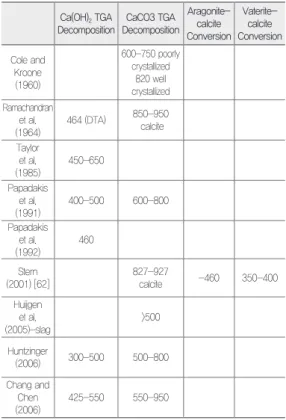
over various ranges of temperatures. The change in mass is based on the principle that a state change in mass is due to the chemical components of a specimen decomposing into gaseous compounds and evaporating into the atmosphere. The mass loss can be calculated by measuring the mass of the specimen before and after the reaction. Table 1 illustrates the decomposition temperature of CaCO
3, which is generally around 550~800℃ (Lim et al., 2010).
Table 1. TGA decomposition of CaCO3 (Lim et al., 2010) Ca(OH)2 TGA
Decomposition
CaCO3 TGA Decomposition
Aragonite- calcite Conversion
Vaterite- calcite Conversion Cole and
Kroone (1960)
600-750 poorly crystallized
820 well crystallized Ramachandran
et al.
(1964)
464 (DTA) 850-950 calcite Taylor
et al.
(1985)
450-650
Papadakis et al.
(1991)
400-500 600-800 Papadakis
et al.
(1992) 460
Stern (2001) [62]
827-927
calcite -460 350-400
Huijgen et al.
(2005)-slag
>500
Huntzinger
(2006) 300-500 500-800
Chang and Chen (2006)
425-550 550-950
RESULTS AND DISSUTIONS
Accelerated carbonation of industrial solid waste incineration ash
Table 2 shows the particle size distribution of
industrial solid waste incineration bottom ash, presenting a regular distribution ratio of each particle size.
Table 2. Particle size distribution of industrial solid waste incineration (ISWI) bottom ash (Unit : %)
Particle Size (㎜) +4.75 2.36
∼4.75 1.18
∼2.36 0.6
∼1.18 0.3
∼0.6 0.15
∼0.3 -0.15 Total
11.5 9.7 12.1 15.6 21.6 12.6 16.9 100
Table 3 shows the particle size distribution of the incineration bottom ash and fly ash. Particles under 100 mesh particle size composed 99% of the incineration fly ash, and particles under 100 mesh particle size composed 17% of the incineration bottom ash. Heavy metals are generally contained in materials with a high content of small particle size, and calcium for the carbonation reaction is also included in materials with high content of small size particles. Therefore, specimens of incineration bottom ash and fly ash with particle sizes smaller than a 100 mesh were used for effective experiments.
Table 3. Particle size distribution of ISWI ash (Unit : %) Bottom Ash Fly Ash
+100mesh(150㎛) 83 1
-100mesh(150㎛) 17 99
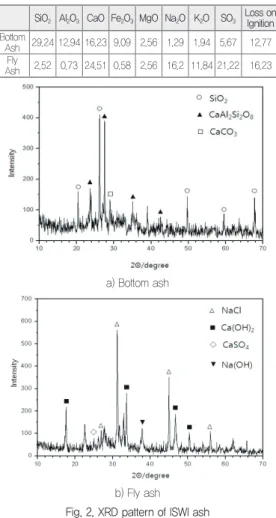
Table 4 shows the chemical compositions ISWI bottom ash and fly ash. The major components of ISWI bottom ash are 29.24%
SiO
2, 12.94% Al
2O
3, 16.23% CaO, and 9.09%
Fe
2O
3. The major components of ISWI fly ash
are 24.51% CaO, 16.2% Na
2O, 11.84% K
2O,
and 21.22% SO
3. X-ray fluorescence (XRF,
Rigaku, Primus 2) and X-ray diffraction (XRD,
Rigaku, RU-200) were used in the analyses of the chemical compositions and crystalline structures of ISWI ash. Figure 2 illustrates the XRD crystalline analysis results. From the analyses the major crystalline structures of ISWI bottom ash are composed of SiO
2(Quartz), CaAl
2Si
2O
8(Anorthite), and CaCO
3(Calcite), and the major crystalline structures of ISWI fly ash are composed of NaCl, Ca(OH)
2, CaSO
4, and NaOH.
Table 4. Chemical composition of ISWI ash (Unit: wt.%) SiO2 Al2O3 CaO Fe2O3 MgO Na2O K2O SO3 Loss on
Ignition Bottom
Ash 29.24 12.94 16.23 9.09 2.56 1.29 1.94 5.67 12.77 Fly
Ash 2.52 0.73 24.51 0.58 2.56 16.2 11.84 21.22 16.23
Table 5 shows the concentration of leached heavy metals from ISWI bottom ash of each
particle size. The concentrations of heavy metals for each particle size were below the environment standard and Cr and Cd were not leached at all from the bottom ash.
Table 5. The concentration of leached heavy metals in ISWI bottom ash (Unit: mg/L)
Cr Cu Pb Cd
Particle Size (mm)
Total specimen ND 0.2 0.3 ND
+4.75㎜ ND 0.2 0.3 ND
2.36∼4.75 ND 0.2 0.3 ND
1.18∼2.36 ND 0.2 0.3 ND
0.6∼1.18 ND 0.2 0.3 ND
0.3∼0.6 ND 0.2 0.3 ND
0.15∼0.3 ND 0.2 0.3 ND
-0.15㎜ ND 0.2 0.3 ND
Standard 1.5 3 3 0.3
※ ND = Not Detected
Table 6 shows the leaching concentration and total content of ISWI ash specimens with particle sizes smaller than a 100 mesh.
ISWI bottom ash showed that the leached concentrations of metals were below the environment standard, but the fly ash showed very high Pb concentration well above the environment standard. Therefore, a stabilization process is required to prevent pollution caused by leaching of Pb, and an accelerated carbonation processing method was employed in the experiments for stabilization of ISWI bottom and fly ash.
Table 6. The concentration of leached (mg/L) and total (mg/kg) heavy metals in ISWI ash under 100mesh
Cr Cu Pb Cd
Leached Total Leached Total Leached Total Leached Total Bottom Ash
(-100mesh) ND 311 0.20 7773 0.30 6756 ND 25 Fly Ash
(-100mesh) ND 14.5 0.43 730.5 58.6 9195 0.04 239
Standard 1.5 3 3 0.3
※ ND = Not Detected Fig. 2. XRD pattern of ISWI ash
a) Bottom ash
b) Fly ash
Effect of carbonation reaction in ISWI ash The pH values of ISWI bottom and fly ash were measured after carbonation reactions under wet carbonation conditions. Figure 3 shows the pH of ISWI bottom and fly ash before and after the carbonation reactions.
The pH of the bottom and fly ash before the carbonation reactions was 10 ~ 12, but below 7 after the carbonation reactions. The decrease in pH is due to saturation of carbon dioxide by CO
32-ions, and this signals the termination of the carbonation reaction.
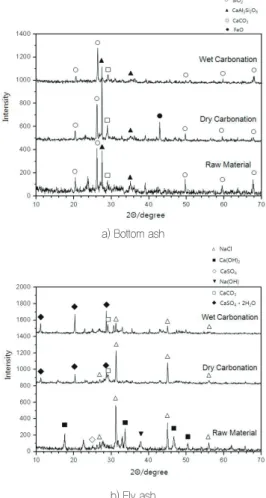
The changes in the mineral phases of the ISWI bottom and fly ash before and after the carbonation reactions were measured with
XRD and the results are illustrated in Figure 4. ISWI bottom and fly ash both showed increases in calcium carbonate(CaCO
3), and calcite, which did not exist in the initial state, was generated in fly ash. The calcite generation reflects the generation of Portlandite (Ca(OH)
2), a hydration material, and carbon dioxide through the carbonation reaction. In addition, the intensity of NaCl peak was reduced after the carbonation reaction.
Table 7 shows the leaching content of the heavy metals from ISWI bottom and fly ash
Fig. 3. Behavior of pH during accelerated carbonation b) Fly ash
a) Bottom ash
Fig. 4. XRD pattern of carbonated ISWI ash b) Fly ash
a) Bottom ash
smaller than a 100 mesh after carbonation reactions through accelerated carbonation.
Although the ISWI bottom ash did not show a substantial difference, the very high Pb leaching in fly ash, 58.6mg/L, was reduced to 0.18 and 0.20 after wet and dry carbonation, respectively, and these values are below the environment standard. Therefore, Pb, a hazardous heavy metal, is determined to be stabilized by wet and dry carbonation reactions and ISWI ash can thus be available for recycling.
Table 7. Leaching concentration of heavy metals in ISWI ash with accelerated carbonation (Unit : mg/L)
Cr Cu Pb Cd
Bottom Ash
Raw ND 0.2 0.3 ND
Dry Carbonation ND 0.2 0.2 ND
Wet Carbonation ND 0.2 0.2 ND
Fly Ash
Raw ND 0.43 58.6 0.04
Dry Carbonation ND 0.45 0.18 0.03
Wet Carbonation ND 0.2 0.2 ND
Standard 1.5 3 3 0.3
※ ND = Not Detected
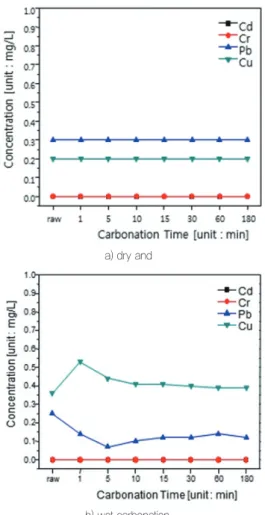
Figure 5 illustrates Cr, Cu, Pb, and Cd leaching concentrations of bottom ash with respect to the dry and wet carbonation times.
The concentrations of each heavy metal were lower than the international environment standard and did not show any significant change in leaching. However, the leaching of Pb stabilized as time elapsed. These results appear to be due to difficulty in measuring the carbonation effect at very low initial heavy metal concentrations.
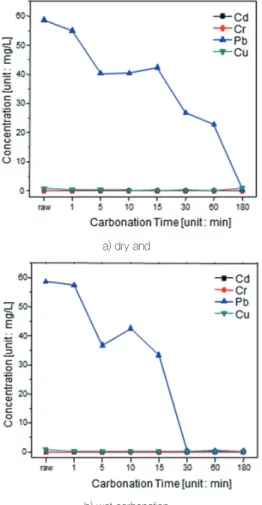
Figure 6 illustrates the Cr, Cu, Pb, and Cd leaching during dry and wet carbonation.
The behavior of Cu during dry carbonation reflected a slow carbonation effect taking place at an initial concentration of 0.85mg/
L, and the leaching decreased. However, the concentration increased to 0.93mg/L and the leaching showed an increasing trend when the reaction time was increased to 180 minutes.
This reveals that carbonation time is important for the stabilization of Cu of ISWI fly ash.
Fig. 5. Leaching behavior of heavy metals in ISWI bottom ash vs. reaction time using
b) wet carbonation.
a) dry and
In addition, Pb yielded the best result in the stabilization of fly ash heavy metals through carbonation, showing leaching of 0.36mg/L, which is significantly lower than the international environment standard of 3mg/L.
The behavior of the heavy metals in wet carbonation showed an excellent carbonation effect in Cu from the initial phase as leaching decreased from 0.82mg/L. The leaching was almost identical from the reaction time of 5 minutes to 180 minutes. Therefore, Cu
carbonation must have been completed by around 5 minutes of reaction, and prolonged reaction appears to be unnecessary. In addition, as in the dry carbonation results, Pb of the fly ash yielded a significant stabilization effect. After carbonation of 180 minutes, the Pb concentration dropped from an initial value of 168.85mg/L to very low leaching of 0.34mg/L, which is significantly lower than 3.0mg/L.
Behavior of chlorine in ISWI during washing process
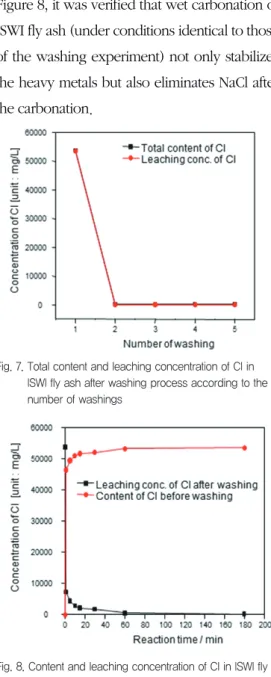
As Figure 4 illustrates, NaCl did not exist in the bottom ash but an abundant amount was present in the fly ash. This difference in the presence of chlorine arises from the mixing of domestic waste and industrial solid waste during the collection process. Therefore, this study on the behavior of chlorine targets fly ash. As figure 7 illustrates, the chlorine analysis of ISWI fly ash after washing shows that most of the NaCl in ISWI fly ash is leached. In addition, with an abundant supply of water, it was verified that most of the chlorine could be eliminated with just one washing.
As the results showed above, most of the chlorine could be eliminated through washing treatment, and this study verified the leaching of dissolved chlorine with respect to time for fly ash. As Figure 8 illustrates, the analysis of residual chlorine shows that most of the chlorine was leached after 1 minute after the reaction, and only 222mg/L of chlorine was
Fig. 6. Leaching behavior of heavy metals in ISWI fly ash vs.
reaction time using b) wet carbonation
a) dry and
present in the fly ash after 60 minutes.
Therefore, with the results from Figure 7 and Figure 8, it was verified that wet carbonation of ISWI fly ash (under conditions identical to those of the washing experiment) not only stabilizes the heavy metals but also eliminates NaCl after the carbonation.
CO
2sequestration in ISWI ash after carbonation reaction
CO
2sequestration per 1kg based on the
carbonation rates revealed that the CO
2sequestration of ISWI bottom ash was approximately 3.1g-CO
2/kg and that of the fly ash was approximately 19.2g-CO
2/kg, which is 6 times higher than that of the bottom ash. In addition, the bottom and fly ash processed with wet carbonation both yielded about twofold higher CO
2sequestration than that processed with dry carbonation (Table 8).
Table 8. Carbonation rate and CO2 sequestration in ISWI ash Carbonation CO2 Sequestration
(kg-CO2/ton-waste)
Bottom Ash Dry Carbonation 3.1
Wet Carbonation 6.8
Fly Ash Dry Carbonation 19.2
Wet Carbonation 34.6
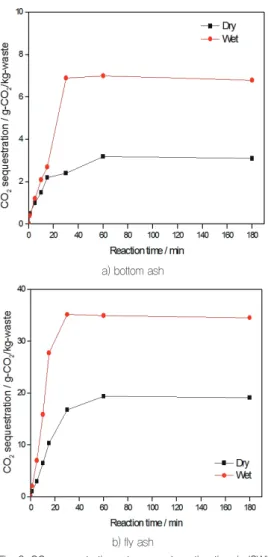
Most of the carbonation reaction was completed when the reaction time passed 60 minutes, and CO
2sequestration after 60 minutes did not show a significant change with the carbonation reaction of ISWI ash smaller than a 100 mesh. In addition, the wet carbonation CO
2sequestration (dry: 3.2g- CO
2/kg, wet: 7.0g-CO
2/kg-reaction time:
60minutes) was approximately twice as large as that of dry carbonation (Figure 9, a). Like bottom ash, the carbonation of the fly ash was almost completed when the carbonation reaction time passed 60 minutes, and no change in CO
2sequestration occurred after 60 minutes. In addition, CO
2sequestration for 1kg of ISWI bottom ash was 19.7g-CO
2/kg from dry carbonation and 35.0g-CO
2/kg from wet carbonation. The sequestration from wet
Fig. 8. Content and leaching concentration of Cl in ISWI fly ash after washing process versus the reaction time Fig. 7. Total content and leaching concentration of Cl in
ISWI fly ash after washing process according to the number of washings
carbonation was clearly higher than that of dry carbonation (Figure 9, b).
CONCLUSION
Industrial solid waste incineration (ISWI) bottom ash and fly ash contain large amounts of heavy metals and chlorine, and leaching of heavy metals of ISWI ash has become an issue due to environmental and recycling concerns.
Therefore, the stabilization of heavy metals,
chlorine, and expansion substances has been conducted in this study to resolve these issues.
The major components of ISWI bottom ash were 29.24% SiO
2, 12.94% Al
2O
3, 16.23% CaO, and 9.09% Fe
2O
3, and the major components of the ISWI fly ash were 24.51% CaO, 16.2% Na
2O, 11.84% K
2O, and 21.22% SO
3. In addition, the major crystalline structures of the bottom ash were SiO
2(Quartz), CaAl
2Si
2O
8(Anorthite), and CaCO
3(Calcite), and the major crystalline structures of the fly ash were NaCl, Ca(OH)
2, CaSO
4, and NaOH. Heavy metal leaching from the bottom ash was below the environment standard, but the fly ash yielded a significantly high concentration of leached Pb of 58.6mg/L, which is well above the environment standard.
Strong alkaline ISWI ash was neutralized, and the high Pb leaching from the fly ash was stabilized to below the environment standard through dry and wet accelerated carbonation.
In addition, portlandite, an expansion substance, and NaCl, salt, were also stabilized.
The carbonation rates of ISWI bottom ash and fly ash by accelerated carbonation yielded a fly ash carbonation rate that was approximately 4.6 times higher than that of the bottom ash. This difference in the carbonation rates appears to arise from the abundant hydration materials such as Ca(OH)
2in the ISWI fly ash.
CO
2sequestration of the bottom ash and the fly ash based on the carbonation rates yielded maximum values of 6.8kg-CO
2/ton-waste and 34.6kg-CO
2/ton-waste for the bottom ash
Fig. 9. CO2 sequestration rate vs. carbonation time in ISWI b) fly ash
a) bottom ash