http://dx.doi.org/10.4491/KSEE.2014.36.2.119 ISSN 1225-5025
발광박테리아 Vibrio fischeri를 이용한 과불화합물과 중금속의 복합독성평가 Toxic Interactions of Perfluorinated Compounds (PFCs)
with Heavy Metals Using Vibrio fischeri
이우미․김지성*․김일호*,**,†․김석구*,**․윤영한**
Woo-Mi Lee․Ji-Sung Kim*․IL-Ho Kim*,**,†․Seog-ku Kim*,**․Young-han Yoon**
금강유역환경청․*과학기술연합대학원대학교 건설환경공학과․**한국건설기술연구원 환경연구실 Geum River Basin Environmental Office․*Department of Construction Environment Engineering, University of Science
and Technology․**Environmental Engineering Research Division, Korea Institute of Construction Technology (2013년 10월 25일 접수, 2014년 2월 3일 채택)
Abstract : The object of this study was to evaluate the combined toxic interactions of the perfluorooctanoic acid (PFOA) or per- fluorooctane sulfonate (PFOS) with six heavy metals (Cu, Zn, Cr, Cd, Hg, and Pb). The individual and combined toxic effects were assessed using the Vibrio fischeri assay. In case of the individual toxicity, PFOA was higher toxic than PFOS and toxicity of PFOA and PFOS were lower than heavy metal. In the toxicity of heavy metals, the Hg2+ was found to be most toxic followed by Pb2+, Cr6+, Cu2+, Zn2+, and Cd2+. The combined toxicity of PFOA or PFOS with Cr6+ were synergistic effect because the EC50mix
values were less than 1 TU. PFOA + Zn2+, PFOS + Zn2+, PFOA + Cd2+ and PFOS + Cd2+ produced addictive effect. Except in these case, all of binary mixtures show antagonistic effect. This study proved potential risk of coexistent with perfluorinated compounds and heavy metals in water environment.
Key Words : Combined Toxic Effect, Heavy Metal, PFOA, PFOS, Vibrio fischeri
요약 : 본 연구에서는 과불화합물(PFOA, PFOS)과 수계에 보편적으로 존재하는 중금속(Cu, Zn, Cr, Cd, Pb, Hg)의 복합독성을 Vibrio fischeri를 이용하여 평가하였다. PFOA와 PFOS의 경우, 30 min-EC50값이 각각 134.21 (119.54-150.68)와 235.97 (180.96- 307.70) mg/L로 PFOS 보다는 PFOA의 독성이 높은 것으로 나타났다. 한편 중금속류의 독성은 Hg2+의 독성이 가장 높았으며, 이어서 Pb2+, Cr6+, Cu2+, Zn2+, Cd2+ 순으로 높은 독성민감도를 나타냈다. 과불화합물류와 중금속류의 복합독성의 경우, PFOA 와 PFOS 모두 Cr6+과 공존할 시 상승효과가 나타났으며, PFOA + Zn2+, PFOS + Zn2, PFOA + Cd2+, PFOS + Cd2+의 조합은 상가 효과를 나타냈다. 이외의 복합물질은 모두 길항작용을 하는 것으로 확인되었다. 본 연구에서는 과불화합물인 PFOA, PFOS와 중금속 복합물질들의 조합에 따른 상호작용이 상이함을 확인하였고 이 결과로부터 과불화합물과 중금속 공존할 때 수환경에 야기할 수 있는 잠재적 위해성을 예측할 수 있다.
주제어 : 복합독성, 중금속, PFOA, PFOS, Vibrio fischeri
1. 서 론
과불화합물(Perfluorinated chemicals, PFCs)은 계면활성제 및 유화제로 사용되고 있는 신종 오염물질로 잔류성과 생물 축적성이 높아 논란이 되고 있다. 이중 perfluorooctanoic acid (PFOA)와 perfluorooctane sulfonate (PFOS)는 대표적인 과 불화합물로써 그 자체도 생산되나 8:2 fluorotelomer alcohol 나 2-N-ethyl (perfluorooctanesulfonamido) ethanol 등의 과 불화합물이 분해되어 생성되는 최종 분해산물로도 알려져 있다.1) PFOA와 PFOS는 소수성(Hydrophobic) 및 소유성 (Oleophobic)의 특성을 지녀 방수나 방유처리가 필요한 옷, 가구, 카펫, 종이, 음식물 포장 등 다양한 생활용품의 표면 처리제 및 샴푸, 광택제, 주방세척제 등의 계면활성제에 사 용되고 있다.2,3) PFOA와 PFOS는 화학적 생물학적으로 안 정하여 생분해, 광분해, 가수분해 등에 의해 잘 분해되지 않 아 환경내에 잔류성이 높으며,4) 생물축적성도 높아 먹이사 슬 상위레벨에 있는 어류와 이를 섭취한 새에서 생물농축 (Bioconcentration) 및 생물농축확대(Biomagnification)가 관찰
되었다는 보고가 있다.5~7) 또한 잠재적으로 발달 및 생식독 성과 내분비계 장애물질로의 가능성도 제기되었으며,8) 인체 의 혈액뿐만 아니라 원거리인 극지에 서식하는 동물에서도 검출되고 있어 문제의 심각성을 더하고 있다.2) 특히 PFOS 의 경우 2009년 스톡홀름협약에 의해 신규 POPs 물질로 등 록되었으나 대체물질이 없어 제한적 사용(사진인화, 반도체 의 광반사저감 코팅, 에칭제(etching agent), 항공 유압유, 특 정 의료기구 등)9)을 허가하고 있으며, 유럽연합에서는 Direc- tive 2006/122/EC에 의거하여 PFOS사용을 제한하고 있다.
PFOA의 경우 전 세계의 하천수에서 420 ng/L, PFOS는 157 ng/L의 농도가 검출된바 있으며, 국내에서 PFOA는 1.0~153 ng/L, PFOS는 0.4~396 ng/L로 분포하고 있는 것으 로 조사되었다.10) 한편 PFOA와 PFOS는 수환경에서 다양 한 오염물질과 함께 검출되고 있으며 실 생태계에 미치는 영향을 평가하기 위해서는 복합물질에 대한 독성평가가 수 행되어야 한다. 복합독성영향은 이화학적인 분석방법으로 는 평가가 어려우며 생물을 이용한 검정법을 통하여 실제 수생태계에 야기되는 독성영향 예측이 가능하다. 생태독성
평가는 다양한 생물종을 대상으로 하고 있는데 이중 Vibrio fischeri는 해양 미생물이라는 제한점이 있으나 유해물질에 대한 높은 민감도로 단시간의 노출에도 독성을 평가할 수 있다는 장점이 있어 독성스크리닝시 일반적으로 사용되는 생물종이다.11) 특히 저렴한 비용으로 하천수나 배출수에 대 한 수생태 독성 모니터링시 V. fischeri를 이용한 시스템이 이용되고 있다.12)
PFOA 또는 PFOS와 오염물질(Hg, Cd, PPB (propylpraben), 2,4-D (2-(2,4-dichlorophenoxi) acetic acid), FURA (furazo- lidone)의 복합독성은 Rodea-Palomares 등13)에 의해 수행된 바 있으나 평가대상 오염물질이 제한적이고 주로 PFOS 위 주로 연구가14~16) 진행되어 좀 더 다양한 오염물질과의 복합 독성을 평가할 필요가 있다.
본 연구에서는 PFOA 또는 PFOS와 수계에 보편적으로 존 재하는 Cu, Zn, Cr, Cd, Pb, Hg 등의 중금속과의 복합독성 을 평가하였다. 복합독성 영향은 발광박테리아인 V. fischeri 를 이용하여 오염물질에 따른 발광저해 정도로 판단하였다.
V. fischeri는 복합독성을 평가하기에 앞서 과불화합물과 중 금속의 단일물질 독성을 평가한 후 과불화합물과 중금속을 혼합한 binary mixture의 독성을 평가하였다.
2. 연구방법
2.1. 시험물질
PFOS (heptadecafluorooctanesulfonic acid solution; ~40%
in H2O(T)와 PFOA (perfluorooctanoic acid, 96% purity)는 Sigma사 제품을 사용하였다. 6종의 중금속은 copper(II) ch- loride dihydrate (CuCl2 2H2O, 99% purity, WAKO chemical), zinc chloride (ZnCl2, 98% purity, Junsei), potassium dichro- mate (K2Cr2O7, 99.5% purity, Yakuri pure chemicals), cad- mium chloride (CdCl2, ≥99% purity, Fluka), mercury(II) chloride (HgCl2, 99.5% purity, Daejung), lead(II) chloride (PbCl2, 99% purity, Junsei)을 사용하였다. 과불화합물과 중 금속은 2% NaCl을 이용하여 표준용액을 제조하였다. PFOS 및 PFOA는 수용해도(PFOS: 0.68 g/L, PFOA: 3.4 g/L)를 고 려하여 500 mg/L로 제조하였으며, 6종의 중금속은 1,000 mg/L의 표준용액을 제조하여 실험에 사용하였다.
2.2. V. fischeri assay
V. fischeri의 발광저해실험은 KSIISO 11348:317)에 준하여 수행하였다. 동결건조상태의 V. fischeri (NRRL B-11177, VF201, NeoEnBiz Co, Korea)는 노출전 reagent solution (RS202, NeoEnBiz Co, Korea)을 이용하여 활성화하였다.
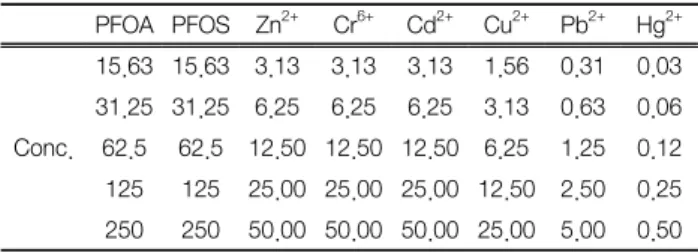
각 시험물질의 최대농도는 PFOA, PFOS, Cu2+, Zn2+, Cr6+, Cd2+, Pb2+, Hg2+ 순으로 250, 250, 25, 50, 50, 50, 5, 0.5 mg/L 이며, 각 물질은 연속 희석하여, 대조군(2% NaCl)을 포함하 여 6개 농도로 준비하였다(Table 1).
PFOA 또는 PFOS와 중금속 복합물질의 농도비는 단일물
Table 1. Application concentration of each single chemicals (mg/L)
PFOA PFOS Zn2+ Cr6+ Cd2+ Cu2+ Pb2+ Hg2+
Conc.
15.63 15.63 3.13 3.13 3.13 1.56 0.31 0.03 31.25 31.25 6.25 6.25 6.25 3.13 0.63 0.06
62.5 62.5 12.50 12.50 12.50 6.25 1.25 0.12 125 125 25.00 25.00 25.00 12.50 2.50 0.25 250 250 50.00 50.00 50.00 25.00 5.00 0.50
Table 2. Mixing ratio of PFOA or PFOS with heavy metals Combination of mixture Mixing ratio by
concentration
Mixing ratio by volume PFOA or PFOS + Zn2+
1:5
1:1 PFOA or PFOS + Cr6+
PFOA or PFOS + Cd2+
PFOA or PFOS + Cu2+ 1:10 PFOA or PFOS + Pb2+ 1:50 PFOA or PFOS + Hg2+ 1:500
질의 독성결과를 바탕으로 Table 2와 같이 설정하였다. 단 일독성시험과 마찬가지로 각 혼합물은 연속희석 하여 6개 의 농도로 준비하였다. 96-well microplate에 시험물질 100 µL와 V. fischeri 현탁액 100 µL를 주입하여 혼합한 후 V.
fischeri를 주입한 시점으로부터 30분간 노출 시험하였다. 모 든 시험물질 및 시험에 사용한 96-well plate는 15±1℃로 준 비한 후 실험에 사용하였으며, 각 농도별 3회 반복 측정하 였다. 발광도는 V. fischeri를 시험물질에 노출한 직후 측정 한 초기발광도와 시험물질 노출 5, 15, 30분 후의 발광도를 luminometer (Lubi, Microdigital, Korea)를 이용하여 측정하 였으며 초기발광도 대비 노출시간별 상대적 발광 저해도를 평가하였다.
2.3. 데이터 분석
오염물질에 대한 V. fischeri의 발광저해정도는 대조구 대 비 각 노출농도별 감소한 발광율을 산출하여 평가하였다.
독성 종말점으로는 5, 15, 30 min-EC50와 5, 15, 30 min- NOEC을 평가하였다. 반수영향농도(EC50)는 US EPA의 tri- mmed Spearman- Karber method18)를 이용하였고 무영향농도 (No-observed-effect concentration, NOEC)는 다중비교법을 기반으로 하는 프로그램인 Dunnett's program을 이용하였다.19) 통계분석에 사용된 이 두 프로그램은 95%의 신뢰수준을 가 지고 평가된다. PFOA 또는 PFOS와 중금속의 binary mixture 에 대한 독성은 toxic unit (TU)모델을 이용하여 분석하였다.20) 단일물질에 대한 독성결과(EC50)를 바탕으로 binary mixture
의 EC50인 EC50mix를 산출하여 복합독성을 평가하였다. 단일
물질의 농도를 EC50로 나눠줌으로써 그 물질에 대한 TU로 환산한 후(TU = 노출농도/EC50), TU기반의 용량반응관계식 (dose-response relationship)에 의해 EC50mix를 산출한다(식 (1)). EC50mix가 1 TU일 경우 상가(additive), 1 TU보다 클 경우
Table 3. Previous toxicity studies of 6 heavy metals (Cu, Hg, Cd, Zn, Pb, Cr), PFOA, and PFOS for Vibrio fischeri Test
chemical
Bacteria status
(manufacturer) Pre-culture Test medium
Test temp (℃).
Test duration
(min)
Measurement (manufacturer)
EC50
(mg/L) Reference
HgCl2 V. fischeri NRRL B-11177 (NR)*
Using diluted solution
for 15 min 2% NaCl NR 30 LUMIStox 0.62 Son et al.29)
Hg* V. fischeri (NR)
Using LB broth with 2.5% NaCl at 25℃ until early-exponential phase
2% NaCl 25
5 Luminometer (TD-20/20, Turner designs, CA, USA)
1.6±0.6
Cho et al.28)
10 0.8±0.5
30 0.8±0.2
Cd(NO3)2 V.fischeri NRRL B-11177 (NR)
Using diluted solution
for 15 min 2% NaCl NR 30 LUMIStox 4.94 Son et al.29)
Cd* V. fischeri (NR)
Using LB broth with 2.5% NaCl at 25 until early-exponential phase
2% NaCl 25
5 Luminometer (TD-20/20, Turner designs, CA, USA)
22.2±2.4
Cho et al.28)
10 21.7±2.9
30 21.8±2.2
Cd* V. fischeri (NR) NR 2% NaCl NR 30 500 Azur Microtox® 7.965 Gue´guen et
al.27) PbCl2 V. fischeri NRRL
B-11177 (NR)
Using diluted solution
for 15 min 2% NaCl NR 30 LUMIStox 1.53 Son et al.29)
Pb* V. fischeri NR 2% NaCl NR 30 500 Azur Microtox® 0.122 Gue'guen et al.27)
PbCl2 V. fischeri
(SDI, USA) NR 2% NaCl NR 15 Microtox 500 (SDI, USA) 0.48
(0.37-0.63) Tsiridis et al.30)
Pb(NO3)2
V. fischeri (SDI, USA)
Using cultivation media (ZnSO4 and NaCl)
for 5 days
2% NaCl 15 15
TOXcontrol
70~110
Lopez-Roldan et al.31)
30 80~130
K2Cr2O7 V.fischeri NRRL B-11177 (NR)
Using diluted solution
for 15 min 2% NaCl NR 30 LUMIStox 4.28 Son et al.29)
Cr6* V. fischeri (NR)
Using LB broth with 2.5% NaCl at 25℃ until early-exponential phase
2% NaCl 25
5 Luminometer (TD-20/20, Turner designs, CA, USA)
18.9±2.3
Cho et al.28)
10 17.2±2.4
30 17.5±1.9
Cr6* V. fisheri (NR) NR 2% NaCl NR 30 500 Azur Microtox® 13.756 Gue'guen et al.27) CuSO4
5H2O
V. fischeri NRRL B-11177 (NR)
Using diluted solution for
15 min 2% NaCl NR 30 LUMIStox 11.09 Son et al.29)
Cu* V. fischeri (NR)
Using LB broth with 2.5% NaCl at 25℃ until early-exponential phase
2% NaCl 25
5 Luminometer (TD-20/20, Turner designs, CA, USA)
31.1±13.9
Cho et al.28)
10 37.1±7.8
30 36.0±14.6
Cu* V. fisheri (NR) NR 2% NaCl NR 30 500 Azur Microtox® 0.58 Gue'guen et al.27)
CuCl2・ 2H2O
V. fischeri
(SDI, USA) NR 2% NaCl NR 15 Microtox 500 (SDI, USA) 0.25
(0.18-0.30) Tsiridis et al.30) CuSO4・
5H2O
V. fischeri (SDI, USA)
Using cultivation media (ZnSO4 and NaCl)
for 5 days
2% NaCl 15 15
TOXcontrol
10.61±1.9
Lopez-Roldan et al.31)
30 4.68±3.3
ZnSO4 V. fischeri (NR) NR 2% NaCl 15 30
ToxAlert 10 4.5
Jennings et al.23)
Microtox 2.11
LUMIStox 25
Zn* V. fischeri (NR) Culture in LB broth
with 2.5% NaCl) 2% NaCl 25
5 Luminometer (TD-20/20, Turner designs, CA, USA)
13.3±1.5
Cho et al.28)
10 12.8±1.3
30 13.4±1.9
Zn* V. fisheri (NR) NR 2% NaCl NR 30 500 Azur Microtox® 0.488 Gue'guen et al.27) ZnCl2 V. fischeri
(SDI, USA) NR 2% NaCl NR 15 Microtox 500 (SDI, USA) 1.50
(1.36-1.59) Tsiridis et al.30) PFOS V. fischeri
NRRL-B 11177 (Macherey-Nagel,
Germany)
Incubated at 3℃
for 5 min 2% NaCl 18 15 Centro LB 960
luminometer
>500
Rosal et al.24)
PFOA 524
(505-538)
* Detail chemical composition was not reported, NR: not reported
Fig. 1. Luminescence of V. fischeri exposed to (A) PFOA and (B) PFOS for 30 min. Bars represent one standard deviation of the mean of three replicates. Significant differences from control (p<0.05) are marked with an asterisk.
길항(antagonistic), 1 TU보다 작을 경우 상승(synergistic)으로 평가한다.21)
∑
(1)
3. 결과 및 고찰
3.1. 과불화합물 독성평가
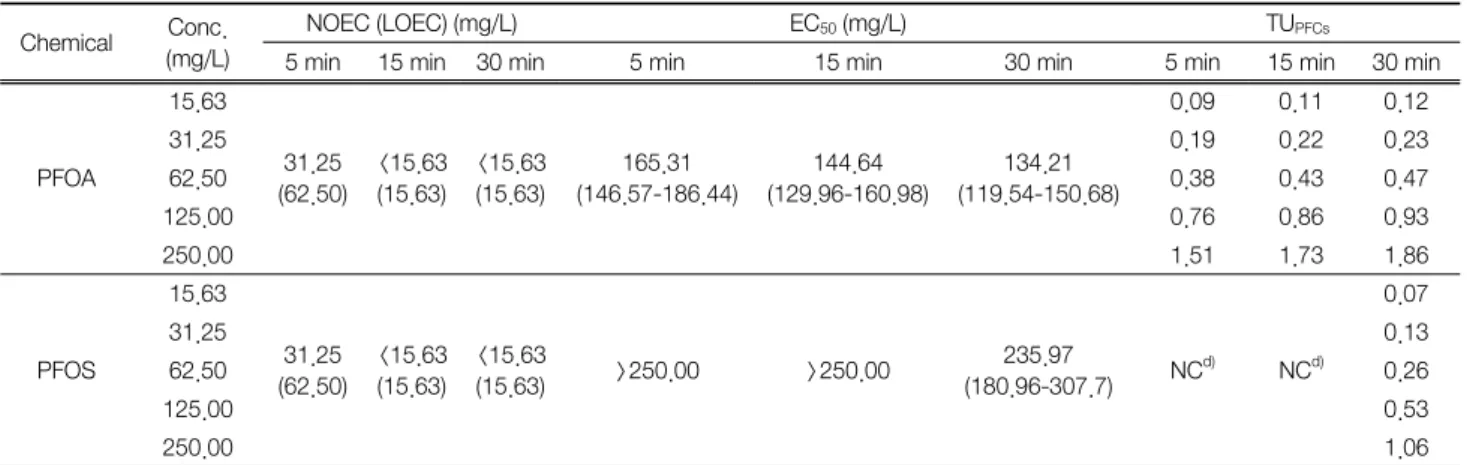
Fig. 1은 PFOA와 PFOS의 노출농도별 V. fischeri의 발광 저해도를 대조구 대비 백분율로 나타낸 것이다. PFOA와 PFOS 모두 최저농도인 15.63 mg/L에서 노출 15분, 30분후 대조구 대비 유의한 발광감소가 나타났으며, 62.50 mg/L의 경우 노출시간에 관계없이 대조구에 비해 통계적으로 유의 한 발광저해가 관찰되었다. PFOA와 PFOS에 노출된 V. fis- cheri의 시간대별(5, 15, 30분) 50% 발광저해 영향농도를 산 출하였다(Table 3). PFOA의 5 min-EC50, 15 min-EC50, 30 min- EC50는 각각 165.31 (146.57-186.44), 144.64 (129.96-160.98), 134.21 (119.54-150.68) mg/L로 산출되었다. PFOS의 경우 노출 15분까지 최고농도인 250 mg/L에서 대조구 대비 49%
의 발광저해를 나타내었으며 노출 30분 후의 EC50는 235.97 (180.96-307.70) mg/L로 계산되었다. 따라서 V. fischeri를 이 용한 독성평가결과 PFOA의 독성이 PFOS보다 더 높은 것 으로 확인되었다. 한편 PFOA가 PFOS보다 더 높은 독성을 나타내는 것은 극표면적(polar surface area, PSA)에 의한 차 이에 의해 발생되었을 가능성이 있다.13,22) PFOA와 PFOS 의 극 표면적은 각각 37.3Å2와 62.8Å2로13) PFOA의 극 표면 적이 적어 세포투과성이 뛰어나 세포막 손상이 더 크게 발 생할 수 있기 때문이다. V. fischeri를 이용한 기존 독성연구 의 PFOA와 PFOS의 15 min-EC50는 각각 524 mg/L와 >500 mg/L이었으며(Table 3),24) 이는 본 연구결과와 비교시 2배 이
상 높은 수치이다. V. fishceri의 독성차이는 실험과정 및 박테 리아의 제조사의 차이에 의한 것으로 보고된 바 있다.23)
타 수생생물의 경우 녹조류, 남조류, 물벼룩에 대한 선행 연구가 보고되었다. 녹조류인 Pseudokirchneriella subcapi- tata24)의 경우 PFOA와 PFOS에 대한 96 h-EC50는 각각 96.2 mg/L와 35 mg/L로 PFOS의 독성이 높았다. 물벼룩인 Monia macrocopa25)의 경우 PFOA와 PFOS에 대한 24 h-EC50가 226.4 와 73.4 mg/L였으며 Daphnia magna26)의 경우 PFOA의 24 h- EC50는 336.23 mg/L, PFOS는 94.32 mg/L로 두 종 모두 PFOS에 대한 민감도가 높았으며 M. macrocopa가 D. magna 에 비해 민감하였다. 반면 남조류인 Anabaena24)는 EC50가 72.3 (PFOA)와 143.27 (PFOS) mg/L로 녹조류와 물벼룩과 달리 PFOA에 더 높은 독성영향을 나타냈다. 본 연구에서 대상으로 한 V. fischeri의 EC50값은 앞서 보고된 타 수생생 물에 비해 높게 산출되었는데 이는 노출시간이 30분 이내로 짧기 때문으로 판단된다. V. fischeri와 Anabaena 등 박테리아 는 PFOA에 더 민감하였고 조류와 물벼룩은 PFOS에 민감하 여 물질에 따른 생물종간의 민감도 차이도 확인하였다.
한편 TUPFOA와 TUPFOS는 중금속과의 복합독성평가시 사용 하는 개별물질의 TU농도로 노출농도를 각 노출시간별 EC50
로 나누어 환산하였다(Table 4).
3.2. 중금속 독성평가
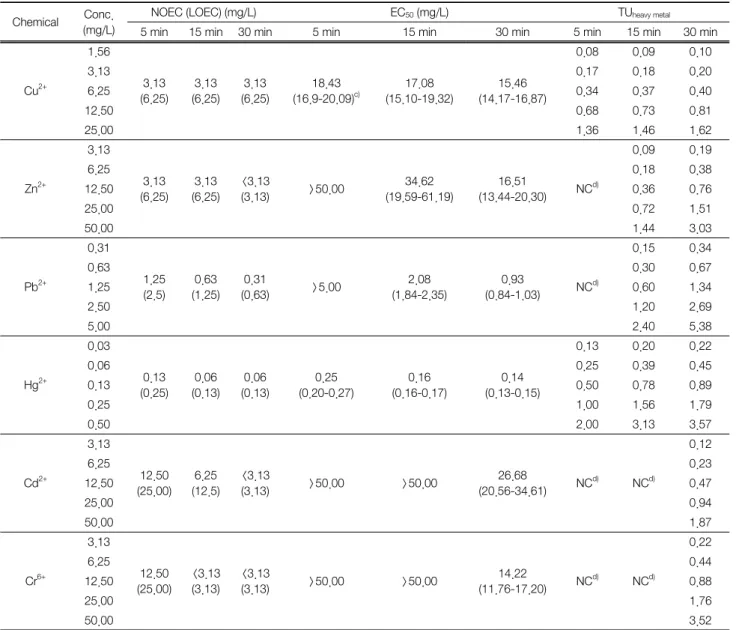
Fig. 2는 Cu2+, Hg2+, Cd2+, Zn2+, Pb2+, Cr6+ 등의 6종 중금 속에 대한 V. fishceri의 대조구대비 발광 저해율을 나타낸 것 이다. 중금속의 노출농도 증가에 따라 V. fischeri의 발광저해 율도 증가하였다. 6종 중금속의 30 min-EC50는 Cu2+, Hg2+, Cd2+, Zn2+, Pb2+, Cr6+ 순으로 15.46 (14.14-16.87), 0.14 (0.13- 0.15), 26.68 (20.56-34.61), 16.51 (13.44-20.30), 0.93 (0.84- 1.03), 14.22 (11.76-17.20) mg/L로 계산되어 Hg의 독성이 가장 높고 Cd의 독성이 가장 낮은 것으로 확인되었다.
Table 4. The no-observed effect concentration (NOEC)a), the median effective concentration (EC50)b), and toxic unit (TU) for lumine- scence of Vibrio fischeri exposed to PFOA and PFOS
Chemical Conc.
(mg/L)
NOEC (LOEC) (mg/L) EC50 (mg/L) TUPFCs
5 min 15 min 30 min 5 min 15 min 30 min 5 min 15 min 30 min
PFOA
15.63
31.25 (62.50)
<15.63 (15.63)
<15.63 (15.63)
165.31 (146.57-186.44)
144.64 (129.96-160.98)
134.21 (119.54-150.68)
0.09 0.11 0.12
31.25 0.19 0.22 0.23
62.50 0.38 0.43 0.47
125.00 0.76 0.86 0.93
250.00 1.51 1.73 1.86
PFOS
15.63
31.25 (62.50)
<15.63 (15.63)
<15.63
(15.63) >250.00 >250.00 235.97
(180.96-307.7) NCd) NCd)
0.07
31.25 0.13
62.50 0.26
125.00 0.53
250.00 1.06
a)Dunnett’s program, b)Trimmed Spearman-Karber method, c)95% confidence level is in parenthese, d)Not calculated.
Fig. 2. Luminescence of V. fischeri exposed to (a) Cu2+, (b) Hg2+, (c) Cd2+, (d) Zn2+, (e) Pb2+, and (f) Cr6+ for 30 min. Bars represent one standard deviation of the mean of three replicates. Significant differences from control (p<0.05) are marked with an asterisk.
Fig. 3. The median effective concentration of mixture (EC50mix) of V. fischeri exposed to mixture of (a) PFOA or (b) PFOS with 6 heavy metals for 30 min. Bars represent 95% upper and lower confidence of EC50mix.
본 연구에서 수행한 6종 중금속에 대한 V. fischeri의 선행 연구 결과에 따르면, 30 min-EC50기준으로 Cu의 경우 0.5827)~ 3628) mg/L, Zn은 0.48827)~2523) mg/L, Cr은 4.2829)~17.528) mg/L, Cd는 7.96527)~21.828) mg/L, Hg는 0.6229)~0.828) mg/L, Pb는 0.12227)~13031) mg/L이었다(Table 3). 본 연구에서 도출 된 독성값과 기존연구결과의 비교시 Cd를 제외한 나머지 물 질의 경우 선행연구의 독성값 범위에 포함되었다. 한편 Pb 의 경우 선행연구결과의 최저값과 최대값이 100배 이상 큰 차이를 나타내었다. Table 3에서와 같이 선행연구들의 시험 조건을 비교하였으나 각각의 시험조건(중금속 화합물, 박테 리아 종류, 온도, 측정기기, 노출시간, 배양여부 등)이 상이 하여 명확하게 비교가 어려우나 3.1절에서 기술한바와 같이 실험과정 및 박테리아의 상태 그리고 실험에 사용한 중금 속의 염형태의 차이에 발생되었을 가능성이 있다.23,32) 또한 시험배지의 이온강도, 완충능력, 단백질함량에 의해 독성차 이가 나타날 수 있다.23)
3.3. 과불화합물과 중금속의 복합독성 평가
PFOA 또는 PFOS와 6종 중금속의 binary mixture에 대한 독성영향을 EC50mix를 산출하여 평가하였다(Fig. 3). PFOA 와 중금속의 30 min-EC50mix는 PFOA + Cu2+, PFOA + Hg2+, PFOA + Cd2+, PFOA + Zn2+, PFOA + Pb2+순으로 1.96 (1.76- 2.17), 1.71 (1.82-1.93), 1.15 (1.35-1.58), 1.13 (1.00-1.28), 2.08 (1.87-2.33)로 1 TU 이상으로 산출되어 길항작용을 하는 것 으로 확인되었다. 반면 PFOA + Cr6+의 경우 30 min-EC50mix
값이 0.41 (0.25-0.66)로 개별물질 독성의 합보다 독성영향 이 증가하는 상승작용이 나타났다. 30 min-EC50mix를 기준으 로 PFOA와 중금속 복합물질의 독성은 PFOA + Cr6+이 가 장 높고 이후 PFOA + Zn2+> PFOA + Cd2+> PFOA + Hg2+>
PFOA + Cu2+> PFOA + Pb2+ 순의 독성민감도를 나타냈다.
PFOS와 중금속의 30 min-EC50mix는 PFOS + Cu2+, PFOS + Hg2+, PFOS + Cd2+, PFOS + Zn2+, PFOS + Cr6+, PFOS + Pb2+
순으로 2.22 (1.89-2.60), 1.50 (1.41-1.60), 0.99 (0.86-1.13), 0.91 (0.79-1.05), 0.36 (0.26-0.49), 1.32 (1.09-1.60)로 계산 되어 PFOS + Cr6+의 독성이 가장 높았으며 이후 PFOS + Zn2+ > PFOS + Cd2+ > PFOS + Pb2+ > PFOS + Hg2+ > PFOS + Cu2+ 순의 독성영향을 나타냈다. PFOS + Cr6+의 경우 PFOA + Cr6+와 같이 상승효과를 나타내는 것으로 확인되었으며, PFOS + Zn2와 PFOS + Cd2+는 두 물질의 독성의 합과 동일한 상가효과를 나타내었다. 한편 이외에 PFOS + Cu2+, PFOS + Hg2+, PFOS + Pb2+는 길항작용이 나타났다. Cr6+의 경우 단일 물질에서는 6종의 중금속중 중간수준의 독성이었으나 PFOA 또는 PFOS와의 복합물질은 가장 높은 독성을 나타냈다. 이 외에도 단일물질과 복합물질간의 독성민감도는 상이하였다.
한편 Anabaena를 이용하여 PFOA + Hg2+, PFOA + Cd2+, PFOS + Hg2+, PFOS + Cd2+의 복합독성을 평가한 연구에도 길항작용 이 나타남을 확인하였다.13) 이러한 현상은 음이온계면활성 제에 속하는 PFOA와 PFOS에 의해 양전하를 띄는 중금속이 안정화되기 때문으로 설명된다.13)
4. 결 론
본 연구에서는 과불화합물질 중 대표적인 PFOA와 PFOS 가 수체에서 중금속과 공존할 때의 복합독성영향을 평가하 고자 하였다. 독성영향은 V. fischeri를 이용하여 평가하였 으며 그 결과 다음과 같은 결론을 얻었다. 단일물질의 경우 PFOA와 PFOS의 독성은 PFOA가 PFOS보다 독성이 더 높 은 것으로 나타났다. 한편 PFOA와 PFOS의 독성은 6종의 중금속에 비해 독성이 상대적으로 낮은 것으로 나타났으며, 대상중금속의 독성은 30 min-EC50기준으로 Hg2+의 독성이 가장 높았으며 뒤이어 Pb2+> Cr6+> Cu2+> Zn2+> Cd2+ 순으 로 높은 독성을 나타냈다. PFOA, PFOS와 각 중금속들과의 복 합독성의 경우 30 min-EC50mix를 기준으로 PFOA 또는 PFOS 와 Cr의 복합물질은 상승효과, PFOS + Zn2+와 PFOS + Cd2+
Table 5. The no-observed effect concentration (NOEC)a), the median effective concentration (EC50)b), and toxic unit (TU) for lumine- scence of Vibrio fischeri exposed to Cu2+, Zn2+, Pb2+, Hg2+, Cd2+, and Cr6+
Chemical Conc.
(mg/L)
NOEC (LOEC) (mg/L) EC50 (mg/L) TUheavy metal
5 min 15 min 30 min 5 min 15 min 30 min 5 min 15 min 30 min
Cu2+
1.56
3.13 (6.25)
3.13 (6.25)
3.13 (6.25)
18.43 (16.9-20.09)c)
17.08 (15.10-19.32)
15.46 (14.17-16.87)
0.08 0.09 0.10
3.13 0.17 0.18 0.20
6.25 0.34 0.37 0.40
12.50 0.68 0.73 0.81
25.00 1.36 1.46 1.62
Zn2+
3.13
3.13 (6.25)
3.13 (6.25)
<3.13
(3.13) >50.00 34.62
(19.59-61.19)
16.51
(13.44-20.30) NCd)
0.09 0.19
6.25 0.18 0.38
12.50 0.36 0.76
25.00 0.72 1.51
50.00 1.44 3.03
Pb2+
0.31
1.25 (2.5)
0.63 (1.25)
0.31
(0.63) >5.00 2.08
(1.84-2.35)
0.93
(0.84-1.03) NCd)
0.15 0.34
0.63 0.30 0.67
1.25 0.60 1.34
2.50 1.20 2.69
5.00 2.40 5.38
Hg2+
0.03
0.13 (0.25)
0.06 (0.13)
0.06 (0.13)
0.25 (0.20-0.27)
0.16 (0.16-0.17)
0.14 (0.13-0.15)
0.13 0.20 0.22
0.06 0.25 0.39 0.45
0.13 0.50 0.78 0.89
0.25 1.00 1.56 1.79
0.50 2.00 3.13 3.57
Cd2+
3.13
12.50 (25.00)
6.25 (12.5)
<3.13
(3.13) >50.00 >50.00 26.68
(20.56-34.61) NCd) NCd)
0.12
6.25 0.23
12.50 0.47
25.00 0.94
50.00 1.87
Cr6+
3.13
12.50 (25.00)
<3.13 (3.13)
<3.13
(3.13) >50.00 >50.00 14.22
(11.76-17.20) NCd) NCd)
0.22
6.25 0.44
12.50 0.88
25.00 1.76
50.00 3.52
a)Dunnett’s program, b)Trimmed Spearman-Karber method, c)95% confidence level is in parenthese, d)Not calculated.
는 상가효과를 나타내었으며 그 외 복합물질은 모두 길항 작용이 나타났다. 전반적으로, 복합물질의 독성영향은 개별 물질의 독성정도와는 차이를 나타냄을 확인하였고 물질의 조합에 따른 차이도 관찰하였다. 보편적으로 수체에는 다 양한 물질이 공존하고 있고 이러한 물질간의 상호작용을 통 해 나타나는 독성영향은 물질이 상이할 수 있으므로 이에 관한 후속연구가 필요하다고 사료된다.
Reference
1. Parsons, J. R., Saez, M., Dolfing, J. and de Voogt, P., “Bio- degradation of perfluorinated compounds,” Rev. Environ. Con- tam. Toxicol., 196, 53~71(2008).
2. Liu, W., Chen, S., Quan, X. and Jin, Y., “Toxic effect of serial perfluorosulfonic and perfluorocarboxylic acid on the membrane system of a freshwater alga measured by flow cytometry,” Environ. Toxicol. Chem., 27(7), 1597~1604(2008).
3. Suja, F., Pramanik, B. K. and Zain, S. M., “Contamination, bioaccumulation and toxic effects of perfluorinated chemicals (PFCs) in the water environment: a review paper,” Water Sci. Technol., 60(6), 1533~1544(2009).
4. Agency for Toxic Substance and Disease Registry, “Draft toxicological profile for perfluoroalkyls,” http://www.atsdr.
cdc.gov/toxprofiles/tp200.pdf(2009).
5. United Nations Environment Program, “Risk profile on per- fluorooctane sulfonate,” Stockholm Convention on Persistent Organic Pollutants Review Committee, Geneva(2006).
6. Benford, D., de Boer, J., Carere, A., di Domenico, A., Johan- sson, N., Schrenk, D., Schoeters, G., de Voogt, P. and Del- latte, E., “Opinion of the Scientific Panel on Contaminants in
the Food chain on perfluorooctane sulfonate (PFOS), perfluo- rooctanoic acid (PFOA) and their salts,” EFSA, 653, 1~131 (2008).
7. Moermond, C. T. A., Verbruggen, E. M. J. and Smit, C. E.,
“Environmental risk limits for PFOS: A proposal for water quality standards in accordance with the Water Framework Directive,” RIVM Report 601714013(2010).
8. Jensen, A. A. and Leffers, H., “Emerging endocrine disrup- ters: perfluoroalkylated substances,” Int. J. Androl., 31, 161~
169(2008).
9. Stockholm Convention, “Acceptable purposes: PFOS and PFOSF,” http://chm.pops.int/Implementation/Exemptions/
AcceptablePurposesPFOSandPFOSF/tabid/794/Default.aspx#
_ftnref1(2013).
10. Ministry of Environment/National Institute of Environmental Research, “Press release; research of endocrine disrupters in industrial area,”(2009).
11. Marugan, J., Bru, D., Pablos, C. and Catala, M., “Compa- rative evaluation of acute toxicity by Vibrio fischeri and fern spore based bioassays in the follow-up of toxic chemicals degradation by photocatalysis,” J. Hazard. Mater., 213-214, 117~122(2012).
12. Power, E. A. and Boumphrey, R., “International trends in bioassay use for effluent management,” Ecotoxicol., 13, 377~
398(2004).
13. Rodea-Palomares, I., Leganes, F., Rosal, R. and Fernandez- Pinas, F., “Toxicological interactions of perfluorooctane sul- fonic acid (PFOS) and perfluorooctanoic acid (PFOA) with selected pollutants,” J. Hazard. Mater., 201-202, 209~218 (2012).
14. Keiter, S., Baumann, L., Färber, H., Holbech, H., Skutlarek, D., Engwall, M. and Braunbeck, T., “Long-term effects of a binary mixture of perfluorooctane sulfonate (PFOS) and bis- phenol A (BPA) in zebrafish (Danio reiro),” Aquat. Toxicol., 118-119, 116~129(2012).
15. Kim, S., Ji, K., Lee, S., Lee, J., Kim, J., Kim, S., Kho, Y.
and Choi, K., “Perfluorooctane sulfonic acid exposure incre- ases cadmium toxicity in early life stage of zebrafish, Danio rerio,” Environ. Toxicol. Chem., 30, 870-877(2010).
16. Liu, W., Zhang, Y. B., Quan, X., Jin, Y. H. and Chen, S.,
“Effect of perfluorooctane sulfonate on toxicity and cell up- take of other compounds with different hydrophobicity in green alga,” Chemosphere, 75, 405-409(2009).
17. KSIISO, “Water quality - determination of the inhibitory ef- fect of water samples on the light emission of Vibrio fischeri (luminescent bacteria test) - part3 : method using freeze-dried bacteria,” KSIISO 11348:3(2009).
18. Hamilton, M. A., Russo, R. C. and Thurston, R. V., “Tri- mmed Spearman-Karber method for estimating median lethal concentrations in toxicity bioassays,” Environ. Sci. Technol., 11, 714~719(1977); Correction 12, 417(1978).
19. Dunnett, C. W., “Multiple comparison proceure for compa- ring several treatments with a control,” J. Am. Stat. Assoc., 50, 1096-1121(1995).
20. Van der Geest, H. G., Greve, G. D., Blivin, M. E., Kraak, M. H. S. and van Gestel, C. A. M., “Mixture toxicity of copper and diazinon to larvae of the mayfly judging addi- tivity at different effect levels,” Environ. Toxicol. Chem., 19 (12), 2900~2905(2000).
21. An, Y. J. and Lee, W. M., “Decreased toxicity to terrestrial plants associated with a mixture of methyl-tert butyl ether and its metabolite tert-butyl alcohol,” Environ. Toxicol. Chem., 26(8), 1711~1716(2007).
22. Nobels, I., Dardenne, F., de Coen, W. and Blust, R., “App- lication of a multiple endpoint bacterial reporter assay to evaluate toxicological relevant endpoints of perfluorinated compounds with different functional groups and varying cha- in length,” Toxicol. in vitro, 24, 1768-1774(2010).
23. Jennings, V. L. K., Rayner-brandes, M. H. and Bird, D. J.,
“Assessing chemical toxicity with the bioluminescent photo- bacterium (Vibrio fischeri): A comparison of three comercial systems,” Water Res., 35, 3448~3456(2001).
24. Rosal, R., Rodea-Palomares, I., Boltes, K., Fernandez-Pinas, F., Leganes, F. and Petre, A., “Ecotoxicological assessment of surfactants in the aquatic environment: Combined toxi- city of docusate sodium with chlorinated pollutants,” Che- mosphere, 81, 288~293(2010)
25. Lee, C. W., Kim, H. M. and Choi, K. H., “Toxicity assess- ment of PFOA and PFOS using freshwater flea Hyalella azteca,” J. Environ. Toxicol., 22(3), 271~277(2007) 26. Kim, K. Cho, J., Yoon, J., Lee, C., Choi, K., Kim, H. and
Ryu, J., “Toxicity evaluation of perfluorinated compounds using Daphnia magna,” Environ. Health Toxicol., 25, 153~
159(2010).
27. Guéguena, C., Gilbina, R., Pardosa, M. and Dominika, J.,
“Water toxicity and metal contamination assessment of a polluted river: the Upper Vistula River (poland),” Appl. Geo- chem., 19, 153~162(2004).
28. Cho, J. C., Park, K. J., Ihm, H. S., Park J. E., Kim, S. Y., Kang, I., Lee, K. H., Jahng, D., Lee, D. H. and Kim, S. J.,
“A novel continuous toxicity test system using a luminously modified freshwater bacterium,” Biosens. Bioelectron., 20, 338~344(2004).
29. Son, Y. H, Lee, H. M., Ryu, J. K. and Rhu, H. I., “A study on biotoxicity assessment of toxic materials on Vibrio fis- cheri,” Kor. J. Environ. Toxicol., 9(2), 41~50(1994).
30. Tsiridis, V., Petala, M., Samaras, P., Hadjispyrou, S., Sa- kellaropoulos, G. and Kungolos, A., “Interactive toxic effects of heavy metals and humic acids on Vibrio fischeri,” Eco- toxicol. Environ. Saf., 63, 158~167(2006).
31. Lopez-Roldan, R., Kazlauskaite, L., Ribo, J., Carme Riva, M., Gonzalez, S., Cortina, J. L., “Evaluation of an automated luminescent bacteria assay for in situ aquatic toxicity deter- mination,” Sci. Total. Environ., 440, 307~313(2012).
32. Greene, J. C., Miller, W. E., Debacon, M. K., Long, M. A.
and Bartels, C. L., “A comparison of three microbial assay procedures for measuring toxicity of chemicals residues,”
Arch. Environ. Contam. Toxicol., 14, 659~667(1985).