The Efficacy of Psychological Interventions for Complex Trauma: A Systematic Review and Meta-Analysis
Hyunjung Choi
1†Wooyeol Lee
1Simyang Heo
2Jahye Kim
21Department of Psychology, Chungbuk National University, Cheongju; 2Traumahealing Center Human Hearts, Seoul, Korea
This study meta-analyzed interventions for symptom constructs of complex posttraumatic stress disorder related to complex trauma, such as child abuse, multiple interpersonal trauma, and organized violence. From 42 randomized controlled studies, 164 effect sizes were calculated comprising various treatment comparisons and outcomes. Cognitive processing therapy/cog- nitive therapy (CPT/CT), narrative exposure therapy (NET), phase-based trauma-focused cognitive behavior therapy (phased TF-CBT), single-phased TF-CBT (single TF-CBT), prolonged exposure (PE), eye movement desensitization and re- processing (EMDR), and present-centered therapy (PCT) each showed moderate to large effect sizes on PTSD. For depres- sion, CPT/CT, phased TF-CBT, single TF-CBT, NET, and PE showed moderate to large effect sizes. Meta regression revealed that efficacy on PTSD and depression was greater with trauma-focused than with present-centered interventions. Limited evidence made it impossible to compare phased treatments and single-phase treatments. Outcomes of disturbance in self or- ganization (DSO) were relatively scarce; however, among those, CPT/CT, PE, and PCT showed large to moderate effect sizes on negative self-concept. For emotion regulation and interpersonal problems, phased TF-CBT seemed to be promising.
Treatment completion rates were similar between trauma-focused and present-centered. Population and study characteristics did not affect efficacy; however, we discussed related clinical issues.
Keywords: complex trauma; evidence-based interventions; posttraumatic stress disorder; complex posttraumatic stress disorder; meta-analysis
Recently, the International Classification of Diseases 11th Revi- sion (ICD-11) included a diagnosis of complex posttraumatic stress disorder (CPTSD), which consists of three core posttrau- matic stress symptoms (reexperience, avoidance, and sense of threat) and additional symptoms of disturbance in self organiza- tion (DSO) represented by affect dysregulation, negative self-con- cept, and disturbances in relationships (World Health Organiza- tion, 2018). This inclusion reflects previous understandings about the complicated impacts of complex trauma (Briere, 1992; Her-
man, 1992; van der Kolk, 1996), and has foundations from recent empirical studies that revealed profiles of CPTSD or DSO that are independent from PTSD (Cloitre, Garvert, Brewin, Bryant, &
Maercker, 2013; Knefel, Garvert, Cloitre, & Lueger-Schuster, 2015), or borderline personality disorder (BPD) (Cloitre, Garvert, Weiss, Carlson, & Bryant, 2014). A measurement for CPTSD has also been developed and validated emphasizing clinical utility as well as universal applicability (Cloitre et al., 2018).
Since the official recognition of CPTSD has shown recent prog- ress, searching for empirically supported psychological treatment of CPTSD is required. For PTSD, clinical guidelines of psychologi- cal treatments are clearly established (American Psychological As- sociation, 2017); however, some controversial issues remain in the treatment of CPTSD. There are clinical guidelines for CPTSD; for example, the International Society of Traumatic Stress Studies
eISSN 2733-4538
†Correspondence to Hyunjung Choi, Department of Psychology, Chungbuk National University, 1 Chung-daero, Suwon-gu, Cheongju, Korea; E-mail:
Received Jan 03, 2020; Revised Feb 09, 2020; Accepted Feb 27, 2020
This work was supported by the Ministry of Education of the Republic of Korea and the National Research Foundation of Korea (NRF-2017S1A5B5A07062178).
(ISTSS) expert consensus, suggests that phase-oriented treatment may be beneficial to individuals with complex symptoms (Cloitre et al., 2012). Critiques pointed out that trauma-focused CBT (TF- CBT) developed for PTSD also may be efficacious for people with complex trauma, and that phase orientation lacks evidence in util- ity (e.g., De Jongh et al., 2016). However, this discussion may be re- futed, that it focused on PTSD and depressive symptoms and ex- clude broad symptoms of DSO and did not consider the possible adverse effects, such as increased distress during the exposure process. A systematic review among women survivors of child- hood abuse reported that exposure-based CBTs had shown above moderate effect size for PTSD; however, with CPTSD, affect man- agement interventions brought better improvement and lower drop out (Dorrepaal et al., 2014). They concluded that phase-based treatment would be more suitable for CPTSD which prepares cli- ents with distress tolerance for subsequent trauma-focused and exposure-based treatments.
This study aimed to meta-analyze the efficacy of interventions for CPTSD constructs and to identify optimal treatment for com- plex trauma, including PTSD and related pervasive symptoms.
Unlike review studies that rely on a subjective synthesis, a meta- analysis calculates the effect size (Jang & Shin, 2011) and by com- paring randomize controlled trials, meta-analysis can give a com- prehensive understanding in which treatment for whom may be efficacious (Seidler & Wagner, 2006), providing critical evidence to clinical guidelines and policy making (Cooper, 2010).
Karatzias et al. (2019), which is the first meta-analysis according to the ICD-11 CPTSD, recently reported the efficacy of 51 ran- domized controlled studies that included outcomes of PTSD and at least one DSO symptom. Studies using compact measurement tools for CPTSD should be first considered, as Brewin et al. (2017) mentioned that not the type of trauma but the symptomatology post trauma would decide the diagnosis of CPTSD. However, be- cause to date, efficacy studies using a dedicated measure for CPTSD were rare (Karatzias et al., 2019), focusing on the type of the trauma for a meta-analysis may provide additional guidelines in real-world settings. To expand the findings, our study focused on populations that had experienced what represents previous definition of complex trauma.
Earlier, Herman (1992, 1997) had identified complex trauma re-
sulting from multiple, repeated, prolonged, and systematic trau- matization, especially of an interpersonal nature, such as child abuse, domestic violence, sexual exploitation, combat, or torture may complicate posttraumatic adaptation. Also, Hobfoll and col- leagues discovered that it is the degree of resource loss during sus- tained trauma exposure that leads to severe and chronic symptom trajectories (Hobfoll, Mancini, Hall, Canetti, & Bonanno, 2011).
Similarly, as reported by Courtois and Ford (2013), complex trau- ma involves “traumatic attachment (p. 25)”, which is repetitive and cumulative, causing severe alterations in one’s ordinary develop- mental process, life, and identity. These conditions were consid- ered to be associated with symptom complications, such as emo- tion dysregulation, identity problems, disruptions in relationships, somatization, alterations in consciousness, and altered systems of meaning (Briere, 1992; Herman, 1992; Pelcovitz et al., 1997), in ad- dition to core symptoms of PTSD.
Therefore, we focused on studies including the above previous descriptions of complex trauma, and those that dealt with symp- toms, such as PTSD, depression, anxiety, dissociation, negative self-concept, emotion dysregulation, interpersonal problems, bor- derline personality disorder, and self-harm behaviors. Systematic review and meta-analyses included randomized controlled studies of major psychological treatments, including phase-based treat- ments, trauma-focused treatments, and other psychosocial ap- proaches. For trauma-focused treatments, effect size of each treat- ment was calculated, because in the applied setting each treatment is trained and conducted distinctively, and fidelity of each treatment is an important issue. Predictors of treatment efficacy were exam- ined using meta-regression analyses. We hypothesized that trau- ma-focused treatments would be efficacious for PTSD compared to non-trauma focused treatments. For other complex symptoms, phased-based trauma-focused treatments would show higher effi- cacy compared to a single-phase trauma-focused treatment.
Methods
Study selection
The search period covered from 1990 to September 2017, since it was in the 1990s that discussion of complex trauma first began (e.g., Terr, 1990), up to the date when the search was initiated. The
PsychINFO, PubMed, PILOTS, and Medline databases were searched using the EndNote ×5. Selections were organized by the PICOT guideline (Institute of Medicine, 2011). For population (P), intervention (I), and outcomes (O), search terms were entered as follows; (complex trauma OR multiple trauma OR child abuse OR child neglect OR child adversity OR maltreatment OR torture OR sexual trauma OR domestic violence OR intimate partner violence OR prostitution OR bereavement) AND (psychotherapy OR psy- chological treatment OR exposure OR EMDR OR trauma-focused cognitive behavioral therapy OR cognitive processing OR cogni- tive restructuring OR dialectical behavior therapy OR present- centered OR stress management OR gestalt OR psychoanalytic OR mentalization OR somatic experiencing OR sensorimotor psychotherapy OR advocacy OR group therapy OR psychoeduca- tion) AND (PTSD OR suicid* OR self-harm OR self-injury OR emotion regulation OR self-regulation OR self-organization OR substance OR eating OR borderline personality disorder OR de- press* OR identity OR interperson* OR relation*).
For comparison (C), treatment as usual, waiting list, and active treatment comparison studies were selected; and for study type (T), conducting a randomized controlled trial, using validated in- struments, and peer reviewed studies were eligible. Exclusion cri- teria included non-peer reviewed literature, review article, partici- pants under the age 18, offender study, non-face-to face therapy, and non-individual therapy (couple or family therapy, or group therapy as major interventions).
Intervention listed recommended treatments for PTSD (APA, 2017), which are trauma-focused treatments such as prolonged ex- posure (PE; Foa & Rothbaum, 1998), cognitive processing (Resick
& Schnicke, 1992) or cognitive therapy (Ehlers, Clark, Hackmann, McManus, & Fennell, 2005) for PTSD, cognitive behavior therapy (CBT) composed of interventions based on cognitive behavioral principles, eye movement desensitization and reprocessing (EMDR; Shapiro, 1995), and dialectical behavior therapy (Line- han, 1993). Relatively newly recognized somatic based interven- tions such as somatic experiencing (SE; Levine, 2010) and senso- rimotor psychotherapy (SP; Ogden & Fisher, 2015) were also in- cluded. Additionally, non-trauma focused, present-centered thera- pies (PCT) were included, as were treatments from traditionally established approaches in psychotherapy related to our main tar-
get symptoms. Last, “advocacy” was included to seek psychosocial interventions for complicated areas of human rights violations.
Comparisons for treatment completers and intent-to-treat analysis were planned. Two researchers independently worked on the search and reviewed titles and abstracts consequently. A third re- searcher cross-checked and discussed disagreements to find reso- lutions. Finally, all three researchers reviewed full texts for final selection and resolved discrepancies.
Data extraction
Two researchers each with expertise in trauma studies and statis- tics, extracted data for standardized differences between treatment groups, seeking agreements. Intent-to-treat scores and follow-up data (versus post data) were firstly coded. When these were not available, completer scores or post data were coded and recorded separately as study characteristics. When both self-report mea- surements and clinical interviews were reported, clinical interview data were used. Means and SDs were mainly extracted, and SDs were calculated if standard errors were given instead. Because no studies reported pre-post data correlations, a moderate value of r =.5 was coded according to Becker (1990). Studies reporting raw differences with confidence intervals, and ds were coded as such.
When the number of participants from pre-intervention to follow- up differed in the reported intent-to-treat analysis, we decided us- ing the number of pre-intervention participants, and this calcula- tion were confirmed by being most closely matched with an alter- native calculation according to Morris (2008).
Study characteristics were independently coded by three re- searchers, and the first author cross-checked each data. Each study characteristic was organized into a table, including intervention arms, intervention type (trauma-focused or not, and phased-ori- ented or not), average number of sessions, number of participants, number of treatment completers (according to the definition of completion in each study), completer rate, follow-up duration, tar- geted outcomes, measurements of outcomes, analysis type (intent- to-treat or completer), and study location. Each participant’s char- acteristics was also organized, such as female gender (%), low SES (percentage of people with lowest income or insecure social status level, based on the report of each study), and European/Caucasian ethnicity (%). The type of trauma experience (organized violence
such as torture, terrorism, living in a conflict region, detention, or persecution; child abuse; multiple interpersonal trauma; and mili- tary trauma), and intervention setting (outpatient, residential, or shelter) were also coded.
Analysis
Quality assessment
Following the methodology checklist for randomized controlled trials of NICE (2012), two researchers completed the quality as- sessment, and final decisions were made by discussing uncertain- ties. Low, unclear/unknown, and high risks of bias were assessed in four domains, such as selection, performance, attrition, and de- tection. Overall risk of bias was decided as low, moderate, and high depending on the level of risk in each domain. At least three low risks of bias on each domain were considered overall as low risk. Two low risks without any high risks were considered to be an overall moderate risk. Overall risk was rated as high when one or more high risks were detected in any domain.
Effect size and meta regression analysis
Comprehensive Meta-Analysis 3 was used for the meta-analyses.
As by “shifting the unit of analysis” (Cooper, 1998), effect size was used as the unit of analysis. Hedges’ g was chosen as the effect size to overcome the shortcomings of Cohen’s d which often overesti- mates the effect size. The effect size and 95% confidence interval were calculated for each intervention. Effect size was interpreted as large (>.80), moderate (.50 to .80), small (.20 to .50), or none (<.20) according to Cohen (1988). Heterogeneity was assessed us- ing the I 2 and tau2 statistics. Because we assumed heterogeneity, a random effect model was chosen, with maximum likelihood esti- mation. We assessed publication bias using the funnel plot, and Trim and Fill (Duval & Tweedie, 2000) and conducted sensitivity analyses. Among comparisons of psychological treatment and TAU/WL, univariate meta-regression was conducted by entering each study characteristic such as type of trauma (childhood abuse, organized violence, multiple interpersonal trauma), compositions of low SES (%), female gender (%), and European/Caucasian eth- nicity (%), session length, intent-to-treat (vs. completer) study, risk of bias levels (high vs. low, and high vs. moderate), and trauma-fo- cused treatment (vs. non-trauma focused).
Results
Study selection
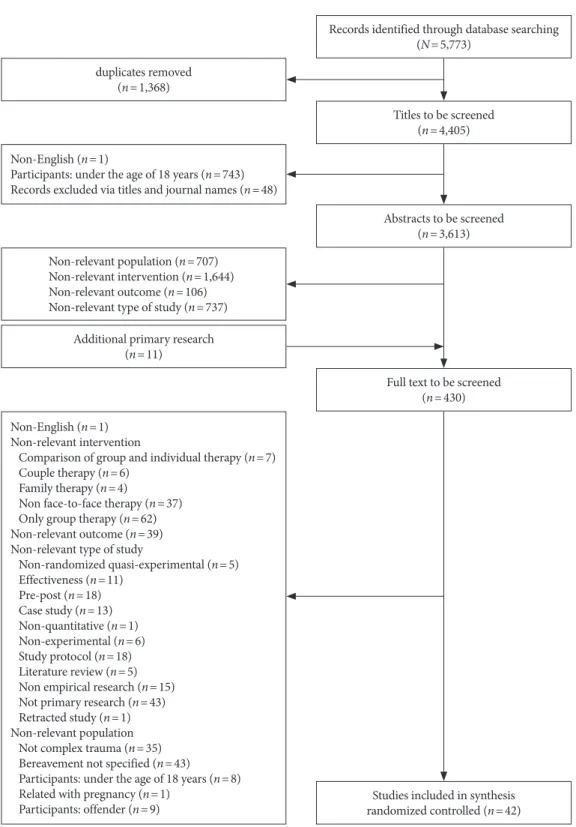
A flowchart of data selections is presented in Figure 1. A total of 5,773 articles were searched, then by screening via titles and ab- stracts, and adding 11 primary articles searched by ancestry ap- proach from secondary analysis articles, a total of 430 articles re- mained for full text screening. Studies with bereaved participants were all excluded, because the researchers agreed that information to conclude whether it would be a multiple or complex experience were insufficient. The final screening excluded 372 articles, leav- ing 42 randomized controlled studies eligible for the full inclusion criteria.
Study characteristics
Study and participant characteristics of the 42 randomized con- trolled studies are presented in Table 1 and in Appendices I and II.
Most of the studies were conducted in Western countries. For tar- get symptoms, majority assessed efficacy on PTSD and depres- sion. Studies assessing DSO related symptoms were relatively scarce. Studies were mainly conducted in outpatient settings. Sev- en studies (16.7%) did not report follow-up data, and the other 35 studies (83.3%) reported follow-up data in which duration ranged from one to 24 months. There were four studies (9.5%) that had a phased-based design. Twenty-four studies (57.1%) reported data of intent-to-treat analysis clearly enough to be included in the meta- analysis.
The total number of participants from all studies was 4,455, ranging from 18 to 347 individuals in each study. Based on type of trauma, child abuse, multiple interpersonal trauma, organized vi- olence, and military-trauma studies were identified. For gender, most studies had higher composition of females, except eight stud- ies (19.0%) with less than 50% of female participants were all relat- ed to organized violence. There was no male-only study.
For the ethnicity of the participants, 40.5% included European/
Caucasian people at over 50%, and the rest included diverse eth- nicities. For SES, twelve studies (28.6%) had less than 50% of peo- ple with low SES. There were 12 studies (28.6%) focusing mainly on a low-resource population, including refugees and asylum seekers, a culturally diverse population with low income, and peo-
ple in shelter setting.
The average number of individual sessions ranged from one (psychoeducation) to 38.6 (DBT-PE) sessions, and average for all studies was 11.20 sessions. The treatment completer rate ranged
from 48.2 to 100%; one study did not clearly report the number of completers. The average completer rate was calculated (all com- pleters / all participants) to be 75.9%.
Figure 1. Flow chart of search result.
duplicates removed (n=1,368)
Additional primary research (n=11)
Non-English (n=1)
Participants: under the age of 18 years (n=743) Records excluded via titles and journal names (n=48)
Non-English (n=1) Non-relevant intervention
Comparison of group and individual therapy (n=7) Couple therapy (n=6)
Family therapy (n=4)
Non face-to-face therapy (n=37) Only group therapy (n=62) Non-relevant outcome (n=39) Non-relevant type of study
Non-randomized quasi-experimental (n=5) Effectiveness (n=11)
Pre-post (n=18) Case study (n=13) Non-quantitative (n=1) Non-experimental (n=6) Study protocol (n=18) Literature review (n=5) Non empirical research (n=15) Not primary research (n=43) Retracted study (n=1) Non-relevant population Not complex trauma (n=35) Bereavement not specified (n=43)
Participants: under the age of 18 years (n=8) Related with pregnancy (n=1)
Participants: offender (n=9)
Non-relevant population (n=707) Non-relevant intervention (n=1,644) Non-relevant outcome (n=106) Non-relevant type of study (n=737)
Records identified through database searching (N=5,773)
Titles to be screened (n=4,405)
Abstracts to be screened (n=3,613)
Full text to be screened (n=430)
Studies included in synthesis randomized controlled (n=42)
Quality assessments
Quality assessments of the 42 randomized controlled studies are shown in Appendix II. Assessment of selection bias showed that 20 studies had a low risk of bias in randomized selection with ade- quate concealment, whereas the other 22 studies were rated as un- clear because of limited reporting. Assessing performance bias, 26 studies had low risk, 14 were unclear, and two had a high risk which was related to the uneven number of sessions between com- parisons. Whether participants were blind to allocation was most- ly not clearly reported or eventually not applicable, and this was also true for the blindness of the therapists. Results of attrition bias assessment showed that 34 had low risk, one was unclear, and sev- en had high risk. In attrition bias, high risk was mainly related to Table 1. Number of Studies According to Study and Participant Characteristics
Characteristics n (%)
Study characteristics Location
USA 22 (52.4)
Germany 9 (21.4)
Australia 2 (4.8)
Canada 2 (4.8)
Chile 1 (2.4)
China 1 (2.4)
Iraq 1 (2.4)
Ireland 1 (2.4)
Kurdistan 1 (2.4)
Romania 1 (2.4)
Thailand 1 (2.4)
Setting
Outpatient 39 (92.9)
Residential 2 (4.80)
Shelter 1 (2.4)
Target symptom
PTSD 37 (88.1)
Depression 42 (100)
Anxiety 15(35.7)
Dissociation 6 (14.3)
Negative self-concept 7 (16.7)
Emotion dysregulation 2 (4.8)
Interpersonal problem 4 (9.5)
Borderline personality disorder 2 (4.8)
Substance use 1 (2.4)
Non-suicidal self-injury and suicidality 1 (2.4) Analysis
Reported follow-up data (1-24 Months) 35 (83.3) Conducted intent-to-treat analysis 24 (57.1)
Characteristics n (%)
Participant characteristics Type of trauma
Child abuse 13 (31)
Multiple interpersonal trauma 14 (33.3)
Organized violence 11 (26.2)
Military trauma 4 (9.5)
Gender
Female only 24 (57.1)
Female over 50% 8 (19)
Female less than 50% 8 (19)
Male only 0 (0)
Not clear 2 (4.8)
Ethnicity
European/Caucasian over 50% 17 (40.5) Only non-European/Caucasian 10 (23.8) Diverse (European/Caucasian less than 50%) 12 (28.6)
Not clear 3 (7.1)
Social economic status (SES)
Low SES people over 50% 19 (45.2)
Low SES people less than 50% 12 (28.6)
Not clear 11 (26.2)
attrition rates between comparison groups. Assessing risk for de- tection, 17 studies had low risk; unclear studies had limited reports on investigator's blindness or used self-report instruments instead of standardized interviews for outcome assessment. Overall, 17 studies (40.4%) had low risk, eight (19.0%) moderate risk, and 17 (40.4%) high risks.
Effect size outcomes
We calculated 164 effect sizes of various comparisons and out- comes from the 42 studies. Further analyses were based on each treatment. The Hedges’ g with its confidence interval and the I 2 and tau2 statistics for each comparison are provided in a supple- mentary Tables 1–4.
Single-phased trauma-focused psychotherapy
Effect size of single phased trauma treatments such as CPT/CT, NET, PE, single TF-CBT, and EMDR studies were as follows.
Cognitive processing therapy and cognitive therapy (CPT/CT) There were ten studies (ten comparisons) examining the efficacy of CPT/CT. Outcomes of PTSD, anxiety, depression, dissociation, and negative self-concept symptoms were assessed. In nine com- parisons with TAU/WL, CPT/CT showed large effect size on PTSD (n= 9, g =1.155, 95% CI .684 to 1.625), depression (n= 9, g =1.172, 95% CI .657 to 1.688), and negative self-concept (n=3, g =1.110, 95% CI .027 to 2.193). Small effect size was shown on anxiety (n=2, g =.390, 95% CI .140 to .641). Only one study assessed dissociation, which had shown large effect size (g =1.352). Treatment comple- tion rate for CPT/CT ranged from 48.2 to 94.7%, and the average rate was 69.8% (384/550).
Narrative exposure therapy (NET)
Seven studies (eight comparisons) examined NET. Outcomes of PTSD, depression, dissociation, and BPD symptoms were as- sessed. Among eight comparisons with TAU/WL, NET had large effect size on PTSD (n=8, g =.969, 95% CI .464 to 1.474) and mod- erate effect size on depression (n=8, g =.580, 95% CI .320 to .841).
One study comparing NET with treatment by experts assessed dissociation (g =.181) and BPD symptoms (g =.221) showing small effect sizes. Treatment completion rate ranged from 64.7 to 100%, and the average rate was 82.4% (131/159).
Prolonged exposure (PE)
Six studies (eight comparisons) examined PE (including PE with cognitive restructuring). Outcomes of PTSD, depression, anxiety, negative self-concept, and dissociative symptoms were assessed.
PE compared with TAU/WL had moderate effect size on PTSD (n=7, g =.643, 95% CI .371 to .915), depression(n=7, g =.514, 95%
CI .319 to .708), and negative self-concept (n=2, g =.643, 95% CI .081 to 1.205). Small effect size was shown on anxiety (n=4, g = .245, 95% CI .055 to .436). Treatment completion rate ranged from 53.2 to 65.8%, and the average rate was 61.5% (276/449).
Trauma-focused CBT (single TF-CBT)
We grouped five studies using a combination of trauma-focused CBT techniques, such as exposure and skills training, as single TF- CBT. Outcomes of PTSD, depression, anxiety, and substance use symptoms were assessed. In comparisons with TAU/WL, TF-CBT showed large effect size on PTSD (n=4, g =1.268, 95% CI .592 to 1.944), depression (n=3, g =1.035 95% CI .194 to 1.876), and anxi- ety (n=2, g =1.156, 95% CI .331 to 1.980). One study reported the efficacy of exposure included CBT on substance use compared to the usual CBT, showing no superiority (g =.154). One study did not report the number of completers; other than this, treatment completion rate ranged from 67.1 to 98%, and the average rate was 82.1% (312/380).
Eye movement desensitization and reprocessing (EMDR) Three studies (four comparisons) examined EMDR. Outcomes of PTSD, depression, anxiety, and negative self-concept symptoms were assessed. Among four comparisons with TAU/WL, EMDR showed large effect size on anxiety (n=4, g =.830, 95% CI .351 to 1.309), moderate effect size on PTSD (n=4, g =.767, 95% CI .361 to 1.173), and small effect size on depression (n=4, g =.374, 95%
CI .057 to .691). One study reported a result in negative self-con- cept that showed a small effect size (g =.457). Treatment comple- tion rate ranged from 50 to 100%, and the average rate was 85.9%
(55/64).
Phase-based trauma-focused cognitive behavior therapy (phased TF-CBT)
Four studies (four comparisons) examined phase-oriented treat- ment consisting of DBT based skills training and exposure thera- py, including DBT-PTSD, STAIRS-PE (skills training in affect and interpersonal regulation-PE), and DBT-PE arms. Outcomes of PTSD, depression, anxiety, dissociation, BPD, emotion regulation, interpersonal problems, non-suicidal self-injury (NSSI), and sui- cidality symptoms were assessed. Among comparisons with TAU/
WL, large effect size were shown on PTSD (n=2, g =1.378, 95% CI .984 to 1.772) and depression (n=2, g =.956, 95% CI .195 to 1.717), and moderate effect size was found in dissociation (n=2, g =.718, 95% CI .195 to 1.241). One study reported BPD symptoms, show- ing small effect size (g =.440). Another study reported large effect
size each on emotion regulation (g =1.305) and interpersonal problems (g =1.270). Treatment completion rate ranged from 58.8 to 84.8%, and the average rate was 76.1% (89/117).
Non-trauma focused psychotherapy
Studies of CBT without treating trauma materials, and PCTs were examined.
Non-trauma focused CBT (non-TF-CBT)
We included two studies of stabilization-oriented skills training and behavior activation in non-trauma focused CBTs (non-TF- CBT). These two comparisons with TAU/WL showed small effect size on PTSD symptoms (n=2, g =.216, 95% CI -.038 to .470) and depression (n=2, g =.441, 95% CI .120 to .762). A study of behav- ior activation showed moderate effect size on anxiety (g =.513).
Treatment completion ranged from 54.3 to 71.9%, and the average rate was 67.8% (101/149).
Present-centered therapy (PCT)
There were seven PCT (seven comparisons) including three inter- personal psychotherapy (IPT) studies, one holographic reprocess- ing, one emotion-focused therapy, one present-centered therapy, and one brief psychodynamic psychotherapy. Outcomes of PTSD, depression, anxiety, dissociation, negative self-concept, and inter- personal problem symptoms were assessed. Compared with TAU/
WL, present-centered therapies showed moderate effect size on PTSD (n= 6, g =.562, 95% CI .203 to .921), anxiety (n=3, g =.576, 95% CI .175 to .978), and negative self-concept (n=3, g =.588, 95%
CI .154 to 1.021). They had small effect size on depression (n= 6, g =.446, 95% CI .225 to .667) and interpersonal problems (n=2, g =.332, 95% CI -.108 to .771). One study reported dissociation showing large effect size (g =1.081). Treatment completion ranged from 75 to 94.1%, and the average rate was 79.8% (198/248).
Other psychosocial interventions
One study reported the efficacy of one-session individual psycho- education vs. WL. Small effect size was shown in PTSD symptoms (g =.264); however, none in depression (g =.065) or anxiety (g =.070). Completer rate was 97.4%. Two studies reported efficacy of advocacy vs. usual care on depression with interpersonal vio-
lence. Results showed no effects (n=2, g =.048, 95% CI -.133 to .229). Finally, one study reported the efficacy of additional men- toring with usual care on depression compared to only usual care.
It showed a moderate effect size on depression (g =.546). Comple- tion rate was 79.6%.
Active treatment comparisons
There were six studies comparing major trauma-focused interven- tions. Comparing PE to PE with cognitive restructuring, there was no differences in efficacy on PTSD symptoms (n=2, g =.117, 95%
CI -.117 to .352) and depression (n=2, g =.166, 95% CI -.070 to .403).
Two studies compared phased TF-CBT to only skills training, and phased TF-CBT had small effect size on PTSD symptoms (n=2, g =.403 95% CI -.088 to .895), depression (n=2, g =.391, 95% CI -.099 to .881), and anxiety (n=2, g =.473, 95% CI -.021 to .967).
One study reported efficacy for phased TF-CBT (DBT-PE) on dissociation (g =.381), and suicidality (g =.286), showing small ef- fect size compared to DBT-only intervention. Phased TF-CBT (DBT-PE) compared to DBT-only showed no better efficacy on NSSI (g =.190). Another comparison reported that phased TF- CBT (STAIR/exposure) showed moderate effect size on emotion regulation (g =.576) and interpersonal problems (g =.626) com- pared to skills training only. Also, efficacy of phased TF-CBT (STAIR/exposure) compared to exposure with supportive coun- seling, showing large effect size on anxiety (g =.922), moderate ef- fect size on interpersonal problems (g =.586), and small effect size on symptoms of PTSD (g =.350), depression (g =.231), and emo- tion regulation (g =.390).
Publication bias and sensitivity analysis
Presented in the Figure 2, publication bias was examined by the funnel plot of psychological treatments vs. TAU/WL, among out- comes of PTSD, depression, and anxiety symptoms, which had more than 10 comparisons required to draw the funnel plot. Fun- nel plot and Trim and Fill (Duval & Tweedie, 2000) revealed no publication bias.
Forest plots of psychological treatments vs. TAU/WL on each symptom outcome are presented in Supplementary Figures 1–5.
We conducted sensitivity analysis by comparing the random effect size by removing each single comparison. First, we analyzed based on outcomes that had more than five comparisons. Comparing psychological treatments to TAU/WL, for PTSD symptoms (n=32, g =.936, 95% CI .712 to 1.161, I 2=84.546, tau2=.320), ef- fect size was maintained when removing any comparison (g = .871–.967). Using Trim and Fill, effect size and 95% confidence in- terval values were unchanged, leaving out publication bias. Also, for depression (n=31, g =.688, 95% CI .511 to .864, I 2=73.293, tau2=.171), removing any comparison had little impact on the ef- fect size (g =.637–.710). By Trim and Fill, effect size and 95% con- fidence interval values remained unchanged. This was the same for anxiety symptoms (n=12, g =.699, 95% CI .435 to .963, I 2= 79.894, tau2=.161), effect size range after each removal (g =.593–
.754), and effect size before and after Trim and Fill were maintained.
For negative self-concept (n= 6, g =.762, 95% CI .306 to 1.218, I 2= 68.884, tau2=.219), effect size range after each removal (g =.522–
.847) was maintained. For dissociation (n= 6, g =.857, 95% CI .539 to 1.179, I 2=43.627, tau2=.069), there were some changes in effect size range after some removal (g =.754–.968); removal of studies with BPD participants increased the effect size to .936 and .968, respectively.
Next, we conducted sensitivity analyses based on each psycho- logical treatment. Among comparisons of CPT/CT and TAU/WL, removing two studies that provided less than four sessions, effect size for PTSD symptoms (n=7, g =1.348, 95% CI .805 to 1.891), and depression (n=7, g =1.383, 95% CI .767 to 2.000) increased.
Among comparisons of NET and TAU/WL, removing a study that provided less than four sessions, effect size for PTSD symp- toms (n=7, g =1.103, 95% CI .570 to 1.636) and depression (n=7, Figure 2. Funnel plot of comparisons on outcomes of PTSD, depression, and anxiety.
0
0.2
0.4
0.6
0.8
Standard error
-4 -3 -2 -1 0 1 2 3 4 Hedges’s g
Funnel plot of standard error by hedges’s g
Posttraumatic stress disorder
0
0.1
0.2
0.3
0.4
Standard error
-2 -1.5 -1.0 -0.5 0 0.5 1.0 1.5 2.0 Hedges’s g
Funnel plot of standard error by hedges’s g
Anxiety 0
0.1 0.2 0.3 0.4 0.5 0.6
Standard error
-3 -2 -1 0 1 2 3 Hedges’s g
Funnel plot of standard error by hedges’s g
Depression
g =.702, 95% CI .399 to 1.004) increased. Additionally, removing a study with BPD participants, effect size for PTSD symptoms (n= 6, g =1.252, 95% CI .710 to 1.794) and depression (n= 6, g = .716, 95% CI - .391 to 1.042) increased. Among comparisons of EMDR and TAU/WL, removing a study that provided two ses- sions decreased the effect size of PTSD symptoms (n=3, g =.655, 95% CI .102 to 1.207), and depression (n=3, g =.277, 95% CI -.129 to .683). We could not remove a BPD participant study in phased TF-CBT vs. TAU/WL comparison because there were too few comparisons.
Univariate meta-regression analyses
We selected comparisons of psychological treatments to TAU/WL and did meta-regression analyses on outcome symptoms of PTSD and depression. Other outcome symptoms did not have enough comparisons for meta-regression and thus could not be examined.
We did univariate analyses of study characteristics. The type of trauma (childhood abuse vs. organized violence, childhood abuse vs. multiple interpersonal trauma), compositions of low/insecure SES (%), female gender (%), European/Caucasian ethnicity (%), studies mainly with low-resource populations, session length, in- tent-to-treat (vs. completer) study, and risk of bias levels (high vs.
low, high vs. moderate) each did not predict efficacy on PTSD or depression. Trauma-focused treatment (vs. non-trauma focused) predicted efficacy for both PTSD (n=31, R2=.18, coefficient=
.639, 95% CI=.042–1.240, Z=2.10, p<.05) and depression (n=31, R2=.19, coefficient=.426, 95% CI=.015–.837, Z=2.04, p<.05).
Discussion
This meta-analysis found 42 RCT studies indicating that psycho- logical treatments promise efficacy for people with complex trau- ma in various degrees across constructs of CPTSD. Most studies were conducted in American or European regions. Compared to PTSD or depression studies, studies targeting DSO symptoms, dissociation, comorbid BPD, or self-harm behaviors were scarce.
No studies included low intelligence participants. These symp- toms were more likely to be included in the exclusion criteria, as previous discussions point out (Bradley, Greene, Russ, Dutra, &
Westen, 2005; Leeman et al., 2017). There were more female par-
ticipant studies than male, and participant ethnicity was diverse.
Some studies reported SES information of participants, however, more precise reports may be helpful for future analysis.
Our meta analyses showed that on PTSD symptoms of complex trauma, psychological treatments such as CPT/CT, NET, phased TF-CBT, and single TF-CBT had large effect size, and PE, EMDR, and PCT showed moderate effect size. This result supports the idea that CPTSD treatment may benefit building from current PTSD treatments (ISTSS Guidelines Committee, 2018; Karatzias et al., 2019). For depression, CPT/CT, phased TF-CBT, and single TF-CBT showed large effect size, NET and PE moderate effect size, and EMDR, non-TF-CBT, and PCT small effect size. CBT based trauma-focused treatments seemed to work favorably on depressive symptoms of complex trauma.
That PCT showed similar effect size to PE and EMDR on PTSD, showing that it may reduce complex trauma PTSD, indicates that PCT may be an option when trauma-focused therapies cannot be adjusted because of client preferences or accessibility of interven- tion. Nonetheless, our meta-regression revealed that trauma-fo- cused interventions compared to PCT or non-trauma focused in- terventions had higher efficacy on PTSD and depression of com- plex trauma. This supports previous studies reporting the superi- ority of trauma-focused interventions in chronic PTSD (Bisson, Roberts, Andrew, Cooper, & Lewis, 2013), organized trauma (ter Heide, Mooren, & Kleber, 2016), military PTSD (Haagen, Smid, Knipscheer, & Kleber, 2015), and child abuse related PTSD (Eh- ring et al., 2014).
Considering CPT/CT and NET, the number of sessions (over four) seemed to increase the efficacy for symptoms of PTSD and depression; however, this was not true for EMDR. It is hard to con- clude, since there were few comparisons; however, BPD symptoms seemed to negatively influence the efficacy of interventions. Previ- ous quantitative review of treatments for child abuse CPTSD (de- fined as PTSD plus disorders of extreme stress or PTSD with per- sonality disorders) concluded that exposure promised short-term improvements; however, within intent-to-treat analysis, affect modulation rather than exposure brought more favorable out- comes, including less dropout (Dorrepaal et al., 2014). Therefore, complicated presentations, such as comorbidity of personality dis- orders related with complex trauma may require additional inter-
ventions, such as skills training prior to exposure. Skills training may aid the exposure process and maintain the efficacy of expo- sure by changing efficacy moderators, such as dissociation(e.g., Cloitre, Petkova, Wang, & Lu, 2012; Kleindienst et al., 2016) or emotion dysregulation(e.g., Hien, Lopez-Castro, Papini, Gorman,
& Ruglass, 2017) frequent in complex trauma.
Among DSO symptoms, for negative self-concept, large effect size was found in CPT/CT, and moderate effect size in PE and PCT. For emotion regulation and interpersonal problems, com- parisons were insufficient to reach any conclusions. Since phased TF-CBT interventions seemed to promise large efficacy, it may also be true for DSO symptoms that dealing with both trauma material and training for regulation strategies are beneficial. Not only for processing trauma memories but also for mastering how to regulate oneself and deal with outside world would lead to ad- justments in current self and interpersonal life. However, we can- not confirm without more evidence using well agreed instruments for DSO symptoms. Further studies targeting DSO symptoms may find out whether this efficacy comes from sequential inter- ventions or combinations of skills training and exposure.
Among 42 studies, 57.1% reported numbers to code intent-to- treat data. Meta-regression showed that intent-to-treat data did not affect the effect size. Because maintaining treatment comple- tion is an important task for CPTSD treatment, future interven- tions reporting intent-to-treat data would provide rich evidence.
Average treatment completer rate from all studies was 75.9%, and average treatment completion rates for each intervention were as followed; CPT/CT was 69.8%, NET was 82.4%, PE was 61.5%, phased TF-CBT was 76.1%, EMDR was 85.9%, single TF-CBT was 82.1%, non-TF-CBT was 67.8%, and PCT was 79.8%. In a previous meta-analysis of dropout rates for PTSD treatments, average drop- out rate was reported to be 18.3%, including dropout rate of trauma- specific treatments as 36%, whereas for present-centered treatment the dropout rate was 22% (Imel, Laska, Jakupcak, & Simpson, 2013), showing rates similar to those in our report. However, in our study, fluctuations in comparisons exist. It should be mentioned that in our study, unlike the PTSD study of Imel et al. (2013), non-trauma focused, present-centered treatments did not show a superior com- pletion rate compared to trauma-focused treatments. The differ- ences in completion rate across studies require further evidence
seeking participant or context-related moderators that influence attrition, which will support evidence-based decision-making in practice.
Six studies focused on active treatment comparisons; for instance, adding cognitive restructuring to exposure did not change efficacy on PTSD. However, adding skills training to exposure seemed to decrease DSO, also, on anxiety and interpersonal problems large to moderate efficacy was shown, and on PTSD, depression, and emotion regulation small efficacy was shown. Adding exposure to skills training showed moderate efficacy for emotion regulation and interpersonal problems, and small efficacy for PTSD, depres- sion, anxiety, dissociation, and suicidality, but showed similar re- sults in NSSI. From this evidence we may suggest that for complex traumas, multiple interventions, such as skills training along with trauma-focused exposure treatments, may have more benefits on DSO than does single intervention. However, as mentioned above, evidence is scarce to conclude whether this means that phase-based treatments are superior to non-phased treatments in CPTSD.
Since lack of social resources may influence trajectories of trau- ma recovery (e.g., Hall, Murray, Galea, Canetti, & Hobfoll, 2015;
Miller & Rasmussen, 2010), it was important in our study to seek social conditions of participants as moderators of efficacy. Most studies were conducted in North America and Europe. Further evidence from diverse cultural regions is in need. We found that studies were evenly conducted among various ethnicities, and eth- nicity had no influence on PTSD and depression efficacy out- comes in the meta-regression. Also, SES of participants did not af- fect treatment efficacy on PTSD and depression, which is in line with previous discussions that prolonged economic loss may have little effect on the imminent course of PTSD (Hall et al., 2015).
However, given that SES of participants was mostly not clearly reported, and that we did not use robust indicators for SES, it is difficult to draw conclusions. In addition, social conditions influ- encing efficacy on DSO symptoms could not be analyzed, bring- ing attention to the concern that PTSD focused treatment would overlook various difficulties and the effect of daily psychological distress of social conditions (Miller & Rasmussen, 2010). Future studies may help by seeking social conditions as moderators on outcomes of DSO. Advocacy and mentoring were adapted in in- terventions for interpersonal abuse; however, outcome measure-
ments were limited and showed no significant efficacy. We may mention that some studies of non-trauma focused brief interven- tions were conducted with participants of diverse ethnicity with unstable social economic resources, implying that people with the least resources may also have the fewest treatment opportunities.
Compared to these studies, studies adjusting trauma-focused in- tervention to low-resource populations showed strong efficacy.
Therefore, gathering resources to provide both trauma-focused interventions and consistent psychosocial resource support for marginalized people should be considered.
Most studies dealt with interpersonal trauma including child abuse; however, the type of trauma did not affect treatment efficacy.
Previous meta regression reported that childhood onset of trauma is related to a smaller effect (Karatzias et al., 2019); so, more evi- dence is needed to conclude whether it is the onset age that mat- ters, or cumulative aspect or loss of resources is what is associated.
Overall assessment of risk of bias concluded that 59.5% of the studies had low to moderate risk; however, high risk studies were up to 40%, reflecting the limitations of conducting a rigor meth- odology trial with complex trauma experienced people. A previ- ous analysis reported that rigorous methodology was related to higher efficacy in CPTSD (Karatzias et al., 2019); however, in our study, having a high risk did not affect efficacy on PTSD and de- pression. In our study, PCT studies tend to have high risks; so, ac- cording to previous findings, lowering the risk of bias in PCT studies may change its efficacy.
We have limitations to consider. We included studies dealing with complex trauma and did not limit to CPTSD diagnosis.
Therefore, we cannot conclude that our results indicate efficacy for ICD-11 CPTSD; however, we sought important evidence deal- ing with PTSD and the pervasive symptoms, including DSO, of complex trauma. Limitations are that meta-regression focused on only PTSD and depression, given that DSO symptoms or dissocia- tion were measured in less than 16.6% of the studies. Further stud- ies targeting CPTSD symptoms with validated instruments will improve future discussions in CPTSD treatment. Also, we exclud- ed group therapies. Previous meta-analyses found that for PTSD, individual therapies were more effective than were group ap- proaches (Ehrings et al., 2014); however, for CPTSD, no such evi- dence was found (Karatzias et al., 2019). Future research may ana-
lyze how group therapy would be effective in DSO symptoms. In study selection and coding procedures, four researchers were in- volved to minimize possible errors or omissions; however, the lim- itation is that the intercoder reliability was not calculated. Also, excluding non-peer reviewed articles hindered encompassing grey literature, giving a possibility of publication bias, so effect size may be less accurate (Conn, Valentin, Cooper, & Rantz, 2003). Howev- er, including grey literature in psychiatry research also have risks (Martin, Pérez, Sacristán, & Álvarez, 2005), so future research may consider including grey literature, only with sensitivity analy- sis supporting the evidence. Lastly, adverse effects of treatments were not examined, and further study should address evidence of possible distress following therapeutic gain.
Despite its limitations, this study synthesized the evidence in the treatment of complex trauma. Implications suggest that cur- rent PTSD interventions are equally beneficial for people with complex trauma, and a combination of skills training and expo- sure in a phase-oriented way seems promising. More evidence is in need to identify which intervention for whom, when, in which or- der, and for how long would be effective for specific profiles of CPTSD, and we may expect future advances and moderations in current treatments to improve efficacy on CPTSD.
Supplemental materials
Supplemental materials are available at https://doi.org/10.15842/
kjcp.2020.39.2.007.
Author contributions statement
HJC, assistant professor in the Department of Psychology at Chun- gbuk National University, as the principal investigator of the re- search grant, designed the research, participated in selection and coding, analyzed data, and prepared the manuscript. WYL, assis- tant professor in the Department of Psychology at Chungbuk Na- tional University, supervised data coding and statistical analyses, and prepared the manuscript. SYH, a certified mental health pro- fessional, and JHK, a certified mental health professional who is now a doctoral student at Chungbuk National University, both se- lected, assessed, and coded research data. All authors provided critical feedback, participated in preparing the manuscript, and ap- proved the final submission.
References
American Psychological Association. (2017). Clinical practice guide- line for the treatment of posttraumatic stress disorder (PTSD) in adults. Washington, DC: Author.
Becker, B. J. (1990). Coaching for the scholastic aptitude test: Fur- ther synthesis and appraisal. Review of Educational Research, 60, 373-417.
Bisson, J. I., Roberts, N. P., Andrew, M., Cooper, R., & Lewis, C.
(2013). Psychological therapies for chronic post‐traumatic stress disorder (PTSD) in adults. Cochrane Database of Systematic Re- views, 2013, CD003388.
Bradley, R., Greene, J., Russ, E., Dutra, L., & Westen, D. (2005). A multidimensional meta-analysis of psychotherapy for PTSD.
American Journal of Psychiatry, 162, 214-227.
Brewin, C. R., Cloitre, M., Hyland, P., Shevlin, M., Maercker, A., Bryant, R. A., . . . Reed, G. M. (2017). A review of current evidence regarding the ICD-11 proposals for diagnosing PTSD and com- plex PTSD. Clinical Psychology Review, 58, 1-15.
Briere, J. N. (1992). Child abuse trauma: Theory and treatment of the lasting effects. Thousand Oaks, CA: Sage Publications.
Cloitre, M., Courtois, C., Ford, J., Green, B., Alexander, P., Briere, J., . . . van der Hart, O. (2012). The ISTSS Expert Consensus Treat- ment Guidelines for Complex PTSD in Adults. Retrieved from http://www.istss.org/AM/Template.cfm?Section=ISTSS_Com- plex_PTSD_ Treatment_Guidelines&Template=/CM/Content- Display.cfm&ContentID=5185
Cloitre, M., Garvert, D. W., Brewin, C. R., Bryant, R. A., & Maerck- er, A. (2013). Evidence for proposed ICD-11 PTSD and complex PTSD: A latent profile analysis. European Journal of Psychotrau- matology, 4, 20706.
Cloitre, M., Garvert, D. W., Weiss, B., Carlson, E. B., & Bryant, R. A.
(2014). Distinguishing PTSD, complex PTSD, and borderline personality disorder: A latent class analysis. European Journal of Psychotraumatology, 5, 25097.
Cloitre, M., Petkova, E., Wang, J., & Lu Lassell, F. (2012). An exam- ination of the influence of a sequential treatment on the course and impact of dissociation among women with PTSD related to childhood abuse. Depression and Anxiety, 29, 709-717.
Cloitre, M., Shevlin, M., Brewin, C., Bisson, J. I., Roberts, N. P., Maercker, A., . . . Hyland, P. (2018). The International Trauma Questionnaire: Development of a self‐report measure of ICD‐11 PTSD and complex PTSD. Acta Psychiatrica Scandinavica, 138, 536-546.
Cohen, J. (1988). Statistical power analysis for the behavioral science (2nd ed.). Hillsdale, NJ: Erlbaum.
Conn, V. S., Valentine, J. C., Cooper, H. M., & Rantz, M. J. (2003).
Grey literature in meta-analysis. Nursing Research, 52, 256-261.
Cooper, H. M. (1998). Synthesizing research: A guide for literature
reviews (3rd ed.). Thousand Oaks, CA: Sage.
Cooper, H. M. (2010). Research synthesis and meta-analysis: A step by step approach. New York, NY: Sage.
Courtois, C. A., & Ford, J. D. (2013). Treatment of complex trauma:
A sequenced, relationship-based approach. New York, NY : Guil- ford Press.
De Jongh, A., Resick, P. A., Zoellner, L. A., van Minnen, A., Lee, C.
W., Monson, C. M., . . . Bicanic, I. A. E. (2016). Critical analysis of the current treatment guidelines for complex PTSD in adults.
Depression and Anxiety, 33, 359-369.
Dorrepaal, E., Thomaes, K., Hoogendoorn, A. W., Veltman, D. J., Draijer, N., & van Balkom, A. J. L. M. (2014). Evidence-based treatment for adult women with child abuse-related complex PTSD: A quantitative review. European Journal of Psychotrauma- tology, 5, 23613.
Duval, S., & Tweedie, R. (2000). Trim and fill: A simple funnel- plot-based method of testing and adjusting for publication bias in meta-analysis. Biometrics, 56, 455-463.
Ehlers, A., Clark, D. M., Hackmann, A., McManus, F., & Fennell, M. (2005). Cognitive therapy for post-traumatic stress disorder:
Development and evaluation. Behaviour Research and Therapy, 43, 413-431.
Ehring, T., Welboren, R., Morina, N., Wicherts, J. M., Freitag, J., &
Emmelkamp, P. M. (2014). Meta-analysis of psychological treat- ments for posttraumatic stress disorder in adult survivors of childhood abuse. Clinical Psychology Review, 34, 645-657.
Foa, E. B., & Rothbaum, B. O. (1998). Treating the trauma of rape:
Cognitive-behavioral therapy for PTSD. New York, NY: Guilford Press.
Haagen, J. F., Smid, G. E., Knipscheer, J. W., & Kleber, R. J. (2015).
The efficacy of recommended treatments for veterans with PTSD:
A metaregression analysis. Clinical Psychology Review, 40, 184- 194.
Hall, B. J., Murray, S. M., Galea, S., Canetti, D., & Hobfoll, S. E. (2015).
Loss of social resources predicts incident posttraumatic stress disorder during ongoing political violence within the Palestinian Authority. Social Psychiatry and Psychiatric Epidemiology, 50, 561- 568.
Herman, J. L. (1992). Complex PTSD: A syndrome in survivors of prolonged and repeated trauma. In M. J. Horowitz (Ed.), Essen- tial papers on post traumatic stress disorder. New York, NY: New York University Press.
Herman, J. L. (1997). Trauma and recovery: The aftermath of vio- lence-from domestic abuse to political terror. New York, NY: Basic Books.
Hien, D. A., Lopez-Castro, T., Papini, S., Gorman, B., & Ruglass, L.
M. (2017). Emotion dysregulation moderates the effect of cogni- tive behavior therapy with prolonged exposure for co-occuring PTSD and substance use disorders. Joural of Anxiety Disorders,
52, 53-61.
Hobfoll, S. E., Mancini, A. D., Hall, B. J., Canetti, D., & Bonanno, G.
A. (2011). The limits of resilience: Distress following chronic po- litical violence among Palestinians. Social Science & Medicine, 72, 1400-1408.
Imel, Z. E., Laska, K., Jakupcak, M., & Simpson, T. L. (2013). Meta- analysis of dropout in treatments for posttraumatic stress disor- der. Journal of Consulting and Clinical Psychology, 81, 394-404.
Institute of Medicine. (2011). Finding What Works in Health Care:
Standards for Systematic Reviews. Washington, DC: The National Academies Press.
ISTSS Guidelines Committee. (2018). ISTSS Guidelines Position Paper on Complex PTSD in Adults. Oakbrook Terrace, IL: Au- thor.
Jang, D., & Shin, I. (2011). Historical development of meta-analysis as an educational research methodology. Journal of Curriculum and Evaluation, 14, 309-332.
Karatzias, T., Murphy, P., Cloitre, M., Bisson, J., Roberts, N., Shev- lin, M., . . . Hutton, P. (2019). Psychological interventions for ICD-11 complex PTSD symptoms: Systematic review and meta- analysis. Psychological Medicine, 49, 1-15.
Kleindienst, N., Priebe, K., Görg, N., Dyer, A., Steil, R., Lyssenko, L., . . . Bohus, M. (2016). State dissociation moderates response to dialectical behavior therapy for posttraumatic stress disorder in women with and without borderline personality disorder. Eu- ropean Journal of Psychotraumatology, 7, 30375.
Knefel, M., Garvert, D. W., Cloitre, M., & Lueger-Schuster, B. (2015).
Update to an evaluation of ICD-11 PTSD and complex PTSD criteria in a sample of adult survivors of childhood institutional abuse by Knefel & Lueger-Schuster (2013): A latent profile anal- ysis. European Journal of Psychotraumatology, 6, 25290.
Leeman, R. F., Hefner, K., Frohe, T., Murray, A., Rosenheck, R. A., Watts, B. V., & Sofuoglu, M. (2017). Exclusion of participants based on substance use status: Findings from randomized con- trolled trials of treatments for PTSD. Behaviour Research and Therapy, 89, 33-40.
Levine, P. A. (2010). In an unspoken voice: How the body releases trauma and restores goodness. Berkeley, CA: North Atlantic Books.
Linehan, M. (1993). Cognitive-Behavioral Treatment of Borderline Personality Disorder. New York, NY: Guilford Press.
Martin, J. L. R., Pérez, V., Sacristán, M., & Álvarez, E. (2005). Is grey literature essential for a better control of publication bias in
psychiatry? An example from three meta-analyses of schizophre- nia. European Psychiatry, 20, 550-553.
Miller, K. E., & Rasmussen, A. (2010). War exposure, daily stressors, and mental health in conflict and post-conflict settings: Bridging the divide between trauma-focused and psychosocial frameworks.
Social Science & Medicine, 70, 7-16.
Morris, S. B. (2008). Estimating effect sizes from pretest-posttest- control group designs. Organizational Research Methods, 11, 364-386.
National Institute for Health and Care Excellence (NICE). (2012).
The guidelines manual. London: National Institute for Health and Care Excellence.
Ogden, P., & Fisher, J. (2015). Sensorimotor psychotherapy: Inter- ventions for trauma and attachment (Norton series on interper- sonal neurobiology). New York, NY: WW Norton & Company.
Pelcovitz, D., van der Kolk, B. A., Roth, S., Mandel, E. S., Kaplan, S.,
& Resick, P. (1997). Development of a criteria set and a struc- tured interview for disorders of extreme stress (SIDES). Journal of Traumatic Stress, 10, 3-16.
Resick, P. A., & Schnicke, M. K. (1992). Cognitive processing ther- apy for sexual assault victims. Journal of Consulting and Clinical Psychology, 60, 748.
Seidler, G. H., & Wagner, F. E. (2006). Comparing the efficacy of EMDR and trauma-focused cognitive-behavioral therapy in the treatment of PTSD: A meta-analytic study. Psychological Medi- cine, 36, 1515-1522.
Shapiro, F. (1995). Eye movement desensitization and reprocessing:
Basic principles, protocols, and procedures. New York, NY: Guil- ford Press.
ter Heide, F. J. J., Mooren, T. M., & Kleber, R. J. (2016). Complex PTSD and phased treatment in refugees: A debate piece. Europe- an Journal of Psychotraumatology, 7, 28687.
Terr, L. (1990). Too scared to cry. New York, NY: Basic Books.
van der Kolk, B. A. (1996). The complexity of adaptation to trauma:
Self-regulation, stimulus discrimination, and characterological development. In B. A. van der Kolk, A. C. McFarlane, & L. Weisæth (Eds.), Traumatic stress: The effects of overwhelming experience on mind, body, and society (pp.182-213). New York, NY: Guilford Press.
World Health Organization. (2018). International Classification of Disorders, 11th edition. Geneva: World Health Organization.
l.
https://doi.org/10.15842/kjcp.2020.39.2.007
Study Main intervention Trauma-
focused Treatment arms individual session
(min. per session) N Female
(%) economic
status (%) Caucasian (%)
Pre n Completer
n completer rate
monthsF/U
Adenauer
2011 NET Y NET 12 (108) 34 48.8 87.5 0 16 15 93.8 0
WL 44.4 100 0 18 16 88.9
Bichescu
2007 NET Y NET 5 (120) 18 0 - 100 9 9 100 6
Psychoeducation 1 11.1 - 100 9 9 100
Bohus
2013 DBT-PTSD Y DBT-PTSD 23 (45) 74 100 - - 36 29 80.6 6
TAU/WL 100 - - 38 29 76.3
Bolton
2014a BA N BA 12 281 57 50 0 114 82 71.9 6
CPT Y CPT 12 58.4 48 0 101 67 66.3
WL 59.1 56 0 66 53 80.3
Bolton
2014b Common elements Y CETA 9.7 (60) 347 61 59.9 0 182 148 81.3 0
Treatment approach (CETA) WL 64.2 58.8 0 165 126 76.4
Chard
2005 CPT Y CPT 10 (60) 71 100 41 81.4 36 28 77.8 12
WL 100 41 81.4 35 27 77.1
Cloitre
2002 STAIR-PE Y STAIR-PE 16 58 100 31 46 31 22 71 0
WL 100 31 46 27 24 88.9
Cloitre
2010 STAIR-PE Y STAIR-exposure 16 104 100 32.3 37 33 28 84.8 6
N STAIR-support 16 100 28.1 37 38 28 73.7
Y Support-exposure 16 100 46.4 33 33 20 60.6
Duffy
2007 CBT Y CBT 12 58 34.5 - 100 29 20 69 4
WL 44.8 - 100 29 29 100
Edmond
1999 EMDR Y EMDR 6 (90) 59 100 38 85 20 20 100 3
N TAU 6 100 38 85 20 19 95
WL 100 38 85 19 13 68.4
Foa 2005 PE Y PE 9 (90–120) 179 100 47.4 49.2 79 52 65.8 12
PE/cognitive restructuring Y PE/cognitive restructuring 9 (90–120) 100 47.4 49.2 74 44 59.5
WL 100 47.4 49.2 26 25 96.2
Galovski
2012 CPT Y CPT 7.5 100 - 67 42 53 33 62.3 3
WL - 67 42 47 37 78.7
Ghafoori
2016 Psychoeducation N Psychoeducation 1 (90) 86 52.6 89.2 29.7 38 37 97.4 1
WL 20.8 86.7 23.3 48 30 62.5
Ghafoori
2017 PE Y PE 6.79 (60–90) 71 83 61.7 36.2 47 25 53.2 0
Present-centered 8.67 (60–90) 83.3 66.7 12.5 24 18 75
Harkness
2012 CBT Y CBT 16.56 203 63.5 - - 70 47 67.1 12
IPT N IPT 17.15 63.5 - - 64 50 78.1
Psychological Interventions for Complex Tra
i.org/10.15842/kjcp.2020.39.2.007
Study Main intervention Trauma-
focused Treatment arms Average structured individual session
(min. per session) N Female (%)
Low social economic status (%)
European/
Caucasian (%)
Pre n Completer n
Treatment completer
rate
monthsF/U
Harned
2014 DBT-PE Y DBT-PE 38.6 (60) 26 100 75 80.8 17 10 58.8 3
DBT N DBT 28.8 (120–150) 100 75 80.8 9 5 55.6 3
Hensel- Dittmann 2011
NET Y NET 10 (90) 28 - 89.3 2 15 12 80 12
N Stress inoculation 10 (90) - 89.3 2 13 11 84.6 12
Hijazi
2014 NET Y NET 3 (60–90) 63 63.4 100 0 41 39 95.1 4
WL 40.9 100 0 22 21 95.5
Johnson
2011 Stabilization N Stabilization (HOPE)+standard
shelter service 6.8 (60–90) 70 100 62.9 48.6 35 19 54.3 6
N Standard shelter service 100 82.9 37.1 35 33 94.3
Jung
2013 CRIM (CT) Y Cognitive restructuring and
imagery modification 2 (50–90) 34 100 - 89.3 17 14 82.4 1
WL 100 - 89.3 17 14 82.4
Katz
2014 PE Y PE 10 51 100 71 41 17 10 58.8 0
Holographic reprocessing N Holographic reprocessing 10 100 47 41 17 16 94.1
N Person centered 10 100 41 47 17 11 64.7
Korte
2017 TF-CBT Y Exposure (COPE) 12 (90) 81 7.4 d/k 68.5 54 - 0
N Relapse prevention (CBT) 12 (90) 14.8 d/k 44.4 27 -
Kubany
2003 CT Y Cognitive therapy 8.5 (90) 37 100 d/k 48.6 19 18 94.7 3
WL 100 d/k 48.6 18
McDonagh
2005 PE Y PE/cognitive restructure 14 (90–120) 74 100 42 90 29 17 58.6 6
present-centered N Present-centered 14 (90–120) 100 50 95 22 20 90.9
WL 100 30 96 23 20 87
Neuner
2010 NET Y NET 8.79 (120) 32 31.3 100 0 16 14 87.5 6
TAU - 31.3 100 0 16 16 100
Nixon
2016 CPT Y CPT 3.5 (90) 47 92 26 83 25 15 60 12
TAU 3.5 100 18 91 22 17 77.3
Pabst
2014 NET Y NET 17.2 (90) 22 100 - - 11 9 81.8 12
TBE 14.4 (90) 100 - - 11 8 72.7
Paivio
2010 Emotion-focused (Imaginal
Confrontation, IC) N Emotion-focused (IC) 16.9 (60) 56 50 20 95 27 20 74.1 6
N EF w/o imaginal confrontation 16.8 (60) 56 8 84 28 25 89.3
Pigeon
2009 IPT N IPT 12 70 100 65 62 37 28 77 0
N TAU 6.3 100 73 54 33 19 58
Resick
2002 CPT Y CPT 12 (60–90) 171 100 - 71 62 41 66.1 9
PE Y PE 12 (60–90) 100 - 71 62 40 64.5
l.
https://doi.org/10.15842/kjcp.2020.39.2.007
Study Main intervention Trauma-
focused Treatment arms Average structured individual session
(min. per session) N Female (%)
Low social economic status (%)
European/
Caucasian (%)
Pre n Completer n
Treatment completer
rate
monthsF/U
Resick
2008 CPT Y CPT 12 (60) 162 100 79 62 56 27 48.2 6
CPT without WA N CPT-C 12 (60) 100 46 62 51 29 56.9
Written accounts Y WA 12 (60–120) 100 42 62 55 30 54.5
Scheck
1998 EMDR Y EMDR 2 (90) 67 100 - 62 34 30 88.2 3
N TAU 2 (90) 100 - 62 33 30 90.9
Schnurr
2007 PE Y PE 10 (90) 284 100 37.6 56 141 88 62.4 6
N Present-centered 10 (90) 100 39.2 53 143 113 79
Stenmark
2013 NET Y NET 10 (90) 81 33.3 100 0 51 33 64.7 6
N TAU 10 (90) 26.7 100 0 30 21 70
Sullivan
1999 advocacy N Advocacy 20 (120) 278 100 59 42 143 135 94.4 24
Control 100 59 42 135 130 96.3
Suris
2013 CPT Y CPT 9.7 86 82.7 35 44 52 34 65.4 6
N Present-centered 10.5 88.2 41 44 34 28 82.4
Taft
2011 Mentoring N Mentor+clinician_care 174 100 75.2 67.3 113 90 79.6 12
Usual clinician care 100 70.5 60.7 61 43 70.5
Talbot
2011 IPT N IPT 12.9 70 100 59 62 37 31 83.8 9
N TAU 6.3 100 58 55 33 22 66.7
ter Heide
2011 EMDR Y EMDR 11 (90) 20 50 70 0 10 5 50 3
Stabilization 11 (60) 30 70 0 10 5 50
Tiwari
2010 Advocacy N Advocacy+usual service 12 (30) 200 100 30 0 100 100 100 9
Usual service 100 32 0 100 100 100
Vitriol
2009 Psychodynamic N Psychodynamic 12 87 100 - 0 44 33 75 6
N Standard treatment 100 - 0 43 23 53.5
Weiss
2015 Common elements treatment
approach (CETA) Y CETA 9.94 (50–60) 149 32.3 61.7 0 99 97 98 4
WL 28 50 0 50 50 100
CPT Y CPT 12 193 32.6 57.3 0 129 107 82.9 5
WL 37.5 54.7 0 64 64 100
Note. BA=behavioral activation treatment; CBT=cognitive behavioral therapy; CETA=common elements treatment approach; COPE=Concurrent Treatment of PTSD and Substance Use Disorders Using Prolonged Exposure; CPT=cognitive processing therapy; CPT-C=Cognitive processing therapy-cognitive therapy only; CRIM=Cognitive restructuring and imagery modifi- cation; CT=cognitive therapy; DBT=dialectical behavior therapy; DBT-PTSD=dialectical behavior therapy for posttraumatic stress disorder; EMDR=eye movement desensitization and re- processing; EF w/o imaginal confrontation=emotion focused without imaginal confrontation; Emotion-focused(IC)=emotion-focused (Imaginal Confrontation); HOPE=Helping to Over- come PTSD through Empowerment; IPT=interpersonal psychotherapy; NET=narrative exposure therapy; PE=prolonged exposure; STAIR-PE=skills training in affect and interpersonal reg- ulation-prolonged exposure; STAIR=skills training in affect and interpersonal regulation; TAU=treatment as usual; TBE=Treatment by Experts for Borderline Personality Disorder; TF- CBT=Trauma-Focused Cognitive Behavioral Therapy; WA=written accounts; WL=waiting list.
Appendix II. Study Characteristics and Risk of Bias Assessment of Selected Studies
Study Main
intervention Outcome Instrument Trauma type Study
location Setting Phase- oriented Intent-
to-treat Risk of bias Adenauer
2011 NET Depression HAM-D Organized violence
(conflict/torture/detention/
persecution)
Germany Outpatient N N Low
Bichescu
2007 NET Depression BDI Organized violence
(conflict/torture/detention/
persecution)
Romania Outpatient N Y Moderate
Bohus 2013 DBT-PTSD BPD
Depression Dissociation PTSD
BSLBDI-II DESCAPS
Child abuse (under the age 18) Germany Residential Y Y Low
Bolton
2014a BA
CPT Anxiety
Depression PTSD
HSCL-25 HSCL-25 HTQ
Organized violence (conflict/torture/detention/
persecution)
Kurdistan Outpatient N Y Moderate
Bolton
2014b Common elements treatment approach (CETA)
Anxiety Depression PTSD
HSCL-25 HSCL-25 HTQ
Organized violence (conflict/torture/detention/
persecution)
Thailand Outpatient N Y Low
Chard 2005 CPT Depression
Dissociation PTSD
BDI-II DES-II CAPS-SX
Child abuse (average age of
onset=6.4 years) USA Outpatient N N High
Cloitre
2002 STAIR-PE Anxiety
Depression Dissociation Emotion
regulation Interpersonal=
problem PTSD
STAI-S BDIDISS NMRIIP CAPS
Child abuse (under the age 18) USA Outpatient Y N Moderate
Cloitre
2010 STAIR-PE Anxiety
Depression Emotion
regulation Interpersonal=
problem PTSD
STAI-S BDINMR IIPCAPS
Child abuse (under the age 18) USA Outpatient Y Y Low
Duffy 2007 CBT Depression
PTSD BDI
PDS Organized violence (conflict/torture/detention/
persecution)
Ireland Outpatient N Y High
Edmond
1999 EMDR Anxiety
Depression PTSD
STAIBDI IES
Child abuse (average age of
onset=6.5 years) USA Outpatient N N High
Foa
2005 PE
PE/cognitive restructuring
Depression
PTSD BDI
PSS-I Multiple interpersonal trauma USA Outpatient N Y Low Galovski
2012 CPT Depression
PTSD BDI-II
CAPS Multiple interpersonal trauma USA Outpatient N Y Low Ghafoori
2016 psychoeducation Anxiety Depression PTSD
BSI-18 BSI-18 PCL-C
Multiple interpersonal trauma USA Outpatient N N High
Ghafoori
2017 PE Anxiety
Depression PTSD
BSI-18 BSI-18 PCL-5
Multiple interpersonal trauma USA Outpatient N Y High
Harkness
2012 CBT
IPT Depression HAM-D Child abuse (under the age 17) Canada Outpatient N Y Low
(Continued to the next page)