— 42 —
INTRODUCTION
Coastal habitats are well known to be important nur- sery areas for both larval and juvenile stages of marine fish species (Jenkins and Wheatley, 1998; Lazzari et al., 1999; Guidetti, 2000; Paperno et al., 2001; Kwak and Klumpp, 2004; Lanksburry et al., 2005; Pattrick and Strydom, 2008). Many marine fish species spawn in or near coastal habitats such as bays and estuaries to pro- vide the early life stages with favourable habitats for de- velopment. Many ichthyoplankton studies have been made in the coastal areas in the southern sea, Korea such as Changson channel (Kim, 1983), Nakdong River Estu- ary (Cha and Huh, 1988), Kwangyang Bay (Yoo and Cha, 1988; Cha and Park, 1994), Jinhae Bay (Yoo et al., 1992), and Coastal off Tongyong (Park et al., 2005).
Masan Bay have been known one of polluted area where environmental disturbances have occurred every year due to industrial complex around coastal areas since 1980’s, however, construction of sewage treatment plant may give it to improve the water quality (Kim, 2003; Oh et al., 2005). Oceanographic studies in Masan Bay has
been focused on the sustainable management for target water quality to date (Lee and Park, 2003; Oh et al., 2005), and little is known about ichthyoplankton com- pared with other regions in Korea, although some studies have been conducted on fish assemblages with using gill nets (Youm, 1997; Kwak and Huh, 2007).
The objective of this study was to examine the tempo- ral and spatial variation in species composition and abun- dance of ichthyoplankton in Masan Bay and to determine the relationships between environmental factors and ichthyoplankton abundance.
MATERIALS AND METHODS
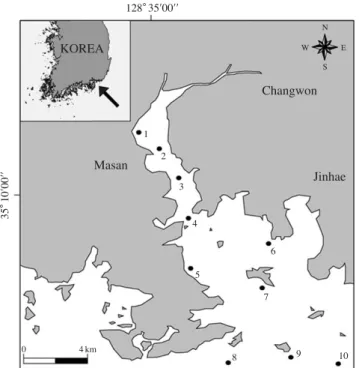
Masan Bay was a semi-closed bay and were located several small islands (Fig. 1). Pelagic eggs and larvae of fish were collected with a Bongo net (60 cm diameter, 0.33 mm mesh) at 10 stations in February, May, July, and September 2007. The net, fitted with a flowmeter, was towed horizontally at a speed of 2~3 knot lasting 10 minutes from surface to 10 m depth, and then the vol- ume of water filtered by the net was estimated.
Specimens were preserved immediately in 10% forma- lin after capture. The identification and counting pelagic eggs and larval fish species were carried out under a dis-
Temporal and Spatial Variation in Species Composition and Abundances of Ichthyoplankton in Masan Bay
By Seok Nam Kwak and Joo Myun Park 1,
*Environ-Ecological Engineering Institute Co., Ltd., 110-54 Millak-Dong, Suyeong-gu, Busan 613-827, Korea
1 Korea Inter-University Institute of Ocean Science, Pukyong National University, Busan 608-737, Korea
ABSTRACT A total of 4 pelagic eggs and 24 larval fish species were collected in Masan Bay.
Engraulis japonicus eggs predominated in pelagic eggs. Abundant larval fishes were Omobranchus elegans, Scomber japonicus, Acanthogobius flavimanus, Hexagrammos otakii, Repomucenus sp., Scartella cristata and Gobiidae sp., and these 7 species accounted for 78.5% in the total number of individuals. Temporal and spatial variation in both species composition and abundance of was large:
the peak abundances of pelagic eggs and larval fishes occurred in July 2007, whilst these were lowest in February 2007. Higher abundance of ichtyoplankton were at station 5 than those of other stations.
Temporal changes in the abundances of pelagic eggs and larval fishes corresponded with tempera- ture. Pelagic eggs and larval fishes varied among stations between with shallower inner stations and deeper outer stations with physical characteristics such as depth and local topography.
Key words : Ichthyoplankton, temporal and spatial variation, Masan Bay
*Corresponding author: Joo Myun Park Tel: 82-51-629-6570 Fax: 82-51-629-6568, E-mail: [email protected] ISSN: 1225-8598 (Print), 2288-3371 (Online)
Accepted: March 18, 2014
http://www.fishkorea.or.kr
secting microscope in the laboratory. The species were identified according to Okiyama (1988), Lee et al. (1981), Kim et al. (1986), Masuda et al. (1984), and Kim et al.
(2005). Water temperature and salinity were monitored on each sampling occasion.
The ichthyoplankton data were log-transformed (log 10 (x + + 1)) before analysing the data. Diversity (H′) (Shannon and Weaver, 1949) was calculated as:
H′= =-»P i ×log 2 P i
where n is the number of individuals of each i species in a sample and N is the total number of individuals.
Association of 10 stations for larval fishes, Pianka’s similarity index (Pianka, 1973), A ij was calculated as:
»(P ih ×P jh ) A ij = =mmmmmmmmmmmmm
»P 2 ih ×»P 2 jh
where A ij is the similarity of species j on species i. P ih is the proportion of individuals of a i in a particular month h, P jh is the proportion of individuals of a j in a particular month h. Values for the similarity index may vary bet- ween 0, if no similarity occurs, and 1 for complete simi- larity. The Pianka’s similarity index was subjected to an average linkage analysis.
A one-way ANOVA with orthogonal design was used to analyse variations in ichthyoplankton abundance and environmental factors with season. The relationships bet- ween ichthyoplankton abundance and environmental fac- tors were analysed using Pearson’s correlation coefficient.
Hierarchical cluster analyses based on the Bray-Curtis similarity based on %W were used for the classification and ordination of stations. Non-metric multi-dimensional scaling (NMDS) ordination was used to plot each stations as a point on an ordination plot, in terms of Bray-Curtis similarity. These were applied by the PRIMER software package.
RESULTS
1. Temperature and salinity
Temperature at the study site ranged from 9.6� C in Feb- ruary to 27.5� C in July 2007. Salinity was similar at around 33.5‰ except in rainy season in July (Fig. 2).
2. Ichthyoplankton species composition
A total of 10,223 pelagic eggs belonging to 4 species (including 3 unidentified fish species) were collected and Engraulis japonicus eggs (40.7%) dominant in the num- ber of eggs (Table 1). A total of 12,674 larvae were caught, comprising 24 species (including Gobiidae). Numerically dominant larval fishes were Omobranchus elegans (19.6
%), Scomber japonicus (18.0%), Acanthogobius flavim- anus (10.8%), Hexagrammos otakii (9.9%), Repomucen- us sp. (9.8%), Scartella cristata (5.5%), and Gobiidae sp.
(4.9%), together accounting for 78.5% of the catch (Table 2).
Fig. 1. Map showing the sampling sites.
Fig. 2. Variations of temperature and salinity in Masan Bay in 2007.
Temperature (� C) Salinity (‰ )
30
25
20
15
10
5
0
Feb. May Jul. Sep.
Sampling month (2007)
40 35 30 25 20 15 10 5 0 Temperature Salinity
Table 1. Species composition of pelagic eggs in Masan Bay in 2007 (unit: eggs/1,000 m 3 )
Species Feb. May Jul. Sep. Total
Engraulis japonicus 34 2,026 812 1,289 4,161 Unidentified sp. 1 69 2,277 727 14 3,087 Unidentified sp. 2 14 1,185 348 47 1,594 Unidentified sp. 3 1,233 99 49 1,381
Total 117 6,721 1,986 1,399 10,223
128�35′00′′
Changwon
Masan KOREA
N
S
W E
1 2
3
4
5
6
7
8 9 10
0 4 km
Jinhae
35 � 10 ′00 ′′
3. Temporal variation in abundance of ichthyoplankton
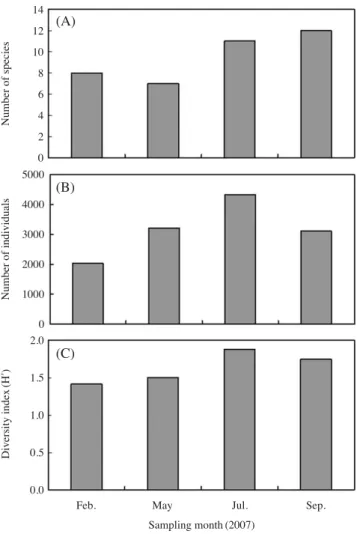
The abundance of pelagic eggs varied with seasons showing a peak in May 2007 (6,721 eggs/1,000 m 3 ). For larval fishes, the number of species (8~12 species) vari- ed with seasons. Higher number of larval fish species were collected in September 2007 (Fig. 3A). Abundance varied significantly with seasons showing high abun- dance in July 2007 when O. elegans, S. japonicus, and Repomucenus sp., were dominant while catch rate was low in February 2007. The diversity index ranged from 1.41 to 1.88, and the highest value was in July 2007 (Fig.
3C). Correlation analysis between ichthyoplankton abun- dance and environmental factors showed that there was found significantly positive correlation between larval fish abundance and water temperature (P⁄0.05).
4. Spatial variation in abundance of ichthyoplankton A large difference in overall pelagic eggs abundance was observed among 10 stations. Overall, mean pelagic egg abundance were higher at station 5,6,7,9 (413~488 eggs/1,000 m 3 ) (Fig. 4). For larval fishes, abundances differed substantially between different stations. Higher mean larval fishes abundance was at station 1,5,9 (442~
718 larvae/1,000 m 3 ) (Fig. 5). Larval fish density ranged from 24 to 218 larvae/1,000 m 3 except at the station 9 (847 larvae/1,000 m 3 ) in February 2007 and ⁄400 larvae
/1,000 m 3 were shown except at the station 5,7 (1,329 larvae/1,000 m 3 and 530 larvae/1,000 m 3 ) in May 2007.
Higher abundance was at the station 1 (1,112 larvae/1,000 m 3 ) and the station 5 (1,006 larvae/1,000 m 3 ) when many S. japonicus, T. japonicus and Gobiidae sp. were present in July 2007. However, the highest density was at station 6 (596 larvae/1,000 m 3 ) with ranged from 80 larvae/1,000 m 3 to 428 larvae/1,000 m 3 in other stations in September 2007.
The dendrogram of larval fishes shows several groups (40% similarity) which identify the 10 stations in Feb- ruary, May, July and September (Fig. 6). Cluster analysis of four seasons data split into two or three group. These groups can be distinguished into inner stations and outer stations. Inner stations close to the land and higher num- bers of Engraulis japonicus (in February), gobiid species including A. flavimanus (in May and July) and Repomu- cenus sp. (in September) were collected. However, outer stations located in mouth of bay and higher abundances of H. otakii (in February), S. japonicus (in May) and O.
Table 2. Species composition of larval fish in Masan Bay in 2007 (unit: larvae/1,000 m 3 )
Species Feb. May Jul. Sep. Total
Omobranchus elegans 958 1,531 2,489
Scomber japonicus 861 1,361 55 2,277
Acanthogobius flavimanus 1,366 1,366
Hexagrammos otakii 1,141 113 1,254
Repomucenus sp. 47 654 543 1,244
Scartella cristata 568 94 34 696
Gobiidae sp. 59 66 500 625
Clupea pallasii 376 376
Sillago japonicus 342 342
Trachurus japonicus 24 185 102 311
Engraulis japonicus 129 56 106 291
Rudarius ercodes 238 238
Sebastes inermis 53 113 166
Pholis nebulosa 145 145
Syngnathus schlegelii 72 68 140
Plecoglossus altivelis 136 136
Parablennius yatabei 94 94
Sebastes pachycephalus 90 90
Stephanolepis cirrhifer 88 88
Platycephalus indicus 80 80
Sebastes schlegeli 75 75
Spratelloides japonicus 64 64
Girella punctata 58 58
Apogon lineatus 29 29
Total 2,027 3,213 4,327 3,107 12,674
Fig. 3. Temporal variations in (A) number of species, (B) number of individuals, and (C) diversity index of larval fish in Masan Bay in 2007.
14 12 10 8 6 4 2 0
(A)
(B)
(C)
5000
4000
3000
2000
1000
0
Number of species Number of individuals Diversity index (H ′)
2.0
1.5
1.0
0.5
0.0
Feb. May Jul. Sep.
Sampling month (2007)
elegans (in September) were occurred during study peri- ods. The groupings set out in the dendrograms described above were also well represented in the MDS ordination plots for each stations in each seasons.
DISCUSSION
A total of 4 pelagic eggs and 24 larval fishes were recorded from Masan Bay. The dominant species was E.
japonicus in pelagic eggs and O. elegans, S. japonicus, A. flavimanus, H. otakii, Repomucenus sp., S. cristata, and Gobiidae sp. in larval fish. Compared with studies of ichthyoplankton in the southern area nearby the study area (Table 3), 44 larval fishes in Changson channel (Kim, 1983), 8 pelagic eggs and 26 larval fishes Nakdong River Estuary (Cha and Huh, 1988), 10 pelagic eggs and 21 lar- val fishes in Kwangyang Bay (Cha and Park, 1994), and 74 larval fishes in th coastal off Tongyong (Park et al., 2005) were occurred. These results indicated similar pat- tern was studies of Kwangyang Bay, and Nakdong River Estuary, and was fewer value than those of Changson channel and coastal off Tongyong despite of difference of study periods and interval of sampling.
Engraulis japonicus, S. japonicus, and H. otakii among ichtyoplanktons are of commercial and recreational impor- tance. In particular, pelagic eggs of E. japonicus was dom- inated in the coastal areas of Korean peninsula include
Jeju Island (Kim, 1983; Cha and Huh, 1988; Cha and Park, 1994; Oh, 2003; Lee and Go, 2006). Lim and Ok (1977) have reported that pelagic eggs of E. japonicus was widely occurred at the temperature between 9� C to 32� C.
For larval fish species, Gobiidae sp., A. flavimanus, Repomucenus sp. were dominated by most of other areas in the southern sea, and O. elegans, H. otakii were also common larval fishes in the Nakdong River Estuary and Kwangyang Bay (Cha and Huh, 1988; Cha and Park, 1994; Oh, 2003). Repomucenus sp. mainly inhabits on sandy mud substrate in the coastal area, and O. elegans and Gobiidae sp. were higher numbers in the crevice of rocky shore and tide pool in the coastal area (Mito, 1965;
Takita, 1980, 1983; Kim et al., 2005). These larval fishes including S. japonicus were higher numbers in July and September 2007 with 23.5~27.5� C in the study area.
Such result are agreement with other studies of ichthy- oplankton in the coastal area of southern sea such as Nakdong River Estuary, Kwangyang Bay, and coastal off Tongyoung (Cha and Huh, 1988; Oh, 2003; Park et al., 2005).
Each dominant larval fishes exhibited their own dis- tinct seasonal occurrence pattern and different time of peak abundance. Peak numbers of H. otakii and Clupea pallasii in February 2007, those of A. flavimanus and S.
cristata were in May 2007, O. elegans and S. japonicus were in July 2007, Repomucenus sp. and O. elegans were
Fig. 4. Spatial variations in number of pelagic eggs in Masan Bay in 2007.
128�35′00′′ 128�35′00′′
Feb. May
Changwon
Changwon Changwon
Masan
Masan
Masan
Masan Jinhae
Jinhae
Jinhae
Jinhae Changwon
Jul. Sep.
0~50 51~250 251~750 751~1,500 1,501~2,000 eggs/1,000 m
335 � 10 ′00 ′′ 35 � 10 ′00 ′′
Fig. 5. Spatial variations in number of larval fish in Masan Bay in 2007.
128�35′00′′ 128�35′00′′
35 � 10 ′00 ′′ 35 � 10 ′00 ′′
Feb. May
Jul. Sep.
Changwon Changwon
Changwon Changwon
Masan Masan
Masan Masan
0~50 51~250 251~750 751~1,500 1,501~2,000 larvae/1,000 m
3Jinhae Jinhae
Jinhae Jinhae
in September 2007. These results indicate that peak abun- dance was closely related with the spawning time. Peak recruitment and abundance of one species was separated several months from other species, with some overlap with another species. Hence Masan Bay is partitioned temporally by dominant larval fishes in this ways. Other studies have shown similar patterns of variable in ichthy- oplankton in the coastal areas, Korea (Cha and Huh, 1988;
Oh, 2003; Park et al., 2005).
Temporal variation in both species composition and abundance of larval fishes appear to be considerable for ichthyoplankton. In Masan Bay, peak abundance of pelag- ic eggs was in May 2007, and those of larval fishes in
July 2007 when temperature was relatively high. Several other studies have demonstrated a positive correlation between temperature and ichthyoplankton abundances (Cha and Huh, 1988; Cha and Park, 1994; Oh, 2003; Park et al., 2005). A significantly greater abundance of larval fish in this period confirmed that larval fish was likely to be related to the abundances of food organisms with higher temperature for survival during the early life stages in the study area.
Spatial variation on in both species composition and abundance of larval fishes was also remarkable charac- teristics in Masan Bay. Different abundance and species contributed by grouping inner and outer site which iden-
Fig. 6. Dendrogram and MDS illustrating the species associations of larval fish species in Masan Bay.
0 20 40 60 80 100
7 2
3
5 1
4
610
8 9
2
8
5 10 6
7
4
9
31
9
9
6 6
4
4
3
3
5 5
2
2 7
1 7
1
8
8
10
10
4 6 10 8 9 2 7 5 1 3 2 1 3 8 9 4 7 6 5 10
8 10 6 9 1 4 7 2 3 5 1 2 3 4 7 5 6 10 8 9
February Stress 0.05 May Stress 0.06
July Stress 0.04 September Stress 0.06
Similarity
tify the 10 stations with cluster analysis. Theses results may be explained difference of physical parameter such as depth and local topography in each stations. Inner sta- tions were shallow sites and were located close to land, and it was easy for many larval fishes to settle down with slow current. Therefore most of larval fishes which inhab- its on bottom area such as A. flavimanus, Repomucenus sp., S. cristata, and Gobiidae sp. were more abundant than those of other stations, deeper sites. Park et al. (2005) also demonstrated higher numbers of larval fishes were in shallow, moderate current, and input of fresh water in the coastal off Tongyoung. Hence we suggested that tem- poral and spatial variation in species composition and abundance of ichthyoplankton was correlated with tem- perature and physical characteristics such as depth and local topography.
ACKNOWLEDGMENTS
We are grateful to Yoon Ju Nam and Jik Young Jeong, Marine Eco-Technology Institute Co., Ltd., for assistan- ce with sampling and data analysis. We also thank Dr.
David W Klumpp (AIMS) for his constructive comments in structure of English.
REFERENCES
Cha, S.S. and K.J. Park. 1994. Distribution of the ichthyo- plankton in Kwangyang Bay. Kor. J. Ichthyol., 6: 60- 70. (in Korean)
Cha, S.S. and S.H. Huh. 1988. Variation in abundances of ichthyoplankton in the Nakdong River Estuary. Bull.
Kor. Fish. Tech. Soc., 24: 135-143. (in Korean) Guidetti, P. 2000. Differences among fish assemblages asso-
ciated with nearshore Posidonia oceanica seagrass beds, rocky-algal reefs and unvegetated sand habitats in the Adriatic Sea. Estuar. Coast. Shelf Sci., 50: 515- 529.
Jenkins, G.P. and M.J. Wheatley. 1998. The influence of habitat structure on nearshore fish assemblages in a southern Australian embayment: comparison of shal- low seagrass, reef-algal and unvegetated sand habitat, with emphasis on their importance to recruitment. J.
Exp. Mar. Biol. Ecol., 221: 148-172.
Kim, D.M. 2003. Ecological modeling for estimation of envi- ronmental characteristics in Masan Bay. J. Environ.
Sci., 12: 841-846.
Kim, I.S., Y. Choi, C.L. Lee, Y.J. Lee, B.J. Kim and J.H. Lim.
2005. Illustrated Book of Korean Fish. Kyo-Hak Publ., Seoul, 615pp. (in Korean)
Kim, J.M., J.M. Yoo, J.K. Myoung and J.Y. Lim. 1986.
Guides to the early stages of marine fishes in the
Table 3. Comparisons of ichthyoplankton were surveyed in some areas close to this study area Source Present study Park et al. (2005) Cha and Park (1994) Cha and Huh (1988) Kim (1983) Sampling periods Jan. to Dec. 2006 Mar. 1998 to Feb. 1999 Feb. to Dec. 1990 Feb. 1987 to Jan., 1988 Jun. 1982 to May 1983 Study area Masan Bay Tongyoung Kwangyang Bay Nakdong River Estuary Changson Channel Number of stations 10 4 8 8 1 Intervals of sampling Seasonal Monthly Bimonthly Monthly Monthly Pelagic eggs Number of species 1 speices, 3 unidentified - 1 family, 2 genus, 7 species 1 family, 4 genus, - 2 species, 1 unidentified Fish larvae Number of species 1 family, 1 genus, 22 species 4 family, 18 genus, 2 family, 3 genus, 16 species 2 family, 5 genus, 18 species, 3 genus, 41 species 48 species, 4 unidentified 1 unidentified Dominant species Omobranchus elegans (19.6) Engraulis japonicus (48.9) Engraulis japonicus (34.5) Engraulis japonicus (38.6) Engrauli sjaponicus (86.6) (%N) Scomber japonicus (18.0) Repomucenus sp. (17.8) Gobiidae (24.5) Gobiidae (15.3) Acanthogobius flavimanus (5.9) Acanthogobius flavimanus (10.8) Parablennius yatabei (6.3) Konosirus puntatus (12.8) Repomucenus sp. (15.0) Endrias sp. (1.7) Hexagrammos otakii (9.9) Acanthogobius sp. (4.4) Argyrosomus argentatus (8.0) Coilia sp. (14.0) Sebastes inermis (1.2) Repomucenus sp. (9.8) Tridentiger sp. (3.2) Leiognathus nuchalis (7.4) Hexagrammos otakii (6.6) Leucopsarion petersi (0.8)
Korean waters. KORDI Report, BSPE00060-98-3, 369pp. (in Korean)
Kim, Y.K. 1983. Fish larvae of Changson channel in Nam- hae, Korea. Bull. Kor. Fish. Soc., 16: 163-180. (in Korean)
Kwak, S.N. and D.W. Klumpp. 2004. Temporal variation in species composition and abundance of fish and deca- pods in Cockle Bay, North Queensland, Australia.
Aquat. Bot., 78: 119-134.
Kwak, S.N. and S.H. Huh. 2007. Temporal cariation in spec- ies Composition and abundance of Fish assemblages in Masan Bay. Kor. J. Ichthyol., 19: 132-141. (in Korean)
Lanksburry, J.A., J.T. Duffy-Anderson, K.L. Mier and M.T.
Wilson. 2005. Ichthyoplankton abundance, distribu- tion, and assemblage structure in the Gulf of Alaska during September 2000 and 2001. Estuar. Coast. Shelf Sci., 64: 775-785.
Lazzari, M.A., S. Sherman, C.S. Brown, J. King, B.J. Joule, S.B. Chenoweth and R.W. Langton. 1999. Seasonal and annual variations in abundance and species com- position of two nearshore fish communities in Maine.
Estuaries, 22: 636-647.
Lee, D.I. and C.G. Park. 2003. The Ecological modeling for estimation of total allowable pollutant loading capa- city in Masan Bay. J. Kor. Soc. Wat. Qual., 19: 575- 583. (in Korean)
Lee, S.J. and Y.B. Go. 2006. Study on the distribution pat- terns of Anchovy eggs and larvae and environmental characteristics in the eastern part of Jeju Strait, Korea.
Kor. J. Ichthyol., 18: 36-44. (in Korean)
Lee, T.Y., Y.U. Kim, P. Chin and Y.J. Kang. 1981. Fish eggs and ind. of the coastal waters in Korea. In: Natl.
Fish. Univ., 109pp. (in Korean)
Lim, J.Y. and I.S. Ok. 1977. Studies on the occurrence and distribution of eggs and larvae of anchovy in the Korean waters. Bull. Jap. Soc. Fish. Oceanogr., 59:
115-122. (in Korean)
Masuda, H., K. Amaoka, C. Arago, T. Ueno and T. Yoshino.
1984. The Fishes of the Japanese Archipelago. Tokai Univ. Press, Tokyo, Text and Plates. p. 437 + + 370 plates.
Mito, S. 1965. Studies on the fish eggs and ind. found in the Seto Inland-II. A list of species with some morphol- ogical and ecological notes. Publ. Naikai Reg. Fish.
Res. Lab., 4: 1-17.
Oh, H.T., J.H. Goo, S.E. Park, Y.S. Choi, R.H. Jung, W.J.
Choi, W.C. Lee and J.S. Park. 2005. Analysis of water quality caused by improvement of sewage treatment plant in Masan Bay. J. Environ. Sci., 14: 777-783. (in Korean)
Oh, S.H. 2003. Species composition and community structure of fishes in Kwangyang Bay. Korea, Ph.D. Thesis.
Yeosu National University, 220pp. (in Korean) Okiyama, M. 1988. An Atlas of the Early Stages Fishes in
Japan. Tokai Univ. Press, Tokyo, 1474pp.
Paperno, R., K.J. Mille and E. Kadison. 2001. Patterns in species composition of fish and selected invertebrate assemblages in estuarine subregions near Ponce de Leon Inlet, Florida. Estuar. Coast. Shelf Sci., 52: 117- 130.
Park, K.D., J.G. Myoung, Y.J. Kang and Y.U. Kim. 2005.
Seasonal variation of abundance and species compo- sition of ichthyoplankton in the coastal water off Tongyoung, Korea. J. Kor. Fish. Soc., 38: 385-392.
(in Korean)
Pattrick, P. and N.A. Strydom. 2008. Composition, abun- dance, distribution and seasonally of larval fishes in the shallow nearshore of the proposed Grwater Addo Marine Reserve, Algoa Bay, South Africa. Estuar.
Coast. Shelf Sci., 79: 251-262.
Pianka, E.R. 1973. The structure of lizard communities. Ann.
Rev. Ecol. Syst., 4: 53-74.
Shannon, C.E. and W. Weaver. 1949. The Mathematical Theory of Communication. Illinois Univ. Press, Ur- bana, 117pp.
Takita, T. 1980. Embryonic development and ind. of three dragonnets. Bull. Jap. Soc. Sci. Fish., 46: 1-7.
Takita, T. 1983. Embryonic and larval development of Call- ionymus. Jap. J. Ichthyol., 29: 441-445.
Yoo, J.M. and S.S. Cha. 1988. Variation of abundance of ichthyoplankton in Kwangyang Bay. Ocean Res., 10:
79-84. (in Korean)
Yoo, J.M., S. Kim, E.K. Lee and J.S. Lee. 1992. The distri- bution of ichthyoplankton in Chinhae Bay. Ocean Res., 14: 77-82. (in Korean)
Youm, M.G. 1997. Community patterns of demersal fishes
by the baited traps and bottom gillnets in the Masan
Bay, heavily polluted area. Bull. Kor. Soc. Fish. Tech.,
33: 298-310. (in Korean)
마산만에 출현하는 난자치어 종조성과 출현량의 시공간 변동
곽석남∙박주면