ISSN 2234-3806 • eISSN 2234-3814
https://doi.org/10.3343/alm.2021.41.3.339 www.annlabmed.org 339
Ann Lab Med 2021;41:339-341
https://doi.org/10.3343/alm.2021.41.3.339
Letter to the Editor
Diagnostic Immunology
Algorithm using Neuron-Specific Enolase and Pro- Gastrin-Releasing Peptide to Increase the Diagnostic Accuracy for Small Cell Lung Cancer
Haeyoung Lee , M.D., Ph.D.1, Sung Dal Park , M.D., Ph.D.1, Taeyun Kim , M.D.2, Jehun Kim , M.D., Ph.D.2, Tae Won Jang , M.D., Ph.D.2, Hyunji Choi , M.D.3, and Hyunyong Hwang , M.D., Ph.D.3
1Department of Thoracic and Cardiovascular Surgery, 2Division of Pulmonology, Department of Internal Medicine, 3Department of Laboratory Medicine, Kosin University Gospel Hospital, Busan, Korea
Dear Editor,
Small cell lung cancer (SCLC) is an aggressive neuroendocrine tumor that accounts for approximately 15% of all lung cancers [1]. Because cancer cells in SCLC grow rapidly, the cancer likely has invaded other organs by the time symptoms present, which frequently delays initial treatment [2]. Therefore, early detection of SCLC is essential for improving the prognosis.
Chest X-ray and computed tomography (CT) are the diagnos- tic methods of choice in lung cancer. Although low-dose CT is recommended for lung cancer screening in high-risk popula- tions, issues concerning its efficacy, high false-positive rates, overdiagnosis, significant costs, and radiation risk have been raised [3]. Therefore, it is important to focus on harmless bio- markers, and neuron-specific enolase (NSE) has been acknowl- edged as the most reliable tumor marker for SCLC [4].
Pro-gastrin-releasing peptide (ProGRP) has been used for SCLC screening in Korea since the fully automated ARCHITECT ProGRP immunoassay (Abbott Laboratories, Abbott Park, USA) was introduced in 2012. While ProGRP is a better SCLC marker than NSE [5], it is not as commonly used in clinical practice as NSE. This is likely because of the low serum stability of ProGRP [6]. In the Elecsys ProGRP assay (Roche Diagnostics Interna-
tional, Rotkreuz, Switzerland) that was developed later, the Pro- GRP-stability issue was solved, and the assay showed clear ben- efits over the ARCHITECT ProGRP assay [7].
Although numerous studies have compared the validity of vari- ous tumor markers in SCLC diagnosis [8-10], no study has pre- sented a practically available tool that uses NSE and ProGRP to increase the diagnostic accuracy. The goal of our study was to create an algorithm to differentiate SCLC from non-small cell lung cancer (NSCLC) using NSE and ProGRP. We prospectively analyzed serum samples from 100 lung cancer patients (age=
67.8 ±1.0 years, male/female ratio =2.85), including 24 SCLC and 76 NSCLC patients (adenocarcinoma [N=47], squamous cell carcinoma [N=25], large-cell carcinoma [N=3], and ade- nosquamous carcinoma [N=1]), for NSE and ProGRP. The In- stitutional Review Board of Kosin University Gospel Hospital, Busan, Korea, approved the study protocol (KUGH 2015-06- 106). Informed consent was obtained from the patients. NSE (Elecsys NSE, Roche Diagnostics International) and ProGRP (Elecsys ProGRP, Roche Diagnostics International) levels were analyzed using the Cobas e601 module (Roche Diagnostics In- ternational).
The area under the receiver operating characteristic (ROC)
Received: May 26, 2020 Revision received: July 20, 2020 Accepted: November 13, 2020
Corresponding author: Hyunyong Hwang, M.D., Ph.D.
Department of Laboratory Medicine, Kosin University Gospel Hospital, 262 Gamcheon-ro, Seo-gu, Busan 49267, Korea
Tel: +82-51-990-6371, Fax: +82-51-990-3034 E-mail: [email protected]
© Korean Society for Laboratory Medicine
This is an Open Access article distributed under the terms of the Creative Commons Attribution Non-Commercial License (https://creativecommons.org/licenses/by-nc/4.0) which permits unrestricted non-commercial use, distribution, and reproduction in any medium, provided the original work is properly cited.
1 / 1 CROSSMARK_logo_3_Test
2017-03-16 https://crossmark-cdn.crossref.org/widget/v2.0/logos/CROSSMARK_Color_square.svg
Lee H, et al.
A proposed algorithm for SCLC diagnosis
340 www.annlabmed.org https://doi.org/10.3343/alm.2021.41.3.339 Table 1. Sensitivity, specificity, accuracy, and AUC of NSE, ProGRP, and the proposed algorithm for SCLC
Test SCLC (N)
Sn (%) Sp (%) Ac (%) Cut-off Mean (SD) AUC (95% CI) P
+ – Total
NSE + 23 50 73 95.8 34.2 49.0 17.30 ng/mL 38.27 (37.84) ng/mL 0.847 (0.760-0.935) <0.001
– 1 26 27
Total 24 76 100
ProGRP + 18 4 22 75.0 94.7 90.0 85.70 pg/mL 374.59 (1,279.93) pg/mL 0.867 (0.766-0.969) <0.001
– 6 72 78
Total 24 76 100
Algorithm +
– 21
3 4
72 25
75 87.5 94.7 93.0 14.24 ng/mL
83.97 ng/mL - - -
Total 24 76 100
The percentage of positive results for NSE was 68.06% (49/72) in NSCLC and 31.94% (23/72) in SCLC. The mean±SD of NSE level in SCLC was signifi- cantly greater than that in NSCLC (76.1±54.7 vs. 26.3±19.2; P <0.001); this explains the low specificity for NSE. When the 2-by-2 table for estimating the diagnostic accuracy of NSE, ProGRP, and algorithm test results was prepared, the positive test results were categorized into true positives and false positives, and negative results into true negatives and false negatives. Diagnostic accuracy was defined as the fraction of true positives and true negatives derived from all classifications.
Abbreviations: SCLC, small cell lung cancer; NSCLC, non-small cell lung cancer; NSE, neuron-specific enolase; ProGRP, pro-gastrin-releasing peptide; Sn, sensitivity; Sp, specificity; Ac, diagnostic accuracy; SD, standard deviation; AUC, the area under the receiver operating characteristic curve; CI, confidence interval.
curve, sensitivity, specificity, and diagnostic accuracy results are presented in Table 1. ProGRP level showed excellent performance in differentiating between SCLC and NSCLC at a cutoff value of 85.70 pg/mL but had a relatively weak sensitivity, whereas NSE level showed excellent sensitivity but very low specificity at a cutoff value of 17.30 ng/mL. This indicates that NSE level alone may lead to false-positive results at a cutoff value of 17.30 ng/mL and that it cannot accurately differentiate between SCLC and NSCLC.
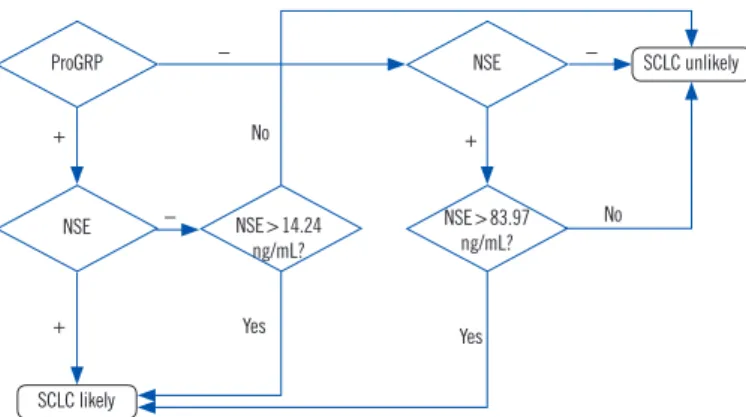
We created an algorithm using NSE and ProGRP to increase the diagnostic accuracy for SCLC (Fig. 1). When ProGRP and NSE results differed, the final result was decided by the algo- rithm. If the NSE level was greater than 14.24 ng/mL (the cutoff value for 100% sensitivity based on ROC curve analysis) in the ProGRP (+)/NSE (–) group or 83.97 ng/mL (mean plus three times the SD of NSE level in the NSCLC group) in the ProGRP (–)/NSE (+) group, a positive result was reported. By applying this algorithm, we could improve the relatively low sensitivity of ProGRP level from 75% to 87.5%, with a specificity of 94.7%.
The accuracy improved to 93% from 90% for ProGRP level and 49% for NSE level.
The algorithm was created considering the limited number of lung cancer patients and is based on the NSE and ProGRP lev- els from our hospital. The cutoff values of NSE and ProGRP lev- els could vary in each institution. We did not evaluate the NSE and ProGRP levels in normal control or other cancer groups;
these need to be further studied.
In conclusion, an elevated NSE level is observed in many NSCLC patients. NSE level alone is not sufficient to accurately differentiate between SCLC and NSCLC. To improve the diag- nostic power and accuracy for SCLC, ProGRP level needs to be additionally tested. Sequential testing of NSE and ProGRP levels and application of a diagnostic algorithm could increase the ac-
Fig. 1. Algorithm for differentiating between SCLC and NSCLC. The cutoff value for ProGRP is 85.70 pg/mL, and that for NSE is 17.30 ng/mL. When a discordant result is observed between ProGRP and NSE, two cutoff values are used. One of the values is 14.24 ng/mL, which is the cutoff value for 100% sensitivity of NSE based on the ROC curve analysis, and the other is 83.97 ng/mL, which is the mean value plus 3SD of NSE in the NSCLC patient group. We cal- culated these values based on the test results of 100 patients. There- fore, these values could be adjusted based on the evaluated patient groups in each institution.
Abbreviations: NSE, neuron-specific enolase; ProGRP, pro-gastrin- releasing peptide; SCLC, small cell lung cancer.
No
Yes Yes
− −
−
+ +
+
NSE>14.24 No ng/mL?
NSE>83.97 ng/mL?
SCLC likely
SCLC unlikely ProGRP
NSE
NSE
Lee H, et al.
A proposed algorithm for SCLC diagnosis
https://doi.org/10.3343/alm.2021.41.3.339 www.annlabmed.org 341
curacy of SCLC diagnosis. Further studies assessing the clinical usefulness of this algorithm by comparing routine diagnostic processes using radiological and histological methods with the present algorithm are warranted.
AUTHOR CONTRIBUTIONS
Conceptualization: Hwang H and Lee H; data curation: Choi H and Lee H; methodology: Jang TW, Park SD, and Kim T; valida- tion: Hwang H; writing-original draft: Lee H; writing-review & ed- iting: Hwang H.
CONFLICTS OF INTEREST
None declared.
RESEARCH FUNDING
This work was supported by the Research Program funded by Roche Diagnostics.
ORCID
Haeyoung Lee https://orcid.org/0000-0003-4972-3608 Sung Dal Park https://orcid.org/0000-0002-3344-9803 Jehun Kim https://orcid.org/0000-0002-2594-0256 Taeyun Kim https://orcid.org/0000-0001-7786-5051 Tae Won Jang https://orcid.org/0000-0001-8075-8097 Hyunji Choi https://orcid.org/0000-0002-6453-7099
Hyunyong Hwang https://orcid.org/0000-0003-0662-3041
REFERENCES
1. Gazdar AF, Bunn PA, Minna JD. Small-cell lung cancer: what we know, what we need to know and the path forward. Nat Rev Cancer 2017;17:
725-37.
2. Yang S, Zhang Z, Wang Q. Emerging therapies for small cell lung can- cer. J Hematol Oncol 2019;12:47.
3. Shen H. Low-dose CT for lung cancer screening: opportunities and chal- lenges. Front Med 2018;12:116-21.
4. Isgrò MA, Bottoni P, Scatena R. Neuron-specific enolase as a biomark- er: biochemical and clinical aspects. Adv Exp Med Biol 2015;867:125- 43.
5. Nisman B, Biran H, Ramu N, Heching N, Barak V, Peretz T. The diag- nostic and prognostic value of ProGRP in lung cancer. Anticancer Res 2009;29:4827-32.
6. Kim HR, Oh IJ, Shin MG, Park JS, Choi HJ, Ban HJ, et al. Plasma pro GRP concentration is sensitive and specific for discriminating small cell lung cancer from nonmalignant conditions or non-small cell lung can- cer. J Korean Med Sci 2011;26:625-30.
7. Korse CM, Holdenrieder S, Zhi XY, Zhang X, Qiu L, Geistanger A, et al.
Multicenter evaluation of a new progastrin-releasing peptide (ProGRP) immunoassay across Europe and China. Clin Chim Acta 2015;438:388- 95.
8. Liu L, Teng J, Zhang L, Cong P, Yao Y, Sun G, et al. The combination of the tumor markers suggests the histological diagnosis of lung cancer.
Biomed Res Int 2017;2017:2013989.
9. Oya Y, Yoshida T, Uemura T, Murakami Y, Inaba Y, Hida T. Serum Pro GRP and NSE levels predicting small cell lung cancer transformation in a patient with ALK rearrangement-positive non-small cell lung cancer:
A case report. Oncol Lett 2018;16:4219-22.
10. Yang DW, Zhang Y, Hong QY, Hu J, Li C, Pan BS, et al. Role of a serum- based biomarker panel in the early diagnosis of lung cancer for a cohort of high-risk patients. Cancer 2015;121(S17):3113-21.