Vol. 21, No. 1, 2009:63-78 http://www.esasang.com
미국인용 체질진단지에 의한 체질별 응답차이에 따른 문항분석
: Pilot test
이의주․유정희
경희대학교 한의과대학 사상체질과
Abstract
A Study on Comparison of Responses to Short Form Sasang Classification Questionnaire for American (SF_SSCQ-A)
: Pilot test
Lee Eui-Ju, Yoo Jung-Hee
Dep. of Sasang Constitutional Medicine, College of Korean Medicine, Kyunghee Univ., Republic of Korea
1. Purpose
This study has focused on response rates of the questionnaire which considered as a basic data to identify constitution for American.
2. Methods
By analysing the tendency of the respondents who has defined constitution by clinical diagnosis and comparing of their answers, the result of their constitution analysis by our questionnaire were re-examed. The answer of each question to each constitution were tested how it is relevent to a scale of a constitution.
Each item response rate on SF_SSCQ-A was analysed about those who had been tested and diagnosed as Taeyangin, Soyangin, Taeeumin, Soeumin respectively.
3. Results
There were the 55 significant items; 13 Taeyangin items, 13 Soyangin items, 20 Taeeumin items, 9 Soeumin items. However, there were the 11 low response rate items (below 10 %) and 4 no response items.
Key Words : Questionnaire, Sasang Constitution, Response Rate,
1)
∙접수일 2009년 03월 08일; 승인일 2009년 03월 23일
∙교신저자 : 이의주
서울시 동대문구 회기동 경희의료원 한방병원 사상체질과 Tel : +82-2-958-9230 Fax : +82-2-958-9234
E-mail : [email protected]
∙이 연구는 2008년도 경희의료원 임상교원 해외연수보조금 의 지원에 의한 결과임.
Attribution
Category Tayangin Soyangin Taeumin Soeumin Number of items
(except double items)
Appearances 14 14 15 14 57 (47)
Personality 14 11 8 8 41 (40)
Commonly found symptoms 7 9 10 12 38 (37)
Total 35 (25.7%) 34 (25.0%) 33 (24.3%) 34 (25.0%) 136 (124)
Table 1. Contents of SF_SSCQ-A
Ⅰ. 緖 論
사상의학은 동무 이제마(1837~1900)가 19세기 말 경 그의 저서 동의수세보원과 격치고를 저술하 여, 인간의 체질적인 유형을 태양인ㆍ소양인ㆍ태음인 ㆍ소음인으로 구분하고, 각 체질의 생리와 병리, 치료, 그리고 양생을 연구함으로써 만들어낸 새롭고 독창적 인 체질의학이다1).
이제마는 체질진단의 방법으로 동의수세보원의
「사상인변증론」에서 체형기상ㆍ용모사기ㆍ성질재 간ㆍ항심 및 심욕 등을 제시하고 있다2). 사상체질의학 에서는 객관적인 체질진단이 무엇보다 중요하다고 할 수 있으며, 최근의 사상체질진단법은 크게 외형(체형 기상ㆍ용모사기), 심성(성질재간ㆍ항심ㆍ심욕), 증상 (소증ㆍ병증)의 세 가지 범주에서 연구되고 있다. 외형 에 대하여는 체형3-6)과 용모7-12)의 실제 계측을 통한 체질별 형상의 정형화 연구가 진행되고 있고, 심성과 증상에 대해서는 자기보고식 설문조사기법13-16)이 주 로 연구되어 사용되고 있다.
2005년 한국한의학연구원과 대한한의학회 사상체 질의학회가 공동 개발하여 이미 타당성 및 표준화 연구 를 거쳐 환자용 체질진단지(Sasang Sasang Classification Questionnaire for patient; SSCQ-P)를 개발하였다17). 사 상체질의학의 세계화를 위해서는 손쉽고 간편하게 사 용할 수 있는 국내외적으로 동일한 체계의 체질진단 지(Short Form)의 사용이 필요하게 되었다. 이후 신뢰 도, 타당화 및 표준화된 체질진단지(SSCQ-P)의 설문자 료를 바탕으로 Short Form(SF_SSCQ)이 개발되었다18). 국외의 사상체질진단지 연구를 살펴보면, 김19,20)은 몽골인에게 동의수세보원의 체질변증기준으로 사 상체질을 진단하고 설문지를 병행하여 몽골설문지 (2003 Sasang Classification Questionnaire for Mongolian;
03'SDQ-M)의 신뢰도 및 타당도를 연구하였다. 이후 김은 SF_SSCQ를 다시 몽골어로 번역하였고18), 유21)는 이것의 신뢰도검사를 보고하였다.
한편, 고22)는 ‘북미지역주민의 사상체질분포에 관 한 연구’를 통하여 한국의 독창적인 의학인 사상체질 의학을 이용하여 북미지역의 사상체질의 분포를 조사 한 바 있다. 그러나 미국에서 한국인용 체질설문지로 체질분포를 조사한 것은 의미가 있으나, 문화적 언어 적 차이를 고려하지 않았다. 그리하여 이미 한국 및 몽골에서 검증된 위의 설문지를 기초하여 영어로 번 역후 pilot test로써 체질별 응답빈도를 평가함을 목적 으로 한다.
이에 본 저자는 영어로 번역된 SF_SSCQ (SF_SSCQ for American; 이하 SF_SSCQ-A라 함)를 미국인에게 적 용 가능성을 알아보기 위하여 미국 메릴랜드주에 거 주하는 미국인 성인 50명 설문지의 체질별 응답빈도 를 분석하여 그 결과를 보고하는 바이다.
Ⅱ. 硏究方法
1. 연구계획
본 연구는 비실험적 연구(non-experimental design)로 미국인의 사상인 체질진단의 객관화를 위한 설문조사 연구이다.
2. SF_SSCQ-A의 개요
설문지는 용모와 체형 47문항(37.9%), 심성 40문항 (32.3%), 평소 증상 및 질병 37문항(29.8%)으로 총124 문항이다. 또한 체질에 따른 문항의 분포를 보면 체질 간에 공통적인 문항(12개 문항)을 포함하여 태양인 35
문항(25.7%), 소양인 34문항(25.0%), 태음인 33문항 (24.3%), 소음인 34문항(25.0%)으로 총 136문항으로 구성되어 있다. 또한 Mongolian-SDQ는 모든 문항이
‘③그렇다 ②보통이다 ①아니다’의 3지 선택형 문항 으로 구성하였다(Table 1).
3. 연구대상
미국 메릴랜드주에 거주하는 미국인으로 18세 이 상이며 80세 미만인 50명을 대상으로 본 연구에 동의 하여 스스로 설문을 응답할 수 있는 자를 대상으로 한다. 제외자는 정신질환자, 뇌손상 등으로 인하여 의 사소통이 불편하고 자유롭게 거동을 할 수 없는 자, 16세 미만과 80세 이상인 자 등이 해당된다. 또한, 시 험중지 및 탈락기준, 분석 제외 기준은 설문지 작성이 미흡한 자, 피험자가 임상시험 참가 동의를 철회한 자, 기타 담당자의 판단에 의해 시험의 진행이 적합지 못하다고 판단되는 경우 등이 해당된다.
임상시험의 참여에 동의하며 SF_SSCQ-A을 작성하 고 체질의학과 전문의의 체질진단을 통해 태양인, 소 양인, 태음인, 소음인으로 진단된 50명을 대상으로 하 였다. 그 중 설문지 작성이 미흡한 자 6명을 제외한 44명의 설문자료를 분석하였다.
4. 자료분석 방법
SF_SSCQ-A 문항에 대한 체질별 반응빈도율을 확인 하기 위해 SPSS 13.0 for Windows 분석 프로그램을 이 용하였다.
각각의 질문과 네 개 체질간의 연관성 여부는 교차 분석(Crosstabulation Analysis)을 통한 카이제곱 검정 (chi-square test)과 P값에 의하여 통계적 유의성을 살펴 보았다. 유의한 문항은 다중비교를 실시하여 체질간 차이를 분석하였다.
Ⅲ. 結 果
1. 연구대상자의 인구학적 특성
본 연구에 포함된 사례들의 성별, 신장, 체중등의
분포는 아래 Table 2에 제시하였다.
성별에 따른 분포는 다음과 같다. 남자는 8명이고 여자는 36명이며 태양인 2.3%, 소양인34.1 %, 태음인 36.4%, 소음인 27.3%이다. 성별에 따른 체질별 차이는 없었다. 전체 대상자의 평균 연령은 43.35±12.54세이 며, 체질별 차이는 없었다. BMI는 태음인군이 소양인, 소음인군에 비해 유의하게 컸다 (P<0.05).
2. 체질별 응답차이에 따른 문항분석
체질별 교차분석을 실시하여 (1) 통계적 유의한 차 이가 있음(p<0.05) (2) 통계적 경향성이 있음 (p<0.1) (3) 해당 체질의 반응빈도율이 가장 높음을 유의미한 문항으로 분류하였다.
이러한 유의성이 있었던 문항은 55문항이었다. 이 문항 중 체질별 체질판단에 유의성이 있다고 판단된 문항은 태양인 13문항, 소양인 13문항, 태음인 20문항, 소음인 9문항이었다.
(1) 태양인 문항 분류
태양인이 희소하기 때문에 기존 연구에서는 태양 인을 제외한 세 체질로 분류하여 연구가 진행되었었 다. 이번 연구에는 1명의 태양인이 포함된 설문지를 다른 체질과의 비교하는 것은 의미가 없으므로, 태양 인 문항과 그것의 응답여부를 가지고서 문항분석을 실시하였다.
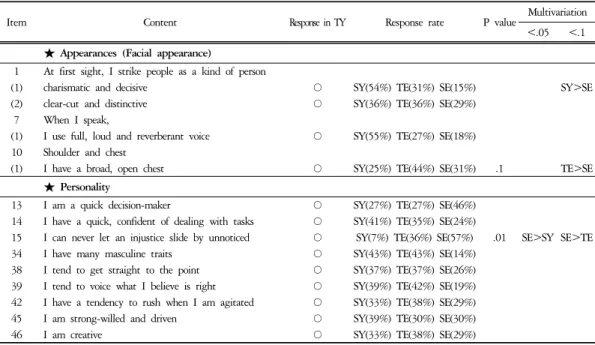
이러한 조건을 만족한 문항은 13문항이었다. 용모 부문에서 첫인상 1(1), 1(2), 사기(말) 7(1), 어깨와 가슴 10(1)으로 4문항이고, 성격부문에서 13, 14, 15, 34, 38, 39, 42, 45, 46으로 9문항이었다.
태양인의 반응이 체질문항에 상응하는 것은 다음과 같다(Table 3).
(2) 소양인 문항 분류
태양인 1명을 제외한 43명의 체질별 교차분석을 실시하여 소양인 15명이 타체질과의 통계적 유의성이 있다고 판단된 문항을 분류하였다.
이중 소양인이 다른 체질과의 통계적으로 유의성이 있었던 문항은 13문항이었다. 용모부문에서 첫인상 1(3), 눈 3(2), 코 4(1), 4(2), 사기(말) 7(2)으로 5문항이고,
Taeyangin(N=1) Soyangin(N=15) Taeumin(N=16) Soeumin(N=12) Total(N=44)
Age (year) 50 39.67±10.80 46.67±12.97 43.25±14.14 43.35±12.54*a
Sex (Male/Female) 0/1 3/12 5/11 0/12 8/36a
BMI (kg/m2) 23.47 26.26±5.91 30.52±7.74 24.31±5.00 27.01±6.64
Blood type A type B type AB type O type Don’t know
1 0 0 0 0
2 2 4 1 5
4 2 3 0 6
3 0 7 0 2
10 4 14 1 13 Marriage
marriaged single divorce lose etc
0 0 1 0 0
5 5 3 1 1
10 1 3 0 1
4 6 2 0 0
19 12 9 1 2 Education
No high school university graduate school
0 0 1 0
1 1 5 8
0 8 4 3
0 2 5 5
1 11 15 16 People
African-American Caucasian Hispanic etc
0 0 1 0
1 8 2 4
9 7 0 0
5 6 0 1
15 21 3 5
*Values are mean ± standard deviation.
a; There is no significant difference between groups by oneway analysis of variances or crosstabulation analysis.
Table 2. Demosociographic Characteristics
Item Content Response in TY Response rate P value Multivariation
<.05 <.1
★ Appearances (Facial appearance)
1 At first sight, I strike people as a kind of person
(1) charismatic and decisive ○ SY(54%) TE(31%) SE(15%) SY>SE
(2) clear-cut and distinctive ○ SY(36%) TE(36%) SE(29%)
7 When I speak,
(1) I use full, loud and reverberant voice ○ SY(55%) TE(27%) SE(18%) 10 Shoulder and chest
(1) I have a broad, open chest ○ SY(25%) TE(44%) SE(31%) .1 TE>SE
★ Personality
13 I am a quick decision-maker ○ SY(27%) TE(27%) SE(46%)
14 I have a quick, confident of dealing with tasks ○ SY(41%) TE(35%) SE(24%)
15 I can never let an injustice slide by unnoticed ○ SY(7%) TE(36%) SE(57%) .01 SE>SY SE>TE
34 I have many masculine traits ○ SY(43%) TE(43%) SE(14%)
38 I tend to get straight to the point ○ SY(37%) TE(37%) SE(26%) 39 I tend to voice what I believe is right ○ SY(39%) TE(42%) SE(19%) 42 I have a tendency to rush when I am agitated ○ SY(33%) TE(38%) SE(29%)
45 I am strong-willed and driven ○ SY(39%) TE(30%) SE(30%)
46 I am creative ○ SY(33%) TE(38%) SE(29%)
Table 3. Response Rate in Taeyang Questions
Item Content Response rate P value Multivariation
<.05 <.1
★ Appearances (Facial appearance)
1 At first sight, I strike people as a kind of person
(3) nimble(resourceful) and brave
SY(50%) TE(36%) SE(14%)
SY>SE3 One of the dominant characteristics of my eyes is that
(2) they are remarkably vivid and intense
SY(43%) TE(14%) SE(43%)
4 One of the dominant characteristics of my nose is that(1) it is high-bridged and bird like
SY(50%) TE(50%) SE(0%)
.09 SY>SE(2) it has a narrow and pointed tip
SY(50%) TE(50%) SE(0%)
7 When I speak,
(2) I talk fast
SY(50%) TE(38%) SE(13%)
SY>SE★ Physical attributes 8 Overall body frame
(2) I have a small body frame
SY(83%) TE(0%) SE(17%)
.07 SY>TE11 I have a walking gait
(1) light and spry
SY(40%) TE(20%) SE(40%)
★ Personality
22 I am quick-tempered
SY(50%) TE(17%) SE(33%)
23 I lead an active life
SY(38%) TE(37%) SE(38%)
.1 SE>TE49 I tend to tackle multiple tasks at a time
SY(39%) TE(39%) SE(21%)
50 I find it difficult to give the final finishing touch to a taskSY(57%) TE(29%) SE(14%)
★ Common symptoms 56 Stool
(2) 1 day without bowel movement can cause extreme discomfort
SY(40%) TE(30%) SE(30%)
SY>TE 58 Signs of unhealthiness(2) Nighttime is when I feel the greatest fatigue
SY(44%) TE(31%) SE(25%)
Table 4. Response Rate in Soyang Questions체형부문에서 체형 8(2), 걸음 11(1)으로 2문항이고, 성격부문에서 22, 23, 49, 50으로 4문항이고, 증상부문 에서 대변 56(2), 비건강조건 58(2)으로 2문항이었다.
소양인의 반응이 다른 체질과 통계적으로 차이를 보인 문항은 다음과 같다(Table 4).
(3) 태음인 문항 분류
태양인 1명을 제외한 43명의 체질별 교차분석을 실시하여 태음인 16명이 타체질과의 통계적 유의성이 있다고 판단된 문항을 분류하였다.
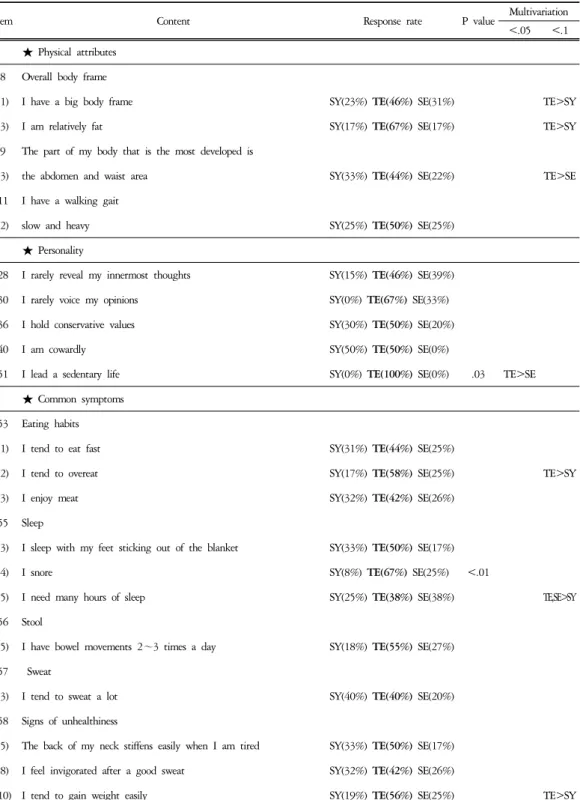
이중 태음인이 다른 체질과의 통계적으로 유의성 이 있었던 문항은 20문항이었다. 체형부문에서 체형 8(1), 8(3), 발달 부위 9(3), 걸음 11(2)으로 4문항이고, 성격부문에서 28, 30, 36, 40, 51으로 5문항이고, 증상 부문에서 식습관 53(1), 53(2), 53(3), 수면 55(3), 55(4), 55(5), 대변 56(5), 땀 57(3), 비건강조건 58(5), 58(8), 58(10)으로 11문항이었다.
태음인의 반응이 다른 체질과 통계적으로 차이를 보인 문항은 다음과 같다(Table 5).
Item Content Response rate P value Multivariation
<.05 <.1
★ Physical attributes 8 Overall body frame
(1) I have a big body frame SY(23%) TE(46%) SE(31%) TE>SY
(3) I am relatively fat SY(17%) TE(67%) SE(17%) TE>SY
9 The part of my body that is the most developed is
(3) the abdomen and waist area SY(33%) TE(44%) SE(22%) TE>SE
11 I have a walking gait
(2) slow and heavy SY(25%) TE(50%) SE(25%)
★ Personality
28 I rarely reveal my innermost thoughts SY(15%) TE(46%) SE(39%)
30 I rarely voice my opinions SY(0%) TE(67%) SE(33%)
36 I hold conservative values SY(30%) TE(50%) SE(20%)
40 I am cowardly SY(50%) TE(50%) SE(0%)
51 I lead a sedentary life SY(0%) TE(100%) SE(0%) .03 TE>SE
★ Common symptoms 53 Eating habits
(1) I tend to eat fast SY(31%) TE(44%) SE(25%)
(2) I tend to overeat SY(17%) TE(58%) SE(25%) TE>SY
(3) I enjoy meat SY(32%) TE(42%) SE(26%)
55 Sleep
(3) I sleep with my feet sticking out of the blanket SY(33%) TE(50%) SE(17%)
(4) I snore SY(8%) TE(67%) SE(25%) <.01
(5) I need many hours of sleep SY(25%) TE(38%) SE(38%) TE,SE>SY
56 Stool
(5) I have bowel movements 2~3 times a day SY(18%) TE(55%) SE(27%) 57 Sweat
(3) I tend to sweat a lot SY(40%) TE(40%) SE(20%)
58 Signs of unhealthiness
(5) The back of my neck stiffens easily when I am tired SY(33%) TE(50%) SE(17%) (8) I feel invigorated after a good sweat SY(32%) TE(42%) SE(26%)
(10) I tend to gain weight easily SY(19%) TE(56%) SE(25%) TE>SY
Table 5. Response Rate in Taeum Questions
Item Content Response rate P value Multivariation
<.05 <.1
★ Appearances (Facial appearance)
1 At first sight, I strike people as a kind of person
(8) calm and composed SY(26%) TE(32%) SE(42%) .08 SE>SY SE>TE
3 One of the dominant characteristics of my eyes is that
(4) I often smile with my eyes SY(0%) TE(0%) SE(100%)
7 When I speak,
(4) I use a soft, calm voice SY(27%) TE(36%) SE(36%)
★ Physical attributes 10 Shoulder and chest
(2) My shoulders normally turn SY(0%) TE(38%) SE(63%) .04 SE>SY TE>SY
★ Personality
25 I do my work thoroughly SY(26%) TE(37%) SE(37%) SE>SY
35 I have many feminine traits SY(32%) TE(26%) SE(42%) SE>TE
44 I am timid SY(33%) TE(0%) SE(67%)
★ Common symptoms 53 Eating habits
(6) I hardly drink any water SY(0%) TE(50%) SE(50%)
Table 6. Response Rate in Soeum Questions
(4) 소음인 문항 분류
태양인 1명을 제외한 43명의 체질별 교차분석을 실시하여 소음인 12명이 타체질과의 통계적 유의성이 있다고 판단된 문항을 분류하였다.
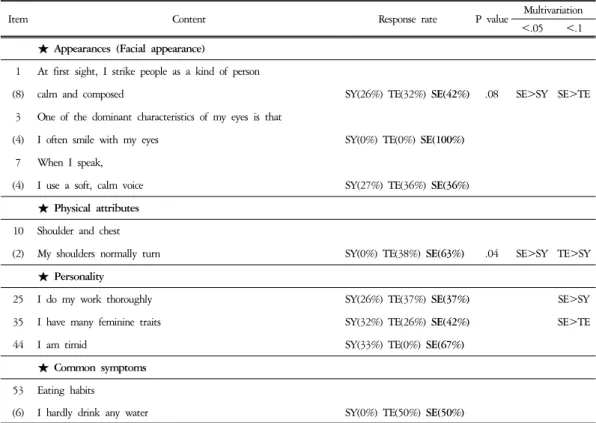
이중 소음인이 다른 체질과의 통계적으로 유의성 이 있었던 문항은 9문항이었다. 용모부문에서 첫인상 1(8), 눈 3(4), 사기(말) 7(4)으로 3문항이고, 체형부문에 서 어깨와 가슴 10(2)으로 1문항이고, 성격부문에서 25, 35, 44으로 3문항이고, 증상부문에서 식습관 53(6), 땀 57(4)으로 2문항이었다.
소음인의 반응이 다른 체질과 통계적으로 차이를 보인 문항은 다음과 같다(Table 6).
(5) 반응빈도율이 낮은 문항
반응빈도의 경향성을 pilot test한 것이므로 반응빈 도율이 낮은 문항을 반응빈도율가 10이하인 문항과 네 체질 모두 응답하지 않은 문항으로 구분하였다.
① 체질문항으로 반응빈도율가 10이하인 문항 체질문항으로 해당 체질의 반응빈도율이 10%이하 인 문항은 11개이다 (Table 7). 용모부문에서 첫인상 1(7), 머리 및 이마 2(2), 걸음 11(3)으로 3문항이고, 성 격부문에서 24, 26, 33으로 3문항이고, 증상부문에서 식습관 53(4), 53(5), 소화 54(4), 수면 55(2), 땀 57(2)으 로 5문항이다.
② 네 체질 모두 응답하지 않은 문항
네 체질에서 모두 응답하지 않은 문항은 4개이다 (Table 7). 용모부문에서 어깨와 가슴 10(3), 10(4), 피부 12(2)으로 3문항이고, 증상부문에서 땀 57(1)으로 1문항 이다.
Item Content Response rate P value Multivariation
<.05 <.1
★ Appearances (Facial appearance)
1 At first sight, I strike people as a kind of person
(7) compliant and meek SY(27%) TE(71%) SE(0%) TE>SE
2 One of the dominant characteristics of my face/head is
(2) its protruding forehead SY(0%) TE(100%) SE(0%)
11 I have a walking gait
(3) demure and cautious SY(43%) TE(57%) SE(0%) TE>SE
★ Personality
24 I am an introvert SY(50%) TE(50%) SE(0%)
26 I am easily angered SY(0%) TE(0%) SE(100%) .07 SE>SY
33 I give greater priority to other people’s concerns than to mine SY(0%) TE(42%) SE(58%) <.01 TE,SE>SY SE>TE
★ Common symptoms 53 Eating habits
(4) I am a picky eater SY(33%) TE(58%) SE(8%) TE>SE
(5) I drink water slowly and in little sips SY(50%) TE(50%) SE(0%) 54 Digestion
(4) Eating wheat products often causes gastric discomfort SY(67%) TE(33%) SE(0%) TE,SE>SY 55 Sleep
(2) I sleep lightly SY(9%) TE(55%) SE(36%) TE>SY
57 Sweat
(2) My legs sweat when I am tired SY(0%) TE(50%) SE(50%)
★ Appearances (Facial appearance) 10 Shoulder and chest
(3) I have narrow(weak looking) shoulders SY(0%) TE(0%) SE(0%)
(4) I have a frail chest SY(0%) TE(0%) SE(0%)
12 I have skin
(2) tight and dry SY(0%) TE(0%) SE(0%)
★ Common symptoms 57 Sweat
(1) My genital area feels cold and damp SY(0%) TE(0%) SE(0%) Table 7. Valueless Questions of Low Response
Ⅳ. 考察 및 結論
본 연구는 영어로 번역된 SF_SSCQ를 미국인에게 적용 가능성을 알아보기 위하여 미국 메릴랜드주에 거주하는 미국인 성인 44명 설문지의 체질별 응답빈 도의 경향성을 분석하였다. 태양인 1명을 제외한 체질 별 교차분석을 실시하여 (1) 통계적 유의한 차이가 있 음(p<0.05) (2) 통계적 경향성이 있음 (p<0.1) (3) 해당
체질의 반응빈도율이 가장 높음을 유의미한 문항으로 분류하였다. 태양인의 경우는 1명의 태양인이 포함된 설문지를 다른 체질과의 비교하는 것은 의미가 없으 므로, 태양인 문항과 그것의 응답여부를 가지고서 문 항분석을 실시하였다. 이러한 유의성이 있었던 문항 은 55문항이었다. 이 문항 중 체질별 체질판단에 유의 성이 있다고 판단된 문항은 태양인 13문항, 소양인 13문항, 태음인 20문항, 소음인 9문항이었다. 한편, 반응
빈도의 경향성을 pilot test한 것이므로 반응빈도율이 낮은 문항을 반응빈도율가 10이하인 문항과 네 체질 모 두 응답하지 않은 문항으로 구분하였다.
태양인의 경우를 살펴보면 다음과 같다. 용모부문 에서 첫인상은 ‘과단성(카리스마적인 면)이 있다’, ‘인 상이 뚜렷하다’라고 응답하였고, 사기(말)은 ‘목소리가 크고 우렁차다’라고 응답하였다. 체형부문에서 어깨와 가슴은 ‘어깨와 가슴을 활짝 펴고 있다’라고 응답하였 다. 성격부문에서 ‘쉽게 결정 한다’, ‘일을 시원하고 대 범하게 처리 한다’, ‘부당해 보이는 것은 그냥 지나치기 어렵다’, ‘남성적이다’, ‘직설적이다’, ‘바른 소리를 잘 한 다’, ‘조급하게 서두른다’, ‘추진력이 강하다, ’창의력이 뛰어나다‘라고 응답하였다. 이것은 태양인의 카리스마 적인 용모와 남성적, 직설적, 창의적인 성격 특성에 반 응한 것이다.
소양인의 경우를 살펴보면 다음과 같다. 용모부문 에서 첫인상은 ‘날쌔면서 용감하다’하며, 눈은 ‘눈빛이 강하다’하며, 코는 ‘콧마루가 높다’, ‘코끝이 얇고 예리 하다’하며, 사기(말)은 ‘말하는 속도가 빠르다’라는 특징을 가지고 있다. 체형부문에서 체형은 ‘체격이 작은 편이 다’하며, 걸음은 ‘가볍고 빠르다’라는 특징을 가지고 있다. 성격부문에서 ‘성격이 급하다’, ‘활동적이며 적 극적이다’, ‘일을 벌이기를 좋아한다’, ‘일의 마무리에 약하다‘라는 특징을 가지고 있다. 증상부문에서 대변 은 ‘하루만 배변을 못해도 아주 불편하다’하며, 몸이 안 좋을 때 자주 나타나는 증상은 ‘낮보다 밤에 피로가 심하다‘라는 특징을 가지고 있다. 이것은 소양인의 날 카로운 용모와 활동적, 적극적인 성격과 규칙적 대변 습관인 완실무병의 조건을 잘 나타내고 있다.
태음인의 경우를 살펴보면 다음과 같다. 체형부문 에서 체형은 ‘체격이 큰 편이다’, ‘뚱뚱한 편이다’하며, 가장 발달된 부위는 ‘배와 허리 부분이다’하며, 걸음 은 ‘느리고 무게 있다’라는 특징을 가지고 있다. 성격 부문에서 ‘속마음을 좀처럼 드러내지 않는다’, ‘자기 의견을 잘 표현하지 않는다’, ‘보수적이다’, ‘겁이 많 다‘, ’움직이기 싫어한다‘라는 특징을 가지고 있다. 증 상부문에서 식습관은 ’빨리 먹는다‘, ’과식 한다‘, ’육 식을 좋아 한다‘하며, 수면은 ’발을 내놓고 잔다‘, ’코 를 곤다‘, ’잠이 많다‘하며, 대변은 ‘하루에 대변을 2~
3회 본다’하며, 땀은 ‘땀이 많다’하며, 몸이 안 좋을
때 자주 나타나는 증상은 ‘피곤하면 뒷목이 쉽게 뭉친 다‘, ’몸이 안 좋을 때 땀을 내면 상쾌하다‘, ’살이 잘 찌는 편이다‘라는 특징을 가지고 있다. 이것은 태음인 의 비만한 용모와 보수적, 음모적 성격과 과식, 폭식, 다면, 다한의 증상을 가지고 있다.
소음인의 경우를 살펴보면 다음과 같다. 용모부문 에서 첫인상은 ‘차분해 보인다’하며, 눈은 ‘눈웃음을 자주 한다’하며, 사기(말)은 ‘목소리가 작고 차분하다’
라는 특징을 가지고 있다. 체형부문에서 어깨와 가슴 은 ‘어깨와 가슴을 오므리고 있다’라는 특징을 가지고 있다. 성격부문에서 ‘자기 일에 꼼꼼하다’, ‘여성적이 다’, ‘소심하다‘라는 특징을 가지고 있다. 증상부문에 서 식습관은 ’물을 거의 안 마신다‘하며, 땀은 ‘땀이 거의 없다‘라는 특징을 가지고 있다. 이것은 소음인의 단아한 용모와 여성적, 소극적인 성격과 무음, 무한의 증상을 가지고 있다.
체질문항으로 해당 체질의 반응빈도율이 10%이하 인 문항은 11개이다. 소양인 문항으로 용모부문에서 머리 및 이마는 ‘이마가 돌출되어 있다’이며, 성격부 문에서 ‘화를 잘 낸다’, ‘자기 일보다 다른 사람의 일을 중히 여긴다’이며, 증상부문에서 수면은 ‘잠귀가 밝 다’, 땀은 ‘피곤하면 하체에 식은땀이 난다’이다. 소음 인 문항으로 용모부문에서 첫인상은 ‘온순하다’, 걸음 은 ‘얌전하고 조심성이 있다’이며, 성격부문에서 ‘내 성적이다’이며, 증상부문에서 식습관은 ‘음식을 가려 먹는다’, ‘물을 빨리 못 마시고 조금씩 천천히 마신다’, 소화는 ‘밀가루 음식을 자주 먹으면 속이 불편하다’이다.
네 체질에서 모두 응답하지 않은 문항은 4개이다. 용 모부문에서 어깨와 가슴은 ‘어깨가 좁다’, ‘가슴이 빈 약하다’, 피부는 ‘탄력은 있으나 윤기가 없다’이며, 증 상부문에서 땀은 ‘생식기 부위가 습하고 냉하다’이다.
위와 같이 반응빈도율이 낮은 것은 매우 사적인 질문인 경우, 부정적이며 반사회적 경항을 가지는 경 우이거나 생소한 문항에 대해 응답율이 떨어졌다. 이 것은 문화적, 사회적 차이에서 기인한 것으로 평가되 며, 가치의 재해석이나 중복된 구조로 된 문항들을 단순구조로 만들거나 보다 명확한 명사의 사용이나 분명한 상황이나 시간 설정을 통한 문항의 의미를 명 확하게 하는 작업이 필요하다. 또한 증상에 관한 항목 에 있어서는 전문의사와 환자 사이의 개념이나 표현
에 있어서 차이가 많이 있을 수 있으므로 전문의사와 의 직접적인 교류가 필요할 것으로 사료된다.
본 연구는 sample size가 적어 결과에 대해 제한적이 다. 그러므로 향후 보다 많은 대상자의 응답을 분석하여 체질별 특징을 비교하는 것이 바람직하다. 체질의 진단 에 용모, 체형, 성격, 증상의 범주로 나눠 문항이 구성되 었으므로 문화적 차이를 고려한 번역이 필수적이다.
Ⅴ. 參考文獻
1. 송일병. 알기쉬운 사상의학. 사상사, 서울, 1996;124.
2. 전국한의과대학사상의학교실 역음. 사상의학 2판.
집문당, 서울, 2004;120.
3. 허만회, 송정모, 김달래, 고병희. 사상인의 형태학적 도식화에 관한 연구. 사상의학회지. 1992;4(1): 107-148.
4. 홍석철, 이수경, 이의주, 한기환, 조용진, 최창석, 고병희, 송일병. 체간부의 사상체질별 형태학적 특징 에 관한 연구. 사상의학회지. 1998;10(1):101-142.
5. 이의주, 이재구, 김정연, 송정모. 한국인 신체분절에 관한 사상의학적 연구. 사상의학회지. 1998;10(1):
143-160.
6. 김종원, 전수형, 설유경, 김규곤, 이의주. 신체계측법 을 이용한 사상체질별ㆍ성별 체형연구. 사상체질의학 회지. 2006;18(1):54-61.
7. 홍석철, 이수경, 송일병. 사상체질별 상안부의 형태 학적인 특징에 관한 연구. 사상의학회지. 1998;10 (1):161-170.
8. 홍석철, 고병희, 송일병. 사상인 이목비구의 형태학 적 특징 연구. 사상체질의학회지. 1998;10(2):221-270.
9. 윤종현, 이수경, 이의주, 고병희, 송일병. 한국인 남녀 50-60대의 사상체질별 안면형태에 관한 표준화 연구.
2000;12(2):23-131.
10. 곽창규, 조용범, 손은혜, 유정희, 고병희, 김종원, 김규곤, 이의주. 3차원 안면자동인식기의 Positioning 오차분석. 사상체질의학회지. 2006;18(2):34-40.
11. 석재화, 조경래, 조용범, 유정희, 곽창규, 황민우, 고병희, 김종원, 김규곤, 이의주. 3차원 안면자동 인식기(3D-AFRA)의 안면 표준점 인식 정확도 검증.
사상체질의학회지. 2007;19(1):50-59.
12. 김윤희, 양춘석, 이준희, 정용재, 유정희, 이승현, 고병희, 이의주. 3차원 안면자동인식기(3D-AFRA) 의 인식도 연구. 사상체질의학회지. 2008;20(1):35-42.
13. 이의주, 고병희, 송일병. 사상변증내용설문조사지 (Ⅰ)의 타당화 연구. 사상의학회지. 1995;7(2):89-100.
14. 김선호, 고병희, 송일병. 사상체질별분류검사지 (QSCCⅡ)의 표준화 연구. 사상의학회지. 1996;
8(1):187-246.
15. 박은경, 이영섭, 박성식. 의사결정나무법을 이용한 체질진단에 관한 연구. 사상의학회지. 2001;13(2):
144-55.
16. 김태연, 유정희, 이의주, 고병희, 송일병. 사상체질 분류검사지(QSCCⅡ)의 uprade 연구(Ⅰ). 사상체질의 학회지. 2003;15(1):37-38.
17. Yoo JH, Kim JW, Kim KK, Kim JY, Kho BH, Lee EJ. Sasangin Diagnosis Questionnaire (SDQ): Test of Relia- bility and Validity. J Alt Comp Med 2007;13(1):
111-122.
18. 김경수, 김상혁, 이갑수, 유정희, 황민우, 이준희, 고병희, 김효정, 이시우, 김종열, 문영식, L. Bazar- garid, N. Tumurbaatar, S. Oldokh, T. Sukhbaatar, 이의 주. 몽골인 체질진단지 개발; 개정 및 번역. 사상체질 의학회지. 2007;19(3):90-125.
19. 김경수, 이수경, 신현규, 고병희, 송일병, 이의주.
몽골인을 위한 사상체질분류검사지의 신뢰도 연구.
2006;18(2):96-112.
20. 김경수, 이수경, 신현규, 고병희, 송일병, 이의주.
몽골인을 위한 사상체질분류검사지의 타당화 연구.
2007;19(1):98-115.
21. Yoo JH, Kim KS, Lee JH, Lee SH, Moon YS, L.
Bazargarid, N. Tumurbaatar, S. Oldokh, T. Sukhbaa- tar, Koh BH, Kim KB, Kim JY, Lee EJ. 2005 Sasangin Diagnosis Questionnaire Mongolian (05’SDQ-M):
Test of Reliability. J Alt Comp Med 2009;15(2):
165-174.
22. 고병희, 김선호, 박병관, Jonathan D. Lavelle, Marianne Tecum, Anthony Ross, Ron Hobbs, Frank Zolli, Kyung-Hee Chin. 북미지역주민의 사상체질 분포에 관한 연구, 사상체질의학회지. 1999;11(2):119-150.
▣ How to fill out this questionnaire:
Read carefully the questions on the following pages, and 1. Select the answer that would best represent you, usually.
2. Answer without thinking very hard what comes to mind first is fine 3. There are no time limits, but do not stay on a single question for too long.
4. Ask your examiner should any confusion arise on how to fill out this questionnaire.
Name Date
Year Month DayDate of birth
Year Month Day( years old)
Height/weight
cm(Inch)kg(Lb)
Sex
① Female ② MaleBlood type
ⓛⓛ Type A ② Type B ③ Type O ④ Type AB⑤ Don’t know
Marital status
① Married ② Unmarried ③ Divorced ④Spouse deceased ⑤ OtherRace
① African-American ② Caucasian ③ Hispanic ④ OtherShort Form Sasang Classification Questionnaire for American (SF_SSCQ-A)
This questionnaire was designed to determine your Sasang constitution type. The constitution type can differ between persons and by itself has a non-judgemental value.
Personal Descriptions
(☞ Fill in the blanks within the bold-framed box)
ID □□□□□□
★ Appearances (Facial appearance)
ID □□□□□□
1. At first sight, I strike people as a kind of person
(1) charismatic and decisive ③ Yes ② Moderate ① No (2) clear-cut and distinctive ③ Yes ② Moderate ① No (3) nimble(resourceful) and brave ③ Yes ② Moderate ① No
(4) witty and clever ③ Yes ② Moderate ① No
(5) Reserved and gentle-mannered ③ Yes ② Moderate ① No (6) dependable and trustworthy ③ Yes ② Moderate ① No (7) compliant and meek ③ Yes ② Moderate ① No
(8) calm and composed ③ Yes ② Moderate ① No
2. One of the dominant characteristics of my face/head is
(1) its large head size ③ Yes ② Moderate ① No (2) its protruding forehead ③ Yes ② Moderate ① No
(3) its wide face ③ Yes ② Moderate ① No
(4) its distinct facial features ③ Yes ② Moderate ① No
(5) its oval shape ③ Yes ② Moderate ① No
3. One of the dominant characteristics of my eyes is that
(1) they are emphatically carismatic eyed ③ Yes ② Moderate ① No (2) they are remarkably vivid and intense ③ Yes ② Moderate ① No (3) they are remarkably huge and show expression ③ Yes ② Moderate ① No (4) I often smile with my eyes ③ Yes ② Moderate ① No
4. One of the dominant characteristics of my nose is that
(1) it is high-bridged and bird like ③ Yes ② Moderate ① No (2) it has a narrow and pointed tip ③ Yes ② Moderate ① No (3) it is big with a blunted tip ③ Yes ② Moderate ① No (4) it has thin nostrils ③ Yes ② Moderate ① No
5. One of the dominant characteristics of my lips is that
(1) they are thin ③ Yes ② Moderate ① No
(2) they are thick ③ Yes ② Moderate ① No
6. One of the dominant characteristics of my ears is that
(1) they are huge ③ Yes ② Moderate ① No
(2) they have thick earlobes ③ Yes ② Moderate ① No
7. When I speak,
(1) I use full, loud and reverberant voice ③ Yes ② Moderate ① No
(2) I talk fast ③ Yes ② Moderate ① No
(3) I use a thick, heavy voice ③ Yes ② Moderate ① No (4) I use a soft, calm voice ③ Yes ② Moderate ① No
★ Physical attributes
8. Overall body frame
(1) Ihave a big body frame ③ Yes ② Moderate ① No (2) I have a small body frame ③ Yes ② Moderate ① No (3) I am relatively fat ③ Yes ② Moderate ① No (4) I am relatively thin ③ Yes ② Moderate ① No
9. The part of my body that is the most developed is
(1) the neck area ③ Yes ② Moderate ① No
(2) the shoulder and chest area ③ Yes ② Moderate ① No (3) the abdomen and waist area ③ Yes ② Moderate ① No
(4) the hip area ③ Yes ② Moderate ① No
10. Shoulder and chest
(1) I have a broad, open chest ③ Yes ② Moderate ① No (2) My shoulders normally turn ③ Yes ② Moderate ① No (3) I have narrow(weak looking) shoulders ③ Yes ② Moderate ① No (4) I have a frail chest ③ Yes ② Moderate ① No
11. I have a walking gait
(1) light and spry ③ Yes ② Moderate ① No
(2) slow and heavy ③ Yes ② Moderate ① No
(3) reserved and cautious ③ Yes ② Moderate ① No
12. I have skin
(1) soft and gentle ③ Yes ② Moderate ① No
(2) tight and dry ③ Yes ② Moderate ① No
(3) thick and rough ③ Yes ② Moderate ① No
★ Personality
13. I am a quick decision-maker ③ Yes ② Moderate ① No 14. I have a quick, confident of dealing with tasks ③ Yes ② Moderate ① No 15. I can never let an injustice slide by unnoticed ③ Yes ② Moderate ① No 16. I rarely voice my grievances ③ Yes ② Moderate ① No 17. I deal with problems rationally and unemotionally ③ Yes ② Moderate ① No 18. I lead a passive life ③ Yes ② Moderate ① No 19. I do not care for third opinions ③ Yes ② Moderate ① No 20. I have to be the best at everything ③ Yes ② Moderate ① No 21. I am slow-tempered ③ Yes ② Moderate ① No 22. I am quick-tempered ③ Yes ② Moderate ① No 23. I lead an active life ③ Yes ② Moderate ① No 24. I am an introvert ③ Yes ② Moderate ① No 25. I do my work thoroughly ③ Yes ② Moderate ① No 26. I am easily angered ③ Yes ② Moderate ① No 27. I may seem active and energetic on the outside,
but inside I am rather sensitive ③ Yes ② Moderate ① No 28. I rarely reveal my innermost thoughts ③ Yes ② Moderate ① No 29. My feelings are often transparent ③ Yes ② Moderate ① No 30. I rarely voice my opinions ③ Yes ② Moderate ① No 31. I have great social skills, but have few true friends ③Yes ② Moderate ① No 32. I do not socialize well and I choose my friends carefully ③ Yes ② Moderate ① No 33. I give greater priority to other people’s concerns than to mine ③ Yes ② Moderate ① No 34. I have many masculine traits ③ Yes ② Moderate ① No 35. I have many feminine traits ③ Yes ② Moderate ① No 36. I hold conservative values ③ Yes ② Moderate ① No 37. I hold liberal values ③ Yes ② Moderate ① No 38. I tend to get straight to the point ③ Yes ② Moderate ① No 39. I tend to voice what I believe is right ③ Yes ② Moderate ① No
40. I am cowardly ③ Yes ② Moderate ① No
41. I react to changes slowly ③ Yes ② Moderate ① No 42. I have a tendency to rush when I am agitated ③ Yes ② Moderate ① No 43. A nagging sense of insecurity often makes decision-making difficult ③ Yes ② Moderate ① No
44. I am timid ③ Yes ② Moderate ① No
45. I am strong-willed and driven ③ Yes ② Moderate ① No
46. I am creative ③ Yes ② Moderate ① No
47. I tend to be self-righteous ③ Yes ② Moderate ① No
48. I do not procrastinate and I usually finish today’s work
before the day is over ③ Yes ② Moderate ① No 49. I tend to tackle multiple tasks at a time ③ Yes ② Moderate ① No 50. I find it difficult to give the final finishing touch to a task ③ Yes ② Moderate ① No 51. I lead a sedentary life ③ Yes ② Moderate ① No 52. I care a lot about my outward appearances ③ Yes ② Moderate ① No
★ Common symptoms
53. Eating habits
(1) I tend to eat fast ③ Yes ② Moderate ① No (2) I tend to overeat ③ Yes ② Moderate ① No
(3) I enjoy meat ③ Yes ② Moderate ① No
(4) I am a picky eater ③ Yes ② Moderate ① No (5) I drink water slowly and in little sips ③ Yes ② Moderate ① No (6) I hardly drink any water ③ Yes ② Moderate ① No
54. Digestion
(1) Eating meat often causes abdominal discomfort ③ Yes ② Moderate ① No (2) I do not get digestive problems from irregular mealtimes ③Yes ② Moderate ① No (3) I have regurgitation and taste sour ③ Yes ② Moderate ① No (4) Eating wheat products often causes gastric discomfort ③ Yes ② Moderate ① No (5) Drinking beer can trigger diarrhea ③ Yes ② Moderate ① No
55. Sleep
(1) My inner agitation sometimes causes sleepless nights ③ Yes ② Moderate ① No
(2) I sleep lightly ③ Yes ② Moderate ① No
(3) I sleep with my feet sticking out of the blanket ③ Yes ② Moderate ① No
(4) I snore ③ Yes ② Moderate ① No
(5) I need many hours of sleep ③ Yes ② Moderate ① No
56. Stool
(1) 4~5 days without bowel movement does not cause discomfort ③ Yes ② Moderate ① No (2) 1 day without bowel movement can cause extreme discomfort ③ Yes ② Moderate ① No (3) I typically have soft, flaccid bowel movement ③ Yes ② Moderate ① No (4) I have regular bowel habits ③ Yes ② Moderate ① No (5) I have bowel movements 2~3 times a day ③ Yes ② Moderate ① No
57. Sweat
(1) My genital area feels cold and damp ③ Yes ② Moderate ① No (2) My legs sweat when I am tired ③ Yes ② Moderate ① No (3) I tend to sweat a lot ③ Yes ② Moderate ① No (4) I hardly sweat at all ③ Yes ② Moderate ① No
58. Signs of unhealthiness
(1) Daytime is when I feel the greatest fatigue ③ Yes ② Moderate ① No (2) Nighttime is when I feel the greatest fatigue ③ Yes ② Moderate ① No (3) My mouth tends to salivate more when I am tired ③ Yes ② Moderate ① No (4) My palms and soles of my feet tend to become heated and
dry when I am tired ③ Yes ② Moderate ① No (5) The back of my neck stiffens easily when I am tired ③ Yes ② Moderate ① No (6) My appetite is heightened when I am tired ③ Yes ② Moderate ① No (7) My urinary output decreases in volume when I am tired ③ Yes ② Moderate ① No (8) I feel invigorated after a good sweat ③ Yes ② Moderate ① No (9) I experience digestive problems when I am tired ③ Yes ② Moderate ① No (10) I tend to gain weight easily ③ Yes ② Moderate ① No (11) I have cold hands and feet ③ Yes ② Moderate ① No (12) My lower abdominal area feels cold ③ Yes ② Moderate ① No