JCS
Journal of Chest SurgeryClinical Research Correlation of Primary Spontaneous Pneumothorax and Air
Pollution in Adolescents
Byung Mo Gu, M.D. 1 , Ho Hyun Ko, M.D. 1 , Yong Joon Ra, M.D. 1 , Hee Sung Lee, M.D., Ph.D. 2 , Hyoung Soo Kim, M.D., Ph.D. 1 , Hong Kyu Lee, M.D. 1
1
Department of Thoracic and Cardiovascular Surgery, Hallym University Sacred Heart Hospital, Anyang;
2Department of Thoracic and Cardiovascular Surgery, Hallym University Dongtan Sacred Heart Hospital, Hwaseong, Korea
ARTICLE INFO
Received June 10, 2020 Revised September 25, 2020 Accepted October 4, 2020 Corresponding author Hong Kyu Lee
Tel 82-31-380-3815 Fax 82-31-380-4118
E-mail [email protected] ORCID
https://orcid.org/0000-0002-9087-7783
Background: We aimed to investigate the characteristics of primary spontaneous pneu- mothorax (PSP) in adolescents and to analyze the relationship between the occurrence of PSP and air pollutants.
Methods: Data pertaining to age, sex, body mass index, smoking status, initial pneumo- thorax volume, presence of bullae, treatment methods, and city of residence were retro- spectively obtained from January 2010 to December 2014. We investigated the association between short-term exposure to air pollutants (SO
2, NO
2, O
3, CO, and PM
10) and the occur- rence of PSP using a case-crossover design with conditional logistic regression.
Results: We collected information from 598 patients who were admitted for PSP, with a mean follow-up duration of 62.9 months. The majority (91.1%) of the patients were male.
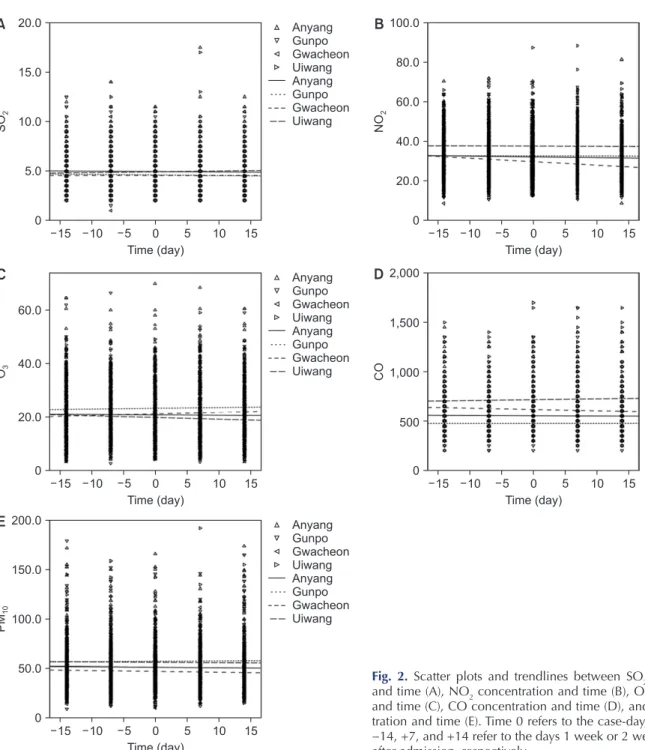
In the case-crossover design, conditional logistic regression showed that no air pollutant was associated with the occurrence of pneumothorax. The results were consistent across all city subgroups (Anyang, Gunpo, Uiwang, and Gwacheon).
Conclusion: In our study, the incidence rate of pneumothorax was 153.8 per 100,000 person-years in male adolescents and 16.7 per 100,000 person-years in female adolescents.
The case-crossover design showed that PSP in adolescents is unlikely to be related to air pollution.
Keywords: Pneumothorax, Air pollution, Adolescent, Epidemiology
Copyright © The Korean Society for Thoracic and Cardiovascular Surgery. 2021. All right reserved.
This is an Open Access article distributed under the terms of the Creative Commons Attribution Non-Commercial License (http://creativecommons.org/licenses/
Introduction
Pneumothorax is an accumulation of air in the pleural space that leads to lung collapse. Primary spontaneous pneumothorax (PSP) is pneumothorax without known lung disease, while secondary spontaneous pneumothorax occurs in people with underlying lung diseases, such as chronic obstructive pulmonary disease and congenital lung disease. Traumatic pneumothorax results from dam- age to lung tissue, such as rib fractures or injuries caused by needles. It can also be caused by blunt chest trauma without direct penetration of the lung. PSP does not pose a high risk for mortality and morbidity, but its suddenly-oc- curring nature, requirement of hospitalization for treat- ment, and high recurrence rate (32% according to a me- ta-analysis) incur high socioeconomic costs [1]. Therefore,
several studies have been conducted on the pathophysiolo- gy and epidemiology of PSP. It is well known from these studies that PSP occurs more frequently in younger people with a low body mass index (BMI), and it shows a clear male predilection [2]. The incidence rate is slightly differ- ent in each country, ranging from 17 to 24 to per 100,000 person-years in men and from 1 to 6 per 100,000 per- son-years in women [3].
The cause of PSP is thought to be the rupture of small, peripheral, usually apical subpleural blebs. Smoking is the most important risk factor for the development of PSP, as it is known to increase the incidence of PSP by 9–22 times [4].
In connection with smoking, meteorological factors and air pollutants have been noted as elements involved in the rupture of bullae in the past. Some studies have investigat- ed this relationship, but with inconsistent results. Bertolac-
https://doi.org/10.5090/kjtcs.20.073
pISSN: 2765-1606 eISSN: 2765-1614
J Chest Surg. 2021;54(1):53-58
https://doi.org/10.5090/kjtcs.20.073
JCS
cini et al. [5] reported that temperature, wind speed, and concentration of air pollutants might explain clusters in hospitalization for PSP. Moreover, in a study conducted by Han et al. [6] in Seoul, Korea, particulate matter (PM) and carbon monoxide (CO) were identified as possible predis- posing factors for PSP, while another study argued that ozone (O
3) and nitrogen dioxide (NO
2) were significantly associated with PSP [7]. However, a case-crossover study in France failed to show a relationship between PSP and short-term air pollution exposure [8].
In the present study, we aimed to examine the associa- tion between PSP and air pollutants in adolescents who had no underlying lung disease and either had never smoked or had a negligible smoking history. Although PSP is known to occur in young people, its incidence rate in adolescents has not been clearly studied [9]. Therefore, based on the information obtained in this study, the inci- dence rate of adolescent pneumothorax will also be investi- gated.
Methods
A single-center retrospective study was conducted of the
medical records of 632 PSP admissions in adolescents, de- fined as between 10 and 19 years of age at the time of ad- mission, from January 2010 to December 2014. Among these episodes, we excluded patients with underlying dis- eases such as pneumonia, tuberculosis, asthma, and other congenital or genetic lung diseases. We also excluded cases of traumatic or iatrogenic pneumothorax and spontaneous hemopneumothorax. Ultimately, 598 patients were eligible for analysis.
Data pertaining to age, sex, BMI, smoking status, initial pneumothorax volume, bulla presence, treatment, and city of residence were retrospectively obtained from our insti- tutional database. The Institutional Review Board of Hal- lym University Sacred Heart Hospital approved this study without informed consent (IRB approval no., 2020-02-004- 001). Most patients, with the exception of 2, underwent chest computed tomography (CT), and we recorded the presence and location of bullae in the chest. Treatment methods were generally selected according to the British Thoracic Society (BTS) guidelines and were classified into observation with oxygen inhalation, chest tube insertion, and surgical intervention [10]. Patients were classified based on their final treatment.
Because PSP is an acute disease, most patients visited or were transported to the hospital in their vicinity. Thus, we investigated air pollutant data in 4 cities (Anyang, Gunpo, Uiwang, and Gwacheon) near the hospitals where most of the patients (93.8%) resided. We hypothesized that if a cluster of PSP hospitalizations occurred, it would be due to weekly changes in pollutant concentrations, rather than daily changes. Therefore, we designed a case-crossover study to investigate the relationship between the occur- rence of PSP and air pollution. Rather than assessing the preceding 3 to 4 days, as done by other researchers [5-8], Table 1. Patients’ characteristics
Characteristic Value
Mean age (yr) 17.2±1.49
Male 545 (91.1)
Female 53 (8.9)
Height (cm) 173.9±6.51
Weight (kg) 58.2±8.36
Body mass index (kg/m
2) 19.2±2.19
Smoking 47 (7.9)
Location
Left side 339 (56.7)
Right side 251 (42.0)
Bilateral 8 (1.3)
Size
Small 354 (59.2)
Large 230 (38.5)
Bulla 289 (48.3)
Ipsilateral side 173 (59.9)
Contralateral side 2 (0.7)
Both sides 114 (39.4)
Treatment
O
2management 8 (1.3)
Chest tube management 172 (28.8)
Operation 418 (69.9)
Length of stay (day) 6.6 (1–31)
Values are presented as mean±standard deviation, number (%), or mean (range), unless otherwise stated.
140 120 100 80 60 40 20
Spring Summer Autumn Winter
No. of cases of pneumothorax
0
December (n=34) January
(n=39) February
(n=30)
September (n=45) October
(n=42) November
(n=47) May
(n=44)
April (n=36)
March (n=34)
August (n=34)
July (n=41)
June (n=41)