• 검색 결과가 없습니다.

Staple Line Coverage with a Polyglycolic Acid Patch and Fibrin Glue without Pleural Abrasion after Thoracoscopic Bullectomy for Primary Spontaneous Pneumothorax

N/A
N/A
Protected

Academic year: 2021

Share "Staple Line Coverage with a Polyglycolic Acid Patch and Fibrin Glue without Pleural Abrasion after Thoracoscopic Bullectomy for Primary Spontaneous Pneumothorax"

Copied!
7
0
0

로드 중.... (전체 텍스트 보기)

전체 글

(1)

ISSN: 2233-601X (Print) ISSN: 2093-6516 (Online)

Department of Thoracic and Cardiovascular Surgery, National Health Insurance Service Ilsan Hospital

Received: February 12, 2016, Revised: February 23, 2016, Accepted: March 8, 2016, Published online: April 5, 2016

Corresponding author: Ki Pyo Hong, Department of Thoracic and Cardiovascular Surgery, National Health Insurance Service Ilsan Hospital, 100 Ilsan-ro, Ilsandong-gu, Goyang 10444, Korea

(Tel) 82-31-900-0632 (Fax) 82-31-900-0343 (E-mail) [email protected]

C

The Korean Society for Thoracic and Cardiovascular Surgery. 2016. All right reserved.

CC
This is an open access article distributed under the terms of the Creative Commons Attribution Non-Commercial License (http://creative- commons.org/licenses/by-nc/4.0) which permits unrestricted non-commercial use, distribution, and reproduction in any medium, provided the original work is properly cited.

Staple Line Coverage with a Polyglycolic Acid Patch and Fibrin Glue without Pleural Abrasion after Thoracoscopic Bullectomy for

Primary Spontaneous Pneumothorax

Ki Pyo Hong, M.D., Ph.D., Do Kyun Kim, M.D., Kyung Hoon Kang, M.D.

Background: This study was conducted to determine the efficacy of staple line coverage using a polyglycolic acid patch and fibrin glue without pleural abrasion to prevent recurrent postoperative pneumothorax. Methods: A retro- spective analysis was carried out of 116 operations performed between January 2011 and April 2013. During this period, staple lines were covered with a polyglycolic acid patch and fibrin glue in 58 cases (group A), while 58 cases underwent thoracoscopic bullectomy only (group B). Results: The median follow-up period was 33 months (range, 22 to 55 months). The duration of chest tube drainage was shorter in group A (group A 2.7±1.2 day vs.

group B 3.9±2.3 day, p=0.001). Prolonged postoperative air leakage occurred more frequently in group B than in group A (43% vs. 19%, p=0.005). The postoperative recurrence rate of pneumothorax was significantly lower in group A (8.6%) than in group B (24.1%) (p=0.043). The total cost of treatment during the follow-up period, including the cost for the treatment of postoperative recurrent pneumothorax, was not significantly different between the two groups (p=0.43). Conclusion: Without pleural abrasion, staple line coverage with a medium-sized polyglycolic acid patch and fibrin glue after thoracoscopic bullectomy for primary spontaneous pneumothorax is a useful technique that can reduce the duration of postoperative pleural drainage and the postoperative recurrence rate of pneumothorax.

Key words: 1. Pneumothorax 2. Thoracoscpy 3. Polyglycolic acid 4. Fibrin tissue adhesive

INTRODUCTION

The surgical treatment of primary spontaneous pneumo- thorax (PSP) is conducted to close air leakage and prevent recurrence. Thoracoscopic bullectomy is generally considered the standard treatment of PSP, and is advantageous because it has been associated with decreased postoperative pain and improved cosmetic outcomes in comparison to open thor- acotomy; however, the postoperative recurrence rate after

thoracoscopic bullectomy has been found to be much higher than the rate of recurrence observed after open thoracotomy procedures [1-5].

Several additional procedures, such as pleural abrasion, par- tial pleurectomy, and chemical pleurodesis, have been per- formed after thoracoscopic bullectomy to reduce the re- currence rate of postoperative pneumothorax and prolonged air leakage. Although these procedures have yielded good re- sults for preventing postoperative recurrence, they can induce

http://dx.doi.org/10.5090/kjtcs.2016.49.2.85

(2)

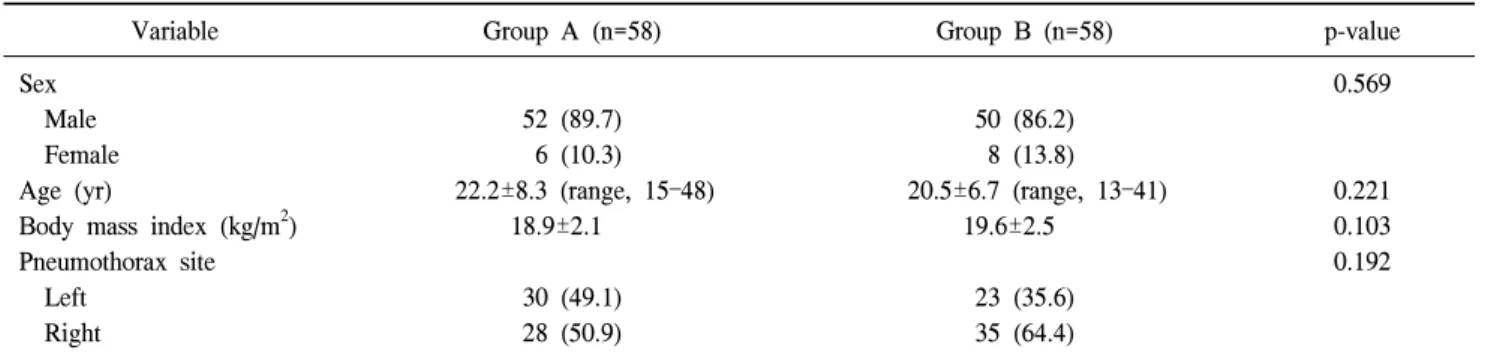
Table 1. Patient characteristics

Variable Group A (n=58) Group B (n=58) p-value

Sex 0.569

Male 52 (89.7) 50 (86.2)

Female 6 (10.3) 8 (13.8)

Age (yr) 22.2±8.3 (range, 15–48) 20.5±6.7 (range, 13–41) 0.221

Body mass index (kg/m

2

) 18.9±2.1 19.6±2.5 0.103

Pneumothorax site 0.192

Left 30 (49.1) 23 (35.6)

Right 28 (50.9) 35 (64.4)

Values are presented as number (%) or mean±standard deviation.

additional postoperative chest pain and increase the risk of morbidity, including hematoma, hemothorax, or tight pleural adhesion that can cause difficulties for subsequent thoracic surgery [6-11]. Moreover, pleural abrasion shows a wide range of recurrence rates because the procedure is not stand- ardized [6-10].

Therefore, researchers have sought to develop an effective post-thoracoscopic bullectomy procedure that is nonaggressive and is not associated with morbidity. Recently, staple line coverage with absorbable mesh has been found to be useful for preventing the postoperative recurrence of pneumothorax and prolonged air leakage around the staple line after thor- acoscopic bullectomy. Although various absorbable materials, such as fleece-coated fibrin glue, Vicryl mesh, and poly- glycolic acid (PGA) patches, have been used to cover staple lines and have been associated with good results [12-16], the reports published so far in the literature have not discussed covering staple lines with a medium-sized PGA patch and fi- brin glue without pleural abrasion.

In this study, we retrospectively investigated the effective- ness of staple line coverage with a medium-sized PGA patch and fibrin glue without pleural abrasion in preventing post- operative recurrent pneumothorax after thoracoscopic bullectomy.

METHODS

This study was approved by the institutional review board of the National Health Insurance Service Ilsan Hospital (2012-17).

1) Patients

From January 2011 to April 2013, 174 cases of thoraco-

scopic bullectomy for spontaneous pneumothorax were per- formed in our hospital. Fifty-eight cases from the initial study population were excluded. The following criteria were used to exclude patients from this study: (1) prior ipsilateral thoraco- scopic bullectomy; (2) a history of pulmonary tuberculosis;

(3) underlying chronic underlying pulmonary disease, such as emphysema; and (4) prior chemical pleurodesis. A single op- eration on one side was counted as one case, and the patients were divided into two groups based the procedures that they underwent. The 56 patients in group A underwent 58 thoraco- scopic bullectomies in which the staple line was covered with an absorbable medium-sized PGA patch (Neoveil, 10×5 cm;

Gunze, Kyoto, Japan) and fibrin glue (Beriplast-P combiset 1 mL; CSL Behring GmbH, Marburg, Germany). In group B, 56 patients underwent 58 bullectomies without any additional procedures. The patient characteristics are presented in Table 1.

2) Surgical indications

Surgical treatment of primary spontaneous pneumothorax was offered when patients exhibited: (1) ipsilateral or con- tralateral recurrent pneumothorax, (2) persistent air leakage (lasting for more than five days), (3) definite bullae that were detected on a chest X-ray or multiple bullae on a computed tomography scan, (4) simultaneous bilateral spontaneous pneu- mothorax, or (5) spontaneous hemopneumothorax (Table 2).

Each patient referred to the corresponding author with a di-

agnosis of primary spontaneous pneumothorax underwent

thoracoscopic bullectomy and the staple line was covered

with an absorbable medium-sized PGA patch (Neoveil, 10×5

cm; Gunze) and fibrin glue (Beriplast-P Combiset 1 mL, CSL

Behring GmbH) if they satisfied the operation criteria. The

(3)

Fig. 1. Intraoperative findings. The staple line was covered with a medium-sized polyglycolic acid patch after application of the throm- bin solution, followed by a fibrin solution that was dripped along the staple line.

Table 2. Operative indications

Indication Group A (n=58) Group B (n=58) p-value

Recurrent pneumothorax 0.12

Ipsilateral 24 (41.4) 29 (50.0)

Contralateral 6 (10.3) 2 (3.4)

Persistent air leak 28 (48.3) 24 (41.4)

Simultaneous bilateral pneumothorax 0 3 (5.2)

Values are presented as number (%).

other consecutive patients referred to the other two surgeons with a diagnosis of primary spontaneous pneumothorax under- went thoracoscopic bullectomy without any additional proce- dures if they satisfied the operation criteria.

3) Operative procedures

The operative procedures for thoracoscopic surgery were as follows. All patients received general anesthesia and were in- tubated with a double-lumen endotracheal tube to allow se- lective contralateral ventilation. The patients were placed in the lateral decubitus position. Three trocars (5 mm or 10 mm, and 12 mm) were inserted into the affected side of the thora- cic wall. All detectable bullae were resected with endoscopic staplers under thoracoscopy. A sealing test was not performed after bullectomy. After gently scrubbing the visceral pleura around the staple line with a sponge on a stick, a thrombin solution (Beriplast-P Combiset 1 mL, CSL Behring GmbH) was dripped along the staple line. Next, a medium-sized PGA patch (Neoveil, 10×5 cm; Gunze) was inserted into the pleu-

ral cavity via an access port and placed on the staple line.

Then, fibrin solution (Beriplast-P Combiset 1 mL, CSL Behring GmbH) was dripped onto the PGA patch along the staple line to fix it onto the visceral pleura (Fig. 1). No addi- tional chemical or mechanical pleurodesis was performed.

After coagulation of the bleeding from the trocar insertion holes, a 28-Fr chest tube was inserted through a trocar in- sertion hole and the other trocar insertion holes were closed with sutures.

4) Postoperative chest tube management

Negative suction was applied immediately after the oper- ation and maintained until chest tube removal. The chest tube was removed after cessation of air leakage, with drainage of less than 100 mL over the course of 24 hours, minimal fluc- tuations of the fluid level (≤10 cm) in the chest tube on coughing or deep breathing, and complete resolution of the pneumothorax.

5) Statistical analysis

All values in the text and tables are presented as means±standard deviation. The data were analyzed using IBM SPSS ver. 21.0 (IBM Co., Armonk, NY, USA). The unpaired t-test, chi-square test, and Fisher’s exact test were used to evaluate between-group differences. All p-values <0.05 were considered to indicate statistical significance.

RESULTS

The preoperative characteristics of groups A and B are pre- sented in Table 1. No significant differences were found in sex, age, body mass index, and pneumothorax site.

No instances of operative mortality occurred in either

(4)

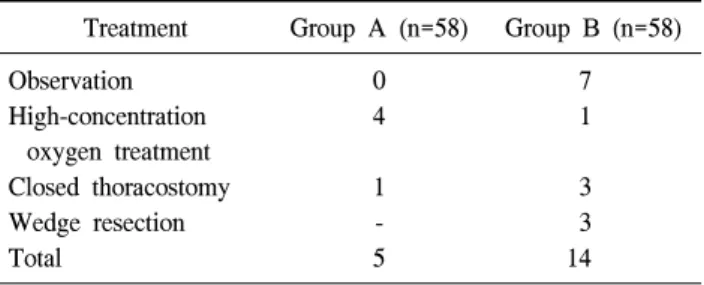
Table 3. Treatments for postoperative recurrent pneumothorax

Treatment Group A (n=58) Group B (n=58)

Observation 0 7

High-concentration oxygen treatment

4 1

Closed thoracostomy 1 3

Wedge resection - 3

Total 5 14

group. The median follow-up was 33 months (range, 22 to 55 months). In group A, the number of wedge resections was significantly larger than in group B (1.7±0.8 vs. 1.3±0.5, p=0.002).

The median duration of chest tube drainage was three days.

Therefore, we defined postoperative prolonged air leakage as four or more days in this study. Prolonged postoperative air leakage occurred more frequently in group B (43% vs. 19%, p=0.005). The duration of chest tube drainage was shorter in group A (2.7±1.2 vs. 3.9±2.3, p=0.001).

The postoperative recurrence rate of pneumothorax was sig- nificantly lower in group A than in group B (8.6% vs.

24.1%, p=0.043). None of the patients in group A required another operation. In group B, a secondary operation was per- formed in three cases of postoperative recurrence (Table 3).

The cost of treatment for the first operation was higher in group A than group B (4,872,783±907,221 Korean won [KRW] vs. 4,340,798±1,227,584 KRW, p=0.01). However, the total cost of the treatment of pneumothorax in the fol- low-up period, including the cost of treating postoperative re- current pneumothorax, was not significantly different between the two groups (5,122,839±1,559,805 KRW vs. 4,872,328±

1,797,685 KRW, p=0.43).

DISCUSSION

Several procedures have been performed after thoracoscopic bullectomy to prevent the postoperative recurrence of pneumothorax. These procedures include pleural abrasion, ap- ical pleurectomy, chemical pleurodesis, and staple line cover- age with an absorbable patch. All of those procedures are in- tended to eventually accomplish pleural symphysis.

Pleural abrasion techniques show significant variability de-

pending on the operating surgeon. The scrubbing material, scrubbing intensity, and range of abrasion have not yet been standardized. As a result, in the literature, the recurrence rate after thoracoscopic bullectomy with pleural abrasion has been reported to range from 2.8% to 12.8% [6-10]. The guidelines published by the British Thoracic Society suggest that pleur- ectomy is slightly more advantageous than pleural abrasion, with recurrence rates of 0.4% after pleurectomy (n=752) and 2.3% after pleural abrasion (n=301) [17]. In addition, pleural abrasion may cause additional chest pain and a possible risk of hematoma or hemothorax.

Apical pleurectomy is an effective method of treating pleu- rodesis using a thoracoscopic approach [17]. However, pleur- ectomy requires a lengthy operation and is technically prob- lematic [18,19]. In addition, it is associated with a higher risk of intraoperative bleeding and longer postoperative chest drainage [8].

Colt et al. [11] reported that talc poudrage for chemical pleurodesis was significantly superior to pleural abrasion.

However, talc pleurodesis can induce severe postoperative chest pain and can cause tight pleural adhesions, even in low- er portions of the lung, which can be difficult to dissect dur- ing future thoracic operations. In addition, talc pleurodesis may cause granuloma formation and decreased pulmonary function over the course of long-term follow-up [18].

Minocycline pleurodesis, another chemical pleurodesis option, was also found to induce severe postoperative pain despite a large dose of intrapleural lidocaine (400 mg) [8].

Recent attention has focused on synthetic bioresorbable

systems. Staple line coverage with an absorbable patch has

been reported to be an effective method for reducing the

postoperative recurrence rate after thoracoscopic stapled bul-

lectomy [12-16]. The high recurrence rate after thoracoscopic

stapled bullectomy has been attributed to causal factors such

as collapsed emphysematous bullae during unilateral ven-

tilation and the insufficient observation of rarely diseased

areas, inappropriate visualization of the diseased areas on the

mediastinal side, and new bulla formation near the staple

lines [13,15,20]. In contrast, postoperative air leakage occurs

mainly along the staple lines, as a result of stapling diffi-

culties, incomplete bullae resection, emphysematous changes

in the resected area, or staple line crossing [21]. Therefore,

(5)

reinforcement of the visceral pleura around the staple line and a surgical focus on the site of bullectomy can prevent the postoperative recurrence of pneumothorax and air leakage.

However, no evidence suggests that absorbable mesh and fi- brin glue thicken and reinforce the normal pleura. According to Nakanishi [13], in a reoperation two years after placing mesh on the pleura, a proliferation of fibrous connective tis- sue between the pleurae, rather than a thickening of the pleura itself, was seen at the site where the absorbable mesh was patched with fibrin glue. The proliferation of fibrous connective tissue between the pleurae was proposed to have occurred as a result of foreign body-induced inflammatory re- actions over several weeks, until the absorbable mesh melted and disappeared. Although the visceral pleura over the sta- pling site was not thickened after application of a PGA patch with fibrin glue, the proliferation of fibrous connective tissue between pleurae induced by a PGA patch reinforced the sta- pling site. Fibrin glue promotes the coagulation cascade and healing reaction at the staple line [22]. Fibrin glue has anti- adhesive activity but disappears between five and seven days after placement [22]. Therefore, fibrin glue may influence sta- ple line healing and fix absorbable mesh to the visceral pleura during the early postoperative phase [13,22,23].

According to Haraguchi et al. [15] and Lee et al. [24], sta- ple line coverage with a PGA patch in addition to pleural abrasion was found to be a useful method for preventing the postoperative recurrence of pneumothorax. However, the com- bination of these two procedures made it difficult to evaluate the effect of each procedure (PGA patch coverage vs. pleural abrasion), because each procedure can induce pleural symphysis. In addition, as mentioned previously, pleural abra- sion is not a standardized procedure and can increase the risk of postoperative morbidity, such as hematoma, hemothorax, and additional postoperative chest pain. Therefore, we aimed to evaluate the effectiveness of staple line coverage using a PGA patch without pleural abrasion.

Sakamoto et al. [25] reported that wide coverage of the staple line with Vicryl mesh (15×15 cm) was effective in de- creasing the incidence of recurrent postoperative pneumo- thorax and in preventing postoperative air leakage. Their study used a wide mesh that could be attached to the entire apex to further reduce postoperative recurrence. However,

new bullae were often found after bullectomy at the apical pleura near previous surgical margins that were stapled with automatic instruments [12]. Therefore, we hypothesized that a medium-sized PGA patch (Neoveil, 10×5 cm; Gunze) would be sufficient for staple line coverage to prevent the post- operative recurrence of pneumothorax and would be more manageable during thoracoscopic surgery than a wide mesh.

Finally, fibrin glue (Beriplast-P combiset 1 mL, CSL Behring GmbH) was used to fix the PGA patch onto the visceral pleura.

In this study, the number of wedge resections in group A was significantly larger than in group B. The rate of post- operative air leakage may increase in proportion to the num- ber of wedge resections. However, the duration of post- operative chest tube drainage was significantly shorter in group A than group B. The rate of prolonged air leakage (for at least four days) was also significantly lower in group A than group B. These results show the effectiveness of staple line coverage with a PGA patch and fibrin glue after thoraco- scopic bullectomy.

The postoperative recurrence rate of pneumothorax was sig- nificantly lower in the group that underwent staple line cover- age with a PGA patch and fibrin glue than in the group that underwent thoracoscopic bullectomy without any additional procedures. This indicates that, without pleural abrasion or chemical pleurodesis, staple line coverage with a PGA patch and fibrin glue is a useful method for reducing the post- operative recurrence of pneumothorax without any additional postoperative morbidity.

Despite the shorter duration of chest tube drainage and the lower incidence of prolonged postoperative air leakage in group A, the cost of the first operation was higher in group A, because the PGA patch and fibrin glue are relatively ex- pensive materials. However, the total cost for the treatment of pneumothorax in the follow-up period, including the cost for the treatment of postoperative recurrent pneumothorax, was not significantly different between the two groups due to a higher recurrence rate in group B. Considering the time cost and physical strain associated with readmission, staple line coverage with a PGA patch and fibrin glue can be considered a cost-effective and time-saving procedure.

In conclusion, staple line coverage with a medium-sized

(6)

PGA patch and fibrin glue after thoracoscopic bullectomy for PSP without pleural abrasion is a useful method for reducing the duration of postoperative pleural drainage and the post- operative recurrence rate of pneumothorax. However, this study was a non-randomized retrospective study and the num- ber of cases was relatively small. Therefore, a large, pro- spective, randomized clinical study with a long-term fol- low-up period is required to confirm the clinical effectiveness of this technique in decreasing postoperative pneumothorax recurrence.

CONFLICT OF INTEREST

No potential conflict of interest relevant to this article was reported.

ACKNOWLEDGMENTS

This work was supported by the National Health Insurance Service Ilsan Hospital Research Grant (2012-17).

REFERENCES

1. Horio H, Nomori H, Fuyuno G, Kobayashi R, Suemasu K.

Limited axillary thoracotomy vs video-assisted thoracoscopic surgery for spontaneous pneumothorax. Surg Endosc 1998;

12:1155-8.

2. Sawada S, Watanabe Y, Moriyama S. Video-assisted thor- acoscopic surgery for primary spontaneous pneumothorax:

evaluation of indications and long-term outcome compared with conservative treatment and open thoracotomy. Chest 2005;127:2226-30.

3. Kim KH, Kim HK, Han JY, Kim JT, Won YS, Choi SS.

Transaxillary minithoracotomy versus video-assisted thoracic surgery for spontaneous pneumothorax. Ann Thorac Surg 1996;61:1510-2.

4. Sahn SA, Heffner JE. Spontaneous pneumothorax. N Engl J Med 2000;342:868-74.

5. Haraguchi S, Koizumi K, Hioki M, et al. Postoperative re- currences of pneumothorax in video-assisted thoracoscopic surgery for primary spontaneous pneumothorax in young patients. J Nippon Med Sch 2008;75:91-5.

6. Gossot D, Galetta D, Stern JB, et al. Results of thoracoscopic pleural abrasion for primary spontaneous pneumothorax.

Surg Endosc 2004;18:466-71.

7. Huh U, Kim YD, Cho JS, I H, Lee JG, Lee JH. The effect of thoracoscopic pleurodesis in primary spontaneous pneu-

mothorax: apical parietal pleurectomy versus pleural abrasion.

Korean J Thorac Cardiovasc Surg 2012;45:316-9.

8. Chen JS, Hsu HH, Huang PM, et al. Thoracoscopic pleurod- esis for primary spontaneous pneumothorax with high re- currence risk: a prospective randomized trial. Ann Surg 2012;255:440-5.

9. Park JS, Han WS, Kim HK, Choi YS. Pleural abrasion for mechanical pleurodesis in surgery for primary spontaneous pneumothorax: is it effective? Surg Laparosc Endosc Percutan Tech 2012;22:62-4.

10. Moreno-Merino S, Congregado M, Gallardo G, et al.

Comparative study of talc poudrage versus pleural abrasion for the treatment of primary spontaneous pneumothorax.

Interact Cardiovasc Thorac Surg 2012;15:81-5.

11. Colt HG, Russack V, Chiu Y, et al. A comparison of thor- acoscopic talc insufflation, slurry, and mechanical abrasion pleurodesis. Chest 1997;111:442-8.

12. Muramatsu T, Ohmori K, Shimamura M, Furuichi M, Takeshita S, Negishi N. Staple line reinforcement with fleece-coated fibrin glue (TachoComb) after thoracoscopic bullectomy for the treatment of spontaneous pneumothorax.

Surg Today 2007;37:745-9.

13. Nakanishi K. An apical symphysial technique using a wide absorbable mesh placed on the apex for primary sponta- neous pneumothorax. Surg Endosc 2009;23:2515-21.

14. Saito T, Kaneda H, Konobu T, Saito Y. The covering with forceps-assisted polymeric biodegradable sheet and endo- stapling method: a simplified technique for wide coverage and reinforcement of staple-line in video-assisted thoraco- scopic bullectomy for spontaneous pneumothorax. Interact Cardiovasc Thorac Surg 2011;12:103-5.

15. Haraguchi S, Koizumi K, Mikami I, et al. Staple line cover- age with a polyglycolic acid sheet plus pleural abrasion by thoracoscopic surgery for primary spontaneous pneumo- thorax in young patients. J Nippon Med Sch 2012;79:139-42.

16. Lin XM, Liu Y, Chi C, Lin CX, Yang Y. Efficacy of an ab- sorbable polyglycolic acid patch in surgery for pneumo- thorax due to silicosis. J Cardiothorac Surg 2012;7:18.

17. Henry M, Arnold T, Harvey J; Pleural Diseases Group, Standards of Care Committee, British Thoracic Society. BTS guidelines for the management of spontaneous pneumo- thorax. Thorax 2003;58 Suppl 2:ii39-52.

18. Chang YC, Chen CW, Huang SH, Chen JS. Modified nee- dlescopic video-assisted thoracic surgery for primary sponta- neous pneumothorax: the long-term effects of apical pleur- ectomy versus pleural abrasion. Surg Endosc 2006;20:

757-62.

19. Rena O, Massera F, Papalia E, Della Pona C, Robustellini M, Casadio C. Surgical pleurodesis for Vanderschueren’s stage III primary spontaneous pneumothorax. Eur Respir J 2008;31:837-41.

20. Hatz RA, Kaps MF, Meimarakis G, Loehe F, Muller C,

(7)

Furst H. Long-term results after video-assisted thoracoscopic surgery for first-time and recurrent spontaneous pneumothorax.

Ann Thorac Surg 2000;70:253-7.

21. Busetto A, Moretti R, Barbaresco S, Fontana P, Pagan V.

Extrapleural bullectomy or lung volume reduction: air tight surgery for emphysema without strip-patch. Acta Chir Hung 1999;38:15-7.

22. Toosie K, Gallego K, Stabile BE, Schaber B, French S, de Virgilio C. Fibrin glue reduces intra-abdominal adhesions to synthetic mesh in a rat ventral hernia model. Am Surg 2000;66:41-5.

23. Eriksen JR, Bech JI, Linnemann D, Rosenberg J. Laparosco- pic intraperitoneal mesh fixation with fibrin sealant (Tisseel) vs. titanium tacks: a randomized controlled experimental study in pigs. Hernia 2008;12:483-91.

24. Lee S, Park SY, Bae MK, et al. Efficacy of polyglycolic acid sheet after thoracoscopic bullectomy for spontaneous pneumothorax. Ann Thorac Surg 2013;95:1919-23.

25. Sakamoto K, Takei H, Nishii T, et al. Staple line coverage

with absorbable mesh after thoracoscopic bullectomy for

spontaneous pneumothorax. Surg Endosc 2004;18:478-81.

수치

Table 1. Patient characteristics
Fig. 1. Intraoperative findings. The staple line was covered with a  medium-sized polyglycolic acid patch after application of the  throm-bin solution, followed by a fibrin solution that was dripped along  the staple line.
Table 3. Treatments for postoperative recurrent pneumothorax

참조

관련 문서