• 검색 결과가 없습니다.

Total Occlusion of the Abdominal Aorta Caused by Detachment of Cardiac Myxoma

N/A
N/A
Protected

Academic year: 2021

Share "Total Occlusion of the Abdominal Aorta Caused by Detachment of Cardiac Myxoma"

Copied!
3
0
0

로드 중.... (전체 텍스트 보기)

전체 글

(1)

Korean J Thorac Cardiovasc Surg 2012;45:183-185 □ Case Report □ http://dx.doi.org/10.5090/kjtcs.2012.45.3.183 ISSN: 2233-601X (Print) ISSN: 2093-6516 (Online)

− 183 −

1

Department of Thoracic and Cardiovascular Surgery, Inje University Busan Paik Hospital, Inje University College of Medicine,

2

Department of Cardiology, Inje University Ilsan Paik Hospital, Inje University College of Medicine

Received: December 26, 2011, Revised: January 11, 2012, Accepted: January 25, 2012

Corresponding author: Kyung-Taek Park, Department of Thoracic and Cardiovascular Surgery, Inje University Busan Paik Hospital, Inje University College of Medicine, 75 Bokji-ro, Busanjin-gu, Busan 614-735, Korea

(Tel) 82-51-890-6834 (Fax) 82-51-891-1297 (E-mail) [email protected]

C

The Korean Society for Thoracic and Cardiovascular Surgery. 2012. All right reserved.

CC
This is an open access article distributed under the terms of the Creative Commons Attribution Non-Commercial License (http://creative- commons.org/licenses/by-nc/3.0) which permits unrestricted non-commercial use, distribution, and reproduction in any medium, provided the original work is properly cited.

Total Occlusion of the Abdominal Aorta Caused by Detachment of Cardiac Myxoma

Sungyong Hong, M.D.

1

, Kyung-Taek Park, M.D.

1

, Hyunmin Choe, M.D.

2

Abdominal aortic occlusion (AAO) caused by detachment of cardiac myxoma (CM) is a very rare complication in patients with CM. Although the nature of CMs has been well established, detachment of CM may cause un- expected serious complications such as vicious embolic events. Actually, in several cases of AAO caused by de- tachment of CM, it has been reported that CM fragments easily migrated to the brain, heart, and lungs, and caused lifelong neurological complications despite appropriate surgical therapy. Herein, we report a case of a pa- tient with AAO caused by detachment of CM who underwent CM excision and abdominal aortic thromboem- bolectomy. Additionally, we have presented the preoperative and postoperative images using 64-multidetector com- puted tomography.

Key words: 1. Aorta, surgery 2. Myxoma

3. Aorta, abdominal

CASE REPORT

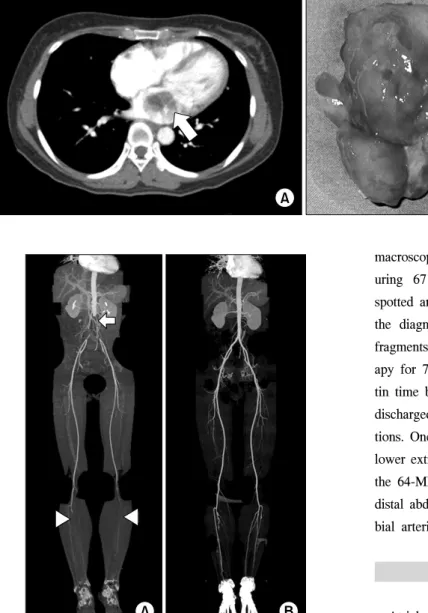
A 41-year-old female patient presented to the emergency room with sudden weakness of the legs that began one hour previously. She had been healthy except for a history of hypertension. The initial heart rate was at 75 beats/min and blood pressure was at 101/63 mmHg. She had cold and mot- tled lower extremities. Cardiac auscultation revealed an audi- ble diastolic murmur. In addition, the femoral, popliteal, and dorsalis pedis arterial pulses were markedly diminished bilate- rally. A 12-lead electrocardiogram and chest X-ray were normal. A conventional chest computed tomography (CT) scan revealed a low attenuation thrombus-like mass in the left atrium (Fig. 1A). A 64-multidetector computed tomography (64-MDCT) angiography of the lower extremities was per-

formed. Three-dimensional, volume-rendering images of 64- MDCT angiography revealed total occlusion of the infrarenal abdominal aorta up to the bilateral common iliac arteries and reduced blood flow in the bilateral anterior and posterior ti- bial arteries (Fig. 2A). Transthoracic echocardiography re- vealed a mobile 44×26 mm mass that was attached to the left interatrial septum and that moved through the mitral valve during diastole. We planned an urgent cardiac myxoma (CM) excision and abdominal aortic thromboembolectomy. We per- formed antegrade and retrograde transfemoral thromboembo- lectomy using Fogarty catheters, which were passed through both common femoral arteries to restore the patency in the bilateral lower extremities. Large numbers of embolic frag- ments were extracted from both the femoral arteriotomy sites.

Embolic fragments had gelatinous features and were mixed

(2)

Sungyong Hong, et al

− 184 −

Fig. 1. (A) Conventional chest com- puted tomography scan revealed a slow attenuation mass lesion in the left atrium (arrow). (B) Postoperative gross findings of cardiac myxoma.

Fig. 2. (A) Preoperative volume-rendering image of 64-multidetec- tor computed tomography angiography demonstrated occlusion of the lower abdominal aorta (arrow) and diminished blood flow in both the lower extremities (arrow head). (B) Postoperative com- puted tomography revealed complete restoration of blood flow.

with the thrombus. Both the dorsalis pedis arterial pulsations and vascular Doppler flow signals were restored immediately after arteriotomy closure. We then performed a sternotomy and removed the CM through the left atrium. The atrial sep- tal defect which was created for mass excision, was covered with an autologous pericardial patch. The mass to be excised was attached to the inferior margin of the fossa ovalis. The

macroscopic specimen showed a nodular outer surface meas- uring 67×58×45 mm and contained multiple hemorrhagic spotted areas (Fig. 1B). The histopathologic report confirmed the diagnosis of a cardiac myxoma and detached myxoma fragments. We used intravenous unfractionated heparin ther- apy for 7 days to maintain the activated partial thromboplas- tin time between 55 and 60 seconds. After 10 days, she was discharged without any vascular or neurological complica- tions. One month after surgery, a follow-up 64-MDCT of the lower extremity was performed. A volume-rendering image of the 64-MDCT angiography revealed patent blood flow in the distal abdominal aorta, and the bilateral common iliac and ti- bial arteries (Fig. 2B).

DISCUSSION

Atrial myxomas have been described as a proliferation of

primitive mesenchymal cells that normally differentiate into

endothelial and smooth muscle cells and fibroblasts. CM rep-

resents roughly 50% of all benign cardiac tumors. Cases of

abdominal aortic occlusion (AAO) caused by detachment of

CM have been reported sporadically and have occurred with-

out any prodromal symptoms. Suprarenal aortic occlusion is

extremely rare because of the decreasing diameter of the de-

scending aorta [1]. Total detachment of cardiac myxoma

causing saddle embolization of the abdominal aorta has also

been rarely reported [1,2]. Although one study reported that

the most common initial presenting symptoms of CM were

related to mitral valve obstruction, the signs or symptoms of

embolism were also noted frequently, with incidences ranging

(3)

Detachment of Cardiac Myxoma

− 185 − from 30% to 40% [3]. The central nervous system is prone to an embolic attack, and the neurologic manifestations in- clude syncope, psychiatric presentations, headaches, and seiz- ures [4]. The emboli generally display a prediction for the brain, but can also affect other organs such as the liver, spleen, kidney, retina, coronary arteries, and peripheral ar- teries [5]. CM emboli may manifest as fulminant cerebral or cerebellar infarction. Also, several case reports of AAO caused by detachment of CM have demonstrated the develop- ment of serious neurological complications such as major stroke, bowel ischemia, amputation, paraplegia, and death [2,3,5,6]. Fortunately, our patient had no neurological signs or symptoms, and hence she recovered more quickly. Both echo- cardiography [6] and 64-MDCT angiography help clinicians in making a precise diagnosis and therapeutic decision.

Moreover, 64-MDCT may be useful to evaluate the embolic involvement in the renal, coronary, gastrointestinal, and pul- monary arterial systems even if the hemodynamic status of the patient is unstable. In the present case of AAO caused by detachment of CM, we performed preoperative and post- operative 64-MDCT angiography. Preoperative 64-MDCT an- giography provided high quality anatomic information about the abdominal aorta, which made surgical decision-making easier. Postoperative 64-MDCT angiography also provided ad- ditional information regarding the flow status and residual embolic occlusion of the lower extremities. Retrograde trans- catheter embolectomy is effective for sweeping embolic

clumps away. Concurrent surgical removal of CM is also es- sential, and the results of surgical excision of an uncom- plicated CM are excellent, such that the recurrence rate is on- ly 5% [7]. In conclusion, prompt diagnosis and surgical inter- vention are very important in cases of AAO caused by de- tachment of CM because they may be beneficial for prevent- ing neurological complications and mortality.

REFERENCES

1. Tsao JH, Lo HC, How CK, Yen DH, Huang CI. Embolic occlusion of the aorta caused by cardiac myxoma. Resusci- tation 2010;81:511.

2. Neff CM, McCowan CL. Complete aortic occlusion caused by cardiac myxoma emboli. Am J Emerg Med 2008;26:110.

e1-2.

3. Pinede L, Duhaut P, Loire R. Clinical presentation of left atrial cardiac myxoma. A series of 112 consecutive cases.

Medicine (Baltimore) 2001;80:159-72.

4. Binning MJ, Sarfati MR, Couldwell WT. Embolic atrial myxoma causing aortic and carotid occlusion. Surg Neurol 2009;71:246-9.

5. Yadav S, Alvarez JM. Catastrophic presentation of atrial myxoma with total occlusion of abdominal aorta. Interact Cardiovasc Thorac Surg 2009;9:913-5.

6. Coley C, Lee KR, Steiner M, Thompson CS. Complete em- bolization of a left atrial myxoma resulting in acute lower extremity ischemia. Tex Heart Inst J 2005;32:238-40.

7. Shavit L, Appelbaum L, Grenader T. Atrial myxoma present-

ing with total occlusion of the abdominal aorta and multiple

peripheral embolism. Eur J Intern Med 2007;18:74-5.

수치

Fig. 1. (A) Conventional chest com- com-puted tomography scan revealed a  slow attenuation mass lesion in the  left atrium (arrow)

참조

관련 문서

• 이명의 치료에 대한 매커니즘과 디지털 음향 기술에 대한 상업적으로의 급속한 발전으로 인해 치료 옵션은 증가했 지만, 선택 가이드 라인은 거의 없음.. •

The proposal of the cell theory as the birth of contemporary cell biology Microscopic studies of plant tissues by Schleiden and of animal tissues by Microscopic studies of

The aim of this study was to evaluate the relationship between the patient’s occlusion and a cracked tooth by using T-scan occlusal analysis and a

그것은 이미지를 문자적 으로 서술하는 문제이며 옐름슬레브Hjelmslev[4]의 용어를 쓰자면 (코노테 이션과 반대되는 의미로서) 공정작용operation의

_____ culture appears to be attractive (도시의) to the

“ Sheikh Nasser has a written message from HH the Amir, Sheikh Sabah Al-Ahmad Al-Jaber Al-Sabah to the Chinese President, Chi Gen Beng related to enhancing mutual

On his part, CEO of Express Roads Authority, Saud Al-Naqqi said that the heavy rains of the previous day led to clogging parts of the express

Kuwait will celebrate on Sunday the fourth anniversary of the UN honoring and proclamation of His Highness the Amir, Sheikh Sabah Al-Ahmad Al-Jaber Al-Sabah as