Decreasing Trends of Neonatal and Infant Mortality Rates in Korea: Compared with Japan, USA, and OECD Nations
Neonatal mortality rate (NMR) and infant mortality rate (IMR) are two of the most important indices reflecting the level of public health of a country. In this review, we investigated changes in NMR and IMR in Korea and compared the results with those of Japan, USA, and OECD nations. During the past 20 yr, NMR and IMR have lowered remarkably from 6.6 and 9.9 in 1993 to 1.7 and 3.2 in 2009, respectively, in Korea. It is an impressive finding that Korean IMR (3.2 in 2009) is lower than the average of OECD nations (4.7 in 2008), and USA (6.3 in 2009), although higher than Japanese IMR (2.8 in 2009). The proportion of NMR among the IMR calculation decreased from 66.7% in 1993 to 53.1% in 2009. The reason the value of Korea was higher than Japan but lower than USA was speculated to be an aspect of the health care service system. Several suggestions in perinatal, neonatal and infantile health care such as establishment of perinatal care center, research network system, regionalization, and new policies for care of pre-term and high risk pregnancy, are elucidated to achieve further improvement on NMR and IMR in Korea.
Key Words: Public health; Epidemiologic methods; Data collection; Vital statistics;
Mortality; Infant mortality; Neonatal mortality; Korea; Japan; United States; OECD;
Epidemiology Ji-Young Chang1, Kyung Suk Lee1,
Won-Ho Hahn1, Sung-Hoon Chung2, Yong-Sung Choi2, Kye Shik Shim1 and Chong-Woo Bae1
1Department of Pediatrics, Kyung Hee University School of Medicine, Seoul; 2Department of Pediatrics, Kyung Hee University Graduate School and Department of Neonatology, Asan Medical Center, University of Ulsan College of Medicine, Seoul, Korea
Received: 29 March 2011 Accepted: 23 May 2011 Address for Correspondence:
Chong-Woo Bae, MD
Department of Pediatrics, Kyung Hee University Hospital at Gangdong, 892 Dongnam-ro, Gangdong-gu, Seoul 134-727, Korea
Tel: +82.2-440-6130, Fax: +82.2-440-7175 E-mail: [email protected]
http://dx.doi.org/10.3346/jkms.2011.26.9.1115 • J Korean Med Sci 2011; 26: 1115-1123 Pediatrics
INTRODUCTION
Infant mortality rate (IMR) is one of the most important indices that represent the level of economy, culture, and society, as well as the public health of a country. The importance of IMR has been well known for over one hundred years, based on the state- ment of Sir Arthur Newsholme, England, 1910, which highlight- ed that the IMR is the most sensitive index among the ones we have to reflect public welfare and hygiene (1). Among several public health indices, IMR and neonatal mortality rate (NMR) are very important because the improvement of NMR and IMR directly influences the survival rate of the pediatric population.
During the past 60 yr, NMR and IMR have improved greatly in Korea due to government support of various systems, includ- ing improvements in the level of health, social and economic development in terms of population health, socio-cultural and economic environment, health care and service system, and the medical system. The first nation-wide IMR and NMR were reported officially in 1993 by the Korea Ministry of Health and Welfare (KMHW), Republic of Korea Government. Before 1993, there were several private Korean reports.
In this review, the changes of NMR and IMR in Korea (last 60 yr) are observed and assessed (covering the last 20 yr of IMR data) in comparison with data from Japan, USA, and member
nations in the Organization for Economic Cooperation and De- velopment (OECD). Policies or factors of environmental change that have influenced changes of NMR and IMR in the national health care and service system of Korea, Japan and USA are also analyzed. Based on these factors, we have proposed develop- mental systems, items, and polices on heath care and disease treatment at the perinatal, neonatal (in particular pre-term in- fant) and infant stages for further improvement of NMR and IMR in Korea.
DATA COLLECTION
The first nation-wide IMR was reported officially in 1993 by the KMHW. Before 1993, there were several private Korean reports and estimation reports by the United Nations (UN). The data between 1941 and 1991 were collected from reports by Park and Park (1981) (1), Han et al. (1996) (2), KMHW (1996) (3), and Han and Kim (1996) (4) as well as the report by the UN for data from 1950 to 2010 (5).
IMR and NMR data after 1993 were sourced from several reports by the Korea Institute for Health and Social Affairs (KIHASA), and by Han et al. (2, 6-10). In addition, KMHW published official reports in 1993 (6), 1996 (11), 1999 (12), 2002 (9), and 2005 (10).
The report of Choi et al. (13), the 2007-2008 KIHASA report and
the publication of KMHW as 2007 and 2009 Yearbook of Health, Welfare and Family Statistics were also collected for IMR and NMR data (14, 15).
For calculating the IMR of 2007-2009 in Korea, we referred to the 2009 statistics for causes of death reported by Statistics Korea (the Statistical Office of Korea) (16). We also referred to the 2009 OECD statistics (17) and the OECD Health Data 2010 (18), and the IMR and NMR data of OECD. In addition, the WHO health statistics and health information systems (19), WHO mortality database (20), database of Japan Ministry of Health Labour and Welfare (21), and Index Mundi (22) were examined for the in- fant mortality for data from USA and Japan.
In the present study, the IMR was defined as (yearly number of deaths within 1 yr after birth/total number of births yearly) × 1,000, and the NMR is defined as (yearly number of death with- in 28 days after birth/total number of births yearly) × 1,000.
CHANGES IN INFANT AND NEONATAL MORTALITY RATES IN KOREA
Historical records for infant mortality rates in Korea Korean IMR data were first published officially by KMHW in 1993. Before that year, most data were reported unofficially. Even in the annual reports of the KMHW yearbook of public health and social statistics, there was no description on IMR between 1955 and 1966. Park and Park (1) reported IMR in 1981 based on the fertility survey of KIHASA in 1971, 1974, and 1976.
After 1993, KMHW reported several IMR data by request to KIHASA. These included the reports by KMHW (3, 6, 9-12, 14, 15) based on the survey of KIHASA by Han et al. (2, 6-10) [in 1993 (6), 1996 (2, 7), 1999 (8), 2002(9), and 2005(10)] and Choi et al.
(13) 2007-2008.
Statistics Korea used the KMHW reports for data between 1993 and 2006, and provided its own data from 2007 (16). These offi- Table 1. Reported infant mortality rates in Korea, 1921-1991
Year IMR Investigator Area References
1921-25 254 Lee KC Seoul cited in 1
1926-30 234 Lee KC Seoul cited in 1
1926-30 242 Mizushima Seoul cited in 1
1931-34 183 Hironaka Seoul cited in 1
1931-35 203 Choe HY Seoul cited in 1
1938-42 118 Park CB Urban area cited in 1
1941-45 150 Kim NI (FS, 1971) Nationwide cited in 1
1944-48 166 Yun DJ Rural area cited in 1
1945-49 166 WFS, 1974 Nationwide cited in 1, 2, 3
1946-50 132 Kim NI (FS, 1971) Nationwide cited in 1, 2, 3
1949-53 97 WFS, 1974 Nationwide cited in 1
1950-54 109 WFS, 1974 Nationwide cited in 1
1951-55 79 Kim NI (FS, 1971) Nationwide cited in 1
1954-59 83 Park HJ Rural area cited in 1
1955-59 60 WFS, 1974 Nationwide cited in 1
1956-60 64 Kim NI (FS, 1971) Nationwide cited in 1
1962 82.9 Park HJ Rural area cited in 2, 3
1960-64 59 WFS, 1974 Nationwide cited in 1
1961-64 45 Kim KS Rural area cited in 1
1961-65 60 Kim NI (FS, 1971) Nationwide cited in 1
1961-65 60 Lee SJ Rural area cited in 1
1962-64 36 Kwon EH Seoul cited in 1
1968 32.2 Kwon EH Seoul cited in 2, 3
1965-69 50 WFS, 1974 Nationwide cited in 1
1966-70 50 Kim NI (FS, 1971) Nationwide cited in 1
1970-72 46 WFS, 1974 Nationwide cited in 1
1971-76 32 Park KH Rural area cited in 1
1974 26 Kim JK Nationwide cited in 2, 3
1974-75 28.4 Han SH Nationwide cited in 4
1984-85 13.9 Han SH Nationwide cited in 4
1986-87 15.4 Han SH Nationwide cited in 2, 3
1986-87 14.7 Kim JK Nationwide cited in 2
1985-88 12.5 Park JH Rural area cited in 2
1986 12.5 Kim IH Nationwide cited in 2
1990 12.8 Statistics Korea Nationwide cited in 2
1991 10.0 Statistics Korea Nationwide cited in 2
FS, fertility survey; WFS, world fertility survey (Sources: reference 1-4).
cial IMR data were reported to the UN and UNICEF since 1993 and recently to the OECD as well (17-20).
The infant mortality rate between 1920 and 1991
KIHASA performed a survey three times for IMR in 1971, 1974, and 1976 and this has been published in 1981 (1). Table 1 sum- marizes the Korean IMR reports before 1991. We can recognize the slowly lowering trends of IMR; 350 before 1920, 240-250 in the 1920s, 180-200 in the 1930s, 160 in the 1940s, 150 in the ear- ly 1940s, 160 in the late 1940s, 100 during the Korean War, 60 in the early 1960s, 50 in the late 1960s, 30-40 in the 1970s, and 15 in the late 1980s.
Fig. 1 demonstrates the Korean IMR estimate reported by the UN between 1950 and 1990; 138 and 107 in the early and late 1950s, 93 and 81 in the early and late 1960s, 58 and 34 in the ear- ly and late 1970s, 27 and 17 in the early and late 1980s, and 9 in the early 1990s.
Infant and neonatal mortality rates since 1993
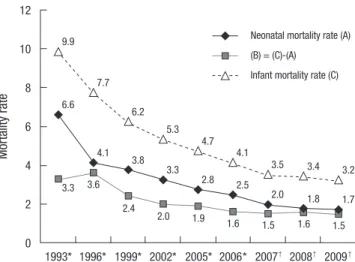
The IMR and NMR in Korea since 1993 are summarized in Fig. 2.
A remarkable lowering in IMR was found; 9.9 in 1993, 6.2 in 1999, 5.3 in 2002, 4.7 in 2005, and 3.2 in 2009. Similar changes were
found in NMR as well; 6.6 in 1993, 3.8 in 1999, 3.3 in 2002, 2.8 in 2005, and 1.7 in 2009. The pattern of IMR in Korea was shown to be lowering in both of NMR and IMR in the 1-12 month age.
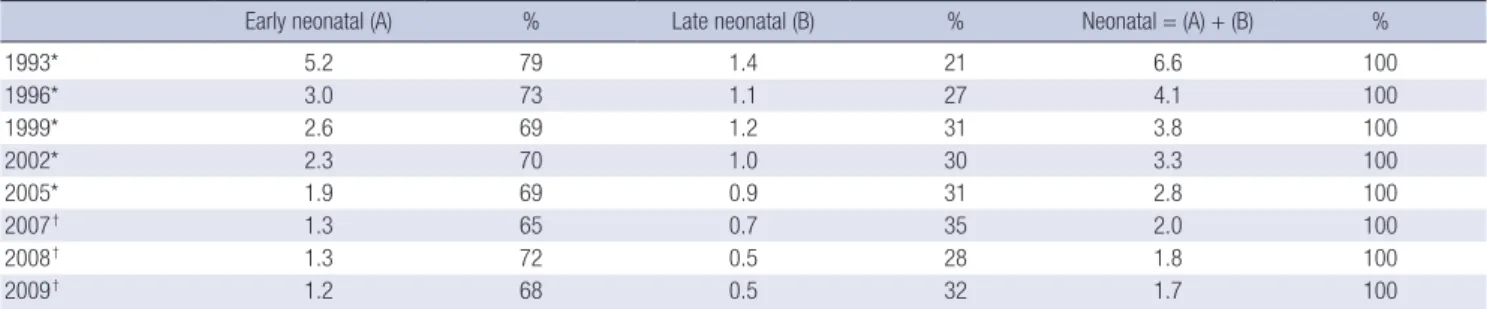
The early NMR (death before 7 days after birth) and the late NMR (death between 7 days and 28 days after birth) from 1993 to 2009 is shown in Table 2. The early NMR is higher than the late NMR implicating that the management of neonates is par- ticularly important in the early neonatal period. The importance of perinatal care and intensive care for babies aged less than 7 days could not be overemphasized.
Importance of NMR in IMR
The ratio of NMR in IMR is shown in Fig. 3. The ratio has been decreasing slowly; 66.7% in 1993, 53.2% in 1996, 61.3% in 1999, 62.3% in 2002, 59.6% in 2005, 61.0% in 2006, 57.1% in 2007, 52.9%
in 2008, and 53.1% in 2009. According to this data, the NMR still consists of approximately half of IMR, implicating the reduction in NMR could be one of the most important factors of improv- ing IMR in Korea.
Fig. 1. Estimates of Korean infant mortality rate reported by the Unit- ed Nations (Sources: reference 5).
Infant mortality rate
138
107 93
81 58
34 27
17
1950-19551955-19601960-19651965-19701970-19751975-19801980-19851985-19901990-19951995-20002000-20052005-2010 160
140 120 100 80 60 40 20 0
9 7 5 4
Fig. 2. Changes in infant and neonatal mortality rate in Korea from 1993 to 2009.
Significant improvement of mortality rates was found. *Data from the Korea Ministry of Health and Welfare; †data from Statistics Korea (Sources: reference 2-15).
Mortality rate
12
10
8
6
4
2
0 1993* 1996* 1999* 2002* 2005* 2006* 2007† 2008† 2009† Neonatal mortality rate (A) (B) = (C)-(A)
Infant mortality rate (C) 9.9
7.7
4.1 3.8
3.3
4.7 4.1
3.5
2.0 1.8
3.4 3.2
1.7 2.8 2.5
5.3 6.2
3.6
2.4 2.0 1.9 1.6 1.5 1.6 1.5
6.6
3.3
Fig. 3. The proportion of neonatal mortality rate in infant mortality rate in Korea from 1993 to 2009. Even though recently the ratio of neonatal mortality rate to infantile mortality rate shows decreasing tendency, it still occupies more than half of infantile mortality rate. *data from the Korea Ministry of Health and Welfare; †Data from Sta- tistics Korea (Sources: reference 2-15).
Neonatal mortality rate 1M-12M mortality rate
1993* 66.7%
1996* 53.2%
1999* 61.3%
2002* 62.3%
2005* 59.6%
2006* 61.0%
2007† 57.1%
2008† 52.9%
2009† 53.1%
0 20 40 % 60 80 100
COMPARISON OF KOREAN INFANT MORTALITY RATE DATA WITH OTHER COUNTRIES
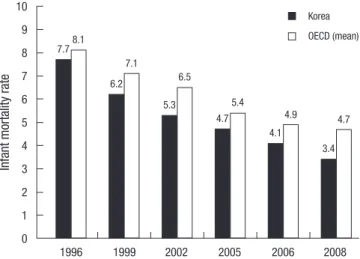
Infant mortality rates of Korea and OECD member nations By January 2011, there were a total of 33 member nations in the OECD. In 2010, OECD Health Data for 2008 on the IMR were re- ported and demonstrated in Fig. 4. We found that the IMR (3.4) of Korea was lower than the mean IMR (4.7) in OECD member nations. In addition, a similar pattern was found throughout 1996, 1999, 2002, 2005, 2006, and 2008 (Fig. 5). The IMR, which is one of the most important health indices, has been lowered in Korea and has been steadily lower than the mean IMR of OECD member nations for the past 15 yr, which is very encouraging
data for the national health status.
Comparison of infant mortality rates between Korea, Japan and USA
Changes of IMR in Korea, Japan, and USA for the past 20 yr are compared in Fig. 6. Despite the higher IMR in Korea than in Japan, it is clear that the impressive improvement has been achieved in the view of NMR and IMR in Korea even showing slightly bet- ter outcome than those of USA. Recent data on the ratio of NMR in IMR in Korea (53.1%), Japan (46.2%), and USA (71.4%) are shown in Fig. 7. The proportion of NMR in IMR in Korea is slight- ly lower than the data of USA but higher than the data of Japan.
Table 2. Neonatal (early and late) mortality rates in Korea, 1993-2009
Early neonatal (A) % Late neonatal (B) % Neonatal = (A) + (B) %
1993* 5.2 79 1.4 21 6.6 100
1996* 3.0 73 1.1 27 4.1 100
1999* 2.6 69 1.2 31 3.8 100
2002* 2.3 70 1.0 30 3.3 100
2005* 1.9 69 0.9 31 2.8 100
2007† 1.3 65 0.7 35 2.0 100
2008† 1.3 72 0.5 28 1.8 100
2009† 1.2 68 0.5 32 1.7 100
Early neonatal, death before 7 days after birth; late neonatal: death between 7 days and 28 days after birth. *Data from the Korea Ministry of Health and Welfare; †data from Statistics Korea (Sources: reference 2, 3, 6-9, 11, 12).
Fig. 4. The infant mortality rates of OECD nations in 2008. The mean in- fant mortality rate of Korea is 3.4 in comparison with 4.7 of OECD nations (Source: reference 18). *The USA in 2006; †Canada and Ireland in 2007.
Turkey Mexico Chile United States*
Slovak Republic Poland Hungary Canada† New Zealand OECD (mean) United Kingdom Australia Switzerland Denmark Netherlands Israel France Italy Austria Spain Germany Korea Belgium Portugal Ireland† Czech Republic Norway Greece Japan Finland Sweden Iceland Slovenia Luxembourg
0 2 4 6 8 10 12 14 16 18
DISCUSSION
Over the years, the KMHW of the Korean government has estab- lished nationwide programs to promote improved health care for pregnant women, childbirth newborns, and infants (23) such as a test for inborn error of metabolism and care for sick infants (1991), registration of pre-term and congenital abnormal neo- nates and medical expense support (2000), early diagnosis of deafness (2007), campaign for preventing blindness of preschool- ers (2000), prevention of maternal hepatitis B infection (2002), nationwide neonatal intensive care unit (NICU) installation sup- port campaign (2008-2011: project for installing 130 NICU beds in 13 hospitals nationwide), health care for pregnant women and children (2008, provision of providing iron supplements and stan- dard mother-child health record book), project for enhancing health of women at the childbearing age (2005), female repro- ductive health enhancement program providing information on
pregnancy, delivery, infant care, breast feeding clinic, creation of healthy maternal environment (2006), day of pregnant wom- an, pregnant woman care campaign, medical expense support for pregnancy and delivery of teen-aged pregnant mothers (2011), prevention of artificial abortion, visiting obstetrics and gynecol- ogy, prevention of infection and safety accidents at postnatal care houses (2005), post-care for contraception procedure (2005), and infertile couple support project (2006). A project for manag- ing an integrated medical center for high-risk mothers and new- borns (e.g. perinatal care center) is also expected to be executed in the following year (2012). Also, Korean Centers for Disease Control and Prevention (Korean CDC) has supported several programs to promote health care for children such as data ser- vice, registration, prevention, and control of infectious diseases in children, vaccination support program, survey surveillance, and service for chronic diseases in children.
The medical insurance system began in Korea in 1963. Chil- dren under the age of 6 have received a 90% insurance discount from hospital bills, paying only 35% of the insurance salary for outpatient cost, and gaining complete exemption during the neo- natal period from 2007. The figures regarding NMR and IMR were presented by the KMHW from 1993 and passed on to Statistics Korea from 2007. In 2007, surveys and statistical analysis methods for infant and maternal death were revised and complemented (24) to develop into a method for calculating more concrete, ac- curate numbers for NMR and IMR. Such revision and supple- mentation of the statistics calculation method facilitated a more accurate calculation of NMR and IMR in Korea. Improvement of NMR and IMR in Korea is stipulated to have been achieved by diverse factors, such as the prevention of diseases for newborns and infants (e.g. vaccination), the development of various med- ical technologies, medicine, tools, and improved nutritional en- vironment, along with the introduction of the previously men- tioned programs in Korea. The development of NICUs for pre- term, low birth weight infants, and high-risk neonates observed Fig. 5. Comparison of infant mortality rate data between Korea and the mean IMR of
OECD nations. Korea shows lower infantile mortality rate than OECD nations for past 20 yr (Sources: reference 16, 17).
Infant mortality rate
10 9 8 7 6 5 4 3 2 1
0 1996 1999 2002 2005 2006 2008
Korea OECD (mean) 7.7
6.2
5.3
4.7
4.1
3.4 8.1
7.1
6.5
5.4
4.9 4.7
Fig. 6. Changes of infant mortality rate in Korea, Japan and the USA for past 20 yr.
Korean infantile mortality rate is lower than data of the USA, but higher than data of Japan. *1993, †1996, ‡1999 (Sources: reference 19-22).
Infant mortality rate
12
10
8
6
4
2
0 199019952000200120022003200420052006 20072008 2009 Korea Japan USA
9.0 8.0
7.0 7.0
6.4 6.4 6.4 6.3 6.3 6.8 6.5
6.9 9.9*
7.7†
6.2‡
5.3 4.7 4.1
3.5 3.4 3.2 4.6 4.3
3.2 3.1 3.0 3.0 2.8 2.8 2.6 2.6 2.6 2.8
Fig. 7. The proportion of neonatal mortality rate in infant mortality rate in Korea, Ja- pan, and the USA in late 2000s. The ratio of neonatal mortality rate to infant mortality rate in Korea is lower than the USA, but higher than Japan (Sources: reference 19-22).
Neonatal mortality rate 1M-12M mortality rate
USA (2006)
Japan (2008)
Korea (2009)
71.4%
46.2%
53.1%
0 20 40 % 60 80 100
in the past 30 yr in the Korean medical community (25) has also contributed to improvements of NMR and IMR, with the support of activities conducted by related academic societies.
The development of health care policies for improving health- care of infants presented by the Japan Ministry of Health, Labour and Welfare in Japan (26) show that the following systems have been executed as national projects: the introduction of health care system for raising pre-term babies (1958), medical care ex- penses for tuberculosis infected children (1958), national health screening program for infants and children (1961), project for researching and treating chronic illness of children and provid- ing health record books for children with certain illnesses (1974), congenital metabolic disorder test and special milk support pro- grams (1977), support for nursing in gestational toxicology (1979), perinatal medical facilities support system (technical operation was achieved by the NICU medical facility repair business of 1979, maternal and fetal ICU and NICU medical facility repair programs of 1984, supporting operative expenses for perinatal medical facility (1996), construction, management, regionaliza- tion of complex regional perinatal center, prevention of mater- nal hepatitis B infection (1985), infant development counseling project (1991), project for providing health care information to mothers and children living abroad (1994), infant health support programs (1994), chronic illness child care support (1996), mod- el for promoting arrangement of nannies in ward (1998), system for raising medical expenses for infants (1990), publication of mother-child health record book (2004), and the New Angel Plan (2000-2004). Furthermore, various health care statistics on peri- natal period, neonates, and infants are being accurately analyzed and presented by the bureau of statistics affiliated with the Jap- anese Ministry of Health, Labour and Welfare. In addition to the activities performed by various academic societies on the peri- natal period, newborns, infants, and various diseases, Neonatal Research Network (1999) (27) and Perinatal Care Center Research Network (2003) (28) are being actively managed as networks for conducting and promoting clinical studies on newborns and perinatal period, and are contributing to the registration of pa- tients, data collection, statistics, education, research, and quali- ty improvement. Furthermore, the decrease in the mortality rate of low and extremely low birth weight infants contributed to the improvement of NMR, IMR in Japan (29, 30). It is believed that such factors have helped Japan develop as the nation with the best NMR and IMR in the world (25, 31). Although most systems of Korea have reached a similar level to that of Japan, Korea falls behind in several aspects, such as the installation, operation, and regionalization of perinatal care centers, and lack of installation of a center for co-managing high-risk mothers with neonates.
Nationwide networks for infants, newborns, and perinatal period are also lacking. Such aspects must be complemented to achieve greater improvement of NMR and IMF in Korea.
National system support for promoting infantile health in the
USA is as follows (26): execution of Medicaid (1965), Medicare (1965), Supplemental Security Income (social health care secu- rity programs for children and pregnant women of the lower in- come group), provision of State Children’s Health Insurance Pro- gram, Children Vaccine Program, Health Start Program (1991, Early Head Start Program, full day care service, parent education, case management, Community Resource Assistant), Early and Periodic Screening, Diagnostic and Treatment (EPSDT) Service Program (1967), folic acid intake program, and health education and campaign (supine position, HIV infection in mother, teen- aged pregnancies, folic acid intake). Along with various activities conducted by diverse related institutes, such as National Insti- tute of Health, a research group for decreasing neonatal and in- fant mortality, National Institute of Child Health and Human Development, National Heart, Lung, and Blood Institute, and Center for Diseases Control, various statistics have been ana- lyzed and presented on the health status of perinatology, neo- nates, and infants by the National Vital Statistics System of the National Center for Health Statistics. Moreover, NMR is greatly improved through the enhanced survival rate of pre-term ba- bies and low birth weight infant achieved by the nationwide in- stitute on National Institute of Child Health and Human Devel- opment (NICHD), Neonatal Research Network (1986) (32), and Vermont Oxford Network (1988) (33) (25, 34-36).
Nevertheless, USA IMR has been presented as 6.3 in 2009, which is far higher than 4.7, the average rate of OECD in 2008.
Also, NMR occupies a much larger portion of IMR in the USA when compared to that of Korea or Japan. The specific reasons for such phenomena are that, unlike Korea or Japan, USA pres- ents problems regarding its different and complex race, sociali- ty, and health care system.
The high IMR of the USA is due to the large IMR differences between races (37). IMR according to race and ethnicity (2008) is presented as 13.35 for non-Hispanic blacks, 8.28 for Ameri- can Indians or Alaska natives, 8.01 for Puerto Ricans, 5.58 for non-Hispanic whites, 5.34 for Mexicans, 5.08 for Cubans, 4.55 for Asians or Pacific Islanders, and 4.52 for Central and South Americans, thus presenting at least 3 fold deviation between races. These figures have not changed greatly since 2000. Such differences can be partly explained by the individually different standards of risk factors between races, such as pre-term, low birth weight infant, socioeconomic status, and access to medi- cal care. The second reason is related to the increase in pre-term babies (37). Pre-term is an important cause of IMR. In 2005, 36.5%
of infant deaths were caused by factors related with pre-term (38).
Pre-term rate has gradually increased in the USA. From 2000 to 2007, pre-term babies less than 34 weeks increased from 3.4%
to 3.6%, while pre-term babies of 34-36 weeks increased from 8.1% to 9.1% among total live births (39). In the same period, pre- term babies of less than 34 weeks increased from 55.7% to 58.2%, while the pre-term babies of 34-36 weeks increased from 9.4%
to 10.0% for IMR (39). The rates were different depending on each race. Whereas nearly half of infant deaths (46%) of non-Hispanic black women (37) are related with pre-term, only 32% are related to non-Hispanic white women (38). The third reason is related to change of maternal conditions, such as the increase in single mothers (37). The IMR of single mothers was rated 9.7% in 2007, which made it 78% higher than the IMR of married mothers (38).
However, the birth rate of single mothers increased from 43.7 in 2002 to 52.9 in 2007, and the ratio of total childbirths increased from 39.7% in 2007 to 40.6% in 2008. In this aspect, the gradual increase of IMR can also be expected. The fourth reason was re- lated to the difficulty in accessing health care due to high medi- cal expenses (37). The medical expenses in the USA occupied 15.3% of total GDP (40). Although this was significantly higher than Korea (6.2%) and Japan (8.2%), the number of doctors and the average days of hospitalization were below the OECD aver- age. In the medical system of the USA, approximately 14.3%- 20.0% of the population is not registered in Medicare, Medicaid, or private insurance, consequently prevented from receiving medical insurance benefits (40, 41). In particular, 8.6% of chil- dren under the age of 18 are unable to receive medical insurance benefits (41). In addition, the infantile non-insurance ratio in the poverty class and the second highest class is measured to be far higher than the average, at 11.6% and 17.4%, respectively. Thus, such information is in sharp contrast to Korea or Japan, where almost all children receive medical benefits through the medi- cal insurance and medical care system (41). To improve such pitfalls in the infantile medical system, Children’s Health Insur- ance Program Re-authorization Act (CHIPRA) was enacted in 2009. This act expands the previously existing Children’s Health Insurance Program (CHIP) or Medicaid to provide medical sup- port to more children (42). However, as such efforts are being strongly resisted by parties of opposing states, it remains ambig- uous whether or not such efforts will effectively reduce IMR in the USA.
The number of total annual live births in Korea has been:
715,020 in 1995, 634,501 in 2000, 435,031 in 2005, and 469,900 in 2010. The crude birth rate has been: 16 in 1995, 13.3 in 2000, 8.9 in 2005, and 9.4 in 2010. And total fertility rate has been: 1.63 in 1995, 1.47 in 2000, 1.08 in 2005, and 1.22 in 2010; indicating that we are in the era of a low birth rate (43). The total number of births has decreased, but the number of births of high-risk pre-term infants or low birth weight infants has been gradually increasing. In Korea, the birth incidence of low birth weight in- fants has been increasing from 3.0%, 3.7%, 4.2% to 4.9%, in 1995, 2000, 2005, and 2009, respectively. While the birth incidence of pre-term infants has also has been increasing from 2.5%, 3.8%, 4.7% to 5.7%, respectively (43, 44). According to the report of the KMHW in 2008, births by mothers with high-risk pregnancy ac- counted for 22% of the total births. Regarding the factor of high- risk mothers, the average age of mothers at birth has been in-
creasing from 27.9 in 1995 to 31.0 in 2009. Particularly, the pro- portion of births by advanced maternal aged group beyond the age of 35 at birth has significantly increased as from 4.7% in 1995, 6.7% in 2000, 10.8% in 2005 to 15.3% in 2009 (44). Also, the mul- tiple birth rates have been increasing as 13.2, 16.9, 21.7, and 27, in 1995, 2000, 2005, and 2009, respectively (45). In addition, the number of births from assisted reproductive technology, which is one of the major causes of multiple births, has been increas- ing since the second half of 1990’s from 2,475 neonates in 1996, 2,232 in 2000 to a 3,255 in 2006. 53.2%, 47.1%, and 53.0% of the births from assisted reproductive technology were multiple births implying that approximately half of such births result in multi- ple births (46). Among births from assisted reproductive technol- ogy in 2006, 43.5% were by mothers of advanced age. This was a much greater percentage in comparison to the 11.8% of the total live births (46). The escalating number of teen-aged pregnancies is another reason for the increase in high risk pregnancies. The percentage of deliveries by women under the age of 20 has been increasing from a 4.2% in 1995, 5.3% in 2000, 3.9% in 2005, to a 5.5% in 2009 (43). According to a report from the Korean Wom- en’s Development Institute by Kim et al. (47), 40% of single moth- ers who had entered 43 of the nationwide adoption institutes in July-August of 2009 were teen-aged pregnancies. Among these single mothers, 40.6% were under 19, 31.8% in the age group of 20-24, 20.9% in the age group of 25-29, and 16.7% were over 30 yr of age. In consideration of these trends, KMHW has made efforts by supporting the registration of neonates born of pre-terms or with congenital anomalies along with medical expense support, holding campaigns for the nationwide installation of NICU, pro- moting improved health care for pregnant women and children, developing projects for improving the general health of women of childbearing age, and providing medical expense support for pregnancy and delivery of teen-aged pregnancies. Korea Minis- try of Gender Equality and Family has aspired to establish and enhance the management systems for single mothers as well.
With these accomplishments as a foundation, further nation- wide support will be required. This along with upgraded man- agement of the increasing number of pre-terms and low birth weight infants and management of high risk pregnancies will lead to improved NMR and IMR in Korea.
PERSPECTIVES
During the past 20 yr, NMR and IMR in Korea have been low- ered remarkably from 6.6 and 9.9 in 1993 to 1.7 and 3.2 in 2009, respectively. These figures, though still higher than those of Ja- pan, are quite impressive as they are lower than the mean val- ues of OECD nations and the USA.
In the discussion above, various factors related to the health and medical care, service system of prinatology, neonates (espe- cially pre-terms) and infants affecting the NMR and IMR in Ko-
rea, Japan, and in the USA, have been analyzed. The current sta- tus of such related factors were reviewed, showing the reasons for the developed status of Japan and the developmental delay of the USA. The establishment of perinatal care center systems and regionalization, along with a nationwide neonatal research system was suggested as aspects which should be introduced into the Korean system with Japan as its role model for further improvement in NMR and IMR. Significant gaps in the provision of adequate health care due to racial differences and high med- ical costs, increase in pre-term babies and teen-aged mothers, and increase in high-risk maternal factors such as advanced ma- ternal aged-pregnancy were considered to be the mainstay of causes for the retention of high NMR and IMR in the USA. In con- trast, Korea’s strong points lie in that there is no significant racial discrimination among races, as well as a wide range of benefi- ciaries for medical care due to the national medical insurance system, although governmental support is yet in need for fur- ther development, with long-term measures for increased inci- dence of pre-term and low birth weight infant, and the number of high-risk pregnancies such as advanced maternal aged- preg- nancy group, multiple births, teen-aged pregnancies, births con- ceived by assisted reproductive technology.
NMR and IMR, with their significant decrease in the past 60 yr of Korean history, have served as indicators for the extensive improvement of national healthcare. For further development in this area, persistent efforts are anticipated in the perinatal, neonatal and infantile health and medical care system.
In order to overcome the low birth rate facing Korean society, nationwide encouragement for childbirth while providing a bet- ter environment for raising our children healthily will be crucial.
Improved child care is an investment in the future generation’s human resources directly having impact on a nation’s power and status. Caring for women throughout pregnancy and child- birth and managing the health of neonates, infants, and children are not only the responsibility of health care personnel and gov- ernment agencies but also belongs to Korean society, as a whole.
ACKNOWLEDGMENTS
The authors would like to thank Young Ja Han, Ph.D. for her works on the Korean infant mortality survey of 1993, 1996, 1999, 2002, 2003, 2005, 2006 under the Korea Institute for Health and Social Affairs and for allowing us to incorporate the statistical results.
REFERENCES
1. Park CB, Park BT. Infant mortality rate: survey of recent fertility in Korea.
Seoul: Korea Institute for Health and Social Affairs, 1981, p 11-25.
2. Han YJ, Doh SR, Seo K, Park JH, Lee SU. Infant mortality level and char- acteristics in 1996. Seoul: Korea Institute for Health and Social Affairs,
Korea Ministry of Health and Welfare, 1998, p 62-4.
3. Korea Ministry of Health and Welfare. Infant mortality survey report in 1996. Seoul: Korea Ministry of Health and Welfare, 1999, p 31-3.
4. Han SH, Kim IS. Recent trends of infant death rates and its determinants in Korea. Korean J Epidemiol 1990; 12: 57-89.
5. UN, UN data, Infant mortality rate. Available at http://data.un.org/Data.
aspx?q=infant+mortality&d=PopDiv&f=variableID%3a77 [accessed on 15 July 2011].
6. Han YJ, Doh SR, Lee SU, Lee HB, Lee MI. Infant mortality survey report in 1993. Seoul: Korea Ministry of Health and Welfare, Korea Institute for Health and Social Affairs, 1997, p 59-60.
7. Han YJ, Doh SR, Lee SU, Lee HB, Lee MI. Infant mortality level and char- acteristics. Seoul: Korea Institute for Health and Social Affairs, 1996, p 70-4.
8. Han YJ, Lee SU, Chang YS, Kim DJ, Lee SU. Infant mortality level and characteristics of perinatal death in 1999. Seoul: Korea Institute for Health and Social Affairs, 2002, p 39-43.
9. Han YJ, Seo K, Lee SU, Lee SU, Shin CW. Infant and maternal death sur- vey report in 2002-2003. Seoul: Korea Institute for Health and Social Af- fairs, Korea Ministry of Health and Welfare, 2005, p 67-70.
10. Han YJ, Choi JS, Seo K, Lee SU, Oh HC, Kim NO, Hong JS, Shin SM, Lee NH. Infant and maternal death survey report in 2005-2006 . Seoul: Korea Institute for Health and Social Affairs, Korean Medical Record Associa- tion, Korea Ministry of Health and Welfare, 2008, p 77-92.
11. Korea Ministry of Health and Welfare. Infant mortality survey report in 1996. Seoul: Korea Ministry of Health and Welfare, 1999, p 33-7.
12. Korea Ministry of Health and Welfare. Infant mortality survey report in 1999. Korea Ministry of Health and Welfare 1999 (Infant mortality level and characteristics of perinatal death in 1999). Seoul: Korea Ministry of Health and Welfare, 2002, p 39-43.
13. Choi JS, Seo K, Lee NH, Lee SU, Shin CW, Bu YK. Infant and maternal death survey report in 2007-2008. Seoul: Korea Institute for Health and Social Affairs, Korean Medical Record Association, Korea Ministry of Health and Welfare, 2010, p 89-90.
14. Korea Ministry of Health and Welfare. Yearbook of heath, welfare and family statistics in 2007. Seoul: Korea Ministry of Health and Welfare, 2007, p 56.
15. Korea Ministry of Health and Welfare. Yearbook of heath, welfare and family statistics. Seoul: Korea Ministry of Health and Welfare in 2009, 2009, p 20.
16 Statistics Korea. Statistical report of causes of death in Korea in 2009.
Available at http://kostat.go.kr/wnsearch/search.jsp [accessed on 15 July 2011].
17. Korea Ministry of Health and Welfare . OECD statistics in 2009. Seoul:
Korea Ministry of Health and Welfare, 2009, p 96.
18. OECD. OECD Health Data 2010, Infant mortality. Available at http://www.
oecd.org/document/0,3746,en_2649_201185_46462759_1_1_1_1,00.html, and http://www.oecd.org/dataoecd/4/36/46796773.pdf [accessed on 15 July 2011].
19. WHO. Health statistics and health information systems, infant mortality.
Available at http://www.who.int/healthinfo/morttables/en/index.html [accessed on 15 July 2011].
20. WHO. WHO mortality database, infant death. Available at http://apps.
who.int/whosis/database/mort/table2.cfm [accessed on 15 July 2011].
21. Japan Ministry of Health, Labour and Welfare. Statistics, infant mortali-
ty rate. Available at http://www.mhlw.go.jp/english/database/db-hw/
report/3.html [accessed on 15 July 2011].
22. Index Mundi. United States infant mortality rate. Index Mundi. Available at http://www.indexmundi.com/united_states/infant_mortality_rate.
html [accessed on 15 July 2011].
23. Ministry of Health and Welfare. Health care and service for newborn, in- fant and mother: 2011. Seoul: Ministry of Health and Welfare, 2011, p 3-9.
24. Statistics Korea. Change of statistical method for infant and mother’s death survey in Korea. Available at http://kostat.go.kr/wnsearch/search.jsp [ac- cessed on 15 July 2011].
25. Hahn WH, Chang JY, Chang YS, Shim KS, Bae CW. Recent trends in neo- natal mortality in very low birth weight Korean infants: in comparison with Japan and the USA. J Korean Med Sci 2011; 26: 467-73.
26. Hwang NM. Health care and service system for newborn and infant in other nations. Proceeding of the 57th annual spring meeting of the Kore- an pediatric Society. 2007, p 19-27.
27. Neonatal Research Network, Japan. Available at http://nrn.shiga-med.
ac.jp/ [accessed on 15 July 2011].
28. Perinatal Care Center Network, Japan. Available at http://plaza.umin.
ac.jp/nrndata/syukei.htm [accessed on 15 July 2011].
29. Kusuda S, Fujimura M, Sakuma I, Aotani H, Kabe K, Itani Y, Ichiba H, Matsunami K, Nishida H. Morbidity and mortality of infants with very low birth weight in Japan: center variation. Pediatrics 2006; 118: e1130-8.
30. Itabashi K, Horiuchi T, Kusuda S, Kabe K, Itani Y, Nakamura T, Fujimura M, Matsuo M. Mortality rates for extremely low birth weight infants born in Japan in 2005. Pediatrics 2009; 123: 445-50.
31. Bae CW. Bench-marking of Japanese perinatal center system for improv- ing maternal and neonatal outcome in Korea. Korean J Perinatol 2010;
21: 129-39.
32. National Institute of Child Health and Human Development (NICHD) Neonatal Research Network. Available at https://neonatal.rti.org/ [ac- cessed on June 2011].
33. Vermont Oxford Network. Available at http://www.vtoxford.org/ [accessed on June 2011].
34. Payne NR, Finkelstein MJ, Liu M, Kaempf JW, Sharek PJ, Olsen S. NICU practices and outcomes associated with 9 years of quality improvement collaboratives. Pediatrics 2010; 125: 437-46.
35. Fanaroff AA, Stoll BJ, Wright LL, Carlo WA, Ehrenkranz RA, Stark AR, Bauer CR, Donovan EF, Korones SB, Laptook AR, Lemons JA, Oh W, Pap- ile LA, Shankaran S, Stevenson DK, Tyson JE. Trends in neonatal mor-
bidity and mortality for very low birthweight infants. Am J Obstet Gyne- col 2007; 196: 147.
36. Stoll BJ, Hansen NI, Bell EF, Shankaran S, Laptook AR, Walsh MC, Hale EC, Newman NS, Schibler K, Carlo WA, Kennedy KA, Poindexter BB, Finer NN, Ehrenkranz RA, Duara S, Sánchez PJ, O’Shea TM, Goldberg RN, Van Meurs KP, Faix RG, Phelps DL, Frantz ID 3rd, Watterberg KL, Saha S, Das A, Higgins RD. Neonatal outcomes of extremely preterm in- fants from the NICHD Neonatal Research Network. Pediatrics 2010; 126:
443-56.
37. Mathews TJ, Miniño AM, Osterman MJ, Strobino DM, Guyer B. Annual summary of vital statistics: 2008. Pediatrics 2011; 127: 146-57.
38. MacDorman MF, Mathews TJ. Recent trends in infant mortality in the United States. NCHS Data Brief 2008; (9): 1-8.
39. Mathews TJ, MacDorman MF, Division of Vital Statistics. Infant mortal- ity statistics from the 2007 period linked birth/infant death data set. Natl Vital Stat Rep 2011; 59: 1-47.
40. Anderson GF, Squires DA. Measuring the U.S. health care system: a cross- national comparison. Issue Brief (Commonw Fund) 2010; 90: 1-10.
41. Cohen RA, Martinez ME. Health insurance coverage: early release of es- timates from the National Health Interview Survey. National Center for Health Statistics. Available at http://www.cdc.gov/nchs/nhis.htm [ac- cessed on 15 July 2011].
42. Children’s Health Insurance Program Reauthorization Act of 2009 (CHIP- RA or Public Law 111-3). The Children’s Health Insurance Program (CHIP).
Available at https://www.cms.gov/chipra/ [accessed on 15 July 2011].
43. Statistics Korea. Birth statistics in Korea in 2010. Available at http://ko- stat.go.kr/wnsearch/search.jsp [accessed on 15 July 2011].
44. Moon JY, Hahn WH, Shim KS, Chang JY, Bae CW. Changes of maternal age distribution in live births and incidence of low birth weight infants in advanced maternal age group in Korea. Korean J Perinatol 2011; 22:
30-6.
45. Choi SH, Park YS, Shim KS, Choi YS, Chang JY, Hahn WH, Bae CW. Re- cent trends in the incidence of multiple births and its consequences on peri- natal problems in Korea. J Korean Med Sci 2010; 25: 1191-6.
46. Park YS, Choi SH, Shim KS, Chang JY, Hahn WH, Choi YS, Bae CW. Mul- tiple births conceived by assisted reproductive technology in Korea. Kore- an J Pediatr 2010; 53: 880-5.
47. Kim HY, Sun BY, Kim EY, Jung JH. Unwed mother’s life world and policy agenda. Korean Women’s Development Institute, 2009, p 39-40.
AUTHOR SUMMARY
Decreasing Trends of Neonatal and Infant Mortality Rates in Korea: Compared with Japan, USA, and OECD Nations
Ji-Young Chang, Kyung Suk Lee, Won-Ho Hahn, Sung-Hoon Chung, Yong-Sung Choi, Kye Shik Shim and Chong-Woo Bae In this review, we investigated changes in neonatal and infant mortality rate (NMR, IMR) in Korea and compared the results with those of Japan, USA, and OECD nations. During the past 20 yr, NMR and IMR have lowered remarkably; the values in 2009 were lower than the average of OECD nations and USA, although higher than Japanese IMR. Several suggestions in perinatal, neonatal and infantile health care were elucidated to achieve further improvement on NMR and IMR in Korea.