1. Introduction
Wireless Communication Technology in Kosovo is relatively new industry. During last two decades this industry had enormous growth by making the mobile telephony and the internet the main mediums of communication. While in 1999 was only one public telecom operator, today are licensed over 101 public and private operators offering various services in telecommunication of which three are the main mobile operators that are part of the study. In a small market like Kosova, in an industry with strong competition and change in customer preferences marketers seeks for
* First Author & Corresponding Author, Faculty of Economy, University of Prishtina "Hasan Prishtina", Kosovo.
Tel: +383 44431246, E-mail: [email protected]
** Associate Professor, Faculty of Economy, University of Prishtina
"Hasan Prishtina", Kosovo.
Tel: +383 44139106, E-mail: [email protected]
© Copyright: Korean Distribution Science Association (KODISA)
This is an Open Access article distributed under the terms of the Creative Commons Attribution Non-Commercial License (https://creativecommons.org/licenses/by-nc/4.0/) which permits unrestricted non-commercial use, distribution, and reproduction in any medium, provided the original work is properly cited.
new strategies and utilized different marketing communication channels to reach the existing and potential customers (Geçti & Gumus, 2014; Hassan, Thurasamy, & Loi, 2017).
According to statistics of the Regulatory Authority of Electronic and Postal Communications with new entrants in the industry, the market share of three main operators has dropped. The users could switch from one brand to another as a result of low switching cost (Aydin & Ozer, 2005;
Rajasekar & Raee, 2013; Xhema, Metin, & Groumpos, 2018) their dissatisfaction with services or products (Nawaz &
Usman, 2011; Karunanithy & Rasanayagam, 2013; Khizindar, Al-Azzam, & Khanfar, 2015; Tabaku & Çerri, 2015; Hafez &
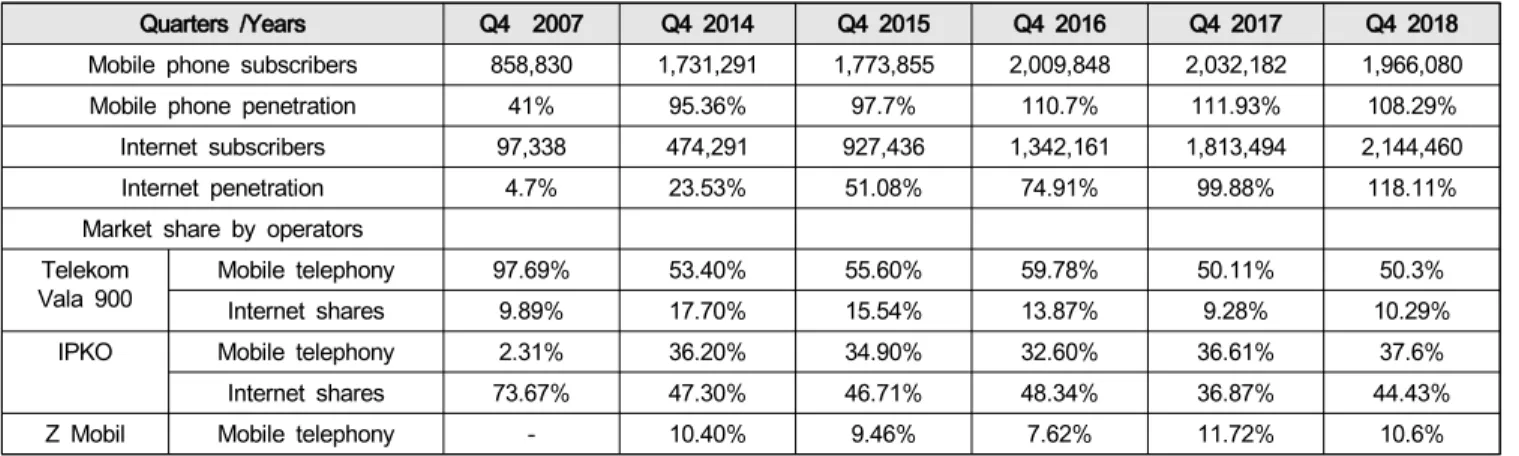
Akther, 2017; Hassan, Thurasamy, & Loi, 2017; Ramadai, Theresia, & Sadalia, 2018). The development trend of the telecommunication industry in Kosovo are presented in the Table 1. the figures of the last quarter for each year were taken as a reference to compare changes in the market share when new operators have entered the market. As indicated in the table below the main public mobile operator Vala900, lost its market shares over new operators entrance with more aggressive promotional strategies, better customer services and more affordable prices.
Print ISSN: 1738-3110 / Online ISSN 2093-7717 http://dx.doi.org/10.15722/jds.17.06.201906.15
The Effects of E-marketing Communications on Brand Loyalty:
The Case of Mobile Telephone Operators in Kosovo
Vjosa MULLATAHIRI
*, Fatos UKAJ
**Received: May 05, 2019. Revised: May 13, 2019. Accepted: June 05, 2019.
Abstract
Purpose – This study evaluates the effects of e-marketing communication on brand loyalty in the mobile communication market in Kosovo. given that no prior studies of this nature are found. It explores the relationships, between e-marketing communication, brand image and customer satisfaction, and their impact on the brand loyalty.
Research design, data, and methodology – The research model of four constructs was developed. The data was collected via online surveys, 423 completed surveys from mobile subscribers were received. To test the relationship between the individual variables and multiple variables with the dependent variable several test were performed including data validity and reliability, bivariate correlation, simple linear and multiple regression analysis using stepwise method.
Results – Positive significant effect of e-Marketing communication on brand loyalty, as well its significant effect on both brand image and customer satisfaction, which subsequently have significant impact on brand loyalty as it was confirmed by previous studies.
Conclusions – The findings confirm that e-Marketing communication is key factor in building well perceived brand image, fostering customer satisfaction, and leading to customer commitment and loyalty towards brands of mobile operators in Kosovo.
Keywords: E-marketing Communication; Brand Loyalty, Brand Image, Customer Satisfaction, Mobile Operators, Kosovo.
JEL Classifications: M30, M31, M37.
Table 1: Development trends through year of the Telecommunication Industry in Kosovo
Quarters /Years Q4 2007 Q4 2014 Q4 2015 Q4 2016 Q4 2017 Q4 2018
Mobile phone subscribers 858,830 1,731,291 1,773,855 2,009,848 2,032,182 1,966,080
Mobile phone penetration 41% 95.36% 97.7% 110.7% 111.93% 108.29%
Internet subscribers 97,338 474,291 927,436 1,342,161 1,813,494 2,144,460
Internet penetration 4.7% 23.53% 51.08% 74.91% 99.88% 118.11%
Market share by operators Telekom
Vala 900 Mobile telephony 97.69% 53.40% 55.60% 59.78% 50.11% 50.3%
Internet shares 9.89% 17.70% 15.54% 13.87% 9.28% 10.29%
IPKO Mobile telephony 2.31% 36.20% 34.90% 32.60% 36.61% 37.6%
Internet shares 73.67% 47.30% 46.71% 48.34% 36.87% 44.43%
Z Mobil Mobile telephony - 10.40% 9.46% 7.62% 11.72% 10.6%
On the one hand mobile operators are working in a highly competitive environment. However, high levels of penetration of the mobile telephony and internet in Kosovo's population works to their advantage because utilizing proper e-marketing communication strategies can help them reach create customer base and build brand loyalty.
Therefore studying the relations between e-marketing communication and loyalty towards brands of mobile operators in Kosovo is very important for marketers of this industry particularly and service providers in general. In a highly competitive environment in this industry, where internet and mobile telephony users are in control, the marketers have to design and deliver brand messages to capture audience's attention, and build customer loyalty (Hassan, Thurasamy, & Loi, 2017) not only to outperform but to make the competition irrelevant (Kim & Mauborgne, 2005).
As in other parts of the world, the information technology (IT) and internet revolutionalised ways of doing business and applying marketing communications. The information technology advanced ways of communicating with customers, from one-way fixed and ambiguous information to interactive communication engaging consumers to upload content and disseminate their own interest and brand and product experiences via email and social media (Bala & Verma, 2018).
Technology, internet and marketing are inseparable and interdependent in optimizing businesses' competitive advantage (Leeflang, Verhoef, Dahlstrom, & Freundt, 2013) building brand image and long-term customer relationships (Lee, James, & Kim, 2014).
E-marketing advanced traditional marketing, it increased efficiency and effectiveness, and transformed marketing strategies (Bala & Verma, 2018), by shifting powers from businesses to customers and creating stronger bonds between customers themselves and between businesses.
Hence shifting from mass customization to customerization by engaging customers in processes of product development and personalizing the product as per their needs (Wind &
Rangaswamy, 2001).
1.1. Research objectives
The aim of this study is to assess the effects of e-Marketing communication on brand loyalty of the mobile operators market in Kosovo. The specific objectives of the study are:
• To assess whether the e-marketing communication has significant relationship with customer satisfaction.
• To assess whether e-marketing communication has significant relationship with brand image.
• To assess whether customers satisfaction has significant relationship with brand loyalty.
• To assess whether brand image has significant relationship with brand loyalty.
• To provide recommendations for mobile operators based on findings of this study.
The study will contribute to enriching the literature related to the impact of the e-marketing communication on brand loyalty, as well as its brand image and customer satisfaction as ascendants for creating the base of loyal customers.
2. Literature Review
2.1. E-marketing communication
Information technology revolutionized all aspects of doing business and dynamics of marketing. Business, marketing and information technology are interdependent structures that optimize one another's competitive advantage (Leeflang, Verhoef, Dahlstrom, & Freundt, 2013) by creating more value and benefits for customers in more cost effective way (Wind & Rangaswamy, 2001; Makarem, Mudambi, &
Podoshen, 2009; Bala & Verma, 2018).
E-marketing utilizes the information technology and
internet for the marketing processes of defining the needs and demands (Leeflang, Verhoef, Dahlstrom, & Freundt, 2013; Khan & Islam, 2017) creating, communicating, delivering and exchanging offerings that have value for customers, partners, and the community (Wind &
Rangaswamy, 2001; Bala & Verma, 2018). Information technology and internet increased efficiency and effectiveness of traditional marketing functions including ways of communicating and maintaining relationships with customers (Martin, Durme, Raulas, & Merisavo, 2003; Khan
& Islam, 2017) and other stakeholders.
Internet, mobile phones, digital TV, email, social media and other communication channels put the customers in the center (Martin, Durme, Raulas, & Merisavo, 2003), balanced the control over the brand images and shifted the bargaining powers from companies to customers (Wind & Rangaswamy, 2001; Rajasekar & Raee, 2013). The internet and social media, turned consumers to "prosumers", whilst consumers are no longer passive receivers of the information but they interact, create news, share ideas and entertainment as well as consume them (Skorbich & Kot, 2018).
Marketers are facing difficulties in retaining control over brand image, since they are competing with collective power of consumers (Skorbich & Kot, 2018). Therefore, they should use company's website and emails (owned media), adds in other websites (paid media) and other social media to tell their story, whilst monitoring internet for communications about their brand (earned media), and respond accordingly (Lovett & Staelin, 2016) to gain customer trust and create brand loyalty. Lawrence, Fournier, and Brunel (2013) pointed out that consumer-generated advertisement (earned media) enhance consumers' engagement with brand, increase consumers' trust , thus leading to brand loyalty.
E-mail communication from brands has strong effect on stimulating visits in retail stores and positive effect on brand loyalty (Merisavo & Raulas, 2004). However the effects of e-mail marketing in brand loyalty should take into consideration factors such as customer's satisfaction with brands, brand image and perceived usefulness of emails. In addition, studies have shown that social media campaigns, followed by popularity of content, social media platforms and application are significant drivers of brand loyalty (Erdogmus
& Çiçek, 2012; Geçti & Gumus, 2014).
In a very dynamic environment where information technology and internet have become the main platforms of doing business, it is vital to assess the relations between e-marketing communication with brand image and how it affects customer satisfaction. Alnaser and Al Shibly (2016) research conducting with 124 customer of Umniah telecom company, reported positive significant correlation between e-marketing mix in general and customer satisfaction. The authors also assessed the effects of separate elements of e-marketing mix indicating that customer satisfaction has positive significant correlation with product, whilst it has positive moderate correlation with price, distribution, and
promotion categories.
Although different authors assessed the effects of separate elements of e-marketing mix (email marketing and social media) (Merisavo & Raulas, 2004; Martin, Durme, Raulas, & Merisavo, 2003; Khan & Islam, 2017) in brand loyalty and customer satisfaction (Alnaser & Al Shibly, 2016), in a highly dynamic environment of telecom and service markets where internet is becoming main platform for doing business, there is a need to assess the effect of e-Marketing in service industry in general and telecom in particular.
2.2. Brand Image
Customers are more prone to purchase from known and trusted brands. Hence, building strong brands has become key priority of most companies (Shocker, 1993; Aaker &
Jacobson, 2001; Lee, James, & Kim, 2014), as it facilitates stronger customer-brand relationships (Keller, 2009) and differentiates the brand from the competition.
Brands are ideas, perceptions, expectations and beliefs in the minds of existing and potential customers (Keller, 2009;
Lee, James, & Kim, 2014) that influence customers' buying behavior (Hafez & Akther, 2017). Effective marketing communication can play crucial role in creating experiences, building communities online and offline, establishing brand awareness and brand image, in other words building strong brands. While the brand awareness relates to consumer's ability to recognize a brand, the brand image reflects consumers' perceptions and preferences for a brand that drives sales and creates brand loyalty (Keller, 2009).
Aydin and Ozer (2005) and Gronroos (as cited in Hafez
& Akther, 2017) also indicated that brand image positively correlated with customer loyalty to brands and are one of the main determinates of customer loyalty. Chen and Myagmarsuren study (as cited in Khizindar, Al-Azzam, &
Khanfar, 2015) reports that when a customer buys a product it leads them becoming faithful to the product.
Moreover, Nguyen and Leblanc (as cited in Aydin & Ozer, 2005) also demonstrated positive correlation between brand image and customer loyalty in three sectors including telecommunication, retailing and education. The significant direct effect of brand image in brand loyalty of mobile service users was also confirmed by Khizindar and Al-Azzam (2015), who also pointed out that positive brand image contributes to building company's reputation. However, Nawaz and Usman (2011) study indictated that reputation partially contributes to the relationship between to satisfaction and loyalty.
2.3. Customer satisfaction
In the internet age and a highly competitive markets, customer satisfaction and customer retention is vital for
business growth and maintaining market shares. Many scholars concluded that customer satisfaction is strongly correlated with brand loyalty and it leads to continual purchase from the same brand (Nawaz & Usman, 2011;
Karunanithy & Rasanayagam, 2013; Khizindar, Al-Azzam, &
Khanfar, 2015; Tabaku & Çerri, 2015; Hafez & Akther, 2017;
Hassan, Thurasamy, & Loi, 2017; Ramadai, Theresia, &
Sadalia, 2018; Lee, James, & Kim, 2014)
According to Oliver (1999) satisfaction is when customers' sense that the offer provides the results as per the standard of pleasure versus displeasure. Bitner and Zeithaml (as cited in Ganiyu, Uche, & Elizabeth, 2012), consider that satisfaction is consumers' evaluation for a offering in terms that it meets their expectations.
Customer satisfaction is an indicator of the company's potential profits (Ganiyu, Uche, & Elizabeth, 2012), since satisfied customers are prone to repurchase (Lee, James, &
Kim, 2014), spread positive word-of-mouth for its product and the company (Khizindar, Al-Azzam, & Khanfar, 2015) and tent to be loyal to the company (Karunanithy &
Rasanayagam, 2013; Tabaku & Çerri, 2015; Hafez & Akther, 2017).
Szymanski and Henard (as cited in Ganiyu, Uche, &
Elizabeth, 2012), in their study have presented 15 positive and significant correlations between customer satisfaction and loyalty. In additon, Nawaz and Usman (2011) and Hassan, Thurasamy, and Loi (2017) also pointed out that the satisfaction creates commitment towards the brand in the mobile phone network market and has positive effect in continuous purchasing from the same brand.
2.4. Brand Loyalty
A brand is a promise between a firm and the customer, to deliver a predictably positive experience and set of desirable benefits with its products and service" to create loyalty (Keller, 2009; Lee, James, & Kim, 2014).
Brands assist companies to shift from transaction to relationship based marketing (Webster, 2000), builds loyal customer base (Shocker, 1993), creates asset tht generates long-term profits (Aaker & Jacobson, 2001) and gives "trade leverage" (Webster, 2000) to companies. Customer loyalty to product or brand helps company to charge the premium price, reduce marketing and operational cost; and customers serve as promoters of the company (Nawaz & Usman, 2011; Yeboah, Mensah, Nimsah, & Mensah, 2013).
Brand loyalty is an important component in service industry in particular in telecom industry (Santouridis &
Trivellas, 2010, as cited in Nawaz & Usman 2011), and essential intangible asset that helps companies to differentiate their services in highly competitive markets (Kim
& Mauborgne, 2005)
Considering the importance of brand loyalty to business growth and customer retention, many researchers studied
the antecedents affecting brand loyalty in different sectors including telecommunication/mobile operators industry. The results of these studies in different countries have reported positive relationship between brand image and loyalty towards the brand in the telecom/mobile operators (Aydin &
Ozer, 2005; Chang & Chong, 2011; Karunanithy &
Rasanayagam, 2013; Khizindar, Al-Azzam, & Khanfar, 2015;
Tabaku & Çerri, 2015). In addition the researches have reported positive relationship between customer satisfaction and loyalty towards the brands in the telecom/mobile operators (Nawaz & Usman, 2011; Chang & Chong, 2011;
Tabaku & Çerri, 2015; Hafez & Akther, 2017; Hassan, Thurasamy, & Loi, 2017; Ramadai, Theresia, & Sadalia, 2018).
3. Hypothesis and Research model
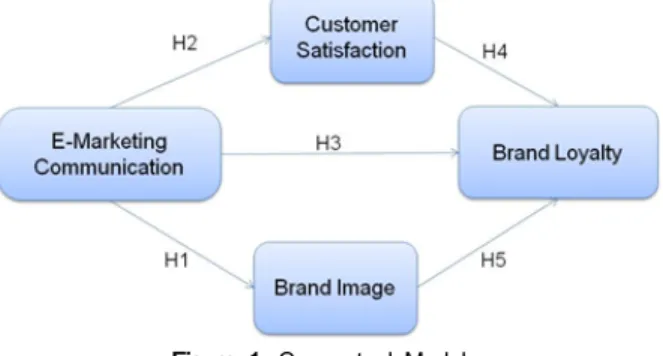
Based on extant literature review were formulated hypothesis and developed the conceptual model presented in the Figure 1. below presents the research model and correlations between variables. The arrows indicate the direction of the effect.
H1: e-Marketing communication has positive significant effect on brand image.
H2: e-Marketing communication has positive significant effect on customer satisfaction.
H3: e-Marketing communication has positive significant effect on brand loyalty.
H4: Brand image has positive significant effect on brand loyalty.
H5: Customer satisfaction has positive significant effect on brand loyalty.
Figure 1: Conceptual Model
4. Methodology and Summary Statistics
An online survey was conducted on April, 2019, to collect the empirical data from subscribers of three mobile operators (Vala900, IPKO and Z-mobile) in Kosovo. The data was collected as part of the broader doctorial study in the field
of the impact of e-Marketing communication in the brand loyalty.
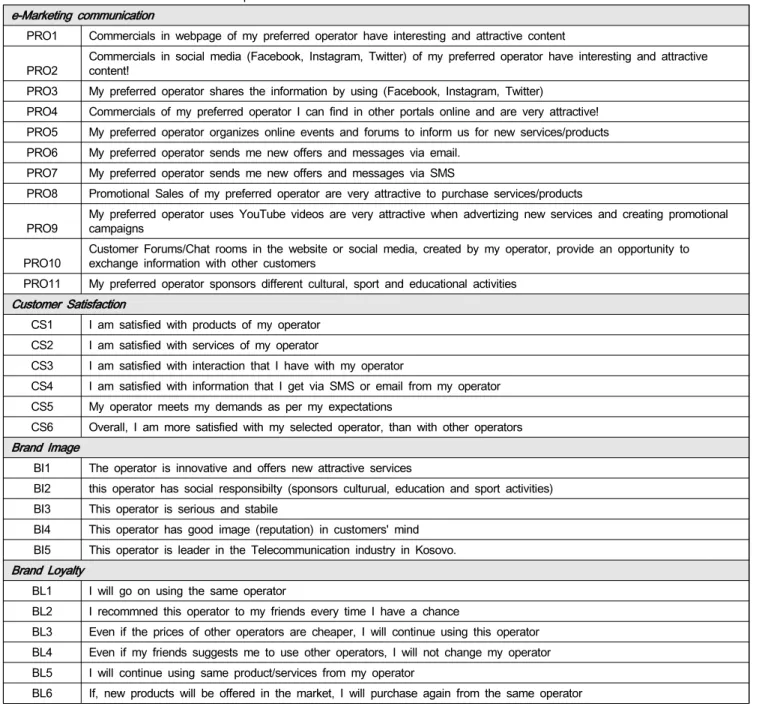
Based on prior studies and extant literature, the conceptual model comprises of four constructs was build. All constructs were measured by using five point Likert scale statements, from "strongly agree" to "strongly disagree". The construct for e-Marketing communication was measured using 11 items (Alnaser & Al Shibly, 2016; Lovett & Staelin, 2016; Bala & Verma, 2018), confirmed if they are valid and reliable to measure e-Marketing Communication Construct.
Customer satisfaction was measured using 6 indicators adapted from Aydin and Ozer (2005), Chang and Chong (2011), Tabaku and Çerri (2015) and Ramadai, Theresia, and Sadalia (2018). And the Brand Image was measured using 5 indicators and Brand loyalty construct was measured using 6 indicators adapted from Aydin and Ozer (2005), Tabaku and Çerri (2015), and Ganiyu, Uche, and Elizabeth (2012). The items of each construct used in the conceptual model are presented in the Table 2.
Table 2: Items of the construct in the Conceptual model e-Marketing communication
PRO1 Commercials in webpage of my preferred operator have interesting and attractive content
PRO2 Commercials in social media (Facebook, Instagram, Twitter) of my preferred operator have interesting and attractive content!
PRO3 My preferred operator shares the information by using (Facebook, Instagram, Twitter)
PRO4 Commercials of my preferred operator I can find in other portals online and are very attractive!
PRO5 My preferred operator organizes online events and forums to inform us for new services/products PRO6 My preferred operator sends me new offers and messages via email.
PRO7 My preferred operator sends me new offers and messages via SMS
PRO8 Promotional Sales of my preferred operator are very attractive to purchase services/products
PRO9 My preferred operator uses YouTube videos are very attractive when advertizing new services and creating promotional campaigns
PRO10 Customer Forums/Chat rooms in the website or social media, created by my operator, provide an opportunity to exchange information with other customers
PRO11 My preferred operator sponsors different cultural, sport and educational activities Customer Satisfaction
CS1 I am satisfied with products of my operator CS2 I am satisfied with services of my operator
CS3 I am satisfied with interaction that I have with my operator
CS4 I am satisfied with information that I get via SMS or email from my operator CS5 My operator meets my demands as per my expectations
CS6 Overall, I am more satisfied with my selected operator, than with other operators Brand Image
BI1 The operator is innovative and offers new attractive services
BI2 this operator has social responsibilty (sponsors culturual, education and sport activities) BI3 This operator is serious and stabile
BI4 This operator has good image (reputation) in customers' mind BI5 This operator is leader in the Telecommunication industry in Kosovo.
Brand Loyalty
BL1 I will go on using the same operator
BL2 I recommned this operator to my friends every time I have a chance
BL3 Even if the prices of other operators are cheaper, I will continue using this operator BL4 Even if my friends suggests me to use other operators, I will not change my operator BL5 I will continue using same product/services from my operator
BL6 If, new products will be offered in the market, I will purchase again from the same operator
4.1. Data Collection
A online questionnaire self-administered questionnaire was developed using SurveyMonkey and distributed via Facebook and email to subscribers of mobile operators in Kosovo.
Based on extant literature review was developed a questionnaire that consisted of 80 questions divided in 12 general questions and statements that measure 12 constructs including 4 Ps of e-Marketing, customer satisfaction, brand image, brand loyalty, customer satisfaction, trust, service quality, perceived appropriate offers and affective commitment. All constructs were measured by using five point Likert scale.
However for the purpose of this study will be considered only four constructs e-Marketing communication, customer satisfaction, brand image and brand loyalty.
The main criteria for survey participation was being subscriber of at least one mobile operator and choosing the most preferred operator. The respondents who responded
"No" respectively "Neither" to the questions, were not included in the survey. Out of 564 collected questionnaires, only 423 (75%) were confirmed as complete and usable for further data analysis.
4.2. Data Analysis and Results
Out of 423 respondents, 38.8% were men and 61.2%
women; 54.1% of the respondents were between age 19-25 years, 11.1% were in group age 26-30; 45.4% of respondents completed Bachelor degree and 38.9%
completed secondary school. All respondents were subscribers of at least one mobile operator; 47% of respondents subscribed with Vala900, 47.7% subscribed with IPKO, and 14.4% subscribed with Z-Mobile; however 9.1%
of respondents subscribed with two or more mobile operators. Thus, to obtain valid responses related to e-marketing communication, customer satisfaction, brand image and loyalty, the respondents were asked to select their most preferred operator. The results show that 40.9%
of respondents preferred Vala900, 45.4% of them preferred IPKO, and 13.7% preferred Z-mobile.
The descriptive data analysis indicates high mean value of each construct. The mean value for e-Marketing communication is 3.79, indicating respondents perception for good performance of e-Marketing communication. The mean value for customer satisfaction (4.06) and brand image (4.02) indicates respondents satisfaction with their preferred brand and perceived brand image quite high. Finally, respondents show high loyalty towards their selected brand with mean value of 4.06.
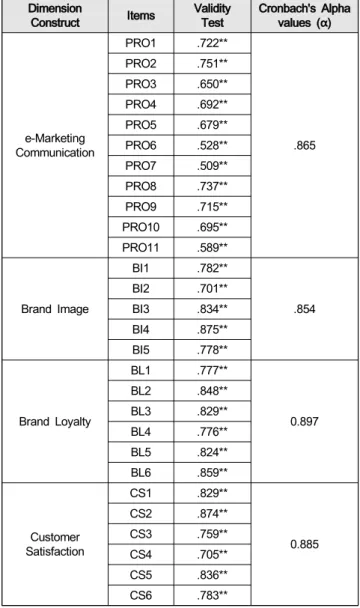
To reduce measurement errors, was conducted validity and reliability test. The assess the validity was conducted a correlation between each item scale and summated scales (average) of the respective construct. The validity test
resulted with confirmation that collected data for e-marketing communication, customer satisfaction, brand image and loyalty construct are valid to be used for further analysis. To assess the degree of internal consistency or reliability between multiple measurement variables within each construct was performed Cronbach's alpha. For the results to be acceptable the lower limit of Cronbach's alpha is .70, however in exploratory analysis Cronbach's alpha value of .60, is acceptable Ghozali (as cited in Ramadai, Theresia, &
Sadalia, 2018). As presented in the Table 2. the results of Cronbach's alpha for e-Marketing Communication is .865, Customer Satisfaction is .885, Brand image .854 and Brand Loyalty is .897 are all above .80, which indicates consistency of entire scale for every dimension or construct.
Table 3: Validity and Reliability test for items and the constructs Dimension
Construct Items Validity
Test Cronbach's Alpha values (α)
e-Marketing Communication
PRO1 .722**
.865
PRO2 .751**
PRO3 .650**
PRO4 .692**
PRO5 .679**
PRO6 .528**
PRO7 .509**
PRO8 .737**
PRO9 .715**
PRO10 .695**
PRO11 .589**
Brand Image
BI1 .782**
.854
BI2 .701**
BI3 .834**
BI4 .875**
BI5 .778**
Brand Loyalty
BL1 .777**
0.897
BL2 .848**
BL3 .829**
BL4 .776**
BL5 .824**
BL6 .859**
Customer Satisfaction
CS1 .829**
0.885
CS2 .874**
CS3 .759**
CS4 .705**
CS5 .836**
CS6 .783**
The simple linear regression was performed to test model fit for e-Marketing Communication as the predictor for three
dependent variables including customer satisfaction, brand image and brand loyalty, without interaction of other variables. As presented in the Table 3. the results derived from the simple linear regression indicate that Model 1. and Model 2 significantly predict Customer satisfaction, F(1,421)
=326,853, p=.000) with R2 of .437, and Brand Image, F(1,421)=317.023, p=.000) with R2 of .430, indicating that 43.7% of variances in the customer satisfaction and 43% of variances in Brand Image can be explained by the predictor without the influence of other variables. Model 3. significantly predicts variances in Brand Loyalty can be explained by the predictor, F(1,421)=226.642, p=.000) with R2 of .350, however the percentage (35%) is slightly lower compared to other models. The Adjusted R2, for three models is close to R2 suggesting that if models derived from the population, 43.6% of variations in the Customer satisfaction, 42.8% in Brand Image and 34.8% in Brand loyalty can be accounted from the predictor variables.
In addition, multiple regression by using stepwise method was performed to test the model fit when three predictor variables interact at the dependent variable Brand Loyalty.
The results presented in Table 3. indicate that Model 6.
significantly predicts that variances in Brand Loyalty can be explained by three predictor variables F(1,421)=222.564, p=
.045) with R2 of .614, indicating the highest percentage (61.47%) of variances in the brand loyalty can be explained by three predictor variables; with customer satisfaction having the highest contribution t(1,421)=8,316, p= .000, followed by brand image t(1,421)=7,223, p=.000 and e-Marketing communication t(1,421)=2,011, p=.045.
Considering the results we can confirm that the conceptual model presented in the Figure 1. is good model fit because F-ratio>1, and p< .05 (Uyanik & Guler, 2013; Nimon &
Oswald, 2013) indicating that Model 1, Model 2. Model 3 and Model 6, significantly improve our ability to predict the outcome variable in this case brand loyalty.
4.3. Hypothesis Testing
To test the hypothesis and assess how individual predictors affect the dependent variable, were calculated standardized coefficients (β) and un-standardized coefficients, and t value of the variables with level of significance of 0.05. If, calculated significance level of t value is lower (.000) than set level of significance (.05), it indicates that β
≠ 0, and the result are statistically significant (Uyanik &
Guler, 2013; Nimon & Oswald, 2013).
The standardized coefficients of the linear regression, shows the e-Marketing Communication has significant positive effect on Brand Image β= .655, t(1,421)= 17,805, p=
.000; significant positive effect on Customer Satisfaction, β=
.740, t(1,421) = 22,586, p= .000; and significant effect on Brand Loyalty β= .592, t(1,421) = 15,055, p= .000, which is somewhat lower compared to effects in customer satisfaction and brand image.
The results also show that both Brand Image, β= .726, t(1,421) = 21,674, p = .000 and Customer Satisfaction β=
.740, t(1,421) = 22,586, p= .000, have significant positive effect on Brand Loyalty.
Table 4: Model Fit Analysis
Model Predictor Dependent Variable R R² Adjusted R² F Value Sig.
1 e-MarketingComm Custom. Satisfaction .661 0.437 .436 326.853 .000
2 e-MarketingComm Brand image .655 0.430 .428 317.023 .000
3 e-MarketingComm Brand Loyalty .592 0.350 .348 226.642 .000
5 Custom. Satisfaction Brand Loyalty .740 0.548 .547 510.111 .000b
6 Custom. Satisfaction BrandImage Brand Loyalty .781 0.611 .609 329.438 .000c
7 Custom. Satisfaction
BrandImage eMarketingComm Brand Loyalty .784 0.614 .612 222.564 .000d
b. Predictors: (Constant), Customer Satisfaction
c. Predictors: (Constant), Customer Satisfaction, Brand Image
d. Predictors: (Constant), Customer Satisfaction, Brand Image, eMarketingComm Dependent Variable: Brand Loyalty
Table 5: Hypothesis testing
Path Standardized Coefficients t value Sig. Hypothesis testing
β
e-MarkComm → Brand Image .655 17.805 .000 H1: Supported
e-MarkComm → Satisfaction .740 22.586 .000 H2: Supported
e-MarkComm → Brand Loyalty .592 15.055 .000 H3: Supported
Brand Image → Brand Loyalty .726 21.674 .000 H4: Supported
Satisfaction → Brand Loyalty .740 22.586 .000 H5: Supported
The findings of this study provide evidence that application of e-Marketing communication has positive significant effect on Brand Image, very high impact on Customer satisfaction, and moderate impact on Brand loyalty. Nonetheless the study also re confirms prior findings from different researchers that Customer Satisfaction is strongly correlated and has significant effect in Brand loyalty (Nawaz & Usman, 2011; Karunanithy & Rasanayagam, 2013;
Khizindar, Al-Azzam, & Khanfar, 2015; Tabaku & Çerri, 2015; Hafez & Akther, 2017; Hassan, Thurasamy, & Loi, 2017; Ramadai, Theresia, & Sadalia, 2018).
The results of this study also show that brand image in telecommunication sector in Kosovo has positive significant effect in brand loyalty, similar to other countries such as Turkey (Aydin & Ozer, 2005), Pakistan (Nawaz & Usman, 2011), Albania (Tabaku & Çerri, 2015), and Indonesia (Ramadai, Theresia, & Sadalia, 2018).
5. Conclusion
This study has indicated that e-marketing communication is an important determinant of brand loyalty. As well, it effects customer perceptions on brand image and contributes significantly to customer satisfaction, which in long run significantly influence loyalty towards a specific brand in the telecommunication market.
In highly competitive environment as services cannot be differentiated, it is of paramount importance having loyal customers. Thus, marketers of mobile operators in Kosovo, should consider customer-centric approach when developing e-Marketing communication strategy. More satisfied customers can create long term effects in building the base of loyal customers, who can be future influencers and promoters of the brand. Moreover, well perceived brands in the minds of customers can create affective commitment towards the brand (Izogo, 2017), leading to repetitive purchase (Lee, James, & Kim, 2014) and loyalty even if the competitors provide lower prices.
This study confirms the impact of e-Marketing communication in creating loyal customers towards the specific brands in telecommunication sector in Kosovo.
References
Aaker, D. A., & Jacobson, R. (2001). The Value Relevance of Brand Attitude in High Technology Markets. Journal of Marketing Research, 38(4), 485-493.
Alnaser, A. S., & Al Shibly, M. S. (2016). Effects of applying emarkting mix elements on customer satisfaction in telecommunication sector: case study of an Umniah company. Journal of Advanced Social
Research, 6(11), 11-39.
Aydin, S., & Ozer, G. (2005). The analysis of antecedents of customer loyalty in the Turkish mobile telecommunication market. European Journal of Marketing, 39(7/8), 910-925.
Bala, M., & Verma, D. (2018). A Critical Review of Digital Marketing. International Journal of Management, IT and Enineering, 8(10), 321-339.
Chang, P. K., & Chong, H. L. (2011). Customer satisfaction and loyalty on service provided by Malaysian telecommunication companies. Proceedings of the 2011 International Conference on Electricla Engineering and Informatics. Bandung, Indonesia:
Institut Teknologi Bandung, Indonesia.
Erdogmus, I. E., & Çiçek, M. (2012). The impact of social media marketing on brand loyalty. 8th International Strategic Management Conference (pp. 1353-1360).
Elsevier Ltd.
Ganiyu, R. A., Uche, I. I., & Elizabeth, A. O. (2012). Is Customer Satisfaction an Indicator of Customer Loyalty? Australian Journal of Business and Management Research, 2(7), 14-20.
Geçti, F., & Gumus, N. (2014). Investigating the Facebook Applications and their Impact on Customer Loyalty in the Turkish Mobile Telecommunication Industry. International Journal of Business and Management, 9(5), 195-207.
Hafez, M., & Akther, N. (2017). Determinants of Customer Loyalty in Mobile Telecommunicatiion Industry in Bangladesh. Global Journal of Management and Business Research: A Administration and Management, 17(1), 141-148.
Hassan, S. H., Thurasamy, R. T., & Loi, W. Y. (2017).
E-lifestyle, Customer Satisfaction and Loyalty among Mobile Subscribers in Thailand. International Review of Management and Marketing, 7(1), 354-362.
Izogo, E. E. (2017). Customer loyalty in telecom service sector: The role of service quality and customer commitment. The TQM Journal, 29(1), 19-36.
Karunanithy, K., & Rasanayagam, D. (2013). Impact of Customer Satisfaction on Customer Loyalty towards Sri Lanka Telecom PLC. Industrial Engineering Letters, 3(7), 66-71.
Keller, K. L. (2009). Building Strong brands in a modern marketing communications environment. Journal of Marketing Communciations , 15, 139-155.
Khan, A. R., & Islam, A. (2017). The Impact of Digital Marketing on Increasing Customer Loyalty: A study on Dhaka City, Bangladesh. International Journal of Economics, Commerce and Management, 5(4), 521-528.
Khizindar, T. M., Al-Azzam, A. F., & Khanfar, I. A.
(2015). An Empirical Study Of Factors Affecting Customer Loyalty Of Telecommunication Industry In The Kingdom Of Saudi Arabia. British Journal of
Marketing Studies, 3(5), 98-115.
Kim, C. W., & Mauborgne, R. (2005). Value innovation: A leap into the blue ocean. Journal of Business Strategy, 26(2), 22-28.
Lawrence, B., Fournier, S., & Brunel, F. (2013). When Companies Don't Make the Ad: A Multi-Method Inquiry into the Differential Effectiveness of Consumer- Generated Advertising. Journal of Advertising, 42(4), 292-307.
Lee, L. J., James, J. D., & Kim, Y. K. (2014). A Reconceptualization of Brand Image. International Journal of Business Administration, 5(4), 1-11.
Leeflang, P. S., Verhoef, P. C., Dahlstrom, P., & Freundt, T. (2013). Challenges and solutions for marketing in a digital era. European Management Journal, 32(2014), 1-12.
Lovett, M. J., & Staelin, R. (2016). The Role of Paid, Earned, and Owned Media in Building Entertainment Brands: Reminding, Informing, and Enhancing Enjoyment. Marketing Science, 35(1), 142-57.
Makarem, S., Mudambi, S., & Podoshen, J. S. (2009).
Satisfaction in technology-enabled service encounters.
Journal of Services Marketing, 33(3), 134-144.
Martin, B. A., Durme, J. V., Raulas, M., & Merisavo, M.
(2003). Email Advertising: Exploratory Insights from Finland. Journal of Advertising and Research, 43(3), 293-300.
Merisavo, M., & Raulas, M. (2004). The Impact of email Marketing on Brand Loyalty. Journal of Product &
Brand Management, 13(7), 498-505.
Nawaz, N.-U.-A., & Usman, A. (2011). What Makes Customers Brand Loyal: A study on Telecommunication Sector in Pakistan. International Journal of Business and Social Science, 2(14), 213-221.
Nimon, K. F., & Oswald, F. L. (2013). Understanding the Results of Multiple Linear Regression Beyond Standardized Regression Coefficients. Organizational Research Methods, 16(4), 1-25.
Oliver, R. L. (1999). Whence Customer Loyalty? Journal of Marketing , 63(Special Issue), 33-44.
Rajasekar, J., & Raee, M. A. (2013). An analysis of the
telecommunication industry in the Sultanate of of Oman using Michael Porter's competitive strategy model.
Competitiveness Review An International Business Journal, 23(3), 234-259.
Ramadai, Theresia, M., & Sadalia, I. (2018). The Determinants of Customer Loyalty for Telecommunication Providers. journal of Research in Business, Economics and Management, 10(3).
Shocker, A. D. (1993). Journal of Marketing Review, 30(2), 256-258.
Skorbich, L., & Kot, S. (2018). Marketing 3.0 in Contemporary Marketing Management Activities of Enterprises. Proceedings of the 2nd International Conference Contemporary Issues in Theory and Practice of Management (pp.591-597). Çestokova:
Çestokova University of Technology, Faculty of Management.
Tabaku, E., & Çerri, S. (2015). An Empirical Investigation of Customer Loyalty in Telecommunication Industry in Albania. Mediterranean Journal of Social Sciences, 6(1), 224-231.
Uyanik, G. K., & Guler, N. (2013). A study on multiple linear regression analysis. 4th International Conference on New Horizons in Education (pp.234-240). Sakarya, Turkey: Elsevier Ltd.
Webster, F. E. Jr. (2000). Understanding the Relationships among Brands, Consumers, and Resellers. Journal of the Academy of Marketing Science, 28(1), 17-23.
Wind, J., & Rangaswamy, A. (2001). Customerization:
The next revolution in mass customization. Journal of Interactive Marketing, 15(1), 13-32.
Xhema, J., Metin, H., & Groumpos, P. (2018).
Switching-Costs, Corporate Image and Product Quality effect on Customer Loyalty: Kosovo Retail Market.
Elsevier Ltd, 287-292.
Yeboah, A., Mensah, S. O., Nimsah, W. K., & Mensah, N. O. (2013). The effects of Brand Name on Customer Loyalty in the Mobile Communication Industry in Ghana. European Centre for Research Training and Development UK, 1(3), 62-86.