청소년 대상 라돈 위해 의사전달 경로 선정을 위한 인식도 조사 연구
박태현* · 전형진** · 강대용*** · 권명희**** · 박시현* · 박세정* · 이철민*
†*서경대학교 화학생명공학과
**한국환경정책 평가연구원 국토환경정보센터,
***연세대학교 원주의과대학 유전체 코호트 연구소
****국립환경과학원 생활환경연구과
A Study on Perception for Risk Communication Channel Selection for Radon for Youth
Tae Hyun Park *, Hyung Jin Jeon**, Dae Ryong Kang***, Myung Hee Kwon****, Si Hyun Park *, Se Jung Park*, and Cheol Min Lee*
†*Department of Chemical & Biological Engineering, Seokyeong University
**Korea Environmental Information Center, Korea Environment Institute
***Institute of Genomic Cohort, College of Medicine, Yonsei University, Wonju
****Indoor air and noise Research division, National Institute of Environmental Research
ABSTRACT
Objectives: The purpose of this study is to obtain basic data on the development of a risk communication model through an investigation of risk perception for radon and identify effective risk communication channels.
Methods: A questionnaire was used to evaluate differences in perception level according to respective communication channels. A chi-squared test was used to analyze the difference in pre- and post-risk communication by communication channel. One-way ANOVA was used to analyze the difference in the radon risk perception rate for each communication channel.
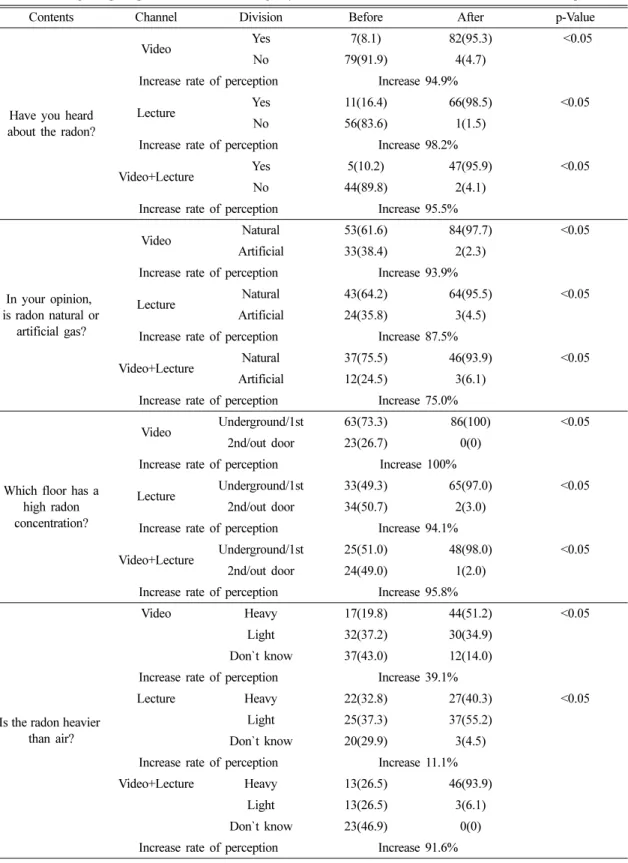
Results: All of the communication channels resulted in increased radon risk perception, but there was no statistical difference between them in terms of perception (p>0.05). However, based on previous findings that it is effective to use a multi-channel approach, it is considered that communication channels based on duplicate avenues is most appropriate.
Conclusions: It is expected that this study will be used as basic data to better understand the formation of public opinion about radon risk and to understand the social reaction to each risk factor.
Keywords: Radon, risk communication, ANOVA, perception
I. 서 론
산업화로 의한 도시화는 우리에게 삶의 풍요를
가져온 반면 환경오염 등과 같은 다양한 형태의 사 회적 위험을 야기하기에 이르렀으며, 또한 위험사 회라는 새로운 용어의 생성 및 사용을 가져오게 되
†