식용 고구마 신품종 ‘다호미’
이형운
1
* ・ 정미남2
・ 이준설1
・ 송연상3
・ 한선경1
・ 김재명1
・ 안승현2
・ 남상식1
・ 김학신2
・ 서세정4
・ 박광근5
1농촌진흥청 국립식량과학원 바이오에너지작물연구소, 2농촌진흥청 국립식량과학원,
3농촌진흥청, 4식품의약품안전평가원, 5농촌진흥청 국립식량과학원 중부작물부
A New Sweetpotato Variety ‘Dahomi’ for Table Use
Hyeong-Un Lee
1
*, Mi-Nam Chung2
, Joon-Seol Lee1
, Yeon-Sang Song3
, Seon-Kyeong Han1
, Jae-Myung Kim1
, Seung-Hyun Ahn2
, Sang-Sik Nam1
, Hag-Sin Kim2
, Sae-Jung Suh4
, and Kwang-Geun Park5
1Bioenergy Crop Research Institute, National Institute of Crop Science, RDA, Muan 534-833, Korea
2National Institute of Crop Science, RDA, Wanju 565-851, Korea
3Rural Development Administration, Jeonju 560-500, Korea
4National Institute of Food and Drug Safety Evaluation, Cheongju 361-951, Korea
5Department of Middle Area Crop Science, National Institute of Crop Science, RDA, Suwon 441-707, Korea
Abstract : ‘Dahomi’, a new sweetpotato variety, was developed for table use by the sweetpotato breeding team of Bioenergy Crop Research Institute, National Institute of Crop Science (NICS), RDA in 2012. This variety was derived from the cross between ‘Muan4’ and ‘Jinhongmi’ in 2005. The seedling and line selections were performed from 2007 to 2008, preliminary and advanced yield trials were carried out from 2009 to 2010, and the regional yield trials was conducted at five locations from 2011 to 2012 and it was named as ‘Dahomi’. This variety has three or five lobes leaf, green leaf, stem, and petiole. Storage root of
‘Dahomi’ was elliptic, red skin, light orange flesh. This variety is resistant to fusarium wilt, but susceptible to root-knot nematode. Texture of steamed storage root was intermediate, and degree Brix of steamed storage root was 24.8 °Brix. The total sugar content of raw and steamed storage root was 9.7, 32.0/100 dry weight (g), respectively, which was higher than that of
‘Yulmi. Storage root yield of ‘Dahomi’ was 26.3 MT/ha under the early seasonal cultivation, which was 52% higher than that of ‘Yulmi’. Storage root yield of ‘Dahomi’ was 21.9 MT/ha under the optimum and late seasonal cultivation, which was 35%
higher than that of ‘Yulmi’. The number of storage roots over 50 g per plant was 2.8 and the average weight of storage root was 138 g under the optimum and late seasonal cultivation.
Keywords : Sweetpotato, Breeding, Variety, Dahomi, Table use
*Corresponding author (E-mail: [email protected], Tel: +82-61- 450-0141, Fax: +82-61-453-0085)
(Received on July 24, 2015. Revised on August 30, 2015.
Accepted on August 31, 2015.)
Copyright ⓒ 2015 by the Korean Society of Breeding Science 324
This is an Open-Access article distributed under the terms of the Creative Commons Attribution Non-Commercial License (http://creativecommons.org/licenses/by-nc/3.0) which permits unrestricted non-commercial use, distribution, and reproduction in any medium, provided the original work is properly cited.
서 언
고구마는 식이섬유, 미네랄, 비타민뿐만 아니라 안토시아 닌, 베타카로틴과 같은 항산화 성분을 다량 함유하고 있어 (Woolfe 1993) 건강 기능성 식품으로 인식되고 있으며 식용, 제빵, 제과, 면류, 음료, 주류, 천연색소 등 용도가 매우 다양 하다(Lee et al. 2013). 고구마의 단위면적당 생산량은 2000
년 21.4 MT/ha에서 2013년에는 14.8 MT/ha으로 30% 이상 감소하였는데(KOSIS 2013) 이는 고구마의 연작, 병해충 감 수성 품종의 재배 면적 확대, 이상기상 등이 원인인 것으로 고려된다. 특히 덩굴쪼김병은 단위면적당 수량 감소의 주요 원인으로서 품종의 덩굴쪼김병 저항성은 고구마 재배 농가의 품종 선택에 많은 영향을 미친다. 고구마의 가격은 6월에서 8 월까지 높게 형성되고 9월부터는 홍수 출하로 인해 가격이 하 락하기 때문에 조기재배 수량 또한 농가의 품종 선택에 있어 서 주요 관심사이다. 최근까지 국립식량과학원에서 육성한 식 용 고구마는 육색이 황색 또는 농황색인 품종들이 주를 이루 고 있으며 육색이 주황색인 ‘신황미’(Jeong et al. 2000), ‘주
Muan4
Seonmi Dahomi
Jinhongmi
Jeungmi
Fig. 1. Genealogical diagram of ‘Dahomi’.
Year 2005 2006 2007 2008 2009 2010 2011 2012
Generation Crossing Seedling 1st year
Seedling 2nd year
Seedling 3rd year
Seedling 4th year
Seedling 5th year
Seedling 6th year
Seedling 7th year
Muan4
× Jinhongmi
1
・ 4
・ 505
MI2005-05-04 → → → Dahomi (Mokpo80)
Selection and trial steps Seedling
selection Line selection Preliminary yield trial
Advance yield
trial Regional yield trial Fig. 2. Pedigree diagram of ‘Dahomi’.
황미’(Ahn et al. 2006a), ‘해피미’(Ahn et al. 2006b) 등 주 황색고구마 품종들은 베타카로틴 함량은 높으나 쪘을 때의 식미가 떨어져 주로 생식용으로 이용되고 있다.
이에 국립식량과학원 바이오에너지작물연구소에서는 덩굴 쪼김병에 강하면서 조기재배 수량이 많고 찌거나 구웠을 때 식미가 양호한 담주황 육색의 식용 고구마 ‘다호미’ 품종을 개발한 바 육성 경위와 주요 특성을 보고하고자 한다.
재료 및 방법
본 시험의 조기재배는 4월 중순에 무안에서, 보통기재배는 6월 상순에 춘천, 청원, 익산, 무안, 진주 5개 지역에서 2년간 지역적응시험을 수행하였다. 재배방법은 비닐멀칭재배를 하였 으며, 재식밀도는 75 × 20 cm, 시비량은 10a당 N-P2O5-K2O
= 5.5-6.3-15.6 kg을 전량 기비로 시용하였으며 퇴비는 1,000 kg을 시용하였다. 기타 재배관리는 농촌진흥청 표준재배법에 준하였으며(RDA 2009), 주요 농업적 특성, 생육, 수량성, 병 해충 저항성, 품질특성 조사는 농촌진흥청 신품종개발공동연
구사업 과제수행계획서 조사기준에 준하여 실시하였다(RDA 2011a, 2012a).
결과 및 고찰
육성경위
‘다호미’는 식미가 우수한 다수성 품종을 육성하기 위하여 2005년에 ‘무안4호’를 모본으로, ‘진홍미’(Ahn et al. 2000) 를 부본으로 하여 인공교배 하였다. 2007년부터 2008년까지 계통선발시험과 2009년부터 2010년까지 생산력검정시험을 실시한 결과 괴근 수량성, 상품성, 식미가 우수한 MI2005- 05-04 계통을 ‘목포80호’로 계통명을 부여하였다. 2011, 2012년 2년간 무안 등 전국 5개 지역에서 지역적응시험을 수 행한 결과, 괴근의 수량성, 상품성이 우수하고 식미가 양호하 여(RDA 2011b, 2012b) 2012년 12월 농촌진흥청 농작물직 무육성신품종선정심의회에서 신품종으로 선정되어 ‘다호미’
라 명명하였다. ‘다호미’의 육성과정과 계통도는 Fig. 1, Fig.
2와 같다.
Table 1. Sprout characteristics of ‘Dahomi’ at nursery bed.
Variety
Sprout appearance
(DAP)
zNo. of sprout
Stem tip color
No. of leaf blade lobes (leaf shape)
Depth of leaf blade lobe
Leaf color
Stem color
Dahomi 19 Medium Green 3 or 5 Moderate Green Green
Yulmi 20 Medium Green Absent
(Cordate) - Green Green
z
DAP: Days after planting
Table 2. Mature vine characteristics of ‘Dahomi’ on field at harvesting stage.
Variety
Vine Length (cm)
Vine weight (MT/ha)
Stem color
Anthocyani n coloration
of node
No. of leaf blade lobes (leaf shape)
Depth of leaf blade
lobe
Leaf color
Extent of anthocyanin
coloration on abaxial
veins
Stem tip color
Petiole color
Dahomi 246 27.2 Green Weak 3 or 5 Moderate Green Large Green Green
Yulmi 215 34.3 Green Absent Absent
(Cordate) - Green Small Green Green
Table 3. Storage root characteristics of ‘Dahomi’.
Variety General shape Skin color Flesh color Root defect
Dahomi Elliptic Red Light orange None
Yulmi Elliptic Light red Light yellow None
Table 4. Resistant index to fusarium wilt, root-knot nematode (Meloidogyne incognita), and storability of storage root of ‘Dahomi’.
Variety Root-knot nematode (0 ~9)
zFusarium wilt (0 ~9)
Black rot (0 ~9)
Soft rot (0 ~9)
Dahomi 9 3 3 3
Yulmi 9 7 3 3
z
0: very resistant, 9: very susceptible
주요특성
묘상 맹아특성
묘상에 씨고구마를 파종한 후 맹아시까지 소요된 기간은
‘다호미’가 19일로 율미의 20일과 비슷하였다. 다호미의 맹아 수는 ‘중’ 정도이며, 끝잎색, 잎색, 줄기색은 녹색이다(Table 1).
지상부 특성
‘다호미’의 덩굴무게는 27.2 MT/ha으로 ‘율미’의 34.3 MT/ha보다 적었다. 줄기색은 녹색이고, 마디의 안토시아닌 발현정도는 약하다. 잎의 결각수는 3개 내지 5개이고, 결각의 깊이는 보통이며 엽색은 녹색, 엽맥의 안토시아닌 분포 정도
는 엽맥의 대부분이 착색되어 넓고, 끝잎색과 잎자루색은 녹 색이다(Table 2).
괴근특성
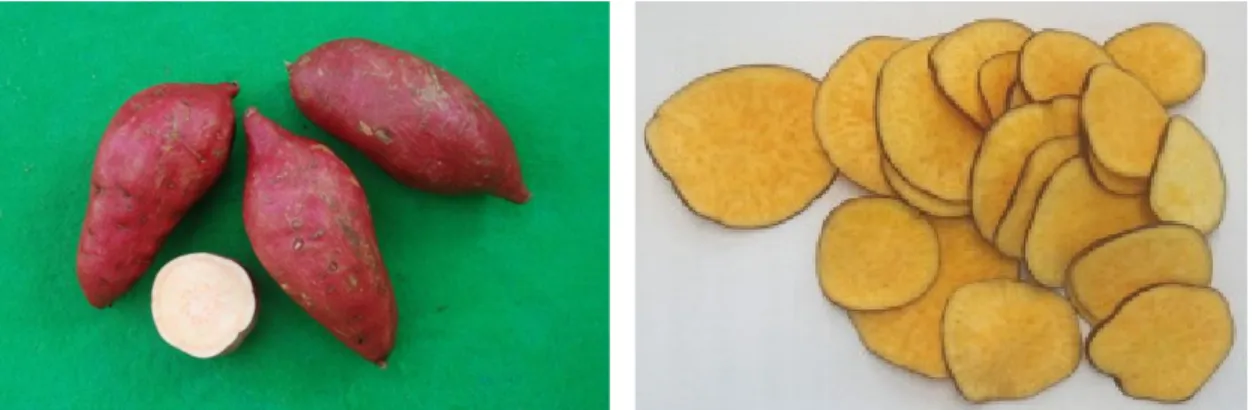
‘다호미’의 괴근 모양은 방추형이고 괴근의 껍질색은 홍색, 육색은 담주황색이며 표피의 골파짐이 없어 상품성이 매우 우수하다(Table 3). 괴근 껍질과 육질의 색도 a값(적색도)이
‘다호미’가 ‘율미’보다 높다(Table 7).
병해충저항성
‘다호미’의 덩굴쪼김병 저항성은 ‘중강’으로 ‘중약’의 ‘율 미’보다 강하고 검은무늬병과 연부병에 대한 저항성은 ‘중강’
Fig. 3. Storage roots and frying chips of ‘Dahomi’ (Left: storage roots, right: frying chips).
Table 5. Quality of storage root of ‘Dahomi’.
Variety
Palatability of steamed storage root
(0-9)
Texture of steamed storage
root
Starch value (%)
Brix° of steamed storage root
Total sugar contents
(g/100g D.W.) Frying chip processing adaptability
Raw Steaming
Dahomi 6.7 Intermediate 20.9 24.8 9.7 32.0 Good
Yulmi 5.0 Dry 24.2 28.7 8.4 30.8 Medium
Table 6. RVA properties of starch of ‘Dahomi’.
Variety Peak viscosity (RVU)
Trough viscosity
(RVU) Breakdown (RVU) Final viscosity
(RVU) Setback (RVU) Pasting Temp. (°C)
Dahomi 301.3 139.2 162.2 207.6 68.4 75.7
Yulmi 307.8 115.8 192.0 183.9 68.1 76.4
으로 ‘율미’와 비슷하나 고구마뿌리혹선충에는 감수성이다 (Table 4).
품질특성
‘다호미’는 육질이 중간질이며 전분가는 20.9%이고 당도 는 24.8 Brix°이다. 총유리당은 생고구마가 9.7, 찐고구마가 32.0 g/100g(D.W.)으로 ‘율미’보다 높으며 찐고구마 식미도 양호하다(Table 5). 전분의 페이스트 점도 특성을 조사한 결 과 ‘다호미’의 강하점도(breakdown)가 162.2 RVU(Rapid Visco Units)로 ‘율미’보다 낮아 호화 중 열, 전단(shearing) 에 대한 저항성이 강하다. ‘다호미’의 치반점도(Setback)는 68.4 RVU로 ‘율미’ 전분의 노화 정도와 차이가 거의 없다.
호화개시온도(pasting temperature)는 75.7°C로 ‘율미’보다 약간 낮다(Table 6). ‘다호미’는 칩 가공시 식미, 저작감, 외관 등 특성도 우수하다(Fig. 3).
수량구성요소 및 수량성
‘다호미’의 생산력검정예비시험과 본시험에서의 상품괴근 수량이 각각 34.8, 20.8 MT/ha으로 ‘율미’보다 각각 134%, 30% 높다(Table 8). 지역적응시험 조기재배시 ‘다호미’의 주 당상품괴근수는 평균 3.6개/주로 ‘율미’의 2.0개/주보다 많고, 상품괴근평균중은 109 g/개로 ‘율미’의 132 g/개보다 낮다.
적기 및 만기재배시 ‘다호미’의 주당상품괴근수는 평균 2.8개 /주로 ‘율미’의 1.9개/주보다 많고, 상품괴근평균중은 138 g/
개로 ‘율미’의 145 g/개보다 낮다(Table 9). ‘다호미’의 상품 괴근수량은 지역적응시험 조기재배시 26.3 MT/ha으로 ‘율 미’의 17.3 MT/ha보다 52% 높고, 적기 및 만기재배시 21.9 MT/ha으로 ‘율미’보다 35% 높다(Table 10).
적응지역 및 재배상 유의점
‘다호미’는 전국에서 재배가 가능하고, 질소비료 과다 시 덩굴이 길어질 우려가 있어 균형시비가 필요하다. 장기간 저
Table 7. Chroma value of strorage root of ‘Dahomi’.
Variety
Chroma value
zSkin Flesh
L a b L a b
Dahomi 39.6 18.9 7.9 76.0 20.2 34.3
Yulmi 47.2 16.8 11.1 86.3 0.8 29.0
z
L, Lightness: black=0, white=100; a, redness to greenness: green=-80, red=+80; b, yellowness to blueness: blue=-80, yellowness=+80
Table 8. Storage root yield (MT/ha) over 50 g of ‘Dahomi’ on preliminary and advanced yield trials.
Variety Storage root yield (MT/ha)
Preliminary yield trial Index
zAdvanced yield trial Index
Dahomi 34.8 234 20.8 130
Yulmi 14.9 100 16.0 100
z
Index: (yield of ‘Dahomi’ / yield of ‘Yulmi’) × 100
Table 9. Average number of storage root per plant, and average weight of storage root of ‘Dahomi’ on regional yield trial.
Variety Cultivation season
Average no. of storage root per plant
Average weight of storage root (g)
2011 2012 Mean 2011 2012 Mean
Dahomi Early 3.5 3.7 3.6 129 89 109
Optimum and late 2.4 3.2 2.8 131 144 138
Yulmi Early 1.8 2.2 2.0 135 129 132
Optimum and late 1.7 2.1 1.9 140 149 145
Table 10. Storage root yield (MT/ha) over 50 g of ‘Dahomi’ on regional yield trial.
Variety Cultivation season Storage root yield (MT/ha)
2011 2012 Mean Index
zDahomi Early 30.5 22.0 26.3 152
Optimum and late 19.3 24.5 21.9 135
Yulmi Early 16.3 18.2 17.3 100
Optimum and late 16.3 16.2 16.3 100
z
Index: (yield of ‘Dahomi’ / yield of ‘Yulmi’) × 100
장시 괴근 내부에 공동화 현상이 발생할 수 있어 장기 저장은 가급적 피하는 것이 좋고, 고구마뿌리혹선충에 감수성이므로 선충 피해가 우려되는 곳에서는 재배에 주의하여야 한다.
적 요
‘다호미’는 국립식량과학원 바이오에너지작물연구소에서 2012년에 육성한 식용 고구마 품종으로 2005년에 ‘무안4호’
를 모본으로, ‘진홍미’를 부본으로 하여 인공교배 하였다.
2007년부터 2008년까지 계통선발시험과 2009년부터 2010년 까지 생산력검정시험을 실시하여 괴근 수량성, 상품성, 식미 가 우수한 MI2005-05-04 계통을 ‘목포80호’로 계통명을 부 여하였다. 2011년부터 2012년까지 2년간 지역적응시험을 수 행한 결과, 괴근의 수량성, 상품성이 우수하고 식미가 양호하 여 2012년 12월 농촌진흥청 농작물직무육성신품종선정심의 회에서 신품종으로 선정되어 ‘다호미’라 명명하였다. ‘다호미’
는 잎의 결각이 3개 내지 5개이고, 결각의 깊이는 보통이며 엽색, 잎자루색, 줄기색은 녹색이다. 괴근의 껍질색은 홍색, 육색은 담주황색이며 괴근 모양이 방추형으로 균일하여 상품 성이 우수하다. ‘다호미’는 덩굴쪼김병에 강한 편이나 뿌리혹 선충에는 저항성이 없다. ‘다호미’는 육질이 중간질이고 전분 가는 20.9%으로 낮은 편이며 당도는 24.8 Brix°이고 총유리 당은 생고구마가 9.7, 찐고구마가 32.0 g/100g (D.W.)으로
‘율미’보다 높다. ‘다호미’는 조기재배시 상품괴근수량이 26.3 MT/ha으로 ‘율미’의 17.3 MT/ha보다 52% 증수되었다. 적기 및 만기재배시 상품괴근수량은 21.9 MT/ha으로 ‘율미’보다 35% 증수되었으며 주당상품괴근수는 2.8개/주, 상품괴근평균 중은 138 g이다.
사 사
본 ‘다호미’ 품종은 농촌진흥청 연구사업(세부과제명: 식용 및 가공용 고구마 유망계통 육성 시험, 세부과제번호:
PJ00871601)의 지원에 의해 이루어졌다. 본 ‘다호미’를 육성 함에 있어 협력하여 주신 국립식량과학원 및 바이오에너지작 물연구소 고구마 연구진, 각도 농업기술원 지역적응시험 담당 자분들과 농촌진흥청 연구정책국 관계관 여러분들께 깊은 감 사를 드리는 바이다.
REFERENCES