• 검색 결과가 없습니다.

The Use of Inappropriate Antibiotics in Patients Admitted to Intensive Care Units with Nursing Home-Acquired Pneumonia at a Korean Teaching Hospital

N/A
N/A
Protected

Academic year: 2021

Share "The Use of Inappropriate Antibiotics in Patients Admitted to Intensive Care Units with Nursing Home-Acquired Pneumonia at a Korean Teaching Hospital"

Copied!
8
0
0

로드 중.... (전체 텍스트 보기)

전체 글

(1)

The Use of Inappropriate Antibiotics in Patients Admitted to Intensive Care Units with Nursing Home–Acquired Pneumonia at a Korean Teaching Hospital

Deok Hee Kim, M.D. 1 , Ha Jeong Kim, M.D. 2 , Hae-Won Koo, M.D. 3 , Won Bae, M.D. 1 , So-Hee Park, M.D. 1 , Hyeon-Kyoung Koo, M.D., Ph.D. 1 , Hye Kyeong Park, M.D. 1 , Sung-Soon Lee, M.D., Ph.D. 1 and Hyung Koo Kang, M.D. 1

1

Division of Pulmonary and Critical Care Medicine, Department of Internal Medicine,

2

Department of Internal Medicine,

3

Neurosurgery, Neuroscience, Radiosurgery and Adaptive Hybrid Neurosurgery Research Center, Inje University Ilsan Paik Hospital, Goyang, Korea

Background: Use of appropriate antibiotics for the treatment of pneumonia is integral in patients admitted to intensive care units (ICUs). Although it is recommended that empirical treatment regimens should be based on the local distribution of pathogens in patients with suspected hospital-acquired pneumonia, few studies observe patients admitted to ICUs with nursing home–acquired pneumonia (NHAP). We found factors associated with the use of inappropriate antibiotics in patients with pneumonia admitted to the ICU via the emergency room (ER).

Methods: We performed a retrospective cohort study of 83 pneumonia patients with confirmed causative bacteria admitted to ICUs via ER March 2015–May 2017. We compared clinical parameters, between patients who received appropriate or inappropriate antibiotics using the Mann-Whitney U, Pearson’s chi-square, and Fisher’s exact tests. We investigated independent factors associated with inappropriate antibiotic use in patients using multivariate logistic regression.

Results: Among 83 patients, 30 patients (36.1%) received inappropriate antibiotics. NHAP patients were more frequently treated with inappropriate antibiotics than with appropriate antibiotics (47.2% vs. 96.7%, p<0.001). Methicillin-resistant Staphylococcus aureus was more frequently isolated from individuals in the inappropriate antibiotics–treated group than in the appropriate antibiotics–treated group (7.5% vs. 70.0%, p<0.001). In multivariate analysis, NHAP was independently associated with the use of inappropriate antibiotics in patients with pneumonia admitted to the ICU via ER.

Conclusion: NHAP is a risk factor associated with the use of inappropriate antibiotics in patients with pneumonia admitted to the ICU via the ER.

Keywords: Nursing Home–Acquired Pneumonia; Pneumonia; Intensive Care Unit

Address for correspondence: Hyung Koo Kang, M.D.

Division of Pulmonary and Critical Care Medicine, Department of Internal Medicine, Inje University Ilsan Paik Hospital, Inje University College of Medicine, 170 Juhwa-ro, Ilsanseo-gu, Goyang 10380, Korea

Phone: 82-31-910-7946, Fax: 82-31-910-7219, E-mail: [email protected]

Received: Feb. 12, 2019, Revised: May. 7, 2019, Accepted: May. 23, 2019, Published online: Nov. 7, 2019

cc
It is identical to the Creative Commons Attribution Non-Commercial License (http://creativecommons.org/licenses/by-nc/4.0/).

Copyright © 2020

The Korean Academy of Tuberculosis and Respiratory Diseases.

(2)

Introduction

Pneumonia is the most serious of common infections that occur in nursing home residents and is associated with con- siderable morbidity and mortality

1-3

. The median incidence of nursing home-associated pneumonia (NHAP) is 1 per 1,000 patient-days, many-fold higher than that among persons residing in the community

4

. NHAP patients tend to be more elderly and have greater comorbidity, and severe functional impairment, as compared to community-acquired pneumo- nia patients

5,6

. In particular, critically ill patients admitted to intensive care units (ICUs) with pneumonia can progress to acute respiratory distress syndrome and acute lung injury, which are associated with a mortality rate of more than 50%

7

. Therefore, it is important to determine the appropriate empiri- cal antibiotics for successful treatment of patients admitted to ICU with NHAP.

The 2016 Infectious Disease Society of America (IDSA) and the American Thoracic Society (ATS) guidelines recommend that each hospital should generate antibiograms to guide healthcare professionals on the optimal choice of antibiot- ics without the concept of healthcare-associated pneumonia (HCAP) including NHAP

8

. However, few nursing home facili- ties can generate antibiograms due to a number of challenges and barriers, such as lack of laboratory resources and person- nel dedicated to the development and implementation of antibiograms

9

. Therefore, it is still important to broadly study microorganisms to facilitate the appropriate use of empirical antibiotics in NHAP patients. Several studies have shown dif- ferences in the presence of antibiotic-resistant organisms in NHAP patients, compared with community-acquired pneu- monia (CAP) and hospital-acquired pneumonia patients

4-6,10-12

. However, few studies have been conducted on NHAP patients requiring ICU care

13,14

. In the present study, we aimed to find factors associated with the use of inappropriate antibiotics in patients with pneumonia who were admitted to an ICU via the emergency room (ER).

Materials and Methods

1. Study subjects

In this observational cohort study, we retrospectively reviewed the medical records of patients with pneumonia admitted to an ICU via ER at a teaching hospital between March 2015 and May 2017. We excluded patients who were transferred from other acute care hospitals or had received treatment for pneumonia within the previous 3 months.

Pneumonia was diagnosed based the presence of a new opacity development and at least two of the following four clinical criteria: fever or hypothermia (body temperature

>38°C or ≤35°C), leukocytosis or leukopenia (white blood cell

count ≥10,000/μL or ≤4,000/μL), newly developed respiratory symptoms (cough, sputum, pleuritic chest pain, and dyspnea), and altered breath sounds on auscultation

15

. We defined NHAP as pneumonia occurring in a resident of a nursing home or a long-term care facility

1

. All patients were admitted to an ICU for close monitoring or after requiring mechanical ventilation with shock or acute respiratory failure in an ER.

The Institutional Review Board of Inje University Ilsan Paik Hospital approved the study design, including the review and publishing of information obtained from patient records (IRB No. 2017-12-018). The requirement for informed consent was waived for the use of patient medical data because all person- ally identifying information was removed before analysis.

2. Measurement

Patient medical records were reviewed to obtain data on clinical characteristics, clinical parameters, laboratory find- ings, clinical outcomes, and isolated microorganisms. Co- morbidities including diabetes mellitus, degenerative nerve disease, chronic obstructive pulmonary disease, malignant neoplasm, and chronic renal disease were reviewed. Clinical parameters included the CURB-65 (confusion, urea, respira- tory rate, blood pressure, age more than 65 years) for assess- ing the severity of pneumonia

16

, use of vasopressors, and need of mechanical ventilator. Prior antibiotics use within 90 days was arbitrarily defined as use of antibiotics within 90 days for reasons other than pneumonia.

3. Microbiology

Microbiological studies were conducted using two sets of blood cultures, gram staining and culture using sputum, tracheal aspirate, and bronchial washing fluids that were obtained by bronchoscopy. Respiratory specimens were cultured in a semi-quantitative manner, and pathogens were identified when a predominant microorganism was detected from group 4 or 5 sputum, according to Murray and Washing- ton’s grading system. Blood cultures were considered to be positive if pathogens were present, there were no other infec- tion sources that could explain a positive culture, and the pos- sibility of contamination was excluded. Urinary antigen test for Streptococcus pneumoniae was also considered to indi- cate etiological pathogens. The antibiotic sensitivity of all iso- lated pathogens was identified using a disc diffusion method.

Multidrug-resistant gram-negative bacteria (MDRGNB) for

Pseudomonas aeruginosa, Enterococcus species, Enterobac-

teriaceae, and Acinetobacter species was defined as acquired

non-susceptibility to at least one agent in three or more anti-

microbial categories

17

.

(3)

4. Antibiotic therapy

All patients were initially administered broad empirical an- tibiotics according to the ATS/IDSA guideline

18

. The detailed antibiotic regimen complied with the attending physician’s choice, taking into consideration any risk factors of the patient.

In this study, the use of inappropriate antibiotics was defined as the use of empirical antibiotics which were not effective or which were unnecessarily broad against the identified patho- gens based on in vitro susceptibility testing

6

.

5. Statistical analysis

The data are presented as medians and interquartile ranges for continuous variables and as numbers (%) for categorical variables. The data were compared using the Mann-Whitney U test for continuous variables and Pearson’s chi-square test or Fisher exact test for categorical variables. Multivariate lo- gistic regression analysis was used to determine independent factors associated with the use of inappropriate antibiotics in patients with HCAP. All tests were 2-sided and a p-value <0.05 was considered significant. All statistical analyses were per- formed using IBM SPSS Statistics for Windows version 22.0 (IBM Corp., Armonk, NY, USA).

Results

1. Baseline characteristics

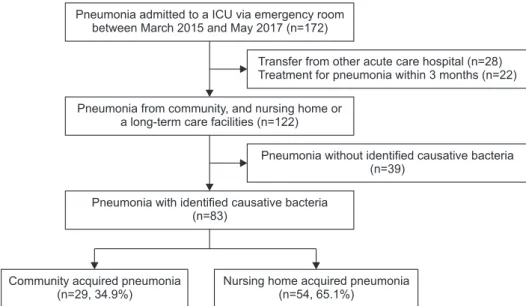
From the medical records of 172 patients with pneumonia admitted to an ICU via ER, after excluding 28 patients who were transferred from other acute care hospitals and 22 pa- tients who had received treatment for pneumonia within the previous 3 months, a total of 122 patients with CAP and NHAP

were included. Among 122 patients, 83 with identified caus- ative bacteria were included in the present study; 39 patients were excluded because a causative agent could not be identi- fied. Of the 83 patients, 29 patients had CAP (34.9%) and 54 had NHAP (65.1%) (Figure 1). In this study, 50 patients (63.9%) and 30 patients (36.1%) received appropriate and inappro- priate antibiotics, respectively. Among the total 88 patients, respiratory viral real-time polymerase chain reaction was performed in 48 (57.8%) and 16 (19.3%) patients were con- firmed to have bacterial and viral co-infections. The clinical characteristics of the study subjects are summarized in Table 1. NHAP patients were more frequently treated with inappro- priate antibiotics rather than appropriate antibiotics (47.2%

[25/53] vs. 96.7% [29/30], p<0.001). A CURB-65 score ≥3 was more common in the inappropriate antibiotic-treated group than in the appropriate antibiotic-treated group (25.8% [31/53]

vs. 70.0% [21/30], p=0.046). There were no significant differ- ences between the clinical parameters, laboratory parameters, and identified microorganisms between the two groups. The differences in clinical outcomes, including duration of overall admission, duration of ICU admission, and 30-day mortality, between the two groups were not significant.

2. Initial antibiotics treatment

In 29 CAP patients and 54 NHAP patients admitted to the ICU via ER, the majority of them received combination antibi- otic therapy as the initial treatment (CAP 71.4%, NHAP 66.7%) (Table 2). Among the 54 NHAP patients, 25 (46.3%) received appropriate antibiotics. Patients treated with combination antibiotics that included vancomycin were more frequently encountered in the appropriate antibiotics group than in the inappropriate antibiotics group (20.0% [5/25] vs. 0% [0/29], p=0.017).

Figure 1. Flow chart for study enrollment.

ICU: intensive care unit.

(4)

3. Microorganisms identified in 83 patients

The identified microorganisms in the study subjects are summarized in Table 3. Streptococcus pneumoniae was more frequently isolated from subjects in the appropriate antibiot- ics group than from those in the inappropriate antibiotics group (20.8% [11/53] vs. 0% [0/30], p<0.001). Staphylococcus aureus was more frequently isolated from subjects in the in- appropriate antibiotics group than from those in the appropri- ate antibiotics group (28.3% [15/53] vs. 70% [21/30], p<0.001).

The prevalence of the other identified microorganisms was not significantly different between the two groups. Methicillin- resistant Staphylococcus aureus (MRSA) was more frequently

isolated from subjects in the inappropriate antibiotics group than from those in the appropriate antibiotics group (7.5%

[4/54] vs. 70% [21/30], p<0.001). The prevalence of MDRGNB was not significantly different between the two groups.

4. Factors associated with the use of inappropriate antibiotics

Candidate variables for logistic regression analysis included prior antibiotics use within 90 days, NHAP, identification of polymicrobial pathogens, and MDRGNB, which were objec- tive variables with p<0.1 when the appropriate antibiotics group and inappropriate antibiotics group were compared Table 1. Baseline characteristics and treatment outcomes of 83 patients admitted to intensive care units with pneumonia

Characteristic Appropriate antibiotics

(n=53) Inappropriate antibiotics

(n=30) p-value

Age, yr 77 (65−86) 74 (64−83) 0.977

Male 33 (62.3) 19 (63.3) 0.923

Lifetime nonsmoker 31 (58.5) 18 (60.0) 0.893

Comorbidity

Diabetes mellitus 13 (24.5) 12 (40.0) 0.140

Cardiovascular disease 17 (32.1) 12 (40.0) 0.467

Degenerative nerve disease 16 (30.2) 10 (33.3) 0.767

COPD 12 (22.6) 6 (20.0) 0.779

Malignant neoplasms 8 (15.1) 2 (6.7) 0.257

Chronic renal disease 3 (5.7) 4 (13.3) 0.227

Prior antibiotics use within 90 days 12 (22.6) 12 (40.0) 0.094

NHAP 25 (47.2) 29 (96.7) <0.001

Clinical parameter

CURB-65 score 3 (2−4) 3 (3−4) 0.291

CURB-65 score ≥3 31 (58.5) 24 (80.0) 0.046

Use of vasopressors 35 (66.0) 21 (70.0) 0.711

Mechanical ventilation 28 (52.8) 20 (66.7) 0.220

Laboratory finding

White blood cell, ×1,000/mm

3

10.18 (5.64−14.93) 9.69 (5.49−15.32) 0.504

Procalcitonin, mg/dL 4.2 (0.5−15.7) 2.1 (0.5−10.1) 0.502

C-reactive protein, mg/dL 13.7 (4.7−21.5) 12.5 (3.4−24.3) 0.824

Platelet, ×1,000/mm

3

207 (143−264) 211 (152−276) 0.837

Creatinine 1.1 (0.7−1.8) 1.1 (0.6−1.5) 0.633

Clinical outcome

Duration of admission, day 14 (6−24) 11 (7−23) 0.627

Duration of ICU admission, day 4 (2−9) 7 (2−9) 0.422

30-Day mortality 14 (26.4) 6 (20.0) 0.511

Values are presented as median (interquartile range) or number (%).

COPD: chronic obstructive disease; NHAP: nursing home–acquired pneumonia; ICU: intensive care unit.

(5)

(Table 4). In multivariate analysis, identification of NHAP (ad- justed odds ratio, 28.66; 95% confidence interval, 3.45−238.12;

p=0.002) was independently associated with the use of inap- propriate antibiotics.

Discussion

In the present study, we showed that the use of inappropri- ate antibiotics was more frequent in NHAP patients. Strepto- Table 3. Microorganisms identified in 83 patients

Microgorganism Appropriate antibiotics (n=53)

Inappropriate antibiotics

(n=30) p-value

Gram-positive bacteria* 26 (49.1) 21 (70.0) 0.064

Streptococcus pneumoniae 11 (20.8) 0 (0.0) 0.007

Staphylococcus aureus 15 (28.3) 21 (70.0) <0.001

Gram-negative bacteria* 28 (52.8) 11 (36.7) 0.156

Pseudomonas aeruginosa 10 (18.9) 2 (6.7) 0.129

Klebsiella pneumoniae 6 (11.3) 4 (13.3) 0.787

Acinetobacter baumanii 0 (0) 2 (6.7) 0.057

Escherichia coli 5 (9.3) 3 (10.0) 0.933

Haemophilus influenza 2 (3.8) 0 (0) 0.281

Moraxella catahallis 2 (3.8) 0 (0) 0.281

Other gram-negative species 4 (7.5) 1 (3.3) 0.438

Polymicrobial pathogens* 1 (1.9) 3 (10.0) 0.097

MRSA 4 (7.5) 21 (70.0) <0.001

MDRGNB 4 (7.5) 6 (20.0) 0.094

CRGNB 4 (7.5) 3 (10.0) 0.699

Values are presented as number (%).

*Both gram-positive and gram-negative bacteria were identified in four patients, and two gram-negative bacteria were identified in one pa- tient.

MRSA: methicillin-resistant Staphylococcus aureus; MDRGNB: multidrug-resistant gram-negative bacteria; CRGNB: carbapenem-resistant gram-negative bacteria.

Table 2. Initial antibiotics treatment in 83 patients Empirical antibiotics

CAP (n=29) NHAP (n=54)

Appropriate antibiotics

(n=28)

Inappropriate antibiotics

(n=1) p-value Appropriate antibiotics

(n=25)

Inappropriate antibiotics

(n=29) p-value

Monotherapy 8 (28.6) 1 (100) 9 (36.0) 10 (34.5)

Fluoroquinolone 2 (7.1) 0 (0) >0.999 0 (0) 0 (0) N/A

Anti-pseudomonal β-lactamase 5 (17.9) 1 (100) 0.207 4 (16.0) 5 (17.2) >0.999

Carbapenem 1 (3.6) 0 (0) >0.999 5 (20.0) 5 (17.2) 0.795

Combination therapy 20 (71.4) 0 (0) 16 (64.0) 19 (65.5)

β-lactamase+macrolide 4 (14.3) 0 (0) >0.999 1 (4.0) 1 (3.4) >0.999

Anti-pseudomonal

β-lactamase+fluoroquinolone 14 (50.0) 0 (0) >0.999 10 (40.0) 18 (62.1) 0.106

Carbapenem+fluoroquinolone 1 (3.6) 0 (0) >0.999 0 (0) 0 (0) N/A

Carbapenem+vancomycin 1 (3.6) 0 (0) >0.999 5 (20.0) 0 (0) 0.017

Values are presented as number (%).

CAP: community-acquired pneumonia; NHAP: nursing home–acquired pneumonia; N/A: not applicable.

(6)

coccus pneumoniae was more frequently isolated from sub- jects in the appropriate antibiotics group, but Staphylococcus aureus was more frequently encountered in the inappropriate antibiotics group. The identification of MRSA was more fre- quently seen in the inappropriate antibiotics group than in the appropriate antibiotics group. In addition, we found that NHAP was a risk factor for the use of inappropriate antibiotics in patients with pneumonia admitted to ICUs via ER.

In this study, we found that the most common pathogen was Staphylococcus aureus (50.0%) in NHAP patients admit- ted to the ICU via ER. Also, the identification of Staphylococ- cus aureus was associated with inappropriate antibiotics

use. Some previous studies that enrolled all cases of NHAP reported that Streptococcus pneumoniae was the most com- mon pathogen among NHAP patients, which was similar to CAP patients

1,4,10-12,19,20

. However, studies that enrolled severe cases of NHAP, including our study, consistently showed that the most common pathogen was Staphylococcus aureus

13,14

, suggesting that antibiotics for targeting Staphylococcus aure- us may be considered in NHAP patients admitted to the ICU.

From this result, it can be inferred that MRSA is the most com- mon pathogen in ICU admitted patients. In this study, MRSA was identified more frequently in NHAP patients (44.4%) than in CAP patients (3.3%).

We showed that the use of inappropriate antibiotics was sig- nificantly different between CAP patients and NHAP patients.

This result could be associated with the presence of resistant pathogens in NHAP patients. Shorr et al.

21

already showed that residence in a nursing home could be an independent factor associated with resistant infection. NHAP patients have poor performance status, presence of a nasogastric tube, swal- lowing difficulties, difficulty with oropharyngeal secretions, increased confusion, and increased agitation

22-25

. Debilitated nursing home residents with a high risk for aspiration are most likely to develop pneumonia

1

. Because nursing home residents are previously exposed to the use of antibiotics for symptomatic urinary infections, lower respiratory infections, wound infections, and infections at other sites

23,24

, NHAP pa- tients who aspirated oral resident flora with antibiotics resis- tance would have drug-resistant pathogens.

We demonstrated that NHAP was a risk factor for the use

of inappropriate antibiotics in patients with pneumonia ad- mitted to the ICU. In particular, NHAP was 29 times for use of inappropriate antibiotics in multivariate analysis. These results were associated with the identification of MRSA in this study. Because MRSA pneumonia is associated with all-cause mortality of 55.5%, rapid institution of appropriate antibiotic therapy is crucial

26

. MRSA burden and transmission were associated with nursing home care for more residents with chronic illness or indwelling devices

27

. Also, a recent increase in frequent, prolonged ventilatory support of an aging, often chronically ill, population has resulted in a large increase in MRSA pneumonia cases in nursing homes

26

. Therefore, physi- cians may consider the use of antibiotics against MRSA for the treatment of NHAP patients admitted to ICU.

In this study, interestingly, the identification of MDRGNB was not associated with the use of inappropriate antibiotics.

The 2005 ATS/IDSA guidelines recommend the use of anti- biotics against MRSA for initial empirical antibiotics therapy for HCAP including NHAP

18

. The prescription according to these guidelines is not likely to be associated with inappropri- ate antibiotics. However, because these guidelines only rec- ommended that additional anti-MRSA antibiotics, including linezolid or vancomycin, be used as additional coverage for patients with MRSA risk factors

18

, physicians may tend not to consider vancomycin or linezolid, which have common side effects, such as nephrotoxicity, for initial empirical therapy.

The 2016 ATS/IDSA guidelines recommend anti-MRSA an- tibiotics in (1) patients who received intravenous antibiotics during the prior 90 days and (2) in units where the prevalence of MRSA among Staphylococcus aureus isolated is not known or is >20% without the concept of NHAP

8

. Therefore, as rec- ommended by these guidelines

8

, physicians should consider antibiotics against MRSA in patients who are at high risk for mortality, such as patients admitted to ICU.

There were several limitations to the present study. First, this was a retrospective study conducted at a single center ICU. Patents who are admitted to the ICU via ER could vary widely by region or country. However, our center is located in a new city between urban and rural areas, suggesting that our sample reflected various conditions of nursing homes. Sec- ond, gold standard examination for confirming pathogens is Table 4. Factors associated with the use of inappropriate antibiotics in 83 patients admitted to the intensive care units with pneumonia

Characteristic Univariate Multivariate

OR (95% CI) p-value OR (95% CI) p-value

Prior antibiotics use within 90 days 2.28 (0.86−6.03) 0.097 1.02 (0.34−3.08) 0.979

NHAP 32.48 (4.12−256.15) 0.001 28.66 (3.45−238.12) 0.002

Polymicrobial pathogens 5.79 (0.57−58.23) 0.137 2.72 (0.26−23.13) 0.401

Identification of MDRGNB 3.06 (0.79−11.89) 0.106 1.39 (0.33−5.47) 0.686

OR: odds ratio; CI: confidence interval; NHAP: nursing home–acquired pneumonia; MDRGNB: multi-drug resistant gram-negative bacteria.

(7)

not equal to all patients. Two patients were confirmed through urine antigens, which cannot be performed via drug sensitiv- ity tests

28

. Although 35% of Streptococcus pneumoniae are reported as MDR Streptococcus pneumoniae in Korea, the re- sistance rates to cephalosporins (10%) and fluoroquinolones (0.6%) are relatively low

29

. In the present study, two positive urine antigens for Streptococcus pneumoniae were consid- ered as drug-sensitive pathogens. Third, we did not perform molecular technique-based tests for the detection of Panton- Valentine leucocidin (PVL). It is known that PVL is a toxin that causes leukocyte destruction and tissue necrosis commonly associated with community-associated MRSA and severe pneumonia

26

. This study focused on evaluating clinical factors associated with the use of inappropriate antibiotics in NHAP patients. Fourth, this study did not enroll many patients with NHAP admitted to the ICU. Larger population studies, such as multicenter or epidemiological studies are needed.

In conclusion, this study demonstrated that NHAP was a risk factor for the use of inappropriate antibiotics in patients with pneumonia admitted to the ICU via the ER. Identification of MRSA was found in patients who received inappropriate antibiotics. Therefore, physicians may consider antibiotics against MRSA as initial empirical antibiotics in NHAP patients who are admitted to ICUs via the ER.

Authors’ Contributions

Conceptualization: Kang HK. Methodology: Kim DH, Kang HK. Formal analysis: Kim DH, Koo HW, Kang HK. Data cura- tion: Kim DH, Kim HJ, Bae W, Park SH, Koo HK, Park HK, Lee SS, Kang HK. Software: Kim DH, Koo HW, Kang HK. Valida- tion: Kim DH, Kang HK. Investigation: Kim DH, Kang HK.

Writing - original draft preparation: Kim DH, Kang HK. Writ- ing - review and editing: Kim DH, Kim HJ, Koo HW, Bae W, Park SH, Koo HK, Park HK, Lee SS, Kang HK. Approval of final manuscript: all authors.

Conflicts of Interest

No potential conflict of interest relevant to this article was reported.

Funding

This study was supported by grants from Alumini Associa- tion of Division of Pulmonary, Allergy and Critical Care Medi- cine, Internal Medicine of Chung-Ang University Hospital (Ungye Research Funds).

References

1. Mylotte JM. Nursing home-acquired pneumonia. Clin Infect Dis 2002;35:1205-11.

2. Mehr DR, Binder EF, Kruse RL, Zweig SC, Madsen R, Popejoy L, et al. Predicting mortality in nursing home residents with lower respiratory tract infection: The Missouri LRI Study.

JAMA 2001;286:2427-36.

3. Muder RR, Brennen C, Swenson DL, Wagener M. Pneumonia in a long-term care facility: a prospective study of outcome.

Arch Intern Med 1996;156:2365-70.

4. Muder RR. Pneumonia in residents of long-term care facili- ties: epidemiology, etiology, management, and prevention.

Am J Med 1998;105:319-30.

5. Martinez-Moragon E, Garcia Ferrer L, Serra Sanchis B, Fer- nandez Fabrellas E, Gomez Belda A, Julve Pardo R. Com- munity-acquired pneumonia among the elderly: differences between patients living at home and in nursing homes. Arch Bronconeumol 2004;40:547-52.

6. Micek ST, Kollef KE, Reichley RM, Roubinian N, Kollef MH.

Health care-associated pneumonia and community-acquired pneumonia: a single-center experience. Antimicrob Agents Chemother 2007;51:3568-73.

7. De Pascale G, Bello G, Tumbarello M, Antonelli M. Severe pneumonia in intensive care: cause, diagnosis, treatment and management: a review of the literature. Curr Opin Pulm Med 2012;18:213-21.

8. Kalil AC, Metersky ML, Klompas M, Muscedere J, Sweeney DA, Palmer LB, et al. Management of adults with hospital- acquired and ventilator-associated pneumonia: 2016 Clini- cal Practice Guidelines by the Infectious Diseases Society of America and the American Thoracic Society. Clin Infect Dis 2016;63:e61-111.

9. Furuno JP, Comer AC, Johnson JK, Rosenberg JH, Moore SL, MacKenzie TD, et al. Using antibiograms to improve antibiot- ic prescribing in skilled nursing facilities. Infect Control Hosp Epidemiol 2014;35 Suppl 3:S56-61.

10. Koh SJ, Lee JH. Clinical characteristics of nursing home- acquired pneumonia in elderly patients admitted to a Korean teaching hospital. Korean J Intern Med 2015;30:638-47.

11. Polverino E, Dambrava P, Cilloniz C, Balasso V, Marcos MA, Esquinas C, et al. Nursing home-acquired pneumonia: a 10 year single-centre experience. Thorax 2010;65:354-9.

12. Carratala J, Mykietiuk A, Fernandez-Sabe N, Suarez C, Dorca J, Verdaguer R, et al. Health care-associated pneumonia requir- ing hospital admission: epidemiology, antibiotic therapy, and clinical outcomes. Arch Intern Med 2007;167:1393-9.

13. El-Solh AA, Sikka P, Ramadan F, Davies J. Etiology of severe pneumonia in the very elderly. Am J Respir Crit Care Med 2001;163(3 Pt 1):645-51.

14. Lee H, Park JY, Lee T, Lee YJ, Lim HJ, Park JS, et al. Intermedi-

ate risk of multidrug-resistant organisms in patients who ad-

mitted intensive care unit with healthcare-associated pneu-

(8)

monia. Korean J Intern Med 2016;31:525-34.

15. Carratala J, Fernandez-Sabe N, Ortega L, Castellsague X, Ro- son B, Dorca J, et al. Outpatient care compared with hospital- ization for community-acquired pneumonia: a randomized trial in low-risk patients. Ann Intern Med 2005;142:165-72.

16. Lim WS, van der Eerden MM, Laing R, Boersma WG, Karalus N, Town GI, et al. Defining community acquired pneumonia severity on presentation to hospital: an international deriva- tion and validation study. Thorax 2003;58:377-82.

17. Magiorakos AP, Srinivasan A, Carey RB, Carmeli Y, Falagas ME, Giske CG, et al. Multidrug-resistant, extensively drug- resistant and pandrug-resistant bacteria: an international expert proposal for interim standard definitions for acquired resistance. Clin Microbiol Infect 2012;18:268-81.

18. American Thoracic Society; Infectious Diseases Society of America. Guidelines for the management of adults with hospital-acquired, ventilator-associated, and healthcare-asso- ciated pneumonia. Am J Respir Crit Care Med 2005;171:388- 416.

19. Lim WS, Macfarlane JT. A prospective comparison of nursing home acquired pneumonia with community acquired pneu- monia. Eur Respir J 2001;18:362-8.

20. Mills K, Graham AC, Winslow BT, Springer KL. Treatment of nursing home-acquired pneumonia. Am Fam Physician 2009;79:976-82.

21. Shorr AF, Zilberberg MD, Micek ST, Kollef MH. Prediction of infection due to antibiotic-resistant bacteria by select risk fac- tors for health care-associated pneumonia. Arch Intern Med 2008;168:2205-10.

22. Loeb M, McGeer A, McArthur M, Walter S, Simor AE. Risk

factors for pneumonia and other lower respiratory tract in- fections in elderly residents of long-term care facilities. Arch Intern Med 1999;159:2058-64.

23. Alvarez S, Shell CG, Woolley TW, Berk SL, Smith JK. Nosoco- mial infections in long-term facilities. J Gerontol 1988;43:M9- 17.

24. Magaziner J, Tenney JH, DeForge B, Hebel JR, Muncie HL Jr, Warren JW. Prevalence and characteristics of nursing home-acquired infections in the aged. J Am Geriatr Soc 1991;39:1071-8.

25. Harkness GA, Bentley DW, Roghmann KJ. Risk factors for nosocomial pneumonia in the elderly. Am J Med 1990;89:457- 63.

26. Rubinstein E, Kollef MH, Nathwani D. Pneumonia caused by methicillin-resistant Staphylococcus aureus . Clin Infect Dis 2008;46 Suppl 5:S378-85.

27. Murphy CR, Quan V, Kim D, Peterson E, Whealon M, Tan G, et al. Nursing home characteristics associated with methi- cillin-resistant Staphylococcus aureus (MRSA) Burden and Transmission. BMC Infect Dis 2012;12:269.

28. Marcos MA, Jimenez de Anta MT, de la Bellacasa JP, Gonzalez J, Martinez E, Garcia E, et al. Rapid urinary antigen test for di- agnosis of pneumococcal community-acquired pneumonia in adults. Eur Respir J 2003;21:209-14.

29. Kim SH, Bae IK, Park D, Lee K, Kim NY, Song SA, et al. Sero- type Distribution and antimicrobial resistance of Streptococ- cus pneumoniae isolates causing invasive and noninvasive

pneumococcal diseases in Korea from 2008 to 2014. Biomed

Res Int 2016;2016:6950482.

수치

Figure 1. Flow chart for study enrollment.
Table 2. Initial antibiotics treatment in 83 patients Empirical antibiotics CAP (n=29) NHAP (n=54)Appropriate  antibiotics (n=28) Inappropriate antibiotics(n=1) p-value Appropriate antibiotics(n=25) Inappropriate antibiotics(n=29) p-value Monotherapy 8 (28

참조

관련 문서

Therefore, this study speculated on block building toys that can enhance spatial sense in infants based on the development of creativity and sociability

(2003), Nosocomial Infection of Malnourished Patients in an Intensive Care Unit. Anal ysis of Nutritional Support Status in the Intensive Care Unit. Korean J crit Ca re Med.

Eighty six point five percent of the subjects felt that the most important factor was visiting a hospital, but combining alternative medicine with hospital

Therefore, nurses should be responsible for the relations to resolve the needs of care between nurses and patients and through communication with the patients,

Moreover, it describes how this education should be oriented with referring to studies and literature based on the understanding of reading book

Higher open conversion rate and prolonged postoperative hospital stay in LATE group were not caused by the delayed operation in this study it seems to be caused by that

• Despite medical intervention with supportive care (78% of the patients use corticosteroids), patients continued to show disabling symptoms, progressive complications,

Further studies should be performed to identity the related factors with the quality of home care service and educational program should be developed to