• 검색 결과가 없습니다.

A Case of Right Sinus of Valsalva Rupture with Dissection into Interventricular Septum Causing Left Ventricular Outflow Tract Obstruction

N/A
N/A
Protected

Academic year: 2022

Share "A Case of Right Sinus of Valsalva Rupture with Dissection into Interventricular Septum Causing Left Ventricular Outflow Tract Obstruction"

Copied!
4
0
0

로드 중.... (전체 텍스트 보기)

전체 글

(1)

770 Copyright © 2013 The Korean Society of Cardiology Korean Circulation Journal

Introduction

Sinus of Valsalva aneurysm (SVA) is a rare anomaly with various clinical manifestations. Right SVAs are more common than left SVAs and if they rupture, they usually rupture into the right ventri- cle or right atrium.

1)

Occasionally, SVA protrusions can lead to he- modynamic obstruction of outflow tract on the underlying ventricle from the SVA origination.

2)3)

But non-traumatic rupture of right SVA complicated by left ventricular outflow tract (LVOT) obstruction has not yet been documented. We report a case of right SVA ruptured into the interventricular septum with resultant LVOT obstruction and aortic regurgitation in a previously healthy, middle-aged woman.

Case Report

http://dx.doi.org/10.4070/kcj.2013.43.11.770 Print ISSN 1738-5520 • On-line ISSN 1738-5555

A Case of Right Sinus of Valsalva Rupture with Dissection into Interventricular Septum Causing

Left Ventricular Outflow Tract Obstruction

Dong Hyun Lee, MD 1 , Eun-Ju Kang, MD 2 , Tae-Ho Park, MD 1 ,

Jong Soo Woo, MD 3 , Sook Hee Hong, MD 4 , and Young-Dae Kim, MD 1

1
Departments of Cardiology,

2

Radiology,

3

Thoracic and Cardiovascular Surgery, and

4

Pathology, Dong-A University College of Medicine, Busan, Korea

Sinus of Valsalva aneurysm (SVA) is an uncommon anomaly of the aorta. Rupture of SVA often precipitates dramatic clinical complica- tions, including heart failures. Right SVAs are the most common type, and when they rupture, they usually rupture into the right ventricle or right atrium. Rupture into left ventricle or interventricular septum is rare. Herein, we report a case of right SVA rupture with dissection into interventricular septum, which produced significant left ventricular outflow tract obstruction and aortic regurgitation. The case was successfully treated by surgical operation. (Korean Circ J 2013;43:770-773)

KEY WORDS: Sinus of Valsalva; Aneurysm; Ventricular outflow obstruction; Aortic valve insufficiency.

Received: March 8, 2013 Revision Received: June 14, 2013 Accepted: July 17, 2013

Correspondence: Young-Dae Kim, MD, Department of Cardiology, Dong- A University College of Medicine, 26 Daesingongwon-ro, Seo-gu, Busan 602-715, Korea

Tel: 82-51-240-2959, Fax: 82-51-255-8174 E-mail: [email protected]

• The authors have no financial conflicts of interest.

This is an Open Access article distributed under the terms of the Creative Commons Attribution Non-Commercial License (http://creativecommons.

org/licenses/by-nc/3.0) which permits unrestricted non-commercial use, distribution, and reproduction in any medium, provided the original work is properly cited.

Case

Fifty-four-year-old female visited outpatient clinic due to the worsening dyspnea experienced in the past month. Recently, she felt shortness of breath even during short distance walking. She also complained of intermittent coughing for the previous 6 months.

She was diagnosed with essential hypertension 2 years ago, and has been taking single antihypertensive medication. She did not re- call any other medical conditions which can explain her symptoms.

On her hospital visit, her blood pressure was 122/68 mm Hg, heart rate 95 beats per minute and respiration rate of 22 per minute. Phy- sical examination was not remarkable except for loud to-and-fro murmurs which were audible along the left sternal border. Breath- ing sound was clear in both lung fields. The chest radiograph sh- owed slight increases in cardiothoracic ratio without signs of pul- monary congestions. The electrocardiogram showed sinus rhythm with QRS configuration of right bundle branch block.

Initial laboratory studies revealed elevated levels of brain natri- uretic peptide to 699 pg/mL, but the levels of cardiac markers in- cluding cardiac troponin and creatine kinase-MB isoenzyme were within normal limits. Routine blood cell counts and chemistry tests were also normal.

On transthoracic echocardiographic exam (TTE), basal part of in-

terventricular septum was dissected by intrusion of a cystic cavity

which communicated with coronary sinus of Valsalva. The cystic st-

ructure appeared in various sizes according to the cardiac cycle,

(2)

771 Dong Hyun Lee, et al.

http://dx.doi.org/10.4070/kcj.2013.43.11.770 www.e-kcj.org

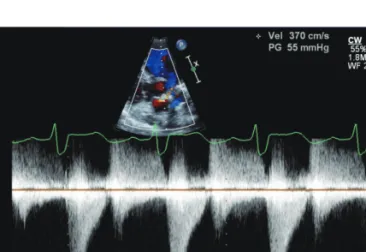
increasing during diastole with protrusion into LVOT (Fig. 1A) and decreasing during systole (Fig. 1B). Transesophageal echocardio- gram (TEE) also showed dynamic changes of the cystic structure with inflows (Fig. 1C) and outflows (Fig. 1D) between the aortic root and the cavity. However, no shunt flow was observed between left and right heart. Although the size of the protruding cavity decreased during systole, the hemodynamic obstruction of LVOT was recogniz- ed by Doppler echocardiography with peak pressure gradients of 55 mm Hg (Fig. 2). Additionally, aortic regurgitant flow of moderate degree was visible during diastole on both the TTE and TEE.

For further evaluations of the anatomical relationship between the SVA and surrounding structures, the cardiac multi-detector computed tomogram (MDCT) was performed. MDCT clearly dem- onstrated the main part of the SVA extending from the right coro- nary sinus (Fig. 3A). Interventricular septal dissection and cyst-sh- aped aneurysm throughout the cardiac cycle was best visualized th- rough the scans (Fig. 3B and C).

Because of the disabling symptoms along with serious anatomic and hemodynamic deteriorations, clinical decision was made to of- fer prompt surgical corrections for the patient. Therefore, repair of interventricular septal dissection with concomitant aortic valve re- placement was conducted. Right coronary cusp was also shortened

and diminished. Replacement of aortic valve through aortotomy was performed with 20 mm ATS mechanical aortic valve prosthesis (Me- dtronic Inc., Minneapolis, MN, USA). Histologic examination of the tissues revealed chronic degenerative changes (Fig. 4). There were no evidences of chronic or acute inflammations or infiltrative dis- orders. The patient was discharged uneventfully 9 days after sur- A

C

B

D

Fig. 1. Echocardiographic findings of SVA with interventricular dissection. Parasternal long axis view in TTE showing various sizes and appearances; in- creased size during diastole (A), decreased size during systole (B). Short axis view in TEE shows inflow from aortic root to SVA during diastole (C) and out- flow during systole (D). SVA: sinus of Valsalva aneurysm, TTE: transthoracic echocardiography, TEE: transesophageal echocardiography.

Fig. 2. Transthoracic echocardiography with continuous wave Doppler

study revealed significant left ventricular outflow tract obstructions with

pressure gradients of 55 mm Hg.

(3)

772 Right Sinus of Valsalva Aneurysm with LVOT Obstruction

http://dx.doi.org/10.4070/kcj.2013.43.11.770 www.e-kcj.org

gery, and did not have any complaints for 3 months thereafter.

Discussion

Sinus of Valsalva aneurysm is an uncommon anomaly of aorta, mostly derived from congenital defects of aorta media, and only rarely from acquired conditions.

4)

The clinical manifestations of SVA vary widely, and they are related to ruptures or mass effects on ad- jacent cardiac structures.

The SVA in the present case originated from the right coronary si- nus, which is the most prevalent site. When the SVA ruptures, they most commonly rupture into right ventricle, followed by right atri- um, creating aortopulmonary shunt.

1)4)

In the present case, right SVA ruptured into interventricular septum by forming a cystic cavity.

Rupture of SVA into interventricular septum is a rare complication,

which comprises of less than 2% of SVA rupture.

1)

An interesting feature of this case is the hemodynamic LVOT ob- struction caused by the protruding septal cavity originated from right SVA. The protrusion into LVOT generated significant pressure gradients of 55 mm Hg during systole, as measured by the Doppler echocardiogram. A case of unruptured SVA causing LVOT has been reported for the first time in 1998,

2)

but it was a case of SVA origi- nating from the left coronary cusp. Right SVAs dissecting the in- terventricular septum with protrusion into LVOT have been previ- ously described.

5)6)

However, no hemodynamic measurements were made. SVA of the right origin with subsequent complications of the hemodynamic LVOT obstruction have not yet been reported to the best of our knowledge. The hemodynamic obstruction of LVOT in addition to acute volume overloading of the aneurysm rupture and aortic regurgitation might have aggravated the patient’s symptoms.

A B C

Fig. 3. MDCT findings. A: left lateral view of reconstructed image well visualizes the right SVA. B: MDCT shows interventricular dissection which forms cys- tic cavity at diastole. C: the interventricular cavity increases in size during diastole. MDCT: multi-detector computed tomography, SVA: sinus of Valsalva an- eurysm.

A B

Fig. 4. Excised valvular tissues show dissected stroma by marked myxoid degeneration (A, H-E stain, ×40) and fibrillar degeneration with focal cystic

changes in the central area of stroma (B, H-E stain, ×100).

(4)

773 Dong Hyun Lee, et al.

http://dx.doi.org/10.4070/kcj.2013.43.11.770 www.e-kcj.org

Novel imaging techniques play an important role in the evaluation of SVAs. Conventionally, both TTE and TEE have been the first line diagnostic tool for anatomic and hemodynamic assessments of SVAs. Nonetheless, the cardiac MDCT and magnetic resonance im- aging can provide additional information regarding 3-dimensional structures and anatomical relations between the SVA and adjacent organs.

7)8)

In the present case, cardiac MDCT clearly demonstrated the configuration of interventricular septal dissection originating from right SVA and the anatomical relation with the aortic root and coronary arteries. Such data could provide valuable information for drawing up a therapeutic plan.

In conclusion, we report a case of right SVA ruptured into the in- terventricular septum which causes significant LVOT obstructions and aortic valve regurgitations at the same time, and was success- fully managed through surgery. The MDCT and echocardiography made significant contributions for the evaluation of the case.

References

1. Bricker AO, Avutu B, Mohammed TL, et al. Valsalva sinus aneurysms:

findings at CT and MR imaging. Radiographics 2010;30:99-110.

2. Pepper C, Munsch C, Sivananthan UM, Pye M. Unruptured aneurysm of the left sinus of Valsalva extending into the left ventricular outflow tract: presentation and imaging. Heart 1998;80:190-3.

3. Avci A, Akcakoyun M, Alizada E, et al. Severe right ventricular outflow obstruction by right sinus of valsalva aneurysm. Echocardiography 2010;27:341-3.

4. Feldman DN, Roman MJ. Aneurysms of the sinuses of Valsalva. Car- diology 2006;106:73-81.

5. Taher T, Singal R, Sonnenberg B, Ross D, Graham M. Images in car- diovascular medicine. Sinus of valsalva rupture with dissection into the interventricular septum: diagnosis by echocardiography and mag- netic resonance imaging. Circulation 2005;111:e101-2.

6. Nunes Mdo C, Gelape CL, Barbosa FB, et al. Sinus of valsalva aneurysm with dissection into the interventricular septum. Echocardiography 2008;25:102-4.

7. Das KM, El-Menyar AA, Arafa SE, Suwaidi JA. Intracardiac shunting of ruptured Sinus of Valsalva aneurysm in a patient presented with acute myocardial infarction: role of 64-slice MDCT. Int J Cardiovasc Imaging 2006;22:797-802.

8. Park KH, Shin DG, Son CW, et al. Aneurysm of sinus of valsalva dissect-

ing into the interventricular septum after aortic valve replacement: di-

agnosis by echocardiography and magnetic resonance imaging and

treatment with surgical sealant. Korean Circ J 2011;41:464-8.

수치

Fig. 2. Transthoracic echocardiography with continuous wave Doppler  study revealed significant left ventricular outflow tract obstructions with  pressure gradients of 55 mm Hg.
Fig. 4. Excised valvular tissues show dissected stroma by marked myxoid degeneration (A, H-E stain, ×40) and fibrillar degeneration with focal cystic  changes in the central area of stroma (B, H-E stain, ×100).

참조

관련 문서

– Head rotation to the left causes extension of left arm and leg and flexion of right arm and leg; head rotation to the right causes extension of right arm and leg and

(a) A twisted nematic cell, The LC molecules are aligned horizontally on the left window and vertically on the right window.. They gradually twist (plane upon plane) from one

• The supply and demand curves cross at the equilibrium price and quantity.. • You can read off approximate equilibrium values

A tangential section of the common ivy, Hedera helix, shows some vasicentric tracheids to the left of the vessel, which is the white space at right.. A maceration of the wood

undergo a cyclic process whose sole effects are the flow of heat into the system from a cold. reservoir and the flow of an equivalent amount of heat out of the system into

Any group of species are descended from a common ancestral species, which, over time, split into two species, with these descendents splitting again, and again,

1 John Owen, Justification by Faith Alone, in The Works of John Owen, ed. John Bolt, trans. Scott Clark, "Do This and Live: Christ's Active Obedience as the

core exercise program showed not only increasing peak torque of the right leg, left leg in Hip Extension of exercise group but also increasing peak torque of the right leg, left